
Reports
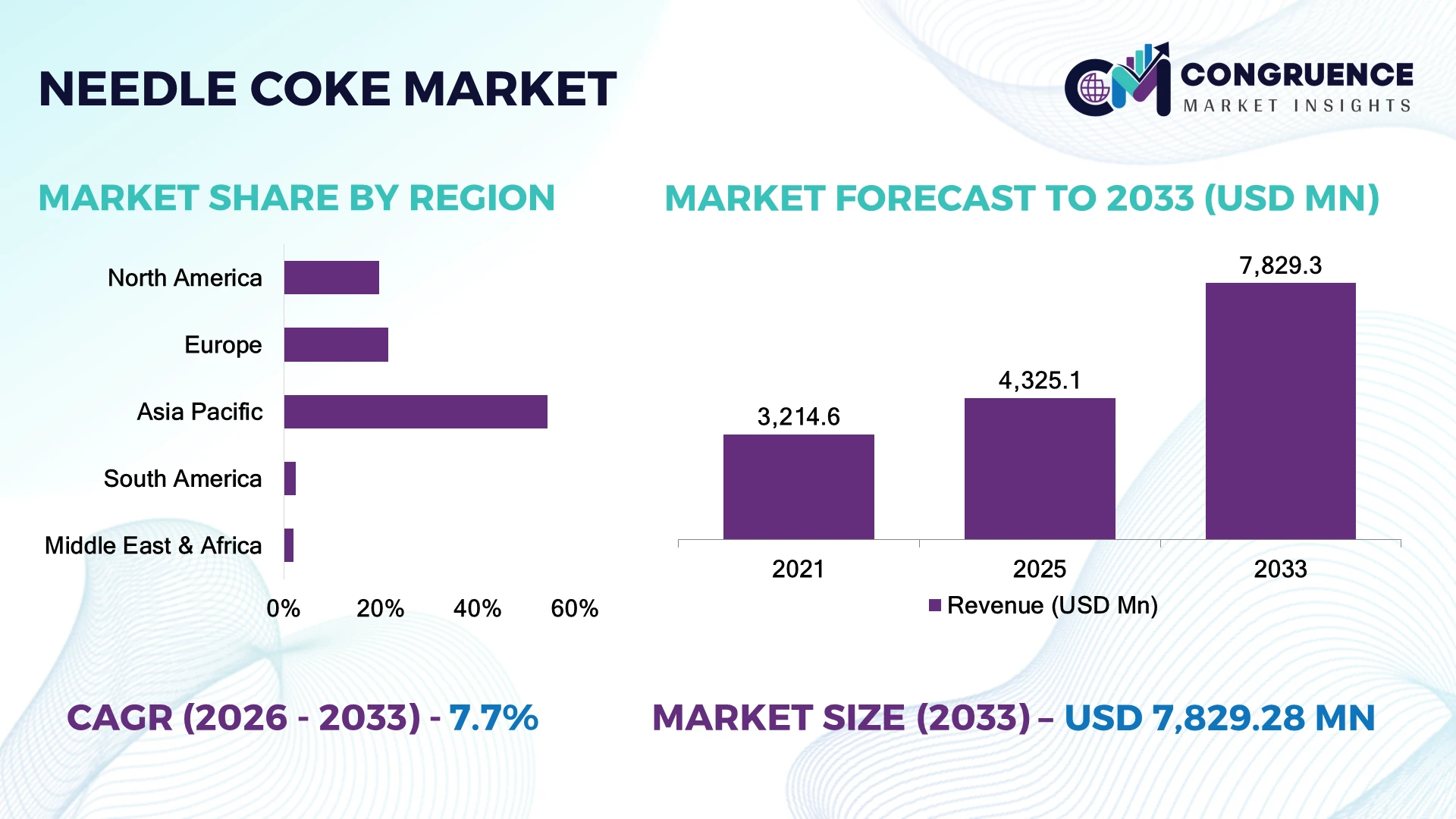
The Global Needle Coke Market was valued at USD 4,325.1 Million in 2025 and is anticipated to reach a value of USD 7,829.3 Million by 2033 expanding at a CAGR of 7.7% between 2026 and 2033. Growth is driven by expanding lithium-ion battery anode production, ultra-high-power graphite electrode manufacturing, and increasing electric arc furnace steelmaking capacity.
China dominates the global Needle Coke market with approximately 48% of production capacity, supported by large-scale lithium-ion battery manufacturing, graphite electrode production, and integrated refining infrastructure. Compared with Japan, which focuses on premium-grade needle coke for high-performance applications, China leads in production scale, with nearly 74% of domestic output supplying battery and electrode manufacturers. Ongoing geopolitical diversification of critical mineral supply chains is accelerating investment in localized carbon material production outside traditional manufacturing hubs.
Companies securing premium feedstock, advanced calcination technology, and long-term battery supply agreements will strengthen competitive positioning as demand for high-performance carbon materials accelerates.
Market Size & Growth: USD 4,325.1 million (2025) to USD 7,829.3 million (2033) at 7.7% CAGR, driven by battery-grade carbon materials and electric arc furnace expansion.
Top Growth Drivers: Lithium-ion batteries (+34%), electric arc furnace steel (+28%), synthetic graphite demand (+22%).
Short-Term Forecast: By 2028, production efficiency improves 16% while energy consumption declines 11%.
Emerging Technologies: AI-enabled process optimization, advanced calcination, and digital quality monitoring improve product consistency.
Regional Leaders: Asia-Pacific, North America, and Europe expand production through battery localization and steel decarbonization initiatives.
Consumer/End-User Trends: Approximately 69% of premium needle coke demand originates from graphite electrode and battery material manufacturers.
Pilot/Case Example: A 2026 process modernization project increased calcination yield by 13% while reducing energy intensity by 10%.
Competitive Landscape: Leading suppliers hold approximately 55% market share through feedstock integration and specialty carbon expertise.
Regulatory & ESG Impact: Electric arc furnace adoption lowers steelmaking emissions by nearly 60% versus conventional blast furnace routes.
Investment & Funding: More than USD 5.2 billion supports battery material expansion, refinery upgrades, and supply-chain localization.
Innovation & Future Outlook: Premium low-sulfur needle coke and battery-grade carbon technologies are reshaping long-term supply priorities.
Needle coke demand is increasingly concentrated in lithium-ion battery anodes, ultra-high-power graphite electrodes, and specialty carbon materials requiring superior crystallinity and thermal performance. Approximately 62% of new investments prioritize premium-grade production with tighter quality control and lower impurity levels. Feedstock diversification and localized refining strategies are becoming essential operational priorities, creating a strong foundation for the strategic discussion below.
Needle coke has become a strategically important material as battery manufacturers and steel producers compete for secure supplies of premium carbon feedstock supporting electrification and industrial decarbonization. Supply-chain restructuring, combined with government-backed battery manufacturing initiatives, is encouraging investment in localized refining capacity, advanced calcination technologies, and integrated carbon material production to reduce dependence on limited high-quality feedstock sources.
Modern delayed coking and precision calcination technologies improve product uniformity by approximately 18% while reducing energy consumption by nearly 12% compared with conventional production methods. China continues leading large-scale manufacturing and downstream battery integration, while Japan maintains technological leadership in premium-grade needle coke for high-performance graphite applications. Over the next two to three years, qualification standards for battery-grade carbon materials and integrated production models are expected to become increasingly important competitive differentiators.
Manufacturers are expanding long-term partnerships with graphite anode producers, modernizing refining assets, and securing premium decant oil supplies to strengthen operational resilience. Battery material producers increasingly integrate high-performance needle coke into synthetic graphite production to improve electrochemical stability and cycle life. Companies combining feedstock security, advanced process control, and strategic downstream partnerships will establish stronger competitive positions as high-performance carbon materials become increasingly critical to global battery and steel value chains.
Rapid expansion of lithium-ion battery manufacturing and ultra-high-power graphite electrode production is reshaping needle coke procurement strategies worldwide. Approximately 66% of premium needle coke consumption is linked to synthetic graphite production, while battery-grade specifications have improved demand for low-sulfur grades by nearly 24%. China's continued investment in battery manufacturing clusters and graphite processing facilities has strengthened integrated carbon material value chains. The shift toward localized battery supply networks is encouraging producers to expand calcination capacity, secure premium decant oil feedstock, and establish long-term supply agreements with anode manufacturers. A decisive competitive advantage now lies in delivering consistently high-crystallinity needle coke capable of supporting next-generation battery performance and longer graphite electrode service life.
Needle coke production remains highly dependent on premium decant oil and low-sulfur refinery streams, creating structural supply limitations for manufacturers. Feedstock expenses account for approximately 54% of production costs, while premium-grade decant oil availability has tightened by nearly 17% due to refinery output optimization and changing crude processing patterns. Japan's limited domestic feedstock availability has increased dependence on imported specialty refinery streams, exposing producers to procurement volatility. These constraints reduce production flexibility, compress operating margins, and delay capacity expansion projects. Companies are responding by diversifying feedstock sourcing, investing in refinery integration, negotiating long-term supply contracts, and optimizing refining technologies to improve raw material utilization and production stability.
The growing transition toward high-energy-density batteries is creating attractive opportunities for premium needle coke manufacturers supplying advanced synthetic graphite producers. High-purity carbon feedstocks improve graphite yield by approximately 19% while reducing impurity levels by nearly 15%, strengthening downstream battery performance. South Korea's expanding battery materials ecosystem is accelerating investment in advanced graphitization technologies and localized carbon processing facilities. Producers are increasing research into customized needle coke grades, digital process optimization, and strategic partnerships with anode manufacturers to develop application-specific products. A key opportunity lies in producing differentiated carbon materials optimized for fast-charging batteries rather than competing solely on commodity electrode markets.
Maintaining uniform crystallinity, coefficient of thermal expansion, and impurity control across large-scale production remains one of the industry's most demanding execution challenges. Approximately 31% of battery material manufacturers identify quality consistency as the primary qualification requirement, while stricter synthetic graphite specifications have increased quality validation procedures by nearly 23%. China's expanding battery manufacturing ecosystem continues raising technical standards for premium carbon materials supplied to high-performance applications. Companies must strengthen advanced analytical testing, digital production monitoring, refinery process control, and collaborative product development to ensure consistent qualification. Long-term competitiveness increasingly depends on process precision rather than production volume alone.
Advanced Calcination Optimization: Producers are deploying AI-assisted furnace control and digital process monitoring, improving calcination efficiency by approximately 16% while reducing energy consumption by nearly 11%. Stricter battery material specifications are accelerating automation investments, enabling manufacturers to stabilize product quality and shorten production adjustment cycles across integrated carbon facilities.
Localized Carbon Supply Networks: Battery manufacturers are restructuring procurement strategies, increasing localized sourcing by approximately 22% and reducing overseas logistics dependence by nearly 18%. Government-backed battery supply-chain initiatives are encouraging refinery partnerships, while needle coke producers expand regional processing capacity to improve feedstock security and customer responsiveness.
Premium Grade Product Shift: Demand for ultra-low-sulfur needle coke has increased by approximately 26%, while customized graphite feedstock orders have expanded nearly 17%. A less obvious development is the growing collaboration between carbon producers and battery developers during product qualification, allowing manufacturers to tailor material characteristics before commercial-scale production begins.
Digital Quality Assurance Expands: Automated laboratory analytics and predictive quality control reduce batch variability by approximately 14% while improving production consistency by nearly 20%. As battery manufacturers tighten material qualification standards, needle coke producers are integrating real-time process analytics, strengthening long-term supply agreements, and modernizing refinery operations to secure premium market positioning.
Petroleum-based needle coke accounts for approximately 67% of the global Needle Coke market, supported by its established availability, consistent crystallinity, and cost efficiency for graphite electrode and synthetic graphite production. Its scalable refining infrastructure and compatibility with ultra-high-power electrode manufacturing continue to secure widespread industrial adoption. Coal tar pitch-based needle coke remains strategically important in specialty applications requiring superior thermal properties, while premium low-sulfur grades are increasingly preferred for battery materials with tighter impurity specifications.
Coal tar pitch-based needle coke is the fastest-growing type as battery-grade synthetic graphite manufacturers seek improved structural uniformity and electrochemical performance. Premium grades enhance graphitization efficiency by approximately 18% while lowering impurity concentrations by nearly 16%, strengthening battery anode quality. Producers are investing in advanced refining technologies, feedstock optimization, and dedicated product development programs to address evolving battery specifications. Investment priorities are steadily shifting toward specialty carbon materials capable of supporting both high-performance energy storage and premium industrial graphite applications.
According to a 2026 assessment by the International Energy Agency, continued expansion of battery manufacturing is increasing demand for high-purity carbon feedstocks, encouraging producers to prioritize premium needle coke capacity over conventional industrial grades.
Graphite electrode production represents approximately 59% of global Needle Coke consumption, reflecting sustained demand from electric arc furnace steelmaking and high-temperature metallurgical processes. The segment benefits from established industrial infrastructure, long-term procurement contracts, and increasing adoption of lower-emission steel production technologies. Synthetic graphite for lithium-ion battery anodes represents a rapidly expanding application, while specialty carbon products and nuclear-grade graphite continue serving niche, high-value industrial requirements with strict quality standards.
Battery anode materials are the fastest-growing application as electric mobility and stationary energy storage require higher-performance synthetic graphite. Premium needle coke improves graphitization yield by approximately 21% while increasing battery material consistency by nearly 17%. Manufacturers are expanding purification capacity, integrating digital quality monitoring, and strengthening partnerships with anode producers to secure long-term supply agreements. Demand is increasingly shifting toward battery-grade carbon materials where product consistency and impurity control have become operationally decisive competitive factors.
A 2025 enterprise survey conducted by the World Steel Association indicated continued expansion of electric arc furnace steel production, reinforcing graphite electrode demand while battery manufacturers simultaneously increased procurement of premium needle coke for synthetic graphite processing.
Graphite electrode manufacturers remain the largest end-user group, accounting for approximately 56% of global Needle Coke demand due to extensive deployment across electric arc furnace steel production. Their purchasing decisions are driven by long-term operational reliability, thermal performance, and consistent carbon quality. Battery material manufacturers are rapidly increasing procurement volumes as synthetic graphite becomes a critical component of lithium-ion battery production. Carbon material processors and specialty graphite manufacturers continue supporting stable demand through customized, application-specific purchasing strategies.
Battery material manufacturers represent the fastest-growing end-user segment as advanced energy storage systems require increasingly stringent carbon specifications. Approximately 29% of newly commissioned premium needle coke capacity is dedicated to battery-grade production, while integrated supply agreements have expanded by nearly 18%. Producers are responding through customized product portfolios, collaborative development programs, and strategic partnerships with synthetic graphite companies. Competitive positioning is steadily shifting toward suppliers capable of delivering application-specific materials with consistent electrochemical performance and secure long-term feedstock availability.
According to a 2026 enterprise assessment published by Benchmark Mineral Intelligence, battery manufacturers are increasingly prioritizing premium needle coke suppliers capable of delivering consistent feedstock quality, long-term supply security, and application-specific material performance for synthetic graphite production.
Asia-Pacific accounted for the largest market share at 54.3% in 2025 however, Middle East & Africa is expected to register the fastest growth, expanding at a CAGR of 8.4% between 2026 and 2033.
Battery Supply Chain Localization Reinforces Premium Carbon Production
North America accounts for approximately 19.6% of the global Needle Coke market, supported by expanding domestic battery manufacturing, electric arc furnace steel production, and investments in critical mineral supply chains. Producers are prioritizing premium needle coke for synthetic graphite applications while modernizing refinery operations to improve feedstock utilization and product consistency. Nearly 61% of regional premium-grade output is directed toward battery materials and ultra-high-power graphite electrodes. Long-term partnerships between refiners and battery material manufacturers are strengthening procurement stability, while integrated carbon processing facilities continue enhancing operational resilience. The region also benefits from increasing investment in downstream graphite processing to reduce dependence on imported battery materials.
United States Market Outlook: The United States leads the regional market through its advanced refining infrastructure, expanding battery manufacturing base, and growing electric arc furnace steel industry. Integrated energy and materials companies are strengthening domestic carbon material supply chains while investing in premium-grade production capabilities. Approximately 64% of newly announced synthetic graphite capacity is supported by domestic needle coke sourcing strategies, reinforcing long-term supply security and industrial competitiveness.
Low-Carbon Steelmaking Strengthens Material Demand
Europe remains a strategically important market due to increasing electric arc furnace steel production, battery manufacturing investments, and industrial decarbonization initiatives. Approximately 26% of regional needle coke consumption supports graphite electrode production for low-emission steelmaking, while battery-grade material demand continues expanding through localized cell manufacturing. Producers are improving feedstock efficiency, adopting advanced calcination technologies, and strengthening partnerships with downstream graphite manufacturers to support high-performance carbon material requirements.
Germany Market Outlook: Germany anchors the European market through its advanced steel industry, expanding battery manufacturing ecosystem, and strong industrial materials expertise. Carbon material producers continue collaborating with automotive and battery supply chains to improve localized sourcing and premium material availability. Around 58% of Germany's graphite processing demand is associated with advanced manufacturing applications requiring high-purity needle coke and consistent carbon quality.
Integrated Manufacturing Ecosystems Sustain Global Leadership
Asia-Pacific leads the global Needle Coke market with approximately 54.3% share, supported by integrated refining, graphite processing, battery manufacturing, and electric arc furnace steel production. China, Japan, and South Korea continue strengthening vertically integrated carbon material value chains, enabling efficient production of premium needle coke and synthetic graphite. Approximately 73% of regional premium needle coke capacity supplies battery and graphite electrode manufacturers, while refinery modernization projects continue improving feedstock conversion efficiency. Companies are expanding specialized calcination facilities and downstream graphite production to secure competitive advantages across high-performance carbon materials.
China Market Outlook: China dominates the regional market through its extensive refining capacity, synthetic graphite manufacturing leadership, and rapidly expanding battery materials industry. Integrated production clusters support efficient movement from feedstock refining to finished anode materials, reducing logistics complexity and production costs. Nearly half of global needle coke manufacturing capacity is concentrated in China, reinforcing its strategic influence across battery and industrial carbon supply chains.
Steel Modernization Supports Industrial Consumption
South America is strengthening its position through modernization of steel production facilities and increasing investment in industrial carbon materials. Brazil remains the largest regional consumer, driven by expanding electric arc furnace operations and growing industrial manufacturing activity. Approximately 43% of graphite electrode demand within the region is associated with upgraded steel production facilities adopting more energy-efficient processes. Although premium needle coke is still largely imported, regional refiners are exploring strategic partnerships to strengthen long-term feedstock availability and reduce procurement risks.
Brazil Market Outlook: Brazil leads regional demand through its integrated steel industry, refinery infrastructure, and industrial manufacturing base. Electric arc furnace modernization projects continue increasing consumption of premium graphite electrodes manufactured using high-quality needle coke. Investment in logistics infrastructure and industrial processing capacity is improving supply-chain efficiency while supporting broader adoption of advanced carbon materials across metallurgical applications.
Industrial Diversification Expands Carbon Material Investments
The Middle East & Africa market is gradually expanding as governments prioritize industrial diversification, downstream petrochemical integration, and advanced materials manufacturing. Refinery modernization programs are creating opportunities for higher-value carbon products, including premium needle coke for industrial applications. Approximately 35% of newly announced downstream refinery investments incorporate advanced residue processing technologies capable of supporting specialty carbon production. Strategic partnerships between energy companies and industrial manufacturers are strengthening the foundation for localized value-added materials production.
Saudi Arabia Market Outlook: Saudi Arabia represents the region's strongest market opportunity due to large-scale refining assets, industrial diversification strategies, and sustained investment in advanced petrochemical processing. Expansion of residue upgrading technologies and downstream manufacturing capabilities is improving the country's ability to produce higher-value carbon materials. Increasing integration between refining operations and industrial manufacturing supports long-term competitiveness in specialty carbon products, including needle coke for domestic and export-oriented applications.
Premium petroleum needle coke producers including Phillips 66, C-Chem, ENEOS, Indian Oil Corporation, and Baosteel Chemical compete directly with coal-based specialty carbon manufacturers and vertically integrated graphite producers for battery and electrode customers. The top five suppliers collectively account for approximately 57% of global capacity. Competition depends on feedstock security, crystallinity, sulfur control, and qualification speed rather than pricing alone. Premium process optimization improves graphitization efficiency by approximately 18%, while integrated refining reduces feedstock procurement risk by nearly 22%. Companies are expanding calcination assets, securing long-term refinery feedstock agreements, forming battery material partnerships, and strengthening vertical integration from refining through synthetic graphite production. The competitive landscape is shifting toward battery-grade material qualification and ex-China supply diversification as customers seek resilient procurement. Limited premium decant oil availability and demanding qualification standards remain decisive entry barriers. Success depends on consistent premium quality, integrated feedstock control, strategic customer partnerships, and reliable large-scale production.
Phillips 66
C-Chem Co., Ltd.
ENEOS Corporation
Indian Oil Corporation Limited
Baosteel Chemical Co., Ltd.
Shanxi Hongte Coal Chemical Co., Ltd.
PetroChina Company Limited
Sinopec Shanghai Petrochemical Company Limited
JXTG Nippon Oil & Energy Corporation
GrafTech International Ltd.
Nippon Steel Chemical & Material Co., Ltd.
Baotailong New Materials Co., Ltd.
Needle coke production is advancing through precision delayed coking, digital furnace control, advanced calcination, and AI-enabled process optimization to produce higher-purity carbon materials for graphite electrodes and battery anodes. Modern process control improves crystallinity consistency by approximately 17% while reducing energy consumption by nearly 12%. Around 64% of newly commissioned premium facilities incorporate automated quality monitoring, enabling tighter sulfur control, higher graphitization performance, and improved operational reliability for downstream synthetic graphite manufacturing.
Emerging technologies include predictive refinery analytics, digital feedstock characterization, advanced impurity removal, and intelligent calcination optimization. Compared with conventional production methods, AI-assisted process control increases premium-grade production yield by approximately 21% while reducing off-specification output by nearly 16%. Integrated battery material producers benefit most because consistent feedstock quality shortens graphite qualification cycles, improves anode performance, and strengthens long-term supply competitiveness across electric mobility and energy storage value chains.
Between 2026 and 2028, digital refinery integration, lower-emission calcination systems, and customized battery-grade needle coke formulations will redefine competitive positioning. Companies investing in automated quality assurance, refinery integration, and application-specific carbon materials will improve production flexibility, strengthen customer qualification success, and capture higher-value battery and specialty graphite opportunities as global supply chains continue regional diversification.
September 2024 Phillips 66 highlighted specialty coke production supporting synthetic graphite anodes for lithium-ion batteries, strengthening its lower-carbon materials strategy and expanding focus on battery supply chains serving electric mobility applications. Source: Phillips 66. (Phillips 66)
January 2025 GrafTech reported its Seadrift petroleum needle coke facility maintains approximately 140,000 metric tons of annual nameplate capacity, reinforcing vertically integrated electrode manufacturing and securing feedstock availability outside China. Source: Investor Presentation. (Q4 Investments)
February 2026 Mitsubishi Chemical announced withdrawal from its needle coke and carbon materials business, recording an estimated ¥85 billion non-recurring loss as part of portfolio restructuring, tightening future premium supply availability. Source: Hydrocarbon Processing. (Hydrocarbon Processing)
May 2026 GrafTech reaffirmed that battery applications are expected to surpass graphite electrode demand for petroleum needle coke within the next two to three years, highlighting accelerated strategic investment in battery-material supply chains. Source: GrafTech Investor Presentation. (Q4 Investments)
This report provides a comprehensive assessment of the Needle Coke market across product types, applications, end-user industries, and major geographic regions. It evaluates petroleum-based and coal tar pitch-based needle coke used in graphite electrodes, lithium-ion battery anodes, specialty graphite, and advanced carbon materials. The analysis covers feedstock availability, refining technologies, calcination processes, quality differentiation, and deployment trends across established manufacturing hubs and emerging battery material ecosystems.
The report also examines advanced process automation, digital quality control, premium carbon purification, and integrated refinery-to-anode value chains shaping competitive dynamics. More than 60% of premium needle coke demand is concentrated in graphite electrodes and battery materials, reflecting the market's increasing focus on high-performance applications. Strategic insights support investment prioritization, capacity expansion, supply-chain localization, competitive benchmarking, downstream partnership strategies, and technology planning while identifying the operational trends expected to influence market direction between 2026 and 2033.
| Report Attribute/Metric | Report Details |
|---|---|
|
Market Revenue in 2025 |
USD 4,325.1 Million |
|
Market Revenue in 2033 |
USD 7,829.3 Million |
|
CAGR (2026 - 2033) |
7.7% |
|
Base Year |
2025 |
|
Forecast Period |
2026 - 2033 |
|
Historic Period |
2021 - 2025 |
|
Segments Covered |
By Type
By Application
By End-User
|
|
Key Report Deliverable |
Revenue Forecast, Growth Trends, Market Dynamics, Segmental Overview, Regional and Country-wise Analysis, Competition Landscape |
|
Region Covered |
North America, Europe, Asia-Pacific, South America, Middle East, Africa |
|
Key Players Analyzed |
Phillips 66, C-Chem Co., Ltd., ENEOS Corporation, Indian Oil Corporation Limited, Baosteel Chemical Co., Ltd., Shanxi Hongte Coal Chemical Co., Ltd., PetroChina Company Limited, Sinopec Shanghai Petrochemical Company Limited, JXTG Nippon Oil & Energy Corporation, GrafTech International Ltd., Nippon Steel Chemical & Material Co., Ltd., Baotailong New Materials Co., Ltd. |
|
Customization & Pricing |
Available on Request (10% Customization is Free) |




