
Reports
The Global Neck Pillow for Traveling Market was valued at USD 1,256.2 Million in 2025 and is anticipated to reach a value of USD 1,972.2 Million by 2033 expanding at a CAGR of 5.8% between 2026 and 2033. Growth is driven by longer-haul air travel, premium cabin upgrades, ergonomic product innovation, and rising adoption of memory-foam and adjustable travel-support designs.
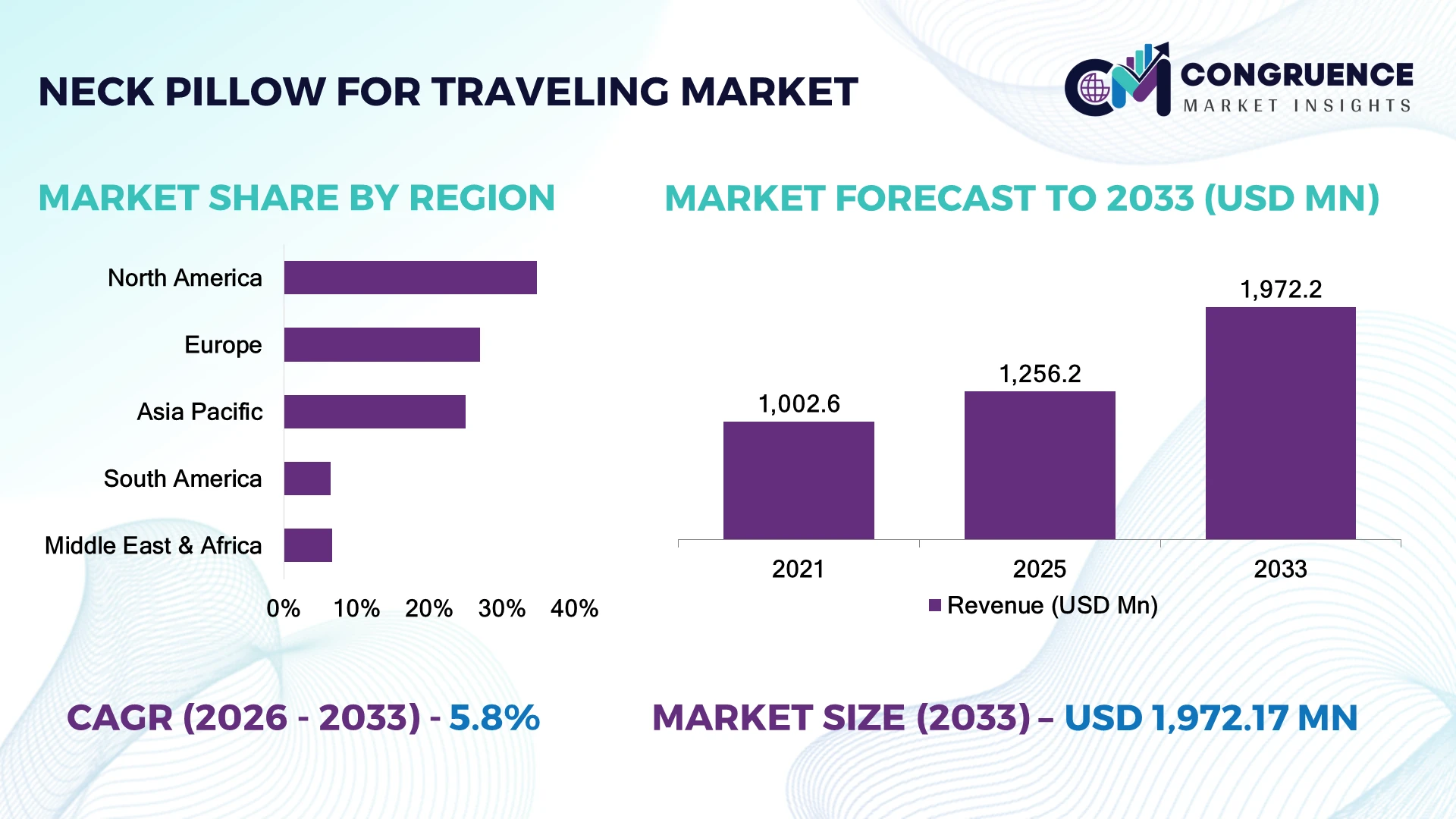
The United States accounts for approximately 28% of global neck pillow for traveling demand, supported by high air-travel frequency, major airline networks, and premium travel-accessory retail. China represents about 17%, backed by expanding domestic aviation and e-commerce manufacturing. U.S. premium-product adoption exceeds 40%, compared with approximately 25% in China, while Asia-Pacific manufacturers increasingly integrate memory foam, cooling fabrics, and adjustable structures.
Geopolitical supply-chain diversification following Red Sea shipping disruptions is accelerating sourcing shifts toward India, Vietnam, and Southeast Asia.
Market Size & Growth: USD 1,256.2 million in 2025 to USD 1,972.2 million by 2033 at 5.8% CAGR, supported by premium ergonomic travel accessories and memory-foam adoption.
Top Growth Drivers: Long-haul travel expansion 6–8%, premium travel-accessory purchases 5–7%, and ergonomic-product adoption 8–10%.
Short-Term Forecast: By 2028, automated cutting and assembly can reduce production costs 6–10%, while digital demand forecasting improves inventory efficiency 10–15%.
Emerging Technologies: Memory foam, cooling textiles, adjustable inflation systems, and compact vacuum-compression packaging are reshaping advanced travel-pillow designs.
Regional Leaders: North America reaches approximately USD 620 million by 2033, Asia-Pacific USD 590 million, and Europe USD 470 million, with online adoption accelerating across Asia.
Consumer/End-User Trends: Approximately 35–40% of premium travel-pillow buyers prioritize ergonomic neck support, while washable and antimicrobial covers increasingly influence repeat purchases.
Pilot/Case Example: 2025 airline-accessory programs using compact ergonomic pillows reduced storage volume approximately 15–20%, improving onboard inventory handling.
Competitive Landscape: Cabeau holds approximately 8–10% of organized premium demand, competing with Trtl, Samsonite, BCOZZY, and Tempur through design, materials, branding, and distribution.
Regulatory & ESG Impact: Recycled fabrics and reduced-plastic packaging can lower packaging material consumption 10–20%, strengthening compliance readiness and retail sustainability positioning.
Investment & Funding: More than USD 250 million is being directed across travel-accessory manufacturing, e-commerce infrastructure, product development, and regional capacity expansion.
Innovation & Future Outlook: Next-generation products will emphasize adjustable support, cooling materials, antimicrobial textiles, compact compression, and digitally optimized designs as manufacturers shift toward premium differentiation.
The Neck Pillow for Traveling Market spans airline passengers, long-distance bus and rail travelers, frequent business travelers, and outdoor tourists. Memory foam, inflatable structures, cooling fabrics, washable covers, and adjustable designs are strengthening product differentiation. Premium ergonomic products represent approximately 35–40% of purchases. Retailers are also reducing packaging volume as global logistics costs and shipping disruptions reshape inventory strategies, creating a transition toward differentiated, compact travel-support products.
The Neck Pillow for Traveling Market is becoming strategically important as travel-accessory manufacturers shift from low-cost commodity products toward ergonomic, branded, and material-differentiated offerings. Airlines, airport retailers, luggage brands, and e-commerce platforms are expanding accessory portfolios, while supply-chain restructuring is increasing the importance of regional manufacturing and shorter replenishment cycles.
Technology is creating measurable product and manufacturing advantages. CNC-based cutting and automated textile assembly can improve production consistency by approximately 10–15% versus predominantly manual workflows, while memory foam and adjustable structures strengthen perceived support and enable premium pricing. North America remains the largest premium-demand center, whereas Asia-Pacific combines faster e-commerce adoption with extensive manufacturing capacity.
Over the next 2–3 years, manufacturers are expected to prioritize lightweight compression, cooling textiles, antimicrobial covers, recyclable packaging, and modular support systems. A practical deployment example is airline and airport retail, where compact packaging can reduce storage requirements by 15–20%. Companies are therefore shifting investment toward Asian sourcing diversification, direct-to-consumer channels, and partnerships with luggage and travel brands. Competitive advantage will increasingly depend on combining ergonomic performance, efficient production, compact logistics, and recognizable product design.
Premium travel accessories are shifting toward ergonomic designs as frequent flyers prioritize cervical support, compactness, and longer-use comfort. Memory-foam and contoured neck pillows account for approximately 40–45% of premium purchases, while adjustable designs are gaining 8–10% annual unit adoption across specialized travel retailers. In the United States, airline and airport retail channels increasingly emphasize branded comfort accessories alongside luggage and sleep products. Manufacturers are responding with breathable foams, adjustable closures, and washable covers, while expanding direct-to-consumer portfolios. The non-obvious advantage is higher accessory attachment value: differentiated pillows enable brands to increase basket value by approximately 10–15% without materially increasing retail footprint.
Foam, technical textiles, elastic components, and molded plastics collectively represent approximately 45–60% of manufacturing cost, leaving margins exposed to polymer and textile-price volatility. Imported specialty foam and fabric inputs can experience 5–12% procurement fluctuations, while ocean freight disruptions can extend replenishment cycles by 10–20%. Chinese manufacturers remain heavily dependent on concentrated component ecosystems around Guangdong and Zhejiang, increasing exposure to logistics interruptions. Companies are reducing this vulnerability through dual sourcing, localized textile procurement, and longer-term supplier contracts. A key operational pressure is that low-priced products have limited scope to absorb input inflation; manufacturers therefore increasingly standardize foam densities, packaging dimensions, and component platforms to reduce SKU-level purchasing complexity.
Compact compression systems, adjustable air chambers, cooling textiles, and modular support structures are opening higher-value niches in travel accessories. Vacuum-compression packaging can reduce packed volume by approximately 30–40%, while adjustable products can achieve 10–15% higher utilization across different passenger preferences. Japan and South Korea offer strong opportunities for compact, multifunctional travel products where luggage space is constrained. Manufacturers are investing in R&D partnerships combining memory foam, phase-change materials, and breathable fabrics. The strongest opportunity lies in modular construction: interchangeable covers and support inserts can reduce product-development cycles by 15–20% while enabling multiple price tiers from a common platform.
Scaling ergonomic neck pillows requires consistent foam density, dimensional tolerances, compression recovery, and textile performance across manufacturing sites. Automated inspection can improve dimensional consistency by approximately 10–15%, but smaller producers still rely heavily on manual assembly and visual quality checks. Cross-border manufacturing also creates variation in material specifications, packaging compression, and stitching quality, producing return rates that can reach 3–6% for poorly controlled programs. Companies must strengthen supplier qualification, digital quality-control systems, and batch-level traceability to maintain consistent performance. For premium brands, the strategic challenge is balancing customization with standardized core components; excessive SKU proliferation can increase inventory complexity by 15–25% and weaken purchasing leverage.
Ergonomic Features Move Upmarket: Contoured memory foam, adjustable closures, and cervical-support structures now represent approximately 40–45% of premium products, while cooling fabrics appear in 15–20%. U.S. brands are emphasizing differentiated comfort claims and washable construction, shifting competition from basic portability toward measurable product functionality and repeat-purchase potential.
Compression Reduces Logistics Footprint: Vacuum-compressed packaging is gaining adoption among e-commerce-oriented manufacturers, reducing packed volume by approximately 30–40% and lowering carton requirements by 15–20%. Chinese exporters are redesigning packaging around smaller parcel dimensions, helping offset freight volatility and improving warehouse utilization without changing the underlying pillow architecture.
Cooling Materials Gain Traction: Phase-change textiles, ventilated foam channels, and moisture-management fabrics are moving from niche products into premium travel ranges. Cooling-oriented models can improve perceived thermal comfort by approximately 10–15%, while breathable construction reduces moisture accumulation. Manufacturers are partnering with textile suppliers to integrate performance fabrics without materially increasing assembly complexity.
Modular SKUs Simplify Inventory: Replaceable covers, adjustable inserts, and shared internal components are gaining traction as brands rationalize product portfolios. Platform-based designs can reduce component duplication by approximately 15–20% and shorten development cycles by 10–15%. European and North American brands are increasingly using common support platforms across multiple colors, fabrics, and retail price points.
Memory foam neck pillows lead the Neck Pillow for Traveling Market with approximately 42–46% share, supported by superior contouring, compression recovery, and compatibility with premium travel-accessory positioning. Traditional polyester-filled pillows retain roughly 18–22%, benefiting from low manufacturing cost and broad mass-market availability, while inflatable pillows account for about 15–19% and remain relevant where luggage-space efficiency is critical. Microbead and other specialty constructions represent the remaining share and serve niche comfort requirements.
Inflatable designs are the fastest-growing type, with adoption increasing approximately 8–10% as travelers prioritize compact storage and lightweight packing. Premium manufacturers are combining inflatable air chambers with foam layers, cooling textiles, and adjustable structures, improving differentiation without creating entirely new production platforms. Companies are therefore directing investment toward hybrid constructions, where compactness and ergonomic support coexist. The strategic shift favors suppliers capable of balancing material performance, compression efficiency, and scalable manufacturing rather than competing solely on unit price.
IATA reported that global passenger demand increased 5.3% in 2025, while the passenger load factor reached a record 83.6%, reinforcing the scale of travel environments in which compact comfort accessories are used.
Air travel represents approximately 62–66% of Neck Pillow for Traveling Market demand, reflecting the product’s strongest fit with prolonged seated journeys, cabin sleeping, and carry-on travel. Long-haul flights account for an estimated 35–40% of air-travel pillow usage, while short-haul flights, buses, trains, and road travel collectively support the remaining demand. Airline-oriented products increasingly emphasize compact construction, washable covers, and compatibility with personal luggage.
Long-distance bus and rail travel is the fastest-growing application, expanding adoption by approximately 7–9% as operators and passengers prioritize onboard comfort. Road-trip usage represents around 10–14%, particularly for family and leisure travel. Companies are responding with differentiated designs for seat geometry, adjustable support, and compact packaging rather than relying on a universal pillow configuration. The operational implication is significant: application-specific designs allow manufacturers to develop higher-margin SKUs while retailers can segment displays and online merchandising around journey duration and transport mode.
IATA recorded 109.7 million international premium-class passengers in 2025, up 4.5% year on year, strengthening the addressable market for higher-comfort travel accessories and premium passenger-experience products.
Frequent travelers represent approximately 38–42% of Neck Pillow for Traveling Market demand, supported by repeated flight exposure, stronger willingness to purchase ergonomic accessories, and greater sensitivity to comfort during long journeys. Leisure travelers account for approximately 32–36%, while business travelers represent 15–19%; occasional and other users comprise the balance. Frequent travelers also show stronger interest in washable covers, adjustable support, cooling materials, and compact storage.
Business travelers are the fastest-growing premium end-user group, with adoption increasing approximately 8–10% as employers and professionals place greater emphasis on productivity and comfort during high-frequency travel. Leisure buyers remain more price-sensitive, encouraging manufacturers to maintain entry-level polyester and inflatable ranges alongside premium foam products. Companies are increasingly using tiered pricing, luggage-brand partnerships, airport retail placement, and direct-to-consumer customization to capture different purchasing behaviors. The competitive opportunity is shifting toward repeat-use customers, where durability and ergonomic performance can support higher lifetime customer value.
IATA’s 2025 Global Passenger Survey collected more than 10,000 responses across over 200 countries, while 86% of passengers reported satisfaction with their travel experience, highlighting the importance of passenger-experience attributes across diverse traveler groups.
North America accounted for the largest market share at 34.8% in 2025 however, Asia-Pacific is expected to register the fastest growth, expanding at a CAGR of 6.8% between 2026 and 2033.
Premium travel accessories shift toward ergonomic and multifunctional designs
North America represents approximately 34.8% of global Neck Pillow for Traveling Market demand, supported by high air-travel frequency, premium luggage retail, and strong direct-to-consumer distribution. The United States accounts for the majority of regional consumption, with premium ergonomic products representing approximately 40% of purchases. Airport retailers, luggage brands, and online marketplaces are expanding memory-foam, cooling-fabric, and adjustable-support portfolios. Product development is increasingly linked to compact packaging, washable covers, and differentiated cervical-support structures. Manufacturers are also using domestic fulfillment networks to shorten replenishment cycles by approximately 10–15%. The region's mature retail infrastructure gives branded suppliers an advantage in premium positioning, while private-label producers remain competitive through standardized materials and high-volume sourcing.
United States Market Outlook: The United States remains the region's primary commercial hub, combining extensive airline connectivity with sophisticated travel-accessory retail. Approximately 28% of global market demand originates from U.S. consumers. Major brands increasingly prioritize airport concessions, e-commerce fulfillment, and partnerships with luggage and travel-product retailers. Premium consumers show stronger preference for memory foam, adjustable support, and compact compression designs, supporting higher-value product segmentation.
Sustainability and compact design reshape premium travel accessories
Europe represents approximately 27% of global demand, with Germany, the UK, France, Italy, and Spain forming the principal consumption markets. Sustainability requirements and consumer preference for durable products are encouraging recycled textiles, washable covers, and reduced-plastic packaging. Approximately 30–35% of premium products increasingly incorporate at least one sustainability-oriented material or packaging feature. European luggage and travel-accessory companies are emphasizing compact designs suited to rail and air travel, while specialty retailers expand ergonomic product ranges. Manufacturers are also rationalizing SKUs to reduce inventory duplication by approximately 10–15%, improving procurement efficiency while retaining differentiated fabrics and finishes.
Germany Market Outlook: Germany combines a large outbound-travel base with sophisticated luggage, textile, and consumer-goods manufacturing capabilities. Premium ergonomic products account for an estimated 35–40% of German demand. Manufacturers and retailers increasingly emphasize durable construction, recyclable materials, and compact packaging, while established logistics infrastructure supports rapid replenishment across Central European markets.
Manufacturing scale accelerates product innovation and export flexibility
Asia-Pacific accounts for approximately 25% of global Neck Pillow for Traveling Market demand and represents the strongest manufacturing and sourcing base. China contributes approximately 17% of global consumption while also supplying a substantial share of worldwide travel-accessory production. India, Japan, South Korea, and Southeast Asian economies are expanding e-commerce distribution and premium travel-product adoption. Chinese manufacturers increasingly combine memory foam, inflatable structures, cooling fabrics, and automated textile assembly, improving production efficiency by approximately 10–15%. Supply-chain diversification is also moving selected production and component sourcing toward Vietnam and India as companies reduce dependence on concentrated manufacturing clusters.
China Market Outlook: China remains the dominant Asia-Pacific manufacturing center, supported by established foam, textile, plastics, packaging, and consumer-product supply chains. Guangdong and Zhejiang provide dense supplier ecosystems that support rapid product iteration and export-scale production. Approximately 17% of global market demand comes from China, while domestic e-commerce channels enable manufacturers to test new ergonomic and multifunctional designs before broader international expansion.
Air-travel expansion strengthens demand for compact comfort products
South America represents approximately 6.5% of global Neck Pillow for Traveling Market demand, with Brazil accounting for more than half of regional consumption. Rising domestic aviation activity, long-distance bus travel, and expanding online retail are strengthening demand for affordable ergonomic products. Memory foam and inflatable designs together represent approximately 55–60% of premium regional purchases, while lower-priced polyester products remain important in mass retail. Brazil's established consumer-goods distribution network supports national product launches, although imported specialty foams and technical fabrics can extend replenishment cycles by 10–15%. Manufacturers are responding through regional warehousing, localized packaging, and multi-channel distribution rather than relying exclusively on imported finished products.
Brazil Market Outlook: Brazil is the principal commercial market in South America, supported by its large consumer base, extensive domestic aviation network, and developed e-commerce ecosystem. Premium travel accessories are increasingly sold through online marketplaces and luggage retailers, with ergonomic products representing approximately 30–35% of demand. Local distributors are strengthening inventory availability through regional fulfillment centers and broader private-label portfolios.
Aviation infrastructure and premium tourism reshape accessory demand
Middle East & Africa accounts for approximately 6.7% of global Neck Pillow for Traveling Market demand, with the UAE, Saudi Arabia, South Africa, and Egypt representing major commercial centers. Dubai and Doha function as important aviation and passenger-transit hubs, supporting premium travel-accessory sales through airport retail. Premium ergonomic products represent approximately 35–40% of demand in Gulf markets, considerably above many price-sensitive African markets. Major tourism and aviation infrastructure programs are increasing passenger-facing retail opportunities, while regional distributors are expanding luggage and comfort-accessory portfolios. Companies increasingly use centralized Gulf warehouses to reduce replenishment times by approximately 15–20% and support airport, hotel, and e-commerce channels.
Saudi Arabia Market Outlook: Saudi Arabia is emerging as a strategically important premium travel-accessory market through aviation expansion, tourism development, and large-scale hospitality investment. Travel retailers are broadening comfort-product assortments around airport and hospitality locations. Premium ergonomic pillows, compact travel products, and branded accessories are particularly relevant to higher-spending travelers, while localized distribution partnerships improve availability across major urban centers.
Cabeau, Trtl, Samsonite, BCOZZY, and Tempur compete across premium ergonomic, branded mass-market, and comfort-led travel pillows. Cabeau and Trtl compete directly on patented support and premium design, while Samsonite leverages luggage distribution and regional private-label producers compete on price and flexible sourcing. The top five players collectively account for approximately 18% of organized global demand. Competition centers on price, materials, portability, customization, and retail reach; premium products command 25–60% higher prices, while compression can reduce packed volume 30–50%. Players are launching adjustable structures, cooling fabrics, recycled materials, and licensed collaborations while expanding airport, e-commerce, and corporate channels. The competitive shift is from commodity U-shaped pillows toward engineered, application-specific support systems. Entry pressure comes from low-cost Asian manufacturing, but brand trust, patented designs, ergonomic validation, and distribution relationships protect premium positions. Winning requires distinctive support technology, compact logistics, diversified sourcing, and multichannel distribution that converts functional differentiation into repeat purchases strongly.
Cabeau
Trtl
Samsonite
BCOZZY
Tempur
Ostrichpillow
Sea to Summit
Eagle Creek
Lewis N. Clark
Cloudz
Klymit
Go Travel
Current production increasingly uses CNC-cut textile components, automated stitching, precision foam shaping, and digital quality inspection. Automated cutting and stitching can improve production efficiency by 10–15% versus labor-intensive workflows, while reducing material waste 5–10%. Adoption is strongest among high-volume manufacturers serving e-commerce and luggage brands, where repeatable dimensions and shorter cycle times directly improve SKU consistency and fulfillment performance.
Product technology is shifting toward dual-density memory foam, adjustable support structures, cooling vents, phase-change fabrics, and inflatable chambers. Premium ergonomic models increasingly integrate two or more of these features, improving thermal management or fit performance by approximately 10–15%. Cabeau and Trtl benefit from patented support architectures, while mass-market producers gain through modular components and standardized manufacturing platforms. Compression systems can reduce packed volume 30–50%, improving logistics efficiency.
From 2026–2028, machine vision, automated packaging, recycled-material processing, and digitally optimized product configuration will become more important. Compared with conventional manual inspection, vision-assisted inspection can improve defect consistency by 10–20%. Manufacturers combining automation with sustainable materials gain procurement and retail advantages as buyers increasingly scrutinize packaging and material footprints. The competitive priority is shifting toward integrated product engineering, efficient production, compact logistics, and differentiated ergonomic performance across premium, mass-market, and private-label travel accessory portfolios.
April 2025 Cabeau launched Evolution X, a customizable neck pillow developed through six years of research and thousands of hours of surveys. The design limits head movement to 10°, strengthening premium positioning through adjustable support, cooling, antimicrobial, and recycled materials.
June 2025 Trtl partnered with the British & Irish Lions for a Travel Pillow Cool edition supporting the Australia 2025 tour. The collaboration added three special-edition colors and thermoregulating fabric, expanding sports-linked merchandising opportunities and premium brand visibility. Source: trtltravel.com (Cabeau)
September 2026 Red Dot recognized Cabeau’s Evolution X for design, highlighting adjustable circumference and height, front structural support, ventilation openings, and 15° forward head positioning. The award strengthens design-led differentiation and validates ergonomic engineering in premium travel accessories. Source: red-dot.org (Red Dot Design Award)
October 2025 PEOPLE Travel Awards selected Cabeau Evolution X among its travel accessory winners after staff testing focused on functionality and durability. The recognition strengthens premium retail visibility and supports consumer consideration of engineered neck-support products for long-haul travel. Source: people.com (People.com)
The Neck Pillow for Traveling Market Report evaluates memory foam, inflatable, microbead, polyester-filled, and hybrid constructions across air travel, rail and bus travel, road travel, and other mobility applications. End-user coverage includes frequent, leisure, business, family, and corporate buyers, with premium ergonomic and compact-compression niches assessed separately. Regional analysis spans North America, Europe, Asia-Pacific, South America, and Middle East & Africa, including the United States, China, Germany, Brazil, and Saudi Arabia.
The report assesses ergonomic support systems, cooling textiles, adjustable structures, compression technology, recycled materials, automated manufacturing, and digital quality control. Premium ergonomic products represent approximately 40–45% of premium purchases, while compression technologies can reduce packed volume 30–50%. Competitive analysis covers leading brands, regional manufacturers, distribution models, partnerships, sourcing strategies, and product innovation, supporting investment planning, expansion, portfolio positioning, and strategic decisions through 2026–2033.
| Report Attribute/Metric | Report Details |
|---|---|
|
Market Revenue in 2025 |
USD 1,256.2 Million |
|
Market Revenue in 2033 |
USD 1,972.2 Million |
|
CAGR (2026 - 2033) |
5.8% |
|
Base Year |
2025 |
|
Forecast Period |
2026 - 2033 |
|
Historic Period |
2021 - 2025 |
|
Segments Covered |
By Type
By Application
By End-User
|
|
Key Report Deliverable |
Revenue Forecast, Growth Trends, Market Dynamics, Segmental Overview, Regional and Country-wise Analysis, Competition Landscape |
|
Region Covered |
North America, Europe, Asia-Pacific, South America, Middle East, Africa |
|
Key Players Analyzed |
Cabeau, Trtl, Samsonite, BCOZZY, Tempur, Ostrichpillow, Sea to Summit, Eagle Creek, Lewis N. Clark, Cloudz, Klymit, Go Travel |
|
Customization & Pricing |
Available on Request (10% Customization is Free) |




