
Reports
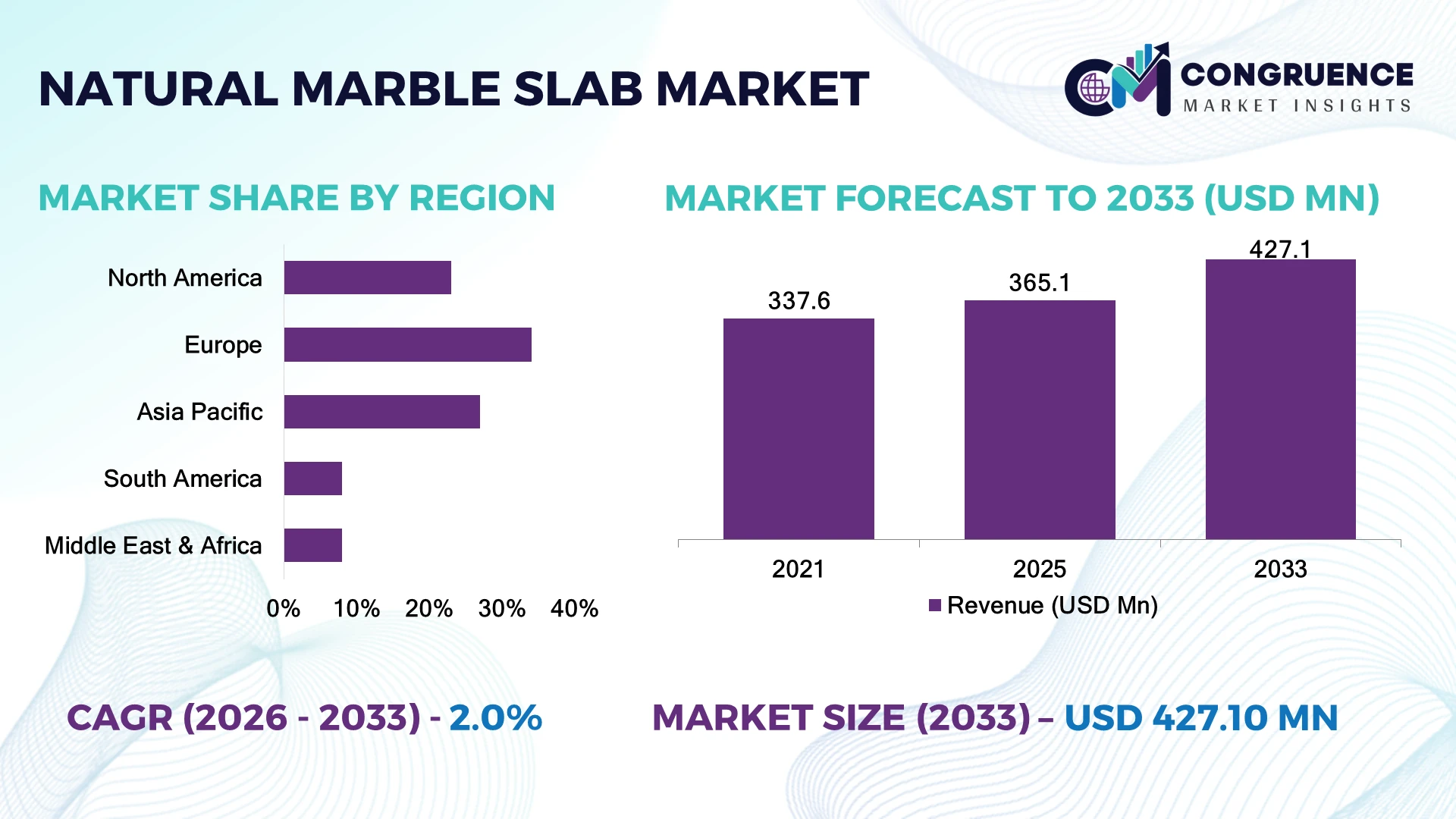
The Global Natural Marble Slab Market was valued at USD 365.1 Million in 2025 and is anticipated to reach a value of USD 427.1 Million by 2033 expanding at a CAGR of 1.98% between 2026 and 2033. Growth is being driven by rising premium architectural stone consumption in luxury residential towers, hospitality developments, and large-scale commercial renovation projects requiring high-grade natural marble finishes.
Italy remains the dominant country in the global natural marble slab industry, accounting for approximately 18% of processed premium marble slab exports and operating more than 1,500 stone-processing facilities. The country benefits from the globally recognized Carrara marble ecosystem and strong demand from luxury construction and interior design sectors. In comparison, Türkiye contributes over 30% of global marble block production capacity, while Italy maintains higher value-added processing and export realization. Advanced CNC stone-cutting adoption exceeds 65% among leading Italian processors, strengthening production precision and export competitiveness amid ongoing European infrastructure modernization initiatives.
This leadership reinforces the importance of securing premium stone supply networks, processing capabilities, and high-value architectural partnerships.
Market Size & Growth: USD 365.1 million in 2025 reaching USD 427.1 million by 2033, supported by premium construction and high-end interior renovation activity.
Top Growth Drivers: Luxury residential demand (+12%), hospitality refurbishment projects (+9%), and premium commercial interiors (+8%).
Short-Term Forecast: By 2028, automated stone-processing facilities are expected to reduce production waste by nearly 15%.
Emerging Technologies: AI-based slab inspection, CNC automation, and digital vein-matching systems improve cutting precision by over 20%.
Regional Leaders: Europe (~USD 145 million), Asia-Pacific (~USD 112 million), and Middle East (~USD 58 million); premium architectural adoption remains strong.
Consumer/End-User Trends: More than 55% of luxury residential projects prefer natural stone surfaces for premium aesthetics and durability.
Pilot/Case Example: A 2024 Italian processing modernization project improved material utilization by approximately 18%.
Competitive Landscape: Top producers control nearly 35% market share; key players include Levantina, Antolini, Polycor, Temmer Marble, and Fox Marble.
Regulatory & ESG Impact: Water-recycling systems reduce quarry processing water consumption by up to 30%.
Investment & Funding: Over USD 500 million invested globally in quarry modernization, processing upgrades, and export expansion initiatives.
Innovation & Future Outlook: Digital slab visualization and advanced surface-finishing technologies are accelerating premium product differentiation.
Natural marble slabs continue to gain traction across luxury residential developments, hospitality projects, premium retail spaces, and landmark commercial buildings. Digital slab-matching software, automated polishing systems, and precision CNC processing are improving material utilization by nearly 20%. Growing preference for traceable stone sourcing and stricter quarry environmental management standards are reshaping procurement strategies, while Middle Eastern megaprojects and upscale urban redevelopment programs create new demand channels, setting the stage for deeper strategic market evaluation.
Natural marble slabs are becoming strategically important as developers, architects, and premium construction firms increasingly prioritize distinctive materials that enhance project value and design differentiation. The market is benefiting from infrastructure modernization, luxury real-estate expansion, and the restructuring of global stone supply chains as buyers seek reliable sourcing alternatives beyond traditional procurement channels. Premium natural stone is increasingly viewed as a long-term asset rather than a commodity building material.
Technology adoption is reshaping competitiveness across the value chain. Advanced CNC cutting systems can improve slab yield by 15–20% compared with conventional processing methods while reducing material waste. Italy and Türkiye continue to dominate premium production and quarry operations, whereas India is strengthening its position through processing capacity expansion and export-oriented manufacturing. Digital slab visualization platforms are also reducing project selection cycles by approximately 25%, improving customer engagement and operational efficiency.
Over the next two to three years, producers are expected to prioritize processing automation, quarry modernization, and strategic distribution partnerships. Large hospitality developments in the Gulf region provide a practical example of premium marble deployment at scale. Companies investing in supply-chain resilience, processing precision, and premium product portfolios will secure stronger competitive positioning and long-term relevance in the global architectural materials landscape.
The strongest market driver is the increasing integration of natural marble slabs into luxury residential, hospitality, and commercial developments. Premium construction spending in several Gulf countries has expanded by more than 10%, while luxury residential project launches in major urban centers have risen by approximately 15% over the past few years. Architects continue to specify natural marble in high-visibility applications because premium stone finishes can increase perceived property value by 8–12%. Ongoing infrastructure modernization and urban redevelopment programs are also supporting demand. In response, leading producers are expanding processing capacity, investing in automated finishing technologies, and strengthening relationships with architects and developers. A key operational insight is that premium-grade processed slabs generate significantly higher margins than raw stone exports, encouraging value-added manufacturing strategies.
Cost instability across quarrying, transportation, and energy-intensive processing remains a structural limitation. Energy expenses represent nearly 25–30% of total processing costs for many marble manufacturers, while freight rates in some export corridors remain 15–20% above pre-disruption levels. Quarry permit approvals and environmental compliance requirements have also become more stringent in several producing countries. These factors directly affect production planning, profitability, and export competitiveness. Companies are responding by diversifying quarry sources, negotiating long-term logistics contracts, and increasing local inventory buffers. An important strategic insight is that vertically integrated operators with quarry ownership and processing facilities are better positioned to manage cost fluctuations and maintain consistent product availability for large-scale architectural projects.
Significant opportunities are emerging through advanced processing technologies and expanding demand in developing construction hubs. Automated slab inspection systems can improve defect detection rates by more than 25%, while digital inventory platforms reduce order fulfillment times by nearly 20%. India, Saudi Arabia, and Vietnam are witnessing increasing adoption of premium architectural materials as urban development accelerates. Sustainability-focused quarry management and water-recycling systems capable of reducing water usage by up to 30% are also becoming differentiating factors. Companies are investing in R&D, digital showroom technologies, and strategic partnerships with design firms to capture higher-value projects. A less obvious opportunity lies in customized book-matched marble solutions, where premium visual consistency commands stronger margins and enhances competitive differentiation.
Ensuring uniform quality, traceability, and specification compliance across geographically dispersed quarry and processing operations remains a major challenge. Natural variation can affect up to 15% of slab batches, creating complexity for large commercial projects that require visual consistency. Skilled stone-processing labor shortages exceeding 10% in several production hubs further complicate operations. At the same time, increasingly complex project specifications require tighter quality assurance and digital documentation. These pressures can impact customer confidence, project timelines, and long-term competitiveness. Companies must invest in advanced quality-control systems, workforce training, digital traceability platforms, and supplier certification programs. A critical strategic insight is that firms capable of delivering consistent premium-grade material at scale will gain a significant advantage in securing large international architectural contracts.
AI-Enabled Stone Grading Adoption – Marble processors are increasingly deploying AI-powered visual inspection systems to automate slab grading and defect detection. Automated classification accuracy has improved by nearly 25%, while manual inspection time has declined by approximately 30%. Italian and Indian processors are integrating machine vision directly into polishing and cutting workflows, enabling faster throughput and more consistent quality. This shift is reducing rework costs and supporting premium product positioning. Companies are scaling digital inspection infrastructure and partnering with industrial automation providers to standardize production quality across multiple facilities.
Water Recycling System Expansion – Stricter environmental compliance requirements and rising utility costs are accelerating the deployment of closed-loop water management systems. Advanced recycling installations now recover up to 85% of processing water, while freshwater consumption has fallen by nearly 35% in modern facilities. Quarry operators in Türkiye and Spain are restructuring processing workflows around resource-efficiency targets. Beyond compliance benefits, reduced water dependency is lowering operational risk and improving production continuity. Companies are expanding sustainability-focused investments to strengthen eligibility for large commercial and public-sector projects.
Digital Inventory and Procurement Networks – Real-time inventory platforms are transforming slab sourcing and distribution operations. Digital catalog adoption has increased by more than 40%, while project specification cycles have shortened by nearly 20%. Buyers increasingly evaluate slab availability, vein patterns, and finishing options through integrated digital platforms before procurement decisions. This operational transition is improving order accuracy and reducing inventory holding requirements. Leading suppliers are expanding cloud-based product libraries and integrating procurement systems with distributor networks to improve responsiveness.
Premium Customization and Bookmatching – Demand is shifting toward customized architectural stone solutions rather than standardized slab inventories. Bookmatched marble installations have increased by approximately 18%, while premium finishing requests have risen by nearly 15%. Luxury hospitality projects and flagship commercial developments are driving adoption of digitally planned slab sequencing and precision fabrication workflows. The trend is increasing average project complexity and margin potential. Producers are expanding design-support teams, investing in advanced CNC equipment, and restructuring sales models around high-value bespoke architectural applications.
White Marble remains the leading segment, accounting for approximately 38% of global demand. Its dominance stems from strong specification rates in luxury residential, hospitality, and commercial projects where premium aesthetics, design flexibility, and long-term value retention are critical. White varieties such as Carrara and Calacatta continue to command strong demand due to their compatibility with modern architectural concepts. Grey Marble follows as a mature segment, benefiting from growing use in contemporary commercial interiors and large-scale mixed-use developments. Together, white and grey varieties represent more than 60% of premium architectural stone installations. Black Marble is emerging as the fastest-growing segment as designers increasingly favor high-contrast luxury finishes and statement applications. Adoption has increased by nearly 12% across premium retail and hospitality projects. Beige Marble maintains relevance in large residential developments due to design versatility and cost efficiency, while Green and Other Specialty Marbles are gaining traction in bespoke projects where visual differentiation is prioritized. Companies are expanding quarry investments, developing exclusive stone collections, and strengthening premium distribution networks to capture higher-value architectural specifications.
Flooring remains the dominant application segment, representing approximately 42% of total marble slab utilization. High foot-traffic durability, premium appearance, and long service life continue to make marble flooring a preferred choice across luxury hotels, commercial complexes, and upscale residential projects. Wall Cladding represents the second-largest application, benefiting from growing demand for visually distinctive building façades and interior architectural features. Together, flooring and wall cladding account for a significant share of premium stone consumption in modern construction projects. Countertops are the fastest-growing application segment, supported by increasing adoption in luxury kitchens, hospitality suites, and premium commercial spaces. Demand for marble countertops has increased by approximately 14% in high-end residential developments. Staircases and Decorative Applications continue expanding through customized architectural projects, while furniture-integrated stone surfaces are gaining niche traction. Companies are increasing fabrication capabilities, investing in precision finishing technologies, and expanding project-specific customization services to address evolving application requirements and complex design specifications.
Commercial Construction remains the largest end-user segment, accounting for approximately 46% of total marble slab consumption. Large-scale hotels, corporate developments, luxury retail complexes, and mixed-use projects require substantial volumes of premium stone for flooring, façades, and interior finishes. Procurement decisions in this segment are strongly influenced by project scale, design differentiation, and lifecycle performance requirements. Institutional projects including airports, cultural centers, and government buildings continue to contribute stable demand due to their emphasis on premium architectural materials and long-term durability. Residential Construction is the fastest-growing end-user group as luxury housing developments and premium renovation activity expand. Adoption has increased by nearly 13% in upscale urban residential projects. Interior Design Firms play an increasingly influential role in material specification, while Real Estate Developers are prioritizing premium finishes to enhance property positioning and buyer perception. Companies are responding through customized product portfolios, architect-focused partnerships, design consultation programs, and project-specific pricing strategies. Competitive positioning is increasingly tied to specification influence rather than solely production capacity.
Europe accounted for the largest market share at 34% in 2025 however, Asia-Pacific is expected to register the fastest growth, expanding at a CAGR of 3.1% between 2026 and 2033.

North America accounted for approximately 23% of global natural marble slab demand, supported by luxury residential construction, commercial refurbishment projects, and premium hospitality investments. The United States remains the primary consumption center, with marble increasingly specified for high-end flooring, countertops, and architectural wall systems. Growing adoption of digital slab visualization and automated fabrication technologies has improved project planning efficiency by nearly 20%, enabling faster material selection and installation workflows. The market is also benefiting from increasing investment in mixed-use urban developments and luxury residential communities. Distributors and fabricators are expanding inventory management systems and strengthening direct partnerships with international quarry operators to secure premium-grade stone supply and reduce procurement lead times.
United States Market Outlook: The United States represents the largest marble slab consumption market in North America due to its extensive luxury construction and remodeling sector. Premium residential projects account for a substantial share of natural stone specifications, while hospitality and corporate developments continue to support large-volume procurement. More than 60% of high-end kitchen renovation projects in major metropolitan areas now evaluate natural stone options during material selection. Fabricators are investing in CNC processing equipment and digital inventory platforms to improve customization capabilities and project execution speed.
Europe remains the largest regional market with approximately 34% share, supported by its concentration of premium marble quarrying, processing expertise, and export-oriented manufacturing. Italy, Spain, and Greece continue to dominate value-added stone production through advanced fabrication capabilities and established architectural supply chains. Sustainability initiatives are reshaping operations, with modern processing facilities reducing water consumption by more than 30% through recycling systems. Increased adoption of automated cutting and polishing technologies has improved production precision and material utilization. Manufacturers are modernizing facilities, expanding premium product portfolios, and integrating digital quality-control systems to strengthen competitiveness in luxury architectural applications.
Italy Market Outlook: Italy remains the strategic center of premium marble processing and global architectural stone exports. The country's manufacturing ecosystem combines quarry access, advanced fabrication expertise, and strong relationships with architects and developers worldwide. More than 65% of leading Italian stone processors utilize advanced CNC technologies for precision fabrication and customized project execution. Continuous investment in automation, sustainability programs, and premium design collaboration enables Italian companies to maintain leadership in high-value architectural and luxury construction projects.
Asia-Pacific accounts for approximately 27% of global market activity and represents the fastest-expanding regional landscape due to rapid urbanization, premium real-estate development, and manufacturing capacity growth. India and China serve as major processing and consumption hubs, supported by large-scale infrastructure and commercial construction programs. Investments in automated processing lines have increased production efficiency by nearly 18%, helping suppliers address rising demand for premium architectural materials. Export-oriented processors are expanding fabrication capabilities while developers increasingly specify marble for luxury residential towers, hospitality projects, and commercial complexes. Growing integration of digital procurement systems is also improving project coordination and inventory visibility.
India Market Outlook: India has emerged as a major processing and export hub due to its extensive stone-processing infrastructure and competitive manufacturing base. The country hosts thousands of processing units supplying both domestic and international markets. Advanced polishing and fabrication facilities continue to expand across Rajasthan and other stone-processing clusters. Automated production adoption has increased significantly, improving throughput and reducing material wastage. Strong construction activity and rising luxury housing investments further strengthen demand for premium marble slab products.
South America accounts for approximately 8% of global natural marble slab demand and maintains strategic importance through quarry resources and export-focused stone industries. Brazil remains the dominant regional player, benefiting from extensive natural stone reserves and established international trade networks. Investments in modern processing equipment have improved slab yield rates by roughly 15%, supporting greater value-added production. While infrastructure limitations and logistics costs continue to affect operational efficiency, increasing demand from international architectural projects is encouraging modernization across the supply chain. Producers are focusing on premium finishes, product differentiation, and export market expansion to improve competitiveness.
Brazil Market Outlook: Brazil serves as the leading natural stone production and export center in South America, supported by abundant geological resources and established processing expertise. The country continues to strengthen its presence in premium architectural stone markets through investments in fabrication technology and quality-control systems. Export-oriented manufacturers increasingly focus on customized slab production and specialty finishes. Growing deployment of automated cutting systems has enhanced production consistency and strengthened Brazil’s position within international commercial and residential construction supply chains.
The Middle East & Africa region represents approximately 8% of global market activity and is increasingly influenced by large-scale urban development, hospitality investments, and infrastructure modernization programs. Premium marble slabs are being widely specified across luxury hotels, mixed-use developments, commercial complexes, and landmark construction projects. Large construction programs in Gulf countries have increased demand for premium architectural stone, while modernization initiatives continue to elevate quality standards and project specifications. Developers are prioritizing premium finishes and customized stone applications to differentiate flagship projects. Suppliers are responding through regional distribution expansion, fabrication partnerships, and localized inventory strategies to improve project delivery timelines.
Saudi Arabia Market Outlook: Saudi Arabia is the most strategically significant market in the region due to its large-scale infrastructure pipeline and ambitious urban development programs. Luxury hospitality, tourism, and mixed-use construction projects continue to generate strong demand for premium marble materials. High-value developments increasingly require customized stone fabrication and advanced finishing solutions. International suppliers are strengthening partnerships with local contractors and distributors to support project execution requirements, while growing investment in construction modernization continues to expand opportunities for premium natural marble slab deployment.
The Natural Marble Slab Market is characterized by competition between global integrated stone leaders such as Levantina, Polycor, Antolini, Temmer Marble, and Fox Marble, and regional quarry-based processors across Türkiye, India, Brazil, and Greece. The top five players collectively account for approximately 28% of market activity, reflecting a fragmented but quality-driven structure. Competition is centered on supply-chain control, premium stone availability, customization capability, and processing efficiency. Vertically integrated operators improve delivery reliability by nearly 20%, while automated fabrication systems enhance material utilization by 15–25%. Premium suppliers increasingly compete on digital slab visualization, project-specific customization, and sustainable processing standards rather than price alone. Companies are expanding quarry ownership, modernizing fabrication facilities, strengthening distributor partnerships, and integrating digital inventory management. A notable competitive shift is the growing advantage of firms controlling both quarry resources and downstream processing operations. Limited access to premium reserves and capital-intensive processing infrastructure remain key barriers. Winning requires secure stone resources, advanced fabrication capabilities, consistent quality, and strong architectural specification influence.
Polycor Inc.
Antolini Luigi & C. S.p.A.
Temmer Marble
Fox Marble Holdings plc
Dimpomar
Best Cheer Stone Group
Xiamen Wanli Stone Co., Ltd.
Fujian Fengshan Stone Group
Kangli Stone Group
Topalidis S.A.
Pakistan Onyx Marble
Mármoles Marín S.A.
Vetter Stone Company
Natural marble slab production is increasingly shaped by advanced CNC machining, AI-enabled slab inspection, and automated polishing technologies. Modern CNC systems improve cutting precision by approximately 20% while reducing raw material wastage by nearly 15%. AI-based visual grading platforms are now deployed by an estimated 35% of large processors, enabling faster defect identification and more consistent quality control. These technologies strengthen production efficiency and support premium product positioning.
Digital fabrication workflows and cloud-based slab management systems are emerging as key operational differentiators. Compared with conventional manual planning methods, digital slab mapping improves material utilization by approximately 18% and reduces project planning time by nearly 25%. Adoption continues to expand among integrated processors seeking faster response times and greater customization capabilities. Companies with advanced digital workflows benefit from stronger project execution, improved inventory visibility, and higher-value architectural contracts.
Between 2026 and 2028, robotic handling systems, digital twin production environments, and predictive maintenance platforms are expected to accelerate deployment. Automated facilities can reduce equipment downtime by approximately 20% compared with legacy maintenance models. The greatest competitive advantage will accrue to vertically integrated operators that combine quarry ownership, automated fabrication, and digital customer engagement. Early adopters are positioning themselves to secure premium architectural specifications and improve operational resilience as quality requirements continue to intensify.
October 2024 – Polycor announced more than US$15 million in advanced manufacturing investments across facilities in Quebec and Indiana, adding production lines to increase volume, improve efficiency, and enhance quality. The expansion strengthens North American supply capabilities and supports higher-value stone applications. Source: www.polycor.com
April 2025 – Levantina unveiled its 2025 “New Generation” collection featuring 30 monumental natural stone slabs in an architectural installation in Madrid. The launch expanded premium product visibility and reinforced the company’s positioning in high-end architectural and design projects. Source: www.levantina.com
May 2025 – Levantina highlighted its integrated marble, granite, and Techlam business model at Coverings 2025, streamlining logistics and product access through a unified commercial platform. The strategy improves supply-chain efficiency and strengthens customer engagement across multiple stone categories. Source: www.levantina.com
2025 – Levantina reported an annual carbon-footprint reduction of 18.35% while expanding environmental certifications and advancing zero-waste manufacturing initiatives. The achievement strengthens sustainability credentials and improves competitiveness in environmentally focused construction specifications.
The Natural Marble Slab Market report provides comprehensive analysis across major marble types including White Marble, Black Marble, Grey Marble, Beige Marble, Green Marble, and specialty varieties. The study evaluates demand across flooring, wall cladding, countertops, staircases, decorative applications, and other architectural uses. Coverage extends to commercial construction, residential construction, institutional projects, interior design firms, and real-estate development activities. Regional assessment spans North America, Europe, Asia-Pacific, South America, and the Middle East & Africa, incorporating production dynamics, trade flows, processing capabilities, and deployment patterns.
The report also examines technology adoption trends including CNC fabrication, AI-assisted quality inspection, digital slab visualization, automated polishing systems, and sustainability-focused processing practices. Analysis covers competitive positioning of major producers, quarry integration strategies, premium stone sourcing trends, and evolving architectural specifications. More than one-third of market activity remains concentrated within premium construction applications, while digital processing adoption continues to expand across leading fabrication facilities. The study supports investment evaluation, market-entry planning, expansion prioritization, competitive benchmarking, and strategic decision-making through 2033.
| Report Attribute / Metric | Details |
|---|---|
| Market Revenue (2025) | USD 365.1 Million |
| Market Revenue (2033) | USD 427.1 Million |
| CAGR (2026–2033) | 1.98% |
| Base Year | 2025 |
| Forecast Period | 2026–2033 |
| Historic Period | 2021–2025 |
| Segments Covered |
By Type
By Application
By End-User
|
| Key Deliverables | Revenue Forecast; Market Trends; Growth Drivers & Restraints; Technology Insights; Segmentation Analysis; Regional Insights; Competitive Landscape; Regulatory & ESG Overview; Recent Developments |
| Regions Covered | North America; Europe; Asia-Pacific; South America; Middle East & Africa |
| Companies Profiled | Levantina Group; Polycor Inc.; Antolini Luigi & C. S.p.A.; Temmer Marble; Fox Marble Holdings plc; Dimpomar; Best Cheer Stone Group; Xiamen Wanli Stone Co., Ltd.; Fujian Fengshan Stone Group; Kangli Stone Group; Topalidis S.A.; Pakistan Onyx Marble; Mármoles Marín S.A.; Vetter Stone Company |
| Customization & Pricing | Available on Request (10% Customization Free) |




