
Reports
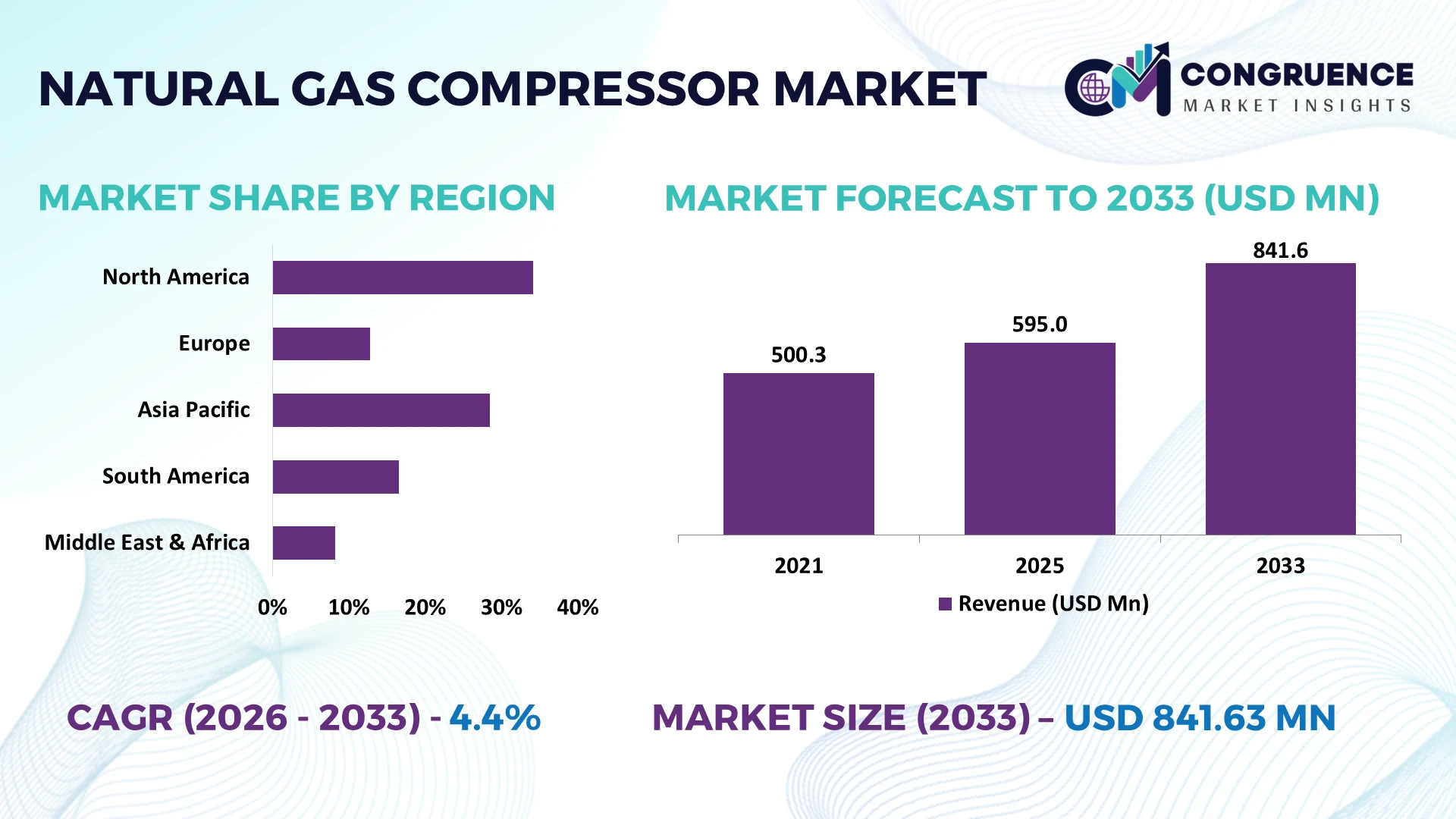
The Global Natural Gas Compressor Market was valued at USD 595.0 Million in 2025 and is anticipated to reach a value of USD 841.6 Million by 2033 expanding at a CAGR of 4.43% between 2026 and 2033. Growth is driven by LNG infrastructure expansion, pipeline capacity additions, compressor-station modernization, and replacement of gas-turbine-driven equipment with higher-efficiency electric and digitally optimized compression systems.
The U.S. remains the dominant country, supported by extensive gas transmission infrastructure and LNG expansion, while India is accelerating deployment through its National Gas Grid, with GAIL reporting 5,626 km of ongoing pipeline projects involving INR 29,716 crore of investment. North American pipeline projects also continue adding substantial compression capacity, including more than 200,000 HP on the Southeast Supply Enhancement Project.
Strategically, suppliers should prioritize high-efficiency compressor trains, digital optimization, electrification, and localized service networks in LNG and expanding gas-transmission corridors.
Market Size & Growth: Market value stands at USD 595.0 million in 2025 and is projected to reach USD 841.6 million by 2033, supported by LNG capacity additions and pipeline modernization.
Top Growth Drivers: LNG infrastructure expansion contributes approximately 35%, pipeline modernization 30%, and industrial gas utilization 25% to the principal growth drivers.
Short-Term Forecast: By 2028, digitally optimized compressor operations are targeted to reduce fuel consumption by 5–10% while improving equipment utilization by 8–12%.
Emerging Technologies: AI-based optimization, variable-speed electric drives, and advanced compressor materials are shifting operations toward predictive maintenance and lower-emission compression.
Regional Leaders: North America is projected at approximately USD 289 million, Asia Pacific at USD 240 million, and Europe at USD 143 million by 2033, with electrification and digital monitoring accelerating deployment.
Consumer/End-User Trends: Oil and gas operators account for more than 50% of demand, while LNG, power generation, and industrial users increasingly prioritize remotely monitored compression assets.
Pilot/Case Example: In 2025, TC Energy's AI-driven compression optimization program generated 180 actionable optimization opportunities and eliminated 54,000 metric tons of CO₂e across its operations.
Competitive Landscape: North America holds approximately 34% market share, with Atlas Copco, Baker Hughes, Howden, Ingersoll Rand, and Ariel Corporation competing through compressor efficiency, service coverage, and digital controls.
Regulatory & ESG Impact: Electrification and optimization programs are targeting 5–15% reductions in compressor fuel consumption and emissions, strengthening compliance positioning across tightening methane and carbon-management regimes.
Investment & Funding: ADNOC Gas awarded USD 2.1 billion in 2025 contracts covering LNG pre-conditioning, compression facilities, and transmission infrastructure, reinforcing large-scale Middle Eastern gas infrastructure investment.
Innovation & Future Outlook: Next-generation systems are combining AI diagnostics, electric drives, advanced sealing, and low-emission designs, shifting competition from equipment supply toward lifecycle efficiency and digital service models.
The global Natural Gas Compressor Market is increasingly shaped by LNG expansion, pipeline reliability, and compressor electrification. Demand is particularly strong across gas transmission, LNG processing, petrochemicals, and power generation, while digital condition monitoring is gaining traction, with AI-based optimization already producing measurable emissions reductions. U.S. LNG expansion and India's National Gas Grid development reinforce the shift toward integrated, efficiency-focused compression infrastructure.
Natural gas compressors are becoming strategically important because pipeline reliability, LNG exports, and industrial gas availability increasingly depend on precise pressure management. The expansion of U.S. LNG infrastructure, India's National Gas Grid, and Middle Eastern LNG projects is redirecting investment toward high-capacity, digitally controlled compression systems rather than conventional replacement equipment.
Technology selection is also changing operating economics. AI-enabled optimization can identify fuel-efficient compressor configurations continuously, while electric drives reduce dependence on combustion-based turbine systems and support lower-emission operations. TC Energy's optimization deployment across more than 1,000 compressor units demonstrates how digital control can translate operational data into measurable emissions benefits.
Regional priorities remain distinct: North America emphasizes pipeline expansion and LNG connectivity, India focuses on network penetration and industrial gas access, while the Middle East prioritizes integrated gas processing and LNG export infrastructure. Over the next 2–3 years, operators are expected to increase remote monitoring, electrification, predictive maintenance, and compressor-station upgrades. Companies securing technology partnerships and localized service capabilities will strengthen lifecycle economics and operational resilience.
LNG export development and transmission-network expansion are directly increasing requirements for high-capacity compression. North America accounted for approximately 34% of the market in 2025, while major U.S. pipeline projects are adding substantial transportation and compression capacity. India's National Gas Grid is also expanding across industrial corridors, with 5,626 km of pipeline projects under development. The resulting demand favors centrifugal and reciprocating systems with higher availability and remote diagnostics. Companies are responding through compressor-station expansion, electric-drive deployment, and long-term service agreements. A non-obvious advantage is that compression modernization allows operators to increase throughput without proportionally expanding pipeline footprints.
Large compressor stations require significant capital, specialized engineering, and long procurement cycles, constraining deployment where gas infrastructure remains fragmented. Equipment, installation, and maintenance costs can represent 15–25% of project budgets for compression-intensive infrastructure, while imported components expose operators to currency and supply-chain volatility. Complex integration between compressors, turbines, electric motors, SCADA systems, and pipeline controls further increases commissioning requirements. In the U.S., numerous pipeline projects require regulatory approvals before construction, extending development timelines. Manufacturers are reducing exposure through regional assembly, multi-year component contracts, standardized compressor platforms, and service hubs. The key operational constraint is no longer equipment availability alone; integration time increasingly determines project economics.
Electrification, AI optimization, and predictive maintenance create an underpenetrated opportunity across mature pipeline networks. Digital optimization can generate fuel and emissions savings of roughly 5–15%, while predictive monitoring can reduce unplanned maintenance exposure by approximately 10–20% when integrated with compressor performance data. TC Energy has already implemented AI-supported optimization across 365 stations and more than 1,000 units, demonstrating the scalability of data-driven compression management. India is also testing electric-drive conversion within its compressor fleet, strengthening the case for lower-emission compression. Suppliers that combine compressors, controls, analytics, and lifecycle services can capture greater value than equipment-only vendors.
The next challenge is integrating advanced compressors into aging pipeline and processing infrastructure without compromising reliability. Approximately 20–30% of legacy compression assets can require significant control-system, instrumentation, or mechanical upgrades before advanced analytics can operate effectively. Cybersecurity also becomes more important as compressor stations increasingly connect operational technology with centralized monitoring platforms. Workforce capability is another pressure point, particularly where operators must manage rotating equipment alongside AI-enabled control systems. India's expanding pipeline network and Middle Eastern LNG projects illustrate the scale of infrastructure requiring coordinated engineering and commissioning expertise. Companies must invest in OT cybersecurity, technician training, standardized interfaces, and predictive-maintenance partnerships. The strategic priority is building digitally compatible compression fleets without sacrificing operational continuity.
Digital Station Optimization Accelerates: Operators are moving from scheduled compressor maintenance toward continuous performance analytics, with digital monitoring estimated across 29% of new station packages in 2025. AI-assisted loading can reduce power consumption by about 23%, improving utilization without adding equipment. U.S. operators are increasingly integrating sensors with control systems as pipeline capacity additions accelerate, while suppliers expand software-enabled service partnerships.
Electric-Drive Adoption Expands: Electric and hybrid compressor configurations are gaining traction as operators respond to emissions requirements and fuel-cost pressure. Electric-drive and hybrid packages represented an estimated 41% of new 2025 project awards in one industry assessment, while electric motors can exceed 95% efficiency. Companies are prioritizing grid-connected stations and dual-drive systems, creating a non-obvious shift toward flexible power architecture rather than single-driver installations.
Compression Capacity Moves South: U.S. pipeline development is increasingly concentrated around Gulf Coast gas demand. Projects completed in 2025 added approximately 6.3 Bcf/d of capacity, with 85% directed toward the South Central region. This is accelerating compressor-station upgrades around LNG-linked corridors and changing procurement toward larger, continuous-duty equipment. Companies are responding with higher-capacity packages, expanded service networks, and station modernization programs.
Reliability Upgrades Become Targeted: Operators are increasingly modifying existing compressor stations instead of relying exclusively on greenfield construction. The 2025–2026 U.S. project pipeline includes station modifications, replacement equipment, and targeted compression additions, while one Southeast project combines three station modifications with one new station. This approach shortens infrastructure deployment cycles and directs capital toward bottleneck removal, reliability, and firm transportation capacity.
Centrifugal Compressors represent the leading type, with approximately 46.5% share in 2026, supported by high-flow transmission pipelines, LNG facilities, and continuous-duty gas processing. Their scalability and steady-flow performance make them more suitable for large stations than reciprocating and rotary systems, while reciprocating compressors remain important where high pressure ratios and variable-flow requirements dominate. Rotary Compressors, Screw Compressors, Axial Compressors, and Others retain specialized positions across lower-flow, packaged, and technically specific applications. Companies are therefore maintaining multi-technology portfolios while concentrating new product investment on high-efficiency centrifugal platforms.
Reciprocating Compressors remain a mature and strategically important alternative because they handle changing flow conditions and high-pressure applications effectively. Centrifugal systems are gaining preference in large-scale infrastructure, while reciprocating equipment remains stronger in specialized compression duties. Approximately 23% of new compressor-station packages in one 2025 assessment incorporated advanced digital monitoring, increasing the value of intelligent controls across both technologies. Suppliers are responding with modular designs, predictive diagnostics, and application-specific engineering rather than pursuing a single technology model.
Gas Transmission and Distribution is the leading application, accounting for approximately 45% of demand, because compressors are essential for maintaining pressure and throughput across long-distance pipelines. Gas Processing follows at roughly 25%, supported by LNG, gas conditioning, and processing infrastructure. Gas Storage and Gas Gathering remain operationally important but more specialized, while Others serves niche compression requirements. The mature transmission segment prioritizes uptime and station reliability, whereas processing applications increasingly emphasize automation and flexible operating ranges. Companies are directing capital toward station upgrades, higher-capacity trains, and digitally controlled equipment.
Gas Processing is gaining faster strategic importance as LNG and gas-treatment infrastructure expands. Processing facilities increasingly require precise pressure control, continuous operation, and equipment compatible with changing gas compositions. Transmission projects remain larger in installed infrastructure, but processing projects create stronger demand for integrated compressor packages and advanced controls. In 2025, U.S. pipeline projects added approximately 6.3 Bcf/d of capacity, with 85% directed toward the South Central region, reinforcing demand for compression around Gulf Coast gas and LNG corridors.
Oil and Gas is the dominant end-user, representing approximately 63.5% of market demand in 2025 because compression is embedded across production, gathering, transmission, processing, storage, and LNG operations. Power Generation follows at approximately 11.8%, while Chemical & Petrochemical contributes around 18.4%; Manufacturing, Mining, and Others serve more specialized requirements. Oil and Gas buyers prioritize reliability, pressure stability, methane management, and lifecycle economics, whereas industrial users increasingly favor compact and application-specific systems. Companies are responding with long-term service contracts, retrofit programs, predictive monitoring, and flexible compressor configurations.
Chemical & Petrochemical is expanding its strategic role as new processing capacity increases demand for continuous-duty compression, while Power Generation requires dependable gas delivery for combined-cycle and flexible generation assets. Oil and Gas remains the scale leader, but purchasing priorities are diverging: large operators emphasize fleet standardization and remote monitoring, while industrial buyers focus more heavily on installation flexibility and operating cost. This is pushing suppliers toward customized packages, digital service agreements, and localized maintenance capabilities.
North America accounted for the largest market share at 34.1% in 2025 however, Asia Pacific is expected to register the fastest growth, expanding at a CAGR of 5.91% between 2026 and 2033.
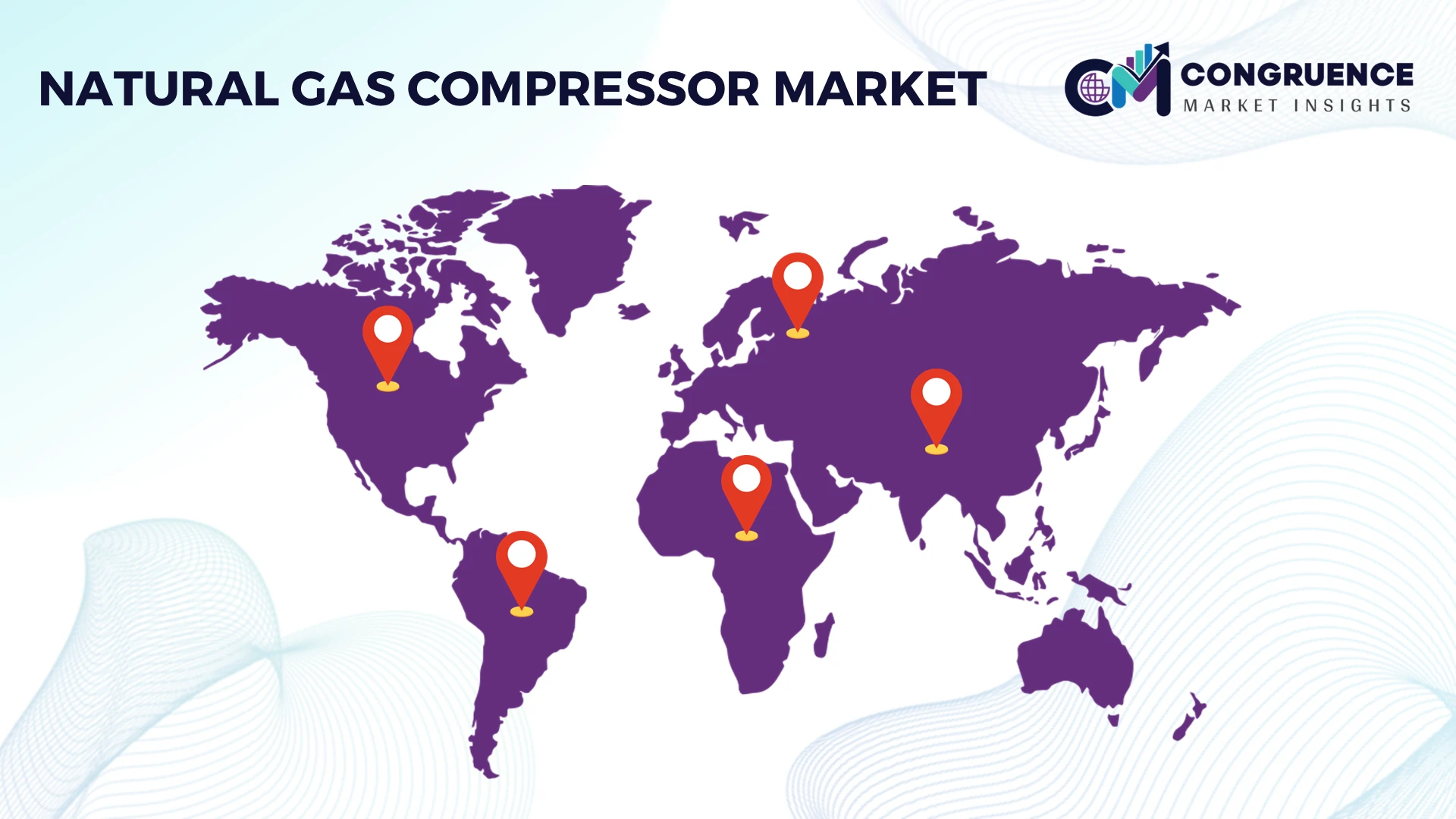
North America held the largest regional position with 34.1% of the global market in 2025, supported by extensive transmission infrastructure, shale-gas production, LNG exports, and compressor-intensive midstream operations. The U.S. remains the dominant country, with more than 1,000 billion cubic meters of natural gas production in 2023 and LNG liquefaction capacity exceeding 90 million tonnes annually. Compressor demand is concentrated around the Permian, Marcellus, Haynesville, and Gulf Coast corridors. Operators are upgrading aging stations with electric drives, advanced controls, and higher-capacity compressor trains. The region's established service ecosystem also supports faster deployment and maintenance cycles.
U.S. Market Outlook: The U.S. represents the region's largest compressor market because of its extensive interstate pipeline network, shale production base, and LNG infrastructure. The country is increasingly directing investment toward compressor-station expansion and modernization along Gulf Coast and major shale corridors. More than 90 million tonnes per year of LNG liquefaction capacity creates sustained requirements for gas gathering, processing, transmission, and LNG-related compression equipment.
Europe represented approximately 12.8% of the global market in 2025, with demand increasingly shaped by energy-security restructuring, LNG import diversification, storage expansion, and modernization of mature transmission infrastructure. Germany, Italy, the Netherlands, and the U.K. remain important deployment centers, while operators are prioritizing equipment that improves efficiency and reduces methane leakage. LNG infrastructure expansion following the reduction of Russian pipeline-gas dependence has redirected procurement toward compression and gas-handling assets. Companies are increasingly combining compressor upgrades with digital monitoring, variable-speed drives, and predictive maintenance to extend operating life while controlling energy consumption across aging networks.
Germany Market Outlook: Germany is the region's most strategically significant deployment market because of its extensive gas infrastructure and accelerated LNG-import diversification. The country has developed multiple LNG receiving facilities since 2022, strengthening demand for associated gas-handling and compression systems. Operators are also modernizing transmission assets to improve reliability and operational efficiency, creating opportunities for high-efficiency compressors, digital controls, and long-term maintenance agreements.
Asia Pacific accounted for approximately 28.4% of the global market in 2025 and represents the fastest-growing regional market, supported by expanding gas consumption, LNG infrastructure, pipeline construction, and industrialization across China, India, Japan, South Korea, and Southeast Asia. China has developed more than 120,000 kilometers of natural gas pipelines, creating substantial requirements for transmission and distribution compression. India is simultaneously expanding city-gas and CNG infrastructure, while Japan and South Korea maintain sophisticated LNG import and processing systems. Manufacturers are responding with modular compressor packages, localized production, automation, and partnerships with regional EPC contractors.
China Market Outlook: China leads Asia Pacific through its large gas-transmission network, industrial base, LNG infrastructure, and expanding storage capacity. More than 120,000 kilometers of natural gas pipelines require extensive pressure-management equipment across transmission and distribution corridors. Domestic compressor manufacturers are strengthening their position through localized engineering and production, while international suppliers increasingly pursue technology partnerships and service agreements to participate in large infrastructure projects.
South America represented approximately 16.5% of the global market in 2025, with Brazil and Argentina providing the strongest demand centers. Brazil's offshore gas production and expanding pre-salt infrastructure require reliable gathering, processing, and transmission compression, while Argentina's Vaca Muerta development is increasing requirements for gas gathering and pipeline capacity. Infrastructure constraints remain significant, particularly where new production outpaces transportation capacity. Operators are therefore prioritizing modular compressor packages and phased station expansion rather than relying solely on large greenfield systems. Suppliers are strengthening local service capabilities and EPC relationships to shorten installation cycles and improve equipment availability.
Brazil Market Outlook: Brazil is the region's most significant compressor market because of its large offshore production base, expanding gas-processing infrastructure, and growing role in domestic gas supply. Pre-salt developments require compression across production and processing chains, creating demand for high-reliability equipment capable of operating in demanding offshore environments. Petrobras and associated contractors continue emphasizing production efficiency, equipment reliability, and infrastructure integration, supporting specialized compressor deployment.
Middle East & Africa represented approximately 8.2% of the global market in 2025, with demand concentrated in Saudi Arabia, the UAE, Qatar, Algeria, and other gas-producing markets. Large gas-processing, pipeline, LNG, and petrochemical projects are increasing requirements for high-capacity compression, while national energy strategies are shifting investment toward gas monetization and domestic industrial development. Saudi Arabia's Jafurah development and Master Gas System expansion are particularly important compression-demand centers. Companies are responding with integrated compressor trains, advanced monitoring, high-efficiency drivers, and long-term service partnerships designed for large-scale continuous operations.
Saudi Arabia Market Outlook: Saudi Arabia leads the regional deployment landscape through extensive gas-processing investment, the Jafurah unconventional gas development, and expansion of the Master Gas System. The country's strategy to increase domestic gas utilization is generating requirements across gathering, processing, transmission, and petrochemical infrastructure. Compressor suppliers are increasingly targeting integrated project packages and long-term service arrangements, while high-efficiency equipment supports the country's broader industrialization and gas-monetization objectives.
Baker Hughes, Siemens Energy, Solar Turbines, Ariel Corporation, and Burckhardt Compression compete as major OEMs and compressor specialists, while Atlas Copco, Mitsubishi Heavy Industries, Howden, and Kobelco target regional and application-specific projects. The top five players collectively account for approximately 30.5% of market share. Competition centers on technology, lifecycle cost, delivery capability, and customization: advanced compressor systems can improve efficiency by 5–8%, while predictive monitoring can reduce unplanned downtime by 15–25%. Major suppliers are expanding through LNG and pipeline projects, technology partnerships, localized manufacturing, and service agreements. The competitive shift is toward electric-drive compression, digital diagnostics, hydrogen-ready equipment, and integrated lifecycle services. High qualification requirements, engineering expertise, reliability records, and established customer relationships create significant entry barriers. Regional suppliers face pressure from global OEMs with broader service networks, while global players face pricing pressure in standardized equipment. Winning requires proven reliability, faster project execution, local support, efficient technology, and competitive lifecycle economics.
Baker Hughes
Siemens Energy
Solar Turbines
Mitsubishi Heavy Industries
Atlas Copco
Burckhardt Compression
Ariel Corporation
Elliott Group
Howden
Ingersoll Rand
Kobelco Compressors
MAN Energy Solutions
Digital monitoring, variable-speed drives, anti-surge controls, and predictive maintenance are becoming standard in modern compressor stations. Variable-speed drives can reduce energy consumption by 10–20% during variable-load operation, while predictive analytics can lower unplanned downtime by 15–25%. Adoption is strongest in new transmission facilities and brownfield modernization projects, giving operators improved availability and lower maintenance exposure.
High-efficiency centrifugal aerodynamics and advanced reciprocating compressors are replacing older fixed-performance equipment. Modern compressor trains can deliver approximately 5–8% higher efficiency than legacy systems, while electric-drive configurations eliminate fuel consumption associated with gas turbines. Leading suppliers increasingly integrate compression hardware with automation, remote diagnostics, and condition-monitoring platforms, benefiting OEMs with established digital-service capabilities.
Between 2026 and 2028, hydrogen-ready compressors, digital twins, electrification, and modular compression packages will gain commercial importance. Hydrogen-compatible designs can support blends up to 10%, reducing future equipment-replacement risk. Digital-twin technologies can improve maintenance planning and equipment utilization by approximately 10–15%. Buyers acting now can reduce operating costs and improve flexibility, while suppliers combining equipment, controls, software, and lifecycle services gain stronger competitive differentiation.
April 2024 Baker Hughes received an order from Snam for three NovaLT12 turbocompressors for Italy’s Sulmona station, with fuel flexibility for hydrogen blends up to 10%. The project supports the 425-km Adriatic Line and advances hydrogen-ready gas infrastructure. Source: bakerhughes.com
April 2024 Baker Hughes secured an order for 17 centrifugal compressors for Saudi Aramco’s Master Gas System Phase 3, following 18 units supplied during earlier phases. The project expands national gas distribution while supporting Baker Hughes’ Saudi manufacturing expansion.
November 2024 Burckhardt Compression won an order to supply boil-off-gas and pipeline-injection compressors for Germany’s Brunsbüttel LNG terminal, scheduled for regular operation in 2027. The award strengthens LNG import infrastructure and expands the company’s European terminal presence. Source: burckhardtcompression.com
March 2026 Siemens Energy and ESENTIA advanced Mexico’s 2026–2028 gas-system expansion with two new 15-MW turbo-compression units. The project supports the Wahalajara System, which spans more than 2,000 km and supplies 16% of Mexico’s national gas demand. Source: siemens-energy.com
The Natural Gas Compressor Market Report covers centrifugal, reciprocating, rotary, screw, axial, and other compressor types across gas transmission and distribution, gas processing, gas storage, gas gathering, and specialized applications. End-user coverage includes oil and gas, power generation, chemical and petrochemical, manufacturing, mining, and emerging gas infrastructure. The analysis evaluates compressor deployment according to operating conditions, capacity requirements, modernization needs, and infrastructure development.
Regional analysis covers North America, Europe, Asia Pacific, South America, and Middle East & Africa, with country-level assessment of major production, pipeline, LNG, and processing markets. Technology coverage includes electric drives, digital monitoring, predictive maintenance, anti-surge systems, hydrogen-ready compression, and modular packages. The report supports investment planning, geographic expansion, procurement decisions, competitive positioning, technology selection, and strategic planning for market developments between 2026 and 2033.
| Report Attribute / Metric | Details |
|---|---|
| Market Revenue (2025) | USD 595.0 Million |
| Market Revenue (2033) | USD 841.6 Million |
| CAGR (2026–2033) | 4.43% |
| Base Year | 2025 |
| Forecast Period | 2026–2033 |
| Historic Period | 2021–2025 |
| Segments Covered |
By Type
By Application
By End-User
|
| Key Deliverables | Revenue Forecast; Market Trends; Growth Drivers & Restraints; Technology Insights; Segmentation Analysis; Regional Insights; Competitive Landscape; Regulatory & ESG Overview; Recent Developments |
| Regions Covered | North America; Europe; Asia Pacific; South America; Middle East & Africa |
| Companies Profiled | Baker Hughes; Siemens Energy; Solar Turbines; Mitsubishi Heavy Industries; Atlas Copco; Burckhardt Compression; Ariel Corporation; Elliott Group; Howden; Ingersoll Rand; Kobelco Compressors; MAN Energy Solutions |
| Customization & Pricing | Available on Request (10% Customization Free) |




