
Reports
The Global Natural Food Additives Market was valued at USD 9,298.3 Million in 2025 and is anticipated to reach a value of USD 16,338.1 Million by 2033 expanding at a CAGR of 7.3% between 2026 and 2033. Growing clean-label reformulation, natural preservation technologies, and plant-derived ingredient innovation are accelerating adoption of natural food additives across processed foods, beverages, dairy, and bakery products.
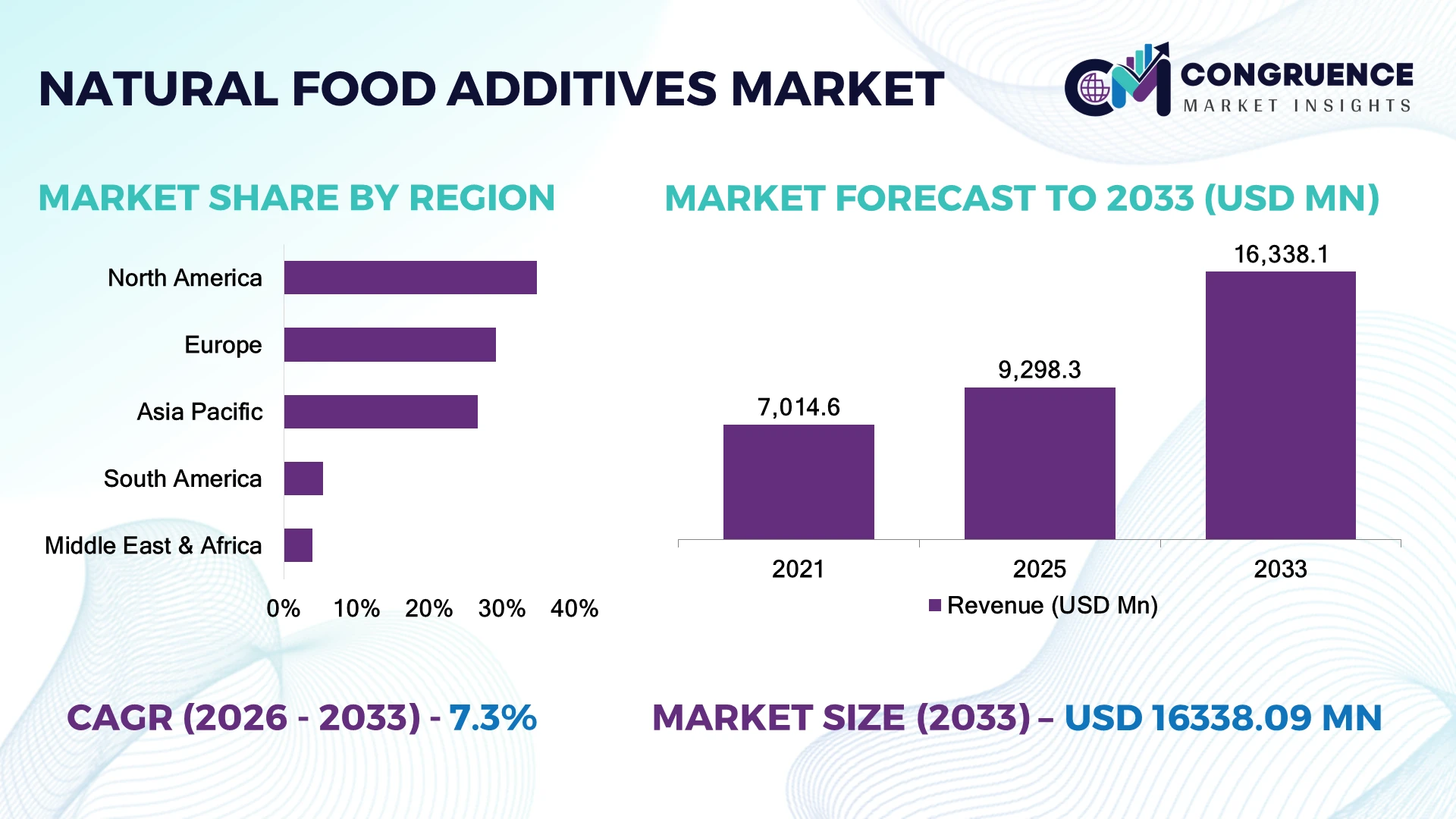
The United States leads the market with approximately 31% of global consumption, supported by advanced food processing infrastructure, extensive ingredient innovation, and strong investment in clean-label product development. More than 67% of newly launched packaged food products incorporate naturally derived colors, flavors, or preservatives, while Germany emphasizes premium botanical extracts and organic formulations. Ongoing supply-chain diversification following geopolitical disruptions has encouraged manufacturers to regionalize sourcing of botanical and fermentation-derived ingredients.
Manufacturers investing in traceable raw materials, advanced extraction technologies, and sustainable sourcing partnerships are strengthening long-term competitive positioning.
Market Size & Growth: USD 9,298.3 Million in 2025 reaches USD 16,338.1 Million by 2033 at a CAGR of 7.3%, driven by clean-label food reformulation and natural ingredient innovation.
Top Growth Drivers: Clean-label demand (+32%), plant-based foods (+27%), and natural preservation technologies (+21%) accelerate market expansion.
Short-Term Forecast: By 2028, extraction efficiency improves nearly 18%, while ingredient waste declines approximately 14% through process optimization.
Emerging Technologies: Precision fermentation, enzyme-assisted extraction, and AI-supported formulation improve ingredient functionality and consistency.
Regional Leaders: North America exceeds USD 5.7 Billion, Europe approaches USD 4.6 Billion, and Asia-Pacific surpasses USD 4.9 Billion through premium food innovation.
Consumer/End-User Trends: More than 69% of consumers actively prefer foods formulated with recognizable natural ingredients.
Pilot/Case Example: In 2026, enzyme-assisted extraction improved natural pigment yield by approximately 24%, reducing processing losses.
Competitive Landscape: Leading suppliers control nearly 41% of the market, led by Givaudan, Kerry Group, ADM, DSM-Firmenich, and Sensient Technologies.
Regulatory & ESG Impact: Sustainable ingredient sourcing reduces agricultural waste by nearly 16% while supporting evolving food compliance standards.
Investment & Funding: More than USD 2.1 Billion supports botanical extraction facilities, fermentation technologies, and regional manufacturing expansion.
Innovation & Future Outlook: Precision-derived natural ingredients and sustainable extraction technologies are reshaping premium food formulation.
Natural Food Additives are experiencing expanding demand across bakery, beverages, dairy, confectionery, and processed foods as manufacturers replace synthetic ingredients with botanical extracts, fermentation-derived compounds, and natural antioxidants. Nearly 61% of premium food launches now emphasize clean-label ingredient declarations, while evolving food labeling regulations and diversified agricultural sourcing continue influencing formulation strategies, providing the foundation for the broader strategic discussion.
The Natural Food Additives Market has become strategically important as food manufacturers compete through ingredient transparency, nutritional quality, and clean-label product differentiation rather than conventional formulation strategies. Regulatory scrutiny surrounding synthetic additives and increasing consumer preference for naturally sourced ingredients are accelerating reformulation initiatives across packaged food categories. Simultaneously, supply-chain diversification and regional sourcing strategies are reshaping procurement priorities for botanical extracts, natural colors, and fermentation-derived ingredients.
Advanced enzyme-assisted extraction and precision fermentation technologies improve ingredient recovery by approximately 23% compared with conventional solvent-based extraction while reducing energy consumption by nearly 17%. Europe continues leading regulatory-driven clean-label innovation, whereas Asia-Pacific is expanding manufacturing capacity and botanical ingredient processing to support growing regional demand. During the next two to three years, more than 58% of premium food manufacturers are expected to integrate advanced natural ingredient processing technologies into commercial production.
A food ingredient producer deploying precision fermentation for natural flavor production can improve supply consistency while reducing dependence on seasonal agricultural availability. Companies are expanding investments in sustainable sourcing partnerships, biotechnology research, and regional processing facilities to strengthen operational resilience. Businesses combining traceable supply chains, advanced extraction technologies, regulatory compliance, and scalable natural ingredient production will establish stronger competitive positioning and long-term value creation in the evolving food ingredients industry.
Clean-label reformulation has become the primary catalyst for natural food additive adoption as food manufacturers replace synthetic preservatives, colors, and flavor enhancers with naturally derived alternatives. More than 68% of premium packaged food launches now feature natural ingredient claims, while botanical extracts and fermentation-derived additives have expanded by approximately 26% across processed food formulations. The United States continues strengthening investments in advanced ingredient processing and traceable agricultural sourcing following global supply-chain diversification initiatives. This structural shift improves formulation transparency and brand value. Manufacturers are responding through biotechnology investments, sustainable sourcing partnerships, precision extraction technologies, and expanded production capacity to accelerate commercialization while meeting evolving regulatory and consumer expectations.
Natural food additive production remains highly dependent on agricultural raw materials, exposing manufacturers to seasonal variability, climate-related disruptions, and commodity price fluctuations. Prices of botanical extracts and selected natural pigments have increased by approximately 18–22% during periods of constrained harvests, while ingredient standardization adds nearly 15% to production costs. India and Madagascar continue experiencing periodic supply volatility for spice-derived extracts and natural flavor ingredients, affecting procurement planning and manufacturing consistency. These structural limitations reduce production flexibility and margin stability. Companies are mitigating risks through contract farming, diversified sourcing networks, localized processing facilities, and expanded investment in fermentation-derived alternatives to strengthen long-term supply resilience.
Precision fermentation and cellular biotechnology are creating new opportunities to produce natural colors, flavors, antioxidants, and sweeteners with greater consistency than conventional agricultural sourcing. More than 54% of leading ingredient manufacturers are expanding biotechnology research, while fermentation-based production improves ingredient consistency by approximately 24% and reduces agricultural dependency by nearly 20%. Singapore continues strengthening food biotechnology infrastructure through innovation-focused regulatory frameworks and commercial manufacturing investments. Companies are increasing R&D spending, forming biotechnology partnerships, and expanding pilot-scale fermentation facilities to commercialize next-generation ingredients. A significant strategic opportunity lies in producing premium natural additives independent of seasonal crop availability while improving scalability and supply security.
Maintaining consistent ingredient quality across multiple sourcing regions remains a major execution challenge for natural food additive manufacturers. Nearly 49% of food producers identify batch-to-batch variability as a critical operational concern, while analytical verification requirements increase quality assurance workloads by approximately 21%. Germany continues strengthening quality verification standards for botanical ingredients, requiring greater investment in traceability and analytical testing. These operational complexities affect product consistency, export readiness, and multinational food manufacturing. Companies must strengthen digital traceability, advanced analytical technologies, supplier qualification programs, and standardized processing protocols through long-term investment and strategic collaboration to ensure reliable commercial-scale ingredient performance.
Fermentation-Derived Ingredients Expand Precision fermentation is becoming a preferred production pathway for natural flavors and specialty ingredients, improving production consistency by approximately 24% while reducing dependence on seasonal crops by nearly 20%. Food manufacturers are expanding biotechnology partnerships and scaling commercial fermentation facilities to strengthen supply continuity and formulation reliability.
Natural Color Innovation Advances Demand for botanical pigments continues rising as more than 63% of premium food launches replace synthetic colors with naturally derived alternatives. Advanced extraction and stabilization technologies improve pigment retention by approximately 18%, while manufacturers strengthen regional sourcing networks to address agricultural variability and evolving food labeling requirements.
Traceable Ingredient Supply Chains Digital traceability platforms are becoming standard across premium ingredient sourcing, improving supply-chain visibility by nearly 31% and reducing supplier verification time by approximately 19%. Companies are integrating blockchain-enabled documentation, automated quality monitoring, and long-term agricultural partnerships to strengthen compliance and consumer confidence in clean-label food products.
Multi-Functional Additives Gain Preference Food manufacturers increasingly adopt natural additives delivering preservation, flavor enhancement, and nutritional functionality within a single formulation. Multifunctional ingredient utilization has increased by approximately 22%, while formulation complexity declines by nearly 16% through ingredient consolidation. Suppliers are investing in advanced extraction technologies and application research to develop versatile ingredient systems that improve manufacturing efficiency and premium product differentiation.
Natural Flavors accounted for approximately 34% of the Natural Food Additives Market in 2025, maintaining leadership due to their broad applicability across beverages, dairy, bakery, confectionery, and processed foods. Their ability to improve sensory appeal while supporting clean-label positioning makes them the preferred choice for food manufacturers replacing artificial flavoring agents. Natural Colors continue gaining traction as regulatory scrutiny of synthetic colorants increases, while Natural Sweeteners remain strategically important for sugar-reduction initiatives. Natural Emulsifiers and Natural Antioxidants strengthen formulation stability and shelf life, whereas Natural Hydrocolloids support texture enhancement in premium food applications. Ingredient suppliers continue investing in botanical extraction, fermentation technologies, and sustainable sourcing to expand high-value product portfolios.
Natural Preservatives represent the fastest-growing segment as manufacturers increasingly replace synthetic antimicrobial agents with naturally derived alternatives. Nearly 58% of newly reformulated packaged food products now incorporate plant-derived preservatives or fermentation-based preservation systems to satisfy consumer expectations and regulatory requirements. Companies are strengthening innovation through biotechnology partnerships, regional extraction facilities, and multifunctional ingredient development, shifting investment toward additives that simultaneously improve food safety, shelf life, and clean-label compliance.
According to findings released by the Institute of Food Technologists during 2025, food manufacturers continued accelerating reformulation strategies centered on naturally derived ingredients, reinforcing commercial demand for clean-label flavoring, preservation, and stabilization solutions.
Beverages accounted for approximately 31% of total market demand in 2025, supported by rapid innovation in functional drinks, flavored water, juices, dairy beverages, and plant-based beverages. Natural flavors, colors, sweeteners, and stabilizers remain essential for maintaining product quality while meeting clean-label formulation goals. Bakery & Confectionery continues representing a mature application due to consistent demand for natural colors, emulsifiers, and flavor systems, while Dairy Products increasingly adopt natural stabilizers and preservatives to enhance product stability. Meat & Poultry and Sauces & Dressings remain strategically important as manufacturers seek natural preservation technologies that maintain freshness and sensory quality.
Processed Foods represent the fastest-growing application as large food manufacturers accelerate reformulation initiatives across ready meals, snacks, frozen foods, and convenience products. Nearly 61% of newly introduced packaged food products emphasize naturally sourced ingredients to strengthen ingredient transparency and regulatory compliance. Companies continue expanding advanced formulation capabilities, automation in ingredient blending, and collaborative product development with food processors, reinforcing operational efficiency while increasing adoption of multifunctional natural additive systems.
Industry observations published during 2026 by the International Food Information Council highlighted continued consumer preference for recognizable ingredient labels, encouraging food manufacturers to expand natural additive utilization across mainstream packaged food categories.
Food & Beverage Manufacturers accounted for approximately 71% of total market demand in 2025 due to large-scale utilization of natural additives across beverages, dairy, bakery, processed foods, confectionery, and ready-to-eat products. Their continuous reformulation programs, extensive production capacity, and strict regulatory compliance requirements drive sustained procurement of natural flavors, preservatives, colors, and stabilizers. Nutraceutical Manufacturers continue expanding demand for botanical ingredients and natural antioxidants, while Food Service Providers and Private Label Brands strengthen purchasing activity through premium clean-label offerings. Ingredient suppliers are responding with customized formulations, application-specific solutions, and long-term sourcing partnerships.
Functional Food Manufacturers represent the fastest-growing end-user segment as preventive health, fortified foods, and wellness-oriented nutrition become central product development priorities. Nearly 56% of premium functional food launches now incorporate multiple naturally derived additive systems to improve nutritional value, stability, and label transparency. Companies are targeting this segment through biotechnology partnerships, customized ingredient platforms, application laboratories, and sustainable sourcing strategies, positioning themselves competitively within the rapidly evolving clean-label food ecosystem.
According to the 2025 industry assessment published by the International Food Information Council, continued expansion of clean-label food purchasing has accelerated demand for naturally sourced ingredients among mainstream food manufacturers and functional food producers worldwide.
North America accounted for the largest market share at 34.8% in 2025 however, Asia-Pacific is expected to register the fastest growth, expanding at a CAGR of 8.4% between 2026 and 2033.
Clean-label innovation strengthens ingredient manufacturing leadership
North America accounted for approximately 34.8% of the global Natural Food Additives Market in 2025, supported by advanced food processing infrastructure, strong consumer demand for clean-label products, and continuous investment in botanical ingredient technologies. Food manufacturers increasingly replace synthetic additives with naturally derived flavors, colors, preservatives, and sweeteners across packaged foods and beverages. Nearly 68% of premium food reformulation projects now prioritize natural ingredient systems, while fermentation-based additive production continues expanding through biotechnology partnerships. Companies are strengthening domestic botanical extraction capacity, digital ingredient traceability, and vertically integrated sourcing networks to improve operational resilience and accelerate commercialization of premium food ingredients.
United States Market Outlook: The United States dominates the regional market through its extensive food manufacturing ecosystem, advanced ingredient research capabilities, and strong biotechnology sector. Large food producers continue investing in enzyme-assisted extraction, fermentation-derived ingredients, and sustainable sourcing programs to improve product differentiation. More than 70% of major packaged food manufacturers actively expand clean-label product portfolios, encouraging suppliers to strengthen domestic processing capacity, innovation centers, and long-term agricultural partnerships.
Regulatory compliance accelerates premium ingredient transformation
Europe represented approximately 29.1% of the global market in 2025, driven by stringent food regulations, mature organic food production, and high consumer preference for naturally sourced ingredients. Manufacturers continue reformulating packaged foods with botanical extracts, natural antioxidants, and plant-derived colors to strengthen label transparency and regulatory alignment. Nearly 60% of premium ingredient launches emphasize sustainable sourcing and traceable raw materials. Ingredient suppliers continue expanding extraction facilities, regional sourcing partnerships, and advanced quality verification systems to improve operational consistency while supporting premium food innovation.
Germany Market Outlook: Germany remains the region's largest market owing to its advanced food ingredient manufacturing sector, strong research infrastructure, and leadership in sustainable processing technologies. Food companies continue integrating precision extraction, botanical processing, and fermentation technologies into commercial production. More than 58% of premium ingredient manufacturers are expanding investments in traceability systems and environmentally efficient processing, strengthening Germany's role as a leading innovation hub for natural food additives.
Manufacturing scale and botanical resources drive expansion
Asia-Pacific accounted for approximately 26.7% of the global market in 2025 and continues recording the fastest expansion through growing processed food production, rising health awareness, and abundant agricultural resources. China, India, Japan, and Southeast Asia remain major producers of botanical extracts, natural flavors, spices, and fermentation-derived ingredients supporting domestic and export demand. Nearly 65% of regional ingredient manufacturers have expanded processing capacity or automation capabilities to improve efficiency and quality consistency. Companies continue strengthening biotechnology partnerships, sustainable sourcing programs, and localized manufacturing to improve competitiveness across domestic and international markets.
China Market Outlook: China leads the regional market through its extensive food processing infrastructure, large botanical ingredient supply base, and rapidly expanding biotechnology investments. Domestic manufacturers continue scaling enzyme-assisted extraction and fermentation technologies while strengthening export-oriented production capabilities. More than 63% of leading ingredient processors have upgraded automated manufacturing systems, improving production consistency and supporting global demand for natural food additives.
Agricultural resources strengthen natural ingredient production
South America accounted for approximately 5.4% of the global market in 2025, supported by abundant agricultural biodiversity and increasing investment in value-added food ingredient processing. Natural extracts from fruits, herbs, spices, and botanical sources continue supporting regional production of flavors, colors, and antioxidants. Nearly 43% of new processing investments focus on improving ingredient standardization and export quality. Although logistics infrastructure remains uneven across several markets, manufacturers continue expanding regional partnerships and localized processing facilities to strengthen operational efficiency and international competitiveness.
Brazil Market Outlook: Brazil leads the regional market through its diversified agricultural production, extensive food processing sector, and growing exports of natural botanical ingredients. Food ingredient manufacturers continue investing in advanced extraction technologies and sustainable cultivation practices to strengthen premium ingredient production. Expanding collaborations between agricultural producers and ingredient processors continue improving raw material consistency while supporting long-term export growth.
Food modernization supports premium ingredient adoption
The Middle East & Africa accounted for approximately 4.0% of the global market in 2025, driven by expanding food processing investments, growing demand for healthier packaged foods, and modernization of regional manufacturing facilities. Premium food producers increasingly adopt natural preservatives, flavors, and sweeteners to strengthen product quality and align with evolving consumer preferences. Nearly 39% of new food processing projects incorporate upgraded ingredient handling and quality management systems. Companies continue strengthening regional distribution networks, local partnerships, and food processing infrastructure to improve market accessibility and supply reliability.
Saudi Arabia Market Outlook: Saudi Arabia leads regional development through continued investment in food manufacturing, food security initiatives, and industrial diversification programs. Domestic processors increasingly integrate premium natural ingredients into dairy, bakery, beverage, and convenience food production. More than 50% of newly commissioned food manufacturing facilities include modern ingredient processing and quality control systems, encouraging suppliers to establish regional distribution partnerships and localized technical support capabilities.
Global ingredient leaders including Givaudan, Kerry Group, ADM, dsm-firmenich, and Sensient Technologies compete directly with botanical extract specialists and regional ingredient processors through formulation expertise, extraction technology, and vertically integrated sourcing. The top five companies collectively account for approximately 41% of the global market, creating a moderately consolidated competitive environment. Competition increasingly centers on clean-label functionality, ingredient traceability, extraction efficiency, and supply reliability rather than price alone. Advanced extraction technologies improve ingredient yield by nearly 22%, while vertically integrated sourcing reduces procurement risk by approximately 18% and automated processing lowers production losses by 15%. Companies are strengthening market positions through biotechnology partnerships, sustainable farming programs, regional processing expansion, and fermentation-based ingredient innovation. The competitive shift favors precision-derived natural ingredients over conventional crop-dependent production, while consistent raw material quality and regulatory compliance remain major entry barriers. Winning requires resilient sourcing, scalable extraction technologies, validated clean-label performance, and continuous formulation innovation.
Givaudan SA
Kerry Group plc
ADM
dsm-firmenich
Sensient Technologies Corporation
International Flavors & Fragrances Inc.
Symrise AG
Döhler GmbH
Kalsec Inc.
Ingredion Incorporated
Tate & Lyle PLC
Corbion N.V.
Advanced enzyme-assisted extraction, precision fermentation, and supercritical fluid extraction are transforming natural food additive production by improving ingredient purity, yield, and consistency. Enzyme-assisted extraction increases recovery efficiency by approximately 23%, while optimized processing reduces solvent consumption by nearly 18%. More than 60% of premium ingredient manufacturers are integrating automated quality monitoring and digital traceability into production operations. These technologies improve manufacturing reliability, strengthen clean-label compliance, and enhance supply-chain transparency for global food manufacturers.
Emerging technologies including precision fermentation, AI-assisted formulation, and microencapsulation are replacing conventional crop-dependent ingredient production for selected flavors, colors, and bioactive compounds. Compared with traditional solvent extraction, precision fermentation improves batch consistency by approximately 28% while reducing agricultural dependency by nearly 20%. Global ingredient innovators benefit most because biotechnology platforms accelerate product commercialization, strengthen supply resilience, and enable premium customized ingredient solutions across multiple food categories.
Between 2026 and 2028, fermentation-derived natural ingredients, digital traceability platforms, and intelligent process optimization will reshape competitive positioning. Automated quality verification is expected to exceed 55% adoption among leading ingredient manufacturers as food companies strengthen transparency and regulatory readiness. Businesses investing in biotechnology, sustainable extraction, AI-enabled formulation development, and integrated agricultural partnerships will establish stronger operational resilience, faster innovation cycles, and long-term differentiation as clean-label food production becomes increasingly technology driven.
February 2025 Givaudan partnered with Dole Asia Holdings to distribute upcycled Green Banana Powder for clean-label texturizing applications, providing a natural alternative to modified starches and gums. Business impact: expands sustainable ingredient portfolios for food manufacturers. Source: Givaudan
May 2025 The U.S. Food and Drug Administration approved three new food colors from natural sources, expanding formulation options for manufacturers transitioning away from petroleum-based dyes. Business impact: accelerates commercial adoption of naturally derived color systems. Source: FDA
October 2025 dsm-firmenich opened its global food innovation center in Delft, Netherlands, strengthening collaborative development of healthier and sustainable food ingredient solutions. Business impact: enhances customer co-development capabilities and accelerates natural ingredient innovation. Source: dsm-firmenich
April 2026 dsm-firmenich launched next-generation Vertis™ textured vegetable proteins integrated with ModulaSENSE® taste modulation technology to improve plant-based food performance. Business impact: advances natural taste optimization and premium formulation capabilities. Source: dsm-firmenich
The report provides comprehensive analysis of the Natural Food Additives Market across natural flavors, natural colors, natural sweeteners, natural preservatives, natural emulsifiers, natural antioxidants, and hydrocolloids. It evaluates demand across beverages, bakery and confectionery, dairy products, processed foods, meat and poultry, sauces and dressings, and other food applications while assessing purchasing patterns among food manufacturers, functional food producers, nutraceutical manufacturers, private-label brands, and food service operators. Regional coverage includes North America, Europe, Asia-Pacific, South America, and the Middle East & Africa.
The study analyzes clean-label reformulation trends, botanical extraction technologies, precision fermentation, enzyme-assisted processing, sustainable ingredient sourcing, and digital traceability alongside competitive benchmarking of leading ingredient suppliers. It evaluates adoption patterns, manufacturing strategies, application development, and operational positioning to support investment planning, product innovation, regional expansion, partnership evaluation, and long-term competitive strategy across the natural food additives industry between 2026 and 2033.
| Report Attribute/Metric | Report Details |
|---|---|
|
Market Revenue in 2025 |
USD 9,298.3 Million |
|
Market Revenue in 2033 |
USD 16,338.1 Million |
|
CAGR (2026 - 2033) |
7.3% |
|
Base Year |
2025 |
|
Forecast Period |
2026 - 2033 |
|
Historic Period |
2021 - 2025 |
|
Segments Covered |
By Type
By Application
By End-User
|
|
Key Report Deliverable |
Revenue Forecast, Growth Trends, Market Dynamics, Segmental Overview, Regional and Country-wise Analysis, Competition Landscape |
|
Region Covered |
North America, Europe, Asia-Pacific, South America, Middle East, Africa |
|
Key Players Analyzed |
Givaudan SA, Kerry Group plc, ADM, dsm-firmenich, Sensient Technologies Corporation, International Flavors & Fragrances Inc., Symrise AG, Döhler GmbH, Kalsec Inc., Ingredion Incorporated, Tate & Lyle PLC, Corbion N.V. |
|
Customization & Pricing |
Available on Request (10% Customization is Free) |




