
Reports
The Global Nanocellulose in Composites and Coatings Market was valued at USD 523 Million in 2025 and is anticipated to reach a value of USD 912.13 Million by 2033 expanding at a CAGR of 7.2% between 2026 and 2033. Growth is driven by lightweight polymer reinforcement, high-barrier recyclable coatings, water-based paint rheology modification, and commercial scaling of cellulose nanofiber and cellulose nanocrystal production.
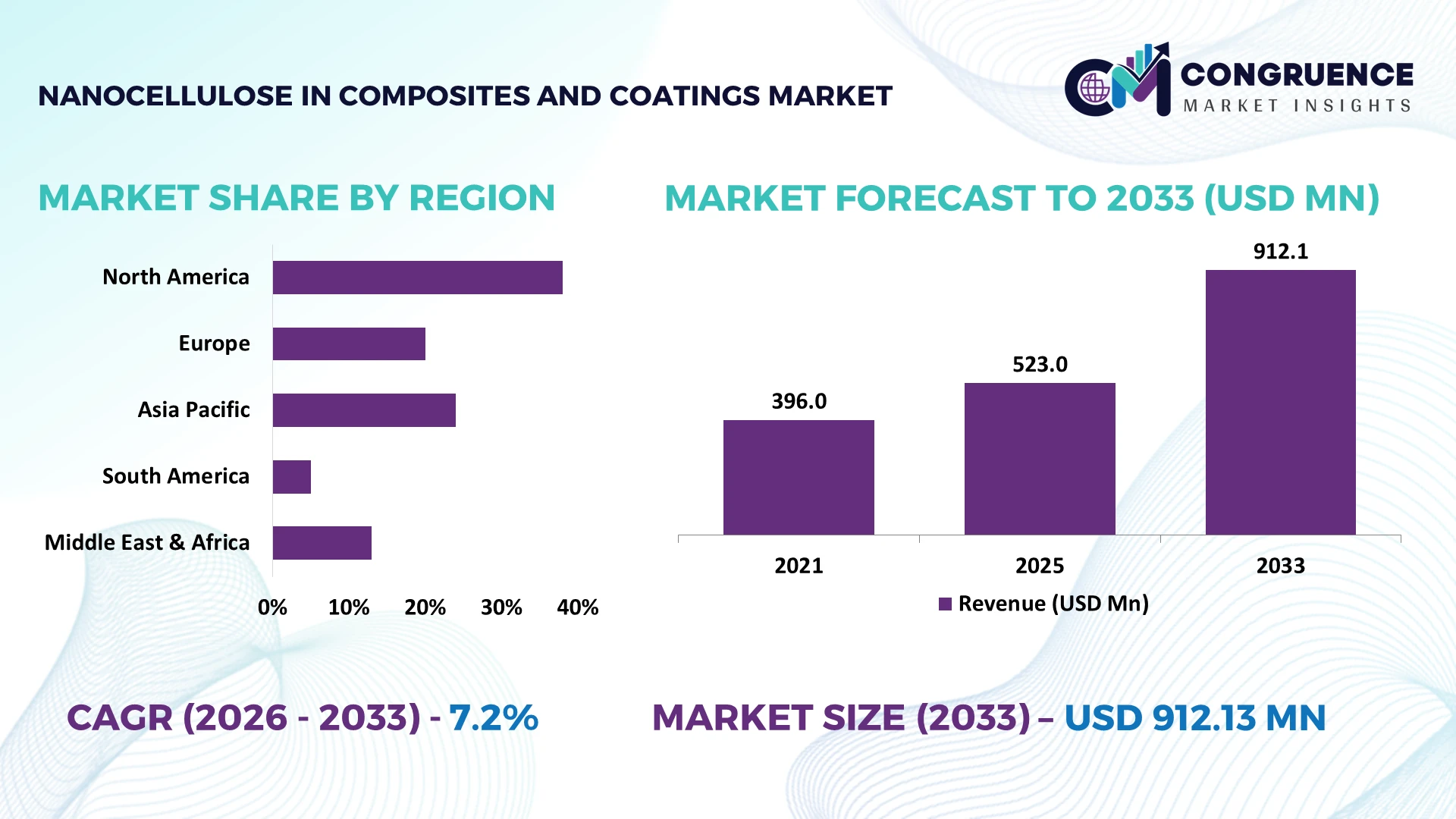
Japan holds the strongest industrial CNF commercialization footprint, led by Nippon Paper’s 500-tonne/year Ishinomaki line and automotive, packaging, coatings, and resin applications. Its flagship capacity is about 67% above Canada’s 300-tonne/year CelluForce CNC facility, while Nippon Paper targets 600 tonnes/year of CNF-reinforced resin sales by 2030. EU packaging rules applying from August 2026 are simultaneously accelerating recyclable barrier-material qualification.
Strategically, suppliers combining scalable fibrillation, surface functionalization, application-specific dispersion, and converter partnerships are best positioned to convert nanocellulose performance gains into repeatable industrial volumes.
Market Size & Growth: USD 523 million in 2025 reaches USD 912.13 million by 2033 at 7.2%, supported by advanced bio-based reinforcement and barrier coatings.
Top Growth Drivers: Barrier performance +99%, process efficiency +50%, and water-vapor transmission reduction 30% strengthen adoption across coatings and composites.
Short-Term Forecast: By 2027, optimized fibrillation and coating workflows target 10–20% lower material loading while maintaining required mechanical and barrier properties.
Emerging Technologies: TEMPO-oxidized CNF, surface-modified CNC, nanocellulose-nanoclay hybrids, and automated dispersion systems are expanding high-performance formulation windows.
Regional Leaders: By 2033, North America approaches USD 310 million, Asia-Pacific USD 274 million, and Europe USD 265 million, with packaging and lightweight composites driving adoption.
Consumer/End-User Trends: Nanocellulose coatings demonstrate up to 99% oxygen-transmission suppression, strengthening demand for recyclable food and flexible packaging structures.
Pilot/Case Example: A 2025 nanocellulose composite coating achieved 44% lower water-vapor transmission and over 99.9% antibacterial efficacy.
Competitive Landscape: Nippon Paper holds a leading commercialization position with 500 tonnes/year capacity; CelluForce, UPM, Stora Enso, and Daicel strengthen global competition.
Regulatory & ESG Impact: EU PPWR implementation from 2026 strengthens recyclable packaging requirements, accelerating substitution of difficult-to-recycle multilayer barriers.
Investment & Funding: CelluForce secured approximately CAD 1.87 million in 2025 government support for CNC process optimization through 2028.
Innovation & Future Outlook: Nippon Paper targets 600 tonnes/year of CNF-reinforced resin sales by 2030, shifting commercialization toward structural automotive and durable composite applications.
Nanocellulose in Composites and Coatings demand is concentrating in recyclable packaging, automotive lightweighting, water-based paints, specialty paper, polymers, and functional surface treatments. Nanocellulose-based barrier structures have demonstrated more than 99% oxygen-transmission suppression, while surface modification is improving moisture resistance and polymer compatibility. EU packaging regulation and localized biomass supply are now pushing manufacturers toward scalable coating, compounding, and dispersion technologies, setting up the market’s strategic transition.
Nanocellulose is becoming strategically important because it links lightweight reinforcement, recyclable barrier coatings, rheology control, and bio-based material substitution within the same platform. The most important market shift is regulatory: packaging rules in Europe are tightening recyclability requirements, increasing interest in mono-material and fiber-based structures that reduce dependence on multilayer plastics. At the same time, automotive and specialty-coating users are demanding stronger performance at lower material loading.
Compared with conventional mineral fillers, well-dispersed nanocellulose can deliver comparable reinforcement at 30–50% lower additive loading while improving stiffness and barrier performance. Japan leads commercial cellulose nanofiber deployment in automotive and packaging applications, while Canada has deeper cellulose nanocrystal scale and Europe leads recyclable coating qualification. Over the next 2–3 years, adoption will concentrate on water-based coatings, thermoplastic compounds, paper barriers, and lightweight structural composites where processing compatibility is already proven.
A practical deployment is nanocellulose added to a water-based barrier coating to reduce oxygen transmission while maintaining repulpability. Producers are investing in surface modification, drying, redispersion, and application-development partnerships. Competitive advantage will favor suppliers that convert laboratory performance into stable industrial dispersions, consistent viscosity, and repeatable downstream processing.
The strongest driver is the shift toward lighter, thinner, and recyclable material systems across packaging, automotive, coatings, and specialty composites. Nanocellulose can improve tensile or flexural performance by roughly 15–30% at low loading, while optimized coatings can reduce oxygen transmission by more than 90%. In Europe, recyclability requirements are accelerating interest in fiber-based barrier structures that replace harder-to-recycle multilayer laminates. In Japan, automotive suppliers are evaluating cellulose nanofiber-reinforced resins to reduce component weight without sacrificing stiffness. This creates a direct cause-and-effect chain: tighter material-efficiency targets increase demand for high-performance bio-based additives, which pushes producers toward application-specific grades. Companies are responding through pilot lines, automotive partnerships, coating trials, and compounding collaborations. The strategic insight is that nanocellulose wins where it replaces both reinforcement and functional additives simultaneously.
Commercial scale is constrained less by raw cellulose availability than by processing economics, especially dewatering, drying, redispersion, and uniform incorporation into hydrophobic polymers. Nanocellulose slurries can contain more than 90% water, making transport inefficient, while energy-intensive drying can account for 20–30% of processing cost. Poor dispersion can also reduce expected composite performance by more than 15%, undermining the premium paid for nanoscale reinforcement. Canada and Japan have commercial production assets, but many converters still require customized handling systems rather than standard additive workflows. Suppliers are reducing risk through higher-solids concentrates, masterbatch formats, local conversion partnerships, and surface-modified grades. The operational insight is that cost competitiveness depends as much on reducing water movement and dispersion steps as on lowering fibrillation cost itself.
The largest opportunity lies in surface-functionalized nanocellulose engineered for specific polymers, coatings, adhesives, and barrier systems rather than sold as a generic bio-additive. Hydrophobically modified grades can improve polymer compatibility by 20–40%, while optimized nanocellulose coatings can cut water-vapor transmission by roughly 30–50%. This expands addressable demand beyond paper into automotive thermoplastics, corrosion-resistant coatings, flexible packaging, and high-performance films. Japan is moving toward cellulose nanofiber-reinforced thermoplastics, while European converters are prioritizing recyclable barrier architectures ahead of stricter packaging implementation. Companies are positioning through silanization, esterification, TEMPO oxidation, masterbatch development, and partnerships with resin formulators. A non-obvious opportunity is formulation simplification: one tailored nanocellulose grade can provide reinforcement, rheology modification, and barrier enhancement, reducing the number of additives required in complex coating systems.
The long-term challenge is maintaining nanoscale consistency across feedstock variation, fibrillation intensity, surface chemistry, moisture content, and downstream processing. Fiber dimensions can vary by more than 20% between batches if pretreatment and refining conditions drift, while coating viscosity can shift by 10–15% with small solids or charge-density changes. These deviations directly affect sprayability, coating weight, composite dispersion, and line speed. Japan’s highly controlled pilot applications demonstrate performance potential, but broader deployment requires specification-level reproducibility across thousands of tonnes. Producers must invest in inline rheology control, particle-size monitoring, automated fibrillation, standardized drying, and converter-specific qualification protocols. The strategic risk is not whether nanocellulose performs in laboratory tests, but whether suppliers can reproduce that performance at industrial throughput without disrupting existing coating, extrusion, or compounding lines.
Commercial CNF Capacity Moves Upstream: Japan is shifting nanocellulose from pilot production toward industrial compounding. Daio Paper’s 2,000-tonne annual CNF composite-resin facility operates at roughly 20 times its previous pilot capacity. Producers are integrating pretreatment, fibrillation, and resin compounding into single workflows, reducing handling steps and improving batch consistency for automotive and durable composite customers.
Barrier Coatings Replace Complex Laminates: Packaging converters are accelerating water-based nanocellulose barrier development as EU packaging rules applied from August 2026. Optimized CNF coatings can reduce oxygen transmission by more than 90% and water-vapor transmission by 30–50%. Companies are redesigning paper structures, coating lines, and drying conditions to achieve recyclable performance without conventional multilayer plastic architectures.
High-Solids Formats Cut Logistics Burden: Suppliers are moving from dilute slurries toward concentrates, powders, and masterbatches because conventional CNF dispersions can contain more than 90% water. Higher-solids formats can reduce transported water by 50% or more and simplify dosing at converter sites. Producers are investing in redispersion technology, surface modification, and localized formulation partnerships to improve delivered economics.
Application Development Becomes Customer-Specific: Nanocellulose suppliers increasingly customize fibril dimensions, surface charge, and functionalization rather than offering one universal grade. CelluForce’s 300-tonne CNC operation supports multiple product grades, while process modernization has delivered more than 50% efficiency improvement. The non-obvious shift is commercial: technical-service capability is becoming as important as production capacity for securing repeat composite and coating qualifications.
Cellulose Nanofibers account for approximately 36% of market demand, supported by high aspect ratio, strong reinforcement capability, rheology control, and compatibility with coatings, thermoplastics, and paper structures. Their performance at relatively low loading makes CNF attractive where weight reduction and barrier functionality must coexist. Microfibrillated Cellulose represents about 23%, benefiting from established pulp-processing routes and easier integration into paints, construction formulations, and fiber-based packaging.
Nanocellulose Composites are the fastest-growing type as manufacturers move from selling standalone fibrils toward application-ready compounded materials. Commercial CNF composite capacity in Japan reached 2,000 tonnes annually in 2025, representing a 20-fold increase over the associated pilot scale. Cellulose Nanocrystals remain strategically important for high-stiffness, optical, and specialty coating applications, while Bacterial Cellulose serves smaller high-purity niches. Producers are therefore shifting investment toward compounded pellets, surface-modified grades, and high-solids formats that reduce converter processing complexity and shorten industrial qualification cycles.
Barrier Coatings lead with an estimated 31% share because nanocellulose creates dense hydrogen-bonded networks that significantly restrict oxygen transmission while maintaining a fiber-compatible material structure. Packaging Materials account for approximately 26%, supported by demand for recyclable paper-based structures and lower-plastic packaging. Protective Coatings remain important where nanocellulose improves rheology, film formation, crack resistance, and functional additive distribution within water-based formulations.
Automotive Components are the fastest-growing application as cellulose nanofiber composites move into lightweight interior and semi-structural parts. Properly formulated CNF reinforcement can improve mechanical performance by approximately 15–30% at low loading, while optimized barrier layers can suppress oxygen transmission by more than 90%. Structural Composites provide another emerging pathway across panels and molded components. Manufacturers are responding through automated coating, resin-compatible surface treatment, masterbatch development, and converter partnerships. The investment shift favors applications where nanocellulose simultaneously reduces weight, simplifies coating structures, and increases functional performance rather than serving purely as a bio-based replacement.
Packaging Manufacturers account for approximately 38% of end-user demand because nanocellulose directly addresses oxygen barrier, coating rheology, paper strengthening, and recyclable-structure requirements. Automotive Manufacturers represent roughly 21% and are the fastest-growing buyer group as lightweighting programs increasingly evaluate CNF-reinforced thermoplastics for interior panels, housings, and semi-structural components. Chemical Producers remain strategically important because they convert raw fibrils into functional dispersions, surface-treated grades, coatings, and masterbatches tailored to downstream processing.
Construction Companies use nanocellulose selectively in cementitious additives, coatings, insulation, and specialty composites, while Electronics Manufacturers target thin films, flexible substrates, and high-purity functional materials. Automotive programs can target 10–20% component-weight reduction through material substitution and optimized design, strengthening the business case where processing consistency is proven. Suppliers are responding with application-specific grades, local technical support, co-development agreements, and pricing structures linked to performance rather than raw tonnage. Future demand is shifting toward buyers able to integrate nanocellulose into established industrial lines without adding costly preprocessing.
North America accounted for the largest market share at 34% in 2025 however, Asia-Pacific is expected to register the fastest growth, expanding at a CAGR of 8.4% between 2026 and 2033.

Commercial CNC Scale Strengthens Application Development
North America accounts for approximately 34% of global demand, supported by Canada’s commercial cellulose nanocrystal infrastructure, U.S. forest-products innovation, packaging conversion, coatings formulation, and lightweight composite development. Canada hosts CelluForce’s 300-tonne annual CNC facility, providing industrial-scale material for coatings, polymers, adhesives, and specialty formulations. The region’s advantage extends beyond production into resin compounding and application engineering, allowing suppliers to qualify nanocellulose against conventional rheology modifiers and reinforcing additives. U.S. packaging manufacturers are testing fiber-compatible barriers as brand owners pursue recyclable structures, while automotive and construction formulators are evaluating low-loading reinforcement. Producers are investing in higher-solids products, surface-modified grades, drying technologies, and customer-specific dispersions. The operational priority is reducing water transportation and downstream mixing complexity, which directly determines whether nanoscale performance translates into acceptable delivered economics.
Canada Market Outlook: Canada remains strategically important through abundant certified forest feedstock, established pulp infrastructure, university research, and commercial CNC manufacturing. CelluForce operates approximately 300 tonnes of annual CNC capacity and has improved manufacturing efficiency by more than 50% through process optimization. Canadian suppliers are emphasizing advanced surface chemistry and application partnerships, creating stronger pathways into industrial coatings, polymers, cementitious materials, and packaging systems.
Recyclability Rules Reshape Coating Architecture
Europe represents approximately 29% of global demand, with Finland, Sweden, Germany, France, and Norway combining advanced pulp infrastructure with coatings, packaging, automotive, and composite engineering. Packaging regulation is becoming a major operational catalyst as EU requirements push converters toward recyclable structures and reduced material complexity. Nanocellulose coatings can reduce oxygen transmission by more than 90%, making them relevant for paper-based barriers where conventional polymer laminates complicate recycling. Nordic pulp producers possess integrated feedstock and fibrillation capabilities, while German converters provide high-value automotive and industrial coating channels. Companies are investing in pilot coating lines, bio-based dispersion systems, surface modification, and partnerships between pulp producers and packaging converters. Europe’s distinctive advantage is specification pull: regulatory requirements create measurable performance targets, accelerating qualification of nanocellulose where recyclability and barrier performance must be achieved simultaneously.
Finland Market Outlook: Finland combines extensive forestry resources, advanced pulp engineering, coating expertise, and established nanocellulose development through companies such as UPM and Stora Enso. Forests cover more than 70% of the country’s land area, supporting a substantial renewable feedstock base. Finnish producers are integrating nanofibrillation with existing pulp operations while targeting paper barriers, specialty coatings, adhesives, and composite applications requiring scalable bio-based functionality.
Japan Converts Pilot Technology Into Industrial Capacity
Asia-Pacific represents approximately 27% of global demand, led by Japan’s commercial cellulose nanofiber ecosystem and expanding materials research in China, South Korea, and India. Japan has moved decisively from laboratory fibrillation toward application-ready compounds: Daio Paper established 2,000 tonnes of annual CNF composite-resin capacity, approximately 20 times its previous pilot scale. Nippon Paper separately operates a 500-tonne annual CNF production line, strengthening supply for packaging, coatings, additives, and reinforced polymers. Japanese automotive lightweighting provides an important commercialization route, while China’s large paper, coatings, and plastics industries create substantial downstream potential. Producers are developing dry powders, resin masterbatches, hydrophobic CNF, and continuous compounding systems to reduce converter integration barriers. The region’s competitive shift centers on manufacturing format rather than fibril availability, with pre-compounded materials increasingly preferred over dilute suspensions.
Japan Market Outlook: Japan possesses the strongest commercial CNF deployment infrastructure through Nippon Paper, Daio Paper, Daicel, and other industrial groups. Commercial capacities ranging from hundreds to 2,000 tonnes annually demonstrate progression toward volume applications. Manufacturers are prioritizing thermoplastic compounds, automotive parts, packaging barriers, and functional additives, using integrated application development to shorten qualification and establish repeat demand beyond demonstration projects.
Forest Resources Support Local Value Addition
South America accounts for approximately 6% of global demand, with Brazil providing the strongest industrial foundation through its globally competitive eucalyptus pulp, packaging, coatings, automotive, and composite sectors. Brazil produces more than 20 million tonnes of market pulp annually, creating substantial cellulose feedstock availability for higher-value nanomaterials. Universities and pulp companies are developing cellulose nanofibrils from eucalyptus residues and industrial side streams, while packaging converters represent the most practical commercialization channel. Nanocellulose also aligns with Brazil’s established automotive bio-composite expertise, although limited dedicated commercial nanocellulose capacity constrains immediate scale. Companies are pursuing pilot production, university partnerships, pulp-integrated processing, and coating trials rather than standalone large plants. The strategic opportunity lies in converting low-cost forestry resources into functional materials locally, reducing dependence on imported specialty additives while increasing value captured from each tonne of pulp.
Brazil Market Outlook: Brazil combines high-productivity eucalyptus plantations with large pulp mills and established paper, packaging, automotive, and chemical industries. Plantation eucalyptus can achieve productivity above 35 cubic meters per hectare annually, giving Brazilian producers favorable fiber economics. Commercial success depends on integrating nanocellulose production directly with pulp facilities, where utilities, feedstock handling, water treatment, and established customer networks can materially reduce scale-up costs.
Industrial Diversification Creates Specialized Entry Points
Middle East & Africa represents approximately 4% of global demand, with adoption concentrated in specialty coatings, construction materials, packaging, water treatment, and advanced composites. South Africa provides established forestry and pulp infrastructure, while Saudi Arabia and the UAE offer growing advanced-material opportunities linked to construction modernization and industrial diversification. Nanocellulose loadings of approximately 1–5% can materially modify rheology and reinforcement performance, making the technology relevant where imported specialty additives carry high delivered costs. Commercial production remains limited, so universities, chemical formulators, and construction-material companies dominate development activity. Saudi and Emirati industrial strategies are encouraging localization of specialty chemicals and advanced manufacturing, creating partnership opportunities for technology providers. Successful deployment requires dry or concentrated nanocellulose formats because transporting high-water-content suspensions over long distances undermines both cost efficiency and operational practicality.
South Africa Market Outlook: South Africa provides the region’s strongest feedstock and research platform through commercial forestry, pulp production, universities, and established chemical processing. Plantation forests cover more than 1.2 million hectares, creating a substantial cellulose resource. Local commercialization is best positioned around construction coatings, packaging, composites, and industrial formulations where domestic fiber processing can replace imported functional additives and support higher-value forestry output.
Nippon Paper, CelluForce, UPM, Stora Enso, and Daio Paper compete through scale, fibrillation technology, application development, and integrated fiber supply, while specialist producers challenge them with customized surface chemistry. The top five hold approximately 38% combined share, reflecting fragmented downstream qualification. Commercial plants range from 300-tonne CNC capacity to 2,000-tonne CNF composite output, while optimized processes have improved manufacturing efficiency by over 50%. Surface modification can reduce required loading by 20–30%, strengthening competition on delivered performance rather than price per kilogram. Producers are expanding compounding, high-solids concentrates, pilot coating lines, and converter partnerships while vertically integrating pulp feedstock with nanocellulose processing. Competition is shifting from aqueous fibril supply toward application-ready masterbatches and functional coatings. Drying economics, dispersion reproducibility, customer qualification, and intellectual property remain key entry barriers. Winning requires consistent nanoscale morphology, low integration cost, scalable functionalization, secure cellulose supply, and direct application support that converts technical performance into repeat industrial orders.
Nippon Paper Industries Co., Ltd.
CelluForce Inc.
UPM-Kymmene Corporation
Stora Enso Oyj
Daio Paper Corporation
Daicel Corporation
Borregaard ASA
Sappi Limited
Oji Holdings Corporation
Chuetsu Pulp & Paper Co., Ltd.
Melodea Ltd.
GranBio Technologies
Anomera Inc.
FiberLean Technologies
Current nanocellulose processing combines mechanical fibrillation, TEMPO oxidation, enzymatic pretreatment, surface functionalization, and high-shear dispersion. Modern pretreatment can reduce fibrillation energy by 30–50%, while optimized CNC or CNF additions of 1–5% improve coating rheology and composite reinforcement. Compared with conventional untreated mechanical fibrillation, chemically assisted processing delivers roughly 40% lower energy demand, improving production economics and enabling more consistent nanoscale morphology at scale.
Emerging technologies center on high-solids masterbatches, carbamate-modified CNF, slot-die coating, spray deposition, and continuous compounding. Daio Paper’s commercial process supports 2,000 tonnes annually, twenty times its pilot capacity, while CNF masterbatches reach 67% cellulose concentration. Surface-modified nanocellulose can also be spray-processed at 4–7% solids versus 1.5–2.3% for native material, improving coating throughput and reducing drying requirements for industrial converters.
Disruptive development is moving toward solvent-free functionalization, recycled-feedstock CNC, bio-based hybrid barriers, and automated rheology control. Wastepaper-derived CNC coatings have demonstrated 14-fold higher water-vapor resistance and 250-fold higher air resistance than uncoated paper. Between 2026 and 2028, integrated pulp producers and formulators that control fibrillation, modification, drying, compounding, and application engineering will gain advantage. Acting now matters because industrial customers increasingly require application-ready materials that run on existing coating and extrusion assets without costly process redesign.
May 2024 Daio Paper approved a commercial ELLEX-R67 CNF composite-resin plant at Mishima with 2,000-tonne annual capacity, targeting automotive components and appliances. The investment moved CNF from pilot production toward industrial supply while addressing manufacturing-cost barriers. Source: daio-paper.co.jp
April 2025 University of Dhaka researchers demonstrated wastepaper-derived CNC coatings with 14-times higher water-vapor resistance and 250-times higher air resistance than uncoated paper. The development established recycled cellulose feedstock as a functional route for high-barrier packaging applications. Source: rsc.org
July 2025 Daio Paper started commercial ELLEX-R67 production at its 2,000-tonne annual Mishima facility, delivering 20-times the capacity of its pilot plant. The scale-up established stable CNF composite supply for automotive and appliance customers while improving dispersion and productivity. Source: nedo.go.jp
September 2026 researchers reported fluorine-free CNF superhydrophobic coatings using MTMS-PDMS modification, achieving a 155.3° contact angle while retaining resistance to abrasion, extreme pH, salt, and sub-zero exposure. The process strengthens nanocellulose positioning in demanding protective-coating applications. Source: sciencedirect.com
The report evaluates Cellulose Nanofibers, Cellulose Nanocrystals, Bacterial Cellulose, Microfibrillated Cellulose, and Nanocellulose Composites across Barrier Coatings, Structural Composites, Protective Coatings, Packaging Materials, and Automotive Components. End-user analysis covers Packaging Manufacturers, Automotive Manufacturers, Construction Companies, Electronics Manufacturers, and Chemical Producers. Cellulose Nanofibers represent approximately 36% of type demand, while Packaging Manufacturers account for about 38% of end-user consumption.
Regional coverage spans North America, Europe, Asia-Pacific, South America, and Middle East & Africa, assessing production infrastructure, feedstock availability, application qualification, and commercialization. Technology analysis covers advanced fibrillation, TEMPO oxidation, surface functionalization, high-solids masterbatches, slot-die coating, continuous compounding, recycled-feedstock CNC, and automated rheology control. The 2026–2033 framework supports capacity investment, application partnerships, geographic expansion, product development, supplier selection, and competitive positioning as nanocellulose moves from specialty dispersions toward application-ready industrial composites and coatings.
| Report Attribute/Metric | Report Details |
|---|---|
Market Revenue in 2025 | USD 523 Million |
Market Revenue in 2033 | USD 912.13 Million |
CAGR (2026 - 2033) | 7.2% |
Base Year | 2025 |
Forecast Period | 2026 - 2033 |
Historic Period | 2021 - 2025 |
Segments Covered | By Type
By Application
By End-User
|
Key Report Deliverable | Revenue Forecast, Growth Trends, Market Dynamics, Segmental Overview, Regional and Country-wise Analysis, Competition Landscape |
Region Covered | North America, Europe, Asia-Pacific, South America, Middle East, Africa |
Key Players Analyzed | Nippon Paper Industries Co., Ltd., CelluForce Inc., UPM-Kymmene Corporation, Stora Enso Oyj, Daio Paper Corporation, Daicel Corporation, Borregaard ASA, Sappi Limited, Oji Holdings Corporation, Chuetsu Pulp & Paper Co., Ltd., Melodea Ltd., GranBio Technologies, Anomera Inc., FiberLean Technologies |
Customization & Pricing | Available on Request (10% Customization is Free) |




