
Reports
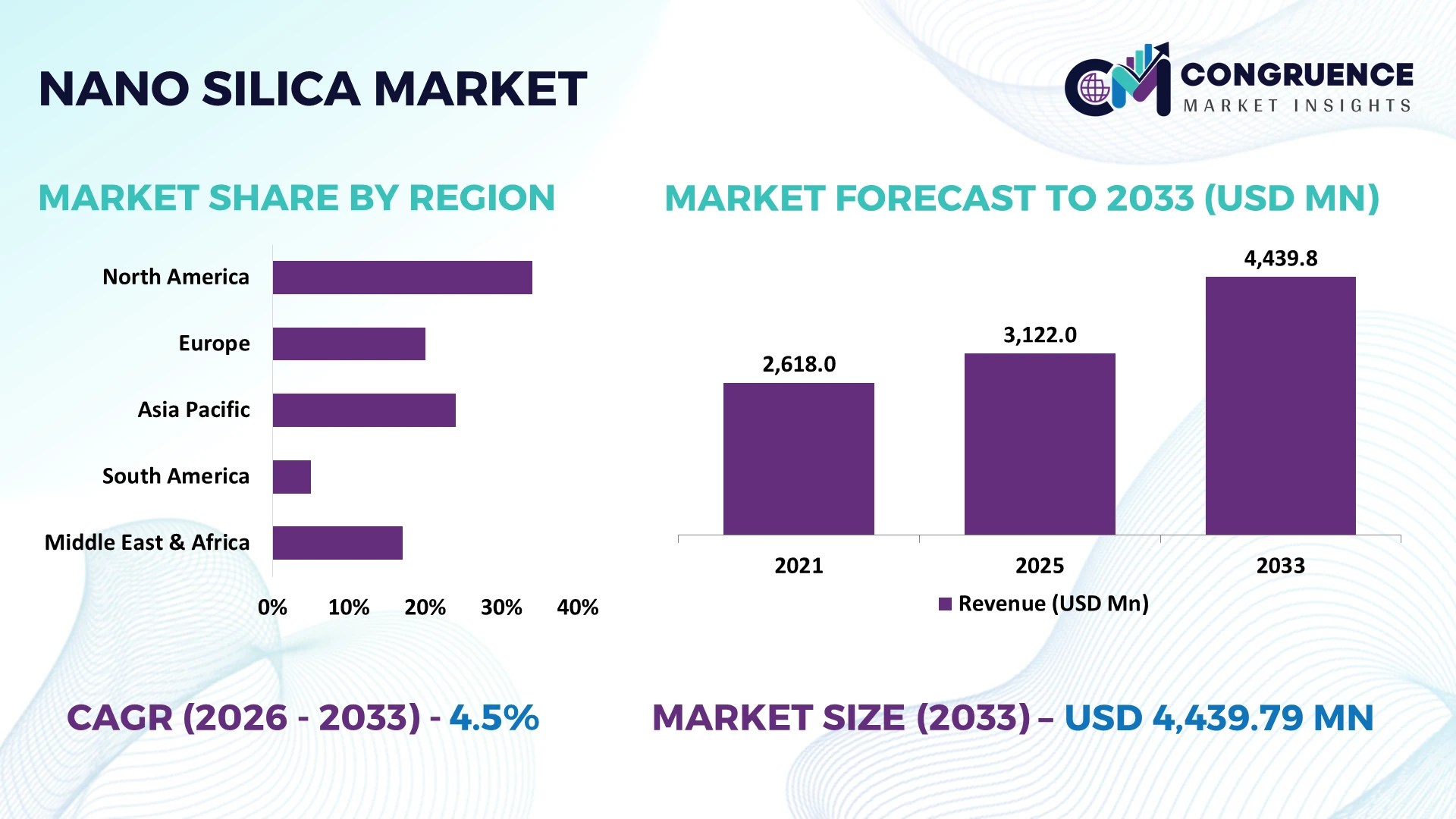
The Global Nano Silica Market was valued at USD 3122 Million in 2025 and is anticipated to reach a value of USD 4439.79 Million by 2033 expanding at a CAGR of 4.5% between 2026 and 2033. Growth is driven by nanosilica’s ability to strengthen cementitious materials, improve tire and rubber reinforcement, and deliver higher-performance protective nanocoatings with lower material loading.
China holds a dominant position, representing about 14.4% of global nanosilica revenue in 2025, while its market is projected at USD 659.9 million by 2033. A Jiangsu bio-based nanosilica project targets 100,000 metric tons annually with USD 117.63 million investment, supporting construction, rubber, coatings, and advanced materials under China’s dual-carbon strategy. India is projected at USD 148 million by 2033, showing faster regional expansion.
Strategically, suppliers should prioritize China-led capacity expansion while targeting India’s accelerating adoption and higher-value engineered applications.
Market Size & Growth: USD 3,122 million in 2025 to USD 4,439.79 million by 2033 at 4.5% CAGR, supported by advanced concrete, rubber reinforcement, and nanocoating applications.
Top Growth Drivers: Concrete strength improvement +15.5%; coating demand growth 16.5%; Asia Pacific share 33.8%, reinforcing three high-growth demand engines.
Short-Term Forecast: By 2028, higher-performance formulations are positioned to deliver 10–15% material-efficiency gains as optimized nanosilica dispersion replaces heavier conventional reinforcement systems.
Emerging Technologies: AI-assisted formulation, automated particle-size control, bio-based nanosilica, and precision colloidal dispersion are reshaping advanced-material production and quality consistency.
Regional Leaders: Asia Pacific reaches USD 1,515.8 million by 2033, North America USD 1,128.0 million, while India reaches USD 148 million; adoption is strongest across construction, automotive, coatings, and electronics.
Consumer/End-User Trends: Rubber accounted for 33.9% of nanosilica end-use revenue in 2025, reflecting stronger adoption in tires, seals, gaskets, and performance compounds.
Pilot/Case Example: A concrete study using 3% nanosilica increased compressive strength by 15.5% and flexural strength by 27.3% after 28 days versus conventional concrete.
Competitive Landscape: Evonik, Cabot, Wacker Chemie, Fuso Chemical, and AkzoNobel anchor the competitive field, while China’s 14.4% country share strengthens regional manufacturing influence.
Regulatory & ESG Impact: China’s dual-carbon strategy is accelerating bio-based material investment; a USD 117.63 million project targets 100,000 metric tons of annual bio-based nanosilica output.
Investment & Funding: USD 117.63 million is committed to the Jiangsu bio-based nanosilica facility, signaling a shift toward renewable feedstocks, localized production, and supply-chain resilience.
Innovation & Future Outlook: Next-generation colloidal systems, bio-derived feedstocks, AI formulation, and application-specific nanosilica grades will shift competition from volume supply toward precision performance and differentiated materials.
The Nano Silica Market is gaining traction across high-performance concrete, automotive rubber, protective coatings, electronics, and healthcare materials. Advanced dispersion and bio-based production are improving formulation performance, while nanosilica-enhanced concrete has demonstrated strength gains above 15%. China’s capacity expansion and dual-carbon policies are reinforcing regional supply-chain localization, creating a strategic shift toward specialized grades and application-driven innovation.
Nano silica is becoming strategically important because it improves material performance at low loading levels, giving manufacturers a direct route to lighter, stronger, and more durable products. In concrete, 3% nanosilica has demonstrated 15.5% higher compressive strength and 27.3% higher flexural strength versus conventional formulations. This performance advantage is pushing suppliers toward application-specific grades, tighter particle engineering, and integrated formulation partnerships.
Supply-chain restructuring is also reshaping competition. China’s investment in a 100,000-ton annual bio-based nanosilica facility reflects the shift toward localized production and renewable feedstocks. Over the next 2–3 years, automated dispersion, AI-assisted formulation, and bio-derived silica are positioned to improve processing consistency by 5–10% while reducing formulation waste. India is emerging as a faster-expanding manufacturing base, while China retains greater production scale and material-processing depth.
A practical deployment example is nanosilica-enhanced concrete for infrastructure modernization, where higher strength enables material optimization and longer service intervals. Companies are increasing investments in pilot plants, downstream formulation laboratories, and partnerships with construction, tire, coating, and electronics manufacturers. Competitive advantage will increasingly depend on controlling particle quality, application integration, and localized supply rather than simply expanding production volume.
Construction and automotive applications are strengthening demand for engineered nanosilica because small additions deliver disproportionate performance gains. Concrete incorporating 3% nanosilica has recorded 15.5% higher compressive strength, while flexural strength increased 27.3%. Rubber represented about 33.9% of end-use demand in 2025, reinforcing its importance in tire and elastomer formulations. China’s expansion of bio-based production further links material innovation with supply-chain localization. Manufacturers are responding through application-specific grades, automated dispersion systems, and downstream partnerships. The non-obvious advantage is formulation efficiency: suppliers that control particle-size distribution can capture higher-value applications without proportionally increasing material consumption, strengthening margins and customer retention.
Production economics remain constrained by energy-intensive processing, feedstock variability, and specialized dispersion requirements. Bio-based nanosilica facilities require significant upfront investment, with one Chinese project committing USD 117.63 million for 100,000 tons of annual capacity. Poor dispersion can reduce expected performance by roughly 5–10%, increasing formulation adjustments and quality-control costs. China’s large manufacturing base reduces some logistics pressure, but overseas buyers remain exposed to shipping disruptions and qualification delays. Companies are countering these constraints through localized production, multi-year feedstock contracts, regional warehousing, and process automation. The strategic pressure is clear: capacity without consistent particle quality creates limited competitive value, making process control as important as production scale.
Next-generation nanosilica offers opportunities beyond conventional construction and rubber applications. Bio-based production, AI-assisted formulation, and precision colloidal dispersion can improve processing efficiency by 5–10% while enabling application-specific material characteristics. India’s expanding infrastructure and manufacturing ecosystem creates an attractive market for locally produced grades, particularly in concrete, coatings, and automotive components. Electronics and protective coatings also provide higher-value opportunities where particle uniformity and surface functionality command stronger differentiation. Companies are positioning through R&D centers, university partnerships, pilot-scale production, and joint development agreements with end users. A non-obvious opportunity lies in combining nanosilica with digital formulation tools, allowing suppliers to sell performance-engineered solutions rather than commodity particles and strengthening long-term customer integration.
Scaling nanosilica from laboratory formulations to continuous industrial production remains a major execution challenge. Variations of only 5–10% in particle dispersion or surface characteristics can alter viscosity, strength, or coating behavior, complicating qualification across different manufacturing lines. China has greater production depth, while Indian manufacturers face comparatively greater requirements for localized processing and application expertise. Automated quality monitoring can reduce batch inconsistency by approximately 5%, but integration with legacy mixing and curing equipment remains complex. Companies must invest in inline characterization, skilled process engineering, and customer-side validation infrastructure. The key long-term challenge is maintaining identical performance across geographically distributed plants, because inconsistent material behavior can undermine certifications, production reliability, and premium positioning.
Precision Dispersion Automation: Automated dispersion and particle-size monitoring are gaining traction, targeting 5–10% lower batch variability and 3–7% faster formulation cycles. Chinese producers are integrating inline controls to improve consistency across concrete, coatings, and rubber production, strengthening quality performance while reducing rework.
AI Formulation Optimization: AI-assisted mix design is entering nanosilica development, with advanced modeling targeting 5–8% shorter laboratory optimization cycles and more consistent material-performance predictions. Manufacturers are combining simulation with automated testing to reduce trial-and-error workflows and accelerate qualification for engineered construction and coating formulations.
Bio-Based Capacity Shift: China’s USD 117.63 million bio-based nanosilica investment targets 100,000 tons of annual capacity, linking production expansion with carbon-reduction priorities. The shift strengthens domestic feedstock utilization and supply resilience, while manufacturers increasingly prioritize renewable inputs and localized processing to reduce exposure to international logistics disruptions.
High-Purity Grade Expansion: Electronics-focused nanosilica demand is pushing purity requirements above 99.9%, with tighter particle uniformity supporting precision polishing and semiconductor processes. Suppliers are upgrading purification and surface-treatment systems, while customer qualification increasingly favors specialized grades that can reduce defect-related processing losses by 3–5%.
Precipitated silica commands approximately 34.7% of the broader specialty-silica market, supported by scalable wet processing, established rubber integration, and relatively efficient production economics. Fumed silica remains important for high-surface-area applications and rheology control, while silica gel serves specialized adsorption and moisture-management requirements. Manufacturers are increasingly differentiating grades through surface modification and tighter particle specifications rather than competing purely through capacity expansion.
Colloidal silica is gaining momentum in precision applications, particularly electronics and semiconductor processing, where it accounts for about 39.6% of its application base. Adoption is being reinforced by requirements for controlled particle size, high purity, and stable dispersion. Companies are directing investment toward high-performance colloidal formulations, while mature precipitated and fumed grades retain volume advantages across established industrial applications.
Rubber and tires represent the leading application, supported by silica reinforcement, rolling-resistance reduction, wet-grip performance, and tire-compound optimization. Rubber applications account for approximately 33.9% of nanosilica demand, giving tire manufacturers substantial influence over grade specifications. Concrete and cement remain major volume applications, while coatings and paints increasingly use nanosilica for hardness, abrasion resistance, and surface protection. Suppliers are expanding customized formulations and technical partnerships to improve compound compatibility.
Electronics is the fastest-developing application because semiconductor manufacturing requires tighter particle uniformity and surface control. Electronics and semiconductor uses represent approximately 39.6% of colloidal-silica demand, strengthening investment in high-purity grades and precision dispersion. Adhesives and sealants remain specialized performance markets, with adoption focused on viscosity control and mechanical reinforcement. Companies are shifting investment toward application-specific production lines where tighter specifications support premium pricing and stronger customer retention.
Construction remains the dominant end-user because nanosilica improves cement hydration, strength development, durability, and material efficiency across infrastructure projects. Automotive is another major consumer through tire and elastomer applications, while chemicals use nanosilica in formulation, processing, and specialty-material systems. Construction-focused buyers prioritize scalable supply and consistent performance, prompting manufacturers to expand regional inventories, technical support, and application-specific grades.
Electronics is the fastest-growing strategic end-user, driven by semiconductor polishing, high-purity processing, and tighter defect-control requirements. Electronics and semiconductor applications represent approximately 39.6% of colloidal-silica demand, demonstrating concentrated demand for precision materials. Pharmaceuticals remain a specialized segment where purity and controlled formulation are critical. Suppliers are responding with customer qualification programs, customized particle engineering, and long-term partnerships, shifting investment toward technically demanding users with higher switching barriers.
North America accounted for the largest market share at 29.1% in 2025 however, Asia-Pacific is expected to register the fastest growth, expanding at a CAGR of 5.4% between 2026 and 2033.

Advanced Materials and Infrastructure Modernization
North America maintains a strong nanosilica position through advanced construction materials, high-performance coatings, automotive compounds, and electronics manufacturing. The United States represents the region’s principal demand center, supported by established specialty-chemical production and large-scale infrastructure modernization. Construction and transportation projects increasingly prioritize higher-strength concrete and durable surface technologies, creating demand for engineered particle sizes and controlled dispersion. Approximately 29.1% of global nanosilica demand is concentrated in North America, reflecting its mature industrial base and higher-value application mix. U.S. manufacturers are increasing collaboration with downstream formulators to shorten qualification cycles and improve material consistency. The region’s competitive advantage is shifting from production volume toward formulation expertise, regulatory compliance, and application-specific product development.
United States Market Outlook: The United States remains the strategic country market because of its concentration of specialty-material producers, automotive manufacturers, semiconductor facilities, and infrastructure projects. Federal infrastructure investment is strengthening demand for performance-enhanced concrete, while semiconductor expansion is increasing requirements for high-purity colloidal silica. Manufacturers are prioritizing localized technical centers and customer qualification programs.
Low-Carbon Materials and Process Efficiency
Europe’s nanosilica market is being reshaped by decarbonization requirements, sustainable construction, advanced coatings, and stricter material-performance standards. Germany, France, Italy, and the United Kingdom provide strong industrial demand through automotive manufacturing, construction chemicals, specialty coatings, and engineered materials. European formulators increasingly use nanosilica to improve mechanical performance while reducing material intensity, supporting more efficient cement and coating systems. Approximately 24% of European specialty-silica consumption is linked to construction-related applications, reinforcing the importance of infrastructure modernization. Sustainability requirements are encouraging bio-derived and lower-impact production pathways. Companies are responding through low-emission processing, renewable feedstocks, and partnerships with downstream manufacturers seeking documented environmental performance.
Germany Market Outlook: Germany holds a strategically important position through its automotive, chemicals, construction-materials, and advanced manufacturing ecosystems. The country’s emphasis on resource efficiency supports nanosilica applications that improve concrete durability, tire performance, and coating resistance. Manufacturers are increasingly integrating nanosilica into customized formulations, strengthening technical differentiation and premium application development.
Manufacturing Scale Meets Capacity Localization
Asia-Pacific represents the largest strategic production and consumption base, with approximately 34% market share, led by China, Japan, South Korea, and India. China combines extensive construction activity, tire manufacturing, coatings production, and specialty-chemical capacity, while Japan and South Korea provide stronger high-purity and electronics-oriented applications. India is strengthening infrastructure and automotive manufacturing demand. China’s planned 100,000-ton annual bio-based nanosilica facility, backed by USD 117.63 million investment, demonstrates the shift toward localized capacity and renewable feedstocks. Companies are expanding production near downstream industrial clusters to reduce logistics exposure and improve customer responsiveness. The region’s key advantage is its ability to serve both high-volume construction markets and technically demanding electronics applications.
China Market Outlook: China is the most influential nanosilica market because of its integrated chemical manufacturing, construction, tire, coatings, and electronics ecosystems. The planned 100,000-ton bio-based facility strengthens domestic production capacity while supporting carbon-reduction objectives. Producers are moving toward application-specific grades, automated quality control, and localized downstream partnerships, reinforcing China’s role as a manufacturing and technology-development center.
Construction and Industrial Formulation Expansion
South America is developing as an application-led nanosilica market, with Brazil representing the primary demand center through construction, automotive, coatings, and industrial manufacturing. Infrastructure modernization and demand for durable cementitious materials are strengthening interest in nanosilica-enhanced formulations. Brazil accounts for more than 45% of the region’s specialty-chemical consumption, giving suppliers the strongest commercial base for localized expansion. Imported specialty materials remain exposed to currency fluctuations, logistics costs, and longer qualification cycles. Companies are responding through distributor partnerships, regional inventory networks, and technical collaborations with concrete and coatings producers. The strongest opportunity lies in reducing dependence on imported high-performance grades through local formulation and application development rather than pursuing large-scale commodity production.
Brazil Market Outlook: Brazil provides the strongest country-level opportunity because of its large construction sector, established automotive manufacturing base, and broad specialty-chemical ecosystem. Expanding infrastructure activity supports nanosilica use in concrete and protective coatings, while domestic formulators increasingly seek consistent particle quality. Suppliers with local technical support and dependable inventory can reduce qualification delays and strengthen industrial-account penetration.
Mega-Projects Drive High-Performance Materials
The Middle East & Africa market is increasingly tied to large infrastructure, urban development, industrial diversification, and high-performance construction materials. Saudi Arabia and the United Arab Emirates are the principal demand centers, supported by commercial, transportation, energy, and smart-city developments. Saudi Arabia’s Vision 2030 project pipeline is increasing demand for durable concrete, coatings, and specialty materials capable of operating under demanding climatic conditions. Nanosilica improves strength, permeability resistance, and surface durability, making it relevant to long-life infrastructure. Companies are responding through distributor partnerships, project-specific formulation support, and localized technical services rather than immediate large-scale manufacturing. The region’s strategic value lies in premium project applications where performance specifications outweigh commodity pricing.
Saudi Arabia Market Outlook: Saudi Arabia offers the strongest country-level opportunity because of its infrastructure pipeline, industrial diversification agenda, and large-scale urban development. Nanosilica-enhanced concrete and protective coatings are particularly relevant for projects exposed to heat, dust, and aggressive environmental conditions. Suppliers are strengthening relationships with construction-material producers and engineering contractors to secure project-level specifications and recurring demand.
Evonik, Cabot, Wacker Chemie, Fuso Chemical, and Nouryon compete as global technology and specialty-material leaders, while regional producers challenge them through cost, localized supply, and customized grades. The top five players collectively hold an estimated 35–40% share, leaving substantial room for regional competition. Competition centers on particle engineering, purity, pricing, supply reliability, and formulation support, with advanced grades delivering 5–10% performance improvements in targeted applications. Producers are expanding capacity, forming downstream partnerships, and integrating surface-treatment capabilities to protect margins. China’s capacity expansion is intensifying supply-chain competition, while electronics applications are shifting rivalry toward high-purity and precision-controlled materials. Entry barriers remain high because qualification cycles, process expertise, quality consistency, and capital-intensive production restrict rapid scale-up. Cost leaders compete aggressively in construction and rubber, while technology-focused suppliers target electronics, coatings, and advanced composites. Winning requires localized supply, consistent particle specifications, application-specific innovation, and close customer integration rather than capacity alone.
Evonik Industries AG
Cabot Corporation
Wacker Chemie AG
Fuso Chemical Co., Ltd.
Nouryon
Tokuyama Corporation
Nissan Chemical Corporation
JSR Corporation
OCI Company Ltd.
Fuji Silysia Chemical Ltd.
Grace
Sibelco
Madhu Silica Pvt. Ltd.
Brisil Technologies Pvt. Ltd.
Conventional nanosilica production increasingly uses automated particle-size monitoring, surface treatment, and controlled dispersion systems. Inline characterization can improve batch consistency by 5–8% and reduce formulation rework by 3–5%. Adoption is strongest among large specialty-material producers serving construction, rubber, and coatings. Compared with manual quality control, automated monitoring improves process consistency by approximately 7%, giving integrated suppliers faster qualification and fewer off-specification batches.
Emerging technologies include AI-assisted formulation, bio-based silica production, and precision colloidal systems. AI modeling can shorten formulation optimization cycles by 5–10%, while automated dispersion improves processing efficiency by about 3–6%. Bio-based manufacturing is gaining deployment through large-scale projects, including 100,000-ton annual capacity planning in China. These technologies benefit suppliers combining production scale with application laboratories and digital process control.
During 2026–2028, disruptive competition will center on high-purity nanosilica, advanced surface functionalization, and digitally optimized formulations for electronics, semiconductor polishing, and specialty coatings. High-purity grades can improve application performance by 5–8% where particle uniformity is critical. Companies integrating AI, automation, and localized production will gain speed and supply resilience, while cost-focused producers remain strongest in standardized construction and rubber applications.
October 2024 Evonik broke ground on a Charleston, South Carolina expansion, increasing precipitated silica capacity 50%. The investment targets U.S. green-tire demand, strengthens localized supply, improves customer resilience, and reinforces North American manufacturing capabilities for sustainable tire applications. Source: evonik.com
April 2026 Cabot Sanmar announced a ₹220 crore brownfield expansion at Mettur, India, for fumed silica. Commissioning is planned for Q4 2027, expanding domestic supply and supporting pharmaceuticals, coatings, adhesives, specialty chemicals, and India’s advanced manufacturing ecosystem. Source: economictimes.indiatimes.com
June 2026 Tata Chemicals reported 50 KTPA specialty-silica capacity expansion, targeted for commissioning by 2028. The company also commercialized rice-husk-based green silica, strengthening sustainable tire-material supply, improving handling efficiency, and supporting overseas market expansion through differentiated products globally. Source: tatachemicals.com
January 2025 PCBL reported equipment orders for its nano-silica pilot plant, with commissioning expected within months. The initiative expands specialty-material capabilities, supports process innovation, and positions the company for application development in advanced industrial markets and commercial-scale production. Source: nsearchives.nseindia.com
The Nano Silica Market Report covers four product types: Fumed Silica, Precipitated Silica, Colloidal Silica, and Gel Silica, alongside five major applications spanning Concrete & Cement, Coatings & Paints, Rubber & Tires, Adhesives & Sealants, and Electronics. End-user coverage includes Construction, Automotive, Chemicals, Electronics, and Pharmaceuticals, enabling assessment of demand concentration, application intensity, and purchasing behavior.
The report evaluates North America, Europe, Asia-Pacific, South America, and the Middle East & Africa, with country-level analysis of major manufacturing and consumption centers. Technology coverage includes automated dispersion, high-purity processing, surface functionalization, AI-assisted formulation, and bio-based production. Competitive analysis covers 10–14 influential participants, supporting investment planning, capacity expansion, partnership evaluation, supply-chain localization, product positioning, and strategic decisions through 2026–2033.
| Report Attribute/Metric | Report Details |
|---|---|
Market Revenue in 2025 | USD 3122 Million |
Market Revenue in 2033 | USD 4439.79 Million |
CAGR (2026 - 2033) | 4.5% |
Base Year | 2025 |
Forecast Period | 2026 - 2033 |
Historic Period | 2021 - 2025 |
Segments Covered | By Type
By Application
By End-User
|
Key Report Deliverable | Revenue Forecast, Growth Trends, Market Dynamics, Segmental Overview, Regional and Country-wise Analysis, Competition Landscape |
Region Covered | North America, Europe, Asia-Pacific, South America, Middle East, Africa |
Key Players Analyzed | Evonik Industries AG, Cabot Corporation, Wacker Chemie AG, Fuso Chemical Co., Ltd., Nouryon, Tokuyama Corporation, Nissan Chemical Corporation, JSR Corporation, OCI Company Ltd., Fuji Silysia Chemical Ltd., Grace, Sibelco, Madhu Silica Pvt. Ltd., Brisil Technologies Pvt. Ltd. |
Customization & Pricing | Available on Request (10% Customization is Free) |




