
Reports
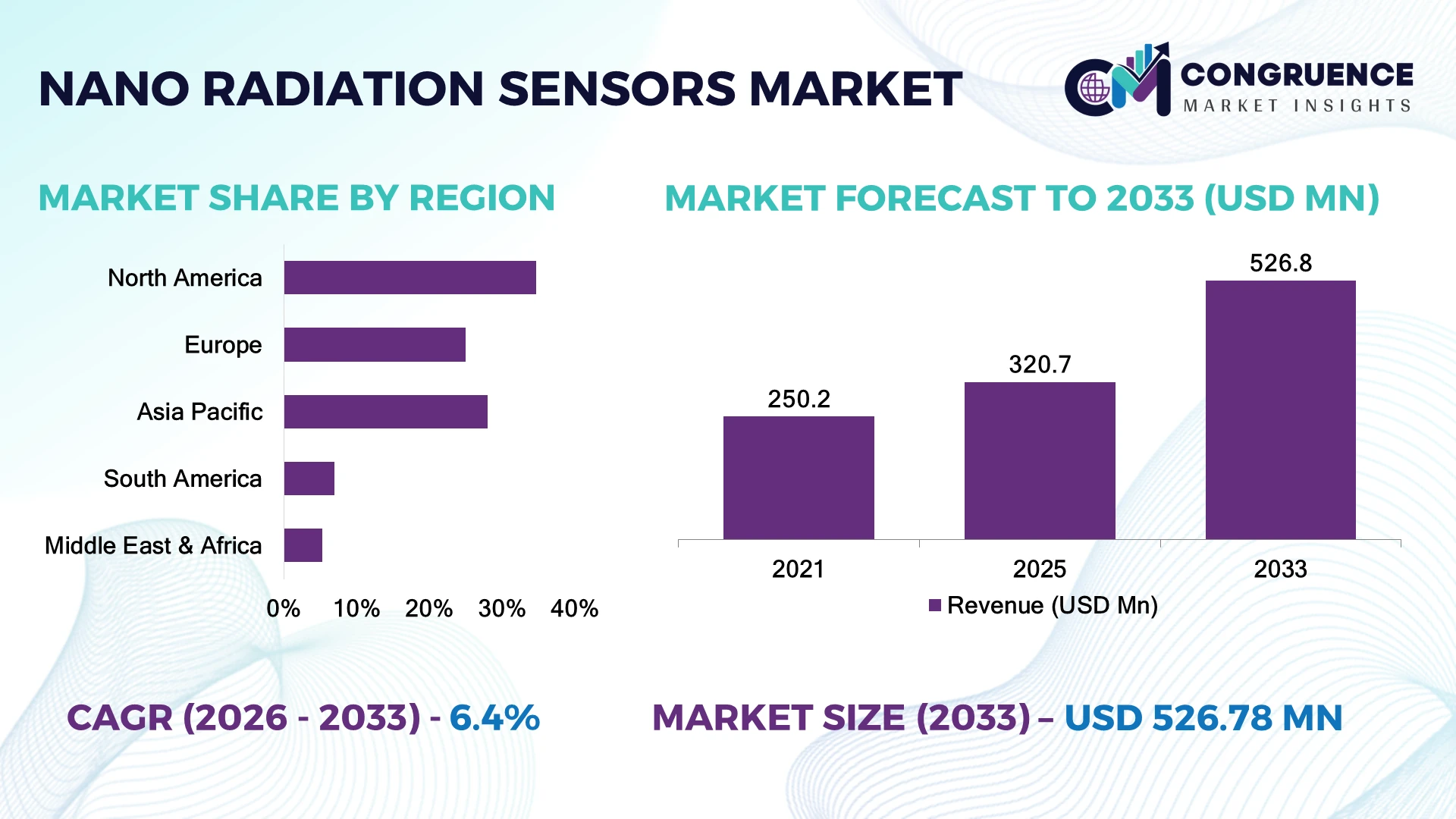
The Global Nano Radiation Sensors Market was valued at USD 320.7 Million in 2025 and is anticipated to reach a value of USD 526.8 Million by 2033 expanding at a CAGR of 6.4% between 2026 and 2033. Growth is driven by miniaturized semiconductor detectors, precision medical dosimetry, nuclear facility monitoring, and demand for portable radiation detection in security and industrial applications.
The United States remains a strategically important market because of its medical imaging infrastructure, national security programs, semiconductor research, and nuclear energy operations. Global nuclear capacity reached approximately 420 GW at the end of 2025, strengthening the importance of reliable radiation monitoring across power generation and related safety systems. China is expanding nuclear construction and advanced electronics manufacturing, while Japan maintains expertise in precision instrumentation and semiconductor technologies. Nano-enabled detectors are attracting research attention because smaller sensing structures can support compact instruments without sacrificing application-specific sensitivity.
Strategic implication: Companies should prioritize validated sensitivity, radiation tolerance, manufacturability, and integration into medical, industrial, and nuclear monitoring systems to convert research advances into commercially deployable products.
Market Size & Growth: The market is estimated at USD 320.7 million in 2025 and is projected to reach USD 526.8 million by 2033, supported by miniaturized detection and precision monitoring requirements.
Top Growth Drivers: Medical dosimetry, nuclear monitoring, and security screening are core demand areas; global nuclear capacity reached approximately 420 GW at the end of 2025.
Short-Term Forecast: By 2028, manufacturers will prioritize compact sensor modules, lower power consumption, and integration with digital monitoring systems rather than miniaturization alone.
Emerging Technologies: Nanostructured semiconductors, perovskite materials, photonic sensing, and advanced scintillators are expanding options for radiation detection and dose measurement.
Regional Leaders: North America accounts for an estimated 34.7% of market demand in one 2025 industry assessment; Asia-Pacific benefits from nuclear construction and electronics manufacturing.
Consumer/End-User Trends: Hospitals prioritize dose accuracy and imaging quality, while nuclear operators and security teams require dependable monitoring, rapid alerts, and reliable calibration.
Pilot/Case Example: A photonic calorimeter developed by NIST researchers survived radiation exposure 10,000 times higher than a typical medical therapy procedure without observed damage or performance degradation.
Competitive Landscape: Detector manufacturers, semiconductor specialists, and instrumentation suppliers compete through sensitivity, material stability, signal processing, calibration, and application-specific integration.
Regulatory & ESG Impact: Medical radiation monitoring must support dose optimization and quality assurance; reliable detection also strengthens worker protection and radiological safety procedures.
Investment & Funding: Nuclear modernization and semiconductor research support development priorities, while nanomaterial stability, production yield, and device qualification remain critical commercialization considerations.
Innovation & Future Outlook: The market is moving toward compact, low-power, application-specific sensors with digital connectivity, improved radiation tolerance, and integration into portable monitoring platforms.
The nano radiation sensors market covers miniaturized detection technologies designed to measure ionizing radiation in healthcare, nuclear facilities, security systems, industrial operations, and scientific research. Nanostructured semiconductors, advanced scintillators, and photonic sensing architectures support efforts to improve detector size, sensitivity, and integration. Medical imaging quality assurance and the monitoring requirements of nuclear installations remain important operational applications. As sensor developers move from laboratory prototypes toward qualified products, reproducibility, calibration, material stability, and manufacturing yield are becoming central commercial considerations.
Nano radiation sensors are strategically important because they can place radiation measurement closer to patients, workers, equipment, and critical infrastructure. Smaller sensing structures support compact dosimeters and integrated monitoring modules, while advances in semiconductor and photonic materials create alternatives to conventional detector architectures. Global nuclear capacity reached approximately 420 GW at the end of 2025, reinforcing the need for reliable radiological monitoring. Medical imaging also requires accurate dose measurement and consistent quality assurance, making validated sensor performance essential for commercial adoption.
Conventional detector systems remain established in regulated applications, but nanostructured and photonic approaches offer opportunities for miniaturization and integration. NIST research on a chip-based photonic calorimeter demonstrated radiation resilience after exposure 10,000 times higher than a typical medical therapy procedure. This result demonstrates laboratory robustness, not universal superiority across sensor types. North American developers benefit from medical-device and semiconductor research ecosystems, while China and Japan contribute through electronics manufacturing, materials development, and nuclear technology capabilities.
During 2026–2028, suppliers should concentrate on reproducible fabrication, calibration, low-noise signal processing, and integration with digital monitoring platforms. Healthcare deployments require validated dose accuracy, whereas nuclear and security applications prioritize dependable performance under demanding conditions. Partnerships between material researchers, detector manufacturers, and system integrators can accelerate qualification and commercialization. Competitive advantage will depend on translating nanoscale sensitivity into repeatable field performance, manufacturable designs, and demonstrable operational value.
Medical imaging, radiation therapy, and nuclear facility operations require accurate detection across different radiation levels and operating conditions. Global nuclear capacity reached approximately 420 GW at the end of 2025, reinforcing demand for dependable monitoring systems, while medical imaging standards require controlled dosimetry and equipment quality assurance. Nanostructured semiconductors and photonic architectures can support compact sensing modules for portable and integrated applications. The commercial driver is not miniaturization alone: reduced form factor must coexist with calibrated accuracy, stable response, and reliable signal processing. Manufacturers are investing in material engineering, detector packaging, and application-specific electronics. Suppliers that demonstrate repeatable measurements and straightforward integration can shorten customer qualification cycles and strengthen their position in safety-critical deployments.
Nano radiation sensors face commercialization constraints because nanoscale material properties can vary with fabrication conditions, temperature, radiation exposure, and packaging. Even small inconsistencies can affect sensitivity, baseline stability, and device-to-device calibration. This complicates high-volume production compared with mature detector technologies that already have established manufacturing and qualification processes. Perovskite-based and other emerging materials also require careful evaluation of environmental stability and long-term signal consistency. Suppliers must control material purity, fabrication tolerances, packaging, and calibration procedures before expanding production. Pilot manufacturing and independent performance validation help identify yield losses early. The key business pressure is achieving reproducible performance at an acceptable unit cost without sacrificing detector reliability or delaying qualification for medical, industrial, and nuclear applications.
Miniaturized radiation sensors create opportunities for wearable dosimeters, portable inspection instruments, compact medical devices, and embedded monitoring systems. Chip-based photonic sensing research demonstrates how optical measurement principles can be integrated into small structures designed for demanding radiation environments. These approaches support development pathways where conventional instruments are too large or difficult to integrate. Medical imaging offers an application-specific opportunity because dose measurement and image-quality assurance must operate together. Nuclear operators and security integrators also need compact monitoring at distributed locations. Companies are positioning through collaborations with research institutions, semiconductor fabrication partners, and equipment manufacturers. The strongest commercial opportunity lies in qualified modules that combine sensing, signal conditioning, calibration, and data output rather than selling an unintegrated sensing material alone.
Moving nano radiation sensors from research prototypes into operational systems requires rigorous testing across radiation energies, dose rates, temperatures, and long-term exposure conditions. Medical applications must meet applicable performance and quality requirements, while nuclear and security deployments need dependable alarms, stable calibration, and reliable integration with existing monitoring infrastructure. Sensors must also distinguish genuine radiation signals from electronic noise and environmental interference. Digital connectivity introduces additional requirements for data integrity, cybersecurity, and maintenance. Companies should establish application-specific validation protocols, conduct field trials, and work with qualified system integrators before large-scale deployment. Competitive success depends on proving traceable measurement performance and consistent operation over time, not simply demonstrating high sensitivity under controlled laboratory conditions.
Photonic Detection Advances Miniaturized Dosimetry — Research into chip-based photonic calorimeters is exploring radiation measurement through changes in optical properties caused by absorbed energy. NIST researchers reported that a prototype survived exposure 10,000 times higher than a typical medical therapy procedure without observed damage or performance degradation. This is a laboratory result rather than a commercial adoption statistic. Developers are investigating radiation-resilient optical platforms for compact instruments and demanding environments.
Nuclear Expansion Reinforces Monitoring Requirements — Global nuclear capacity remained approximately 420 GW at the end of 2025, with ten reactor construction starts adding a combined 12.2 GW of planned capacity during the year. This infrastructure activity sustains requirements for radiation monitoring, worker protection, and operational safety. Sensor suppliers are focusing on stable calibration, durable packaging, and integration with plant monitoring systems rather than sensitivity claims alone.
Medical Imaging Tightens Dose Measurement Priorities — Diagnostic X-ray systems operate across generating potentials of 20–150 kV under the scope of a recognized dosimetry standard for relevant diagnostic applications. Healthcare providers prioritize dose accuracy, image quality, and repeatable quality assurance. Nano-enabled semiconductor and photonic designs are being explored for compact measurement modules, while manufacturers must demonstrate traceable performance and application-specific validation before clinical integration.
Advanced Materials Expand Detector Design Choices — Silicon-based semiconductors, nanostructured materials, perovskites, and advanced scintillators offer different trade-offs in sensitivity, stability, fabrication, and cost. Market estimates identify silicon-based devices as a leading material category, while perovskite approaches attract research interest for compact and flexible designs. Companies are assessing production yield, environmental stability, and repeatable response before scaling new architectures. Material selection is becoming a manufacturing and qualification decision, not simply a laboratory performance choice.
Solid-state detectors represent the leading type in the nano radiation sensors market, accounting for an estimated 57.35% share in 2025 in one industry assessment. Their position reflects compact architecture, semiconductor integration, and suitability for precision dosimetry, portable instruments, and radiation-monitoring electronics. Silicon-based devices benefit from established fabrication capabilities, while compound semiconductors such as cadmium telluride and silicon carbide serve specialized detection requirements. Gas-filled detectors remain relevant for established monitoring and measurement systems, particularly where familiar operating principles and application-specific calibration matter. Manufacturers are investing in miniaturized electronics and improved signal processing to combine detector performance with compact system design.
Scintillation detectors are an important emerging category, supported by advances in nanocrystal materials, photodetectors, and hybrid readout systems. Their adoption is linked to applications requiring efficient radiation-to-light conversion and integration with advanced signal-processing electronics. Industry forecasts identify scintillation as a faster-growing type, although deployment depends on material stability, optical coupling, and production consistency. A 5–10% improvement in light collection or readout efficiency can strengthen a design's competitiveness, but this is a target-dependent engineering range, not a universal market result. Companies are prioritizing hybrid detector development and fabrication partnerships. Investment is shifting toward scalable architectures that deliver repeatable sensitivity and reliable calibration.
Healthcare is the leading application, representing an estimated 29.12% of nano radiation sensor demand in 2025 in one industry assessment. Medical imaging, radiotherapy dosimetry, and equipment quality assurance require precise measurement, repeatability, and dependable calibration. Compact detectors can support integration into smaller instruments and improve spatially resolved dose measurement. Nuclear power plants and industrial inspection remain established applications because operators need dependable radiation monitoring, worker protection, and process assurance. Homeland security and defense applications require portable detection, rapid identification, and stable performance in challenging environments. Suppliers are adapting products to application-specific dose ranges, radiation energies, and calibration protocols.
Nuclear monitoring and security applications offer important expansion opportunities as infrastructure operators modernize distributed monitoring and emergency-response capabilities. Global nuclear capacity remained around 420 GW at the end of 2025, while ten reactor construction starts added 12.2 GW of planned capacity, strengthening the long-term need for radiation-safety systems. Consumer electronics and research applications remain more specialized, constrained by integration cost, qualification requirements, and the need to demonstrate clear value over conventional sensors. Companies are developing modular sensor packages and digital interfaces to simplify integration into medical equipment, plant monitoring, and portable instruments. Investment should prioritize validated performance and application partnerships rather than assuming that laboratory miniaturization automatically translates into broad deployment.
Healthcare organizations are a leading end-user group, with an estimated 35–36% share used as a planning benchmark based on broader radiation-detection industry data rather than an independently verified nano-sensor-only split. Hospitals, imaging centres, and radiotherapy facilities require accurate dose measurement, quality assurance, and reliable calibration across equipment lifecycles. Energy operators, including nuclear utilities, also require radiation monitoring for worker safety, plant operations, and environmental compliance. Industrial users apply detectors in inspection, materials testing, and process monitoring, while defense and public-sector organizations prioritize portability, dependable detection, and response readiness. Suppliers are tailoring sensitivity, packaging, interfaces, and calibration support to these different procurement requirements.
Energy operators are a strategically important growth group as nuclear projects and plant modernization increase the need for reliable monitoring at fixed and distributed locations. Healthcare buyers generally emphasize traceability and integration with clinical workflows, whereas energy and defense customers place greater weight on environmental resilience, long-term support, and reliable operation under demanding conditions. Industrial customers focus on measurement repeatability and compatibility with existing instrumentation. These differences favor application-specific modules rather than one universal sensor design. Manufacturers are pursuing partnerships with equipment integrators, research laboratories, and calibration specialists to shorten qualification cycles. Investment priorities should focus on validated field performance, scalable production, and dependable support for regulated environments.
North America accounted for the largest market share at 34.65% in 2025 however, Asia-Pacific is expected to register the fastest growth, expanding at a CAGR of 5.73% between 2026 and 2033.
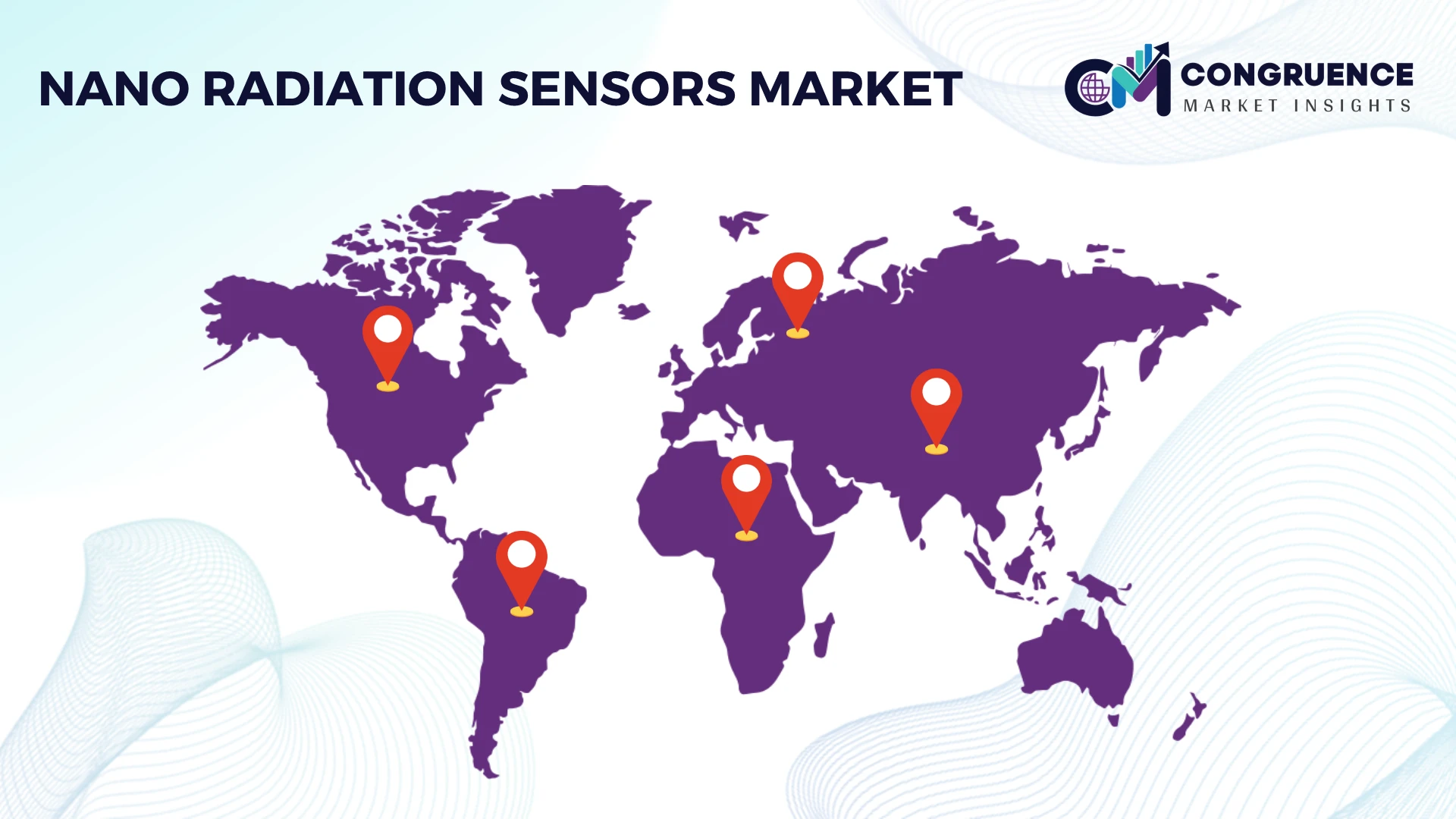
Medical Dosimetry and Nuclear Modernization Reinforce Detector Demand
North America leads the nano radiation sensors market through established healthcare infrastructure, semiconductor research, defense programs, and nuclear power operations. The region accounted for an estimated 34.65% of global market share in 2025. Demand concentrates in the United States, where medical imaging, radiotherapy, laboratory research, and industrial inspection require accurate radiation measurement. Compact semiconductor detectors and integrated monitoring modules are attracting interest because they support miniaturized instruments and digital data collection. The region's 2025 nuclear fleet included approximately 94 operating reactors in the United States, sustaining requirements for radiation monitoring, maintenance, and worker protection. Suppliers benefit from established research institutions and equipment integrators, but commercial success depends on validated accuracy, calibration, and dependable manufacturing.
United States Market Outlook: The United States combines nuclear infrastructure, medical-device development, advanced semiconductor research, and national laboratory capabilities. Healthcare providers require traceable dosimetry, while nuclear operators need dependable area monitoring and radiation-resistant instrumentation. The country's semiconductor ecosystem supports development of compact sensing components and integrated readout electronics. Companies that collaborate with research laboratories, medical equipment manufacturers, and calibration specialists can shorten product qualification cycles. For investors, the most defensible opportunities lie in validated detector modules and specialized systems rather than unqualified nanomaterials alone.
Nuclear Lifecycle Management and Medical Measurement Drive Innovation
Europe represents an established market for radiation sensors, supported by nuclear power operations, radiotherapy, research laboratories, industrial inspection, and radiological safety requirements. France is particularly important because nuclear generation forms a substantial part of its electricity system, while Germany and other industrial economies sustain demand for measurement and inspection equipment. Detector developers are improving semiconductor integration, calibration stability, and digital interfaces for clinical and industrial workflows. European customers place considerable emphasis on traceability, equipment qualification, and long-term reliability. These requirements favor suppliers that can demonstrate reproducible measurements and provide lifecycle support rather than competing on sensor sensitivity alone.
France Market Outlook: France offers a strong application base through nuclear power generation, radiation research, medical imaging, and radiotherapy infrastructure. Its nuclear fleet creates continuing requirements for monitoring, maintenance, and radiological protection, while research organizations support advanced detector development. Suppliers can differentiate through radiation-tolerant materials, reliable calibration, and integration with existing monitoring systems. Partnerships with nuclear operators, laboratories, and medical equipment developers are important routes to commercialization. Product qualification and service continuity remain essential because customers operate within stringent safety and quality frameworks.
Reactor Construction and Electronics Manufacturing Strengthen Regional Positioning
Asia-Pacific combines expanding nuclear infrastructure with semiconductor manufacturing, medical technology investment, and advanced materials research. The region is the fastest-growing market, with demand supported by China, Japan, South Korea, and India. China is a major nuclear construction hub: 36 reactors were under construction in 2026, representing more than 49% of the global total. This pipeline strengthens the need for radiation monitoring, equipment qualification, and plant safety systems. Japan and South Korea contribute established precision electronics and detector expertise, while India's nuclear expansion and healthcare infrastructure create additional application opportunities. Manufacturers are positioning through local engineering, component partnerships, and application-specific sensor development.
China Market Outlook: China combines a large electronics manufacturing base with rapid nuclear infrastructure development and substantial investment in domestic technology. Its 36 reactors under construction in 2026 create a significant future requirement for plant instrumentation, radiation protection, and maintenance systems. Local semiconductor and materials capabilities also support the development of compact detector modules and integrated electronics. Suppliers that align products with local qualification requirements and industrial procurement channels can improve market access. Manufacturing scale is an advantage, but detector accuracy, reliability, and long-term stability remain critical to acceptance in safety-sensitive applications.
Nuclear Operations and Medical Infrastructure Sustain Specialized Demand
South America represents a specialized market for nano radiation sensors, with demand concentrated in Brazil and Argentina through nuclear power, healthcare, research, and industrial inspection. Brazil's operating nuclear fleet supports monitoring and radiological protection requirements, while hospitals and research laboratories need reliable dosimetry and measurement systems. Adoption is constrained by limited local production of advanced detector components and dependence on imported instrumentation. Buyers therefore prioritize equipment reliability, calibration support, and replacement availability. Suppliers can strengthen their position through distributor partnerships, technical training, and integration with established radiation-monitoring systems rather than relying on standalone sensor sales.
Brazil Market Outlook: Brazil is the region's most significant market because it operates two nuclear power reactors and maintains established nuclear research, medical imaging, and industrial inspection capabilities. These applications require dependable radiation measurement, quality assurance, and worker protection. Local demand also benefits from hospitals and research institutions using specialized diagnostic and laboratory equipment. International suppliers can improve competitiveness through Brazilian distribution partnerships, local technical support, and calibration services. Commercial expansion will depend on procurement budgets, import economics, and the ability to meet application-specific performance requirements.
Nuclear Commissioning and Healthcare Modernization Expand Monitoring Needs
The Middle East and Africa market is developing around nuclear power, medical imaging, industrial inspection, and radiological security. The United Arab Emirates has established a regional nuclear generation base through the Barakah plant, while Saudi Arabia is investing in broader energy and technology infrastructure. South Africa contributes established nuclear operations and radiation research. These activities require monitoring systems, calibrated detectors, and dependable safety instrumentation. Advanced nano radiation sensors remain a specialized rather than universal procurement choice because customers must demonstrate performance and lifecycle value against established detector technologies. Suppliers are best positioned through local service partnerships, technical qualification, and integration with existing monitoring infrastructure.
United Arab Emirates Market Outlook: The UAE is an important market because the Barakah nuclear power plant operates four reactors with a combined capacity of approximately 5.6 GW. This infrastructure supports continuing requirements for radiation monitoring, maintenance, personnel protection, and environmental measurement. The country's investment in advanced healthcare and industrial infrastructure also creates opportunities for specialized detector systems. Suppliers should emphasize reliable calibration, radiation tolerance, service responsiveness, and compatibility with established safety procedures. Partnerships with plant operators, medical institutions, and qualified technology integrators can help convert advanced sensing capabilities into deployable solutions.
Thermo Fisher Scientific and Mirion Technologies compete in radiation-monitoring systems, while Kromek and Hamamatsu Photonics target semiconductor and scintillation detection. Siemens Healthineers competes through medical-imaging integration; photonic and nanomaterial developers challenge established detector architectures. The top five players’ combined share is not disclosed in audited nano-sensor-specific data, so a reliable percentage cannot be verified. Competition turns on sensitivity, radiation tolerance, calibration, price, and supply reliability. A 2026 amorphous-silicon design reduced dark current 18-fold and increased optical absorption 30%, although these remain prototype results. Kromek licensed cadmium-zinc-telluride production technology to Siemens Healthineers in 2025, while Mirion introduced LightLink-based probes. Bosch’s diamond quantum-sensing venture signals investment in alternative sensing platforms. Competition is shifting toward integrated, radiation-resilient modules rather than standalone materials. Qualification, reproducible manufacturing, calibration traceability, and validation cycles deter entrants. Winners pair detector performance with scalable fabrication, application partnerships, and lifecycle support across medical, nuclear, industrial, and security applications globally.
Nano radiation sensing combines semiconductor miniaturization, nanostructured scintillators, and photonic readout. Silicon detectors benefit from fabrication and compact integration; emerging perovskite and nanocomposite structures target stronger signal response and lower-cost production. A 2026 University of Michigan photosensor design reduced dark current approximately 18-fold and increased optical absorption about 30% versus its earlier architecture. These are prototype results, not field-wide efficiency gains.
Photonic calorimeters use optical resonance shifts to measure absorbed radiation and can offer micrometre-scale spatial resolution. NIST reports potential resolution 1,000 times better than conventional calorimetry, while its devices withstood doses up to 1 MGy with little or no damage. Nanomechanical sensors also target broader detection bandwidth; a 2025 study demonstrated 54 Hz bandwidth while maintaining performance near peak detectivity. These advances support compact dosimetry, high-radiation instrumentation, and more precise measurements.
During 2026–2028, the competitive edge will shift toward qualified modules combining sensor material, readout electronics, calibration, and software. Thermo Fisher and Mirion benefit from established instrumentation and service networks; Kromek and developers compete through detector materials and focused applications. Buyers should validate sensitivity, dose range, radiation hardness, temperature stability, and manufacturing consistency in pilots before scaling. Prototype gains matter commercially only when reproducible and compatible with regulated workflows.
The report evaluates nano radiation sensors across solid-state semiconductor detectors, scintillation detectors, photonic sensors, and emerging nanomaterial-based architectures. Application coverage includes medical imaging and dosimetry, nuclear power monitoring, industrial inspection, homeland security, environmental surveillance, and research. End-user analysis spans healthcare providers, nuclear utilities, industrial operators, government and defense agencies, and research laboratories. Regional assessment covers North America, Europe, Asia-Pacific, South America, and the Middle East and Africa, comparing research ecosystems, nuclear infrastructure, and manufacturing capacity.
Technology analysis examines silicon and compound semiconductors, nanocomposites, perovskites, photonic calorimeters, advanced scintillators, signal processing, and radiation-hard packaging. The report compares established detector systems with emerging miniaturized designs, emphasizing sensitivity, calibration, stability, production yield, and integration costs. These insights support investment screening, supplier benchmarking, partnership selection, regional expansion, and product positioning through 2033. It tracks prototypes moving toward qualified medical, nuclear, and security modules.
| Report Attribute/Metric | Report Details |
|---|---|
|
Market Revenue in 2025 |
USD 320.7 Million |
|
Market Revenue in 2033 |
USD 526.8 Million |
|
CAGR (2026 - 2033) |
6.4% |
|
Base Year |
2025 |
|
Forecast Period |
2026 - 2033 |
|
Historic Period |
2021 - 2025 |
|
Segments Covered |
By Type
By Application
By End-User
|
|
Key Report Deliverable |
Revenue Forecast, Growth Trends, Market Dynamics, Segmental Overview, Regional and Country-wise Analysis, Competition Landscape |
|
Region Covered |
North America, Europe, Asia-Pacific, South America, Middle East, Africa |
|
Key Players Analyzed |
Thermo Fisher Scientific Inc., Mirion Technologies, Inc., Kromek Group plc, Hamamatsu Photonics K.K., Siemens Healthineers, GE HealthCare, Canon Medical Systems Corporation, Radiation Monitoring Devices, Inc., Amptek, Inc., Berkeley Nucleonics Corporation, Fluke Corporation, Landauer, Inc., Centronic Limited, LND, Inc. |
|
Customization & Pricing |
Available on Request (10% Customization is Free) |




