
Reports
The Global Nano Liquid Products Market was valued at USD 1,399.5 Million in 2025 and is anticipated to reach a value of USD 2,333.6 Million by 2033 expanding at a CAGR of 6.6% between 2026 and 2033. Growth is driven by rising adoption of nano-enabled coatings, dispersion technologies, conductive fluids, lubricants, and functional liquids requiring improved surface performance, thermal management, and material efficiency.
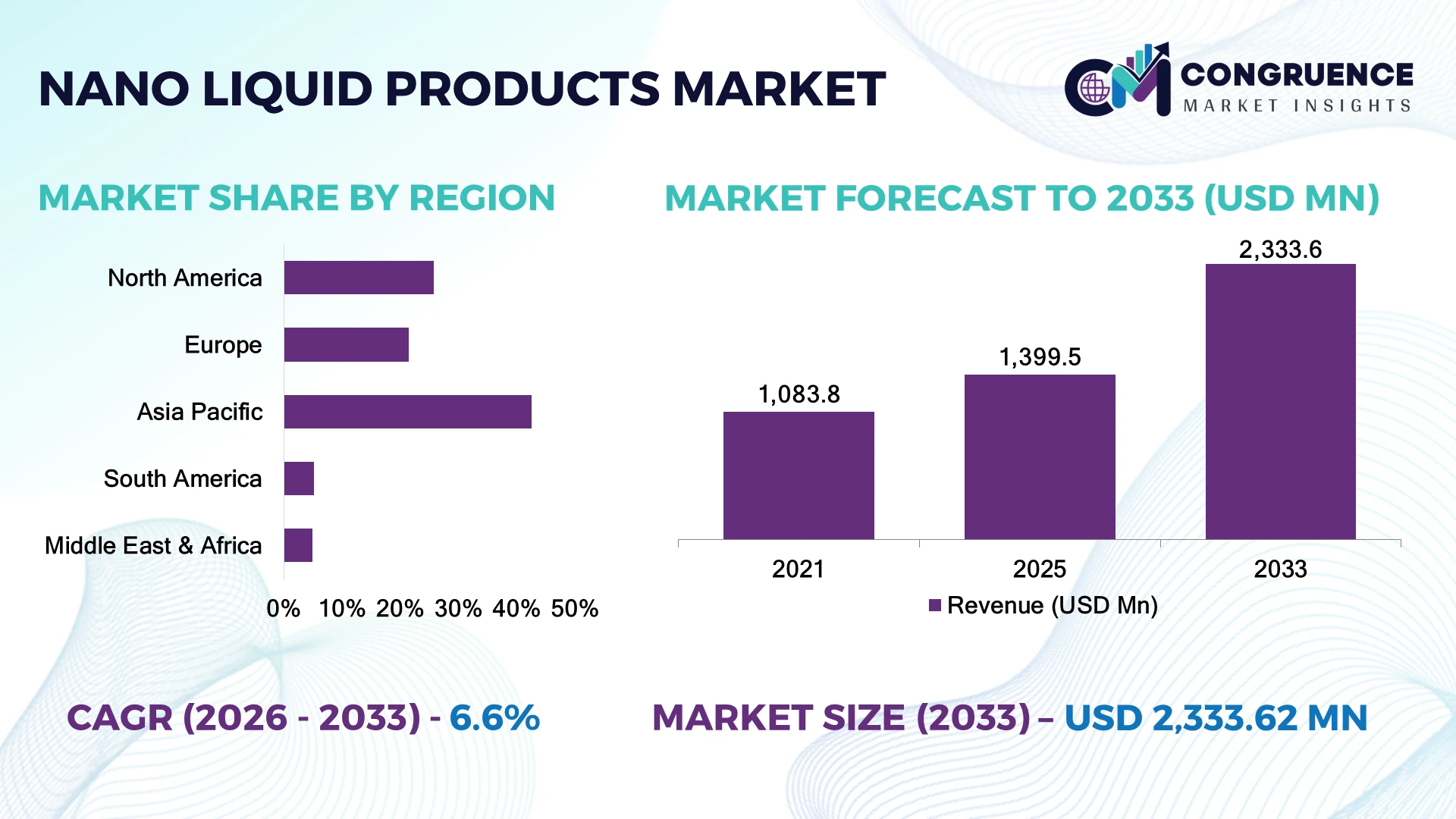
China represents approximately 28% of global Nano Liquid Products demand, supported by electronics, automotive, coatings, energy-storage, and advanced-material manufacturing. The United States contributes about 22%, with stronger adoption in semiconductor processing, aerospace, healthcare, and specialty coatings. China has approximately 35–40% of Asia's nano-material production capacity, while U.S. producers emphasize high-purity formulations and application-specific products. Supply-chain restructuring following U.S.-China technology restrictions is accelerating localized sourcing of critical nano-material inputs and formulation capabilities.
Suppliers with scalable dispersion technology, high-purity feedstock access, and application-specific formulation capabilities are best positioned to capture advanced manufacturing demand.
Market Size & Growth: USD 1,399.5 million in 2025 to USD 2,333.6 million by 2033 at 6.6% CAGR, supported by nano-enabled coatings, electronics, energy storage, and advanced manufacturing.
Top Growth Drivers: Advanced coatings 8–10%, electronics applications 7–9%, and energy-storage materials 8–11%.
Short-Term Forecast: By 2028, automated dispersion and formulation systems can reduce processing costs 8–12% and improve batch consistency 10–15%.
Emerging Technologies: Functionalized nanoparticles, stable nano-dispersions, conductive liquids, and AI-assisted formulation are strengthening performance optimization.
Regional Leaders: Asia-Pacific reaches approximately USD 1.05 billion by 2033, North America USD 600 million, and Europe USD 470 million, with electronics and advanced-material adoption strongest in Asia.
Consumer/End-User Trends: Industrial users account for more than 70% of demand, while application-specific formulations increasingly replace standardized nano-liquid products.
Pilot/Case Example: 2025 advanced-coating production programs using optimized nano-dispersions achieved approximately 10–15% lower material consumption while maintaining surface-performance specifications.
Competitive Landscape: BASF holds approximately 8–10% of organized demand, competing with Evonik, Cabot, Elementis, and BYK through formulation expertise, dispersion technology, and specialty-material portfolios.
Regulatory & ESG Impact: Higher-purity formulations and controlled nanoparticle handling can reduce process waste by approximately 10–15%, supporting tighter workplace and environmental management requirements.
Investment & Funding: More than USD 1 billion is being directed across nano-material production, formulation facilities, semiconductor materials, battery technologies, and advanced-coating capacity.
Innovation & Future Outlook: Next-generation nano liquids will prioritize multifunctional dispersions, conductive properties, thermal management, lower solvent content, and application-specific formulations as manufacturers shift toward performance-led material platforms.
The Nano Liquid Products Market covers nano-enabled coatings, lubricants, conductive fluids, dispersions, polishing formulations, thermal-management liquids, and specialty industrial fluids. Electronics, automotive, energy storage, aerospace, and advanced coatings remain key demand areas. Functionalized nanoparticles and stable dispersion technologies are improving product performance, while approximately 60–70% of industrial applications increasingly require application-specific formulations. Supply-chain localization is becoming more important as advanced-material manufacturers reduce dependence on concentrated nano-material inputs, creating opportunities for specialized formulation suppliers.
The Nano Liquid Products Market is becoming strategically important because nano-enabled formulations increasingly determine performance at the component and process level across electronics, energy storage, automotive, coatings, and precision manufacturing. Rather than functioning as simple material additives, advanced nano liquids are being engineered for specific conductivity, thermal transfer, wear resistance, surface protection, and dispersion requirements.
Technology is creating measurable production advantages. Automated high-shear and controlled-dispersion systems can improve batch consistency by approximately 10–15% compared with conventional mixing, while optimized formulations can reduce material consumption by 8–12%. China retains the strongest manufacturing scale, whereas the United States and Germany emphasize high-purity, application-specific formulations for semiconductors, aerospace, automotive, and industrial coatings. Supply-chain localization is becoming more important as manufacturers seek alternatives to concentrated sources of critical nano-material inputs.
During 2026–2028, companies are expected to increase investment in functionalized nanoparticles, AI-assisted formulation, continuous dispersion, and solvent-reduced systems. In battery and electronics production, controlled nano-dispersions can improve coating uniformity and reduce process variability. Manufacturers are therefore expanding application laboratories, forming partnerships with downstream OEMs, and localizing formulation capacity. Competitive advantage will increasingly depend on formulation precision, reproducible dispersion quality, scalable production, and the ability to translate nanoscale properties into measurable industrial performance.
Electronics, battery, automotive, and specialty-coating manufacturers are increasing use of nano liquids to improve conductivity, thermal transfer, wear resistance, and surface uniformity. Application-specific nano dispersions can reduce material consumption by approximately 8–12%, while optimized coating processes improve functional-layer consistency by 10–15%. In China, semiconductor and battery manufacturing expansion is accelerating demand for high-purity dispersions and conductive formulations. U.S. and German manufacturers are emphasizing tighter particle-size control and application-specific chemistry. Supply-chain localization following tighter technology controls is encouraging producers to establish regional formulation and testing capabilities. Companies are responding through R&D partnerships, pilot-scale facilities, and vertically integrated nanoparticle-to-formulation production. The strategic advantage is shifting toward suppliers capable of delivering reproducible nano-scale performance at industrial batch volumes.
Nano Liquid Products face significant cost sensitivity because nanoparticle feedstocks, surface functionalization agents, specialty solvents, and dispersion equipment can represent approximately 45–65% of formulation costs. High-purity nano-material prices can fluctuate 8–15% across procurement cycles, while imported specialty inputs can extend lead times by 10–20%. China remains a major processing and feedstock hub, creating exposure to export controls and concentrated sourcing. Poor dispersion stability can additionally increase rejected batches by approximately 3–7% in demanding applications. Manufacturers are reducing exposure through dual sourcing, localized precursor production, longer-term contracts, and alternative particle chemistries. The key operational constraint is achieving commercial-scale stability without sacrificing the particle characteristics that justify nano-enabled performance premiums.
Continuous-flow dispersion, AI-assisted formulation, surface-functionalized nanoparticles, and solvent-reduced systems are creating opportunities beyond conventional batch processing. Automated dispersion can increase production throughput by approximately 15–25%, while real-time particle-size monitoring can reduce formulation variability by 10–20%. Japan and South Korea are particularly relevant for precision nano liquids used in electronics, semiconductor processing, and advanced coatings. Battery manufacturers are also evaluating conductive and thermal-management formulations that require tighter particle distribution. Companies are investing in application laboratories, pilot lines, and co-development agreements with OEMs rather than selling undifferentiated nano materials. A less obvious opportunity is formulation-as-a-service, allowing smaller industrial users to access customized nano liquids without investing in specialized dispersion infrastructure.
Scaling nano-liquid formulations from laboratory batches to continuous industrial production remains technically demanding because viscosity, agglomeration, surface chemistry, and particle distribution can change with equipment geometry and process intensity. Scale-up can require 10–20% additional process optimization, while uncontrolled agglomeration can reduce functional performance by 5–15%. Semiconductor and battery plants require tighter contamination controls than conventional coatings facilities, increasing qualification complexity. Workforce shortages in nano-material process engineering further complicate commissioning and quality assurance. Companies must integrate inline particle monitoring, automated dosing, standardized process parameters, and application-specific validation. Strategic partnerships between nano-material producers and downstream manufacturers are becoming essential because successful commercialization depends less on nanoparticle availability than on repeatable performance inside existing industrial production systems.
Inline Quality Monitoring Expands: Manufacturers are increasingly integrating particle-size, viscosity, and concentration monitoring directly into production lines. Inline controls can reduce batch variability by approximately 10–20% and lower manual sampling requirements by 15–25%. Electronics and coating producers are prioritizing closed-loop systems because consistent dispersion quality directly affects downstream yield.
High-Purity Formulations Gain Priority: Semiconductor and advanced-electronics applications are moving toward tighter impurity and particle-size specifications, increasing demand for specialized nano liquids. High-purity formulations can command approximately 15–30% higher pricing than conventional industrial grades. U.S., Japanese, and South Korean suppliers are therefore expanding purification, filtration, and controlled-packaging capabilities.
Powder-to-Liquid Processing Shifts: Some manufacturers are replacing on-site nanoparticle dispersion with pre-formulated liquid concentrates to simplify handling and reduce agglomeration-related processing variability. Ready-to-use or concentrated formulations can reduce preparation time by approximately 20–30% and decrease operator intervention by 15–20%. Suppliers are responding with standardized dilution ratios and application-specific concentrate platforms.
Localized Supply Chains Strengthen: Export controls, logistics volatility, and strategic-material policies are encouraging manufacturers to establish regional formulation and intermediate-production capacity. Companies targeting semiconductor and battery customers increasingly maintain dual-source arrangements, reducing single-supplier exposure by approximately 20–30%. The non-obvious shift is that formulation proximity is becoming a qualification advantage alongside chemistry performance, particularly for time-sensitive industrial production.
Nano dispersions lead the Nano Liquid Products Market with approximately 32–36% share, supported by their scalability across coatings, electronics, energy storage, lubricants, and advanced materials. Their ability to maintain controlled particle distribution within liquid matrices provides stronger process integration than standalone nanoparticle concentrates. Nano coatings account for roughly 22–26%, while nano lubricants represent approximately 15–19%, benefiting from established automotive and industrial applications. Conductive nano liquids and thermal-management formulations comprise the remaining demand and are gaining strategic importance in electronics and battery manufacturing.
Conductive nano liquids represent the fastest-growing type, with adoption increasing approximately 9–12% as semiconductor packaging, printed electronics, and battery electrodes require higher electrical performance from thinner functional layers. Companies are investing in silver, copper, carbon-based, and hybrid nanoparticle formulations while developing lower-loading alternatives. The investment priority is shifting from basic nanoparticle supply toward stable, application-ready liquid formulations that reduce downstream processing requirements.
SEMI reported that global semiconductor materials revenue increased 6.8% in 2025, while wafer-fabrication materials grew 5.4%, reflecting higher material intensity from advanced-node and high-performance computing production.
Advanced coatings represent approximately 28–32% of Nano Liquid Products demand, making them the leading application because nano-enabled formulations improve hardness, corrosion resistance, scratch resistance, hydrophobicity, and surface functionality without requiring major equipment changes. Electronics and semiconductor processing account for approximately 22–26%, while automotive applications contribute around 17–21%. Conventional industrial coatings remain mature, whereas electronics and energy-storage applications increasingly require tighter particle-size and purity specifications.
Energy storage is the fastest-growing application, with adoption expanding approximately 10–13% as conductive and functional nano liquids enter battery electrode, thermal-management, and interface technologies. Companies are scaling application-specific formulations, integrating inline dispersion control, and establishing co-development programs with battery and electronics manufacturers. The commercial implication is a shift toward qualification-driven supply agreements rather than spot purchasing. Suppliers able to demonstrate reproducible particle distribution and stable performance gain stronger positions in high-value manufacturing workflows.
The IEA reported that global EV battery deployment reached 1.2 TWh in 2025, increasing almost 30% year on year, while China accounted for 60% of global EV battery deployment.
Electronics and semiconductor manufacturers represent approximately 27–31% of Nano Liquid Products demand, reflecting intensive requirements for conductive, polishing, thermal-management, and precision coating formulations. Automotive manufacturers account for roughly 21–25%, while chemical and industrial manufacturers contribute approximately 18–22%. Established industrial buyers typically prioritize procurement stability and compatibility with existing processes, whereas semiconductor and battery producers place greater emphasis on purity, particle-size distribution, and qualification consistency.
Battery and energy-storage manufacturers are the fastest-growing end-user group, with nano-liquid adoption increasing approximately 10–13% as electrode performance, thermal management, and advanced cell architectures become more material-intensive. Companies are responding through dedicated application laboratories, joint development agreements, and localized technical support. The competitive opportunity is strongest where suppliers can move beyond material sales into formulation engineering and process integration. Healthcare, aerospace, and specialty manufacturing remain smaller but strategically valuable niches because performance requirements support higher-value customized formulations.
The IEA reported that global battery manufacturing capacity exceeded 4 TWh at the end of 2025, growing approximately 30% from 2024, while China accounted for more than 80% of global capacity.
Asia-Pacific accounted for the largest market share at 42.6% in 2025 however, North America is expected to register the fastest growth, expanding at a CAGR of 7.2% between 2026 and 2033.
High-purity formulations strengthen semiconductor and advanced-material demand
North America represents approximately 25.8% of global Nano Liquid Products Market demand, supported by semiconductor materials, aerospace coatings, electric-vehicle batteries, and specialty chemicals. The United States accounts for more than 85% of regional demand, with high-purity and application-specific formulations commanding the strongest industrial adoption. Semiconductor and electronics applications collectively represent approximately 30–35% of regional consumption. Manufacturers are increasing investment in controlled-dispersion systems, contamination management, and application laboratories, with automated formulation processes improving batch consistency by approximately 10–15%. U.S. technology restrictions on advanced semiconductor equipment are also encouraging domestic material qualification and localized supply arrangements. The competitive advantage increasingly rests with suppliers capable of meeting narrow particle-size distributions and purity specifications while maintaining reliable domestic delivery.
United States Market Outlook: The United States is the principal North American market because of its semiconductor, aerospace, automotive, pharmaceutical, and advanced-coatings manufacturing base. Electronics-related applications represent approximately one-third of domestic nano-liquid demand. Manufacturers are prioritizing domestic formulation capacity, high-purity processing, and collaborative qualification programs with semiconductor and battery producers, reducing dependence on imported specialty formulations.
Regulated material performance accelerates precision formulation
Europe accounts for approximately 21.5% of global Nano Liquid Products demand, supported by Germany, France, Italy, the UK, and the Netherlands. Automotive coatings, industrial surface treatment, electronics, chemical processing, and energy technologies represent major application clusters. Approximately 30–35% of premium European formulations increasingly emphasize lower solvent content, controlled particle dispersion, or improved material efficiency. Regulatory scrutiny around chemical handling and nanoparticle exposure is encouraging better process containment and traceability. German manufacturers are integrating automated dosing and dispersion monitoring, reducing formulation variability by approximately 10–15%. Suppliers are consequently shifting from commodity nano-material sales toward qualified formulations supported by technical documentation and application engineering.
Germany Market Outlook: Germany is Europe's principal industrial market for advanced nano liquids, supported by automotive manufacturing, specialty chemicals, machinery, electronics, and research-intensive materials development. Automotive and industrial coatings account for a substantial portion of domestic utilization. Manufacturers increasingly deploy automated formulation and quality-monitoring systems, while partnerships between chemical suppliers and OEMs accelerate application-specific qualification.
Manufacturing scale reinforces integrated nano-material supply chains
Asia-Pacific represents approximately 42.6% of global Nano Liquid Products demand and remains the dominant production and consumption center. China contributes roughly 28% of worldwide demand, supported by electronics, battery manufacturing, automotive components, coatings, and specialty chemicals. Japan and South Korea contribute significant high-purity demand from semiconductor and precision-electronics industries. Chinese manufacturers benefit from integrated nanoparticle, chemical, dispersion, packaging, and export ecosystems, allowing production costs to remain approximately 10–15% below many specialized Western supply chains. Companies are simultaneously establishing localized formulation capacity in India and Southeast Asia to diversify production and shorten delivery cycles.
China Market Outlook: China remains the most strategically important country because its electronics, battery, automotive, coatings, and chemical industries create both upstream material capacity and downstream application demand. Approximately 28% of global nano-liquid consumption is concentrated in the country. Guangdong, Jiangsu, Zhejiang, and Shanghai provide dense industrial ecosystems supporting rapid formulation development, high-volume production, and export-oriented customization.
Industrial coatings and mining applications anchor specialized demand
South America accounts for approximately 5.2% of global Nano Liquid Products demand, with Brazil representing more than 60% of regional consumption. Automotive coatings, industrial corrosion protection, mining equipment, agriculture-related materials, and specialty chemicals provide the principal application base. Nano-enabled coatings are particularly relevant where abrasion and corrosion resistance extend equipment service intervals. Approximately 20–25% of regional industrial nano-liquid consumption is linked to advanced coating and surface-treatment applications. Brazil's established chemical and automotive manufacturing infrastructure supports localized formulation, although specialty nanoparticles and high-purity inputs remain substantially import-dependent. Companies are responding through distributor partnerships, regional inventories, and localized blending to reduce imported-input lead times.
Brazil Market Outlook: Brazil provides the strongest industrial platform in South America through its automotive, chemical, mining, agricultural, and manufacturing sectors. Demand is concentrated around São Paulo and southern industrial corridors, where specialty-coating producers can integrate nano-enabled formulations into established production lines. Local blending and technical partnerships can reduce dependence on imported finished formulations while improving customer-specific product adaptation.
Advanced coatings support industrial diversification and infrastructure
Middle East & Africa represents approximately 4.9% of global Nano Liquid Products demand, with Saudi Arabia, the UAE, South Africa, and Israel serving as important technology and application centers. Oil and gas equipment, infrastructure coatings, automotive finishes, water treatment, electronics, and specialty chemicals drive adoption. Saudi Arabia and the UAE are increasing investment in advanced manufacturing and industrial diversification, creating demand for corrosion-resistant and functional surface technologies. Nano-enabled coating applications represent approximately 25–30% of regional industrial consumption. Companies are strengthening local distribution, technical service, and formulation partnerships to reduce dependence on imported specialty products and improve project-level response times.
Saudi Arabia Market Outlook: Saudi Arabia is the region's strongest emerging market due to industrial diversification, infrastructure development, energy-sector modernization, and investment in advanced manufacturing. Oil and gas and infrastructure applications create demand for high-performance protective coatings and functional materials. Local technical partnerships and regional warehousing are becoming important as suppliers target shorter project lead times and greater customization for large industrial customers.
BASF, Evonik, Cabot, ALTANA, and Merck compete across specialty dispersions, conductive nano liquids, coating additives, and high-purity electronic materials. Global chemical leaders compete with specialized nanomaterial producers and regional formulation suppliers. The top five players collectively represent approximately 24% of organized demand. Competition centers on formulation performance, purity, dispersion stability, supply reliability, and customization; automated dispersion can improve consistency 10–20%, while localized production can reduce lead times 15–25%. Players are expanding regional plants, forming OEM partnerships, and vertically integrating nanoparticle production with formulation and application support. The competitive shift is toward application-specific liquid systems rather than commodity nano-material supply. Entry barriers include particle functionalization expertise, contamination control, qualification cycles, and industrial-scale dispersion capability. Winning requires reproducible nano-scale performance, localized supply, technical co-development, and scalable formulation platforms that integrate directly into customer production processes while delivering measurable process and material-efficiency advantages.
BASF
Evonik Industries
Cabot Corporation
ALTANA
Merck KGaA
Dow
DuPont
Arkema
Covestro
Clariant
Croda International
Synthomer
Elementis
BYK
Current nano-liquid production increasingly uses high-shear dispersion, ultrasonic processing, surface functionalization, inline particle-size monitoring, and automated dosing. Automated dispersion systems can improve batch consistency by 10–20% and reduce processing time 8–15% versus conventional manual mixing. Adoption is strongest in electronics, coatings, and battery-material facilities where particle distribution directly influences downstream yield and product qualification.
Emerging systems combine AI-assisted formulation, continuous-flow processing, functionalized nanoparticles, and solvent-reduced aqueous dispersions. Real-time monitoring can reduce formulation variability approximately 10–15%, while optimized conductive blends can reduce additive loading 5–10% without sacrificing electrical performance. Cabot benefits from vertically integrated conductive additives and liquid dispersions, while BASF and Evonik benefit from broad formulation portfolios and application-specific chemistry. Competitive advantage increasingly comes from integrating material science with process engineering.
During 2026–2028, machine-learning formulation, automated rheology control, closed-loop dispersion, and digital batch traceability will gain importance. Compared with conventional batch development, AI-assisted formulation can shorten screening cycles approximately 20–30%. Suppliers with pilot-scale validation, high-purity production, and customer co-development capabilities will capture qualification-intensive applications. The priority is to connect nanoparticle design, liquid formulation, process control, and application performance into one scalable technology platform.
February 2026 BASF expanded dispersions production at Mangalore, India, adding a new production line for architectural paints, construction chemicals, and paper. The expansion strengthens local supply reliability and supports advanced, lower-VOC formulations for Indian customers, reducing reliance on imported inputs. Source: BASF
May 2025 Evonik launched four AERODISP dispersions based on SiO₂ and Al₂O₃ for waterborne inkjet coatings. The portfolio improves dot sharpness and fixation while supporting digital printing, giving formulators broader compatibility across packaging, decorative, and textile applications and strengthening capabilities. Source: Evonik
2024 Cabot advanced its Michigan project with a $181 million investment for U.S. battery-grade CNT and conductive-dispersion production, supported by a $50 million DOE award. The project strengthens domestic supply and battery-material solutions while creating hundreds of construction and manufacturing jobs. Source: Cabot Corporation
July 2025 ALTANA recognized a new ECKART UV-curing ink formulation using ultra-thin METALURE pigments and alcohol-based silver-dollar pigments. The technology improves packaging-print performance while reducing environmental burden, strengthening specialty-ink differentiation across food-packaging and global markets through higher-performance commercial formulations. Source: altana.com (Altana)
The Nano Liquid Products Market Report evaluates nano dispersions, nano coatings, nano lubricants, conductive nano liquids, thermal-management formulations, and other functional liquid systems across coatings, electronics, automotive, energy storage, industrial manufacturing, healthcare, aerospace, and specialty chemical applications. End-user coverage includes semiconductor manufacturers, battery producers, automotive companies, coating formulators, chemical processors, and specialized industrial users. Regional analysis covers North America, Europe, Asia-Pacific, South America, and Middle East & Africa, with detailed assessment of China, the United States, Germany, Japan, South Korea, India, and Brazil.
Technology coverage includes high-shear dispersion, surface functionalization, inline particle monitoring, AI-assisted formulation, continuous processing, and low-solvent systems. Nano dispersions represent approximately 32–36% of demand, while conductive formulations are expanding rapidly in battery and electronics applications. The report supports investment planning, localization decisions, technology partnerships, competitive positioning, capacity expansion, and product-development priorities through 2026–2033.
| Report Attribute/Metric | Report Details |
|---|---|
|
Market Revenue in 2025 |
USD 1,399.5 Million |
|
Market Revenue in 2033 |
USD 2,333.6 Million |
|
CAGR (2026 - 2033) |
6.6% |
|
Base Year |
2025 |
|
Forecast Period |
2026 - 2033 |
|
Historic Period |
2021 - 2025 |
|
Segments Covered |
By Type
By Application
By End-User
|
|
Key Report Deliverable |
Revenue Forecast, Growth Trends, Market Dynamics, Segmental Overview, Regional and Country-wise Analysis, Competition Landscape |
|
Region Covered |
North America, Europe, Asia-Pacific, South America, Middle East, Africa |
|
Key Players Analyzed |
BASF, Evonik Industries, Cabot Corporation, ALTANA, Merck KGaA, Dow, DuPont, Arkema, Covestro, Clariant, Croda International, Synthomer, Elementis, BYK |
|
Customization & Pricing |
Available on Request (10% Customization is Free) |




