
Reports
The Global Nacelle Actuation System Market was valued at USD 887.14 Million in 2025 and is anticipated to reach a value of USD 1457.22 Million by 2033 expanding at a CAGR of 6.4% between 2026 and 2033. Growth is driven by commercial aircraft production recovery, higher-rate A320neo and 737 MAX assembly, electric actuation replacing heavier hydraulic architectures, and expanding thrust-reverser and nacelle aftermarket requirements.
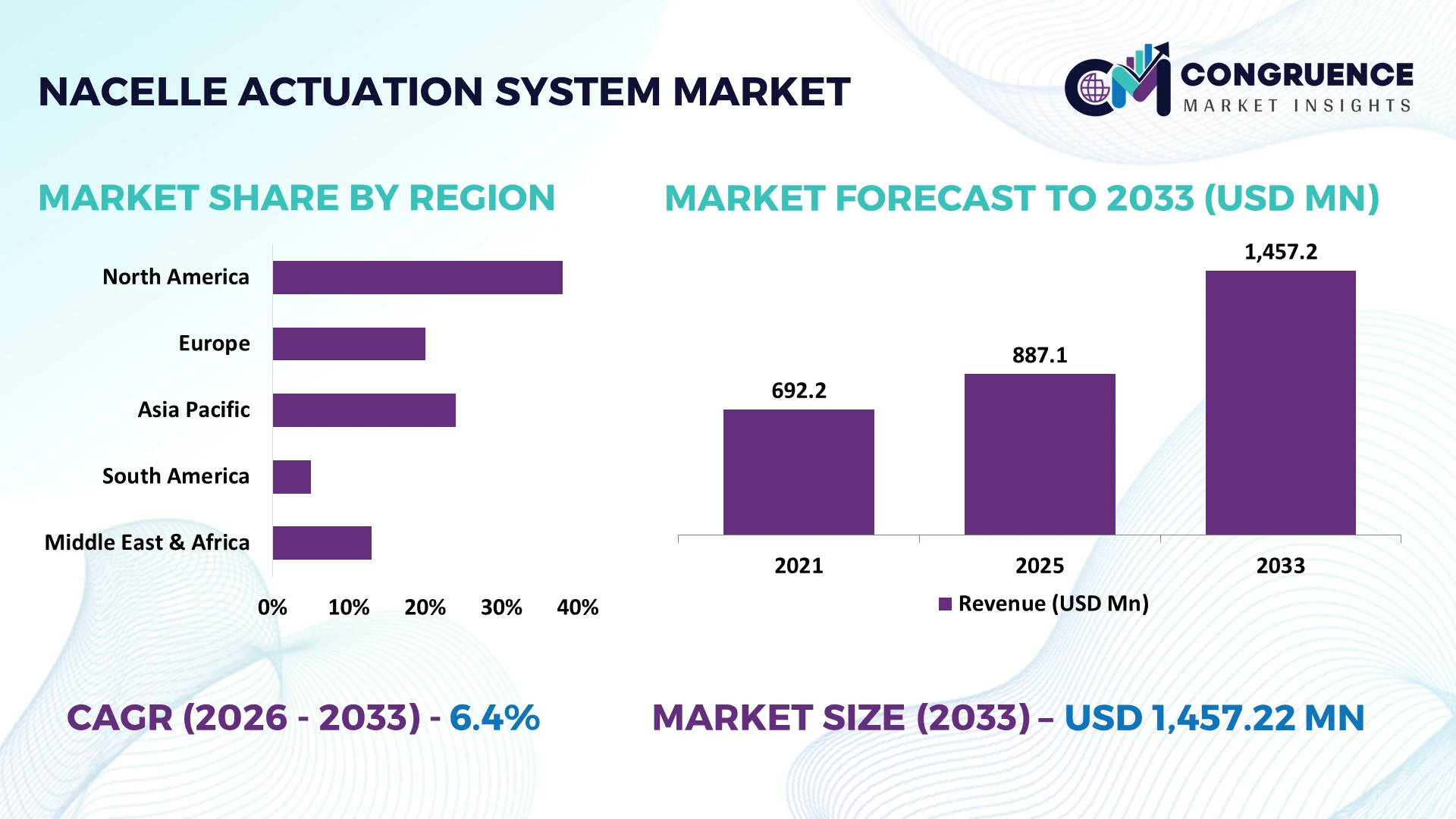
The United States anchors the global nacelle actuation system market with an estimated 35–38% share, supported by Boeing, Collins Aerospace, Honeywell, and extensive MRO infrastructure. Boeing delivered 600 aircraft in 2025, versus Airbus’s 793 globally, while defense modernization strengthens domestic actuation demand. U.S.–China aerospace trade tensions reinforce localized sourcing, dual-supplier qualification, and inventory resilience across flight-critical components.
Strategically, suppliers combining electromechanical actuation, certification capability, lightweight components, and OEM-aligned production scalability hold the strongest position as aircraft output rates increase.
Market Size & Growth: USD 887.14 million in 2025 reaches USD 1,457.22 million by 2033 at 6.4% CAGR, driven by aircraft production ramp-ups and electrification.
Top Growth Drivers: Commercial aircraft backlog expansion above 8%, production-rate recovery above 7%, and nacelle electrification penetration approaching 20% reinforce system demand.
Short-Term Forecast: By 2028, advanced electromechanical architectures can reduce actuation-system weight by approximately 10–15% versus conventional hydraulic configurations.
Emerging Technologies: Smart electromechanical actuators, condition-monitoring sensors, digital twins, and lightweight composite-compatible mechanisms increasingly define next-generation nacelle architectures.
Regional Leaders: North America approaches USD 500 million, Europe USD 420 million, and Asia-Pacific USD 390 million by 2033 as electric actuation deployment expands.
Consumer/End-User Trends: Commercial aviation represents approximately 70% of addressable demand, supported by narrowbody fleet expansion and higher utilization-driven replacement cycles.
Pilot/Case Example: In 2025, Airbus delivered 793 commercial aircraft, increasing 4% year over year and intensifying production requirements across nacelle and actuation supply chains.
Competitive Landscape: Collins Aerospace holds an estimated 20–25% position, competing with Safran, Moog, Woodward, and Parker Hannifin across OEM and aftermarket programs.
Regulatory & ESG Impact: Next-generation aircraft programs target roughly 20–30% lower fuel consumption, increasing pressure for lighter nacelle structures, optimized actuation, and reduced hydraulic complexity.
Investment & Funding: Airbus committed approximately USD 1 billion to Spirit AeroSystems-related asset integration, strengthening control over critical aerostructure and nacelle-linked manufacturing capacity.
Innovation & Future Outlook: More-electric aircraft architectures can deliver 10%+ subsystem weight advantages, shifting competition toward intelligent actuators, predictive diagnostics, and digitally monitored flight-critical systems.
The Nacelle Actuation System Market is increasingly shaped by narrowbody production ramp-ups, thrust-reverser modernization, MRO requirements, and more-electric aircraft architectures. Commercial aviation accounts for approximately 70% of addressable demand, while smart electromechanical actuators and condition-monitoring technologies are reducing hydraulic complexity. Persistent aerospace supply-chain constraints are accelerating dual sourcing and localized production, setting up the market’s broader strategic transformation.
Nacelle actuation systems are becoming strategically important as aircraft manufacturers raise production rates while propulsion architectures shift toward lighter, electrically controlled subsystems. Airbus ended 2025 with an 8,754-aircraft backlog and delivered 793 aircraft, up 4% year over year, increasing pressure on actuator suppliers to scale certified production without sacrificing reliability. Supply-chain restructuring is simultaneously driving dual sourcing, localization, and deeper OEM–tier supplier integration.
Electromechanical thrust-reverser actuation provides a clear technology advantage over conventional hydraulic systems by eliminating hydraulic-fluid leakage, reducing maintenance requirements, and lowering system mass. On COMAC’s C919, the electrically actuated O-Duct nacelle contributes around 0.5% fuel-consumption improvement through aerodynamic and structural optimization. Europe leads nacelle-system engineering, while the United States maintains larger MRO and aircraft-production ecosystems; China is accelerating deployment through C919 industrialization.
Through 2026–2028, production readiness, digital health monitoring, and electrical actuation will define supplier differentiation. Safran’s ETRAS deployment demonstrates how electric motors, composite nacelles, and integrated thrust-reverser controls improve maintainability. Suppliers are increasing automation, qualification capacity, engineering partnerships, and aftermarket support. Competitive leadership will depend on combining certified reliability, production scalability, lower lifecycle maintenance, and seamless integration with next-generation propulsion platforms.
Commercial aircraft production is the strongest immediate demand driver because every nacelle installation requires certified thrust-reverser, locking, opening, and control actuation hardware. Airbus delivered 793 aircraft in 2025, 4% more than 2024, while its backlog reached 8,754 aircraft; A320-family deliveries alone totaled 607 units. These volumes force nacelle suppliers to increase machining, actuator assembly, testing, and repair capacity while maintaining aerospace-grade traceability. Persistent engine and aerostructure bottlenecks have also pushed OEMs toward tighter supplier oversight and dual-source qualification. Safran, Collins Aerospace, Moog, and specialist actuator manufacturers are responding through capacity expansion, automated inspection, long-term supply agreements, and localized support. The strategic advantage belongs to suppliers capable of scaling output without extending certification lead times or compromising dispatch reliability.
Flight-critical actuation systems face structural scalability limits because design changes, alternate materials, electronics, and supplier substitutions require rigorous qualification before entering service. Safran’s thrust-reverser actuation portfolio has accumulated more than 600 million flight hours across approximately 30 years, illustrating the experience barrier facing new entrants. Airbus delivered 793 aircraft in 2025 against an 8,754-unit backlog, yet a supplier fuselage-panel quality issue still disrupted year-end production, demonstrating how single-component problems propagate across aircraft programs. Nacelle actuators face comparable dependency on precision gears, motors, sensors, electronics, and specialty alloys. Suppliers therefore carry substantial testing and inventory costs while OEMs resist unqualified substitutions. Companies are reducing exposure through second-source development, regionalized inventories, multi-year contracts, and tighter supplier-quality surveillance, prioritizing continuity over lowest-component-cost procurement.
Electromechanical nacelle actuation creates a valuable pathway beyond simple hydraulic replacement. Safran’s ETRAS eliminates corrosive hydraulic fluids and reduces maintenance requirements, while the C919’s integrated O-Duct nacelle delivers approximately 0.5% fuel-consumption improvement, equivalent to about 300 kilograms of fuel per flight under stated operating conditions. More than 60% of the C919 LEAP-1C nacelle uses composite material, demonstrating how actuation electrification increasingly integrates with lightweight structural design. Between 2026 and 2028, embedded position sensing, motor-health diagnostics, predictive maintenance, and digital-twin validation will extend this architecture. Suppliers are investing in intelligent controllers, lighter motors, condition-monitoring software, and OEM engineering partnerships. A non-obvious opportunity lies in aftermarket analytics: actuator-health data can convert traditionally reactive maintenance into scheduled component replacement, increasing aircraft availability and strengthening recurring service relationships.
Scaling advanced actuation across multiple aircraft platforms remains difficult because nacelle geometry, engine loads, certification requirements, thermal conditions, and thrust-reverser kinematics vary significantly by program. Airbus’ 2025 backlog of 8,754 aircraft and 607 A320-family deliveries illustrate the industrial scale suppliers must support, while Safran’s actuation systems already span platforms including the A220, A320 family, A330, A380, and Boeing 787. Electrical architectures add controllers, sensors, software, electromagnetic compatibility requirements, and fault-management logic to traditional mechanical certification. Increasing digital content also raises configuration-control and cybersecurity obligations throughout decades-long aircraft service lives. Suppliers must therefore invest in model-based engineering, automated verification, software assurance, test rigs, and specialist engineering talent. Long-term competitiveness depends on standardizing modular actuator technologies without losing the aircraft-specific customization demanded by OEM certification and propulsion-system integration.
Electric Thrust Reversers Gain Ground: Electromechanical thrust-reverser systems are replacing hydraulic architectures on newer aircraft programs because they remove hydraulic fluids, simplify maintenance, and reduce system mass. Safran’s ETRAS on the C919 supports an O-Duct nacelle delivering approximately 0.5% fuel-consumption improvement, while over 60% of the nacelle uses composites. Suppliers are expanding electric-motor, controller, and position-sensing capabilities.
Production Footprints Move Closer: Aircraft manufacturers are restructuring nacelle and actuation supply chains around final-assembly hubs. Airbus delivered 793 aircraft in 2025, up 4%, while inaugurating additional A320-family assembly capacity in Mobile and Tianjin. Actuation suppliers are responding with regional manufacturing, localized repair capability, larger safety stocks, and automated inspection to shorten replenishment cycles and reduce exposure to cross-border component disruptions.
Predictive Maintenance Moves Upstream: Actuator health monitoring is shifting from scheduled inspection toward sensor-driven maintenance using motor-current analysis, position feedback, digital twins, and predictive diagnostics. Modern electric systems remove hydraulic leakage points while condition monitoring targets 5–10% lower unscheduled maintenance exposure. OEMs and tier suppliers are embedding diagnostic electronics earlier in system design, turning nacelle actuation data into an aftermarket service and fleet-availability advantage.
Lightweight Integration Becomes System-Level: Nacelle programs increasingly combine actuation redesign with composite structures rather than optimizing components separately. The C919 nacelle exceeds 60% composite content and delivers a 50% engine-noise reduction alongside its aerodynamic gains. Airbus’ 8,754-aircraft backlog intensifies pressure for repeatable lightweight architectures. Suppliers are standardizing modular actuators and partnering earlier with nacelle integrators to reduce redesign effort across multiple platforms.
Hydraulic Actuation remains the leading type with an estimated 42–46% market share, reflecting decades of certified deployment across thrust reversers, cowls, and established commercial-aircraft platforms. Its high force density and proven reliability support continued use where nacelle mechanisms experience substantial aerodynamic loads. Electro-Hydraulic Actuation accounts for roughly 18–22%, combining conventional hydraulic power with increasingly sophisticated electronic control. Pneumatic Actuation retains a smaller position in legacy or specialized applications where simplicity and available bleed-air infrastructure remain operationally relevant.
Electromechanical Actuation is the fastest-growing type, supported by more-electric aircraft architectures, reduced hydraulic plumbing, easier condition monitoring, and lower maintenance complexity. Electric Actuation and electromechanical configurations together are estimated to represent about 25–30% of new-generation nacelle actuation opportunities. Suppliers including Safran and Moog are concentrating R&D on brushless motors, smart controllers, position sensing, and fault-tolerant electronics. Investment priorities are consequently moving from purely mechanical force generation toward digitally monitored, lighter actuation packages that reduce lifecycle maintenance while improving integration flexibility.
Thrust Reverser applications account for an estimated 48–52% of nacelle actuation demand because deployment requires synchronized locking, translating, opening, and control mechanisms capable of operating reliably under high aerodynamic loads. Engine Cowl applications represent approximately 18–22%, supported by maintenance-access requirements and powered opening systems across commercial aircraft. Engine Accessories remain strategically relevant where auxiliary mechanisms require compact actuation, while Variable Inlet Guide Vanes serve propulsion-airflow optimization requirements on applicable engine architectures.
Exhaust Nozzle actuation is the fastest-growing application, particularly across advanced military propulsion and emerging adaptive-engine concepts where variable geometry improves thrust management and thermal performance. Increasing electronic control is also strengthening Variable Inlet Guide Vanes through tighter integration with engine-management systems. Manufacturers are responding by scaling high-temperature actuators, redundant sensing, digital controllers, and automated test systems. Mature thrust-reverser demand remains volume-driven, while nozzle and variable-geometry applications command greater engineering intensity, shifting investment toward high-performance actuation technologies capable of supporting more complex propulsion architectures.
Commercial Aircraft represent an estimated 62–67% of nacelle actuation demand, reflecting large production volumes, extensive narrowbody fleets, and continuous requirements for thrust-reverser and cowl actuation across new deliveries and maintenance cycles. Aircraft Manufacturers account for approximately 15–18% of direct procurement and integration activity because OEMs increasingly influence actuator architecture, supplier qualification, and lifecycle support. Military Aircraft remain smaller in volume but require higher-performance actuation for variable nozzles, thermal management, and mission-specific nacelle configurations.
Business Jets are the fastest-growing end-user segment in deployment terms, supported by 854 aircraft shipments in 2025, an 11.8% annual increase. Helicopters retain selective demand where engine cowling and accessory actuation requires compact, lightweight mechanisms. Suppliers are targeting commercial OEMs through long-term program partnerships, business-jet manufacturers with lightweight electromechanical systems, and military programs through customized high-load solutions. Competitive positioning increasingly depends on serving both high-volume commercial platforms and lower-volume applications carrying greater technical complexity and aftermarket value.
North America accounted for the largest market share at 37% in 2025 however, Asia-Pacific is expected to register the fastest growth, expanding at a CAGR of 8.1% between 2026 and 2033.

OEM Scale Reinforces Actuation Leadership
North America represents approximately 37% of global nacelle actuation system demand, supported by Boeing aircraft programs, Collins Aerospace actuation technologies, extensive engine manufacturing, and the world’s largest commercial aviation aftermarket. Boeing delivered 600 commercial aircraft in 2025, materially increasing nacelle, thrust-reverser, and replacement-component requirements. U.S. suppliers retain advantages in electromechanical controls, high-force hydraulic actuation, sensors, and certified MRO infrastructure. Production restructuring following aerospace supply-chain disruptions is increasing dual-source qualification and domestic inventory coverage for flight-critical components. The region also benefits from military propulsion programs requiring variable exhaust-nozzle actuation and high-temperature mechanisms. Suppliers are investing in automated testing, predictive maintenance, localized component manufacturing, and repair capacity, strengthening lifecycle service economics alongside original-equipment demand.
United States Market Outlook: The United States combines Boeing’s production ecosystem with Collins Aerospace, Parker Hannifin, Woodward, Moog, and major propulsion-system engineering capabilities. Boeing’s year-end 2025 commercial backlog exceeded 6,100 aircraft, providing substantial embedded demand for nacelle components. Defense propulsion investment additionally supports specialized high-load and variable-geometry actuation technologies unavailable in volume-driven civil applications.
Integrated Nacelle Engineering Drives Electrification
Europe holds approximately 31% of the global market, anchored by Airbus production and France’s concentrated nacelle, propulsion, actuation, and aerospace engineering ecosystem. Airbus delivered 793 commercial aircraft in 2025, including 607 A320-family aircraft, reinforcing demand for certified thrust-reverser and nacelle mechanisms. European engineering increasingly emphasizes more-electric actuation, composite structures, reduced hydraulic complexity, and integrated health monitoring. Safran’s electrical thrust-reverser architecture demonstrates this transition by replacing hydraulic power with electronically controlled electromechanical actuation. European environmental objectives also reinforce aircraft lightweighting and propulsion-efficiency programs, increasing pressure on component suppliers to reduce system mass. Manufacturers are responding through model-based development, composite-compatible mechanisms, digital testing, and long-term OEM partnerships. France, Germany, and the United Kingdom remain critical engineering and production centers supporting both original equipment and aftermarket requirements.
France Market Outlook: France provides a distinctive competitive advantage through Airbus-linked manufacturing and Safran’s integrated nacelle capabilities. Safran’s nacelle portfolio serves major Airbus, Boeing, COMAC, and business-aviation platforms, while its electrical thrust-reverser actuation technology has accumulated extensive operational expertise. French suppliers increasingly combine nacelle structures, actuation, controls, and aftermarket services, strengthening system-level rather than component-level competition.
Aircraft Localization Accelerates System Deployment
Asia-Pacific accounts for approximately 22% of global nacelle actuation system demand, with China increasingly shifting from aircraft consumption toward domestic manufacturing and system integration. COMAC’s C919 provides the strongest technology catalyst: its LEAP-1C nacelle incorporates an electrically actuated O-Duct thrust reverser and exceeds 60% composite content, creating a platform for advanced actuation deployment. Airbus also operates A320-family final assembly in Tianjin, strengthening local aerospace supply-chain capabilities. India is expanding commercial fleets and MRO infrastructure, while Japan maintains specialized aerospace component manufacturing expertise. Rising aircraft utilization creates parallel aftermarket demand for actuator inspection, overhaul, and replacement. Global suppliers are responding through Chinese partnerships, engineering localization, regional repair capacity, and closer integration with aircraft manufacturers, while domestic companies build capabilities around motors, controllers, sensors, and precision mechanisms.
China Market Outlook: China is the region’s most strategically significant market because COMAC is establishing a domestic commercial-aircraft ecosystem around the C919. The aircraft’s nacelle delivers approximately 0.5% fuel-consumption improvement through integrated aerodynamic and structural design. Increasing C919 production encourages localization of actuator components, electronics, testing capabilities, maintenance infrastructure, and qualified aerospace suppliers across major Chinese industrial clusters.
Fleet Renewal Expands Aftermarket Intensity
South America represents approximately 4% of global nacelle actuation system demand, with Brazil providing the region’s principal aerospace manufacturing and engineering base. Embraer’s commercial and executive aircraft programs create original-equipment requirements, while expanding airline utilization supports actuator repair, overhaul, and replacement. Embraer delivered 244 aircraft in 2025, comprising 78 commercial jets and 155 executive jets alongside defense and special-mission deliveries, increasing nacelle-related component activity across multiple aircraft classes. Airlines operating Airbus and Boeing fleets create additional thrust-reverser maintenance demand, but limited local production of specialized actuation electronics and high-precision mechanisms maintains import dependence. Companies are strengthening authorized repair networks, inventory positioning, component exchange programs, and technical partnerships. Brazil’s established aerospace workforce provides a foundation for deeper localization where production volumes justify certification investment.
Brazil Market Outlook: Brazil combines Embraer’s manufacturing scale with a mature aerospace engineering and supplier cluster centered around São José dos Campos. Embraer ended 2025 with a record backlog of 512 aircraft, strengthening forward requirements for propulsion interfaces and aircraft systems. Local engineering capability also supports business-jet and military applications requiring differentiated actuation specifications and aftermarket support.
MRO Expansion Reshapes Regional Demand
Middle East & Africa accounts for approximately 6% of global nacelle actuation system demand, driven primarily by large commercial fleets, expanding maintenance infrastructure, and Gulf aviation investment rather than indigenous aircraft manufacturing. Emirates, Qatar Airways, Etihad Airways, and Saudia operate substantial widebody fleets where thrust-reverser reliability directly influences maintenance scheduling and aircraft availability. Dubai’s Mohammed bin Rashid Aerospace Hub and other Gulf aviation clusters are expanding component-repair capabilities, creating opportunities for actuator overhaul, exchange inventories, diagnostics, and predictive maintenance. Fleet modernization toward Boeing 787, Airbus A350, and next-generation narrowbody aircraft increases requirements for digitally monitored and lightweight nacelle systems. Global suppliers are responding through MRO partnerships, regional service centers, inventory pools, and technical-support agreements, progressively moving higher-value nacelle maintenance closer to operators rather than returning components to European or North American facilities.
United Arab Emirates Market Outlook: The UAE provides the strongest regional platform through Emirates’ large international fleet, Dubai’s aerospace infrastructure, and expanding MRO capability. Emirates has more than 300 aircraft on order across major fleet programs, creating a substantial future installed base for nacelle systems. Localized component support reduces turnaround times and strengthens demand for actuator diagnostics, repair, exchange, and lifecycle services.
Safran, Collins Aerospace, Moog, Parker Hannifin, and Woodward lead nacelle actuation competition, with integrated nacelle specialists challenging diversified aerospace-control suppliers across commercial, defense, and aftermarket programs. The top five capture an estimated 65–70% combined share, reflecting certification barriers and long aircraft-program cycles. Safran competes through vertically integrated nacelles and electric thrust-reverser systems, while Collins leverages broad OEM relationships and aftermarket scale. Moog, Parker Hannifin, and Woodward differentiate through precision motion control, hydraulic expertise, and customized actuation. Electromechanical systems can reduce maintenance complexity by roughly 10–15%, while advanced condition monitoring targets 5–10% lower unscheduled maintenance exposure. Suppliers are expanding engineering partnerships, automated testing, regional repair networks, and digitally monitored products. Competition is shifting from standalone hydraulic hardware toward integrated electric actuation and lifecycle services. Certification expense, flight-hour validation, software assurance, and OEM qualification remain formidable barriers. Winning requires proven reliability, lightweight architecture, scalable production, digital diagnostics, and decades-long aftermarket support.
Safran
RTX Corporation
Moog Inc.
Parker Hannifin Corporation
Woodward, Inc.
Eaton Corporation
Liebherr Group
Triumph Group
Crane Company
Curtiss-Wright Corporation
ITT Inc.
TransDigm Group
Senior plc
Nabtesco Corporation
Current nacelle actuation technology is shifting from centralized hydraulics toward electric thrust-reverser architectures, smart controllers, and lightweight composite integration. Collins’ elecTRAS removes hydraulic interfaces and fluids, cutting integrated nacelle actuation weight by 15–20% versus hydraulic systems. Electric systems now have proven deployment on more than 700 A350-family aircraft, demonstrating that electrification has moved beyond demonstration into fleet-scale operation and lower-maintenance service.
Emerging platforms combine brushless motors, embedded position sensing, digital image correlation, model-based engineering, and predictive diagnostics. Electric thrust-reverser technology has accumulated over 15 million flight hours and 2.2 million flight cycles, providing operating data for smarter fault detection. Modular test environments also allow component-to-system validation, shortening development iterations while improving certification readiness. Suppliers controlling electronics, motors, software, actuation, and nacelle integration gain the strongest competitive advantage.
Disruptive development through 2026–2028 will center on intelligent electromechanical actuation, digital twins, fault-predictive algorithms, and reusable certification test architectures. Safran’s ePRISME laboratory integrates simulation, physical test benches, electromagnetic compatibility, and predictive maintenance research through 2029. Compared with legacy hydraulics, electric architectures deliver 15–20% system-weight improvement while eliminating fluid leakage. OEM-aligned suppliers should invest now because next-generation aircraft increasingly require lighter, software-enabled, maintainable propulsion interfaces with faster diagnostics and scalable cross-platform integration.
December 2024 Woodward agreed to acquire Safran’s North American electromechanical actuation business, including intellectual property, operations, talent, and A350-related agreements. The transaction expands Woodward’s technology base for next-generation aircraft and strengthens its position in advanced aerospace motion control. Source: woodward.com
June 2025 Collins Aerospace opened an elecTRAS production line in Colomiers and electrification engineering capability in Wolverhampton. Its electric thrust-reverser architecture reduces integrated aircraft-system weight by 15–20%, increasing production capacity while simplifying nacelle installation, maintenance, and hydraulic interfaces. Source: rtx.com
December 2025 Safran Nacelles and ESIGELEC created the ePRISME laboratory to advance future electric thrust-reverser actuation. A dedicated team of 15 specialists combines simulation, test benches, predictive maintenance, diagnostics, and reliability research, accelerating technology maturity for commercial aircraft. Source: esigelec.fr
July 2026 Collins Aerospace made its Wolverhampton electric-actuation center fully operational, supporting modular testing from components through complete systems. elecTRAS had exceeded 15 million flight hours across 700-plus A350 aircraft, strengthening certification evidence and scalability for nacelle applications. Source: ainonline.com
The Nacelle Actuation System Market Report evaluates Hydraulic Actuation, Electric Actuation, Electro-Hydraulic Actuation, Electromechanical Actuation, and Pneumatic Actuation across Thrust Reverser, Engine Cowl, Variable Inlet Guide Vanes, Exhaust Nozzle, and Engine Accessories. End-user coverage includes Commercial Aircraft, Military Aircraft, Business Jets, Helicopters, and Aircraft Manufacturers across North America, Europe, Asia-Pacific, South America, and Middle East & Africa.
The analysis tracks more-electric aircraft architectures, intelligent motor controls, predictive diagnostics, digital twins, lightweight nacelle integration, and advanced test systems. Commercial aircraft represent approximately 62–67% of demand, while electric thrust-reverser technology has accumulated over 15 million flight hours across 700-plus A350 aircraft. The report supports 2026–2033 investment planning, supplier qualification, manufacturing expansion, technology selection, aftermarket positioning, partnership strategy, and competitive assessment as actuation transitions toward lighter, digitally monitored, maintainable architectures.
| Report Attribute/Metric | Report Details |
|---|---|
Market Revenue in 2025 | USD 887.14 Million |
Market Revenue in 2033 | USD 1457.22 Million |
CAGR (2026 - 2033) | 6.4% |
Base Year | 2025 |
Forecast Period | 2026 - 2033 |
Historic Period | 2021 - 2025 |
Segments Covered | By Type
By Application
By End-User
|
Key Report Deliverable | Revenue Forecast, Growth Trends, Market Dynamics, Segmental Overview, Regional and Country-wise Analysis, Competition Landscape |
Region Covered | North America, Europe, Asia-Pacific, South America, Middle East, Africa |
Key Players Analyzed | Safran, RTX Corporation, Moog Inc., Parker Hannifin Corporation, Woodward, Inc., Eaton Corporation, Liebherr Group, Triumph Group, Crane Company, Curtiss-Wright Corporation, ITT Inc., TransDigm Group, Senior plc, Nabtesco Corporation |
Customization & Pricing | Available on Request (10% Customization is Free) |




