
Reports
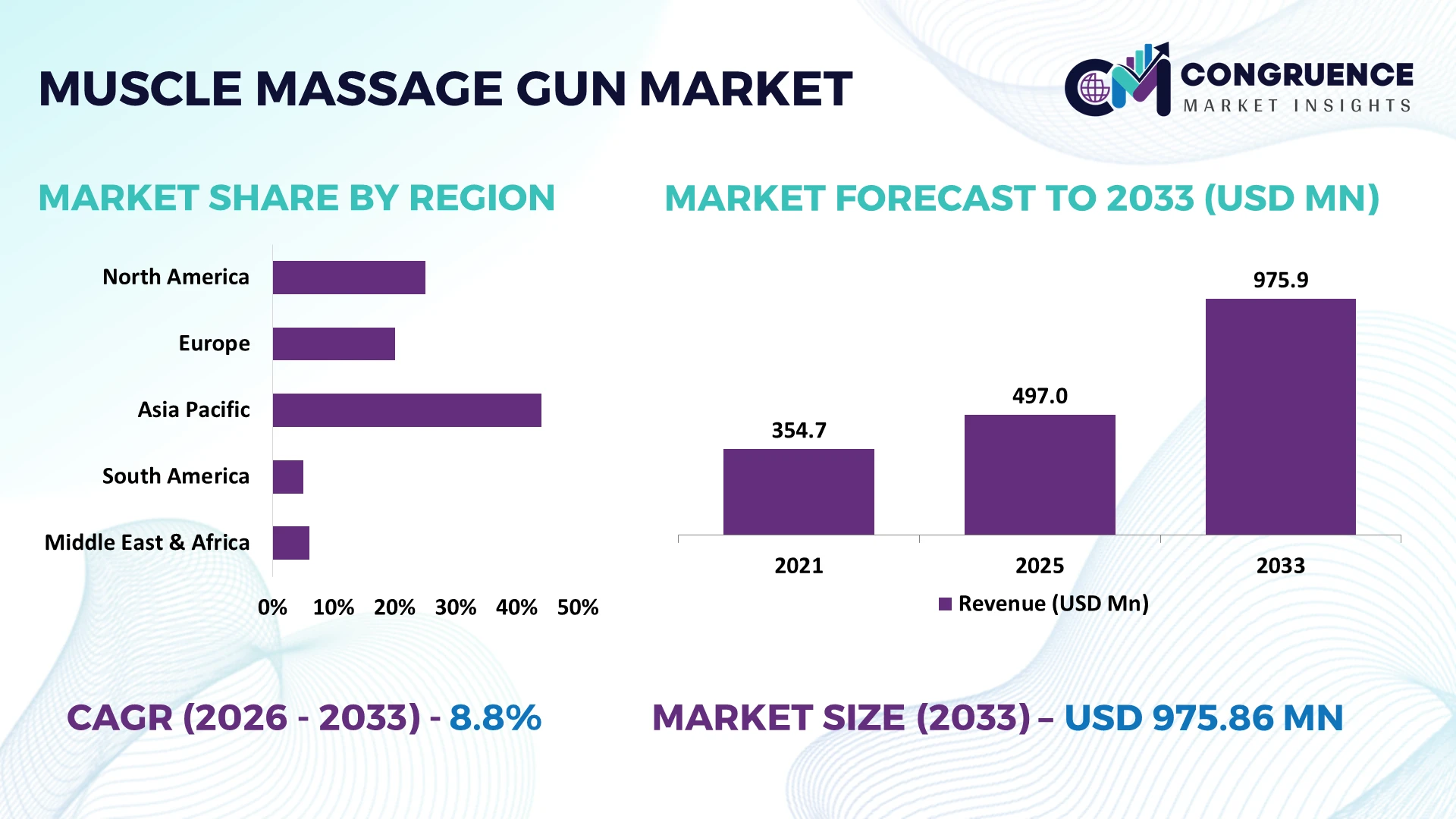
The Global Muscle Massage Gun Market was valued at USD 497 Million in 2025 and is anticipated to reach a value of USD 975.86 Million by 2033 expanding at a CAGR of 8.8% between 2026 and 2033. Growth is driven by home-based muscle recovery, expanding recreational fitness participation, physiotherapy adoption, brushless-motor miniaturization, quieter percussion systems, and direct-to-consumer sports-recovery retailing.
The United States represents an estimated 35% of global Muscle Massage Gun demand, supported by more than 70 million fitness-facility members, extensive sports-medicine infrastructure, and high penetration of connected wellness products. Premium devices increasingly deliver 2,000–3,200 percussions per minute with multiple force settings, widening use beyond athletes into routine recovery. China has greater manufacturing concentration, particularly around Guangdong’s electronics supply chain, while U.S.-China tariff tensions continue encouraging brands to diversify final assembly and sourcing toward Southeast Asia.
Strategically, suppliers should combine clinically differentiated recovery features with diversified manufacturing and mid-premium pricing to defend margins while broadening consumer adoption.
Market Size & Growth: USD 497 million in 2025 reaches USD 975.86 million by 2033 at 8.8%, supported by home recovery and fitness participation.
Top Growth Drivers: Home recovery 38%, recreational fitness 34%, and physiotherapy adoption 28% underpin purchasing momentum.
Short-Term Forecast: By 2028, improved brushless motors can lower operating noise approximately 20%, strengthening home and clinical usability.
Emerging Technologies: Bluetooth coaching, pressure sensing, and heated percussion increasingly combine 3 recovery functions within premium devices.
Regional Leaders: North America approaches USD 360 million, Europe USD 260 million, and Asia-Pacific USD 275 million as omnichannel availability expands.
Consumer/End-User Trends: Approximately 60% of massage-gun usage is home-centered, shifting product design toward portability, quieter motors, and simplified controls.
Pilot/Case Example: A 2024 controlled intervention found five-minute percussion treatment produced measurable acute improvements in lower-limb flexibility without reducing muscle performance.
Competitive Landscape: Therabody holds an estimated 20% premium-market position, competing with Hyperice, RENPHO, Bob and Brad, and HoMedics.
Regulatory & ESG Impact: EU rules require at least 65% recovery of portable-battery weight, increasing design attention toward replaceability and end-of-life handling.
Investment & Funding: More than USD 100 million of disclosed historical funding across leading recovery-technology brands supports product development, retail expansion, and connected wellness ecosystems.
Innovation & Future Outlook: Premium devices increasingly offer 5–6 attachments plus adaptive pressure feedback, shifting competition from raw percussion speed toward personalized recovery experiences.
The Muscle Massage Gun Market is moving beyond athlete-focused recovery toward home wellness, physiotherapy, gyms, occupational recovery, and active-aging applications. Product development emphasizes quieter brushless motors, pressure-feedback sensors, heat integration, compact batteries, and app-guided routines; premium devices commonly provide five or more intensity levels. Consumer purchasing is simultaneously shifting toward portable models that combine recovery functions within one platform. China remains central to motor, battery, and electronics sourcing, while tariff and supply-chain diversification encourages alternative Asian assembly footprints, setting up a strategic contest around differentiation, reliability, and channel reach.
Muscle massage guns are becoming strategically important as recovery technology shifts from specialist sports equipment toward repeat-use wellness hardware spanning fitness, physiotherapy, occupational recovery, and active aging. Digital adoption is also changing product economics: app-guided routines, pressure sensing, and personalized programs create differentiation beyond motor speed. Manufacturing strategies are shifting as brands reduce dependence on concentrated Chinese electronics and battery supply chains by qualifying alternative Asian suppliers and regional fulfillment partners.
Modern brushless motors deliver roughly 20% lower operating noise than earlier brushed designs while improving battery efficiency and device durability. Premium systems operating around 2,400–3,200 percussions per minute increasingly combine adjustable amplitude, force sensing, heat, and guided recovery. The United States favors premium connected products and professional endorsements, whereas India presents stronger potential for compact, value-engineered models distributed through digital marketplaces and expanding fitness networks.
Through 2028, competition will increasingly center on validated recovery protocols, modular attachments, battery longevity, and personalization software. A physiotherapy clinic can assign pressure-controlled routines between supervised sessions, extending recovery support beyond appointments. Manufacturers are investing in quieter platforms, clinical partnerships, localized distribution, and multi-function devices. Sustainable advantage will depend on converting percussion hardware into credible, differentiated recovery ecosystems rather than competing primarily on speed and price.
Rising recreational exercise participation is converting percussion therapy from occasional athletic equipment into routine recovery hardware. More than 70 million Americans held fitness-facility memberships in 2023, while roughly 24% of U.S. adults met both aerobic and muscle-strengthening guidelines, creating a substantial addressable recovery population. Digital fitness also normalizes self-managed post-workout routines, supporting home use between gym sessions. Brands are responding with compact devices weighing below 1 kilogram, simplified intensity controls, and quieter brushless motors designed for frequent domestic operation. Partnerships with trainers, physiotherapists, and sports organizations reinforce product credibility. The strategic shift is frequency: manufacturers that increase weekly usage through portability and guided protocols can strengthen replacement, accessory, and cross-selling economics without relying exclusively on new athlete acquisition.
Lithium-ion batteries create structural cost and compliance pressure because massage guns must satisfy transport, safety, labeling, and end-of-life requirements across multiple jurisdictions. International air transport requires lithium cells and batteries to meet UN 38.3 testing, while EU battery rules target 63% collection of portable-battery waste by 2027 and 73% by 2030. Battery packs can also represent 15%–25% of portable-device component cost, making cell-price and certification changes material to margins. Chinese supply concentration adds procurement exposure for globally distributed brands. Manufacturers are qualifying multiple cell suppliers, redesigning battery modules, strengthening thermal protection, and regionalizing compliance documentation. The operational implication is clear: poorly standardized battery architecture increases certification expense and slows SKU expansion across export markets.
Active aging creates an underpenetrated application beyond gym-centered recovery. Globally, people aged 65 and above represent roughly 10% of the population, while Japan’s share exceeds 29%, creating a concentrated market for mobility-oriented wellness products. Lower-intensity percussion, ergonomic handles, heat integration, and simplified controls can address users seeking muscle comfort and movement support rather than athletic performance. Multi-function designs combining percussion and thermal treatment can also reduce the need for separate recovery devices by 20%–30% on a functional-equipment basis. Companies are developing lighter platforms, clinician-informed routines, pharmacy distribution, and partnerships with rehabilitation providers. The non-obvious opportunity lies in interface design: accessibility, grip geometry, and controlled force delivery can unlock older consumers more effectively than increasing maximum motor power.
Long-term expansion requires manufacturers to distinguish evidence-backed recovery benefits from aggressive consumer-health claims. Percussion therapy studies frequently involve fewer than 50 participants, while treatment protocols vary across amplitude, frequency, duration, and muscle group, limiting standardized performance comparisons. Devices can operate above 3,000 percussions per minute, yet higher speed does not automatically produce superior recovery outcomes. U.S. regulatory scrutiny becomes more relevant when marketing crosses from general wellness into treatment-oriented claims, raising documentation and labeling requirements. Companies must fund larger comparative studies, establish repeatable usage protocols, train professional partners, and build adverse-event monitoring into connected ecosystems. The strategic risk is credibility fragmentation: brands unable to translate engineering specifications into reproducible outcomes will face weaker professional adoption and greater dependence on discount-driven consumer channels.
Compact Designs Reshape Portability Economics Miniaturization is shifting purchase decisions from maximum motor output toward everyday portability. New compact models increasingly weigh 0.5–0.8 kg versus 1.0–1.5 kg for traditional full-size devices, reducing carried weight by roughly 40%. Manufacturers are redesigning motors, batteries, and housings while retaining multiple intensity settings. Airlines’ lithium-battery restrictions are also encouraging travel-friendly battery capacities. Brands are expanding mini product lines and bundled cases, improving usage frequency and opening gifting and travel channels.
Thermal Percussion Gains Premium Positioning Heated attachments are moving from standalone accessories into integrated recovery systems, with premium products delivering approximately 45°C–55°C operating temperatures alongside 3–5 percussion settings. Combining heat and mechanical stimulation consolidates two recovery functions within one device and supports higher-value product positioning. Manufacturers are adding temperature controls, insulated attachment materials, and automatic shutoffs while physiotherapy-oriented brands refine treatment protocols, shifting premium competition toward multifunctionality rather than maximum percussion speed.
Pressure Feedback Guides Recovery Sessions Force sensing is replacing subjective pressure selection in advanced models. Premium devices increasingly display 3–5 pressure zones and synchronize feedback with mobile applications, helping users maintain repeatable treatment intensity. This changes product workflow from unrestricted manual percussion toward guided recovery sessions. Brands are investing in embedded sensors, app interfaces, and personalized routines, while professional partners use feedback to improve user consistency. The non-obvious advantage is behavioral: measurable pressure encourages repeatable technique, strengthening engagement without increasing motor output.
Retail Channels Become More Specialized Massage-gun distribution is expanding beyond online marketplaces into sporting-goods, electronics, physiotherapy, and wellness channels. Premium devices commonly carry 4–6 interchangeable attachments, giving retailers clearer feature differentiation than speed-based merchandising alone. Brands are strengthening demonstration programs, athlete partnerships, and channel-specific bundles while controlling unauthorized discounting. This omnichannel restructuring improves product education and conversion for technically differentiated models, while lower-priced sellers remain concentrated online where comparison shopping intensifies price pressure.
Percussion represents the leading type with an estimated 37% market share, supported by broad applicability across muscle recovery, fitness routines, and professional treatment environments. Adjustable amplitude and multi-speed operation give percussion models greater functional flexibility than simpler Mini or Standard devices. Standard products retain meaningful demand among mainstream buyers seeking balanced price and performance, while Heavy-Duty models address higher-force professional and intensive-use requirements. Cordless designs increasingly function as a baseline configuration across categories rather than a premium differentiator, with typical operating times reaching 2–5 hours between charges.
Heated is the fastest-growing type as manufacturers combine thermal therapy with mechanical percussion within one platform. Integrated systems commonly provide 3–5 temperature settings, improving product differentiation without requiring consumers to purchase separate heating equipment. Mini products are also gaining strategic importance where portability outweighs maximum stall force. Manufacturers are directing product development toward modular attachments, compact batteries, thermal controls, and quieter drive systems, shifting investment from standalone mechanical performance toward multifunctional recovery platforms with stronger premiumization potential.
Muscle Recovery leads application demand with an estimated 32% share because percussion devices are widely positioned for routine muscle preparation, stiffness management, and recovery between training sessions. Post-Workout Recovery follows closely as users incorporate short percussion sessions immediately after exercise, while Warm-Up applications benefit from rapid localized stimulation before activity. Sports Recovery remains more performance-oriented, concentrating demand among competitive and recreational athletes. Pain Relief attracts broader wellness users but requires disciplined product claims because therapeutic positioning carries greater clinical and regulatory scrutiny.
Physical Therapy is the fastest-growing application as practitioners integrate controlled percussion into supervised mobility and soft-tissue workflows. Treatment sessions commonly use localized percussion for approximately 2–5 minutes per muscle group, allowing therapists to incorporate devices without substantially extending appointment duration. Manufacturers are responding with pressure indicators, quieter motors, ergonomic grips, and professional education programs. Investment is consequently shifting toward products that support repeatable protocols and clinician confidence, creating stronger differentiation than consumer models marketed primarily around maximum speed.
Home Users represent the leading end-user group with an estimated 43% share, reflecting direct online availability, falling entry prices, compact designs, and consumer preference for self-managed recovery. Athletes remain influential premium buyers because performance, amplitude, battery endurance, and portability directly affect training routines. Fitness Centers typically purchase durable shared-use devices, while Sports Clinics and Rehabilitation Centers prioritize controlled force delivery, sanitation, and repeatability. Wellness Centers broaden adoption through recovery services that combine percussion with stretching and other non-invasive treatments.
Physical Therapists are the fastest-growing end-user group as device selection moves toward professionally guided application rather than unrestricted consumer use. Clinical buyers favor models offering 4–6 attachments, multiple intensity levels, pressure feedback, and ergonomic handling for repeated sessions. Manufacturers are targeting this segment through practitioner education, professional pricing, rehabilitation partnerships, and extended warranties. Competitive positioning therefore increasingly splits between accessible Home User products optimized for convenience and professional systems differentiated through durability, control, and protocol support.
North America accounted for the largest market share at 38.4% in 2025 however, Asia-Pacific is expected to register the fastest growth, expanding at a CAGR of 10.7% between 2026 and 2033.
Premium Recovery Moves Into Mainstream Wellness
North America represents approximately 38.4% of global demand, with purchasing concentrated around fitness enthusiasts, professional sports, physiotherapy practices, and direct-to-consumer wellness channels. The region supports premiumization because established recovery brands compete through amplitude control, pressure sensing, quieter motors, and proprietary attachments rather than basic percussion speed. U.S. fitness facilities serve more than 70 million members, providing a substantial customer base exposed to structured post-exercise recovery. Sports medicine and rehabilitation networks further support professional product placement, while omnichannel distribution through sporting-goods retailers expands consumer trial. Manufacturers are strengthening practitioner education, athlete partnerships, subscription-based digital content, and retail demonstrations. Competitive differentiation increasingly depends on converting professional credibility into repeat household usage while maintaining clear separation between general wellness positioning and regulated therapeutic claims.
United States Market Outlook: The United States combines extensive professional sports infrastructure with mature e-commerce and high discretionary spending on fitness technology. More than 24% of adults meet both recommended aerobic and muscle-strengthening activity guidelines, creating a sizable recovery-oriented consumer base. Brands increasingly use physical retail demonstrations and clinician partnerships to support premium products that require education beyond specification-based online comparisons.
Battery Regulation Reshapes Product Engineering
Europe holds an estimated 24.7% market share, with Germany, the United Kingdom, France, Italy, and Spain forming major consumption centers. Purchasing increasingly reflects product durability, acoustic performance, battery compliance, and repairability alongside recovery functionality. EU battery regulation establishes a 63% collection target for portable battery waste by 2027, pushing suppliers toward clearer battery documentation and lifecycle management. European sporting clubs, physiotherapy practices, wellness facilities, and specialty retailers provide professional channels alongside e-commerce. Manufacturers are responding with compliant battery systems, recyclable packaging, localized warranties, and product configurations adapted to EU electrical and consumer-safety requirements. The operational advantage increasingly belongs to brands capable of managing compliance centrally across multiple national markets, because standardized documentation and service infrastructure reduce the cost and complexity of maintaining broad European distribution.
Germany Market Outlook: Germany offers a strong combination of sports participation, physiotherapy infrastructure, premium consumer purchasing, and disciplined product-safety expectations. Its rehabilitation ecosystem supports professional-grade devices emphasizing durability and repeatable settings. German buyers also benefit from dense specialist retail and pharmacy networks, making warranty support, technical documentation, and replaceable components strategically important alongside percussion performance.
Manufacturing Scale Meets Rising Consumption
Asia-Pacific accounts for approximately 26.1% of global demand while also functioning as the principal manufacturing base for motors, lithium-ion cells, control electronics, molded housings, and finished massage devices. China’s Guangdong manufacturing ecosystem enables rapid product iteration across brushless motors, battery packs, and consumer electronics assembly. Japan, South Korea, Australia, and India provide increasingly important consumption markets with different pricing requirements. Production proximity shortens development cycles and supports frequent model refreshes, particularly for compact and multifunctional devices. Brands are expanding contract-manufacturing relationships while differentiating through quality control, proprietary attachments, firmware, and industrial design. Supply diversification toward Vietnam and other Asian manufacturing locations is also gaining strategic relevance as tariff exposure and trade-policy uncertainty encourage buyers to reduce dependence on single-country production.
China Market Outlook: China remains the market’s core manufacturing engine because Shenzhen, Dongguan, and surrounding Guangdong industrial clusters integrate motor suppliers, battery assemblers, plastics processors, tooling specialists, and electronics contractors. China produces more than 70% of global lithium-ion battery cells, giving device manufacturers exceptional component access. Competitive advantage therefore rests on rapid engineering cycles, supplier density, scalable OEM production, and increasingly sophisticated domestic brands.
Digital Commerce Broadens Recovery Access
South America represents approximately 4.8% of global demand, led by Brazil and supported by Argentina, Chile, and Colombia. Market development is strongly linked to digital marketplaces, urban gym participation, football culture, and independent physiotherapy services rather than large specialist recovery chains. Brazil’s internet penetration exceeds 80%, enabling international and domestic brands to reach consumers without extensive proprietary retail networks. However, imported electronics face currency volatility, taxation, freight costs, and inconsistent after-sales availability, creating substantial differences between advertised and landed prices. Suppliers are responding through local distributors, marketplace fulfillment, Portuguese and Spanish product content, and narrower SKU portfolios designed around proven price points. Operational success depends on maintaining replacement inventory and warranty responsiveness, because cross-border returns can erase the margin advantage of direct importing.
Brazil Market Outlook: Brazil combines a population exceeding 210 million with one of the world’s largest fitness communities and strong participation in football, running, functional training, and bodybuilding. Marketplace-led purchasing favors competitively priced cordless and standard models, while premium brands target affluent metropolitan consumers. Local inventory and installment-payment options materially improve conversion compared with cross-border fulfillment requiring longer delivery cycles.
Premium Fitness Infrastructure Shapes Adoption
Middle East & Africa contributes approximately 6.0% of global demand, with purchasing concentrated in the UAE, Saudi Arabia, South Africa, and selected high-income urban markets. Gulf countries support premium devices through expanding fitness clubs, luxury wellness facilities, professional sports programs, and hospitality-based recovery services. Saudi Arabia’s sports participation rate has risen above 48%, strengthening the addressable market for personal recovery equipment. South Africa presents a broader price spectrum, combining established gyms with value-oriented e-commerce. Import dependence remains significant across the region, making distributor capability, certification, and spare-parts availability important purchasing considerations. Manufacturers are strengthening regional partnerships, localized digital marketing, and premium retail placement while offering compact models for wider consumer penetration. Recovery products are increasingly positioned within broader lifestyle and performance ecosystems rather than as isolated fitness accessories.
United Arab Emirates Market Outlook: The UAE provides a concentrated premium opportunity through Dubai and Abu Dhabi, where high-income consumers, international fitness chains, sports events, wellness tourism, and luxury hospitality create multiple deployment channels. Internet penetration above 99% supports digitally influenced purchasing, while specialist fitness retailers allow premium brands to demonstrate pressure control, attachments, thermal features, and ergonomic differentiation before purchase.
Therabody and Hyperice compete for premium recovery leadership, while RENPHO, Bob and Brad, and HoMedics pressure pricing through broader consumer channels. The top five players hold an estimated 48% combined share, leaving meaningful space for specialist and digitally native brands. Therabody differentiates through proprietary attachments, guided routines, and professional sports visibility; Hyperice emphasizes athlete partnerships and integrated recovery technology. Value-focused brands typically price comparable devices 30%–50% below flagship premium models, while advanced brushless systems can reduce perceived operating noise by roughly 20%. Competition is shifting toward heated percussion, pressure feedback, compact engineering, and multifunctional recovery rather than maximum speed alone. Companies are expanding retail partnerships, practitioner programs, direct e-commerce, and contract-manufacturing relationships while tightening battery and quality control. Entry barriers center on brand trust, motor durability, lithium-battery compliance, clinical credibility, and channel access. Winning requires differentiated recovery outcomes, reliable hardware, disciplined pricing, and distribution that converts product education into repeatable consumer adoption.
Therabody
Hyperice
RENPHO
Bob and Brad
HoMedics
Ekrin Athletics
Lifepro Fitness
Achedaway
TOLOCO
Hydragun
Addsfit
Pulseroll
Recovapro
Booster Tech
Current massage-gun technology centers on high-torque brushless motors, closed-loop speed control, lithium-ion power management, and force-sensitive percussion. Premium systems sustain 12–16mm amplitude while operating below roughly 50dB, improving acoustic performance by about 20% versus earlier brushed-motor designs. Multi-axis ergonomic housings and anti-stall controllers also maintain percussion consistency under pressure. Adoption is strongest across professional-grade and premium consumer models, where durability and repeatable force justify higher positioning.
Emerging platforms integrate thermoelectric heating and cooling, biometric sensing, adaptive pressure feedback, and connected recovery software. Temperature-controlled attachments spanning approximately 10°C–47°C consolidate thermal and percussion functions within one device, reducing separate equipment requirements by about 25%. Bluetooth-enabled routines increasingly translate sensor feedback into timed treatment protocols. Compared with fixed-speed legacy devices, sensor-controlled systems adjust treatment intensity dynamically, giving physiotherapists and performance users more reproducible sessions while strengthening manufacturer differentiation.
Between 2026 and 2028, embedded intelligence will move personalization from smartphone applications into devices themselves. Algorithms combining pressure, treatment duration, muscle location, and usage history will automate recovery sequencing, while improved battery-management electronics extend usable cycles by approximately 15%. Companies integrating modular therapy heads, onboard sensing, and evidence-based software will gain competitive advantage. Investment matters now because hardware-only differentiation is narrowing rapidly across global manufacturing ecosystems.
September 2024 Therabody launched Theragun Prime Plus, combining 16mm percussive massage with heat and compatibility for cold and vibration attachments. The multifunction platform broadened one-device recovery capability, strengthening premium differentiation beyond percussion-only products across consumer and professional channels.
March 2025 Therabody introduced Theragun Mini Gen 3, engineered 30% smaller and lighter than the original model with three attachments. The redesign strengthened portable recovery positioning, enabling professional-grade percussion to address travel, gym, and everyday wellness use globally.
April 2025 Bob and Brad announced global massage-gun sales exceeding 1 million units across pocket-size, mid-size, and professional models. The milestone validated scaled consumer adoption and supported expansion of heat-and-cold recovery products across accessible home wellness channels worldwide.
March 2025 Therabody-linked research involving 35 active adults evaluated eight percussion protocols; progressive 1,750–2,400 rpm sessions improved hip flexion 5.8% and ankle dorsiflexion 5.6%. The findings strengthened evidence-based protocol development for professional and consumer recovery applications.
The Muscle Massage Gun Market report covers Mini, Standard, Heavy-Duty, Cordless, Percussion, and Heated products across Muscle Recovery, Pain Relief, Sports Recovery, Warm-Up, Post-Workout Recovery, and Physical Therapy applications. End-user analysis spans Athletes, Fitness Centers, Physical Therapists, Sports Clinics, Rehabilitation Centers, Wellness Centers, and Home Users. Percussion models represent approximately 37% of type demand, while Home Users account for roughly 43% of purchasing activity.
Regional coverage includes North America, Europe, Asia-Pacific, South America, and Middle East & Africa, alongside country-level manufacturing, distribution, and adoption dynamics. Technology assessment examines brushless motors, thermoelectric attachments, pressure sensing, battery management, connected routines, and adaptive treatment systems. The 2026–2033 scope supports product-roadmap investment, manufacturing diversification, channel expansion, professional partnerships, pricing strategy, and competitive positioning as recovery devices progress toward multifunctional, sensor-enabled wellness platforms.
| Report Attribute/Metric | Report Details |
|---|---|
Market Revenue in 2025 | USD 497 Million |
Market Revenue in 2033 | USD 975.86 Million |
CAGR (2026 - 2033) | 8.8% |
Base Year | 2025 |
Forecast Period | 2026 - 2033 |
Historic Period | 2021 - 2025 |
Segments Covered | By Type
By Application
By End-User
|
Key Report Deliverable | Revenue Forecast, Growth Trends, Market Dynamics, Segmental Overview, Regional and Country-wise Analysis, Competition Landscape |
Region Covered | North America, Europe, Asia-Pacific, South America, Middle East, Africa |
Key Players Analyzed | Therabody, Hyperice, RENPHO, Bob and Brad, HoMedics, Ekrin Athletics, Lifepro Fitness, Achedaway, TOLOCO, Hydragun, Addsfit, Pulseroll, Recovapro, Booster Tech |
Customization & Pricing | Available on Request (10% Customization is Free) |




