
Reports
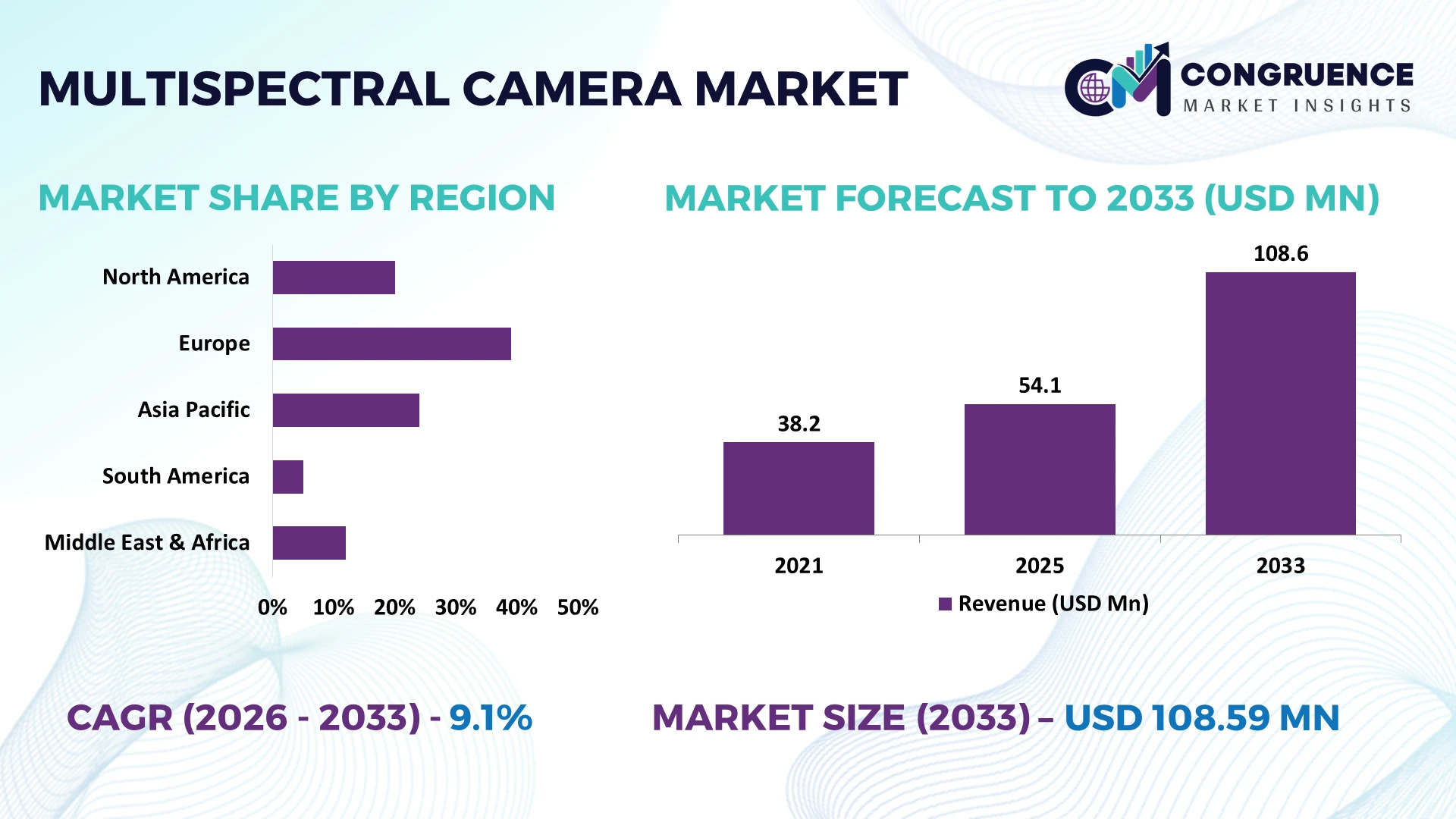
The Global Multispectral Camera Market was valued at USD 54.1 Million in 2025 and is anticipated to reach a value of USD 108.59 Million by 2033 expanding at a CAGR of 9.1% between 2026 and 2033. Growth is driven by UAV-based crop diagnostics, defense ISR modernization, environmental mapping, mineral exploration, and increasing integration of AI analytics with visible, red-edge, near-infrared, and thermal imaging bands.
The United States remains the dominant country market, supported by North America’s roughly 34–36% share of advanced drone-imaging activity and strong adoption across precision agriculture, defense, infrastructure inspection, and geospatial intelligence. U.S. agricultural operations represent about 79% of North American agricultural-drone demand, while crop monitoring and scouting accounts for approximately 38% of deployments, directly supporting multispectral payload utilization. Compared with Canada, the United States benefits from greater commercial drone density, defense procurement, and large-scale precision-farming operations. FAA Part 107 frameworks and geopolitical lessons from Ukraine have accelerated investment in compact multispectral sensing for crop intelligence, surveillance, target discrimination, and resilient remote monitoring.
Strategically, suppliers should prioritize lightweight UAV payloads, calibrated multi-band sensors, edge-AI processing, and application-specific analytics, because competitive differentiation is shifting from camera hardware toward decision-ready spectral intelligence.
Market Size & Growth: USD 54.1 million in 2025 reaches USD 108.59 million by 2033 at 9.1%, driven by precision agriculture, ISR modernization, and automated spectral analytics.
Top Growth Drivers: Precision-agriculture drone monitoring contributes 38%, large commercial farms represent 64% of agricultural-drone adoption, and North America holds about 36% of supporting aerial-imaging demand.
Short-Term Forecast: By 2028, edge-AI spectral classification is expected to reduce image-processing turnaround by approximately 25–35%, improving field-to-decision speed.
Emerging Technologies: AI-based spectral classification, SWIR integration, compact CMOS sensors, edge computing, and synchronized RGB-multispectral fusion are advancing high-growth camera architectures.
Regional Leaders: North America represents approximately USD 19 million, Asia-Pacific about USD 15 million, and Europe near USD 13 million in 2025, led by UAV, defense, and precision-farming adoption.
Consumer/End-User Trends: Crop monitoring captures roughly 38–48% of agricultural-drone applications, strengthening demand for calibrated red-edge and near-infrared imaging payloads.
Pilot/Case Example: A 2025 Indian precision-farming deployment used UAV multispectral sensing for onion yield prediction, demonstrating measurable crop-monitoring accuracy improvements over visual field assessment.
Competitive Landscape: DJI, Teledyne FLIR, MicaSense, Sentera, and Phase One compete across aerial imaging, agriculture, mapping, and industrial inspection; integrated analytics increasingly differentiates suppliers.
Regulatory & ESG Impact: Precision spraying can reduce chemical wastage by approximately 15–30% when multispectral prescription maps guide variable-rate applications, supporting lower-input agricultural operations.
Investment & Funding: Pixxel secured USD 100 million in 2026 for advanced spectral Earth-observation infrastructure, reinforcing investor confidence in multi-band imaging and decision-intelligence platforms.
Innovation & Future Outlook: Four- to six-band UAV cameras, centimeter-level RTK positioning, AI classification, and cloud analytics are shifting value from image acquisition toward automated spectral decision systems.
Multispectral Camera Market demand is strengthening across precision agriculture, defense surveillance, environmental monitoring, mineral exploration, forestry, and infrastructure inspection. Crop monitoring represents roughly 38–48% of agricultural-drone applications, while compact red-edge, NIR, SWIR, AI classification, and RTK-enabled payloads are improving actionable image quality. Defense modernization and supply-chain localization are further increasing demand for sovereign spectral-imaging capability, setting the foundation for strategic market evaluation.
Multispectral cameras are becoming strategically important because agriculture, defense, environmental monitoring, and industrial inspection increasingly require spectral information that conventional RGB imaging cannot deliver. The market is shifting toward UAV-mounted, edge-connected systems capable of generating vegetation indices, material signatures, and anomaly maps in near real time. In agriculture, precision pesticide workflows integrating multispectral sensing can reduce chemical use by 30–50% and off-target drift by 62%.
Compared with manual field inspection or RGB-only imaging, multispectral UAV systems provide centimeter-level spatial intelligence across large areas and can achieve weed-identification accuracy near 95%. The United States leads commercial UAV and defense integration, while China combines strong drone manufacturing with large-scale agricultural automation. India is expanding precision-farming deployment through UAV programs, particularly for crop monitoring and variable-rate spraying.
A practical deployment model combines multispectral cameras, RTK positioning, edge AI, and prescription mapping before autonomous spraying. Through 2026–2028, suppliers are increasing investment in lighter sensors, synchronized RGB–NIR systems, AI classification, and integrated drone partnerships. Competitive advantage will increasingly depend on delivering calibrated spectral intelligence directly into operational workflows rather than selling imaging hardware alone.
Precision agriculture is the strongest structural driver because multispectral cameras identify crop stress, nutrient deficiencies, weeds, and disease before symptoms become clearly visible to the human eye. Integrated UAV systems can reduce pesticide usage by 30–50%, lower off-target drift by 62%, and achieve weed-identification accuracy near 95% under optimized flight conditions. India and China are accelerating agricultural-drone deployment as farm operators shift toward prescription-based spraying and crop-health mapping. This converts multispectral imagery from a diagnostic tool into an input for automated field operations. Camera manufacturers are responding with lighter payloads, synchronized red-edge and NIR sensors, RTK integration, and analytics partnerships. The strategic advantage lies in connecting spectral detection directly with variable-rate application, where every imaging pass produces an actionable treatment map.
Multispectral deployments remain constrained by sensor cost, radiometric calibration requirements, payload weight, and integration complexity across UAV platforms. Advanced systems can require five to ten spectral bands, while dual-camera configurations can exceed 500 grams, reducing flight endurance and limiting compatibility with smaller drones. High-resolution crop mapping at approximately 2 cm per pixel also demands lower flight altitudes, increasing mission time and battery consumption. In countries with fragmented farm structures, these economics reduce scalability. Operators must additionally manage calibration panels, irradiance sensors, RTK corrections, and post-processing software. Manufacturers are addressing these constraints through lighter CMOS architectures, integrated sunshine sensors, standardized mounting systems, and bundled analytics. The operational pressure point is total mission economics: image quality alone does not justify deployment if sensor weight and processing requirements reduce hectares covered per flight.
The strongest future opportunity lies in combining multispectral cameras with edge AI, RTK positioning, and automated actuation. Agricultural UAV systems already achieve 10–15 hectares per hour in field operations, while prescription spraying can reduce pesticide consumption by 30–50% and response latency can fall below 200 milliseconds when edge processing is integrated. In India, this creates a path toward direct camera-to-sprayer workflows rather than separate imaging and treatment missions. Similar architectures can support mining inspection, infrastructure monitoring, forestry, and defense reconnaissance. Suppliers are investing in embedded neural processing, compact multispectral arrays, cloud-to-edge analytics, and drone OEM partnerships. The non-obvious opportunity is workflow monetization: vendors can generate recurring value through analytics subscriptions, calibrated vegetation models, automated reporting, and fleet-level spectral data management rather than relying only on camera sales.
Long-term scalability depends on producing comparable spectral measurements across cameras, altitudes, seasons, lighting conditions, and software platforms. UAV multispectral systems can capture ground sampling distances below 10 cm and classification accuracy above 90%, yet inconsistent radiometric calibration can undermine cross-season analysis. Large AI models also require thousands of labeled images; one recent agricultural dataset used 10,000 multispectral and hyperspectral samples split 70% for training, 15% for validation, and 15% for testing. Defense and infrastructure deployments add cybersecurity and data-sovereignty requirements. Suppliers must therefore invest in sensor calibration, metadata standards, secure edge computing, validation datasets, and interoperable analytics. The critical challenge is not collecting more imagery; it is ensuring that spectral outputs remain reproducible enough for automated operational decisions across different platforms, geographies, and deployment cycles.
Snapshot Imaging Gains Operational Share: Snapshot architectures are gaining ground because full-frame spectral capture removes mechanical scanning and motion distortion. Snapshot technology represents roughly 42.3% of multispectral imaging activity, while some sensor categories exceed 58% adoption. Companies are miniaturizing sensors and increasing frame rates above 60 Hz, improving suitability for drones, robotic inspection, and moving production lines.
Sensor Miniaturization Reshapes UAV Payloads: Compact multispectral systems now integrate RGB, red-edge, and NIR channels in payloads near 200 grams, reducing aircraft load and improving flight flexibility. Four-band RGB-NIR configurations commonly cover approximately 450–800 nm, while precision positioning reaches 5–10 cm. Drone-camera suppliers are redesigning optics, calibration modules, and gimbals around lighter, application-specific payload architectures.
Industrial Spectral Inspection Scales Up: Push-broom technology holds about 39.8% of multispectral industrial-camera value as food, pharmaceutical, semiconductor, and recycling facilities automate line inspection. New SWIR systems operate across approximately 1,130–1,920 nm and reach 527 frames per second. Manufacturers are integrating cameras directly with conveyor controls and machine vision, shifting spectral imaging from laboratory analysis into continuous quality assurance.
Automated Processing Replaces Manual Analysis: Multispectral workflows increasingly combine vegetation indices, machine learning, and automated image pipelines rather than requiring specialist post-processing. Agriculture-focused multispectral imaging represents about 45.8% of precision-imaging technology spending, while crop monitoring captures roughly 56.5% of agricultural-camera applications. Software developers and sensor vendors are integrating automated orthomosaics, classification, and prescription-map generation, reducing the skilled-labor bottleneck in commercial deployments.
RGB-NIR Cameras represent the leading type with an estimated 30–35% share, reflecting their favorable balance between cost, payload weight, spectral utility, and software compatibility. Four-band configurations typically combine red, green, blue, and NIR wavelengths between approximately 450 and 1,000 nm, supporting NDVI, crop-stress detection, mapping, and surveillance without the processing burden of higher-band systems. Multiband Cameras serve applications requiring additional red-edge or application-specific wavelengths and command increasing interest in agriculture and environmental analysis. Filter-Based Cameras remain important where users need selectable spectral bands and controlled laboratory or industrial measurements.
Snapshot Cameras are the fastest-strengthening type because simultaneous band acquisition reduces motion artifacts and enables higher-speed UAV and machine-vision workflows; snapshot architectures account for approximately 42% of broader multispectral imaging deployments. Push-Broom Cameras retain strategic importance in remote sensing and line inspection, where high spectral fidelity outweighs scanning complexity. Manufacturers are prioritizing compact snapshot platforms while maintaining push-broom systems for high-resolution industrial and airborne missions.
Precision Agriculture is the largest application, accounting for approximately 31–39% of multispectral imaging demand depending on system configuration, because crop health, irrigation, nutrient status, and disease detection rely directly on visible, red-edge, and NIR measurements. Agricultural monitoring data show multispectral cameras representing about 46% of imaging-system spending, while crop monitoring captures roughly 56.5% of agricultural-camera applications. Remote Sensing remains a mature application for vegetation mapping, geological observation, and land-use analysis, particularly where UAV and airborne platforms require repeatable spectral datasets.
Industrial Inspection is the fastest-growing application as multispectral systems migrate onto food, pharmaceutical, semiconductor, and recycling lines for contamination and material classification. Environmental Monitoring is expanding through water-quality assessment, forestry, habitat mapping, and pollution detection, while Surveillance remains strategically important for defense and border observation. Camera companies are responding with ruggedized housings, SWIR capability, edge processing, and platform-specific integration. Investment is shifting toward applications where spectral data directly triggers operational decisions rather than simply documenting conditions.
Agriculture Companies represent the leading end-user group with approximately 35–40% of multispectral camera demand, driven by repeated field-scanning requirements, UAV integration, vegetation-index workflows, and the measurable value of site-specific crop management. Multispectral cameras account for roughly 46% of agricultural monitoring-camera technology spending, while precision agriculture and forestry together represent about 39% of portable multispectral-imager demand. Environmental Agencies and Research Institutes remain important buyers because calibrated spectral measurements support vegetation, water, soil, and ecosystem studies requiring long-term comparability.
Industrial Manufacturers are the fastest-strengthening end-user group as multispectral cameras move into automated inspection, material sorting, and contamination detection. Defense Organizations remain high-value purchasers of ruggedized, NIR, SWIR, and surveillance-grade systems, although procurement cycles are longer and security requirements stricter. Suppliers are differentiating through agricultural analytics packages, industrial machine-vision interfaces, defense-grade ruggedization, and research calibration tools. Future demand increasingly rewards vendors capable of tailoring spectral configurations and software workflows to sector-specific operating environments.
North America accounted for the largest market share at 35.8% in 2025 however, Asia-Pacific is expected to register the fastest growth, expanding at a CAGR of 10.4% between 2026 and 2033.

UAV Intelligence Moves Into Operational Workflows
North America holds approximately 35.8% of multispectral camera demand, supported by precision agriculture, defense ISR, environmental mapping, infrastructure inspection, and research-grade remote sensing. The region benefits from mature commercial UAV operations and strong integration between sensor manufacturers, analytics developers, universities, and government agencies. Agriculture remains particularly important: crop monitoring and scouting represents approximately 38% of agricultural-drone applications, creating recurring demand for RGB-NIR and red-edge imaging. U.S. defense modernization is simultaneously increasing interest in compact multi-band payloads capable of material discrimination and low-altitude reconnaissance. FAA commercial-drone rules provide a defined operating framework for enterprise deployments. Manufacturers are responding with sub-500-gram payloads, RTK synchronization, edge processing, and standardized UAV interfaces. Competitive advantage increasingly depends on converting calibrated imagery into application-ready maps without separate specialist processing.
United States Market Outlook: The United States combines extensive commercial UAV infrastructure with defense procurement, large-scale agriculture, geospatial research, and industrial machine vision. Farms exceeding 2,000 acres represent approximately 4% of U.S. farms but control more than half of farmland, creating attractive economics for repeat multispectral surveys. Domestic buyers increasingly prioritize calibrated sensors, RTK-compatible metadata, API integration, and secure processing for high-value operational deployments.
Sustainability Rules Accelerate Precision Monitoring
Europe represents approximately 25–27% of multispectral camera demand, with Germany, France, the United Kingdom, the Netherlands, and Spain supporting agricultural, industrial, research, and environmental deployments. Precision-farming requirements are becoming more operationally significant as EU policy targets a 50% reduction in chemical pesticide use and risk by 2030, increasing the value of spectral crop diagnostics and targeted intervention. Multispectral cameras are also deployed for forest-health assessment, water-quality monitoring, recycling automation, food inspection, and research imaging. Germany provides particularly strong machine-vision and industrial automation capability, while France and Spain offer extensive agricultural applications. Suppliers are integrating cameras with autonomous UAVs, robotics, GIS platforms, and machine-learning software. Europe's distinctive competitive requirement is measurement traceability: calibrated spectral outputs increasingly matter because sustainability reporting and input optimization require comparable data across repeated monitoring cycles.
Germany Market Outlook: Germany combines advanced machine vision, automation engineering, agricultural technology, and environmental monitoring infrastructure. Manufacturing accounts for approximately one-fifth of national economic output, creating substantial potential for spectral inspection in food processing, recycling, chemicals, and advanced materials. German customers emphasize measurement stability, industrial interfaces, calibration accuracy, and integration with automated production systems, favoring technically differentiated camera suppliers over basic imaging vendors.
Drone Manufacturing Scale Lowers Deployment Costs
Asia-Pacific accounts for approximately 28–30% of multispectral camera demand and combines large agricultural areas with concentrated drone, electronics, optical-component, and semiconductor manufacturing. China provides exceptional UAV production scale and increasingly sophisticated precision-agriculture deployments, while India is expanding agricultural drone adoption through government-supported mechanization and digital-farming initiatives. Japan, South Korea, and Australia contribute advanced remote sensing, industrial inspection, mining, and environmental applications. China supplies more than 70% of global commercial drones, giving domestic multispectral-camera integrators access to established aircraft, gimbal, battery, and communications ecosystems. India is simultaneously developing indigenous drone manufacturing and service networks. Sensor companies are responding with compact RGB-NIR modules, integrated irradiance sensors, lower-cost payloads, and application software. The region's structural advantage is rapid hardware iteration: proximity between sensor, electronics, and UAV production compresses product-development and integration cycles.
China Market Outlook: China combines the world's largest commercial-drone manufacturing base with extensive agricultural acreage, electronics production, and expanding remote-sensing capability. DJI's dominant position in civilian UAV manufacturing creates an established integration ecosystem for specialized payload developers. Chinese suppliers increasingly compete through miniaturized optics, embedded AI, integrated gimbals, and aggressive hardware economics, while domestic agricultural modernization provides a large testing environment for automated crop-monitoring technologies.
Large Farms Favor Aerial Crop Intelligence
South America represents approximately 5–6% of multispectral camera demand, with Brazil providing the strongest commercial base through soybean, maize, sugarcane, coffee, forestry, and livestock operations. Large farm sizes improve UAV economics because one multispectral flight can survey substantially more acreage than manual scouting. Brazil cultivates more than 45 million hectares of soybeans, creating a substantial addressable environment for crop-health mapping, disease identification, stand counting, and variable-rate management. Argentina adds demand through grain production, while Chile uses spectral imaging in vineyards, mining, and environmental assessment. Deployment remains constrained by imported sensor costs, technical skills, and connectivity in remote agricultural areas. Vendors are responding through agricultural-drone partnerships, local distributors, cloud processing, and service-based imaging models. Service providers are particularly important because they allow farms to access spectral intelligence without purchasing specialized camera fleets.
Brazil Market Outlook: Brazil offers the strongest country opportunity through industrial-scale agriculture and an established commercial drone ecosystem. Soybean acreage exceeds 45 million hectares, while sugarcane occupies roughly 8 million hectares, supporting repeat crop-surveillance requirements. Multispectral service providers increasingly combine UAV flights with NDVI, red-edge analysis, prescription maps, and agronomic interpretation, converting camera deployment into recurring farm-management services rather than one-time equipment purchases.
Resource Constraints Prioritize Spectral Monitoring
Middle East & Africa represents approximately 4–5% of multispectral camera demand, with adoption concentrated in water-stressed agriculture, mineral exploration, environmental surveillance, security, and infrastructure monitoring. Saudi Arabia and the UAE are investing in precision agriculture and food-security technologies where multispectral sensing supports irrigation optimization and early plant-stress detection. Agriculture consumes approximately 70% of global freshwater withdrawals, making crop-level water intelligence particularly relevant across arid Gulf economies and African farming systems. South Africa adds mining, commercial agriculture, conservation, and surveying demand. Infrastructure limitations and specialist shortages constrain broader deployment across lower-income countries, encouraging drone-as-a-service models. Suppliers are forming partnerships with UAV operators, agritech providers, mining contractors, and research institutions. Commercial success depends on ruggedized equipment and analytics capable of operating under high temperatures, dust, variable connectivity, and limited field-support conditions.
South Africa Market Outlook: South Africa combines sophisticated commercial agriculture, mining operations, conservation programs, and established UAV service providers. Agriculture uses roughly 60% of national water resources, increasing the operational value of multispectral irrigation and crop-stress monitoring. Mining operators also require spectral information for geological mapping, rehabilitation assessment, and environmental compliance, giving camera suppliers a diversified application base beyond agriculture.
Teledyne FLIR, Phase One, Headwall Photonics, Specim, and Cubert compete through imaging performance against Sentera, Spectral Devices, and UAV-focused integrators emphasizing lightweight deployment and application software. The top five suppliers collectively control approximately 42% of multispectral camera demand, leaving specialized niches open to application-focused vendors. Snapshot architectures capture about 42% of broader deployments, while push-broom systems hold roughly 40% of industrial spectral imaging; compact payloads can reduce sensor weight by over 50% versus older multi-camera assemblies. Teledyne and Headwall compete through sensor depth and industrial integration, while Sentera targets agriculture through analytics-linked UAV workflows. Suppliers are expanding partnerships with drone OEMs, machine-vision integrators, and software developers. Competition is shifting from spectral-band count toward edge analytics, calibration stability, and workflow integration. Entry barriers center on optical calibration, application datasets, ruggedization, and integration expertise. Winning requires reliable spectral accuracy, lighter hardware, application-specific analytics, and seamless platform interoperability at operational scale.
Teledyne FLIR
Phase One
Headwall Photonics
Specim
Cubert GmbH
Sentera
Spectral Devices Inc.
BaySpec, Inc.
Photonfocus AG
SAL Engineering
Mapir Camera
Resonon Inc.
JAI A/S
imec
Current multispectral camera technology centers on synchronized RGB-NIR sensors, radiometric calibration, global-shutter CMOS imagers, RTK geotagging, and UAV integration. Five-band systems capture blue, green, red, red-edge, and NIR simultaneously, while 20MP RGB channels deliver centimeter-scale mapping. Integrated calibration and onboard registration can cut post-processing effort by roughly 20–30%, giving agriculture and surveying operators faster, repeatable field intelligence than separate sensor workflows.
Emerging platforms combine multispectral, thermal, SWIR, edge AI, and high-speed snapshot imaging. Integrated payloads weigh about 280–290 grams while storing up to 512GB, supporting single-flight collection across multiple spectral layers. Compared with older multi-camera assemblies, integrated sensors can reduce payload mass by more than 50% and eliminate repeated missions. Industrial users benefit from push-broom systems exceeding 500 frames per second, enabling spectral classification on moving production lines.
Through 2026–2028, disruptive development will center on mosaic-filter snapshot sensors, embedded neural processors, adaptive band selection, and automated camera-to-action workflows. Agricultural models already demonstrate crop-growth prediction R² values above 0.90 in controlled deployments. Camera manufacturers, drone OEMs, and analytics providers integrating calibration, edge inference, and interoperable software will gain advantage. Acting now matters because proprietary spectral datasets and validated application models increasingly determine performance, switching costs, and recurring software value.
March 2024 Sentera expanded 6X Multispectral and 65R sensor compatibility to Inspired Flight’s IF800 Tomcat and IF1200 platforms, enabling science-grade multispectral mapping on two U.S.-built UAV systems and widening deployment options for agriculture, research, and government operators requiring compliant aerial-imaging workflows. Source: inspiredflight.com
September 2025 Specim launched the SX25 SWIR hyperspectral camera with 640 spatial pixels, up to 392 selectable spectral bands, 8-nm spectral resolution, and 162-fps operation, strengthening high-throughput material inspection, mineral classification, food analysis, and research applications requiring repeatable spectral measurements. Source: automation.com
May 2025 Nanjing Agricultural University researchers introduced the SMICGS UAV snapshot multispectral sensor; field models achieved R² values of 0.89 for rice leaf-area index and 0.93 for biomass, demonstrating real-time, non-destructive crop monitoring with simplified mosaic-filter optics and processing. Source: pubmed.ncbi.nlm.nih.gov
February 2026 Specim introduced the FX19 high-speed extended-NIR hyperspectral camera with 640 spatial pixels and operation reaching 527 frames per second, expanding real-time material identification for plastics, textiles, e-waste and industrial sorting lines requiring faster spectral inspection. Source: specim.com
The Multispectral Camera Market Report evaluates RGB-NIR Cameras, Multiband Cameras, Snapshot Cameras, Push-Broom Cameras, and Filter-Based Cameras across Precision Agriculture, Remote Sensing, Environmental Monitoring, Industrial Inspection, and Surveillance. Agriculture-related deployments represent approximately 35–40% of end-user demand, while snapshot architectures are gaining relevance where simultaneous spectral acquisition, compact payloads, and motion-free imaging determine operational performance.
Regional coverage includes North America, Europe, Asia-Pacific, South America, and Middle East & Africa, assessing UAV infrastructure, agricultural digitization, defense procurement, industrial automation, and environmental monitoring. Technology analysis covers CMOS sensors, SWIR, RGB-NIR fusion, radiometric calibration, RTK positioning, edge AI, snapshot imaging, and automated spectral classification. The 2026–2033 framework supports investment planning, geographic expansion, technology partnerships, competitive positioning, and product-development decisions by identifying application-specific adoption patterns and emerging opportunities in automated inspection, precision farming, resource monitoring, and intelligent aerial sensing.
| Report Attribute/Metric | Report Details |
|---|---|
Market Revenue in 2025 | USD 54.1 Million |
Market Revenue in 2033 | USD 108.59 Million |
CAGR (2026 - 2033) | 9.1% |
Base Year | 2025 |
Forecast Period | 2026 - 2033 |
Historic Period | 2021 - 2025 |
Segments Covered | By Type
By Application
By End-User
|
Key Report Deliverable | Revenue Forecast, Growth Trends, Market Dynamics, Segmental Overview, Regional and Country-wise Analysis, Competition Landscape |
Region Covered | North America, Europe, Asia-Pacific, South America, Middle East, Africa |
Key Players Analyzed | Teledyne FLIR, Phase One, Headwall Photonics, Specim, Cubert GmbH, Sentera, Spectral Devices Inc., BaySpec, Inc., Photonfocus AG, SAL Engineering, Mapir Camera, Resonon Inc., JAI A/S, imec |
Customization & Pricing | Available on Request (10% Customization is Free) |




