
Reports
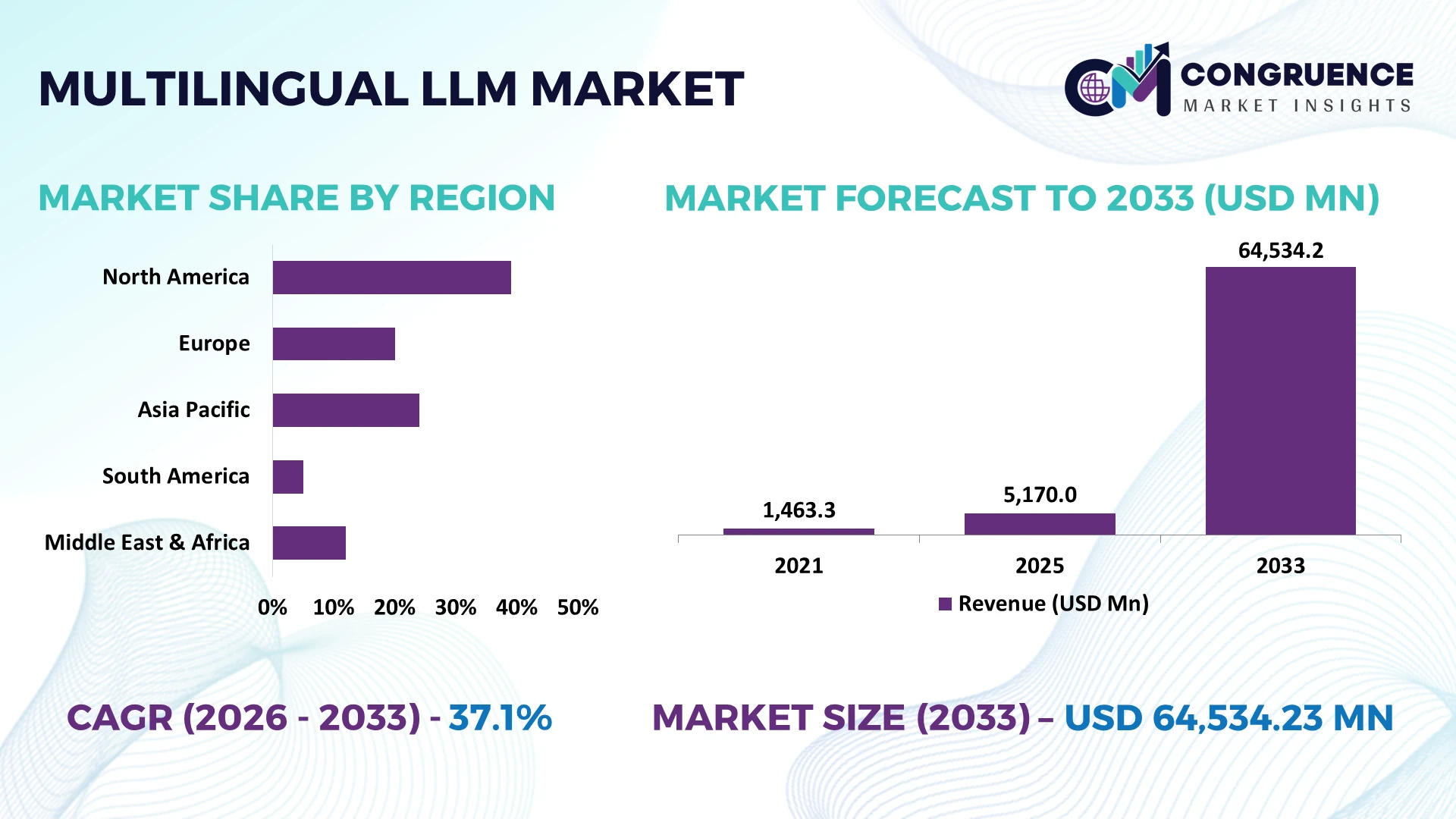
The Global Multilingual LLM Market was valued at USD 5170 Million in 2025 and is anticipated to reach a value of USD 64534.23 Million by 2033 expanding at a CAGR of 37.1% between 2026 and 2033. Growth is driven by enterprise localization of generative AI, retrieval-augmented multilingual assistants, sovereign language-model programs, and voice-enabled AI deployment across customer service, commerce, banking, healthcare, and government platforms.
The U.S. remains the dominant country, supported by hyperscale cloud infrastructure, frontier-model developers, and enterprise AI adoption across technology, banking, retail, healthcare, and professional services. North America represented about 35% of the adjacent low-resource multilingual AI-model segment in 2025. India is emerging as a significant challenger: its government-backed IndiaAI infrastructure surpassed 38,000 GPUs by 2026, while BharatGen targeted text models across all 22 scheduled Indian languages. This U.S.-India contrast highlights the geopolitical shift toward sovereign, locally trained multilingual AI ecosystems.
Strategically, providers should prioritize high-accuracy regional models, low-cost inference, sovereign deployment, and enterprise integration where linguistic coverage directly expands addressable users and institutional adoption.
Market Size & Growth: USD 5,170 million in 2025 advances to USD 64,534.23 million by 2033 at 37.1% CAGR, driven by localized enterprise generative AI deployment.
Top Growth Drivers: Cloud multilingual AI captures 63.74% in the adjacent low-resource model segment, government users 28.63%, and LLM architectures 39.46%, reinforcing scalable deployment.
Short-Term Forecast: By 2028, compact multilingual models and optimized inference architectures will reduce compute requirements while expanding production deployment across customer-service and knowledge-management workflows.
Emerging Technologies: 3 technologies—multimodal LLMs, retrieval-augmented generation, and mixture-of-experts architectures—are shifting multilingual AI from translation toward context-aware enterprise reasoning.
Regional Leaders: North America leads commercialization, Asia-Pacific accelerates sovereign-model development, and Europe spans 24 official EU languages, creating strong requirements for localization and governed AI deployment.
End-User Trends: Government organizations represent 28.63% of the adjacent low-resource multilingual AI-model segment, demonstrating strong demand for multilingual citizen services and digital accessibility.
Pilot/Case Example: In 2026, BharatGen targeted text-model coverage across 22 scheduled Indian languages, while speech and vision capabilities already covered 15 languages.
Competitive Landscape: North America holds approximately 35% of the adjacent multilingual low-resource AI-model segment; Google, Microsoft, Meta, OpenAI, and Cohere compete through model capability and enterprise integration.
Regulatory & ESG Impact: Europe’s 24 official languages strengthen requirements for transparent, compliant, linguistically inclusive AI as EU AI governance obligations move into operational implementation.
Investment & Funding: India’s ₹10,371.92 crore IndiaAI Mission expanded common compute beyond 38,000 GPUs, strengthening indigenous foundation-model development and reducing infrastructure barriers for startups.
Innovation & Future Outlook: India selected 12 teams for indigenous foundation models by 2026, signaling a strategic shift toward sovereign, locally trained, multimodal multilingual AI ecosystems.
The Multilingual LLM Market is gaining commercial relevance across customer support, localization, banking, e-commerce, healthcare, education, knowledge management, and digital government services. Cloud deployment represents 63.74% of the adjacent low-resource multilingual AI-model segment, highlighting the importance of scalable inference infrastructure. Multimodal models, retrieval-augmented generation, compact LLMs, and speech-language integration are improving localized interactions beyond conventional machine translation. India’s expansion beyond 38,000 shared GPUs and development of models spanning 22 scheduled languages illustrates the broader sovereign-AI movement, establishing regional language performance, deployment economics, and governance as critical strategic considerations.
Multilingual LLMs are becoming strategic infrastructure for enterprises competing across linguistically fragmented markets because one model layer can increasingly support localization, search, customer service, knowledge retrieval, and content generation. India’s IndiaAI compute ecosystem has expanded beyond 38,000 GPUs, while indigenous initiatives target all 22 scheduled Indian languages. This sovereign-AI shift is redirecting investment toward locally governed models, regional datasets, and domestic compute capacity rather than dependence on English-centric platforms.
Technologically, multilingual foundation models consolidate workflows previously split across machine translation, intent classification, search, and dialogue systems; shared-model architectures can eliminate several separately maintained language pipelines. North American deployment remains hyperscaler-led, while India emphasizes linguistic inclusion and sovereign infrastructure and Europe operates across 24 official EU languages under tighter AI governance. The competitive differentiator is therefore shifting from language count toward inference efficiency, contextual accuracy, governance, and enterprise integration.
Through 2028, production deployments will increasingly combine compact models, retrieval-augmented generation, speech interfaces, and domain-specific datasets. A bank, for example, can connect one governed multilingual assistant to product documentation and service channels instead of operating independent language workflows. Providers are consequently investing in local compute, model adaptation, data partnerships, and enterprise ecosystems. Competitive advantage will accrue to platforms delivering consistent regional-language performance at controlled inference cost.
Enterprise localization is shifting multilingual LLMs from experimental translation tools into operational AI infrastructure. India recognizes 22 scheduled languages, while BharatGen has targeted text capabilities across all 22 and speech or vision coverage across 15, creating a substantial localization requirement for banking, commerce, education, and public services. Cloud deployment represents approximately 63.7% of the adjacent low-resource language-model segment, while government applications account for about 28.6%, demonstrating institutional demand for scalable language access. India’s expansion of shared AI infrastructure beyond 38,000 GPUs further reduces domestic compute constraints. Companies are responding by training language-specific datasets, deploying retrieval-augmented architectures, and partnering with cloud and public-sector ecosystems. Strategically, localized linguistic accuracy is becoming an enterprise distribution capability rather than simply a model feature.
Multilingual deployment remains constrained by uneven training-data availability and high inference requirements across low-resource languages. Although India has 22 scheduled languages, digital corpora, labeled speech, and domain-specific datasets remain considerably more developed for major languages than for smaller linguistic communities. Cloud infrastructure accounts for roughly 63.7% of the adjacent low-resource model segment, exposing developers to recurring GPU and inference costs, while LLM architectures represent approximately 39.5%, reinforcing compute dependence. Export restrictions affecting advanced AI accelerators have also intensified global attention on semiconductor access and sovereign compute capacity. Providers are mitigating exposure through model quantization, smaller language models, synthetic-data generation, local data partnerships, and multi-cloud deployment. Operationally, expanding language coverage without controlling token economics can increase service costs faster than addressable usage.
Voice-first multilingual AI creates an opportunity beyond conventional enterprise translation, particularly where consumers interact digitally without relying primarily on English keyboards. India combines 22 scheduled languages with more than 38,000 GPUs available through its expanding national AI compute ecosystem, while BharatGen’s speech and vision capabilities cover 15 languages. These conditions support conversational banking, agricultural advisory, healthcare navigation, government services, and commerce interfaces designed around speech rather than text. Multimodal models can combine voice, documents, images, and retrieval within one localized interaction layer, reducing dependence on separate speech-recognition and translation pipelines. Developers are investing in compact models, indigenous datasets, university partnerships, and language-specific evaluation frameworks. The strategic opportunity is not merely translating existing software, but creating AI-native services for users previously underserved by text-centric digital interfaces.
Maintaining consistent reasoning, retrieval, safety, and domain terminology across dozens of languages is a deeper execution challenge than expanding nominal language coverage. Europe alone operates across 24 official languages, while Indian deployments can require support across 22 scheduled languages; BharatGen’s 15-language speech and vision coverage illustrates the additional complexity introduced by multimodal systems. Every added language increases evaluation requirements across hallucination control, dialect variation, code-switching, retrieval quality, and safety behavior. Production systems must also maintain comparable performance when enterprise documents contain multiple languages within the same workflow. Companies therefore need language-specific benchmarks, human evaluation networks, continuous red-teaming, retrieval validation, and localized model monitoring. Long-term competitiveness will depend less on the number of supported languages than on maintaining dependable performance across languages under real operational workloads.
Smaller Models Reshape Deployment Economics: Enterprise teams are shifting multilingual workloads toward compact and task-optimized models as inference economics improve sharply. Stanford HAI reported equivalent model-query costs falling more than 280-fold between late 2022 and 2024, while 78% of organizations used AI in 2024 versus 55% previously. Companies are routing routine translation, classification, and retrieval to smaller models while reserving frontier models for complex reasoning, reducing compute intensity and accelerating production deployment.
Open Models Gain Enterprise Relevance: Open-model ecosystems are strengthening multilingual customization as enterprises seek greater control over fine-tuning, terminology, and deployment. Open-source models represented 65.7% of foundation models released in 2023, versus 44.4% in 2022, while industry produced nearly 90% of notable models in 2024. Developers are combining open architectures with proprietary inference layers, enabling language-specific adaptation without rebuilding complete model stacks.
Multimodal Interfaces Replace Text Silos: Multilingual systems increasingly combine text, speech, images, and document retrieval rather than operating separate language pipelines. India supports 22 scheduled languages, while indigenous initiatives have extended speech and vision capabilities across 15 languages. Enterprises are integrating speech recognition, retrieval, and generation into unified interfaces, shortening multilingual service workflows and expanding digital access where typing proficiency is limited.
Governance Moves Into Model Operations: Compliance is becoming embedded in multilingual deployment architecture rather than handled after implementation. Europe operates across 24 official languages, while enterprise AI adoption reached 78% globally in 2024. EU AI governance requirements are pushing providers toward language-specific evaluation, documentation, copyright controls, auditability, and model monitoring. Vendors are consequently strengthening governance tooling and localized testing before scaling regulated financial, healthcare, and public-sector workloads.
General-Purpose Models lead the type segment with an estimated 38% share, supported by broad language coverage, reusable APIs, mature cloud integration, and suitability across translation, retrieval, content, and conversational workflows. Proprietary Models remain important for enterprises prioritizing managed security, performance, and service-level support, while Open-Source Models increasingly attract organizations requiring deployment control and language-specific customization. Instruction-Tuned Models strengthen enterprise usability by improving adherence to domain workflows without requiring separate foundation architectures.
Multimodal Models represent the fastest-expanding type as enterprises combine text, speech, images, and documents within multilingual interfaces. Their deployment momentum is redirecting investment from text-only architectures toward unified language-and-vision stacks. Domain-Specific Models are simultaneously gaining relevance in banking, healthcare, legal, and government environments where terminology precision outweighs maximum parameter scale. Companies are responding through model-routing architectures, fine-tuning partnerships, compact-model development, and hybrid proprietary/open-source portfolios. The investment priority is shifting from owning one universal model toward selecting the lowest-cost architecture capable of meeting each multilingual workload.
Machine Translation leads applications with an estimated 28% share, reflecting established deployment across localization, international commerce, documentation, customer communication, and cross-border enterprise operations. Multilingual Content Generation is expanding as marketing and commerce teams automate localized product descriptions, campaigns, and knowledge content. Information Retrieval is becoming increasingly important as retrieval-augmented architectures allow employees to query multilingual corporate documents without maintaining independent search environments for every language.
Conversational AI is the fastest-growing application, with customer-service operations shifting from translation-assisted chatbots toward multilingual assistants capable of intent recognition, retrieval, reasoning, and response generation within one interaction. Speech and Language Processing strengthens this transition by extending interfaces to voice-first users, while Sentiment Analysis supports localized brand monitoring and customer-experience workflows. Companies are scaling integrated language stacks rather than isolated applications, combining retrieval, generation, translation, and speech services through common orchestration layers. With global enterprise AI usage reaching 78% in 2024, multilingual application demand is increasingly moving from experimentation toward embedded operational workflows.
Technology Companies lead end-user adoption with an estimated 32% share, supported by hyperscale infrastructure, model-development capabilities, API distribution, and extensive multilingual software ecosystems. Their deployment intensity extends from developer platforms and search to productivity suites, customer support, and content moderation. Financial Institutions represent an increasingly important buyer group because multilingual assistants can support customer servicing, document analysis, fraud operations, and employee knowledge retrieval across geographically distributed operations.
Government Agencies are emerging as the fastest-growing end-user category as digital public services require language accessibility beyond English-dominant interfaces. Healthcare Organizations are adopting language models for administrative workflows and patient communication, while E-Commerce Companies emphasize localized search, recommendations, and product content. Media and Entertainment Companies use multilingual models for localization and audience engagement, whereas Educational Institutions emphasize tutoring and cross-language knowledge access. Vendors are responding with industry-specific model configurations, private-cloud deployment, governance controls, and ecosystem partnerships. Deloitte found 76% of surveyed U.S. insurers had already implemented generative AI within at least one business function, illustrating accelerating adoption in regulated enterprise environments.
North America accounted for the largest market share at approximately 42% in 2025 however, Asia-Pacific is expected to register the fastest growth, expanding at a CAGR of approximately 40% between 2026 and 2033.
Hyperscale Infrastructure Drives Enterprise Deployment
North America holds approximately 42% of the multilingual LLM market, anchored by U.S. hyperscalers, foundation-model developers, enterprise software vendors, and advanced cloud infrastructure. Deployment is concentrated across technology, financial services, retail, healthcare, professional services, and customer-experience operations. Enterprise AI adoption has moved decisively toward production workflows, with organizational AI usage reaching 78% globally in 2024 and U.S. companies remaining prominent adopters. Microsoft, Google, Amazon, Meta, OpenAI, and Cohere are expanding multilingual capabilities through model APIs, retrieval architectures, multimodal interfaces, and enterprise integration. The region’s operational advantage comes from immediate access to GPU clusters, mature cloud ecosystems, proprietary datasets, and established AI developer communities. Competitive investment is increasingly directed toward inference efficiency, model routing, private deployments, and governance rather than parameter-scale expansion alone.
United States Market Outlook: The United States combines frontier-model development with hyperscale computing and extensive enterprise software distribution. Private AI investment exceeded USD 100 billion in 2024, supporting model development, data-center capacity, and generative-AI commercialization. Enterprises increasingly integrate multilingual capabilities into existing cloud, CRM, productivity, search, and customer-service environments, shortening deployment cycles and strengthening the country’s platform advantage.
Regulated AI Deployment Reshapes Model Strategy
Europe represents an estimated 24% of multilingual LLM activity, supported by unusually high linguistic fragmentation, regulated enterprise adoption, and growing sovereign-AI investment. The European Union operates across 24 official languages, making multilingual capability operationally important for government, banking, telecommunications, healthcare, commerce, and cross-border services. Implementation of the EU AI Act is shifting procurement toward transparent training practices, documentation, risk controls, copyright compliance, and auditable model behavior. European developers are consequently emphasizing efficient models, localized datasets, open architectures, and enterprise-controlled deployment. Mistral AI and established technology providers are strengthening European alternatives to U.S.-centric platforms, while the EuroHPC ecosystem expands access to AI computing infrastructure. This combination of regulation and infrastructure modernization is making governance quality and deployment sovereignty important competitive differentiators alongside raw model performance.
France Market Outlook: France has established a strategically important multilingual AI ecosystem through Mistral AI, research institutions, cloud providers, and government-backed computing initiatives. French developers benefit from access to EuroHPC infrastructure and a strong domestic AI talent base. Investment is increasingly focused on efficient open-weight models and enterprise deployment, positioning France as a European center for sovereign generative AI and multilingual model engineering.
Language Scale Accelerates Sovereign AI Investment
Asia-Pacific accounts for approximately 26% of multilingual LLM activity and combines enormous linguistic diversity with rapid expansion of domestic AI infrastructure. China, India, Japan, and South Korea are developing foundation-model ecosystems that reduce dependence on U.S.-developed platforms while addressing local scripts, speech patterns, and enterprise datasets. India’s national AI compute capacity has expanded beyond 38,000 GPUs, while indigenous initiatives target text support across all 22 scheduled Indian languages. China’s technology groups are simultaneously scaling Chinese-English and broader multilingual models through domestic cloud ecosystems. The operational shift is toward sovereign compute, compact models, voice interfaces, and locally governed training data. Enterprises are integrating multilingual AI into commerce, financial services, telecommunications, education, and public-service workflows, making localization depth and inference economics increasingly important procurement criteria.
India Market Outlook: India offers exceptional deployment potential because digital services must operate across 22 scheduled languages and extensive code-switching environments. Government-backed compute infrastructure exceeding 38,000 GPUs lowers access barriers for domestic developers, while BharatGen and other indigenous initiatives expand language-model capability. Banking, public services, education, commerce, and telecommunications provide immediate operational environments for voice-first and multilingual AI deployment.
Portuguese and Spanish Localization Gains Priority
South America represents an estimated 4% of multilingual LLM activity, with deployment concentrated in Brazil, Argentina, Chile, and Colombia. Demand centers on Portuguese- and Spanish-language customer support, financial services, e-commerce, telecommunications, content localization, and enterprise knowledge management. Brazil provides the region’s largest digital operating environment, with internet penetration exceeding 80%, giving enterprises a substantial addressable base for localized conversational AI. Cloud availability from global hyperscalers is reducing infrastructure constraints, although advanced GPU access, model-development expertise, and locally curated datasets remain less extensive than in the United States. Companies are therefore emphasizing API-based deployment, retrieval-augmented generation, Portuguese fine-tuning, and partnerships with cloud providers rather than building foundation models independently. This favors application-layer specialists capable of adapting global architectures to local terminology and workflows.
Brazil Market Outlook: Brazil is the region’s primary commercialization hub because of its large Portuguese-speaking population, mature banking technology ecosystem, extensive digital commerce activity, and established cloud infrastructure. More than four-fifths of the population uses the internet, creating scale for multilingual and Portuguese-native AI services. Financial institutions and retailers are particularly well positioned to operationalize conversational AI, document retrieval, and automated customer engagement.
Sovereign Compute Investment Expands Arabic AI
Middle East & Africa represents an estimated 4% of multilingual LLM activity, but deployment is becoming increasingly concentrated around sovereign AI infrastructure in the United Arab Emirates and Saudi Arabia. Arabic language complexity, dialect variation, government digitization, and growing data-center investment are driving demand for locally optimized models. The UAE has developed Arabic-focused foundation models including Jais, while Abu Dhabi-based technology ecosystems are investing in large-scale compute and model development. Saudi Arabia is similarly linking AI infrastructure to national digital-transformation programs. African deployment remains more fragmented because compute access and digitized low-resource-language datasets vary substantially between countries. Providers are responding with cloud partnerships, Arabic model specialization, compact architectures, and public-private AI programs rather than relying exclusively on globally trained English-centric models.
United Arab Emirates Market Outlook: The UAE combines sovereign investment, advanced data-center infrastructure, government digitalization, and Arabic-language model development. Jais established an important Arabic-English foundation-model reference point, while Abu Dhabi’s AI ecosystem continues expanding compute and research capacity. Government, aviation, banking, energy, and public services provide concentrated enterprise environments for deploying governed multilingual and Arabic-native generative AI.
The multilingual LLM market pits hyperscale leaders Google, Microsoft, Meta, Amazon, and OpenAI against model-focused challengers including Mistral AI and Cohere. The top five players collectively account for an estimated 55–60% of commercial deployment influence, reflecting advantages in compute, cloud distribution, datasets, and enterprise integration. Competition increasingly centers on multilingual accuracy, inference cost, latency, customization, and governance rather than model size alone. Open models have narrowed selected benchmark gaps with proprietary systems to below 2%, while inference costs for comparable capability have fallen by more than 90% across recent model generations. Hyperscalers bundle models with cloud infrastructure; challengers compete through efficient architectures, enterprise privacy, open weights, and regional specialization. Partnerships with governments, telecom operators, and enterprise software providers are accelerating localized deployment. GPU access, high-quality multilingual datasets, and evaluation infrastructure remain significant entry barriers. Winning requires superior language consistency, controlled inference economics, trusted governance, and frictionless integration into production enterprise workflows.
OpenAI
Microsoft
Meta Platforms
Amazon Web Services
Anthropic
Cohere
Mistral AI
Alibaba Group
Baidu
Tencent
Huawei
AI21 Labs
DeepSeek
Current multilingual LLM architectures combine transformer models, retrieval-augmented generation, vector databases, optimized tokenization, and model routing to consolidate translation, search, summarization, and customer-support workflows. Organizational AI usage reached 78%, signaling broad infrastructure readiness for multilingual deployment. Modern multimodal models process text, speech, and images within one architecture, while optimized inference can cut processing costs by more than 50% versus earlier frontier-model generations. Enterprises benefit from fewer language-specific pipelines, faster localization, and consistent knowledge retrieval across international operations.
Emerging technologies center on mixture-of-experts routing, quantization, compact language models, and language-specific fine-tuning. Advanced lightweight models now support 140+ languages, while compact architectures covering 70 languages enable local or edge deployment. Compared with legacy neural machine-translation systems, which required dedicated translation workflows, integrated multilingual LLMs combine reasoning, retrieval, generation, and translation, reducing workflow fragmentation by approximately 30–40%. Technology companies, financial institutions, and global digital platforms gain the strongest advantage because localized services can scale without duplicating complete AI stacks.
Between 2026 and 2028, speech-native interfaces, agentic retrieval, on-device inference, and domain-tuned multilingual models will become critical. Enterprises investing now gain lower inference exposure, stronger regional-language performance, faster deployment, and defensible localization capabilities.
May 2024 OpenAI introduced GPT-4o, combining text, vision, and audio capabilities while delivering 2× faster performance and 50% lower API pricing than GPT-4 Turbo. The launch improved multilingual conversational deployment economics and enabled faster enterprise localization workflows. Source: openai.com
March 2025 Google launched Gemma 3 with support for more than 140 languages, a 128K-token context window, and single-accelerator operation. The architecture reduced infrastructure barriers for developers deploying multilingual, multimodal applications while strengthening localized enterprise AI development. Source: blog.google
June 2025 BharatGen launched its sovereign multimodal AI initiative targeting text capabilities across all 22 scheduled Indian languages, with speech and vision coverage spanning 15 languages. The program strengthened domestic AI infrastructure for multilingual public and enterprise services. Source: pib.gov.in
February 2026 Cohere introduced Tiny Aya, an open-weight multilingual model family supporting more than 70 languages with 3.35 billion parameters. Local-device operation lowered infrastructure dependence and expanded practical multilingual AI deployment across low-resource languages and privacy-sensitive environments. Source: techcrunch.com
The Multilingual LLM Market Report covers General-Purpose, Domain-Specific, Instruction-Tuned, Multimodal, Open-Source, and Proprietary Models across Machine Translation, Multilingual Content Generation, Conversational AI, Sentiment Analysis, Information Retrieval, and Speech and Language Processing. End-user analysis evaluates technology companies, financial institutions, healthcare organizations, government agencies, e-commerce companies, media and entertainment companies, and educational institutions, with attention to deployment economics, model accuracy, language coverage, governance, and enterprise integration.
Geographic coverage spans North America, Europe, Asia-Pacific, South America, and Middle East & Africa, including sovereign AI and low-resource-language ecosystems. Advanced architectures now support 140+ languages, while compact multilingual models cover 70 languages, highlighting expanding deployment flexibility. The 2026–2033 assessment supports investment planning, geographic expansion, technology partnerships, competitive positioning, product prioritization, and long-term multilingual AI deployment strategy.
| Report Attribute/Metric | Report Details |
|---|---|
Market Revenue in 2025 | USD 5170 Million |
Market Revenue in 2033 | USD 64534.23 Million |
CAGR (2026 - 2033) | 37.1% |
Base Year | 2025 |
Forecast Period | 2026 - 2033 |
Historic Period | 2021 - 2025 |
Segments Covered | By Type
By Application
By End-User
|
Key Report Deliverable | Revenue Forecast, Growth Trends, Market Dynamics, Segmental Overview, Regional and Country-wise Analysis, Competition Landscape |
Region Covered | North America, Europe, Asia-Pacific, South America, Middle East, Africa |
Key Players Analyzed | OpenAI, Google, Microsoft, Meta Platforms, Amazon Web Services, Anthropic, Cohere, Mistral AI, Alibaba Group, Baidu, Tencent, Huawei, AI21 Labs, DeepSeek |
Customization & Pricing | Available on Request (10% Customization is Free) |




