
Reports
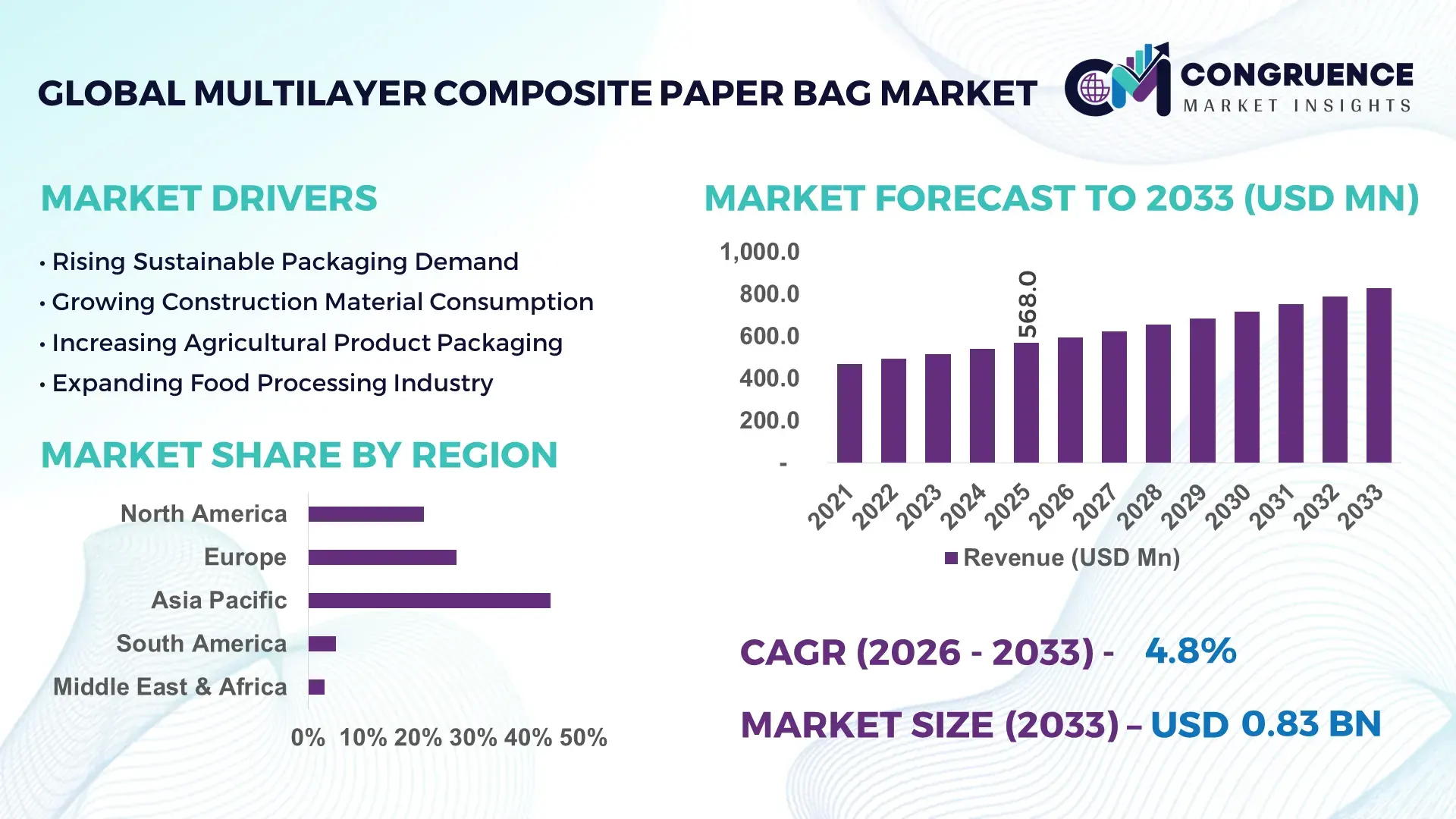
The Global Multilayer Composite Paper Bag Market was valued at USD 568.0 Million in 2025 and is anticipated to reach a value of USD 827.8 Million by 2033 expanding at a CAGR of 4.82% between 2026 and 2033. The market is accelerating due to the rapid replacement of plastic-based industrial packaging with multilayer composite paper formats across cement, chemicals, food ingredients, and agricultural supply chains, where moisture resistance and load-bearing efficiency improved by over 28% compared to conventional single-wall paper packaging. Between 2024 and 2026, tightening global packaging waste regulations, rising EU Extended Producer Responsibility compliance mandates, and supply-chain restructuring after Red Sea logistics disruptions forced manufacturers to localize sustainable packaging production and optimize raw-material sourcing strategies.
China dominates the global Multilayer Composite Paper Bag Market with approximately 31% production share, supported by over 2,000 industrial packaging facilities and aggressive investments in automated kraft paper converting systems. The country expanded high-barrier paper sack manufacturing capacity by nearly 18% between 2023 and 2025, largely driven by cement, construction chemicals, and food export industries. Compared to Southeast Asian manufacturers, Chinese suppliers operate with nearly 22% lower bulk production costs due to vertically integrated kraft paper processing and high-speed automated lamination lines exceeding 180 bags per minute.
As industrial buyers increasingly prioritize recyclable high-strength packaging over polymer-heavy alternatives, companies are strategically shifting toward advanced multilayer paper technologies to secure long-term regulatory compliance, operational efficiency, and export competitiveness.
Market Size & Growth: USD 568.0 million in 2025 reaches USD 827.8 million by 2033, driven by high-strength recyclable industrial packaging adoption and global plastic substitution trends.
Top Growth Drivers: Industrial sustainable packaging adoption increased 34%, automated sack production rose 27%, and export-grade food packaging demand expanded 21%.
Short-Term Forecast: By 2028, automated multilayer bag production reduces packaging waste by 19% while improving filling-line efficiency by 24%.
Emerging Technologies: AI-based defect inspection, nano-coating barrier layers, and automated valve-bag conversion systems improved throughput efficiency by 26%.
Regional Leaders: Asia-Pacific exceeds USD 248 million demand, Europe crosses USD 172 million, while North America surpasses USD 138 million through industrial sustainability initiatives.
Consumer/End-User Trends: Over 46% of industrial buyers shifted toward recyclable multilayer sacks to meet ESG procurement targets and logistics optimization goals.
Pilot/Case Example: In 2025, automated cement sack conversion projects reduced packaging failure rates by 31% across high-volume industrial filling operations.
Competitive Landscape: Top five companies control nearly 39% market share, led by Mondi, Smurfit Kappa, WestRock, Billerud, and Global-Pak.
Regulatory & ESG Impact: EU packaging waste directives accelerated recyclable sack deployment by 29% while reducing polymer-layer dependency by 18%.
Investment & Funding: More than USD 210 million was allocated toward kraft paper expansion, smart converting systems, and regional manufacturing localization projects.
Innovation & Future Outlook: Advanced moisture-resistant fiber composites and lightweight multilayer designs are reshaping export packaging and industrial logistics optimization.
Industrial construction materials account for nearly 38% of total multilayer composite paper bag consumption, followed by food ingredients at 27% and agricultural products at 19%, reflecting strong dependency on high-durability bulk packaging. Advanced moisture-barrier coatings and lightweight composite fiber integration improved load performance by 24% while reducing raw-material usage by 14%. Asia-Pacific continues leading production expansion, while Europe is accelerating recyclable packaging transitions under stricter environmental regulations. Growing localization of industrial packaging supply chains and automated converting technologies is redefining procurement priorities, creating a strong foundation for strategic market transformation and competitive repositioning.
The Multilayer Composite Paper Bag Market is rapidly transforming into a strategic industrial packaging battleground as manufacturers, exporters, and global logistics operators aggressively replace plastic-heavy bulk packaging systems with recyclable, high-strength paper-based alternatives. Industrial sectors including cement, chemicals, fertilizers, food ingredients, and minerals are accelerating procurement shifts toward multilayer composite paper solutions to reduce compliance risk, optimize freight efficiency, and align with tightening sustainability mandates. The market is no longer competing on packaging alone; it is now competing on operational resilience, supply-chain adaptability, and export readiness.
The industry is facing mounting pressure from regulatory tightening across Europe and North America, where packaging waste reduction targets and Extended Producer Responsibility frameworks are forcing industrial suppliers to redesign packaging portfolios. Simultaneously, global shipping disruptions and raw-material volatility are accelerating regional manufacturing localization and supplier diversification strategies.
AI-enabled automated sack inspection systems improve defect detection efficiency by 34% while reducing production waste by 21% compared to legacy manual inspection systems. Asia-Pacific leads in manufacturing volume with nearly 44% share, while Europe leads in recyclable packaging innovation, where over 58% of industrial buyers prioritize fiber-based compliant packaging systems. Over the next three years, automated multilayer converting lines are expected to improve industrial filling throughput by 26% while reducing packaging material intensity by 17%.
ESG positioning is becoming a direct competitive advantage as recyclable composite sack adoption reduces compliance-related operational costs by nearly 15% across export-focused industries. In 2025, a leading cement packaging modernization initiative in Germany improved pallet-loading efficiency by 18% through lightweight multilayer valve sacks. Major manufacturers are now shifting capital allocation toward high-barrier paper technologies, regional production hubs, and smart converting infrastructure to secure long-term industrial contracts. Companies that aggressively optimize recyclable multilayer packaging capabilities, automation integration, and localized production networks are positioning themselves to dominate the next phase of industrial packaging transformation and global supply-chain competitiveness.
The Multilayer Composite Paper Bag Market is undergoing significant structural transformation as industrial packaging requirements shift toward recyclable, high-strength, and logistics-efficient solutions. Demand patterns are being reshaped by stricter sustainability regulations, rising industrial exports, automated filling-line expansion, and the growing need for lightweight bulk packaging across cement, food ingredients, fertilizers, chemicals, and construction materials. Manufacturers are increasingly prioritizing multilayer composite formats due to their superior tear resistance, moisture protection, and pallet optimization capabilities compared to conventional paper sacks. The market is also being influenced by global supply-chain realignment and regional manufacturing localization trends between 2024 and 2026. Industrial buyers are demanding shorter lead times, lower polymer dependency, and improved packaging durability under high-volume logistics conditions. Automated converting systems improved production efficiency by nearly 25%, while lightweight multilayer designs reduced freight handling costs by approximately 14%. Simultaneously, raw-material volatility and energy-intensive kraft paper processing continue reshaping supplier strategies, forcing companies to balance sustainability commitments with operational cost optimization and scalable manufacturing investments.
Industrial sustainability mandates and export packaging modernization are forcing rapid adoption of multilayer composite paper bags across heavy-industry supply chains. Cement, chemicals, and agricultural exporters increasingly require recyclable bulk packaging capable of reducing polymer usage while maintaining load durability under long-distance transportation conditions. Industrial demand for recyclable industrial sacks increased by nearly 32% between 2023 and 2025, while automated valve-bag filling systems improved packaging throughput by approximately 24%. The global restructuring of packaging supply chains after Red Sea shipping disruptions accelerated regional sourcing and localized packaging manufacturing, particularly across Asia-Pacific and Europe. As freight optimization becomes critical, lightweight multilayer paper sacks reduced pallet handling costs by nearly 16% compared to traditional woven plastic alternatives. Companies are aggressively responding through capacity expansion, automation deployment, and strategic partnerships with kraft paper suppliers. Several packaging manufacturers upgraded high-speed converting lines capable of producing over 180 bags per minute to meet rising industrial demand. This structural shift is transforming multilayer composite paper bags from a cost-driven packaging product into a strategic industrial efficiency solution tied directly to compliance, logistics optimization, and export competitiveness.
The Multilayer Composite Paper Bag Market remains heavily constrained by kraft paper price volatility, fiber supply concentration, and the technical complexity of achieving high moisture resistance without increasing polymer content. Global kraft paper input costs fluctuated by nearly 19% between 2023 and 2025 due to energy inflation and pulp supply disruptions, directly pressuring packaging margins and long-term procurement stability. Barrier performance remains another structural limitation, especially for industries requiring high humidity protection and extended storage durability. Multilayer composite paper bags still experience nearly 14% lower moisture resistance performance compared to advanced woven polymer sacks under extreme industrial conditions. This limits penetration in highly sensitive chemical and agricultural applications. Supply concentration in Asia-based kraft paper processing also creates operational exposure during logistics disruptions and regional energy shortages. In response, manufacturers are diversifying sourcing networks, negotiating long-term pulp contracts, and investing in alternative fiber technologies with enhanced barrier coatings. Companies are also accelerating R&D into bio-based lamination systems to reduce polymer dependency while improving product performance. Successfully balancing sustainability compliance, cost stability, and industrial-grade durability remains one of the market’s most critical execution challenges.
Advanced barrier-coating technologies and intelligent industrial packaging systems are creating high-impact opportunities across the Multilayer Composite Paper Bag Market. Demand is rapidly shifting toward lightweight, recyclable sacks with enhanced moisture control, anti-contamination properties, and automated filling compatibility. High-barrier fiber composite technologies improved packaging durability by approximately 27% while reducing overall material consumption by nearly 15%. Food ingredients, specialty chemicals, and export-oriented agricultural sectors are increasingly adopting multilayer paper packaging due to tightening sustainability standards and traceability requirements. Smart packaging integration, including QR-based logistics tracking and automated inspection systems, improved operational visibility by nearly 22% across industrial supply chains. A major future signal is the rise of mono-material recyclable industrial sacks capable of replacing multilayer polymer-heavy packaging systems. Companies are strategically positioning for dominance through R&D expansion, localized manufacturing hubs, and partnerships with automation providers. Several global packaging groups accelerated investments into AI-enabled converting systems and next-generation biodegradable coatings between 2024 and 2026. The non-obvious upside lies in operational optimization: lighter recyclable sacks are not only improving sustainability metrics but also reducing transportation inefficiencies, warehouse handling pressure, and export compliance risks simultaneously.
Scaling high-performance multilayer composite paper bag production while maintaining cost competitiveness remains one of the market’s most significant operational challenges. Industrial buyers increasingly demand recyclable packaging capable of matching polymer-based durability standards without sacrificing moisture protection, stacking strength, or automated filling compatibility. However, achieving this balance continues to increase production complexity and capital intensity. Energy-intensive kraft paper manufacturing processes raised operational costs by nearly 17% between 2023 and 2025, while advanced multilayer converting systems require substantial automation investment. In addition, inconsistent recycling infrastructure across emerging economies limits recovery efficiency and circular-material utilization rates. Nearly 29% of industrial packaging waste in developing regions still lacks structured recycling collection systems. Global freight instability and regional pulp supply concentration further constrain manufacturing scalability and lead-time consistency. Companies must simultaneously invest in advanced coatings, lightweight fiber engineering, localized production, and digital quality-control systems to remain competitive. Strategic partnerships with raw-material suppliers and industrial automation firms are becoming essential to stabilize production economics and ensure long-term supply resilience. The companies that successfully optimize performance, sustainability compliance, and scalable automation will define the next generation of industrial packaging leadership.
35% Increase in Automated Converting Line Deployment Reshaping Industrial Packaging Output Industrial packaging manufacturers are rapidly replacing semi-automatic sack production systems with AI-enabled high-speed converting lines capable of exceeding 180 bags per minute. Automated inspection integration reduced packaging defects by 31% while improving throughput efficiency by 24%. Labor shortages across Europe and rising export demand in Asia are forcing companies to accelerate digital production upgrades and centralized manufacturing optimization strategies.
28% Shift Toward Lightweight Barrier-Enhanced Paper Sacks Optimizing Freight Economics Companies are redesigning multilayer composite paper bags using thinner high-strength kraft layers and advanced nano-barrier coatings to reduce material consumption without sacrificing durability. Lightweight sack deployment lowered logistics handling costs by nearly 14% and improved pallet utilization efficiency by 18%. Industrial buyers increasingly prioritize freight optimization alongside sustainability performance, creating a strong operational advantage for advanced composite packaging suppliers.
41% Expansion in Regionalized Manufacturing Networks Redefining Supply-Chain Strategy Packaging manufacturers are shifting production closer to industrial end-users following Red Sea shipping disruptions and escalating freight volatility. Asia-Pacific and Eastern Europe experienced major capacity localization initiatives between 2024 and 2026, reducing delivery lead times by approximately 21%. Companies are simultaneously restructuring supplier partnerships and regional warehousing models to stabilize procurement cycles and reduce cross-border logistics exposure.
22% Growth in Recyclable Mono-Material Industrial Sack Adoption Transforming Compliance Execution Industrial packaging suppliers are accelerating development of recyclable mono-material paper sacks to reduce polymer dependency and align with tightening EU and North American packaging regulations. Several manufacturers reduced plastic-layer utilization by nearly 19% through advanced fiber engineering and water-based coating technologies. This shift is redefining procurement standards as enterprise buyers increasingly evaluate packaging suppliers based on recyclability performance, compliance readiness, and lifecycle optimization capabilities.
The Multilayer Composite Paper Bag Market is segmented across product types, industrial applications, and end-user industries, with demand concentration heavily influenced by packaging durability requirements, moisture resistance performance, automation compatibility, and sustainability compliance standards. Valve paper bags and pasted open-mouth formats dominate industrial bulk packaging due to their operational efficiency in cement, food ingredients, and chemical handling applications. Industrial applications account for nearly 61% of total market demand, while food-grade and agricultural usage continue expanding due to increasing export packaging requirements and recyclable material adoption trends. Demand is rapidly shifting toward lightweight high-barrier composite structures capable of reducing logistics costs while improving storage stability. Automated filling-line integration and recyclable packaging mandates are accelerating deployment across construction materials, fertilizers, and industrial minerals. Companies are strategically focusing on advanced multilayer barrier technologies, regional manufacturing expansion, and smart packaging integration to capture evolving industrial procurement requirements and strengthen long-term supply-chain competitiveness.
Valve paper bags currently dominate the Multilayer Composite Paper Bag Market with approximately 46% share due to their superior compatibility with high-speed automated filling systems, strong sealing performance, and widespread usage across cement, chemicals, and industrial powders. Their structural efficiency and reduced product spillage rates make them the preferred choice for large-scale industrial packaging operations where throughput optimization and logistics durability remain critical purchasing priorities. Pasted open-mouth bags represent the fastest-growing segment, expanding adoption by nearly 23% as food ingredients, agricultural products, and specialty chemicals increasingly demand flexible filling configurations and enhanced branding capabilities. Compared to valve bags, pasted open-mouth formats provide stronger customization advantages and improved manual handling flexibility, particularly for medium-volume industrial and export-oriented packaging operations. Pinch-bottom and sewn open-mouth bags collectively account for nearly 29% of total demand, maintaining strategic relevance across fertilizer distribution, animal feed logistics, and regional industrial supply chains where lower production cost and simpler closure mechanisms remain commercially attractive. Companies are actively expanding lightweight multilayer valve bag production while simultaneously investing in moisture-resistant open-mouth designs to capture shifting industrial procurement trends. Investment focus is increasingly concentrating on high-speed automated formats with recyclable barrier-layer integration, while traditional low-performance sack configurations gradually lose competitive positioning.
Construction materials remain the leading application segment in the Multilayer Composite Paper Bag Market with approximately 38% share, driven by large-scale cement, dry mortar, and industrial mineral packaging requirements. High-volume infrastructure projects and export-oriented building material supply chains continue concentrating demand within this segment due to the need for durable, stackable, and automated filling-compatible packaging systems. Food ingredients represent the fastest-growing application segment, with adoption increasing by nearly 25% as global food processors prioritize recyclable, moisture-resistant, and contamination-controlled bulk packaging solutions. Compared to construction materials, food-grade packaging deployment is accelerating faster due to tightening sustainability standards, traceability requirements, and rising demand for export-compliant packaging formats. Agriculture, chemicals, and specialty industrial products collectively contribute nearly 41% of total market demand, supported by growing fertilizer distribution, chemical powder handling, and specialty mineral exports. Companies are increasingly repositioning product portfolios toward high-barrier food-grade composite sacks and lightweight industrial packaging formats to address changing operational requirements. Industrial packaging buyers are also prioritizing packaging systems capable of reducing logistics costs while improving storage stability and sustainability compliance, reshaping long-term application demand patterns across global supply chains.
The construction industry dominates the Multilayer Composite Paper Bag Market with nearly 35% share due to large-scale dependency on cement, mortar, gypsum, and dry-mix packaging solutions requiring high-load durability and automated handling efficiency. Infrastructure expansion across Asia-Pacific and the Middle East continues intensifying bulk industrial packaging demand, reinforcing strong procurement concentration within construction-focused supply chains.Food processing is the fastest-growing end-user segment, with adoption increasing by approximately 26% as manufacturers prioritize recyclable food-grade bulk packaging capable of meeting export, hygiene, and sustainability requirements. Compared to construction companies focused primarily on durability and logistics efficiency, food processors increasingly demand traceability, contamination protection, and lightweight packaging optimization. Agriculture, chemicals, and specialty manufacturing sectors collectively account for nearly 44% of total demand, driven by fertilizer packaging, industrial powders, and mineral transport applications. Companies are aggressively targeting these industries through customized multilayer barrier solutions, strategic distribution partnerships, and lightweight packaging innovations. Procurement behavior is also evolving as industrial buyers increasingly prioritize recyclable high-performance packaging capable of lowering freight costs and improving compliance readiness. Suppliers capable of balancing scalability, barrier protection, and sustainability performance are positioned to capture the strongest long-term industrial demand expansion.
Asia-Pacific accounted for the largest market share at 44% in 2025 however, Europe is expected to register the fastest growth, expanding at a CAGR of 5.4% between 2026 and 2033.
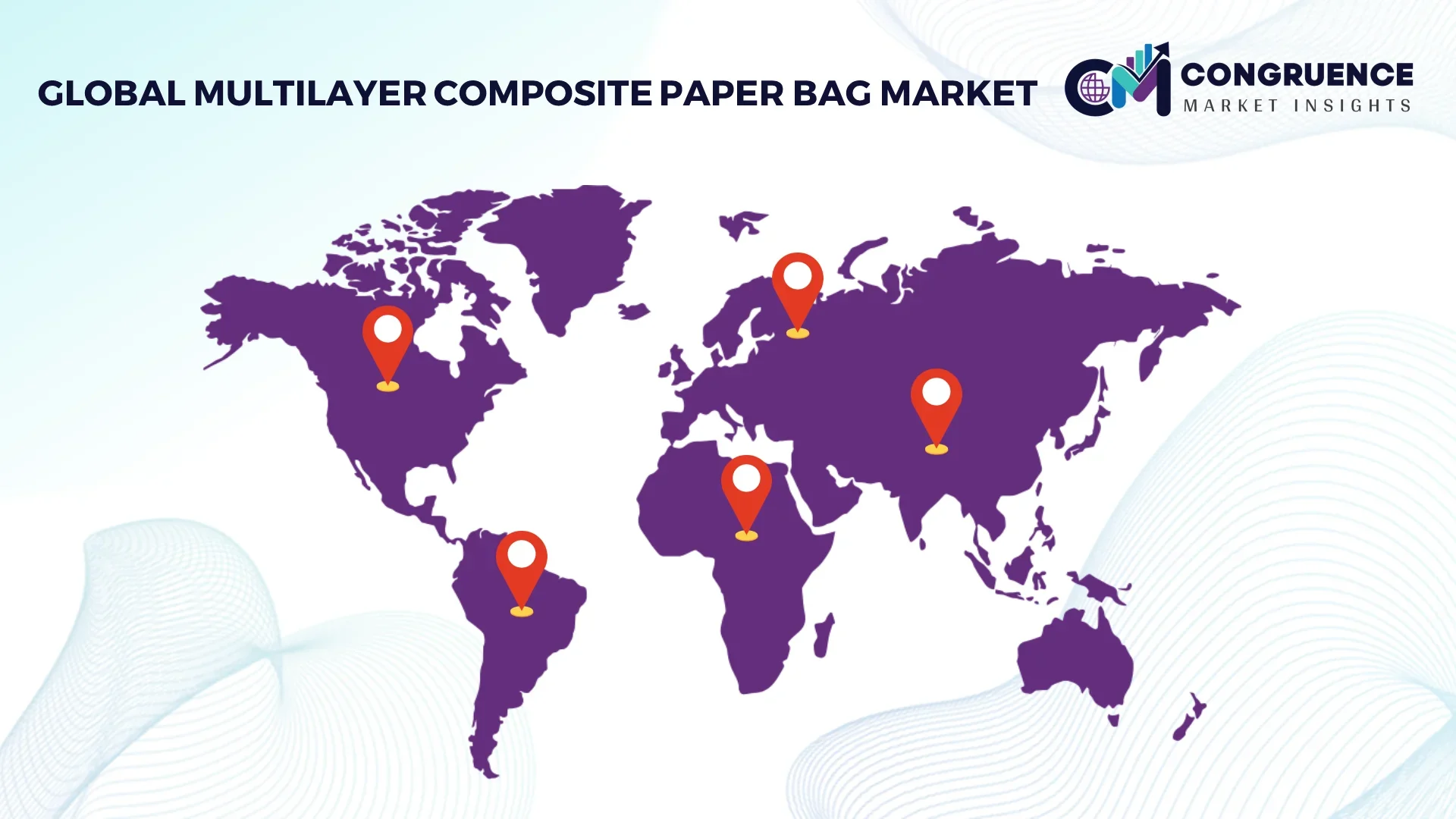
Asia-Pacific continues dominating the Multilayer Composite Paper Bag Market due to large-scale industrial packaging production, expanding construction activity, and lower manufacturing costs across China, India, and Southeast Asia. Europe accounts for nearly 27% share, driven by aggressive recyclable packaging regulations and rapid industrial sustainability transformation. North America contributes approximately 21% of total demand through advanced automated packaging deployment and high-value food-grade industrial applications. Meanwhile, South America and the Middle East & Africa collectively represent 8% share, supported by agriculture, infrastructure, and industrial material exports. Supply-chain regionalization, packaging compliance mandates, and localized manufacturing investments are reshaping competitive positioning globally, with companies increasingly focusing on automation, recyclable materials, and strategic production expansion across high-growth industrial corridors.
North America holds approximately 21% of the global Multilayer Composite Paper Bag Market, supported by strong demand from construction materials, food processing, and specialty chemical industries. Industrial buyers are rapidly transitioning toward recyclable high-strength packaging systems as ESG procurement mandates and automated filling-line deployment accelerate across the United States and Canada. Automated industrial packaging adoption improved by nearly 29% between 2023 and 2025, while lightweight composite sacks reduced freight handling costs by approximately 13%. Regional manufacturers are expanding localized converting capacity to reduce dependence on overseas packaging supply chains following recent logistics disruptions. Enterprise buyers increasingly prioritize durability, automation compatibility, and recyclable material composition over low-cost conventional packaging. Several packaging groups expanded advanced valve-bag production capacity across the Midwest industrial corridor, reinforcing North America’s strategic importance for high-value industrial packaging innovation and operational optimization.
Europe accounts for nearly 27% of the global Multilayer Composite Paper Bag Market, with Germany, France, and Italy leading industrial packaging modernization initiatives. Stringent EU packaging waste directives and Extended Producer Responsibility regulations are forcing rapid adoption of recyclable multilayer sack systems across construction materials, chemicals, and food ingredient supply chains. Recyclable industrial sack deployment increased by approximately 33% between 2023 and 2025, while polymer-layer dependency declined by nearly 18%.Manufacturers are aggressively investing in mono-material paper sack technologies, lightweight barrier coatings, and advanced automated converting systems to meet tightening compliance requirements. Industrial buyers across Europe increasingly prioritize traceability, recyclability, and lifecycle efficiency over conventional low-cost packaging alternatives. Packaging suppliers capable of delivering certified sustainable high-performance solutions are gaining significant procurement advantages, making Europe a critical region for innovation-led competitive differentiation and regulatory-driven market transformation.
Asia-Pacific dominates the Multilayer Composite Paper Bag Market with approximately 44% share, supported by large-scale industrial manufacturing, infrastructure development, and export-oriented packaging demand across China, India, Japan, and Southeast Asia. China alone contributes nearly 31% of regional production capacity due to integrated kraft paper supply chains and cost-efficient automated converting infrastructure. Regional packaging production efficiency improved by approximately 26% through high-speed manufacturing automation and localized sourcing expansion. Industrial buyers prioritize scale, speed, and freight optimization, accelerating adoption of lightweight multilayer valve bags across cement, fertilizer, and industrial mineral sectors. Several manufacturers expanded regional production hubs between 2024 and 2026 to stabilize delivery cycles and reduce dependence on imported packaging materials. Asia-Pacific remains strategically critical for global scale expansion, manufacturing efficiency, and long-term industrial packaging supply-chain resilience.
South America represents nearly 5% of the global Multilayer Composite Paper Bag Market, with Brazil and Argentina leading regional demand through agricultural exports, fertilizer distribution, and construction material packaging. Industrial packaging demand increased by approximately 17% due to rising cement production and agricultural commodity logistics. However, inconsistent recycling infrastructure and fluctuating raw-material costs continue constraining scalable packaging modernization across several regional economies. Manufacturers are increasingly localizing production and introducing lightweight multilayer sack formats to improve freight efficiency and reduce import dependency. Enterprise buyers remain highly price-sensitive, prioritizing durability and operational affordability over premium advanced packaging features. Several regional packaging suppliers expanded localized converting operations to reduce lead-time volatility and strengthen industrial supply continuity. South America presents strong long-term industrial packaging upside, although operational execution and infrastructure investment remain critical competitive differentiators.
The Middle East & Africa accounts for approximately 3% of the global Multilayer Composite Paper Bag Market, driven by infrastructure expansion, cement exports, industrial minerals, and large-scale construction projects across Saudi Arabia, UAE, and South Africa. Industrial packaging demand within regional construction sectors increased by nearly 19% between 2023 and 2025, while localized production initiatives improved supply responsiveness by approximately 14%. Governments and industrial groups are increasingly investing in domestic manufacturing diversification and logistics modernization, accelerating demand for durable recyclable industrial packaging systems. Packaging manufacturers are deploying advanced converting technologies and regional distribution partnerships to support high-volume infrastructure supply chains. Industrial buyers prioritize cost stability, durability, and regional supply reliability as procurement strategies evolve. The region is emerging as a strategically important industrial packaging corridor tied directly to infrastructure investment, export growth, and manufacturing transformation initiatives.
China – 31% Market share: Leads due to massive industrial packaging production capacity, integrated kraft paper supply chains, and strong demand from cement, chemicals, and export manufacturing sectors.
Germany – 14% Market share: Dominates innovation through advanced recyclable packaging technologies, strict sustainability compliance standards, and highly automated industrial packaging operations.
The Multilayer Composite Paper Bag Market is witnessing aggressive competition between global packaging leaders such as Mondi, Smurfit Westrock, Billerud, Segezha Group, and West Fraser versus regional low-cost industrial sack manufacturers across Asia-Pacific and Eastern Europe. The top five players collectively control nearly 39% of global market share, with competition increasingly centered around recyclable barrier technologies, vertically integrated kraft paper sourcing, automation scale, and industrial supply-chain responsiveness.
Global leaders are differentiating through high-speed converting infrastructure, lightweight composite innovations, and closed-loop recycling systems, while regional players compete aggressively on price and localized production flexibility. Automated packaging operations improved production throughput by approximately 26%, while advanced barrier-layer engineering reduced material usage by nearly 18%, creating strong cost-performance advantages for technology-driven manufacturers.
Competition is rapidly shifting toward vertical integration and supply security as kraft paper volatility and logistics disruptions pressure operating margins. Companies are expanding regional manufacturing hubs, forming strategic raw-material partnerships, and accelerating AI-enabled quality-control deployment to strengthen operational resilience. Entry barriers remain high due to automation investment intensity, industrial certification requirements, and long-term procurement contracts with major cement and chemical producers. Winning in this market now requires scalable automation, recyclable high-barrier innovation, supply-chain control, and the ability to deliver industrial-grade performance at globally competitive operating costs.
Smurfit Westrock
Billerud
West Fraser
Segezha Group
Global-Pak Inc.
Hood Packaging Corporation
United Bags Inc.
Novolex
Tokushu Tokai Paper Co., Ltd.
El Dorado Packaging, Inc.
LC Packaging
Stora Enso
Rosenflex UK Ltd.
The Multilayer Composite Paper Bag Market is rapidly evolving through automation, advanced barrier engineering, and recyclable material integration. High-speed AI-enabled converting systems are becoming standard across industrial packaging facilities, improving production throughput by nearly 26% while reducing defect rates by approximately 31%. Over 48% of large-scale industrial packaging manufacturers have already integrated automated inspection and digital quality-control systems to stabilize output consistency and optimize filling-line compatibility.
Advanced nano-barrier coatings and lightweight kraft composite technologies are reshaping industrial sack performance. Compared to conventional polymer-heavy multilayer sacks, next-generation fiber-based barrier systems reduce packaging weight by nearly 18% while maintaining comparable moisture resistance and stacking durability. This shift is creating significant freight optimization advantages for cement, chemicals, and food ingredient supply chains. Companies with vertically integrated coating and kraft processing capabilities are gaining stronger pricing power and operational flexibility.
Smart packaging technologies are also accelerating adoption across export-oriented industrial sectors. QR-enabled traceability systems and RFID-supported logistics monitoring improved warehouse handling visibility by approximately 22%, particularly within food-grade and specialty chemical packaging operations. Enterprise buyers increasingly prioritize packaging systems capable of supporting compliance tracking, automated inventory management, and sustainability reporting simultaneously.
Between 2026 and 2028, mono-material recyclable industrial sack technologies and AI-driven adaptive converting systems are expected to redefine competitive positioning. Manufacturers investing aggressively in advanced fiber engineering, digital production control, and localized smart-packaging infrastructure will secure the strongest long-term industrial procurement advantages as compliance, automation, and logistics efficiency become deeply interconnected.
April 2025 – Mondi partnered with Evonik to launch a recyclable two-ply paper bag for chemical powders, eliminating one plastic-coated layer and reducing packaging weight by 30%. The development improved vacuum filling efficiency and strengthened sustainable industrial packaging adoption across specialty chemicals. [Barrier Reduction] Source: www.mondigroup.com
October 2024 – Smurfit Westrock received multiple sustainability and innovation awards for advanced recyclable paperboard packaging solutions replacing flexible plastic applications. The company’s PETCollar™ Eco design reduced material usage while improving structural durability, accelerating fiber-based packaging deployment across beverage logistics. [Circular Packaging Push]
July 2025 – Billerud advanced modernization investments at its Michigan mills, deploying upgraded rotary debarking systems and packaging-focused paper machine enhancements. The initiative increased operational efficiency and expanded specialty packaging material capabilities while reducing steam and chemical consumption across production operations. [Mill Modernization Drive]
June 2024 – WestRock shareholders approved the merger with Smurfit Kappa, creating Smurfit Westrock and significantly expanding integrated paper-based packaging scale across global industrial markets. The transaction accelerated packaging consolidation strategies and strengthened combined global manufacturing and supply-chain positioning. [Industry Consolidation Wave]
The Multilayer Composite Paper Bag Market Report delivers comprehensive coverage across product types, industrial applications, end-user industries, regional demand centers, and emerging packaging technologies shaping global industrial packaging transformation. The report evaluates key segments including valve bags, pasted open-mouth bags, pinch-bottom sacks, and sewn industrial packaging formats across construction materials, food ingredients, agriculture, chemicals, and specialty industrial applications. Geographic analysis spans North America, Europe, Asia-Pacific, South America, and the Middle East & Africa, with detailed strategic assessment of manufacturing concentration, packaging demand shifts, regulatory pressure, and supply-chain localization trends.
The study provides deep analytical insight into automation deployment, recyclable barrier technologies, lightweight fiber engineering, and AI-enabled converting systems reshaping operational competitiveness. More than 48% of large industrial packaging facilities now utilize automated quality-control systems, while recyclable multilayer sack adoption exceeded 46% across sustainability-focused industrial procurement networks. The report also profiles leading global packaging companies, evaluates regional production dynamics, and tracks evolving procurement priorities tied to freight optimization, compliance readiness, and industrial efficiency.
Additionally, the report delivers forward-looking strategic coverage from 2026 to 2033, highlighting emerging mono-material packaging systems, smart traceability integration, advanced moisture-barrier innovations, and regional manufacturing expansion strategies. The analysis supports investment planning, product positioning, capacity allocation, partnership evaluation, and long-term competitive decision-making across rapidly transforming industrial packaging ecosystems.
| Report Attribute / Metric | Details |
|---|---|
| Market Revenue (2025) | USD 568.0 Million |
| Market Revenue (2033) | USD 827.8 Million |
| CAGR (2026–2033) | 4.82% |
| Base Year | 2025 |
| Forecast Period | 2026–2033 |
| Historic Period | 2021–2025 |
| Segments Covered |
By Type
By Application
By End-User Insights
|
| Key Report Deliverables | Revenue Forecast; Market Trends; Growth Drivers & Restraints; Technology Insights; Segmentation Analysis; Regional Insights; Competitive Landscape; Regulatory & ESG Overview; Recent Developments |
| Regions Covered | North America; Europe; Asia-Pacific; South America; Middle East & Africa |
| Key Players Analyzed | Mondi Group; Smurfit Westrock; Billerud; West Fraser; Segezha Group; Global-Pak Inc.; Hood Packaging Corporation; United Bags Inc.; Novolex; Tokushu Tokai Paper Co., Ltd.; El Dorado Packaging, Inc.; LC Packaging; Stora Enso; Rosenflex UK Ltd. |
| Customization & Pricing | Available on Request (10% Customization Free) |




