
Reports
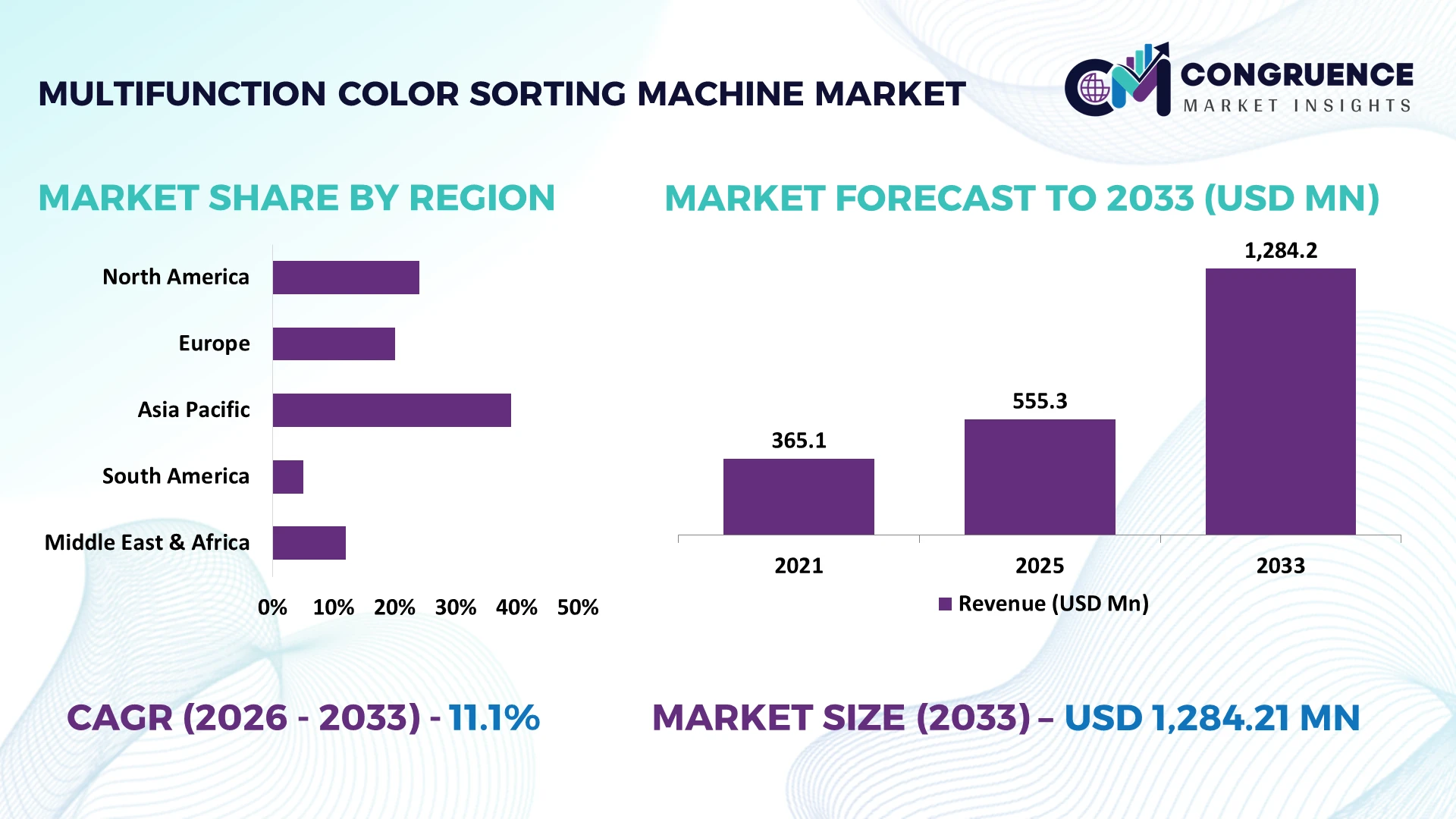
The Global Multifunction Color Sorting Machine Market was valued at USD 555.25 Million in 2025 and is anticipated to reach a value of USD 1284.21 Million by 2033 expanding at a CAGR of 11.05% between 2026 and 2033. Growth is driven by AI-enabled defect recognition, multispectral/NIR inspection, automated yield recovery, and tighter food-quality controls across grain, nuts, pulses, plastics, and recycling operations.
China represents the strongest demand-capacity environment, producing 714.88 million tonnes of grain in 2025, versus India’s projected 376.56 million tonnes in 2025–26; China therefore represents about 65.5% of their combined output base. Meyer invests roughly RMB 150 million annually in R&D, equal to about 6.5% of operating revenue, while accumulating nearly 800 authorized patents by 2025. China’s food-security priorities and expanding automated grain-processing infrastructure reinforce its position, while India’s record crop output creates a rapidly widening addressable base for advanced optical sorting equipment.
Strategically, manufacturers should prioritize AI-enabled, multi-commodity platforms and local service networks in Asia while targeting higher-margin food-safety and resource-recovery applications in Europe and North America.
Market Size & Growth: USD 555.25 million in 2025 advances toward USD 1,284.21 million by 2033 at 11.05%, driven by AI-assisted defect detection, multispectral sensing, and higher-value yield recovery.
Top Growth Drivers: 5–10% improvement in reject concentration from next-generation AI sorting, 10% lower acceptable-product rejection in newer Satake platforms, and EU requirements targeting 10% lower food-processing waste by 2030.
Short-Term Forecast: By 2028, advanced installations will increasingly target approximately 10% lower good-product loss through faster ejectors, automated calibration, and real-time defect classification.
Emerging Technologies: CNN-based deep learning, NIR/SWIR multispectral imaging, 4K cameras, intelligent ejectors, and automated sensitivity calibration are replacing conventional RGB-only sorting architectures.
Regional Leaders: Asia-Pacific remains the volume center; Europe gains from food-waste regulation; North America strengthens premium food-processing automation. Any regional USD allocation remains model-dependent because audited multifunction-sorter regional revenues are not publicly disclosed.
Consumer/End-User Trends: TOMRA Food operates more than 16,100 installed sorting, grading, peeling, and analytical units globally, demonstrating deep automation penetration among processors pursuing consistency and lower material loss.
Pilot/Case Example: In 2025, Bühler’s SORTEX AI700 demonstrated 5–10% improvement in reject concentration through deep-learning classification, increasing recoverable good product while improving impurity removal.
Competitive Landscape: No defensible audited global leader-share percentage is publicly disclosed; Bühler, TOMRA, Meyer, Satake, and Key Technology remain prominent, with Bühler reporting more than 25,000 installed color sorters worldwide.
Regulatory & ESG Impact: The EU’s revised Waste Framework Directive mandates a 10% reduction in food waste from processing and manufacturing by 2030, strengthening the business case for precision sorting and yield optimization.
Investment & Funding: Meyer reports average annual R&D expenditure near RMB 150 million, approximately USD 22.6 million and 6.5% of operating revenue, supporting AI agents, digital intelligence, and next-generation inspection systems.
Innovation & Future Outlook: Satake’s 2026 SLASH β PLUS cuts acceptable-product discharge roughly 10% versus previous models, confirming a strategic shift toward compact, multi-material machines optimized for yield, automation, and lower operating losses.
Multifunction color sorting machines are gaining importance across rice, grains, pulses, nuts, seeds, plastics, and recycling as processors demand higher purity with less material loss. Deep-learning vision, NIR/SWIR sensing, and intelligent ejectors now deliver 5–10% improvements in reject concentration. EU food-waste mandates and Asian processing expansion are accelerating equipment modernization, setting up the market’s next strategic phase.
Multifunction color sorting is becoming strategically important because processors increasingly compete on recoverable yield, contaminant control, traceability, and processing flexibility rather than throughput alone. The shift from rule-based optical inspection toward deep-learning classification is accelerating digital adoption across grains, pulses, nuts, seeds, and recycled materials. Europe adds regulatory pressure: binding rules require a 10% reduction in processing and manufacturing food waste by 2030.
Technology economics increasingly favor advanced systems. Bühler reports its deep-learning SORTEX AI700 improves reject concentration by 5–10%, while Satake’s 2026 high-efficiency ejector operates 1.7 times faster and reduces acceptable material entering rejects by approximately 10% versus its predecessor. China combines large processing scale with domestic equipment innovation, while European deployment increasingly emphasizes food safety, waste minimization, and traceability.
Through 2028, competitive investment will concentrate on AI classification, multispectral sensing, automated calibration, remote diagnostics, and flexible multi-product lines. Satake’s SLASH β PLUS, for example, handles grains, seeds, beans, and plastic pellets at up to 2 tonnes per hour. Equipment manufacturers are consequently expanding R&D and integrated digital platforms; Meyer allocates about 6.5% of operating revenue to R&D. Long-term advantage will belong to suppliers that combine sorting accuracy with yield protection, application flexibility, and lifecycle support.
Processors are replacing conventional color-only inspection with AI-assisted optical sorting because every percentage point of recoverable product directly influences plant economics. Bühler’s deep-learning platform produces a 5–10% improvement in reject concentration, while its SORTEX H platform achieves up to 50% higher reject concentrations through advanced cameras and intelligent algorithms. Europe’s binding 10% food-processing waste reduction target reinforces investment in technologies that prevent usable material entering reject streams. The operational shift is therefore from defect removal toward yield optimization and process intelligence. Suppliers are responding with neural-network classification, real-time defect analytics, remote monitoring, and multispectral inspection. The non-obvious advantage is upstream intelligence: defect-percentage data can identify inconsistent raw-material suppliers before quality losses propagate through production.
Advanced sorting performance still depends on supporting infrastructure that smaller processors cannot standardize easily. Satake’s compact SLASH β PLUS requires 200–240 V electrical supply, approximately 240 NL/min compressed air, and a compressor equivalent to 2.2 kW, despite the sorter itself requiring only 0.6 kW. Its rated throughput varies from 0.5 to 2.0 tonnes per hour depending on material conditions. This exposes a structural constraint in India and other fragmented processing markets: machine capability alone does not determine economics; stable compressed air, controlled feeding, cleaning, and skilled maintenance determine realized performance. Multi-commodity plants also face configuration complexity as defect profiles change between grains, seeds, pulses, and plastics. Vendors are reducing deployment friction through automatic sensitivity settings, tool-free maintenance, remote diagnostics, and integrated I/O controls rather than competing solely on inspection accuracy.
The strongest emerging opportunity is extending intelligent sorting platforms beyond traditional grain applications into plastics, recycling, specialty seeds, and difficult foreign-material detection. Satake’s latest platform processes grains, seeds, beans, and plastic pellets on one architecture while its ejector operates 1.7 times faster, reduces good-product losses by approximately 10%, and delivers roughly three times longer ejector life than the preceding design. In Europe, the 10% food-processing waste target is simultaneously strengthening the economic value of material recovery. The non-obvious opportunity is platform utilization: processors handling seasonal commodities can redeploy flexible machines across product streams, raising annual equipment utilization. Suppliers are positioning through AI R&D, multispectral imaging, configurable ejection, and ecosystem integration; Meyer’s R&D spending averages about 6.5% of operating revenue.
Long-term execution depends on maintaining classification accuracy as feedstock composition, lighting conditions, defect morphology, and contamination rates change. Bühler’s deep-learning approach is trained using millions of labelled images, demonstrating the data intensity required to distinguish subtle differences in color, shape, and texture. Satake specifies maximum throughput under contamination rates of up to 5%, while actual capacity can range from 0.5 to 2.0 tonnes per hour depending on material and removal requirements. This creates a scaling challenge: laboratory-level accuracy does not automatically translate into consistent multi-commodity plant performance. Manufacturers must strengthen application datasets, automated recalibration, edge processing, operator interfaces, and remote service capabilities. The strategic differentiator will increasingly be algorithm robustness and lifecycle intelligence, not camera resolution alone.
Yield Protection Replaces Pure Sorting: Processors are increasingly measuring sorters by recoverable yield rather than defect-removal accuracy alone. Bühler’s newer deep-learning architecture delivers 5–10% higher reject concentration, while Satake’s latest ejector reduces acceptable material entering rejects by around 10%. Suppliers are consequently integrating product-loss analytics, adaptive recipes, and automated calibration into plant workflows.
Compact Platforms Gain Multi-Commodity Roles: Sorting lines are shifting from dedicated single-crop machines toward configurable equipment handling grains, seeds, beans, and plastics. Satake’s 2026 platform processes up to 2 tonnes per hour, uses ejectors operating 1.7 times faster, and extends ejector life roughly threefold. Manufacturers are redesigning portfolios around flexible utilization and faster product changeovers.
Service Models Become Digitally Connected: Remote diagnostics, digital process monitoring, and intelligent-agent interfaces are moving maintenance away from reactive field servicing. Meyer directs about 6.5% of annual operating income toward R&D and had accumulated nearly 800 authorized patents by 2025. Equipment suppliers are scaling software capabilities as uptime, recipe optimization, and lifecycle support become purchasing differentiators.
Waste Regulation Reshapes Sorting Economics: European processors are adapting operations ahead of the binding 10% food-manufacturing waste reduction target for 2030, making reject-stream purity commercially important. Meanwhile, China processed an agricultural base supported by 714.88 million tonnes of grain output in 2025, up 1.2%. Vendors are aligning high-throughput systems with traceability and resource-efficiency requirements.
Chute-Type machines represent the largest type, estimated at approximately 34–36% of current multifunction color sorter deployment, reflecting their established position in rice, wheat, pulses, and seed-processing lines. Gravity-fed architecture supports continuous throughput, relatively straightforward integration, and lower mechanical complexity than Belt-Type equipment. Belt-Type systems retain approximately 20–22% relevance where fragile, irregular, or larger products require controlled presentation. CCD-Based platforms remain important in price-sensitive installations, accounting for an estimated 18–20%, particularly where conventional visible-spectrum defect detection meets processor specifications.
AI-Based equipment is the fastest-transitioning type, with an estimated 15–18% share but rapidly increasing specification in premium food lines as processors prioritize complex defect classification and yield preservation. Multi-Sensor systems, representing roughly 10–12%, combine RGB, NIR, shape, or spectral information where contaminants cannot be separated reliably by color alone. Suppliers are therefore shifting engineering expenditure from standalone cameras toward algorithm-rich, sensor-fusion platforms, while maintaining chute and belt configurations as physical delivery architectures. This redirects competitive advantage toward software, datasets, calibration automation, and application-specific sorting intelligence.
Grains remain the largest application, estimated at approximately 43–46% of multifunction color sorting deployments, supported by continuous-volume processing of rice, wheat, corn, and other cereals. Large milling networks in China and India favor chute-based high-throughput equipment because impurity removal directly influences milling yield, food safety, and export specifications. Pulses account for roughly 16–18%, where color variation, stones, damaged kernels, and foreign material require increasingly sophisticated classification. Nuts represent approximately 13–15%, benefiting from premium-product economics that justify advanced optical inspection and tighter defect thresholds.
Fruits are emerging as the fastest-expanding application, particularly where belt-fed platforms combine color, shape, surface-defect, and maturity inspection. Vegetables also gain from automated grading as processors seek consistent downstream cutting, freezing, and packaging quality. Together, fruits and vegetables represent an estimated 21–25% of application demand, with sensor fusion becoming more valuable than conventional color discrimination. Equipment manufacturers are adapting through wider belt architectures, hyperspectral or NIR integration, application-specific AI models, and modular product-handling systems. Investment is increasingly concentrated where sorting can simultaneously protect quality grade and reduce usable-product losses.
Food Processors constitute the largest end-user group, estimated at approximately 37–40% of multifunction color sorting machine demand because they operate diversified lines requiring contamination control, yield optimization, and standardized finished-product specifications. Grain Mills represent approximately 24–27%, maintaining substantial installed demand through high-volume rice, wheat, and corn operations. Their purchasing decisions emphasize tonnes-per-hour capacity, compressed-air efficiency, ejector reliability, and compatibility with upstream cleaning and downstream packaging equipment.
Exporters are the fastest-strengthening buyer group, estimated at approximately 11–13%, as stricter customer specifications increase requirements for appearance, foreign-material removal, and batch consistency. Agricultural Cooperatives account for roughly 10–12%, with adoption strongest where shared processing infrastructure improves equipment utilization across multiple producers. Packaging Companies represent approximately 8–10% and increasingly deploy final-stage inspection where branded quality assurance justifies additional sorting. Suppliers are responding with scalable configurations, leasing and service models, localized technical support, and multi-commodity software libraries. Future competitive positioning increasingly depends on serving processors and exporters with integrated inspection ecosystems rather than selling standalone sorting hardware.
Asia-Pacific accounted for the largest market share at approximately 47% in 2025 however, Asia-Pacific is expected to register the fastest growth, expanding at a CAGR of approximately 12.4% between 2026 and 2033.

Automation Moves Deeper Into Processing Lines
North America accounts for an estimated 19% of global demand, led by high-value food processing, grain handling, nuts, seeds, and increasingly sophisticated recycling operations. Deployment economics favor sensor-rich equipment because processors prioritize labor productivity, food safety, traceability, and recovery of saleable material. The United States harvested approximately 14.9 billion bushels of corn in 2025, sustaining substantial downstream cleaning, grading, and milling requirements. Advanced processors increasingly integrate optical sorters with conveyors, digital plant controls, automated packaging, and quality-management systems. Equipment suppliers are responding through application centers, remote diagnostics, AI-assisted classification, and localized technical service. The operational shift is particularly important for nut and specialty-food processors, where removing defects without sacrificing acceptable product delivers greater economic value than simply maximizing tonnes processed.
United States Market Outlook: The United States dominates regional deployment through its industrial grain network, large food-processing base, and sophisticated automation infrastructure. California alone typically supplies roughly 80% of global almonds, creating intensive requirements for defect, shell, foreign-material, and quality sorting. Premium processors increasingly specify multi-sensor inspection to protect export quality and minimize unnecessary product rejection.
Waste Reduction Reshapes Equipment Priorities
Europe represents approximately 17% of global multifunction color sorting machine demand, with deployment increasingly influenced by food-loss reduction, circularity, traceability, and stringent product-quality requirements. The EU’s binding 2030 framework targets a 10% reduction in food waste from processing and manufacturing, strengthening the economics of equipment that improves reject concentration and recovers usable material. Sorting is consequently expanding beyond conventional grain cleaning into nuts, seeds, vegetables, specialty foods, and secondary-material recovery. European processors increasingly specify NIR, multispectral imaging, automated recipe management, and digital monitoring rather than basic visible-color inspection. Suppliers such as Bühler and TOMRA are reinforcing AI-based classification and application-specific testing capabilities. A non-obvious shift is occurring in procurement: lifecycle yield improvement and waste avoidance increasingly outweigh initial machine price when processors evaluate advanced sorting platforms.
Germany Market Outlook: Germany provides a strategically important market through highly automated food manufacturing, machinery integration, and stringent quality-control practices. Its food and beverage manufacturing sector includes more than 6,000 enterprises, creating a diversified automation base. German processors favor equipment compatible with Industry 4.0 controls, predictive maintenance, traceability systems, and energy-efficient production lines.
Processing Scale Accelerates Intelligent Sorting
Asia-Pacific holds approximately 47% of global demand, supported by concentrated rice, wheat, pulses, tea, seeds, and processed-food production. China and India create exceptional throughput requirements: China produced 714.88 million tonnes of grain in 2025, while India’s 2025–26 foodgrain output is estimated above 375 million tonnes. Large processing volumes favor high-capacity chute sorters, while premium processors increasingly migrate toward AI classification and multi-sensor defect recognition. Domestic Chinese manufacturers, particularly Meyer, compete aggressively through localized R&D, application engineering, and broad machine portfolios, challenging established international suppliers on price-performance ratios. India presents a different deployment structure, where fragmented milling capacity encourages compact and modular equipment. Suppliers are expanding dealer networks, technical service, localized configurations, and crop-specific algorithms as automation moves from large exporters toward mid-sized processors.
China Market Outlook: China combines the region’s largest grain-processing base with an increasingly sophisticated domestic sorting-equipment ecosystem. Meyer reports average annual R&D expenditure equivalent to roughly 6.5% of operating income and had accumulated nearly 800 authorized patents by 2025. This engineering depth strengthens domestic competition in AI vision, intelligent inspection, and digitally connected sorting platforms.
Export Agriculture Drives Quality Automation
South America represents an estimated 9% of global multifunction color sorting machine demand, with Brazil and Argentina anchoring deployment across soybeans, corn, coffee, pulses, nuts, and specialty export crops. Brazil’s 2025/26 grain harvest is positioned above 350 million tonnes, creating significant requirements for cleaning, grading, contaminant removal, and export-quality assurance. Optical sorting investment is strongest among industrial processors, cooperatives, and exporters where quality specifications directly affect shipment acceptance and product value. Adoption remains less uniform among smaller processors because financing, technical-service coverage, and automation infrastructure vary significantly between production hubs. Suppliers are therefore emphasizing rugged configurations, remote diagnostics, distributor partnerships, and machines capable of processing several commodities. Export-oriented facilities increasingly treat precision sorting as trade infrastructure rather than optional downstream quality equipment.
Brazil Market Outlook: Brazil provides the strongest regional opportunity because enormous soybean, corn, coffee, and bean supply chains feed domestic processing and international exports. The country produces more than 160 million tonnes of soybeans in strong crop years, giving large processors sufficient throughput to justify automated sorting. Local service availability and multi-crop flexibility remain decisive procurement factors.
Food-Security Investment Modernizes Processing
Middle East & Africa represents approximately 8% of global demand, shaped by grain-import dependence, domestic food-security programs, milling modernization, pulses, dates, seeds, and export-oriented agricultural processing. Gulf countries increasingly invest in automated food infrastructure to strengthen supply resilience, while African deployment concentrates around major milling and crop-processing hubs. Egypt is particularly important because annual wheat consumption exceeds 20 million tonnes, requiring extensive handling, milling, cleaning, and quality-control capacity. In South Africa, sophisticated grain and nut processors support higher-specification optical sorting, while Ethiopia and East African markets create application potential in coffee and pulses. Infrastructure reliability, financing, and technical-service availability constrain uniform deployment. Manufacturers are addressing these limitations through regional distributors, modular equipment, operator training, remote support, and machines designed for variable incoming crop quality.
Egypt Market Outlook: Egypt stands out through its strategic wheat-processing infrastructure and large dependence on imported and domestically produced grain. Government food-security priorities support continued modernization of storage, milling, and handling assets. High processing volumes make contaminant detection, grading consistency, and product-loss control commercially important, creating a practical deployment base for high-throughput chute sorting systems.
Bühler, TOMRA, Meyer, Satake, and Key Technology anchor competition, with global technology leaders confronting Chinese cost-performance specialists and application-focused OEMs. The top five are estimated to control roughly 48% of multifunction sorting demand, although audited market-specific shares remain unavailable. Bühler and TOMRA compete through AI, multispectral sensing, application engineering, and global service networks; Meyer pressures incumbents through localized innovation and competitive equipment economics, while Satake leverages grain-processing integration. Advanced AI platforms can improve reject concentration 5–10%, while newer ejector architectures reduce acceptable-product losses around 10%, shifting purchasing decisions from equipment price toward lifecycle yield. Players are expanding application laboratories, remote diagnostics, crop-specific algorithms, and integrated processing solutions. Competitive intensity is moving toward software-defined sorting as conventional CCD hardware becomes increasingly standardized. Entry barriers center on image datasets, application expertise, ejector precision, installed service networks, and processor trust. Winning requires demonstrable yield improvement, multi-commodity flexibility, rapid technical support, and continuously improving classification intelligence.
Bühler Group
TOMRA Systems ASA
Meyer Optoelectronic Technology Inc.
Satake Corporation
Duravant LLC
Hefei Taihe Optoelectronic Technology Co., Ltd.
Anhui Jiexun Optoelectronic Technology Co., Ltd.
Anhui Zhongke Optic-electronic Color Sorter Machinery Co., Ltd.
Hefei Angelon Electronics Co., Ltd.
Orange Sorting Machines (India) Pvt. Ltd.
Daewon GSI Co., Ltd.
Sesotec GmbH
Cimbria
Anzai Manufacturing Co., Ltd.
Current multifunction color sorting platforms combine high-resolution RGB cameras, LED illumination, high-speed ejectors, and machine-vision algorithms. Advanced systems now achieve defect detection above 97% with false rejects below 1%, improving usable yield and reducing rework. Commercial deployment is strongest in grains, nuts, pulses, seeds, and IQF foods, where processors value continuous inspection, recipe switching, and remote diagnostics.
Emerging systems add convolutional neural networks, NIR/SWIR sensing, multispectral imaging, and automated sensitivity control. Deep-learning sorters improve reject concentration by 5–10% versus legacy rule-based optical systems, while next-generation ejectors can cut good-product loss by about 10%. Multi-sensor platforms also distinguish defects invisible to conventional RGB cameras, supporting higher purity, faster changeovers, and lower dependence on highly skilled operators.
Disruptive development centers on AI agents, self-optimizing recipes, edge analytics, and connected line control. Suppliers increasingly integrate sorters with upstream cleaning, quality analyzers, conveyors, and downstream packaging through industrial I/O and cloud monitoring. Between 2026 and 2028, deployment should shift toward autonomous multi-commodity platforms with broader sensor fusion and predictive maintenance. Large processors benefit first because higher utilization accelerates payback, while equipment vendors gain through software, service, and application-data differentiation. Acting now secures yield, traceability, and processing flexibility before intelligent sorting becomes standard at scale.
May 2025 Bühler launched SORTEX AI700 for oat processing, using deep-learning CNNs trained on millions of labeled images. Reject concentration improved 5–10%, raising usable yield while strengthening gluten-contaminant removal, food safety, processor profitability, and quality consistency at scale. Source: MillingMEA.
September 2025 TOMRA introduced the 4C optical sorter for nuts and IQF foods, combining Pulsed LED sensors with multiple AI modes. Detection exceeds 97% while false rejects remain below 1%, improving throughput economics and simplifying operator workflows. Source: PackagingInsights
April 2025 Meyer Optoelectronic launched Meyer Master 4.0, integrating multimodal AI, industrial IoT, automated quality control, and user-trained models. Custom grading models can be trained in one day, shifting sorting from manual adjustment toward autonomous process control. Source: meyerop
June 2026 Satake globally launched SLASH β PLUS, featuring ejectors operating 1.7 times faster than the previous model. Good-product loss falls about 10%, ejector life triples, and five-minute LED startup improves flexibility across food, agriculture, and plastics. Source: satake-group
The report evaluates the Multifunction Color Sorting Machine Market across Belt-Type, Chute-Type, CCD-Based, AI-Based, and Multi-Sensor systems, with applications spanning grains, pulses, nuts, fruits, and vegetables. End-user coverage includes food processors, grain mills, agricultural cooperatives, exporters, and packaging companies, while regional analysis spans North America, Europe, Asia-Pacific, South America, and Middle East & Africa.
Technology coverage examines RGB imaging, NIR/SWIR sensing, deep learning, automated sensitivity control, intelligent ejectors, remote diagnostics, and connected line integration. Asia-Pacific represents roughly 47% of current demand, while advanced AI platforms can improve reject concentration by 5–10% and newer ejectors reduce good-product losses around 10%. The report also assesses niche opportunities in multi-commodity processing and export-quality inspection, supporting investment planning, geographic expansion, competitive benchmarking, partnership strategy, and technology positioning through 2033.
| Report Attribute/Metric | Report Details |
|---|---|
Market Revenue in 2025 | USD 555.25 Million |
Market Revenue in 2033 | USD 1284.21 Million |
CAGR (2026 - 2033) | 11.05% |
Base Year | 2025 |
Forecast Period | 2026 - 2033 |
Historic Period | 2021 - 2025 |
Segments Covered | By Type
By Application
By End-User
|
Key Report Deliverable | Revenue Forecast, Growth Trends, Market Dynamics, Segmental Overview, Regional and Country-wise Analysis, Competition Landscape |
Region Covered | North America, Europe, Asia-Pacific, South America, Middle East, Africa |
Key Players Analyzed | Bühler Group, TOMRA Systems ASA, Meyer Optoelectronic Technology Inc., Satake Corporation, Duravant LLC, Hefei Taihe Optoelectronic Technology Co., Ltd., Anhui Jiexun Optoelectronic Technology Co., Ltd., Anhui Zhongke Optic-electronic Color Sorter Machinery Co., Ltd., Hefei Angelon Electronics Co., Ltd., Orange Sorting Machines (India) Pvt. Ltd., Daewon GSI Co., Ltd., Sesotec GmbH, Cimbria, Anzai Manufacturing Co., Ltd. |
Customization & Pricing | Available on Request (10% Customization is Free) |




