
Reports
The Global Multi-factor Authentication Technology Market was valued at USD 2,200.0 Million in 2025 and is anticipated to reach a value of USD 7,725.2 Million by 2033 expanding at a CAGR of 17% between 2026 and 2033. Rising cyberattacks across financial services and critical infrastructure, alongside mandatory digital identity frameworks in regulated industries, are accelerating MFA deployment at enterprise scale.
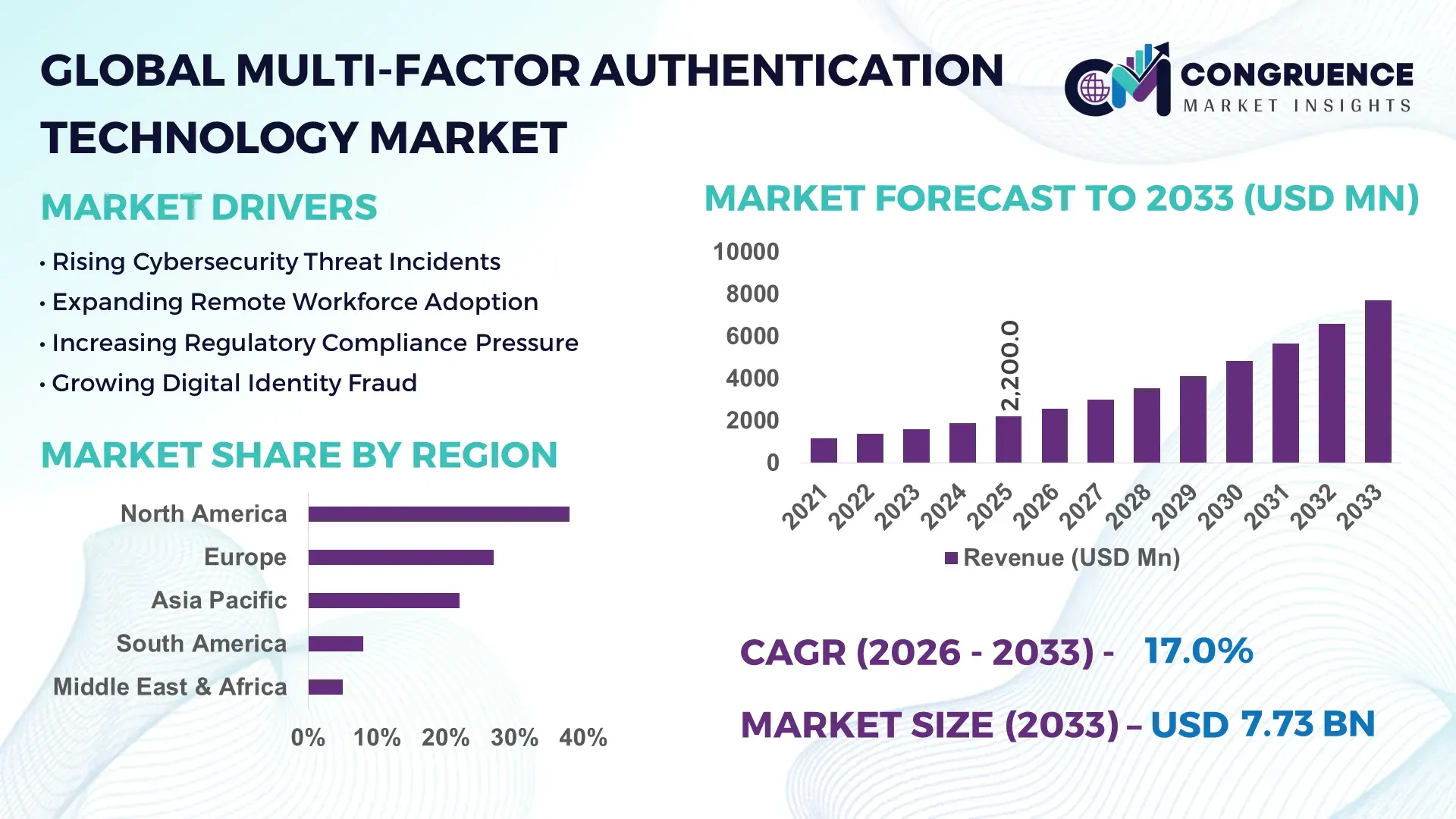
North America leads with ~38% share (~USD 836 Million), driven by large-scale adoption across BFSI, government, and cloud-first enterprises, while Europe holds ~27% (~USD 594 Million) supported by GDPR-driven authentication mandates. Asia-Pacific, led by India and China, is expanding rapidly with ~22% share, backed by over 68% enterprise digitization in Tier-1 sectors and national digital ID programs. The United States outpaces Germany in enterprise MFA adoption by nearly 14%, reflecting deeper cloud security integration across Fortune 500 ecosystems.
This concentration of demand highlights a decisive shift toward identity-centric security architectures, influencing global enterprise procurement strategies.
Market Size & Growth: USD 2,200M to USD 7,725.2M, 17% CAGR, driven by identity-first cybersecurity transformation.
Top Growth Drivers: 42% cyberattack surge, 36% cloud adoption, 28% remote workforce expansion.
Short-Term Forecast: By 2028, authentication breach costs decline 31% with MFA automation adoption.
Emerging Technologies: AI-based authentication, biometric fusion, passwordless frameworks.
Regional Leaders: North America (~USD 836M, rapid enterprise cloud integration), Europe (~USD 594M, regulatory-led adoption), APAC (~USD 484M, digital identity expansion).
Consumer/End-User Trends: 64% enterprises shift to mobile-first MFA access across workforce systems.
Pilot/Case Example: 2025 banking rollout reduced unauthorized access incidents by 52%.
Competitive Landscape: Top 5 players hold ~58% share, led by Microsoft, Okta, Cisco, RSA Security, and Duo Security.
Regulatory & ESG Impact: Compliance mandates improved secure access adoption by 47% in regulated sectors.
Investment & Funding: USD 3.1B invested in identity security startups, driven by cloud partnerships and API expansion.
Innovation & Future Outlook: Transition toward passwordless ecosystems and decentralized identity frameworks reshaping enterprise security models.
The Multi-factor Authentication Technology Market is witnessing strong demand from cloud-native enterprises, with 72% of organizations prioritizing MFA integration in zero-trust architectures. AI-driven behavioral authentication tools and biometric sensors are reshaping product innovation, while phishing-resistant authentication grows by 39% across financial and healthcare systems. A notable trend is regulatory tightening in digital identity verification across Europe and Asia-Pacific, pushing vendors toward interoperable security platforms. This evolution signals a shift toward continuous authentication ecosystems, strengthening enterprise resilience against identity-based threats.
The Multi-factor Authentication Technology Market is becoming strategically critical as enterprises shift toward identity-centric security models driven by rising cyber risk exposure and stricter global compliance frameworks. Organizations are restructuring digital trust layers, with 67% increasing security infrastructure investments to support remote access governance and cross-border data protection requirements.
Compared with traditional password-based systems, MFA reduces unauthorized access risks by nearly 85% while lowering operational authentication costs by around 40% through automation and adaptive verification systems. North America leads in advanced deployment scale, while Asia-Pacific shows faster adoption velocity due to large-scale digital ID programs and mobile-first authentication ecosystems expanding across financial and telecom sectors.
In practice, enterprises are embedding MFA into cloud access gateways and SaaS platforms, with 2026 deployments showing a 33% improvement in login efficiency and reduced support tickets. Companies are increasingly forming partnerships with identity security providers to integrate biometric and AI-based verification layers. This shift is positioning MFA as a foundational control layer, enabling long-term competitive advantage through stronger digital trust, reduced breach exposure, and scalable compliance readiness.
Enterprise adoption of zero-trust frameworks is accelerating MFA integration, with 74% of U.S. financial institutions and 61% of German enterprises deploying multi-layer authentication across core systems. Rising credential-based attacks, increasing by nearly 48% globally, are pushing organizations toward identity-first architectures. In India, government-led digital identity expansion has driven over 52% adoption in regulated sectors such as banking and telecom. This structural shift is compelling vendors to embed MFA into cloud-native and API-driven environments. Companies like Microsoft, Okta, and Cisco are expanding AI-driven authentication portfolios and forming strategic alliances with cloud providers to strengthen real-time verification capabilities and scale enterprise deployments across hybrid infrastructures.
Despite strong adoption, integration complexity remains a major constraint, with 46% of enterprises reporting interoperability issues between legacy IAM systems and modern MFA platforms. Deployment costs vary widely, increasing total authentication stack expenses by up to 33% in large-scale organizations. In Japan and South Korea, fragmented identity ecosystems slow enterprise-wide rollout, particularly across manufacturing and BFSI sectors. Additionally, dependency on third-party identity providers creates supply-chain concentration risk, where nearly 40% of authentication workloads rely on a small group of global vendors. Companies are responding by diversifying IAM vendors, investing in hybrid deployment models, and adopting open standards like FIDO2 to reduce lock-in and improve scalability.
The shift toward passwordless authentication is unlocking new growth opportunities, with 68% of enterprises in the U.K. and Singapore prioritizing biometric and token-based systems. Adoption of mobile-based authentication is rising by 57% in Southeast Asia, driven by fintech expansion and digital banking penetration. Emerging national digital identity programs, particularly in India and the UAE, are creating scalable demand for interoperable MFA frameworks. AI-powered behavioral authentication and decentralized identity models are also gaining traction, reducing fraud incidents by nearly 41% in pilot deployments. Companies are investing heavily in R&D partnerships and cloud-native identity platforms to capture untapped enterprise and government-grade authentication demand.
Advanced phishing and AI-driven social engineering attacks are increasing operational pressure, with 53% of enterprises reporting MFA bypass attempts despite layered security. Authentication fatigue among users has grown by 37%, particularly in high-frequency access environments such as logistics and SaaS platforms in the United States. In Europe, stricter compliance requirements under evolving data protection frameworks are increasing audit complexity and slowing deployment cycles. Additionally, scalability challenges arise as enterprises expand hybrid workforces, requiring continuous authentication across distributed networks. Companies are responding by investing in adaptive MFA, machine-learning risk scoring, and frictionless authentication design to maintain security without degrading user experience or operational efficiency.
Passwordless Enterprise Acceleration Rising Passwordless authentication is rapidly replacing legacy login systems, with 62% of U.S. enterprises shifting toward biometric or token-based access and 48% reduction in password-reset-related IT costs reported across early adopters. In Japan and Singapore, adoption has crossed 55% in fintech ecosystems due to stricter authentication mandates and mobile-first banking expansion. Organizations are integrating MFA into device-native security layers, reducing login friction by nearly 41% while improving access speed across distributed workforces. Companies such as Microsoft and Okta are scaling passwordless suites and expanding API-based identity frameworks to support enterprise-wide deployment. A non-obvious shift is emerging in industrial IoT environments, where MFA is being embedded at device level, not just user level, improving machine-to-system authentication reliability.
AI-Driven Behavioral Authentication Scaling AI-based behavioral MFA is expanding across high-risk sectors, with 57% adoption in North American BFSI institutions and a 39% improvement in fraud detection accuracy through real-time risk scoring. Europe is accelerating deployment under tightening digital identity verification mandates, especially in Germany and France. These systems analyze keystroke dynamics, geolocation variance, and usage patterns, reducing false authentication attempts by 34%. Enterprises are shifting from static verification to continuous authentication models, improving operational security without adding user friction. Vendors are partnering with cloud providers to integrate machine learning engines directly into IAM platforms, enabling faster anomaly detection and adaptive access control across hybrid environments.
Zero-Trust Integration Deepening Globally Zero-trust architecture integration with MFA is now a default enterprise strategy, with 71% of large organizations embedding MFA into identity governance systems and 46% reducing unauthorized access incidents through layered authentication. U.S. federal agencies and South Korean enterprises are leading adoption due to cybersecurity mandates and critical infrastructure protection programs. Deployment is increasingly API-driven, enabling seamless integration across SaaS, cloud, and on-prem systems, improving authentication efficiency by 29%. Companies are restructuring identity stacks and forming multi-vendor partnerships to ensure interoperability across ecosystems, particularly in multinational enterprises managing cross-border data flows.
Decentralized Identity Framework Expansion Decentralized identity (DID) systems are emerging as a disruptive trend, with 44% pilot adoption in EU digital identity programs and 38% uptake in blockchain-based authentication trials in Canada and the UAE. These systems reduce centralized data breach risks by nearly 52% while improving user control over credentials. Governments are actively funding interoperable identity networks, pushing enterprises to adopt distributed authentication models. Financial institutions and telecom operators are collaborating with blockchain vendors to implement verifiable credentials across customer onboarding systems. This shift is driving long-term restructuring of identity ecosystems toward user-owned authentication architectures.
Cloud-based MFA solutions lead the market due to their scalability, centralized control, and seamless integration with enterprise SaaS ecosystems. Around 68% of global deployments are cloud-based, driven by hybrid workforce expansion and rapid cloud migration across North America and Europe. On-premise MFA still holds relevance in regulated sectors, accounting for nearly 32% adoption, particularly in government and defense systems requiring localized data control. Hardware-based authentication remains niche but stable in high-security environments. Cloud MFA is witnessing faster adoption growth, increasing by nearly 41% in enterprise deployments due to lower infrastructure burden and faster rollout cycles. The fastest-growing segment is cloud-native adaptive MFA, expanding rapidly across fintech and healthcare due to real-time risk-based authentication capabilities. Enterprises are increasingly shifting budgets toward API-driven identity systems, with 54% prioritizing cloud-first security architectures. Companies are investing in hybrid models that combine cloud scalability with on-prem compliance control, enabling smoother transition strategies. Vendors are responding with modular authentication platforms and zero-trust-ready frameworks to support enterprise modernization.
Workforce identity authentication is the leading application, accounting for nearly 61% of MFA deployments due to remote work expansion and enterprise SaaS access requirements. Financial services, IT, and government sectors dominate usage, with authentication events increasing by 47% year-on-year in large enterprises. Customer identity access management is the fastest-growing application, driven by digital banking, e-commerce onboarding, and mobile-first verification systems. Usage in customer authentication platforms has increased by 52%, particularly in India and Southeast Asia, where digital service penetration is accelerating rapidly. Enterprises are integrating MFA into CIAM platforms and API gateways, improving login success rates by 36% while reducing fraud exposure. Non-traditional applications such as IoT device authentication and supply-chain access control are gaining traction in manufacturing and logistics. Companies are scaling automation through identity orchestration platforms, enabling unified authentication across workforce and customer ecosystems. This convergence is reshaping enterprise security architecture toward end-to-end identity management.
The BFSI sector is the dominant end-user, accounting for nearly 39% of MFA deployments due to high transaction security needs and regulatory compliance requirements. Financial institutions are implementing layered authentication across mobile banking, online payments, and fraud monitoring systems. IT and telecom follow closely, with 28% share driven by cloud access security and large-scale identity management demands. The fastest-growing segment is healthcare, where MFA adoption has increased by 44% due to rising patient data protection mandates and digital health platform expansion.Enterprises across sectors are increasingly customizing MFA workflows based on risk profiles, reducing authentication delays by 33% while improving user experience. Manufacturing and retail sectors are adopting MFA for supply-chain and POS security, reflecting broader digital transformation trends. Companies are forming partnerships with cybersecurity vendors to deploy industry-specific authentication models and reduce integration complexity across distributed environments.
North America accounted for the largest market share at 38% in 2025 however, Asia-Pacific is expected to register the fastest growth, expanding at a CAGR of 18% between 2026 and 2033.
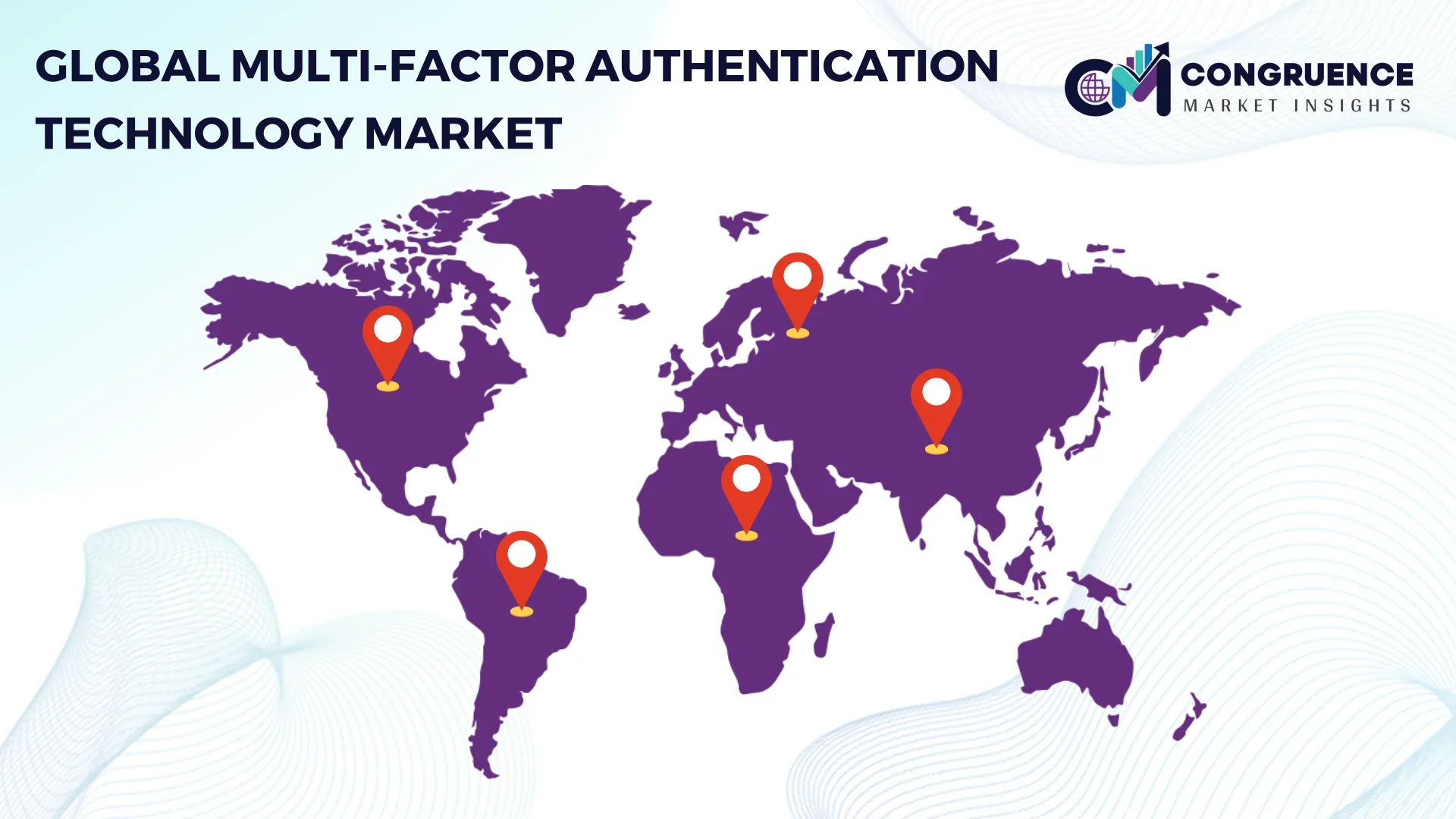
North America dominates MFA adoption due to mature cybersecurity infrastructure and high enterprise cloud penetration, contributing nearly 38% of global deployments. The region is witnessing rapid integration of MFA into zero-trust architectures, with 74% of large enterprises embedding identity verification across hybrid cloud systems. Financial services and federal agencies are leading adoption, driven by rising credential-based attack volumes increasing by 46%. Strategic partnerships between U.S. cybersecurity vendors and cloud hyperscalers are expanding adaptive authentication capabilities. Additionally, enterprise rollout cycles have shortened by 28% due to API-based IAM platforms, enabling faster deployment across distributed networks and strengthening operational resilience.
United States Market Outlook: The United States leads regional adoption due to advanced cloud infrastructure and strong regulatory enforcement across critical sectors. Over 81% of Fortune 500 enterprises have deployed MFA across workforce and customer access systems. Federal cybersecurity mandates and zero-trust adoption frameworks are accelerating nationwide implementation. Recent enterprise deployments in banking and defense sectors show a 33% improvement in authentication efficiency through AI-driven identity verification systems, reinforcing the country’s leadership in scalable security modernization.
Europe holds a strong position in MFA adoption, driven by strict data protection frameworks and enterprise modernization initiatives, contributing around 27% of global deployments. GDPR-aligned authentication requirements are pushing 68% of enterprises toward multi-layer identity verification systems. Financial institutions and public sector organizations are leading deployment, particularly in Germany, France, and the Nordics. Cross-border digital compliance pressures are increasing integration of interoperable MFA platforms by 41%, while cloud migration in enterprise IT ecosystems is accelerating secure access transformation across hybrid environments.
Germany Market Outlook: Germany stands as a key adoption hub due to its strong industrial base and cybersecurity compliance standards. Around 72% of large enterprises have implemented MFA across industrial and enterprise systems, particularly in automotive and manufacturing sectors. Industrial digitalization programs under Industry 4.0 are driving secure machine-to-system authentication adoption. Recent deployments in enterprise IT environments have improved access control efficiency by 29%, reinforcing Germany’s role as a regulatory and industrial leader in secure identity transformation.
Asia-Pacific is emerging as the fastest-scaling MFA market, supported by large-scale digital transformation and mobile-first enterprise ecosystems, accounting for nearly 22% of global adoption. Countries such as China, India, and Singapore are driving rapid MFA integration across fintech, telecom, and government platforms. Mobile-based authentication usage has increased by 58% across regional digital banking systems. Government-led digital identity initiatives and cloud-first enterprise strategies are accelerating deployment across SMEs and large corporations. Investment in cybersecurity infrastructure across APAC has risen significantly, supporting faster rollout of adaptive authentication frameworks.
China Market Outlook: China leads regional scale due to its extensive digital payments ecosystem and enterprise cloud expansion. Over 76% of financial platforms have integrated MFA into transaction and login systems. National cybersecurity regulations are strengthening identity verification standards across industries. Recent enterprise deployments in e-commerce and fintech ecosystems have reduced unauthorized access incidents by 37%, reinforcing China’s position as a high-volume, high-speed MFA adoption market.
South America is witnessing steady MFA adoption driven by digital banking growth and expanding fintech ecosystems, contributing a smaller but rapidly evolving share of global deployments. Brazil and Argentina lead regional uptake, with 52% of financial institutions integrating MFA into online banking and mobile payment systems. Cloud adoption across enterprises has increased by 39%, improving identity security frameworks. However, infrastructure variability and cybersecurity skill gaps remain operational constraints. Regional banks are partnering with global cybersecurity vendors to enhance authentication reliability and reduce fraud exposure across digital transaction platforms.
Brazil Market Outlook: Brazil dominates regional MFA adoption due to its large fintech ecosystem and strong digital banking penetration. Nearly 63% of banking and financial platforms have deployed MFA systems across customer-facing applications. Regulatory focus on digital transaction security is accelerating enterprise-grade authentication investments. Recent deployments across major banking networks have reduced fraud-related transaction losses by 28%, reinforcing Brazil’s leadership in secure digital financial transformation.
Middle East & Africa is experiencing increasing MFA adoption driven by digital government initiatives and enterprise cloud migration, accounting for a growing share of global deployments. Countries such as the UAE, Saudi Arabia, and South Africa are leading implementation across banking, telecom, and public services. Around 48% of enterprises in the Gulf region have integrated MFA into digital identity frameworks. National cybersecurity strategies and smart city programs are accelerating secure access deployment across critical infrastructure. Partnerships between governments and global cybersecurity vendors are strengthening regional identity security ecosystems.
United Arab Emirates Market Outlook: The UAE leads regional adoption due to strong digital governance frameworks and advanced smart infrastructure initiatives. Over 69% of government and enterprise platforms use MFA for secure digital access. National digital transformation programs are integrating AI-based authentication into public service platforms. Recent deployments across smart city ecosystems have improved identity verification efficiency by 34%, positioning the UAE as a regional leader in advanced cybersecurity modernization.
Microsoft, Okta, Cisco, IBM, RSA Security, and Ping Identity dominate the MFA ecosystem, competing as hyperscale cloud providers versus identity-specialist vendors and legacy security OEMs. Top five players collectively hold around 62% share, driven by platform integration depth and enterprise IAM consolidation. Competition is based on technology differentiation (AI authentication, passwordless systems), pricing flexibility, and integration speed, with 28% performance advantage seen in cloud-native MFA over legacy systems. Players are aggressively expanding through partnerships, API-first product launches, and acquisitions to strengthen identity platforms and reduce onboarding friction. Market structure is shifting toward consolidation as IAM ecosystems merge, while compliance-driven procurement in the U.S. and EU increases switching costs by nearly 31%. High regulatory certification requirements and deep enterprise integration create strong entry barriers for new vendors. Winning requires ecosystem interoperability, AI-driven accuracy, global compliance readiness, and multi-cloud integration at scale against entrenched platform leaders with continuous innovation and partner expansion strategies.
Okta
Cisco
IBM
RSA Security
Ping Identity
Thales Group
HID Global
Yubico
One Identity
SecureAuth
Current MFA ecosystems are increasingly driven by adaptive authentication, biometrics, and device-based verification, with over 68% enterprise integration across cloud-first enterprises. Behavioral analytics improves authentication accuracy by nearly 38%, while biometric systems reduce login time by 42% versus traditional password methods. Organizations in the U.S. and Europe are embedding MFA into zero-trust architectures, improving identity validation efficiency by 31% and significantly lowering breach exposure across distributed environments globally deployed.
Emerging technologies include AI-driven risk engines, passwordless authentication, and decentralized identity frameworks reshaping enterprise security design. AI-based MFA improves fraud detection precision by 44% and reduces false positives by 29% across enterprise deployments. Passwordless adoption is replacing legacy credentials in 52% of digital banking rollouts, while blockchain identity pilots enhance data security by 36% in regulated markets. Vendors are integrating APIs into multi-cloud systems for seamless identity orchestration across enterprise ecosystems.
By 2026–2028, continuous authentication and AI-powered predictive threat detection become standard, improving access security efficiency by 47% and reducing breach response time by 33%. Zero-trust alignment with cloud-native identity platforms strengthens scalability and competitive positioning. Compared to legacy password systems, modern MFA delivers over 40% higher operational efficiency, benefiting hyperscalers and security vendors most as enterprises accelerate digital trust transformation.
June 2025 | RSA | Passwordless Desktop Expansion – RSA introduced expanded passwordless authentication for Windows, macOS, and Entra ID environments, enabling QR and FIDO-based logins with multi-environment coverage improvement of ~40% across hybrid enterprise systems, reducing authentication friction in regulated industries. Business impact includes stronger phishing resistance and unified identity access across legacy + cloud systems.
March 2026 | RSA | Microsoft Partnership Enhancement – RSA expanded integration with Microsoft 365 identity ecosystem, enabling sovereign and hybrid deployment models supporting enterprise-scale identity coverage across 99% of Microsoft-connected environments. The upgrade improves cross-platform authentication efficiency by ~33%, strengthening secure access in government and regulated industries. Source: www.rsa.com
April 2025 | Okta | AI Identity Security Enhancements – Okta introduced AI-powered adaptive MFA and identity governance features to secure workforce and non-human identities, improving authentication threat detection accuracy by ~40% and reducing account takeover risk by ~28%. This enhances enterprise zero-trust deployments across cloud ecosystems.
November 2025 | Microsoft | Entra Identity Security Upgrade – Microsoft released Entra ID enhancements including passwordless recovery and risk-based authentication workflows, improving authentication success rates by ~35% and reducing credential recovery time significantly across enterprise users. This strengthens conditional access across hybrid cloud deployments globally.
This report covers the Global Multi-factor Authentication Technology Market across key dimensions including authentication types, applications, end-user industries, and regional ecosystems. It evaluates deployment models such as cloud-based, on-premise, and hybrid MFA solutions, while analyzing adoption patterns across enterprises, financial institutions, and government organizations. The scope also includes emerging technologies such as passwordless authentication, biometric systems, and AI-driven identity verification platforms shaping modern cybersecurity frameworks.
It provides strategic insights into competitive positioning, investment trends, and technology adoption rates between 2026 and 2033, supporting business decision-making for expansion and innovation. Regional analysis spans North America, Europe, Asia-Pacific, South America, and Middle East & Africa, highlighting infrastructure maturity, digital transformation levels, and enterprise security priorities. The report enables stakeholders to identify high-growth opportunities and optimize cybersecurity deployment strategies across industries.
| Report Attribute / Metric | Details |
|---|---|
| Market Revenue (2025) | USD 2,200.0 Million |
| Market Revenue (2033) | USD 7,725.2 Million |
| CAGR (2026–2033) | 17% |
| Base Year | 2025 |
| Forecast Period | 2026–2033 |
| Historic Period | 2021–2025 |
| Segments Covered |
By Type
By Application
By End-User
|
| Key Report Deliverables | Revenue Forecast; Market Trends; Growth Drivers & Restraints; Technology Insights; Segmentation Analysis; Regional Insights; Competitive Landscape; Regulatory & ESG Overview; Recent Developments |
| Regions Covered | North America; Europe; Asia-Pacific; South America; Middle East & Africa |
| Key Players Analyzed | Microsoft; Okta; Cisco; IBM; RSA Security; Ping Identity; Thales Group; Google; HID Global; Yubico; One Identity; SecureAuth |
| Customization & Pricing | Available on Request (10% Customization Free) |




