
Reports
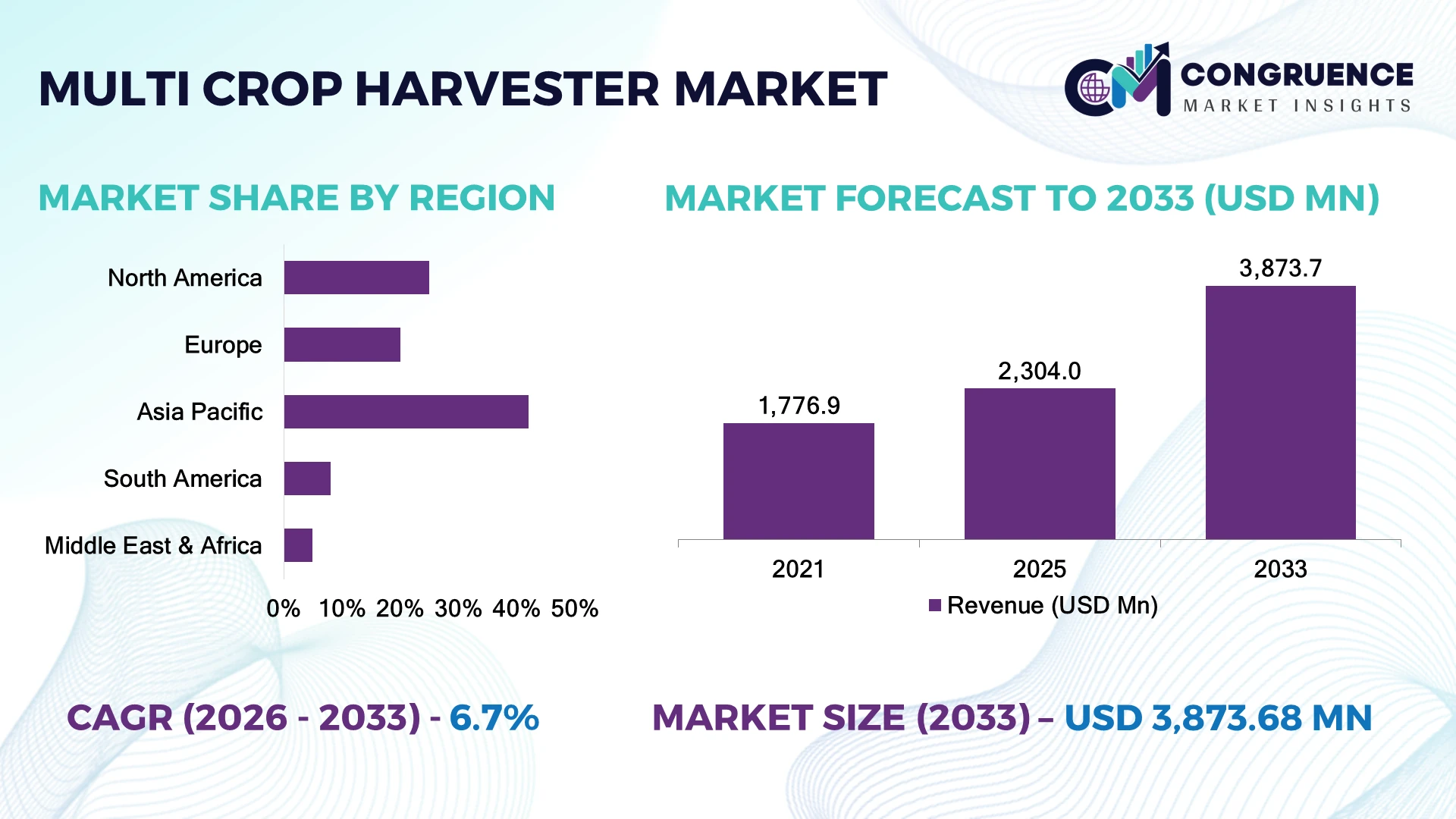
The Global Multi Crop Harvester Market was valued at USD 2,304.0 Million in 2025 and is anticipated to reach a value of USD 3,873.7 Million by 2033 expanding at a CAGR of 6.71% between 2026 and 2033. Growth is driven by mechanized farming adoption, precision agriculture integration, and rising demand for multi-functional harvesting equipment that reduces labor dependency and improves field productivity.
China dominates the global multi crop harvester landscape, accounting for nearly 32% of agricultural machinery production capacity, supported by government-led farm mechanization programs and investments in smart agriculture. India follows with over 40% adoption growth in mechanized harvesting across major grain-producing states, driven by initiatives such as the Sub-Mission on Agricultural Mechanization. Compared with Europe’s automation-focused farms, Asian markets prioritize affordable, versatile machines for fragmented farmland structures.
Strategic investments in localized manufacturing and digital harvesting solutions will determine long-term competitive positioning.
Market Size & Growth: Valued at USD 2,304.0 Million in 2025 and projected to reach USD 3,873.7 Million by 2033, expanding at 6.71% CAGR driven by precision farming and mechanization.
Top Growth Drivers: Labor shortages contribute 35% growth impact, mechanization adoption accounts for 30%, and smart farming technologies influence 25% of market expansion.
Short-Term Forecast: By 2028, automation-enabled harvesters reduce operating costs by 15% and improve harvesting efficiency by 20%.
Emerging Technologies: AI-based crop monitoring, autonomous harvesting systems, and IoT-enabled fleet management are reshaping advanced agricultural equipment.
Regional Leaders: Asia Pacific reaches USD 1.8 billion with mechanized farming expansion; Europe reaches USD 900 million through automation adoption; North America reaches USD 750 million through precision agriculture deployment.
Consumer/End-User Trends: Over 45% of large-scale farms are adopting multifunctional harvesting equipment to improve seasonal productivity.
Pilot/Case Example: In 2024, smart harvester trials in China improved crop collection accuracy by 18% through sensor-based field optimization.
Competitive Landscape: Leading manufacturers include CLAAS, John Deere, CNH Industrial, AGCO Corporation, and Kubota, with leading players controlling approximately 40% of the organized market.
Regulatory & ESG Impact: Sustainable farming policies improve machinery efficiency by 12% through reduced fuel consumption and optimized field operations.
Investment & Funding: More than USD 500 million invested in agricultural automation partnerships and manufacturing expansion projects across Asia and Europe.
Innovation & Future Outlook: Next-generation harvesters integrating AI analytics, autonomous navigation, and modular attachments are driving strategic shifts toward flexible farming operations.
Multi Crop Harvester demand is accelerating across grain, cereal, and commercial farming applications as producers seek higher field utilization and reduced operational dependency. Recent innovations include sensor-based harvesting systems and hybrid machinery platforms, with automation adoption increasing by approximately 25% among advanced farming operations. Supply-chain localization in countries such as India and China is strengthening equipment availability, creating a transition toward digitally enabled agricultural ecosystems.
The Multi Crop Harvester Market is becoming strategically important as agricultural producers prioritize productivity, workforce optimization, and equipment versatility amid changing farming conditions. Global supply-chain restructuring and domestic manufacturing initiatives in India, China, and Southeast Asia are accelerating local production of agricultural machinery while reducing dependence on imported components.
Advanced multi crop harvesters equipped with GPS guidance, AI-based crop detection, and automated controls deliver up to 20% higher field efficiency compared with conventional harvesting systems. Developed markets such as Germany and the United States emphasize autonomous operation and data-driven farming, while India and China focus on affordable machines suitable for diverse crop patterns and smaller land holdings.
Over the next 2–3 years, manufacturers are expected to increase partnerships with technology providers, expand regional assembly facilities, and introduce modular harvesting platforms. For example, Indian agricultural equipment companies are investing in compact harvesters designed for fragmented farmland and seasonal crop cycles. Companies that combine cost-effective manufacturing with digital capabilities will secure stronger competitive advantages and long-term operational leadership.
Rising farm mechanization is the primary driver accelerating multi crop harvester adoption across agricultural economies. Countries such as India and China are increasing machinery penetration as labor availability declines and seasonal harvesting pressures intensify. Mechanized farming adoption has improved productivity by nearly 25%, while precision technologies enhance operational efficiency by approximately 20%. Government support programs, including agricultural equipment subsidies, are encouraging farmers to upgrade from manual and single-crop machinery. Manufacturers are responding through localized production, strategic partnerships, and development of affordable smart harvesters. The shift toward multifunctional equipment enables farmers to manage multiple crops with fewer machines, improving asset utilization and reducing operational downtime.
High acquisition costs and limited service infrastructure restrict adoption among small and medium-scale farmers. Advanced multi crop harvesters equipped with automation features can increase initial investment requirements by 20–30% compared with conventional equipment. In countries with fragmented agricultural land, including India, machine utilization remains constrained due to limited farm sizes and uneven access to maintenance networks. Component supply volatility and imported technology dependency further pressure manufacturing costs. Companies are addressing these barriers through leasing models, regional service centers, and localized component sourcing. Improving financing availability and after-sales support remains essential for expanding deployment beyond large commercial farms.
Digital agriculture adoption creates significant opportunities for next-generation multi crop harvesters through automation, connectivity, and predictive analytics. AI-enabled machinery can improve harvesting accuracy by 15–20% while reducing unnecessary fuel consumption through optimized operations. Emerging markets in Southeast Asia and Africa are investing in agricultural modernization programs, creating demand for adaptable harvesting solutions. Manufacturers are developing modular platforms, remote monitoring systems, and machine-sharing models to reach smaller farming communities. Partnerships between equipment producers and agricultural technology firms are increasing innovation speed. The strongest opportunity lies in combining affordable hardware with digital services that improve productivity without increasing farmer complexity.
Technology integration remains a major challenge as advanced harvesters require skilled operators, reliable connectivity, and upgraded agricultural infrastructure. Approximately 30% of developing-market farms face limitations related to digital readiness and technical support availability. Cybersecurity concerns in connected machinery and compatibility issues between software platforms create additional operational complexity. Countries such as Brazil and India are experiencing increasing demand for operator training programs as smart equipment adoption expands. Companies must invest in workforce development, secure machine platforms, and collaborative ecosystems to ensure consistent deployment. Long-term competitiveness will depend on balancing automation benefits with practical field-level usability.
Autonomous Harvesting Integration AI-guided navigation, sensor-based crop detection, and automated steering systems are gaining adoption, improving harvesting accuracy by 15–20% and reducing operator dependency by nearly 25%. Agricultural machinery manufacturers are integrating machine learning platforms and remote diagnostics to improve field performance. The shift is accelerating as labor shortages in China, India, and Europe push farms toward semi-autonomous operations and connected equipment ecosystems.
Modular Equipment Adoption Growth Farm operators are increasingly selecting modular multi crop harvesters with interchangeable attachments, improving machine utilization by 20–30% across seasonal crop cycles. This operational shift reduces equipment idle time and enables farmers to manage diverse crops using a single platform. Companies are responding by expanding customizable product portfolios and forming component partnerships to support flexible harvesting requirements.
Digital Fleet Management Expansion Connected fleet monitoring systems are becoming a key operational upgrade, with adoption among commercial farms increasing by approximately 30% through GPS tracking, predictive maintenance, and data analytics. These systems reduce maintenance delays by 15% and improve equipment scheduling efficiency. Manufacturers are partnering with agricultural software providers to create integrated machinery management platforms.
Localized Manufacturing Transition Supply-chain disruptions and government localization policies are accelerating regional production strategies, with domestic component sourcing increasing by 20–25% among major agricultural equipment producers. India and China are expanding local assembly capabilities to reduce import dependency and improve delivery speed. Companies are restructuring supply networks through regional partnerships, supplier diversification, and manufacturing investments.
Based on type, self-propelled multi crop harvesters represent the leading segment, accounting for approximately 45% of the market due to higher field mobility, operational efficiency, and suitability for large-scale farming activities. Their ability to integrate GPS systems, automation features, and multiple harvesting functions gives them a competitive advantage over tractor-mounted and portable variants. Adoption is particularly strong among commercial farms in China, the United States, and India, where productivity improvement remains a priority.
Tractor-mounted harvesters hold around 30% share and remain relevant in developing agricultural markets due to lower investment requirements and compatibility with existing farm equipment. Portable harvesters are emerging as the fastest-growing type, expanding by nearly 15% as small and medium farmers seek affordable mechanization solutions. Manufacturers are increasing investments in compact designs, modular configurations, and region-specific product development to capture fragmented farming markets.
Grain harvesting applications dominate the multi crop harvester market, contributing approximately 50% market share due to extensive use in wheat, rice, maize, and cereal production. Large-scale grain cultivation in China, India, and the United States continues to drive demand for high-capacity harvesting equipment capable of reducing seasonal labor pressure. Grain-focused harvesters improve field productivity by nearly 25% compared with conventional manual harvesting methods.
Oilseed and pulse harvesting applications represent emerging growth areas, supported by rising cultivation diversity and demand for flexible machinery. These applications are expanding at nearly 18% adoption growth as farmers seek equipment capable of handling multiple crop conditions. Fruit and vegetable harvesting remains a specialized segment, requiring advanced precision systems and customized attachments. Companies are adapting through application-specific engineering, automation upgrades, and partnerships with agricultural technology providers to improve machine versatility.
Commercial farms represent the largest end-user segment, accounting for approximately 55% of market demand due to higher purchasing capacity, extensive cultivated land, and stronger focus on operational efficiency. Large agricultural enterprises increasingly deploy multi crop harvesters to optimize workforce utilization, reduce harvesting delays, and improve crop management consistency. These users are prioritizing advanced machines with automation, telematics, and predictive maintenance capabilities.
Contract farming operators and agricultural service providers are emerging as the fastest-growing end-user group, with adoption increasing by nearly 20% as shared equipment models expand among smaller farms. Government agricultural institutions and research farms maintain strategic importance through technology trials and mechanization programs. Manufacturers are responding with flexible financing models, leasing partnerships, and customized equipment packages to address different operational scales.
Asia-Pacific accounted for the largest market share at 42% in 2025 however, North America is expected to register the fastest growth, expanding at a CAGR of 7.2% between 2026 and 2033.

North America represents a highly advanced multi crop harvester market, supported by large-scale farming operations, precision agriculture adoption, and strong equipment replacement cycles. The region contributes approximately 25% of global demand, with the United States accounting for the majority of deployments across grain-producing states. More than 60% of large commercial farms utilize some form of connected agricultural machinery, increasing demand for AI-enabled harvesting platforms and autonomous systems. Manufacturers are expanding digital service networks, telematics solutions, and dealer partnerships to improve machine utilization and after-sales support. Rising labor constraints and sustainability-focused farming practices are accelerating investments in fuel-efficient and data-driven harvesting equipment.
United States Market Outlook: The United States remains the key North American market due to extensive commercial farming infrastructure and high technology adoption. Over 900,000 farms operate across the country, creating strong demand for high-capacity harvesting solutions. Companies are prioritizing autonomous navigation, predictive maintenance, and precision farming integration to improve productivity across wheat, corn, and soybean operations.
Europe’s multi crop harvester market is influenced by advanced agricultural technology adoption, environmental regulations, and demand for efficient farming practices. The region contributes nearly 20% of global market demand, with Germany, France, and the United Kingdom representing major deployment centers. European farmers are increasingly adopting automation-enabled equipment, with approximately 35% of large agricultural enterprises integrating digital monitoring systems into machinery operations. Strict emission standards and sustainability initiatives are encouraging manufacturers to develop low-emission engines, electric-assisted systems, and resource-efficient harvesting platforms. Companies are strengthening partnerships with technology providers to enhance automation capabilities and meet evolving regulatory requirements.
Germany Market Outlook: Germany leads Europe’s agricultural machinery innovation landscape through strong manufacturing capabilities and engineering expertise. The country hosts major equipment producers and advanced testing facilities, supporting rapid deployment of smart harvesters. More than 40% of large farms are adopting precision agriculture solutions, creating demand for connected and highly automated harvesting systems.
Asia-Pacific dominates the global multi crop harvester market due to extensive agricultural production, rising mechanization, and strong domestic manufacturing ecosystems. The region accounts for approximately 42% of global demand, supported by China, India, and Japan. China represents a major production hub, contributing nearly 35% of global agricultural machinery output through extensive manufacturing capacity and government-supported modernization programs. India is experiencing accelerated equipment adoption as farm labor availability declines and mechanization initiatives expand. Manufacturers are increasing localized production, improving affordability, and developing compact harvesters suited for fragmented farmland structures. Export-oriented production networks are also expanding across Southeast Asia.
China Market Outlook: China remains the largest Asia-Pacific market with strong agricultural machinery manufacturing capacity and widespread farm modernization programs. Over 70% of large agricultural operations in key provinces have adopted mechanized equipment solutions. Companies are focusing on intelligent harvesting systems, automation upgrades, and domestic component sourcing to strengthen competitiveness.
South America is emerging as a significant market due to large-scale soybean, corn, wheat, and grain production activities. The region contributes nearly 8% of global multi crop harvester demand, with Brazil and Argentina representing major deployment markets. Large agricultural enterprises are increasing investment in high-capacity harvesting equipment to improve productivity across extensive farmland areas. Brazil’s agricultural sector has expanded precision farming adoption, with more than 30% of commercial farms using digital agriculture tools. Infrastructure limitations and uneven service availability remain challenges in remote farming zones. Manufacturers are addressing these issues through regional dealer expansion, financing programs, and localized maintenance networks.
Brazil Market Outlook: Brazil represents the strongest South American market due to its global position in soybean and grain production. The country’s commercial farming sector increasingly relies on advanced harvesting machinery, with over 60 million hectares dedicated to major field crops. Equipment manufacturers are expanding partnerships and service coverage to support large agricultural enterprises.
Middle East & Africa is developing as a transformation-focused market driven by food security initiatives, agricultural modernization projects, and infrastructure investments. The region contributes approximately 5% of global multi crop harvester demand, with adoption concentrated in South Africa, Egypt, Saudi Arabia, and selected commercial farming areas. Government-backed agricultural programs are increasing machinery accessibility, while irrigation expansion projects are improving farming productivity. Mechanization adoption remains below developed markets, creating opportunities for affordable and durable harvesting solutions. Companies are entering the region through distribution partnerships, localized support networks, and equipment financing models to address operational constraints.
South Africa Market Outlook: South Africa is the leading agricultural machinery market in the region due to established commercial farming infrastructure and advanced crop production systems. Approximately 50% of large-scale farms use modern mechanized equipment, supporting demand for efficient multi crop harvesters. Manufacturers are strengthening dealer networks and introducing technology-enabled machines suited to diverse farming conditions.
The Multi Crop Harvester Market features competition between global OEM leaders such as John Deere, CNH Industrial, AGCO, CLAAS, and Kubota against regional manufacturers focused on affordability and localized service. The top five players collectively account for approximately 45% of organized market participation. Competition is centered on automation, machine efficiency, pricing flexibility, dealer networks, and customization. Premium manufacturers invest heavily in AI-enabled harvesting, connected machinery, and predictive maintenance, improving operational efficiency by 15–25%, while regional players compete through lower-cost models and faster support. Companies are expanding manufacturing capacity, forming technology partnerships, and integrating digital platforms to strengthen market presence. The competitive landscape is shifting toward intelligent equipment ecosystems, supply-chain localization, and vertical integration of components and software. High capital requirements, technology expertise, and distribution reach create significant entry barriers. Winning players will combine cost-effective engineering, reliable service networks, and advanced automation capabilities to capture evolving agricultural demand.
CNH Industrial N.V.
AGCO Corporation
CLAAS KGaA mbH
Kubota Corporation
Mahindra & Mahindra Ltd.
SDF Group
Yanmar Holdings Co., Ltd.
Rostselmash
Preet Agro Industries
Kartar Agro Industries
Vishal Combines
Multi crop harvesters are transitioning from mechanical systems toward intelligent agricultural platforms through AI, IoT connectivity, GPS guidance, and automated control technologies. AI-based crop recognition and predictive adjustment systems improve harvesting accuracy by 15–20%, while connected monitoring reduces maintenance downtime by approximately 10–15%. Leading OEMs are integrating digital dashboards and remote diagnostics to improve fleet productivity and operational visibility.
Autonomous navigation represents a major technology shift compared with conventional operator-controlled harvesters. New-generation automated systems improve field efficiency by nearly 20% and reduce manual intervention requirements by 25% compared with older equipment. Large commercial farms in North America and Europe are adopting these solutions faster, while emerging markets prioritize affordable automation packages and modular upgrades.
From 2026 to 2028, competitive advantage will increasingly depend on combining machinery with software ecosystems, predictive analytics, and precision agriculture platforms. John Deere, CNH Industrial, and AGCO benefit from integrated technology portfolios, while regional manufacturers are competing through cost-efficient digital solutions. Companies acting early on automation partnerships, connected platforms, and localized technology development will strengthen long-term market positioning.
February 2025 John Deere introduced expanded automation and productivity enhancements for model year 2026 combines, adding advanced harvesting controls and digital updates. The company focused on reducing operator intervention and improving machine insights. The updates strengthen precision harvesting capabilities across diverse crop conditions. Source: John Deere
January 2024 CNH Industrial announced a €150 million investment in its Zedelgem Harvesting Center of Excellence to expand R&D and production capabilities for New Holland combine harvesters. The facility upgrade includes redesigned assembly operations and advanced manufacturing systems. Source: CNH Industrial
2025 AGCO showcased Fendt IDEAL combines and smart farming technologies, including AI-powered solutions and autonomous technology platforms. The company expanded integration between harvesting equipment and precision agriculture systems to improve productivity and sustainability performance. Source: AGCO Corporation
June 2026 John Deere launched MY27 combine updates across T5/T6, S7, and X9 ranges, introducing predictive ground speed automation using satellite and camera-based crop measurements. The technology improves harvesting consistency and reduces operational costs under variable field conditions. Source: John Deere UK
The Multi Crop Harvester Market Report covers comprehensive analysis across machine types, including self-propelled, tractor-mounted, and portable harvesting systems, along with applications spanning grain, oilseed, pulse, and specialty crop harvesting. The report evaluates adoption patterns among commercial farms, agricultural service providers, and institutional users across North America, Europe, Asia-Pacific, South America, and Middle East & Africa.
The study examines technology integration, automation trends, digital farming solutions, supply-chain developments, and competitive strategies shaping market direction between 2026 and 2033. Coverage includes segment positioning, deployment patterns, manufacturing trends, and innovation strategies of leading industry participants. The report supports investment decisions, expansion planning, partnership development, and competitive positioning by identifying high-potential opportunities, operational challenges, and emerging technology priorities within the evolving agricultural machinery ecosystem.
| Report Attribute / Metric | Details |
|---|---|
| Market Revenue (2025) | USD 2,304.0 Million |
| Market Revenue (2033) | USD 3,873.7 Million |
| CAGR (2026–2033) | 6.71% |
| Base Year | 2025 |
| Forecast Period | 2026–2033 |
| Historic Period | 2021–2025 |
| Segments Covered |
By Type
By Application
By End-User
|
| Key Deliverables | Revenue Forecast; Market Trends; Growth Drivers & Restraints; Technology Insights; Segmentation Analysis; Regional Insights; Competitive Landscape; Regulatory & ESG Overview; Recent Developments |
| Regions Covered | North America; Europe; Asia-Pacific; South America; Middle East & Africa |
| Companies Profiled | John Deere; CNH Industrial N.V.; AGCO Corporation; CLAAS KGaA mbH; Kubota Corporation; Mahindra & Mahindra Ltd.; SDF Group; Yanmar Holdings Co., Ltd.; Rostselmash; Preet Agro Industries; Kartar Agro Industries; Vishal Combines |
| Customization & Pricing | Available on Request (10% Customization Free) |




