
Reports
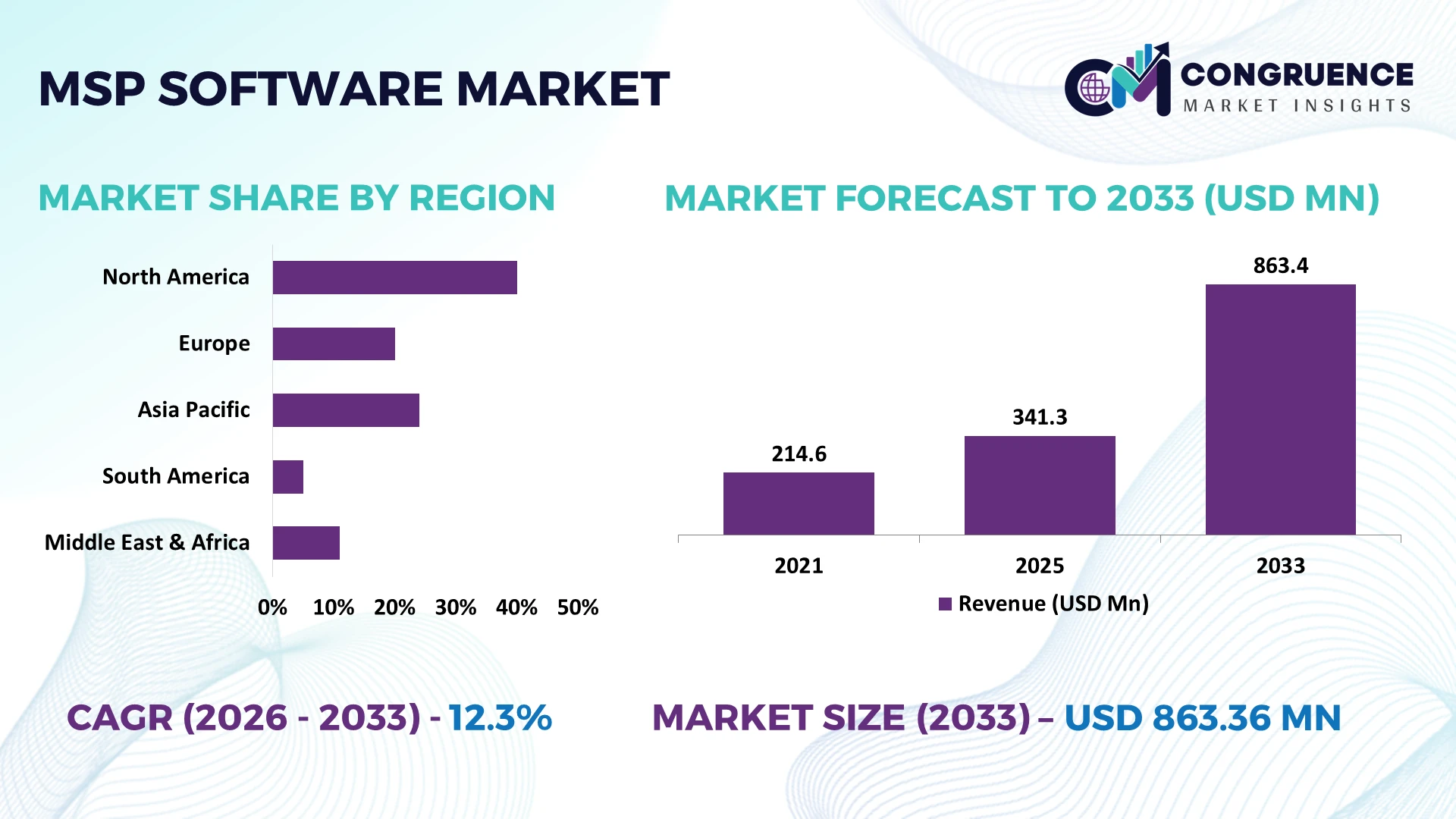
The Global MSP Software Market was valued at USD 341.31 Million in 2025 and is anticipated to reach a value of USD 863.36 Million by 2033 expanding at a CAGR of 12.3% between 2026 and 2033. Cybersecurity service expansion, AI-enabled workflow automation, cloud infrastructure complexity, and consolidation of RMM, PSA, backup, and security tools are accelerating MSP software adoption.
The United States leads the MSP software landscape, supported by the world’s largest mature managed-services ecosystem and extensive SMB cloud adoption. Around 97% of top-performing MSPs offer managed security services, while more than 50% of MSPs have migrated customer workloads to cloud environments. In comparison, European providers face stronger compliance-led modernization under the EU’s NIS2 cybersecurity framework. Integration is becoming a competitive benchmark: 95% of MSPs identify integration between RMM, PSA, and IT documentation as important, while 53% use AI to automate activities including ticketing, monitoring, and patch management.
Strategically, software vendors combining RMM, PSA, cybersecurity, backup, documentation, and AI automation into unified platforms are positioned to capture MSP technology-stack consolidation.
Market Size & Growth: USD 341.31 million in 2025 is projected to reach USD 863.36 million by 2033 at 12.3% CAGR, supported by integrated cybersecurity and service automation.
Top Growth Drivers: 97% of top-performing MSPs provide managed security, over 50% have migrated customer workloads to cloud environments, and 53% use AI-enabled operational automation.
Short-Term Forecast: By 2027, broader AI-assisted ticket triage, remediation, documentation, and monitoring will reduce repetitive technician workloads and increase endpoints managed per technician.
Emerging Technologies: AI copilots, automated remediation, predictive monitoring, API-driven RMM-PSA integration, and identity-centric security are shifting MSP platforms from monitoring tools toward autonomous service orchestration.
Regional Leaders: North America remains the largest mature deployment region, Europe accelerates compliance-oriented adoption under NIS2, while Asia-Pacific gains from rapid cloud and managed cybersecurity expansion.
Consumer/End-User Trends: More than 50% of MSPs report moving customer workloads into cloud environments, strengthening requirements for multi-cloud monitoring, automated backup, endpoint security, and centralized administration.
Pilot/Case Example: In 2025, AI adoption reached 53% among surveyed MSPs for functions including ticketing, patching, and monitoring, demonstrating the transition from experimentation toward production workflows.
Competitive Landscape: ConnectWise, Kaseya, N-able, NinjaOne, and Syncro compete across RMM and PSA workflows, with platform breadth and security integration increasingly determining MSP software selection.
Regulatory & ESG Impact: The EU NIS2 framework expands cybersecurity obligations across 18 critical sectors, strengthening demand for auditable monitoring, incident management, access controls, and security documentation.
Investment & Funding: NinjaOne secured USD 500 million in 2025 financing, highlighting investor confidence in automated endpoint management and integrated IT operations as MSP technology stacks consolidate.
Innovation & Future Outlook: With 95% of MSPs considering RMM, PSA, and documentation integration important, next-generation platforms will compete through unified data, AI agents, automated remediation, and security orchestration.
MSP software demand is increasingly concentrated around automated endpoint management, cybersecurity, cloud operations, PSA-RMM integration, and AI-assisted service delivery. AI is already used by 53% of MSPs for operational automation, while NIS2 is intensifying compliance requirements across European digital infrastructure. Unified, automation-first platforms are consequently becoming central to scalable managed-service delivery and the next phase of competitive strategy.
MSP software is becoming strategically important as providers compete through cybersecurity depth, technician productivity, service automation, and integrated IT operations rather than standalone remote monitoring. Around 95% of MSPs consider integration across RMM, PSA, and documentation important, while 53% already use AI for ticketing, patching, or monitoring. Cloud migration and stricter European cybersecurity obligations under NIS2 are reinforcing the transition toward consolidated management platforms.
AI-assisted workflows provide a clear operational advantage over legacy manual service desks by automating repetitive ticket classification, documentation, remediation, and monitoring tasks. Around 30% of MSPs use AI specifically to eliminate tedious work, while 20% report gaining additional time for strategic activities. U.S. providers are scaling security-led automation rapidly, whereas European MSPs increasingly combine service automation with compliance and governance requirements. Through 2026–2028, AI-assisted operations will move deeper into routine service delivery.
A practical deployment links automated ticket classification with RMM telemetry, allowing predefined remediation before technician escalation. MSPs are consequently directing investment toward integrated security, backup, documentation, PSA, and RMM ecosystems, while partnerships expand MDR and cloud-management capabilities. With cybersecurity becoming central to customer retention, competitive positioning will depend on securely managing more endpoints per technician without proportional workforce expansion.
Cybersecurity is becoming the strongest structural driver for integrated MSP software as customers expect providers to manage protection alongside everyday IT operations. Around 76% of MSPs identify cybersecurity as a leading client concern, 67% rank security among their fastest-growing service categories, and 64% report demand for cybersecurity guidance. In the United States, rising ransomware, identity attacks, and cyber-insurance requirements are pushing SMB-focused providers toward integrated EDR, MDR, backup, vulnerability management, and identity controls. This creates direct demand for RMM and PSA platforms capable of converting security alerts into managed workflows. Vendors are responding through security integrations, acquisitions, and MDR partnerships. The strategic advantage is workflow consolidation: MSPs reduce tool switching while increasing security coverage per technician.
Fragmented technology stacks continue to restrict MSP operating efficiency despite expanding software adoption. Approximately 27% of MSPs report that existing software is not used to its full potential, 15% lose productive time switching between applications, and 12% identify inadequate integration as an operational problem. U.S. MSPs frequently combine separate RMM, PSA, documentation, backup, endpoint security, and billing products accumulated through successive technology cycles. Adding point solutions therefore increases duplicate alerts, data synchronization requirements, licensing complexity, and technician training costs. Providers are responding by rationalizing vendors, standardizing APIs, consolidating contracts, and migrating toward unified platforms. The operational insight is significant: adding functionality does not automatically increase service capacity when technicians must continuously reconcile disconnected systems, making interoperability a direct scalability constraint.
AI-enabled orchestration creates an opportunity to extend MSP software beyond monitoring into semi-autonomous service operations. Only about 6% of surveyed MSPs remain outside generative-AI adoption, while 40% have established data-governance and human-oversight practices. Co-managed IT is also expanding, with 61% of executives reporting increased activity as internal technology teams seek specialist support without fully outsourcing operations. In the United States, this creates an attractive middle market for platforms supporting shared administration, permissions, cybersecurity, and automated remediation. MSP vendors are investing in AI copilots, workflow engines, SaaS backup, compliance automation, and ecosystem integrations. The non-obvious opportunity lies in governed automation: connecting endpoint telemetry, tickets, security events, documentation, and recovery actions can expand technician capacity while preserving human approval for sensitive interventions.
Scaling AI and automation without increasing systemic cybersecurity exposure is becoming a defining execution challenge. Around 83% of SMBs believe AI has increased cybersecurity threats, yet only 51% report having AI-related security policies, while 47% of MSP customers indicate willingness to switch providers for stronger cybersecurity capabilities. The challenge is particularly acute in the United States, where MSP platforms often hold privileged access across hundreds or thousands of customer endpoints. Compromised credentials, remote-management tools, or automated workflows can therefore propagate risk across multiple tenants. Vendors must strengthen privileged-access management, zero-trust authentication, tenant isolation, audit trails, and human approval controls while maintaining automation efficiency. Long-term competitive differentiation will depend on proving that increasingly autonomous MSP operations remain secure, observable, recoverable, and consistently governed at scale.
AI Moves Into Daily Operations: AI is shifting from pilot use into technician workflows, with 30% of MSPs using it to remove repetitive tasks and 20% reporting more time for strategic work. Only 6% remain outside generative-AI adoption. Providers are embedding AI into ticket triage, documentation, scripting, and workflow automation to increase technician capacity without proportional hiring.
M&A Reshapes Platform Standardization: MSP consolidation is accelerating, with 53% considering acquisitions in 2025 compared with 45% a year earlier. Acquirers are standardizing RMM, PSA, billing, and documentation platforms across acquired customer estates. This creates a non-obvious software tailwind: transaction activity increases demand for migration tools, unified reporting, license rationalization, and multi-tenant operational controls.
Co-Managed Delivery Gains Scale: Co-managed IT is moving deeper into enterprise service models, with 61% of MSP executives reporting higher activity year over year and roughly two-thirds deriving up to 50% of business from co-managed services. Providers are restructuring permissions, ticket ownership, escalation, and reporting workflows so internal IT teams and MSP technicians can operate within shared platforms.
Cyber-Recovery Becomes Integrated Workflow: Backup management is shifting from scheduled data protection toward operational cyber resilience. In 2025, 53% of MSPs identified SaaS application backup as a priority and 51% highlighted AI-powered backup and recovery, while 90% expected cybersecurity managed-service sales to increase. Vendors are linking recovery, endpoint telemetry, and incident response to shorten restoration workflows after ransomware or account compromise.
Cloud-Based software leads the type segmentation with approximately 69% of current deployments, reflecting the advantage of centralized administration, elastic licensing, automatic updates, and rapid provisioning across multiple customer environments. On-Premises software retains roughly 31% of deployments, particularly where government agencies, financial institutions, and regulated enterprises require tighter data control. Remote Monitoring is also deeply established, with approximately 74% of providers using monitoring capabilities to maintain continuous infrastructure visibility across distributed customer estates.
Remote Management is the fastest-strengthening functional type as MSPs shift from detecting faults toward resolving them remotely through scripting, patching, configuration changes, and automated remediation. Automated patch-management adoption has reached about 62%, supporting this transition. Network Management remains strategically important for hybrid offices, firewalls, switches, SD-WAN, and wireless infrastructure. Vendors are concentrating product development on cloud-native consoles that combine Remote Monitoring, Remote Management, and Network Management, allowing MSPs to reduce technician travel, standardize service policies, and expand endpoint coverage without rebuilding local infrastructure.
Network Monitoring leads the application segmentation with approximately 35.4% share, supported by the operational requirement to maintain continuous visibility across cloud infrastructure, customer offices, connectivity links, switches, firewalls, and distributed workloads. IT Service Management remains central to ticketing, SLA tracking, technician scheduling, workflow control, and customer support. Endpoint Management is strengthening as hybrid work and device proliferation increase patching, configuration, inventory, and remote-support requirements; broader market evidence indicates endpoint-management adoption has reached about 67%.
Security Management is the fastest-strengthening application as detection, identity protection, vulnerability management, and response become embedded directly into MSP operating platforms. In 2025, 90% of surveyed MSPs expected cybersecurity managed-service sales to increase, creating strong software demand around integrated security workflows. Backup Management is also evolving from periodic data protection toward recovery orchestration, with 53% prioritizing SaaS application backup. Vendors are integrating network alerts, endpoint telemetry, security incidents, service tickets, and backup status into common consoles, shifting investment from isolated monitoring products toward operational platforms capable of coordinating detection, remediation, and recovery.
Managed Service Providers remain the dominant end-user group because MSP software is architected around multi-tenant monitoring, service desks, billing, documentation, endpoint administration, and customer-level automation. Within downstream demand, Small & Medium Businesses account for approximately 64% of MSP software-supported deployments in recent market tracking, reflecting their dependence on outsourced IT operations and limited internal technology staffing. Large Enterprises represent a smaller but increasingly strategic buyer group as co-managed IT expands alongside internal infrastructure teams.
Large Enterprises are the fastest-strengthening end-user opportunity: 61% of MSP executives reported increased co-managed activity, showing that enterprises increasingly combine internal IT ownership with external specialist operations. IT Service Providers are also adopting MSP platforms as they convert project work into recurring managed services, while Government Organizations emphasize secure remote administration, auditability, access controls, and deployment sovereignty. Vendors are responding with role-based administration, multi-tenant security, consumption-based pricing, enterprise integrations, and co-managed permission models. The strategic shift is therefore not away from MSP buyers, but toward platforms capable of serving MSP technicians and enterprise IT teams simultaneously.
North America accounted for the largest market share at approximately 42% in 2025 however, Asia-Pacific is expected to register the fastest growth, expanding at a CAGR of approximately 14% between 2026 and 2033.
Platform Consolidation Drives MSP Scale
North America holds approximately 42% of the global MSP software market, anchored by the United States’ mature managed-services channel, large SMB installed base, cloud penetration, and cybersecurity spending intensity. Operational priorities are shifting from standalone RMM and PSA applications toward integrated endpoint, security, backup, documentation, and service-management platforms. In recent MSP benchmarking, 95% of providers identified integration between core applications as important, while 53% were considering acquisitions, reinforcing demand for standardized multi-tenant platforms capable of absorbing acquired customer estates. Canada adds momentum through cloud modernization and cybersecurity outsourcing among mid-market organizations. Vendors including ConnectWise, Kaseya, N-able, NinjaOne, and Syncro are responding with AI-assisted service desks, automated remediation, consolidated security tooling, and deeper ecosystem integrations, making technician productivity a central purchasing metric.
United States Market Outlook: The United States represents the region’s principal MSP software concentration, supported by more than 33 million small businesses and an extensive technology-services channel. Cybersecurity outsourcing is particularly influential as smaller organizations confront ransomware, identity attacks, and limited internal security staffing. Platform vendors are consequently prioritizing automated endpoint administration, MDR integrations, identity controls, and co-managed IT capabilities for U.S. deployments.
Compliance Reshapes Managed IT Operations
Europe accounts for approximately 27% of global MSP software activity, with the United Kingdom, Germany, France, and the Netherlands forming important deployment centers. The defining structural change is tighter cybersecurity governance under NIS2, which applies across 18 critical sectors and raises expectations around risk management, incident reporting, supply-chain security, and operational accountability. MSPs are therefore integrating documentation, vulnerability management, access controls, security monitoring, and auditable workflows with conventional RMM and PSA functions. Hybrid infrastructure remains important because enterprises must administer cloud workloads alongside established on-premises systems. Providers are also expanding sovereign-cloud and localized data-management capabilities to address privacy and residency requirements. This regulatory environment favors platforms capable of combining operational automation with evidence-based compliance rather than relying on disconnected security and service-management applications.
United Kingdom Market Outlook: The United Kingdom remains one of Europe’s most mature managed-services markets, supported by approximately 5.5 million private-sector businesses and extensive cloud adoption among SMEs. British MSPs increasingly compete through cybersecurity, Microsoft ecosystem management, automation, and compliance services. The country’s established technology channel also supports consolidation, encouraging software vendors to strengthen multi-tenant administration and standardized workflows across expanding MSP groups.
Cloud Scale Accelerates Managed Operations
Asia-Pacific represents approximately 21% of MSP software demand and is shifting rapidly toward cloud-controlled service delivery as enterprises modernize distributed infrastructure. Australia, Japan, India, and Singapore are important deployment markets, while expanding public-cloud availability creates additional requirements for multi-cloud monitoring, endpoint administration, service automation, and cybersecurity orchestration. India provides a distinctive scale advantage through its technology-services workforce: the country’s IT-BPM sector employs more than 5 million people, supporting both domestic managed services and offshore delivery. Australia contributes mature MSP penetration among mid-market businesses, while Japan’s workforce constraints strengthen automation requirements. Vendors are responding with localized cloud infrastructure, channel partnerships, AI-assisted support, and scalable multi-tenant licensing. The operational opportunity increasingly centers on managing geographically distributed customer environments through centralized platforms rather than expanding technician headcount proportionately.
India Market Outlook: India combines a large IT-services ecosystem with rapid enterprise cloud adoption and a substantial SME base. More than 63 million MSMEs create a broad potential customer pool for outsourced technology management, while large Indian IT service providers provide enterprise-scale managed operations. MSP software suppliers are emphasizing automation, cloud management, endpoint visibility, and security integrations suited to high-volume service delivery.
Cloud Modernization Expands Outsourced IT
South America accounts for approximately 6% of global MSP software activity, with Brazil providing the largest concentration of enterprise cloud infrastructure, managed IT providers, and hyperscale data-center investment. Migration toward SaaS, public cloud, digital payments, and distributed working environments is increasing requirements for remote monitoring, endpoint management, backup, and service automation. Brazil’s LGPD privacy regime additionally raises expectations for controlled data handling and auditable IT processes. Chile and Colombia provide secondary deployment centers, supported by improving cloud infrastructure and enterprise digitization. However, uneven broadband quality, currency volatility, technology-skills availability, and comparatively fragmented MSP ecosystems constrain standardized deployment outside major metropolitan areas. Software vendors are responding through local channel partnerships, cloud-hosted delivery, flexible licensing, and centralized remote-management architectures that reduce dependence on extensive physical support infrastructure.
Brazil Market Outlook: Brazil is South America’s strategic MSP software hub, supported by more than 20 million active enterprises and extensive hyperscaler infrastructure development around São Paulo. Financial services, retail, manufacturing, and professional services generate concentrated managed-IT requirements. LGPD compliance and cyber-risk management are pushing Brazilian MSPs toward integrated security, backup, endpoint control, and auditable service-management platforms.
Digital Infrastructure Investment Reshapes Services
Middle East & Africa contributes approximately 4% of global MSP software demand, with the UAE, Saudi Arabia, South Africa, and Israel forming key technology-service centers. Gulf governments are accelerating cloud migration, digital-government programs, cybersecurity modernization, and data-center development, creating more complex environments requiring continuous remote administration. Saudi Arabia’s Vision 2030 transformation is particularly influential as government entities and enterprises expand cloud and digital infrastructure while strengthening localization requirements. The UAE combines high cloud adoption with financial-services, aviation, logistics, and government digitization, supporting sophisticated managed-service requirements. South Africa provides the strongest established MSP ecosystem in sub-Saharan Africa, although infrastructure reliability remains an operational consideration. Vendors are responding through hyperscaler partnerships, localized hosting, cybersecurity alliances, and automated remote-management capabilities designed to reduce dependence on scarce specialist IT personnel.
Saudi Arabia Market Outlook: Saudi Arabia is emerging as a strategically important MSP software deployment market as cloud localization and government digital transformation accelerate. The Kingdom targets a 70% contribution from cloud services to government IT infrastructure, reinforcing requirements for centralized monitoring, service management, security, and compliance. Local data centers and cybersecurity capabilities are consequently becoming important vendor-selection criteria.
ConnectWise, Kaseya, N-able, NinjaOne, and Atera anchor MSP software competition, while Syncro and SuperOps challenge established platforms through cloud-native automation and simplified deployment. The top five players collectively account for approximately 45% of market activity, leaving substantial scope for specialized platforms. Competition increasingly centers on integrated RMM, PSA, endpoint security, backup, documentation, and AI orchestration rather than standalone monitoring. More than 95% of MSPs value core-tool integration, while 30% use AI to eliminate repetitive tasks and 20% report additional strategic-work capacity. Kaseya and ConnectWise compete through broad platform ecosystems; NinjaOne emphasizes endpoint automation, while Atera and SuperOps pursue AI-centric workflows. Acquisitions, security partnerships, API integration, and platform consolidation are intensifying as MSPs rationalize fragmented stacks. High switching costs, customer-data migration, workflow retraining, and integration depth create significant entry barriers. Winning requires measurable technician productivity, strong cybersecurity, reliable multi-tenant architecture, and seamless interoperability across the MSP operating stack.
ConnectWise
Kaseya
N-able
NinjaOne
Atera
Syncro
SuperOps
HaloPSA
ManageEngine
Datto
Pulseway
Barracuda Networks
Acronis
Domotz
AI-assisted PSA and RMM are becoming core MSP technologies, with 53% of providers using AI to automate ticketing, patching, or monitoring. ConnectWise reports Sidekick saves five minutes per service ticket and cuts technician-related software costs by up to 75%. Unified telemetry, automated classification, scripting, and remediation let providers increase endpoint capacity without proportional technician hiring.
Emerging platforms combine generative AI, RPA, security telemetry, backup, documentation, and service management through shared data layers. ConnectWise now supports 70-plus AI-assisted actions, while Kaseya 365 Ops early adopters report saving 160 hours monthly through automated workflows. Compared with disconnected legacy stacks, which can consume over 25% of annual operating value through inefficiency, unified platforms materially improve utilization.
Agentic AI is the disruptive 2026–2028 pathway, progressing from recommendations toward autonomous ticket triage, threat containment, backup verification, and remediation. More than half of MSPs currently automate only about 25% of workloads, leaving substantial deployment headroom. Vendors with integrated RMM-PSA-security datasets benefit most because broader telemetry improves automation context. Acting now establishes workflow data, governance, and integration foundations before autonomous operations become a mainstream competitive requirement across service delivery.
June 2024 ConnectWise launched Sidekick for Security, extending generative AI into cybersecurity workflows and delivering millions of AI-powered recommendations daily across Asio. Natural-language vulnerability, alert, and ticket analysis strengthened automated threat response for MSP technicians. Source: connectwise.com
February 2025 NinjaOne secured $500 million in Series C extensions at a $5 billion valuation, funding autonomous endpoint management, patching, vulnerability remediation, global expansion, and its pending Dropsuite acquisition, strengthening integrated endpoint and data-protection capabilities. Source: ninjaone.com
June 2025 ConnectWise launched PSA powered by Asio, unifying PSA and RMM data while embedding more than 50 prebuilt automation workflows. Shared tickets, assets, contacts, and company data reduce duplication and strengthen hyperautomation across MSP service delivery. Source: connectwise.com
August 2026 Kaseya expanded platform investment by adding 200 developers as AI became embedded across its portfolio. Its consolidated Kaseya 365 architecture delivers average savings of $12 per endpoint, intensifying competition around integrated, AI-driven MSP operations. Source: crn.com
The MSP Software Market report evaluates Cloud-Based, On-Premises, Remote Monitoring, Remote Management, and Network Management platforms across Network Monitoring, IT Service Management, Endpoint Management, Security Management, and Backup Management. End-user coverage includes Small & Medium Businesses, Large Enterprises, Managed Service Providers, IT Service Providers, and Government Organizations. Cloud-based deployment remains prominent, while 53% AI adoption for operational automation signals a decisive technology transition.
Geographic analysis covers North America, Europe, Asia-Pacific, South America, and Middle East & Africa, examining deployment maturity, cybersecurity requirements, cloud infrastructure, and enterprise modernization. The report also evaluates AI-assisted PSA/RMM, agentic automation, cyber resilience, co-managed IT, and integrated data architectures. With 95% of MSPs emphasizing core-tool integration, the analysis supports investment planning, geographic expansion, platform positioning, partnership strategy, and technology priorities through 2033.
| Report Attribute/Metric | Report Details |
|---|---|
Market Revenue in 2025 | USD 341.31 Million |
Market Revenue in 2033 | USD 863.36 Million |
CAGR (2026 - 2033) | 12.3% |
Base Year | 2025 |
Forecast Period | 2026 - 2033 |
Historic Period | 2021 - 2025 |
Segments Covered | By Type
By Application
By End-User
|
Key Report Deliverable | Revenue Forecast, Growth Trends, Market Dynamics, Segmental Overview, Regional and Country-wise Analysis, Competition Landscape |
Region Covered | North America, Europe, Asia-Pacific, South America, Middle East, Africa |
Key Players Analyzed | ConnectWise, Kaseya, N-able, NinjaOne, Atera, Syncro, SuperOps, HaloPSA, ManageEngine, Datto, Pulseway, Barracuda Networks, Acronis, Domotz |
Customization & Pricing | Available on Request (10% Customization is Free) |




