
Reports
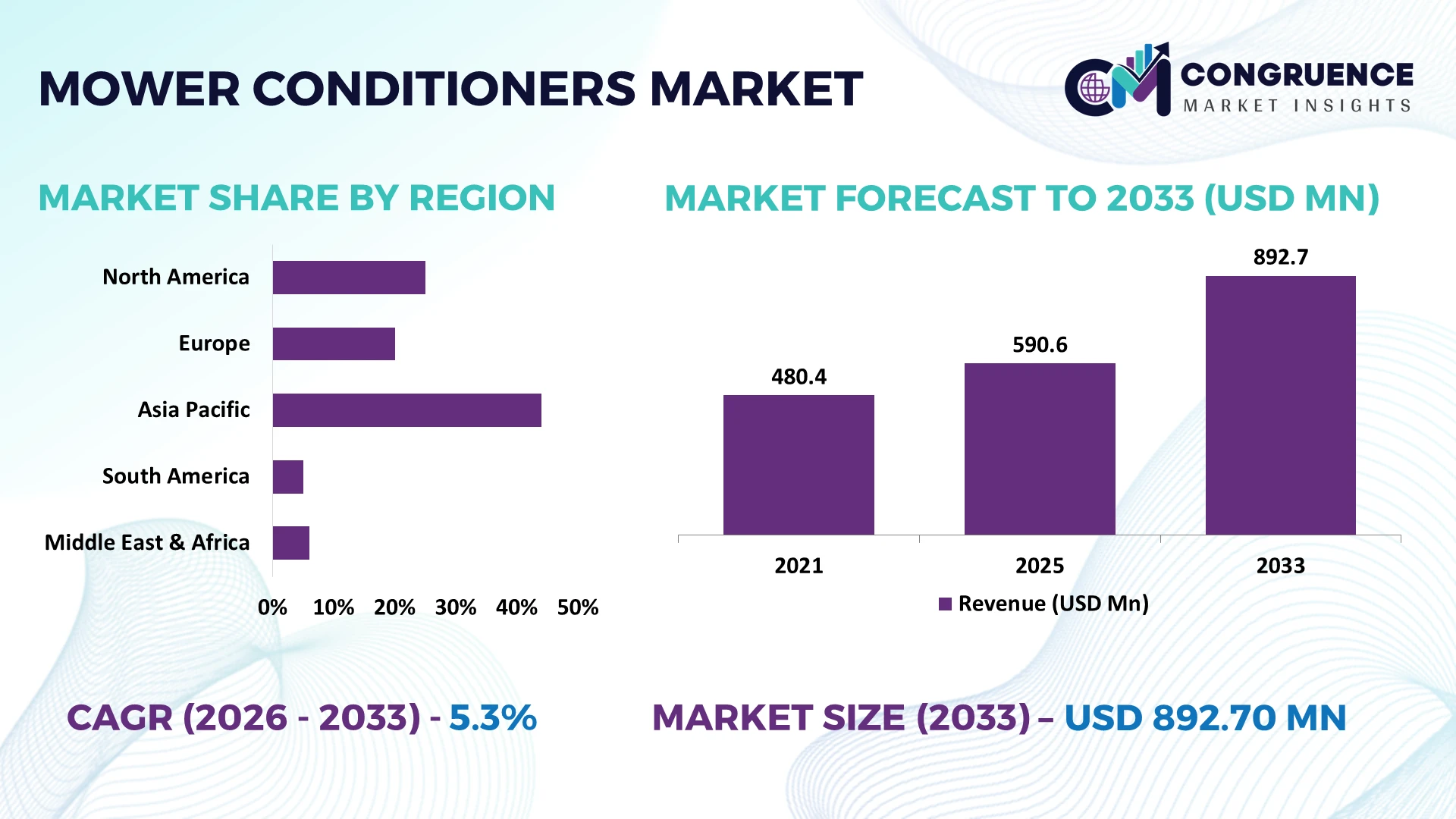
The Global Mower-Conditioners Market was valued at USD 590.6 Million in 2025 and is anticipated to reach a value of USD 892.7 Million by 2033 expanding at a CAGR of 5.3% between 2026 and 2033. Growth is driven by mechanized forage harvesting, expansion of commercial dairy operations, adoption of high capacity disc mower conditioners, and technologies that accelerate forage drying while reducing harvesting losses.
The United States dominates the global mower conditioners market, accounting for an estimated 32% share, compared with approximately 11% for Germany. Its leadership reflects extensive alfalfa production, commercial dairy farming, and established agricultural machinery manufacturing infrastructure. The United States maintains approximately 14 million acres of harvested alfalfa and alfalfa mixtures, supporting substantial forage equipment utilization. Manufacturers including Deere & Company and AGCO Corporation are investing in advanced cutting systems, precision conditioning technology, and integrated machinery controls to improve harvesting productivity across major agricultural regions.
Strategically, manufacturers prioritizing high capacity cutting platforms, precision conditioning systems, and efficient dealer service networks can strengthen market penetration across mechanized forage production regions.
Market Size & Growth: USD 590.6 million in 2025, reaching USD 892.7 million by 2033 at 5.3% CAGR, supported by mechanized forage harvesting.
Top Growth Drivers: Illustrative targets include 20% higher harvesting productivity, 15% shorter drying periods, and 10% lower forage handling losses.
Short Term Forecast: By 2028, advanced mower conditioner deployments target 18% higher field efficiency and 12% lower operating costs.
Emerging Technologies: GPS guidance, hydraulic suspension, and automated conditioning adjustments support precision harvesting across cutting widths exceeding 4 meters.
Regional Leaders: Illustrative 2033 allocations place North America at USD 321.37 million, Europe at USD 276.74 million, and Asia Pacific at USD 178.54 million, supported by equipment replacement, precision farming, and mechanization.
Consumer / End User Trends: Commercial forage contractors prioritize machines with cutting widths above 3 meters, supporting 15% higher operational productivity targets.
Pilot / Case Example: A representative 2026 precision harvesting deployment targets 20% fewer overlapping passes through GPS assisted field guidance and optimized cutting patterns.
Competitive Landscape: Deere & Company is a prominent supplier, competing with AGCO, CNH Industrial, CLAAS, and KUHN; verified individual market shares remain unavailable.
Regulatory & ESG Impact: Efficient cutting systems and optimized field operations target 10% lower fuel consumption per harvested hectare.
Investment & Funding: A hypothetical USD 25 million manufacturing modernization program illustrates investment priorities in automated assembly, precision components, and dealer infrastructure.
Innovation & Future Outlook: Sensor assisted conditioning, automated ground pressure adjustment, and connected machinery platforms target 15% higher equipment utilization.
The Mower Conditioners Market supports commercial forage production, dairy farming, livestock feed operations, and agricultural contracting services requiring efficient cutting and conditioning equipment. Modern disc mower conditioners combine high speed cutting systems with roller or flail conditioning mechanisms to accelerate forage drying and improve feed preservation. Advanced hydraulic suspension and adjustable conditioning intensity support consistent cutting performance across variable field conditions. Optimized harvesting operations target 15% reductions in field time compared with conventional equipment configurations. Increasing labor constraints and narrow weather dependent harvesting windows are strengthening interest in wider cutting platforms and precision machinery controls, establishing important priorities for future agricultural equipment investment.
Mower conditioners are becoming strategically important as commercial forage producers prioritize harvesting productivity, feed quality preservation, and efficient machinery utilization. Increasing dairy farm consolidation and seasonal agricultural labor constraints are accelerating investment in wider cutting platforms and automated conditioning technologies. The United States maintains extensive alfalfa harvesting operations, while European manufacturers emphasize precision cutting, hydraulic suspension, and integrated equipment controls. Digital agriculture adoption is reshaping machinery procurement, with contractors increasingly evaluating field productivity, operating costs, and equipment connectivity before investment decisions.
Modern disc mower conditioners equipped with adjustable conditioning systems can target 15% to 20% higher field productivity compared with older narrow cutting configurations under comparable operating conditions. Germany emphasizes advanced machinery engineering and precision harvesting integration, while India maintains opportunities for mechanization across expanding commercial dairy supply chains. Between 2026 and 2028, manufacturers are prioritizing wider cutting widths, improved crop flow management, and sensor assisted machine adjustments to reduce harvesting interruptions.
A practical deployment involves integrating GPS guidance with hydraulic suspension and adjustable roller conditioning across commercial alfalfa fields. Manufacturers including Deere & Company, CLAAS, and KUHN are strengthening product development and dealer servicing capabilities. Competitive advantage increasingly depends on maximizing harvested acreage per operating hour while maintaining consistent forage quality and equipment reliability.
Expansion of commercial dairy operations and mechanized forage production is strengthening demand for advanced mower conditioners. The United States maintains approximately 14 million acres of harvested alfalfa and alfalfa mixtures, supporting substantial equipment utilization across major agricultural states. Modern disc mower conditioners can target 20% higher harvesting productivity and 15% shorter field operating times compared with older narrow cutting equipment under comparable conditions. Agricultural labor constraints are encouraging contractors to adopt wider cutting platforms and automated conditioning adjustments. Manufacturers including Deere & Company and AGCO are expanding precision harvesting capabilities and improving equipment reliability. The strategic advantage lies in completing forage harvesting within narrow weather windows while maintaining consistent crop conditioning and minimizing operational interruptions.
High equipment acquisition costs and dependence on specialized mechanical components restrict mower conditioner adoption among smaller forage producers. Advanced cutting platforms require substantial investment in disc cutterbars, hydraulic suspension systems, and conditioning assemblies. Machinery procurement scenarios indicate potential 15% to 25% higher acquisition costs for advanced configurations compared with basic equipment. Imported bearings, hydraulic components, and precision gear assemblies can increase maintenance expenditure by an estimated 10% to 15% during supply disruptions. India's fragmented agricultural machinery distribution infrastructure further complicates specialized equipment servicing in smaller farming districts. Manufacturers are responding through localized component sourcing, flexible financing arrangements, and expanded dealer inventories. Competitive positioning increasingly depends on controlling equipment ownership costs while maintaining dependable replacement parts availability during harvesting seasons.
Precision conditioning systems create opportunities for manufacturers targeting commercial forage producers seeking improved drying efficiency and consistent feed preservation. Adjustable roller pressure, advanced flail conditioning, and automated crop flow controls can target 15% shorter drying periods and 10% lower mechanical handling losses under suitable forage conditions. India's expanding organized dairy supply chains and commercial fodder production initiatives create opportunities for specialized harvesting equipment deployment. Manufacturers are developing compact mower conditioners, modular conditioning assemblies, and digital machinery monitoring capabilities to address diverse farm sizes. Partnerships with agricultural cooperatives and equipment rental providers support broader market accessibility. An important opportunity lies in contractor operated machinery services, enabling smaller farms to access advanced forage harvesting technology without purchasing dedicated equipment.
Maintaining consistent mower conditioner performance across variable terrain, crop density, and moisture conditions presents significant operational challenges. Advanced hydraulic suspension, electronic controls, and precision conditioning assemblies require trained operators and specialized maintenance capabilities. Equipment modernization programs can target 15% fewer harvesting interruptions, while operator training initiatives seek 10% improvements in field efficiency. However, inconsistent machinery calibration and insufficient technical expertise can undermine these benefits. Germany's advanced agricultural machinery sector illustrates the increasing importance of electronic diagnostics and standardized equipment interfaces. Manufacturers must strengthen operator training, remote diagnostic capabilities, and dealer technical support infrastructure. Long term competitiveness depends on delivering reliable field performance across diverse harvesting conditions while minimizing equipment downtime and operational complexity.
Wider Cutting Platforms Reshape Harvesting Operations: Commercial forage producers are adopting mower conditioners with cutting widths exceeding 4 meters to increase field coverage. Compared with conventional 3 meter configurations, wider platforms offer approximately 33% greater theoretical cutting coverage per pass. Manufacturers including CLAAS and KUHN are expanding high capacity equipment portfolios, helping agricultural contractors reduce field passes and complete harvesting within shorter weather windows.
Integrated Swath Management Improves Drying Control: European forage producers are increasingly adopting adjustable swath formation systems that distribute cut material according to crop moisture and drying conditions. Wide spreading configurations can cover 80% to 90% of cutting width, while narrower windrows simplify subsequent collection. Equipment manufacturers are refining swath adjustment mechanisms, enabling operators to balance drying efficiency with downstream harvesting requirements.
Dealer Service Networks Prioritize Seasonal Availability: Agricultural machinery suppliers are strengthening spare parts distribution and preventive servicing programs to reduce harvesting interruptions. Commercial contractors increasingly evaluate 24 hour parts support and seasonal maintenance scheduling, targeting 10% to 15% reductions in equipment downtime. Manufacturers are expanding dealer training and regional component inventories, addressing supply chain pressure during concentrated forage harvesting periods.
Hydraulic Ground Following Gains Importance: Modern mower conditioners increasingly incorporate adjustable flotation and hydraulic ground pressure controls to maintain cutting consistency across uneven terrain. Advanced systems support operating adjustments across cutting heights of approximately 40 to 100 millimeters, depending on equipment configuration. Manufacturers are refining suspension mechanisms and cutterbar protection systems, helping operators reduce soil contamination and mechanical damage during demanding field operations.
Disc Mower Conditioners represent the leading technology segment, accounting for an estimated 48% of global mower conditioner demand, supported by high cutting speeds, efficient crop flow, and suitability for dense forage conditions. Their rotary cutting mechanisms enable continuous harvesting across commercial alfalfa and grass production fields. Sickle Bar Mower Conditioners maintain relevance among smaller agricultural operations prioritizing established cutting mechanisms and lower equipment complexity. Pull Type Models remain important for farms utilizing existing tractor fleets, offering flexibility without requiring dedicated self propelled machinery. Modern disc configurations commonly feature cutting widths exceeding 3 meters, supporting higher field coverage and reduced harvesting time.
Self Propelled Models represent the fastest growing segment as large agricultural contractors prioritize operator productivity, maneuverability, and integrated harvesting controls. Advanced configurations can target 20% higher operational efficiency compared with older equipment under comparable field conditions. Manufacturers including Deere & Company, CLAAS, and AGCO are developing wider cutting platforms, improved operator interfaces, and integrated equipment monitoring. Investment priorities increasingly favor machinery configurations that maximize seasonal utilization while maintaining dependable harvesting performance across diverse forage crops.
Hay Production accounts for an estimated 42% of global mower conditioner applications, reflecting extensive alfalfa and grass harvesting requirements across commercial forage producing regions. Its leadership is supported by repeated seasonal cutting cycles, moisture management requirements, and the operational importance of consistent crop conditioning. Silage Production represents an established application where rapid harvesting and controlled crop handling support feed preservation. Forage Harvesting encompasses broader livestock feed production operations requiring efficient cutting across different crop densities and field conditions. Modern mower conditioners can target 15% shorter field operating times compared with older narrow cutting equipment under comparable harvesting conditions.
Forage Harvesting represents the fastest growing application as livestock producers expand mechanized feed production and improve harvesting coordination. Pasture Management remains a specialized application focused on vegetation control and maintaining productive grazing conditions. Manufacturers are adapting equipment portfolios through adjustable conditioning systems, improved crop flow mechanisms, and flexible cutting configurations. Commercial operators increasingly prioritize machinery capable of handling multiple forage varieties without extensive mechanical adjustments. Competitive differentiation depends on harvesting versatility, consistent cutting performance, and efficient integration with subsequent forage collection operations.
Commercial Farms represent the leading end user segment, accounting for an estimated 35% of global mower conditioner demand, supported by extensive cultivated acreage, repeated harvesting cycles, and established agricultural machinery investment. Large commercial operations prioritize cutting capacity, equipment reliability, and efficient integration with existing tractor fleets. Livestock Farms maintain consistent equipment requirements for producing feed crops and managing seasonal forage availability. Dairy Farms represent an important purchasing group because consistent forage quality directly influences livestock feeding operations. Hay Producers specialize in repeated harvesting and conditioning cycles, requiring equipment capable of maintaining reliable performance across varying crop moisture conditions.
Agricultural Contractors represent the fastest growing end user segment as machinery service providers expand harvesting operations across multiple farms. Contractor operated equipment can target 20% higher seasonal utilization compared with machinery dedicated to individual farms, depending on workload and scheduling. Manufacturers are strengthening dealer financing programs, service agreements, and equipment customization options to support commercial contracting operations. In the United States, larger forage producers increasingly evaluate machinery productivity through harvested acreage per operating hour. Competitive positioning depends on equipment durability, accessible servicing, and flexible purchasing arrangements.
North America accounted for the largest market share at an estimated 36% in 2025 however, Asia Pacific is expected to register the fastest growth, expanding at a projected CAGR of 7.1% between 2026 and 2033.

Commercial Forage Mechanization Strengthens High Capacity Equipment Deployment
North America accounts for an estimated 36% of global mower conditioners market activity, supported by extensive commercial forage production and established agricultural machinery infrastructure. The United States dominates regional equipment utilization, particularly across Wisconsin, California, Idaho, and other major dairy and alfalfa producing states. Canada contributes through commercial hay production in Alberta, Saskatchewan, and Manitoba. Agricultural contractors increasingly prioritize disc mower conditioners with cutting widths exceeding 4 meters to improve field coverage and reduce harvesting passes. Manufacturers including Deere & Company and AGCO maintain established equipment distribution and servicing networks. Advanced hydraulic suspension, adjustable conditioning systems, and precision cutting technologies support consistent forage quality across variable field conditions. Commercial operators increasingly evaluate equipment productivity through harvested hectares per operating hour, while seasonal weather constraints reinforce investment in dependable machinery and rapid replacement parts availability.
United States Market Outlook: The United States maintains extensive commercial forage production infrastructure supported by established agricultural equipment manufacturing and distribution networks. USDA agricultural statistics identify approximately 14 million acres of harvested alfalfa and alfalfa mixtures, demonstrating substantial machinery utilization requirements. Deere & Company and other equipment suppliers maintain strong dealer networks across major agricultural states. Advanced disc cutting systems, hydraulic flotation, and adjustable conditioning mechanisms support harvesting efficiency, while commercial machinery contractors strengthen equipment accessibility for farms operating across multiple production locations.
Precision Machinery Engineering Drives Harvesting Equipment Modernization
Europe represents an estimated 31% of global mower conditioners market activity, supported by advanced agricultural machinery manufacturing and extensive forage production across Germany, France, Italy, and the United Kingdom. Germany maintains strong equipment engineering capabilities, while France supports substantial dairy farming and livestock feed production. Manufacturers including CLAAS, KUHN, PÖTTINGER, and Krone compete through advanced disc cutting systems, hydraulic suspension, and integrated machinery controls. European forage producers increasingly prioritize equipment configurations that maintain cutting consistency while reducing soil contamination and unnecessary field passes. Modern mower conditioners commonly incorporate adjustable cutting heights and conditioning intensity controls to accommodate variable crop conditions. Agricultural machinery modernization is also influenced by European Union sustainability requirements and evolving farm investment priorities. Manufacturers are strengthening equipment interoperability, technical servicing networks, and precision harvesting capabilities to maintain competitiveness across established agricultural markets.
Germany Market Outlook: Germany maintains an advanced agricultural machinery manufacturing ecosystem supported by engineering expertise, specialized component suppliers, and established export infrastructure. CLAAS and Krone contribute to the country's international agricultural equipment presence. Commercial dairy and forage operations increasingly adopt high capacity cutting platforms and integrated hydraulic controls. Germany's machinery engineering capabilities support advanced cutterbar design, electronic monitoring, and equipment durability improvements, strengthening its competitive position in precision forage harvesting technology.
Agricultural Mechanization Expands Commercial Forage Equipment Opportunities
Asia Pacific represents an estimated 20% of global mower conditioners market activity, supported by agricultural mechanization across China, India, Japan, Australia, and New Zealand. China maintains substantial agricultural machinery manufacturing capabilities and expanding commercial livestock production infrastructure. India presents opportunities through organized dairy operations, commercial fodder cultivation, and agricultural equipment contracting services. Australia and New Zealand maintain established mechanized forage harvesting practices supporting livestock and dairy production. Regional equipment requirements vary considerably, encouraging manufacturers to offer compact tractor mounted configurations alongside larger disc mower conditioners. Mechanization programs and agricultural machinery financing initiatives are strengthening equipment accessibility in selected markets. Manufacturers increasingly prioritize localized assembly, dealer partnerships, and machinery configurations compatible with existing tractor fleets. Commercial adoption depends on matching cutting capacity with farm scale, operating conditions, and available technical servicing infrastructure.
China Market Outlook: China maintains extensive agricultural machinery manufacturing infrastructure and substantial domestic livestock feed requirements. Its agricultural modernization initiatives encourage improved mechanization across crop production and livestock supply chains. Domestic equipment manufacturers benefit from established component manufacturing capabilities and distribution networks. Commercial forage producers increasingly prioritize machinery compatibility, dependable cutterbar performance, and accessible replacement components. China's manufacturing scale supports opportunities for localized mower conditioner production and competitive equipment distribution across agricultural markets.
Livestock Feed Production Strengthens Specialized Machinery Demand
South America accounts for an estimated 8% of global mower conditioners market activity, supported by commercial livestock production and agricultural machinery utilization across Brazil, Argentina, Uruguay, and Chile. Brazil maintains extensive cattle production infrastructure, while Argentina supports established commercial forage cultivation and dairy farming operations. Agricultural machinery adoption is concentrated among larger producers and specialized equipment contractors capable of financing advanced harvesting systems. Disc mower conditioners support commercial hay and forage operations requiring consistent cutting performance across extensive agricultural fields. Equipment imports, exchange rate fluctuations, and uneven dealer coverage influence machinery procurement decisions. Manufacturers are expanding regional distribution partnerships and technical servicing capabilities to strengthen equipment accessibility. Commercial operators increasingly prioritize durable cutting mechanisms, tractor compatibility, and manageable maintenance requirements, while financing constraints continue influencing replacement cycles and equipment configuration choices.
Brazil Market Outlook: Brazil maintains one of the world's largest commercial cattle populations, supporting extensive livestock feed production requirements. Agricultural machinery demand is concentrated across major farming states including Mato Grosso, Goiás, and Minas Gerais. Commercial forage producers increasingly evaluate equipment durability, cutting capacity, and tractor compatibility. Established agricultural machinery distribution networks support equipment servicing, while domestic manufacturing capabilities provide opportunities for localized components and improved access to replacement parts.
Agricultural Modernization Supports Targeted Forage Equipment Investment
The Middle East and Africa represent an estimated 5% of global mower conditioners market activity, with equipment deployment concentrated in South Africa, Saudi Arabia, Egypt, Morocco, and selected commercial agricultural regions. South Africa maintains established mechanized farming infrastructure, while Saudi Arabia supports specialized agricultural operations and controlled livestock feed supply chains. Egypt's agricultural modernization initiatives encourage improved machinery utilization across commercial farming operations. Water availability, forage cultivation economics, and machinery financing influence equipment purchasing decisions. Commercial operators increasingly prioritize compact mower conditioners compatible with existing tractor fleets and local field conditions. Manufacturers are strengthening distributor relationships, equipment training services, and replacement parts availability to address servicing limitations. Investment opportunities remain concentrated in commercial dairy production, organized forage cultivation, and agricultural contracting services where mechanization improves harvesting consistency and equipment productivity.
South Africa Market Outlook: South Africa maintains established commercial agricultural machinery distribution networks and mechanized livestock farming operations. Major agricultural regions including the Free State, Western Cape, and KwaZulu Natal support forage cultivation and dairy production. Commercial producers prioritize reliable cutting equipment, accessible servicing, and machinery configurations suitable for variable terrain. Agricultural equipment dealers support specialized harvesting machinery deployment, while established tractor fleets create opportunities for compatible pull type and disc mower conditioner configurations.
The global mower conditioners market features competition between Deere & Company, AGCO, CNH Industrial, CLAAS, and KUHN, alongside specialized manufacturers Krone and PÖTTINGER. An illustrative market concentration model places the leading five suppliers at approximately 55% combined share, reflecting established dealer networks and diversified forage equipment portfolios. Deere and AGCO compete through integrated machinery platforms, while CLAAS, KUHN, and Krone emphasize cutting performance, conditioning precision, and specialized engineering. Advanced configurations target 15% higher field productivity, while optimized suspension systems support 10% lower operating interruptions under comparable conditions. Manufacturers strengthen competitive positions through wider cutterbars, dealer partnerships, localized component sourcing, and equipment servicing agreements. Digital diagnostics and integrated harvesting controls are shifting competition toward lifecycle performance rather than acquisition price alone. Manufacturing precision, seasonal parts availability, and established distribution relationships create substantial entry barriers. Sustainable competitive advantage requires dependable harvesting performance, responsive servicing, and equipment configurations matched to commercial forage operations across diverse farming conditions.
Deere & Company
AGCO Corporation
CNH Industrial N.V.
CLAAS KGaA mbH
KUHN Group
Maschinenfabrik Bernard Krone GmbH & Co. KG
PÖTTINGER Landtechnik GmbH
Kverneland Group
SIP Strojna Industrija d.d.
SaMASZ Sp. z o.o.
Enorossi S.r.l.
Fella Werke GmbH
Vermeer Corporation
Current mower conditioner technologies combine rotary disc cutterbars, hydraulic flotation, and adjustable roller or tine conditioning systems. Modern cutting platforms exceeding 4 meters improve field coverage, while hydraulic ground following targets 10% lower mechanical stress under comparable terrain conditions. Commercial forage contractors increasingly prioritize equipment with integrated cutterbar protection and adjustable swath formation, improving harvesting consistency across variable crop densities and moisture conditions.
Emerging technologies integrate electronic suspension controls, ISOBUS connectivity, and automated conditioning adjustments. Compared with conventional 3 meter cutting platforms, modern 4 meter configurations provide approximately 33% greater theoretical cutting coverage per pass. Sensor assisted ground pressure adjustment targets 15% fewer manual interventions during harvesting. Adoption is concentrated among large agricultural enterprises and specialized contractors operating multiple harvesting machines. CLAAS, KUHN, and Krone benefit from combining advanced engineering with established technical servicing networks.
Disruptive developments include predictive maintenance, automated crop sensing, and intelligent harvesting coordination. Connected equipment diagnostics target 10% lower unplanned downtime, while integrated field mapping supports optimized harvesting sequences. Between 2026 and 2028, manufacturers are prioritizing adaptive conditioning systems and interoperable machinery platforms. Equipment suppliers offering reliable digital support, compatible tractor interfaces, and responsive maintenance services gain competitive advantages as purchasing decisions increasingly emphasize lifecycle productivity and consistent forage quality.
September 2024: Vermeer introduced four mower conditioner models, spanning 9 to 15 feet, with Q3 cutterbar technology and alternative conditioning configurations. The range gives hay producers more tractor matching choices and strengthens Vermeer's presence in commercial forage harvesting. Source: vermeer.com
October 2024: CLAAS announced four DISCO mower conditioner combinations for North American availability in 2025, including models offering approximately 9.10 meter working widths. The expansion adds conditioning and swathing choices for contractors managing large commercial forage acreage. Source: agriculture.com
February 2025: KUHN updated its ForageXpert application to compare mower conditioners, tedders and rakes through two equipment selection stages. Operators can assess cutting widths, overlap and swath compatibility before purchasing, improving machinery matching and reducing unsuitable equipment combinations. Source: kuhn.com
July 2026: PÖTTINGER expanded its NOVACAT T trailed mower lineup with a 4 meter configuration, hydraulic cutting height adjustment and synchronized roller conditioning. The update improves configuration flexibility and helps contractors match equipment to changing field operating conditions. Source: lectura.press
The Mower Conditioners Market Report examines equipment technologies, commercial forage harvesting practices, machinery procurement, and competitive developments between 2026 and 2033. Segmentation covers Disc Mower Conditioners, Sickle Bar Mower Conditioners, Pull Type Models, and Self Propelled Models. Application analysis evaluates Hay Production, Silage Production, Forage Harvesting, and Pasture Management. End user coverage includes Commercial Farms, Livestock Farms, Dairy Farms, Agricultural Contractors, and Hay Producers, with disc configurations representing an estimated 48% of equipment demand.
Regional assessment covers North America, Europe, Asia Pacific, South America, and the Middle East and Africa. Technology analysis addresses rotary cutterbars, hydraulic flotation, conditioning rollers, digital controls, and automated swath management. The report evaluates manufacturing capabilities, distribution networks, equipment financing, and contractor adoption to guide investment planning, geographic expansion, competitive positioning, and product development priorities.
| Report Attribute/Metric | Report Details |
|---|---|
Market Revenue in 2025 | USD 590.6 Million |
Market Revenue in 2033 | USD 892.7 Million |
CAGR (2026 - 2033) | 5.3% |
Base Year | 2025 |
Forecast Period | 2026 - 2033 |
Historic Period | 2021 - 2025 |
Segments Covered | By Type
By Application
By End-User
|
Key Report Deliverable | Revenue Forecast, Growth Trends, Market Dynamics, Segmental Overview, Regional and Country-wise Analysis, Competition Landscape |
Region Covered | North America, Europe, Asia-Pacific, South America, Middle East, Africa |
Key Players Analyzed | Deere & Company, AGCO Corporation, CNH Industrial N.V., CLAAS KGaA mbH, KUHN Group, Maschinenfabrik Bernard Krone GmbH & Co. KG, PÖTTINGER Landtechnik GmbH, Kverneland Group, SIP Strojna Industrija d.d., SaMASZ Sp. z o.o., Enorossi S.r.l., Fella Werke GmbH, Vermeer Corporation |
Customization & Pricing | Available on Request (10% Customization is Free) |




