
Reports
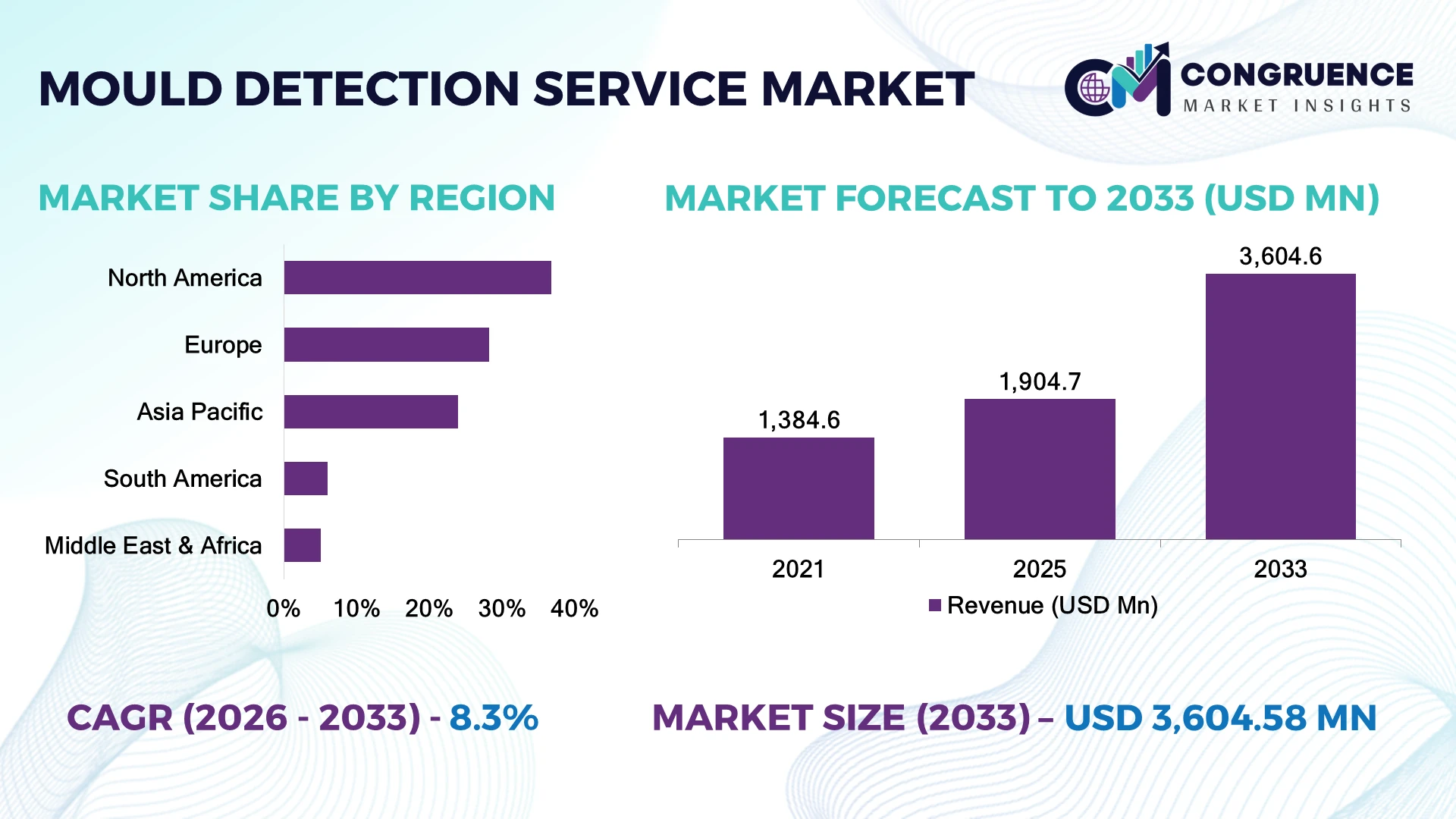
The Global Mould Detection Service Market was valued at USD 1,904.7 Million in 2025 and is anticipated to reach a value of USD 3,604.6 Million by 2033 expanding at a CAGR of 8.3% between 2026 and 2033. Growth is driven by stricter indoor air quality compliance, increased post-water-damage inspections, AI-assisted building diagnostics, and preventive facility maintenance across residential and commercial properties.
The United States leads the global market with approximately 31% share, supported by advanced building inspection networks, extensive insurance-driven assessments, and widespread adoption of digital moisture mapping technologies. More than 62% of large commercial inspection firms now deploy thermal imaging alongside airborne spore analysis, compared with Germany where adoption exceeds 48% across certified environmental inspection providers. Continued climate-related flooding events and resilient infrastructure initiatives have intensified demand for rapid mould assessment and remediation planning across high-risk buildings.
Strategic success increasingly depends on combining digital inspection technologies with scalable environmental diagnostics and rapid-response service capabilities.
Market Size & Growth: USD 1,904.7 million in 2025 to USD 3,604.6 million by 2033 at 8.3%, driven by digital building diagnostics.
Top Growth Drivers: Indoor air quality compliance 34%, water-damage inspections 29%, commercial facility audits 23%.
Short-Term Forecast: By 2028, AI-assisted inspection time falls by 26%.
Emerging Technologies: AI imaging, IoT moisture sensors, and thermal mapping accelerate inspections.
Regional Leaders: North America, Europe, and Asia-Pacific dominate through commercial building modernization.
Consumer/End-User Trends: Nearly 57% of commercial property managers prioritize preventive mould inspections.
Pilot/Case Example: 2026 digital inspection program reduced diagnosis time by 32%.
Competitive Landscape: Top five providers hold approximately 42% through technology-enabled inspection services.
Regulatory & ESG Impact: Preventive indoor environmental programs reduce remediation costs by nearly 28%.
Investment & Funding: More than USD 850 million supports inspection technology, laboratory capacity, and service expansion.
Innovation & Future Outlook: Predictive environmental monitoring and remote diagnostics reshape building health management.
The Mould Detection Service Market is expanding across healthcare facilities, educational institutions, commercial offices, and residential buildings where indoor environmental quality has become an operational priority. AI-enabled image analysis, portable microbial testing, and wireless moisture monitoring improve inspection accuracy, while nearly 46% of enterprise inspections now include digital reporting platforms. Increasing climate-driven moisture risks continue accelerating preventive inspection strategies, setting the stage for broader strategic market transformation.
The Mould Detection Service Market has become strategically important as building owners, insurers, healthcare operators, and facility managers shift from reactive remediation toward preventive environmental risk management. More stringent indoor air quality requirements, climate-related moisture exposure, and digital building management systems are reshaping inspection practices, creating stronger demand for technology-enabled environmental assessment services. Investment is increasingly directed toward predictive inspection capabilities rather than conventional visual assessments.
AI-assisted image recognition combined with thermal imaging improves hidden moisture identification by approximately 35% while reducing inspection time by nearly 30% compared with traditional manual inspection methods. North America leads in enterprise-scale digital inspection deployment, whereas Asia-Pacific is experiencing faster adoption across commercial real estate, hospitality, and industrial facilities due to expanding infrastructure and urban development. During the next two to three years, over half of large commercial property inspections are expected to incorporate integrated digital reporting and sensor-assisted diagnostics.
Service providers are expanding laboratory capabilities, partnering with insurance companies, and investing in cloud-based inspection management platforms that support faster reporting and regulatory documentation. Facility management firms increasingly integrate mould detection into predictive maintenance programs, improving operational continuity and reducing long-term remediation costs. Organizations combining advanced diagnostics, scalable field operations, and data-driven environmental analytics will establish stronger competitive positioning as proactive building health management becomes an industry standard.
Commercial property owners are shifting from reactive remediation to predictive indoor environmental monitoring, driving demand for advanced mould detection services. Nearly 61% of enterprise facility managers now integrate scheduled indoor air quality assessments into maintenance programs, while AI-assisted inspection platforms reduce diagnosis time by approximately 32% and improve hidden moisture identification accuracy by nearly 27%. Following stricter building health regulations and climate-driven flooding events in the United States, organizations are expanding preventive inspection schedules rather than waiting for visible contamination. This transition improves operational continuity, lowers remediation costs, and strengthens regulatory compliance. Service providers are responding through investments in thermal imaging, cloud-based reporting platforms, laboratory expansion, and partnerships with facility management companies to deliver integrated environmental diagnostics at scale.
Variations in inspection protocols, laboratory methodologies, and certification requirements continue limiting consistent service quality across multiple countries. Around 38% of independent inspection firms rely on outsourced laboratory testing, extending project turnaround times by nearly 24%. Australia and Canada continue experiencing shortages of certified environmental inspectors, creating scheduling bottlenecks during peak moisture seasons. These structural limitations increase operating costs, reduce service scalability, and complicate enterprise-wide deployment for large property portfolios. Companies are reducing operational risk by expanding regional laboratory networks, introducing standardized digital inspection workflows, securing long-term analytical service contracts, and adopting portable microbial testing technologies that minimize dependence on centralized laboratory capacity while improving consistency across inspection projects.
Continuous environmental monitoring is transforming mould detection from a periodic inspection service into a data-driven facility management solution. Smart building platforms integrated with IoT moisture sensors can reduce unexpected moisture incidents by approximately 34%, while automated monitoring lowers emergency inspection requirements by nearly 22%. Japan and Singapore are accelerating adoption of intelligent building management technologies that combine environmental analytics with predictive maintenance. Service providers are investing in AI-powered digital twins, subscription-based monitoring platforms, and cloud analytics that deliver continuous building health assessments instead of one-time inspections. A significant emerging opportunity lies in integrating mould diagnostics with insurance risk assessment, creating measurable cost savings and stronger long-term client retention.
Delivering standardized, technology-enabled mould detection across diverse building portfolios remains operationally demanding. More than 43% of large commercial properties operate multiple disconnected building management systems, making seamless integration difficult, while nearly 29% of inspection workflows still require manual data validation before reporting. The United Kingdom continues expanding digital building compliance frameworks, increasing expectations for interoperable environmental data management. Companies must balance rapid digital deployment with laboratory quality assurance, cybersecurity protection, and inspector training to maintain reliable service outcomes. Successful providers are investing in unified inspection software, AI-assisted reporting, workforce certification programs, and secure cloud infrastructure to improve deployment consistency and long-term competitive differentiation.
AI Inspection Automation Expands AI-powered image recognition and thermal diagnostics now improve inspection productivity by nearly 35% while reducing manual assessment time by approximately 30%. Commercial inspection firms are embedding automated reporting into field operations, enabling faster decision-making and improved customer turnaround as digital building compliance expectations continue increasing.
Continuous Moisture Monitoring Grows Wireless IoT moisture monitoring is being deployed across approximately 46% of newly managed commercial facilities, reducing emergency inspection requests by nearly 24%. Climate-driven water intrusion events are encouraging property managers to shift from periodic inspections toward continuous environmental monitoring, prompting companies to expand subscription-based service models.
Insurance Partnership Models Increase Insurance-supported environmental assessments have expanded by approximately 28% as insurers prioritize early damage detection to reduce large remediation claims. Inspection providers are forming strategic partnerships with restoration contractors and claims management organizations, creating integrated workflows that shorten claim processing while improving customer retention and operational efficiency.
Portable Laboratory Technologies Advance Rapid microbial sampling technologies now reduce laboratory processing time by nearly 33% while improving field testing flexibility by approximately 26%. Environmental service companies are restructuring operations around mobile diagnostic units and cloud-connected laboratory platforms, allowing standardized testing across geographically dispersed properties while strengthening enterprise scalability and service consistency.
Laboratory-based mould testing accounted for approximately 39% of the market in 2025, making it the leading service type because of its superior analytical accuracy, regulatory acceptance, and ability to identify airborne spores, surface contamination, and microbial species. Commercial insurers, healthcare facilities, and industrial operators continue relying on laboratory confirmation before remediation, strengthening demand for certified testing. Visual inspection services remain widely used for preliminary assessments, while air sampling supports indoor air quality evaluations in large commercial facilities. Surface sampling retains strategic importance where contamination mapping is required before restoration activities.
Thermal imaging and moisture mapping services represent the fastest-growing segment, expanding through non-destructive diagnostics and AI-assisted building inspections. Their adoption has increased by nearly 31% over the past two years, while integrated inspection packages now account for approximately 46% of enterprise contracts. Companies are investing in portable infrared technologies, cloud-based reporting platforms, and laboratory partnerships to deliver faster, end-to-end diagnostic solutions. This shift is redirecting investment toward technology-enabled inspection workflows that improve scalability while reducing repeat site visits.
According to enterprise findings published by the Indoor Air Quality Association (IAQA) during 2025, integrated inspection protocols combining moisture mapping, thermal imaging, and laboratory verification are increasingly becoming the preferred approach for commercial indoor environmental assessments.
Commercial buildings represented approximately 41% of total market demand in 2025 as offices, retail centers, hotels, healthcare facilities, and educational institutions require regular indoor environmental assessments to meet occupant health standards and operational compliance. High occupancy levels, aging infrastructure, and preventive maintenance programs continue supporting recurring inspection contracts. Residential buildings remain a substantial demand center due to increasing homeowner awareness following water intrusion events, while industrial facilities require specialized contamination assessments in production and storage environments.
Healthcare facilities are emerging as the fastest-growing application segment as infection prevention programs and indoor air quality management become operational priorities. Adoption of scheduled environmental monitoring has increased by nearly 29%, while digital inspection documentation has improved reporting efficiency by approximately 24%. Companies are expanding automated scheduling platforms, integrating environmental monitoring with facility management software, and developing customized service packages for hospitals, pharmaceutical facilities, and educational campuses. Demand is steadily shifting toward continuous building health monitoring instead of isolated inspection projects.
Industry assessments released by the Building Owners and Managers Association (BOMA) during 2025 indicate that preventive indoor environmental inspections are increasingly being incorporated into commercial facility maintenance programs to reduce operational disruptions and remediation costs.
Facility management companies accounted for approximately 38% of market demand in 2025 as they oversee large commercial property portfolios requiring routine environmental monitoring, moisture assessments, and regulatory documentation. Their centralized procurement models and recurring maintenance contracts generate consistent demand for integrated mould detection services. Property owners and managers continue representing a mature customer base, while insurance companies increasingly require certified inspections to validate water damage claims and remediation decisions.
Healthcare organizations are the fastest-growing end-user group, supported by heightened indoor air quality requirements and infection control initiatives. Enterprise adoption within healthcare has increased by nearly 30%, while customized monitoring contracts have expanded by approximately 26%. Service providers are strengthening competitive positioning through specialized healthcare inspection protocols, digital compliance reporting, laboratory collaborations, and long-term maintenance agreements. Future demand is shifting toward enterprise-wide environmental monitoring programs that combine predictive diagnostics with preventive facility management.
A 2025 enterprise survey by the International Facility Management Association (IFMA) reported increasing integration of indoor environmental quality monitoring into preventive maintenance strategies across large commercial property portfolios, reinforcing long-term demand for professional mould detection services.
North America accounted for the largest market share at 36.8% in 2025 however, Asia-Pacific is expected to register the fastest growth, expanding at a CAGR of 9.4% between 2026 and 2033.

Integrated Building Health Monitoring Strengthens Market Leadership
North America maintains market leadership through widespread adoption of preventive indoor environmental monitoring across commercial real estate, healthcare, education, and insurance sectors. Large facility management firms increasingly integrate mould detection into predictive maintenance programs, supported by advanced thermal imaging, laboratory analytics, and cloud-based reporting. The region contributes nearly 40% of enterprise-level inspection deployments, while digital inspection platforms are now utilized in approximately 58% of large commercial projects. Continued investment in smart building modernization and indoor air quality compliance has accelerated deployment of automated moisture monitoring technologies, enabling faster inspections and improved operational efficiency. Service providers continue expanding laboratory capacity, mobile inspection fleets, and technology partnerships to strengthen nationwide service coverage.
United States Market Outlook:
The United States remains the regional growth engine due to extensive commercial property infrastructure, stringent workplace environmental standards, and high insurance penetration. More than 60% of enterprise inspection contracts originate from commercial and institutional facilities where preventive maintenance has become operationally essential. Growing adoption of AI-assisted diagnostics, integrated building management systems, and certified environmental testing continues strengthening service demand while encouraging providers to expand regional laboratory networks and digital reporting capabilities.
Regulatory Compliance Drives Preventive Inspection Adoption
Europe is characterized by strong environmental compliance frameworks, aging building infrastructure, and increasing emphasis on healthy indoor environments. Building renovation initiatives across public infrastructure are expanding demand for routine mould assessments and moisture diagnostics. Approximately 47% of inspection activity is associated with refurbishment and retrofit projects where indoor environmental quality verification is required. Service providers increasingly combine laboratory testing with digital inspection platforms and predictive monitoring technologies to improve reporting consistency. Partnerships between environmental consultants and facility operators continue expanding integrated building health management services across commercial and institutional properties.
Germany Market Outlook:
Germany leads regional demand through its advanced commercial infrastructure, industrial property base, and extensive building modernization programs. Energy-efficient building upgrades have increased moisture monitoring requirements, encouraging wider deployment of thermal imaging and indoor air quality assessments. Enterprise clients increasingly adopt long-term environmental monitoring agreements to support regulatory compliance while reducing remediation costs across office, healthcare, and manufacturing facilities.
Urban Infrastructure Expansion Accelerates Service Deployment
Asia-Pacific represents the fastest-growing regional market as rapid urban construction, commercial real estate expansion, and smart building investments increase demand for professional environmental diagnostics. Large metropolitan developments are integrating digital building management systems that support continuous moisture monitoring and predictive maintenance. Nearly 34% of newly commissioned premium commercial buildings now incorporate advanced indoor environmental monitoring technologies. Service providers are investing in regional laboratories, AI-enabled inspection tools, and technician training to support expanding demand across healthcare, hospitality, and educational infrastructure while improving operational scalability.
China Market Outlook:
China dominates the regional market through extensive commercial construction activity, industrial expansion, and government-supported smart city initiatives. Large public infrastructure projects increasingly require comprehensive indoor environmental quality assessments before occupancy. Growing adoption of intelligent building technologies and automated inspection platforms is strengthening demand for integrated mould detection services, while domestic providers continue expanding laboratory infrastructure and digital inspection capabilities.
Commercial Modernization Supports Service Expansion
South America is experiencing steady market expansion as commercial building upgrades, healthcare investments, and increasing awareness of indoor environmental risks encourage professional inspection services. High humidity conditions across several countries continue supporting recurring demand for moisture assessments and contamination verification. Approximately 29% of inspection projects are now linked to commercial property renovations and facility maintenance programs. Service providers are strengthening regional capabilities through laboratory partnerships, mobile inspection units, and digital documentation systems while balancing infrastructure limitations and varying regulatory maturity across individual markets.
Brazil Market Outlook:
Brazil represents the largest regional opportunity due to its sizeable commercial property sector, healthcare infrastructure, and expanding facility management industry. Corporate property owners increasingly incorporate environmental inspections into preventive maintenance schedules to reduce long-term remediation costs. Growth in hospital modernization and commercial refurbishment projects continues supporting demand for laboratory-based testing, thermal imaging inspections, and integrated indoor air quality management services.
Infrastructure Modernization Expands Environmental Monitoring
The Middle East & Africa market is advancing through large-scale commercial developments, healthcare expansion, hospitality investments, and modernization of public infrastructure. Premium real estate projects increasingly incorporate indoor environmental quality assessments as part of operational commissioning and facility management programs. Approximately 26% of new high-value commercial developments include integrated environmental monitoring during building completion stages. Inspection providers are expanding technical capabilities through digital reporting platforms, specialized laboratory services, and partnerships with engineering consultants to improve service quality across rapidly developing urban centers.
United Arab Emirates Market Outlook:
The United Arab Emirates leads regional adoption through extensive commercial construction, luxury hospitality developments, and advanced smart building implementation. Major mixed-use developments increasingly require certified environmental assessments before operational handover. Continued investment in intelligent facility management platforms, high-performance building standards, and preventive maintenance strategies is creating sustained demand for technology-enabled mould detection services across commercial, healthcare, and hospitality sectors.
The market is led by global environmental testing organizations including Eurofins Scientific, SGS, Intertek, and EMSL Analytical, competing against regional inspection specialists and independent industrial hygiene laboratories for commercial, healthcare, and insurance contracts. The top five participants collectively account for approximately 42% of market activity, leaving substantial opportunities for specialized regional providers. Competition centers on laboratory turnaround, digital reporting, technical accreditation, and nationwide sampling capability rather than price alone. AI-enabled inspection workflows reduce reporting time by nearly 30%, while integrated laboratory networks improve sample processing efficiency by approximately 25%. Leading firms expand through laboratory acquisitions, partnerships with facility management companies, and vertically integrated inspection-to-remediation ecosystems. Regional providers compete through faster local response and customized compliance services. Accreditation requirements, skilled inspector availability, and laboratory investment remain significant entry barriers. Winning requires combining accredited diagnostics, digital inspection platforms, rapid reporting, and enterprise-scale service networks with consistent regulatory compliance across diverse building portfolios.
Eurofins Scientific
SGS SA
Intertek Group plc
Bureau Veritas
ALS Limited
EMSL Analytical, Inc.
TÜV Rheinland
TÜV SÜD
SafeAir Certified Mold Inspection
AirMD
EMLab P&K
Hillmann Consulting, LLC
AI-assisted image analytics, infrared thermography, and cloud-based inspection platforms are redefining mould detection workflows. AI-enabled moisture recognition improves hidden contamination detection by approximately 28%, while advanced thermal imaging reduces inspection duration by nearly 35%. Around 54% of enterprise inspections now incorporate at least one digital diagnostic technology, enabling faster reporting, improved documentation, and more consistent building health assessments. These technologies provide measurable operational advantages for large facility portfolios requiring standardized inspection protocols.
Emerging innovations combine IoT moisture sensors, real-time indoor air quality monitoring, and laboratory molecular diagnostics into continuous environmental surveillance systems. Compared with conventional visual inspections, integrated sensor-based monitoring identifies developing moisture risks approximately 40% earlier while reducing repeat site visits by nearly 25%. Large commercial property managers and healthcare organizations benefit most because continuous monitoring supports predictive maintenance instead of reactive remediation. Service providers investing in unified digital platforms are strengthening long-term customer retention through subscription-based environmental monitoring.
Between 2026 and 2028, predictive analytics, digital twins, and automated laboratory reporting are expected to become mainstream operational tools. Wider deployment of portable PCR-based microbial testing and AI-supported inspection software will accelerate decision-making while improving diagnostic consistency across distributed property portfolios. Organizations adopting integrated environmental intelligence platforms today will achieve stronger operational efficiency, improved compliance performance, and greater competitive differentiation as preventive building health management becomes the preferred enterprise service model.
April 2025 EMSL Analytical highlighted expanded indoor environmental quality testing support following severe Central U.S. flooding, promoting laboratory analysis and inspection tools for water-damaged properties where mould risks increase within 24–48 hours, strengthening disaster response capabilities. Source: EMSL Analytical
May 2025 Intertek launched SupplyTek, an integrated assurance platform helping clients redesign supply chains while accelerating market access. The solution targets faster deployment across global sourcing operations, strengthening environmental testing and compliance services. Source: Intertek
June 2025 EMSL Analytical expanded awareness initiatives after mould concerns temporarily closed a Cleveland fire station, reinforcing rapid laboratory testing, sampling services, and indoor environmental diagnostics to support public facility operators and remediation professionals. Source: EMSL Analytical
August 2025 EMSL Analytical supported investigations following mould exposure concerns at a Texas fire station, emphasizing rapid environmental testing and building inspection capabilities to accelerate remediation planning and minimize operational downtime. Source: EMSL Analytical (EMSL)
This report delivers comprehensive analysis of the global mould detection service market across laboratory testing, visual inspection, air sampling, surface sampling, moisture mapping, and advanced thermal imaging services. It evaluates demand across residential, commercial, industrial, healthcare, educational, and public infrastructure applications while assessing adoption trends among facility management companies, property owners, insurers, and institutional organizations. Regional evaluation covers North America, Europe, Asia-Pacific, South America, and the Middle East & Africa, supported by operational insights across major country markets and competitive service ecosystems.
The study examines laboratory diagnostics, AI-assisted inspection platforms, infrared imaging, IoT-based moisture monitoring, cloud reporting systems, and predictive environmental analytics. It profiles major industry participants, competitive positioning, technology deployment trends, and enterprise adoption patterns, with leading segments representing more than 35% of market demand. Strategic insights support investment prioritization, geographic expansion, partnership evaluation, technology integration, and long-term competitive planning for organizations operating between 2026 and 2033.
| Report Attribute/Metric | Report Details |
|---|---|
|
Market Revenue in 2025 |
USD 1,904.7 Million |
|
Market Revenue in 2033 |
USD 3,604.6 Million |
|
CAGR (2026 - 2033) |
8.3% |
|
Base Year |
2025 |
|
Forecast Period |
2026 - 2033 |
|
Historic Period |
2021 - 2025 |
|
Segments Covered |
By Type
By Application
By End-User
|
|
Key Report Deliverable |
Revenue Forecast, Growth Trends, Market Dynamics, Segmental Overview, Regional and Country-wise Analysis, Competition Landscape |
|
Region Covered |
North America, Europe, Asia-Pacific, South America, Middle East, Africa |
|
Key Players Analyzed |
Eurofins Scientific, SGS SA, Intertek Group plc, Bureau Veritas, ALS Limited, EMSL Analytical, Inc., TÜV Rheinland, TÜV SÜD, SafeAir Certified Mold Inspection, AirMD, EMLab P&K, Hillmann Consulting, LLC |
|
Customization & Pricing |
Available on Request (10% Customization is Free) |




