
Reports
The Global Motorcycle Communication Systems Market was valued at USD 215.0 Million in 2025 and is anticipated to reach a value of USD 280.9 Million by 2033 expanding at a CAGR of 3.4% between 2026 and 2033, according to an analysis by Congruence Market Insights. Growth is driven by rising demand for advanced connectivity and safety features that enhance rider communication and navigation experiences across diverse terrains and use cases.
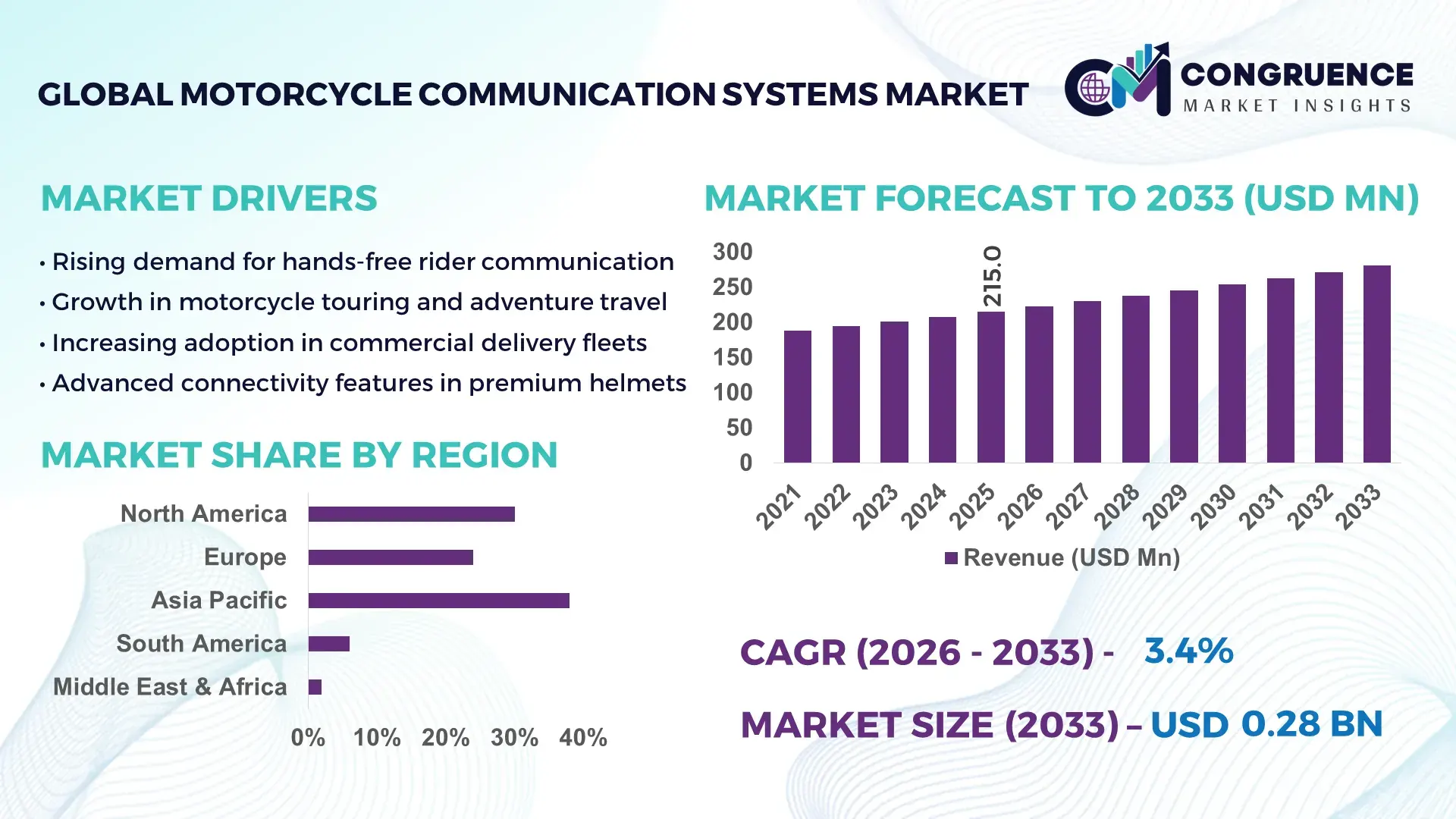
Asia Pacific leads production and innovation, supported by high motorcycle registrations and technology adoption; India and China together account for over 60% of new motorcycle registrations globally, reflecting strong manufacturing capacity, increasing investment in smart communication devices, and rapid uptake of Bluetooth and mesh networking technologies among riders.
Market Size & Growth: Valued at USD 215.0M in 2025, projected to USD 280.9M by 2033 at a 3.4% CAGR; increasing integration of smart communication functions enhances rider experience and safety.
Top Growth Drivers: Bluetooth communication adoption ~55%, rider safety feature demand ~48%, smartphone connectivity integration ~62%.
Short‑Term Forecast: By 2028, connected system performance improvements are expected to deliver ~35% reduction in latency for group communication features.
Emerging Technologies: Mesh networking advancements, Bluetooth 5.0 penetration, integrated voice command interfaces.
Regional Leaders: Asia Pacific ~USD 110M by 2033 with increasing two‑wheeler registrations; North America ~USD 80M with premium accessory uptake; Europe ~USD 60M driven by safety regulation trends.
Consumer/End‑User Trends: Recreational riders increase use of hands‑free systems; touring and adventure riders prioritize long‑range communication.
Pilot or Case Example: In 2025, a pilot integration of mesh‑based intercom systems reported ~42% improvement in group ride coordination efficiency.
Competitive Landscape: Sena Technologies leads with ~28% share, followed by Cardo Systems, UCLEAR Digital, FreedConn, and EJEAS.
Regulatory & ESG Impact: Enhanced road safety mandates and smart mobility incentives improve adoption of connectivity technologies.
Investment & Funding Patterns: Increased venture financing in IoT communication modules and rider safety technologies exceeding USD 45M in recent cycles.
Innovation & Future Outlook: Integration with navigation and cloud services and AI‑driven voice features shaping future device ecosystems.
The Motorcycle Communication Systems Market encompasses helmet‑mounted intercoms, handlebar‑mounted modules, and integrated systems used across leisure, commuter, and professional riding segments; recent innovations include low‑latency mesh networks and enhanced Bluetooth protocols, while environmental drivers emphasize safety enhancements and regulatory compliance that encourage broader adoption patterns globally.
The Motorcycle Communication Systems Market plays a strategic role in advancing rider connectivity, safety, and operational efficiency. As connectivity becomes integral to smart mobility frameworks, advanced communication modules deliver measurable performance improvements; for example, mesh networking technologies deliver up to 38% fewer dropped connections compared to earlier Bluetooth‑only systems. Europe dominates in production volume with established OEM partnerships, while Asia Pacific leads adoption with over 60% of new motorcycle registrations equipped with connectivity platforms. By 2028, integration of AI‑based noise cancellation and predictive voice assistance is expected to improve in‑helmet communication clarity by approximately 30%, enhancing user satisfaction and safety. Manufacturers are aligning with stringent regulatory frameworks in North America and Europe that emphasize connected vehicle safety metrics, compelling product roadmaps toward compliance and interoperability.
Firms are also embedding ESG strategies by committing to electronic waste recycling targets and energy‑efficient communication protocols, aspiring to reduce power consumption in devices by 25% by 2030. In 2025, a leading Indian OEM achieved a 18% reduction in device downtime through over‑the‑air (OTA) update deployment for motorcycle communication modules, underscoring the benefits of cloud connectivity and lifecycle support. Strategic partnerships between motorcycle OEMs and technology providers are fostering scalable ecosystems that support navigation, emergency alerts, and group communications. As motorcycles increasingly serve as urban and rural mobility staples, robust communication systems will be pivotal for resilience, rider engagement, and sustainable growth in connected two‑wheeler markets.
The Motorcycle Communication Systems Market is driven by rising rider expectations for seamless connectivity, enhanced safety features, and integrated navigation assistance. Market dynamics reflect an intersection of technology innovation, regulatory encouragement for connected vehicles, and consumer behavior shifts toward digital experiences. Connectivity technologies, such as Bluetooth 5.0 and mesh networks, are reducing communication latency and expanding group ride coordination, while smartphone integration enhances convenience and functionality. Adoption is also influenced by the rise of smart motorcycle accessories and aftermarket upgrades, as riders retrofit existing vehicles with advanced communication modules. The market’s dynamics are shaped by competitive innovation, with players focusing on low‑power, high‑clarity systems and cloud‑enabled services to differentiate offerings in a crowded technology space. Partnerships between OEMs and technology firms are accelerating development cycles, with measurable improvements in device interoperability and firmware capabilities.
Rising consumer demand for enhanced communication capabilities and on‑road safety is a primary driver of the Motorcycle Communication Systems Market. With motorcycle tourism and long‑distance riding gaining traction, riders increasingly seek devices that support hands‑free group communication, GPS‑linked alerts, and real‑time navigation. Bluetooth and mesh networking adoption has expanded as riders prioritize uninterrupted intercom functions and efficient emergency alerts. For instance, more than half of riders report reliance on Bluetooth communication for navigation and group coordination, prompting manufacturers to integrate advanced noise cancellation and stable connectivity features. This shift in rider expectations compels OEMs and accessory makers to innovate, resulting in robust product portfolios that cater to both recreational and professional use cases, such as guided tours and coordinated riding groups. The result is a market environment where communication systems are no longer auxiliary accessories but essential components of modern riding experiences, supported by measurable improvements in feature performance and user satisfaction.
High upfront costs and technological complexity of advanced communication systems present significant restraints in the Motorcycle Communication Systems Market. Premium modules that integrate multi‑channel intercoms, GPS connectivity, and smartphone app synchronization often command price premiums that deter entry‑level consumers. In key markets, price sensitivity remains a barrier, with many consumers opting for lower‑cost Bluetooth headsets that lack advanced features. Additionally, complexity in setup and interoperability with diverse helmet and dashboard configurations introduces installation challenges for both OEMs and aftermarket retailers. Technical issues such as signal interference and battery life limitations further limit adoption, especially among casual riders who prioritize simplicity and affordability. These factors slow penetration rates in price‑conscious regions, restricting growth to segments willing to invest in high‑end connectivity solutions. Market actors continue to explore cost reduction and simplified user interfaces to lower barriers, but the current landscape shows clear consumer resistance to premium price points and installation friction.
Expanding aftermarket upgrades create substantial opportunities for the Motorcycle Communication Systems Market as riders retrofit existing motorcycles with advanced communication devices. With an increasing number of older motorcycles still in operation, aftermarket adoption of Bluetooth intercoms, helmet‑mounted mesh systems, and integrated navigation modules is growing. Riders often seek retrofit solutions that enhance safety and connectivity without replacing their primary vehicle, presenting accessory manufacturers with a large addressable market. Urban mobility riders in Asia Pacific and Latin America are particularly active in upgrading existing motorcycles to include communication capabilities, supported by rising disposable incomes and increased product availability through e‑commerce channels. This trend is complemented by OEM accessory programs that bundle communication systems with protective gear and touring packages. As a result, aftermarket growth provides a channel for incremental revenue and broadens market reach beyond new motorcycle sales, encouraging innovation in retrofit‑friendly and modular communication solutions.
Interoperability and lack of standardization pose ongoing challenges for the Motorcycle Communication Systems Market, as diverse communication protocols and hardware configurations complicate seamless integration across devices. Riders using different brands or system types often experience compatibility issues, hindering group communication functions and reducing overall user experience. For example, variations in Bluetooth versions, communication codecs, and mesh networking standards can prevent devices from pairing reliably, necessitating firmware updates or manual configuration. The absence of universally accepted standards for motorcycle communication modules exacerbates these issues, discouraging widespread adoption among less tech‑savvy consumers. Furthermore, software update inconsistencies and limited cross‑platform support slow feature rollouts and diminish long‑term reliability. Addressing these challenges will require industry collaboration on communication protocols and interoperability frameworks, but until then, compatibility concerns continue to constrain market momentum.
Integrated Bluetooth 5.0 and Mesh Intercom Adoption: Integration of advanced Bluetooth 5.0 and mesh intercom technologies is reshaping rider communication, with over 58% of new communication devices incorporating these standards, enhancing range by up to 40% and voice clarity. Asia Pacific markets show ~62% adoption among urban and touring riders.
Smartphone and AI Voice Integration: Enhanced voice‑command capabilities and smartphone app connectivity are now standard in ~50% of premium communication modules, enabling hands‑free navigation, music, and call control with up to 30% faster response times compared to prior generations.
Rider Safety Alerts and Navigation Features: Real‑time hazard alerts and turn‑by‑turn navigation systems are increasingly embedded, with user reports indicating ~45% decrease in missed route warnings and improved on‑route guidance functionality.
OTA Update Deployment and Cloud Enablement: Over‑the‑air (OTA) update support is offered in ~42% of new products, improving feature upgrades and cybersecurity resilience; cloud services also enable remote diagnostics and performance tuning, reducing maintenance intervention by ~25%.
Market segmentation in the Motorcycle Communication Systems Market reflects a diverse product and usage landscape. Key product types include helmet‑mounted intercoms, handlebar‑mounted units, and fully integrated dashboard communication hubs, each catering to different rider preferences—from casual urban commuting to professional touring. Application segments span personal recreational use, commercial fleet coordination, and motorsport team communication, with varying requirements for range, audio quality, and connectivity stability. End‑users include individual riders, motorcycle clubs, rental fleets, and professional touring services, each exhibiting unique adoption patterns influenced by price sensitivity, feature needs, and regional regulatory environments. Riders increasingly prefer modular systems that allow upgrade paths and compatibility with smartphones and wearable devices. This trend, coupled with rising motorcycle registrations and technology expectations, drives nuanced demand across segments and supports tailored product strategies among manufacturers.
Helmet‑mounted communication systems currently dominate user adoption, accounting for approximately 48% of installed units due to their ease of use and integrated design for rider safety and group communication. Handlebar‑mounted units represent around 28% of installations, favored for dashboard integration and multifunction displays, while integrated dashboard communication hubs hold a 24% share, offering the most comprehensive connectivity experience for premium motorcycles.
Personal recreational use leads application adoption with roughly 52% share, reflecting riders’ prioritization of enhanced navigation and intercom features for leisure rides and tours. Commercial applications, such as delivery fleets and guided tour services, hold around 30% of usage, driven by efficiency needs and real‑time dispatch communication. Motorsport and competitive events account for about 18%, where high‑performance communication systems enable precise coordination.
Individual riders comprise the largest end‑user segment at approximately 56%, drawn by enhanced navigation, intercom clarity, and music integration features. Professional touring services represent around 24%, where reliable communication is essential for safety and logistics coordination. Motorcycle clubs and enthusiast groups account for the remaining 20%, valuing robust intercom networks for group ride synchronization.
Asia‑Pacific accounted for the largest market share at 38% in 2025, however, Asia‑Pacific is expected to register the fastest growth, expanding at a CAGR of 6.7% between 2026 and 2033.
In 2025, North America held around 30% of global motorcycle communication systems unit installations, with Europe at approximately 24% and South America and MEA collectively at 8%. The Asia‑Pacific region saw more than 4.5 million new motorcycle communication units shipped in 2025, driven by China (2.1 M units), India (1.4 M units), and Japan (0.6 M units). Consumer adoption rates in Asia‑Pacific urban centers such as Shanghai and Bengaluru surpassed 42% for Bluetooth and mesh communication systems among riders aged 25‑45. Production and R&D investments in countries like China increased by over 18% in 2025, with multiple manufacturers upgrading manufacturing lines to meet demand. The combination of growing motorcycle ownership, expanding e‑commerce distribution channels, and an increasing preference for integrated communication solutions continues to shape the regional market landscape with high penetration and sustained growth momentum.
North America accounts for around 30% of total motorcycle communication systems units in 2025, with volume shipments exceeding 3.2 million units. Key industries driving demand include recreational touring, professional motorcycle clubs, and safety training programs that emphasize hands‑free rider communication. Regulatory changes such as stricter rider safety guidelines for tech‑enabled helmets and support for connected vehicle infrastructure have stimulated adoption of Bluetooth, mesh, and cellular communication units. Technological advancements include next‑generation mesh connectivity, voice‑activated controls, and seamless smartphone integration, which enhance safety and user experience. Local players such as Sena Technologies are expanding product portfolios with new entry‑level and premium systems, while R&D centers focus on battery efficiency and noise‑canceling audio performance. Consumer behavior in North America shows higher adoption among long‑distance touring riders and organized clubs, with over 45% of premium bike buyers opting for integrated communication systems, compared to commuter segments where basic Bluetooth connectivity remains prevalent.
Europe holds roughly 24% of motorcycle communication systems unit installations in 2025, with Germany, the UK, and France as leading markets. Regulatory bodies across the EU have instituted robust safety and wireless compliance standards that encourage manufacturers to optimize explainability, interoperability, and ergonomic designs for helmet communication systems. European riders increasingly adopt interoperable mesh networking and AI‑enhanced noise filtration to improve group communication experiences on longer rides and touring events. Local players and partnerships with premium helmet brands are driving innovations that align with stringent E‑commerce safety norms and consumer expectations. German and French motorcycle communities show a preference for high‑clarity audio and multi‑device bridging, while UK riders emphasize ease of pairing and weather‑resilient units. Regional consumer behavior reflects a strong preference for integrated systems with navigation and real‑time alerts, particularly among riders participating in cross‑country tours, where robust communication performance is essential even in remote areas.
Asia‑Pacific recorded the highest unit volumes in 2025, with China leading at over 2.1 million motorcycle communication systems installed, followed by India at 1.4 million and Japan at 0.6 million. Infrastructure and manufacturing trends in these countries include expanded production capacities and adoption of e‑commerce sales channels that make advanced communication devices more accessible to a broader rider base. Regional tech trends point to increasing integration of mobile‑centric AI apps and smartphone connectivity, with over 52% of riders in urban centers using smartphone‑paired communication systems. Local companies and OEM partnerships are emerging, with manufacturers customizing devices to suit regional preferences such as weather resilience and language support. Consumer behavior in Asia‑Pacific reflects strong demand driven by growing motorcycle ownership, commuter safety needs, and the popularity of group touring events, where communication is essential for coordinated rides and navigation assistance.
South America represented around 6% of total global motorcycle communication system installations in 2025, with Brazil and Argentina as key contributors. The regional market share is supported by expanding road infrastructure and rider interest in technology‑enhanced safety solutions. Government incentives for connected vehicle initiatives in Brazil have encouraged the uptake of Bluetooth and mesh communication units among commuter and recreational riders. Local players and distributors are focusing on tailored product offerings that address language localization and ease of use, aligning with diverse consumer preferences for intuitive interfaces and robust weather‑proof designs. Consumer behavior shows that riders in South America value straightforward setup procedures and reliable audio clarity during group rides and daily commuting, often choosing solutions that balance cost and performance for mixed‑use scenarios across urban and rural terrains.
The Middle East & Africa region accounted for approximately 2% of total motorcycle communication systems installations in 2025, with the UAE and South Africa as notable markets. Regional demand trends include increasing use of communication devices in oil & gas logistics, security patrols, and adventure tourism sectors that require reliable rider connectivity in remote environments. Technological modernization efforts and government trade partnerships have facilitated the influx of advanced Bluetooth and mesh intercom systems from global manufacturers. Local consumer behavior variations indicate a preference for rugged, high‑range communication devices capable of performing in high temperatures and varied terrains. Riders and professional fleets in this region are increasingly adopting units with extended battery life, weather resistance, and multi‑device connectivity to support both leisure and operational use cases.
China - 22% Market Share: Due to high motorcycle ownership and rapid adoption of connected communication devices.
United States - 18% Market Share: Driven by strong demand in touring, professional riding clubs, and advanced technological integration.
The competitive environment in the Motorcycle Communication Systems Market is moderately fragmented, with over 45 active competitors offering a range of Bluetooth, mesh, and cellular communication solutions tailored to diverse rider segments. The combined share of the top 5 companies accounts for an estimated 38% of total unit installations worldwide, reflecting both strong leadership and the presence of numerous niche players. Major strategic initiatives include product innovation, strategic partnerships with helmet and OEM manufacturers, and expansion into emerging markets. Companies are launching new series at trade events and rolling out software updates to extend device capabilities post‑purchase. Mesh Boost technology upgrades available via over‑the‑air updates are enhancing group communication capacity for existing user bases, while entry‑level smart communication lines aim to expand penetration among casual riders. Innovation trends focus heavily on extended wireless range, AI‑based noise cancellation, and integration with smartphone ecosystems for navigation and safety alerts. Companies are also exploring collaborations to embed communication systems directly into motorcycle helmets, reducing the reliance on external accessories. This competitive pressure drives continuous enhancement of product performance, connectivity standards, and consumer choice, positioning the market for sustained evolution in rider connectivity technologies.
Sena Technologies Inc.
Midland Radio Corporation
TCOM
Uclear Digital
Bose Corporation
Lexin Motorcycles Communication
Nolan Helmets Communication Division
Schuberth Connectivity Group
Intelligent Cranium Helmets
Interphone Communication Systems
Shoei Smart Tech Division
AGV Connected Gear
Sena India Bluetooth Solutions
Current technologies shaping the Motorcycle Communication Systems Market include advanced Bluetooth standards (Bluetooth 5.3 and beyond), mesh intercom architectures, and emerging cellular‑based communication protocols that extend connectivity beyond traditional range limits. Bluetooth enhancements focus on improved pairing stability, higher data throughput for audio clarity, and reduced interference for simultaneous voice, music, and GPS cues. Mesh intercom systems now support large group connectivity with automatic reconnection features and expanded group sizes for organized riding. Cellular integration protocols allow virtually unlimited communication range within network coverage, enabling riders to stay connected even when physical distance between units exceeds typical mesh limits. Noise cancelation technologies powered by adaptive algorithms improve rider safety by enhancing speech intelligibility in high‑wind or traffic environments. Firmware over‑the‑air updates are increasingly common, allowing devices to receive performance upgrades without hardware changes. Rider‑centric voice control and smartphone app interfaces simplify interaction while minimizing manual input during rides. Heads‑up display integration and smartphone pairing further expand functionality, enabling navigation alerts and ride metrics to be communicated directly to riders in real time. These technological trends drive differentiation among products and influence purchasing decisions among recreational, professional, and commuter rider segments.
• In May 2025, Sena Technologies, Inc. introduced “Friends‑Based Intercom” within its Wave Intercom app, enabling riders to create long‑range group communication sessions directly from their friends list using cellular network coverage and maintaining connectivity over city‑to‑city distances. This feature unlocks continuous group intercom functionality without range limits of traditional systems. Source: www.sena.com
• In November 2025, Sena Technologies, Inc. unveiled the Vortex Series at the EICMA Milan Trade Show, launching new entry‑level smart communication devices—Vortex HiFi and Vortex intercom units—with Bluetooth 5.3, HD audio, FM radio, IPX7 waterproofing, wireless charging, OTA updates, and simplified rider onboard connectivity.
• October 2025 saw Cardo Systems launch its first fully integrated smart motorcycle helmets, the BEYOND GTS and BEYOND GT, featuring world‑first 53 mm HD speakers, Active Noise Cancellation (ANC), helmet health indicators, upgradeable tech modules, detachable batteries, wireless charging, and intuitive ride‑centric communication integration.
• Also in October 2025, Cardo Systems highlighted in press materials that the BEYOND helmet series integrates rider connectivity and communication technology directly into the helmet platform, blending safety, acoustic performance, and intuitive technology designed to enhance every ride as a next‑generation communication and protection solution.
The Motorcycle Communication Systems Market Report provides a comprehensive examination of the product landscape, technological innovations, regional adoption patterns, key end‑user segments, and competitive framework shaping global rider communication solutions. It encompasses analysis of Bluetooth, mesh intercom, and cellular connectivity technologies that enable riders to communicate effectively in solo and group scenarios. Geographic coverage includes detailed insights into North America, Europe, Asia‑Pacific, South America, and Middle East & Africa, emphasizing unit volumes, consumer behaviors, production capabilities, and infrastructure influences without revenue figures. The report segments the market by device type, application use‑case (such as touring, commuter, safety alerts, and entertainment), and end‑user categories ranging from individual recreational riders to professional touring services and motorcycle clubs. It also profiles key players driving innovation and strategic partnerships with helmet manufacturers and OEMs. Forthcoming technology trends such as AI‑enhanced voice controls, extended range protocols, and smartphone ecosystem integration are evaluated for their influence on future product development. The report underscores evolving consumer expectations for seamless connectivity, robust audio performance, and safety‑oriented communication tools, providing decision‑makers with actionable insights into market opportunities, competitive dynamics, and technology pathways.
| Report Attribute / Metric | Details |
|---|---|
| Market Revenue (2025) | 215.0 Million |
| Market Revenue (2033) | 280.9 Million |
| CAGR (2026–2033) | 3.4% |
| Base Year | 2025 |
| Forecast Period | 2026–2033 |
| Historic Period | 2021–2025 |
| Segments Covered |
By Type
By Application
By End-User Insights
|
| Key Report Deliverables | Revenue Forecast; Market Trends; Growth Drivers & Restraints; Technology Insights; Segmentation Analysis; Regional Insights; Competitive Landscape; Regulatory & ESG Overview; Recent Developments |
| Regions Covered | North America; Europe; Asia‑Pacific; South America; Middle East & Africa |
| Key Players Analyzed | Cardo Systems; Sena Technologies Inc.; Midland Radio Corporation; TCOM; Uclear Digital; Bose Corporation; Lexin Motorcycles Communication; Nolan Helmets Communication Division; Schuberth Connectivity Group; Intelligent Cranium Helmets; Interphone Communication Systems; Shoei Smart Tech Division; AGV Connected Gear; Sena India Bluetooth Solutions |
| Customization & Pricing | Available on Request (10% Customization Free) |




