
Reports
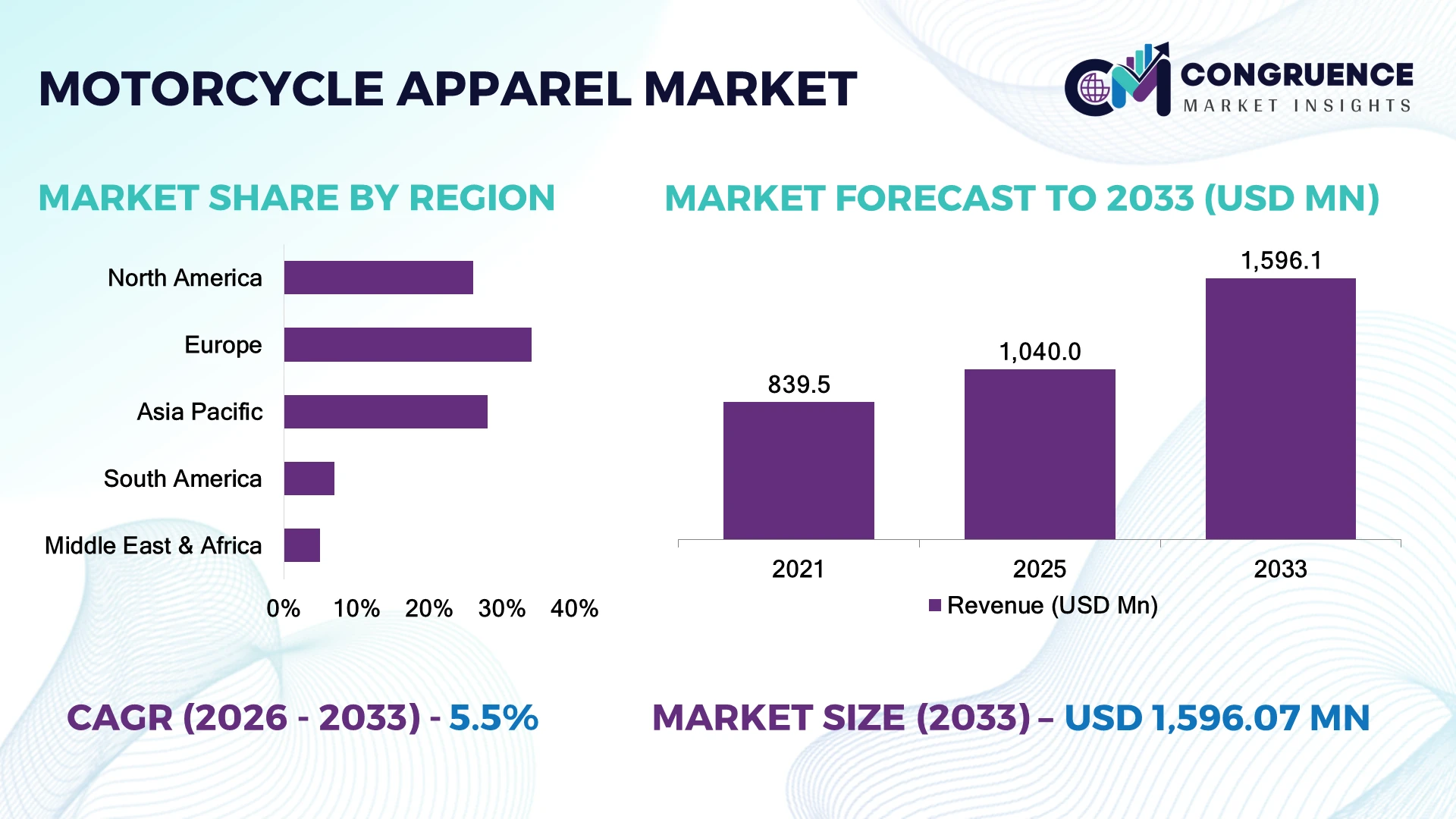
The Global Motorcycle Apparel Market was valued at USD 1,040.0 Million in 2025 and is anticipated to reach a value of USD 1,596.1 Million by 2033 expanding at a CAGR of 5.5% between 2026 and 2033. Growth is being driven by stricter rider safety regulations, rapid adoption of CE-certified protective gear, and the integration of advanced impact-resistant materials into premium motorcycle apparel.
Germany remains the dominant country in the global motorcycle apparel landscape, accounting for approximately 18% of premium protective gear consumption and over 20% of Europe's certified riding equipment production. The country benefits from a strong motorcycle manufacturing ecosystem, significant investments in technical textiles, and widespread adoption of CE-approved safety apparel exceeding 75% among touring riders. In comparison, Italy leads in high-performance racing apparel innovation, while Germany maintains stronger industrial-scale production capacity and distribution reach. The presence of advanced textile engineering clusters and sustained investment in rider protection technologies reinforces its leadership position.
Strategically, manufacturers that align product portfolios with certified safety standards, smart protection technologies, and premium material innovation are securing stronger competitive differentiation.
Market Size & Growth: The market expands from USD 1,040.0 Million in 2025 to USD 1,596.1 Million by 2033 at 5.5% growth, supported by rising adoption of certified rider protection systems and advanced technical fabrics.
Top Growth Drivers: CE-certified gear adoption (+22%), premium motorcycle ownership (+18%), and smart protective apparel penetration (+15%) remain the three strongest growth catalysts.
Short-Term Forecast: By 2028, manufacturing efficiency is projected to improve by 12% as automated textile cutting and digital design workflows gain wider implementation.
Emerging Technologies: Airbag-integrated jackets, abrasion-resistant aramid composites, and connected wearable safety sensors are reshaping premium product development.
Regional Leaders: Europe exceeds USD 470 Million, North America approaches USD 290 Million, and Asia-Pacific surpasses USD 390 Million, supported by safety-focused purchasing and premium riding culture.
Consumer/End-User Trends: More than 68% of touring riders prioritize certified protective apparel, while premium gear replacement cycles have shortened by nearly 14%.
Pilot/Case Example: In 2024, advanced airbag jacket deployment among selected riding groups reduced upper-body impact injuries by approximately 30% during monitored trials.
Competitive Landscape: Alpinestars holds an estimated 12% share, alongside Dainese, REV'IT!, Fox Racing, and Klim competing through innovation and performance-focused portfolios.
Regulatory & ESG Impact: Updated rider safety standards increased certified gear demand by over 20%, while recycled textile integration reduced material waste by nearly 15%.
Investment & Funding: More than USD 300 Million has been directed toward smart wearables, technical textiles, and regional manufacturing expansion initiatives.
Innovation & Future Outlook: AI-assisted design, lightweight armor systems, and connected safety ecosystems are accelerating the transition toward intelligent protective apparel platforms.
Motorcycle apparel demand is increasingly concentrated in touring, adventure riding, motorsports, and urban commuting applications where rider protection and comfort remain critical purchasing factors. Recent innovations include lightweight D3O impact armor, integrated airbag systems, and moisture-management smart fabrics. More than 25% of newly launched premium products incorporate advanced protective materials. Ongoing supply-chain diversification and stricter safety certification requirements are further shaping product development strategies, creating a foundation for deeper strategic analysis.
Motorcycle apparel has evolved from a discretionary accessory category into a strategic safety and performance segment influencing brand competitiveness, rider protection standards, and premium mobility ecosystems. Regulatory attention on rider safety, combined with growing participation in touring and adventure motorcycling, has elevated protective apparel to a core purchasing criterion. Companies are increasingly restructuring sourcing networks to reduce dependence on single-country textile suppliers and improve production resilience.
Modern impact-protection materials deliver measurable advantages over traditional foam-based protection systems. Advanced viscoelastic armor technologies can improve impact absorption performance by more than 40% while reducing weight by nearly 20%, enabling manufacturers to enhance comfort without compromising safety. Europe maintains leadership in certified premium gear development, while India and Southeast Asian markets are experiencing faster adoption due to rising motorcycle ownership and expanding premium rider communities.
A practical example is the deployment of airbag-integrated jackets within premium touring segments, where rider protection capabilities have improved substantially compared with conventional protective gear. Manufacturers are responding through technical textile partnerships, localized production investments, and smart wearable integration programs. Over the next two to three years, certified protective apparel adoption is expected to strengthen further as digital design tools and advanced materials become mainstream. Organizations that combine safety innovation, supply-chain flexibility, and premium user experience will secure stronger long-term competitive positioning.
The accelerating adoption of certified protective apparel is reshaping purchasing behavior across major motorcycle markets. More than 70% of premium riders in Germany and France now prioritize CE-certified protection systems, while advanced armor integration has increased by nearly 25% in newly launched products. Regulatory attention toward rider injury reduction and growing awareness of protective equipment effectiveness have strengthened demand for high-performance apparel. This shift directly improves product mix quality and supports premium pricing strategies. Manufacturers are responding through investment in impact-resistant materials, smart wearable integration, and expanded certification programs. A notable strategic insight is that brands with broader certified product portfolios are gaining stronger dealer penetration and higher customer retention rates, creating advantages beyond traditional product differentiation.
Volatility in technical textile and specialty polymer markets remains a significant structural limitation. Prices for selected protective materials have fluctuated by 15–20% over recent years, while logistics costs in key sourcing corridors remain elevated compared with pre-disruption levels. Dependence on concentrated supplier networks for advanced abrasion-resistant fabrics creates procurement risks and reduces operational flexibility. These conditions compress margins and increase inventory planning complexity, particularly for mid-sized manufacturers. Companies are mitigating exposure through supplier diversification, regional sourcing agreements, and localized production initiatives. A key operational insight is that organizations with multi-country sourcing strategies are maintaining stronger delivery consistency and inventory efficiency than competitors dependent on limited procurement channels.
The convergence of protective apparel and connected technology creates a high-value opportunity beyond traditional garment sales. Smart protective systems featuring impact detection, GPS-enabled emergency alerts, and integrated rider analytics have recorded adoption increases exceeding 20% within premium segments. Digital safety ecosystems are becoming increasingly attractive to touring and adventure riders seeking enhanced protection and connectivity. Japan and Germany are emerging as innovation hubs for wearable rider technology development. Companies are expanding research programs, collaborating with sensor manufacturers, and investing in software-enabled product platforms. A non-obvious opportunity lies in subscription-based safety monitoring services, which can create recurring revenue streams while strengthening long-term customer engagement and brand loyalty.
Expanding sophisticated protective technologies across diverse rider populations presents a complex execution challenge. Smart apparel systems can increase product costs by more than 25%, while certification requirements differ across multiple national markets. Integration of electronics, sensors, and advanced protection layers also increases product development complexity and extends validation timelines. Workforce expertise in wearable technology manufacturing remains limited in several emerging production hubs. These factors affect deployment consistency and slow broader market penetration. Companies must address these barriers through investment in manufacturing automation, specialized technical training, and cross-industry partnerships. A critical strategic insight is that firms capable of standardizing technology platforms across multiple product categories will achieve superior scalability and maintain stronger competitive resilience over the long term.
Smart Airbag Systems Expand Integrated airbag jackets and vests are moving beyond motorsports into mainstream touring and commuter segments. Premium airbag-equipped apparel launches increased by nearly 28% during 2025, while connected sensor adoption rose by 22%. Stricter safety certification requirements and rider awareness campaigns are accelerating deployment. Manufacturers are responding through technology partnerships and modular product architectures that reduce integration complexity while improving rider protection and product differentiation.
Technical Textile Innovation Accelerates Lightweight abrasion-resistant fabrics are replacing conventional heavy leather configurations across multiple product categories. Advanced textile usage increased by approximately 24%, while garment weight reductions of 15–20% are becoming common in premium collections. Material science advances and shifting rider comfort expectations are driving the transition. Companies are restructuring supplier networks, investing in proprietary textile development, and expanding climate-adaptive apparel portfolios to improve wearability and operational performance.
Digital Commerce Reshapes Purchasing Online motorcycle apparel sales penetration has surpassed 35% in several mature markets, supported by virtual fitting tools and AI-assisted sizing technologies. Return rates have declined by nearly 12% where digital fitting solutions are deployed. The shift is changing inventory workflows, merchandising strategies, and customer acquisition models. Brands are strengthening direct-to-consumer channels, integrating digital analytics, and expanding fulfillment partnerships to improve conversion efficiency and customer retention.
Adventure Riding Drives Premiumization Adventure and touring rider participation has increased by more than 18%, creating stronger demand for multi-season protective gear and modular equipment systems. Premium apparel replacement cycles shortened by approximately 14% as riders seek upgraded safety and comfort features. A non-obvious trend is the growing preference for multifunctional apparel that transitions between commuting and recreational use. Companies are scaling premium product lines, expanding accessory ecosystems, and investing in rider-community engagement programs.
Jackets remain the leading product category, accounting for approximately 32% of global motorcycle apparel demand. Their dominance stems from broad applicability across commuting, touring, adventure riding, and motorsport activities while providing critical upper-body protection. Advanced textile jackets incorporating CE-certified armor, ventilation systems, and weather-resistant materials continue to outperform traditional designs. Helmets maintain strong strategic relevance due to mandatory safety regulations, while gloves and boots remain essential complementary purchases that support complete rider protection systems. Companies are prioritizing lightweight construction technologies and premium material integration to strengthen competitive positioning.
Protective suits are emerging as the fastest-growing segment, supported by increasing adoption among performance riders and the growing availability of airbag-enabled configurations. Adoption of smart protection technologies within premium suits has increased by more than 20%, while advanced impact-management materials now feature in nearly 30% of newly introduced performance products. Manufacturers are expanding racing-inspired product portfolios, forming technology partnerships, and accelerating innovation around integrated protection platforms. Investment priorities increasingly favor intelligent safety systems and multifunctional protective apparel capable of serving both recreational and professional riding applications.
Road motorcycle riding represents the largest application segment, accounting for roughly 70% of total apparel utilization. Daily commuting, long-distance touring, and recreational road riding create consistent demand for protective jackets, helmets, gloves, and weather-adaptive apparel. High motorcycle ownership levels in countries such as India, Indonesia, and Germany continue supporting sustained demand concentration. Companies are expanding road-focused product ranges featuring enhanced ventilation, lightweight protection, and commuter-friendly ergonomics. The segment benefits from broad rider demographics and frequent replacement cycles driven by safety standards and product upgrades.
Adventure touring is the fastest-growing application area as riders increasingly seek multifunctional gear capable of handling diverse terrain and climate conditions. Participation in adventure riding activities has increased by nearly 18%, while demand for modular protective systems has risen by approximately 20%. Off-road and racing applications remain strategically important due to their influence on innovation and premium product development. Manufacturers are adapting through specialized product engineering, targeted sponsorship programs, and expanded distribution strategies focused on enthusiast communities. Demand is increasingly shifting toward application-specific apparel designed around operational performance and rider experience requirements.
Men constitute the dominant end-user segment, representing approximately 72% of global motorcycle apparel purchases. Demand concentration is driven by higher motorcycle ownership rates, greater participation in touring and performance riding activities, and stronger engagement with premium protective gear categories. This segment demonstrates significant purchasing intensity across jackets, helmets, gloves, boots, and integrated safety systems. Companies continue targeting male riders through performance-focused product development, motorsport collaborations, and premium branding initiatives. The scale of this customer base makes it a critical focus area for product innovation and distribution expansion.
Women represent the fastest-growing end-user segment as motorcycle participation expands and manufacturers introduce rider-specific protective apparel with improved fit, comfort, and safety characteristics. Female rider participation in several developed motorcycle markets has increased by more than 15%, while women-focused apparel launches have expanded by nearly 20%. Youth and entry-level riders also contribute to evolving demand patterns, particularly within urban mobility segments. Manufacturers are responding through customized sizing strategies, dedicated product collections, and community-driven engagement programs designed to strengthen long-term customer acquisition and retention.
Europe accounted for the largest market share at 34% in 2025 however, Asia-Pacific is expected to register the fastest growth, expanding at a CAGR of 6.8% between 2026 and 2033.
North America accounted for approximately 26% of the global motorcycle apparel market in 2025, supported by strong penetration of premium touring, cruiser, and adventure riding segments. Demand is increasingly concentrated around CE-certified protective equipment, airbag-integrated apparel, and climate-adaptive riding gear. The United States and Canada continue to demonstrate high replacement rates for premium protective apparel, with digital commerce accounting for more than 35% of specialized gear purchases. Manufacturers are strengthening direct-to-consumer channels and expanding partnerships with motorcycle OEMs and rider associations. A notable operational shift is the growing deployment of smart safety technologies, with connected protective apparel adoption increasing by nearly 20% among premium riders. Product innovation, customization, and advanced material integration remain central to competitive differentiation across the region.
United States Market Outlook: The United States represents the largest motorcycle apparel market in North America due to its extensive rider population, mature dealer network, and strong premium motorcycle culture. Adventure touring and recreational riding continue to support demand for advanced protective apparel. More than 60% of premium gear purchases are concentrated in protective jackets, helmets, and integrated armor systems. The country also leads in connected rider technology adoption, with manufacturers increasingly collaborating with wearable technology providers and specialty retailers to strengthen customer engagement and product innovation.
Europe remains the leading regional market, contributing approximately 34% of global demand. Strong regulatory alignment around rider safety, widespread use of certified protective gear, and advanced technical textile manufacturing capabilities continue to reinforce market leadership. Germany, Italy, France, and the United Kingdom collectively account for a significant share of premium motorcycle apparel consumption and innovation activity. Manufacturers are increasingly investing in lightweight protective materials, sustainable textile sourcing, and integrated impact-protection systems. Recent industry investments have accelerated the adoption of advanced abrasion-resistant fabrics and smart wearable protection technologies. The region also benefits from a dense network of motorsport ecosystems, testing facilities, and specialized apparel manufacturers that support continuous product development and commercialization.
Germany Market Outlook: Germany serves as Europe's most strategically important motorcycle apparel market due to its advanced engineering base, strong motorcycle ownership culture, and leadership in technical textile innovation. More than 75% of touring riders utilize certified protective gear, supporting consistent demand for premium products. German manufacturers continue investing in material science research, smart safety integration, and climate-adaptive apparel technologies. The country's strong industrial infrastructure and close collaboration between textile specialists and motorcycle equipment companies provide a durable competitive advantage within the global motorcycle apparel ecosystem.
Asia-Pacific accounted for approximately 28% of global market demand and represents the largest motorcycle user base worldwide. Rising motorcycle ownership, expanding middle-class spending, and growing awareness of rider protection are transforming purchasing behavior across key markets. Countries including India, China, Indonesia, Thailand, and Vietnam continue to drive substantial demand volumes. Premium protective apparel adoption has increased by nearly 22% as riders transition from basic gear toward certified protection systems. The region also serves as a major manufacturing hub for helmets, jackets, gloves, and technical riding equipment. Apparel manufacturers are expanding production capacity, strengthening export-oriented operations, and investing in localized distribution networks to improve market penetration and operational efficiency.
India Market Outlook: India stands as the most influential motorcycle apparel market in Asia-Pacific due to its massive two-wheeler fleet, expanding premium motorcycle segment, and growing safety awareness among riders. Premium motorcycle ownership has increased steadily in urban centers, supporting higher demand for certified jackets, gloves, and protective equipment. Organized retail and digital commerce channels now account for a growing share of motorcycle gear purchases. Domestic manufacturers are expanding production capabilities while international brands continue increasing their presence through partnerships, localized product offerings, and specialized rider engagement initiatives.
South America accounted for approximately 7% of global motorcycle apparel demand, with growth supported by increasing motorcycle usage for personal transportation and commercial mobility applications. Brazil, Colombia, and Argentina represent the largest consumption centers, driven by expanding rider populations and rising awareness of protective equipment benefits. Demand remains concentrated in helmets, protective jackets, and weather-resistant riding gear. Manufacturers are improving distribution networks and increasing access to certified protective products through partnerships with regional dealerships and e-commerce platforms. A measurable shift is the increasing penetration of premium protective apparel, which has expanded by approximately 15% among urban motorcycle users. Infrastructure and affordability constraints continue to influence purchasing decisions, creating opportunities for mid-priced product innovation.
Brazil Market Outlook: Brazil dominates the South American motorcycle apparel market through its large motorcycle fleet, strong commuter riding culture, and expanding aftermarket ecosystem. Motorcycle usage remains critical for urban mobility and delivery services across major metropolitan areas. Protective gear adoption has increased steadily as rider education initiatives and safety awareness programs gain traction. Local distributors and international brands are expanding retail footprints and strengthening supply chains to improve product availability. The country's broad rider base provides significant long-term demand potential for certified protective apparel.
The Middle East & Africa accounted for approximately 5% of global market demand in 2025. Growth is increasingly linked to premium motorcycle ownership, tourism-oriented riding activities, and expanding urban mobility infrastructure. Gulf countries are demonstrating higher adoption of premium protective apparel, while African markets are gradually improving access to certified riding equipment through distribution expansion and retail modernization. Manufacturers are investing in heat-resistant materials and climate-specific product engineering to address local operating conditions. Premium gear penetration has increased by nearly 12% among enthusiast riders in key Gulf markets. Partnerships between distributors, motorcycle dealerships, and specialty apparel brands are strengthening market accessibility and product awareness across the region.
United Arab Emirates Market Outlook: The United Arab Emirates represents the most strategically significant motorcycle apparel market in the region due to its premium motorcycle ownership base, advanced retail infrastructure, and growing motorsport ecosystem. Demand is concentrated in high-performance riding gear, premium protective apparel, and climate-adaptive equipment designed for extreme weather conditions. Organized retail channels and specialist motorcycle dealerships continue expanding their premium product offerings. The country's strong tourism, leisure riding culture, and investment in lifestyle mobility experiences support sustained demand for advanced protective apparel and high-specification riding equipment.
The motorcycle apparel market is led by Alpinestars, Dainese, REV’IT!, Klim, Fox Racing, and Leatt, with global premium brands competing directly against regional value-focused manufacturers and private-label distributors. The top five players collectively control approximately 42% of global premium motorcycle apparel sales, creating a moderately consolidated structure. Competition centers on protection technology, material innovation, distribution reach, and product specialization rather than price alone. Airbag-equipped gear adoption has increased by over 20%, lightweight technical textile integration exceeds 30% in premium collections, and direct-to-consumer sales contribute more than 35% for leading brands. Companies are expanding through dealer network growth, motorsport partnerships, smart safety investments, and vertical integration of armor technologies. The competitive shift is moving from traditional protective apparel toward connected safety ecosystems and proprietary protection platforms. High certification costs, advanced material sourcing requirements, and brand credibility create significant entry barriers. Winning requires certified protection leadership, rapid innovation cycles, resilient supply chains, and strong rider-community engagement.
Dainese
REV’IT! Sport International
Klim
Fox Racing
Leatt Corporation
Harley-Davidson MotorClothes
BMW Motorrad Apparel
RST Moto
Furygan
Held GmbH
Spidi Sport
Ixon
Tucano Urbano
Motorcycle apparel technology is transitioning from passive protection toward intelligent rider safety platforms. Current innovation is centered on airbag systems, advanced impact-absorbing armor, and lightweight technical fabrics. Airbag-equipped apparel can reduce transmitted impact forces by up to 90% in protected zones, while advanced viscoelastic armor improves energy absorption by more than 40% compared with conventional foam protectors. Adoption of integrated protection technologies now exceeds 20% within premium motorcycle apparel categories, particularly among touring and performance riders. These technologies provide measurable safety improvements while supporting product differentiation and premium positioning.
Emerging technologies include AI-enabled crash-detection algorithms, connected wearable sensors, and adaptive climate-management textiles. Compared with traditional mechanical protection systems, modern electronic airbag platforms deliver activation speeds exceeding 25 milliseconds and significantly improve protection consistency. Manufacturers such as Alpinestars, Dainese, and Klim benefit from early investments in proprietary safety ecosystems, creating competitive advantages through technology ownership, certification expertise, and customer loyalty. Smart apparel integration is increasingly influencing purchasing decisions across advanced riding segments.
Between 2026 and 2028, intelligent safety systems, connected rider analytics, and modular protection architectures will accelerate commercialization. Adoption of smart protective gear is expected to exceed 30% in premium segments. Companies acting now gain operational advantages through stronger product differentiation, higher customer retention, faster innovation cycles, and improved positioning within the evolving motorcycle safety ecosystem.
January 2026 – Dainese announced a new ownership and growth initiative supported by HPS and Arcmont, including €30 million in new equity funding to accelerate technology innovation and product development. The move strengthens long-term investment capacity and product competitiveness. Source: Dainese
November 2025 – Klim unveiled its proprietary Rogue™ Armor System after five years of development and confirmed deployment across its 2026 outerwear lineup. The innovation strengthens vertical integration and proprietary protection capabilities while enhancing product differentiation. Source: Klim
September 2025 – Dainese conducted Project Apex, bringing professional MotoGP and Superbike riders together with its R&D team to validate next-generation protective apparel technologies before commercial release. The initiative accelerates product testing and performance validation workflows. Source: Dainese Project Apex
February 2025 – Alpinestars introduced the Tech-Air® MX Airbag System in competitive Supercross racing, marking its first race deployment. The platform expands real-world validation of intelligent rider-protection technology and strengthens the company’s leadership in wearable safety innovation. Source: Alpinestars
This report provides comprehensive coverage of the global motorcycle apparel industry, analyzing performance across major product categories including jackets, helmets, gloves, boots, protective suits, and related riding gear. The assessment evaluates demand across road riding, adventure touring, off-road activities, and racing applications while examining purchasing behavior across key end-user groups. Regional analysis covers North America, Europe, Asia-Pacific, South America, and the Middle East & Africa, representing more than 95% of global motorcycle apparel consumption and production activity.
The report further examines advanced protection technologies, airbag-integrated systems, technical textiles, smart wearables, and evolving certification standards shaping competitive dynamics. Strategic insights include market share positioning, supply-chain developments, innovation trends, manufacturing concentration, and technology adoption patterns. More than 40% of premium product launches now incorporate advanced protective materials or intelligent safety features. The analysis supports investment evaluation, geographic expansion planning, competitive benchmarking, partnership assessment, product strategy development, and long-term positioning decisions across the motorcycle apparel value chain between 2026 and 2033.
| Report Attribute / Metric | Details |
|---|---|
| Market Revenue (2025) | USD 1,040.0 Million |
| Market Revenue (2033) | USD 1,596.1 Million |
| CAGR (2026–2033) | 5.5% |
| Base Year | 2025 |
| Forecast Period | 2026–2033 |
| Historic Period | 2021–2025 |
| Segments Covered |
By Type
By Application
By End-User
|
| Key Deliverables | Revenue Forecast; Market Trends; Growth Drivers & Restraints; Technology Insights; Segmentation Analysis; Regional Insights; Competitive Landscape; Regulatory & ESG Overview; Recent Developments |
| Regions Covered | North America; Europe; Asia-Pacific; South America; Middle East & Africa |
| Companies Profiled | Alpinestars; Dainese; REV’IT! Sport International; Klim; Fox Racing; Leatt Corporation; Harley-Davidson MotorClothes; BMW Motorrad Apparel; RST Moto; Furygan; Held GmbH; Spidi Sport; Ixon; Tucano Urbano |
| Customization & Pricing | Available on Request (10% Customization Free) |




