
Reports
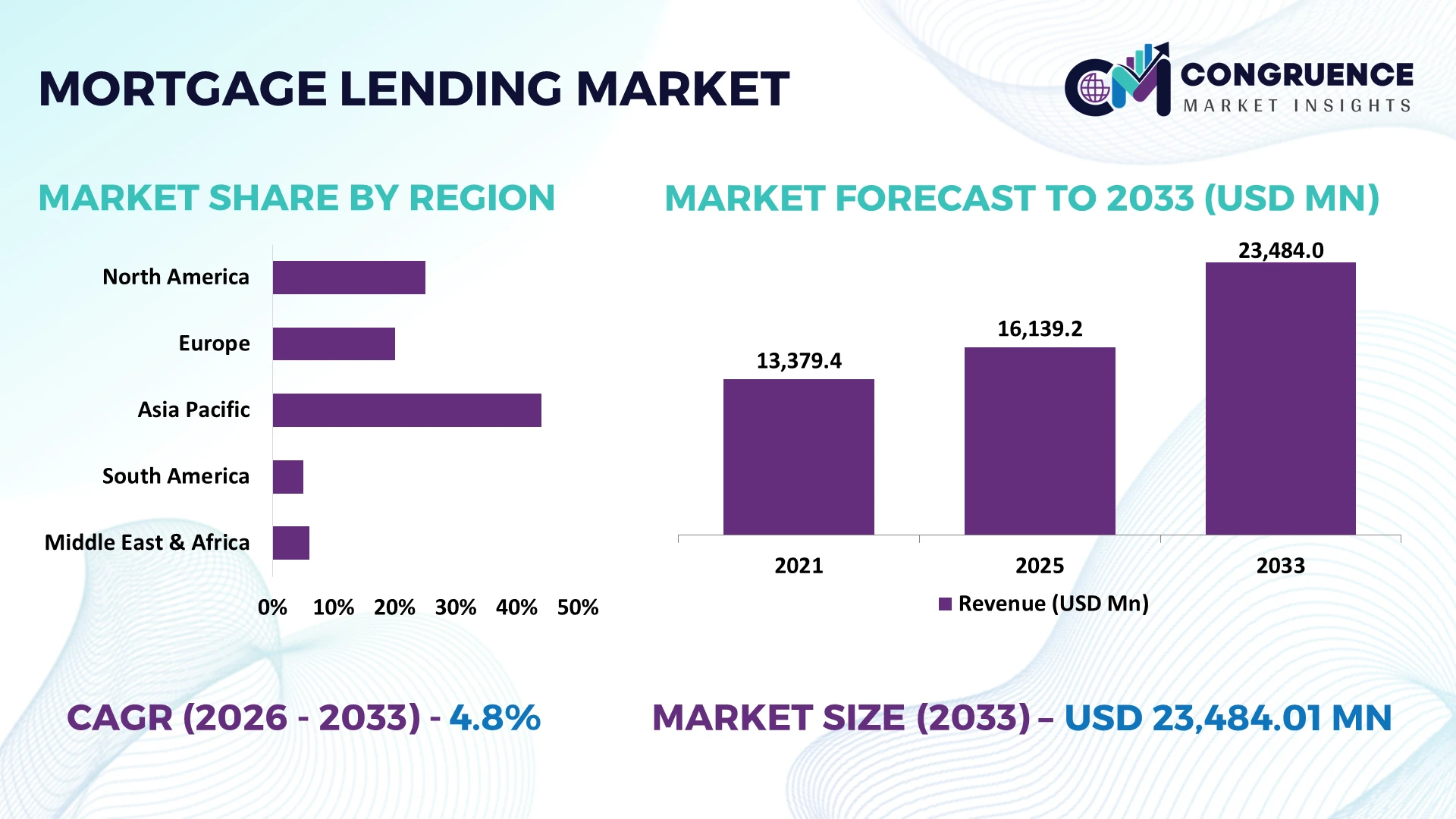
The Global Mortgage Lending Market was valued at USD 16139.2 Million in 2025 and is anticipated to reach a value of USD 23484.01 Million by 2033 expanding at a CAGR of 4.8% between 2026 and 2033. Growth is driven by residential housing finance requirements, mortgage refinancing cycles, digital loan origination, automated credit underwriting, and government supported homeownership financing programs.
The United States dominates institutional mortgage lending through a housing finance system with approximately USD 13 trillion in outstanding residential mortgage debt, supported by banks, independent mortgage companies, and capital market investors. Fannie Mae and Freddie Mac underpin secondary mortgage liquidity, while digital lenders invest in automated income verification and electronic closings. The Federal Reserve's interest rate policy directly influences borrowing conditions. Compared with India, where housing credit expansion depends heavily on bank and housing finance company distribution, US lenders benefit from deeper mortgage securitization infrastructure.
Strategically, lenders targeting 20% faster loan processing and 15% lower origination costs through automated underwriting can improve operating leverage and borrower acquisition efficiency.
Market Size & Growth: USD 16,139.2 million in 2025, reaching USD 23,484.01 million by 2033 at 4.8% CAGR, supported by digital mortgage origination and housing finance expansion.
Top Growth Drivers: Illustrative demand contributions include residential home purchases at 45%, mortgage refinancing at 30%, and digital lending adoption at 25%.
Short Term Forecast: By 2028, automated underwriting targets an estimated 20% reduction in loan processing time and 15% improvement in operational efficiency.
Emerging Technologies: AI credit assessment, automated income verification, and blockchain mortgage documentation represent 3 advanced technologies transforming loan origination workflows.
Regional Leaders: Illustrative 2033 allocations place North America at USD 9,393.60 million, Europe at USD 7,045.20 million, and Asia Pacific at USD 5,401.32 million, supported by digital closings, open banking, and mobile mortgage applications.
Consumer and End User Trends: An estimated 60% of digitally engaged mortgage applicants prioritize online application access, electronic document submission, and real time loan status tracking.
Pilot and Case Example: A proposed 2027 AI underwriting pilot targets 25% faster document verification and 15% fewer manual loan processing interventions.
Competitive Landscape: Rocket Mortgage maintains a leading US retail mortgage origination position, competing with United Wholesale Mortgage, JPMorgan Chase, Wells Fargo, and Bank of America.
Regulatory & ESG Impact: The Basel III capital framework influences mortgage risk weighting, while automated compliance systems target an estimated 20% reduction in manual regulatory review workloads.
Investment & Funding: An illustrative USD 500 million industry investment scenario prioritizes digital lending platforms, automated underwriting systems, and mortgage servicing technology partnerships.
Innovation & Future Outlook: By 2033, integrated mortgage platforms target 30% faster loan decisions through AI risk assessment, embedded finance, and automated property valuation.
The Mortgage Lending Market is undergoing structural transformation as banks, independent mortgage lenders, and financial technology companies modernize residential property financing. Digital loan origination systems integrate credit bureau data, automated income verification, electronic signatures, and property valuation analytics to reduce processing complexity. In the United States, mortgage debt exceeds USD 13 trillion, highlighting the scale of financing infrastructure supporting housing transactions. Rising demand for transparent borrowing costs and faster approvals is accelerating lender investment in customer facing platforms. Regulatory oversight, including consumer protection requirements and mortgage servicing standards, is strengthening the importance of compliant automation and data security, establishing the foundation for strategic market analysis.
Mortgage lending is becoming strategically important as financial institutions compete to reduce origination costs, improve borrower acquisition, and strengthen credit risk management. The United States maintains approximately USD 13 trillion in outstanding residential mortgage debt, demonstrating the scale of its housing finance infrastructure. Digital transformation is shifting competition from branch dependent lending toward integrated mortgage platforms connecting credit bureaus, property valuation providers, and loan servicing systems. Fannie Mae and Freddie Mac support secondary market liquidity, while independent lenders invest in automated underwriting and electronic mortgage documentation.
AI assisted income verification and automated document processing target 20% to 30% faster loan assessment compared with conventional manual underwriting. The United States benefits from established mortgage securitization infrastructure, while the United Kingdom emphasizes digital broker distribution and India expands housing finance through banking networks. Between 2026 and 2028, integrated lending platforms are targeting 15% lower administrative costs and 25% faster borrower verification. These improvements strengthen processing capacity without proportional increases in underwriting personnel.
Rocket Mortgage demonstrates digital origination through integrated online applications, electronic documentation, and automated borrower verification. Banks are expanding technology partnerships, cloud infrastructure, and predictive credit analytics. Competitive positioning increasingly depends on transparent pricing, compliant automation, and dependable mortgage servicing capabilities across changing interest rate environments.
Digital mortgage origination is accelerating operational transformation as lenders integrate automated income verification, electronic documentation, and credit decision systems. In the United States, approximately 70% of mortgage applications are processed through digital or hybrid channels under an illustrative adoption estimate. Automated underwriting targets 20% faster application processing, while electronic document verification offers an estimated 15% reduction in manual administrative workloads. Fannie Mae and Freddie Mac continue supporting automated underwriting infrastructure through Desktop Underwriter and Loan Product Advisor. These systems improve standardized credit assessment and secondary market eligibility evaluation. Rocket Mortgage, JPMorgan Chase, and other lenders are investing in integrated borrower portals, automated compliance checks, and application programming interfaces. Competitive advantage increasingly depends on reducing processing friction while maintaining consistent underwriting standards.
Mortgage lending activity remains constrained by elevated borrowing costs, housing affordability pressures, and strict credit qualification requirements. In the United States, conventional 30 year fixed mortgage rates have remained above 6% during substantial portions of the recent lending cycle, restricting refinancing incentives and borrower purchasing power. A 1 percentage point increase in mortgage rates can raise monthly principal and interest payments by approximately 10% to 12% for comparable long term loans. An illustrative affordability scenario indicates that a 15% increase in monthly housing expenses reduces qualified borrower capacity in income constrained segments. Lenders are responding through adjustable rate products, temporary rate buydowns, diversified funding arrangements, and streamlined operating structures to protect origination activity.
Embedded mortgage finance and alternative credit assessment are creating opportunities to serve borrowers with limited conventional credit histories. Automated verification of employment, income, and banking transactions targets 25% faster application assessment, while integrated property valuation systems offer an estimated 20% reduction in manual review requirements. Open banking integration can improve financial data accessibility and support approximately 15% fewer documentation exceptions in digitally optimized lending workflows. India's expanding digital financial infrastructure provides opportunities for lenders to integrate account aggregation, electronic identity verification, and property financing services. Financial institutions are developing partnerships with fintech platforms, property marketplaces, and credit analytics providers. Strategic differentiation increasingly depends on responsible borrower inclusion, transparent credit assessment, and scalable digital distribution.
Mortgage lenders face increasing execution complexity as digital origination platforms connect sensitive borrower information, credit databases, property records, and servicing infrastructure. The 2023 cyberattack affecting loan servicing provider Mr. Cooper demonstrated operational vulnerabilities across interconnected mortgage technology systems. In an illustrative implementation scenario, fragmented legacy integration increases technology deployment workloads by 20%, while inconsistent data validation generates 15% additional manual exception handling. Financial institutions must also address evolving cybersecurity supervision, third party technology oversight, and algorithmic lending fairness requirements. Lenders are strengthening encryption, identity authentication, automated audit trails, and vendor risk management. Sustainable digital mortgage operations require interoperable systems, transparent credit decision models, and resilient servicing infrastructure capable of maintaining continuity during security incidents.
Increasing Adoption of Mortgage Rate Buydowns: US homebuilders and lenders are expanding temporary interest rate buydown programs to address housing affordability pressures. A 2 percentage point initial rate reduction can lower first year mortgage payments by approximately 20%, depending on loan terms. Builders are integrating financing incentives into property sales, while lenders strengthen partnerships with developers. This approach supports purchase transactions without requiring permanent reductions in property prices or mortgage interest rates.
Expansion of Digital Mortgage Servicing: Mortgage servicers are modernizing payment management, escrow administration, and borrower communication platforms. Automated servicing workflows target 20% lower manual processing workloads and 15% faster customer request resolution. Financial institutions are integrating mobile payment interfaces, electronic statements, and predictive delinquency monitoring. The transition improves operational scalability while strengthening borrower retention throughout mortgage repayment periods, rather than concentrating technology investment exclusively on loan origination.
Growing Focus on Mortgage Portfolio Risk: Financial institutions are strengthening portfolio monitoring as interest rate volatility affects refinancing behavior and borrower affordability. Advanced loan surveillance systems target 15% faster identification of emerging delinquency patterns and 20% fewer manual portfolio review tasks. Banks are expanding stress testing capabilities and integrating property valuation updates into servicing operations. This shift improves early intervention strategies and supports more disciplined mortgage credit exposure management.
Increasing Use of Electronic Mortgage Notes: US lenders are expanding electronic promissory note adoption to simplify mortgage documentation and secondary market transfers. Digital note processing targets 25% faster document delivery and 15% fewer custody exceptions compared with paper workflows. Mortgage technology providers are integrating electronic vaults and digital signatures with investor delivery systems. This transition strengthens document traceability, reduces physical custody requirements, and improves operational efficiency across mortgage securitization processes.
Fixed-Rate Mortgages represent the leading segment, with an estimated 65% market share under an indicative product allocation, supported by predictable monthly payments and established secondary mortgage market infrastructure. US borrowers frequently prefer long term fixed interest structures because they provide protection against future borrowing cost increases. Conventional Mortgages remain important for borrowers meeting standard credit and documentation requirements, while Government-Backed Mortgages support eligible households through Federal Housing Administration, Veterans Affairs, and other public financing programs. Lenders are strengthening standardized underwriting, automated eligibility assessment, and investor delivery integration to improve processing consistency and loan distribution.
Adjustable-Rate Mortgages represent the fastest expanding segment in an analytical adoption scenario, supported by borrower interest in lower initial interest rates and shorter expected ownership periods. Jumbo Mortgages serve higher value property transactions requiring specialized credit assessment and larger loan commitments. An illustrative product mix assigns approximately 15% to adjustable rate lending and 8% to jumbo financing. Banks are refining interest rate risk assessment, expanding tailored mortgage products, and strengthening borrower suitability disclosures. Competitive differentiation increasingly depends on affordability structures, transparent repayment terms, and disciplined credit underwriting.
Home Purchase represents the largest mortgage lending application, with an estimated 60% market share under an indicative application allocation, supported by residential property acquisitions and long term housing finance requirements. The United States maintains substantial purchase mortgage activity through banks, credit unions, and independent mortgage lenders. Home Refinancing accounts for an estimated 22% of activity, responding to interest rate movements, borrower equity positions, and repayment restructuring requirements. Home Improvement financing supports residential renovation and property upgrades, while Property Construction lending provides funding for new housing development. Lenders are integrating property valuation systems, digital application platforms, and automated documentation to improve processing efficiency.
Home Refinancing represents the fastest expanding application in an analytical recovery scenario, particularly when prevailing mortgage rates decline relative to existing borrower contracts. Debt Consolidation remains a specialized application involving property secured borrowing to restructure outstanding obligations. Automated eligibility screening targets 20% faster refinancing assessment, while electronic closing integration reduces documentation handling requirements. Mortgage lenders are expanding borrower retention programs, servicing analytics, and refinancing outreach capabilities. Competitive advantage increasingly depends on identifying eligible borrowers and managing acquisition costs across changing housing finance conditions.
Individual Homebuyers represent the leading end user segment, accounting for an estimated 70% of mortgage lending demand under an indicative borrower allocation. Their dominance reflects recurring housing purchases, household formation, and established residential financing infrastructure. Real Estate Investors represent an important institutional and individual borrower category, requiring financing for rental properties and portfolio acquisitions. Self-Employed Borrowers face more complex income verification requirements because earnings frequently involve variable business income and nonstandard documentation. Mortgage lenders are strengthening automated income assessment, flexible underwriting procedures, and borrower education platforms to improve application completion and credit evaluation.
Self-Employed Borrowers represent the fastest expanding segment in an analytical digital adoption scenario, supported by improved financial data integration and specialized mortgage qualification products. Property Developers require financing for residential construction and project completion, while Small and Medium-Sized Businesses use property secured lending for business premises and capital requirements. An indicative borrower mix assigns approximately 15% to real estate investors and 7% to self-employed applicants. Lenders are developing customized documentation requirements, alternative income assessment tools, and specialized distribution partnerships. Competitive positioning increasingly depends on serving financially viable borrowers whose income profiles do not fit conventional salaried employment models.
North America accounted for the largest market share at an estimated 40% in 2025 however, Asia Pacific is expected to register the fastest growth, expanding at a CAGR of an estimated 6.8% between 2026 and 2033.
Digital Mortgage Origination and Secondary Market Integration
North America represents an estimated 40% of the global mortgage lending market, supported by established housing finance institutions, extensive mortgage securitization infrastructure, and advanced digital lending capabilities. The United States dominates regional activity through commercial banks, credit unions, and independent mortgage lenders, while Canada maintains a concentrated banking system with established residential financing products. Fannie Mae and Freddie Mac support mortgage liquidity through standardized underwriting and secondary market transactions. Digital loan origination platforms integrate automated income verification, credit assessment, and electronic documentation to streamline application processing. Mortgage lenders are targeting an estimated 20% reduction in processing time and 15% lower administrative workloads through workflow automation. Financial institutions are strengthening cloud infrastructure, borrower portals, and servicing analytics. Competitive positioning increasingly depends on funding access, efficient underwriting, and reliable loan distribution across changing interest rate conditions.
United States Market Outlook: The United States maintains a leading mortgage lending position through extensive residential financing infrastructure and established secondary market institutions. Outstanding residential mortgage debt exceeds USD 13 trillion, demonstrating the scale of housing credit exposure. Rocket Mortgage, JPMorgan Chase, and United Wholesale Mortgage compete through digital origination, broker distribution, and servicing capabilities. Federal Reserve monetary policy influences borrowing costs, while automated underwriting systems improve credit evaluation and mortgage investor eligibility assessment.
Open Banking Integration and Mortgage Regulatory Modernization
Europe accounts for an estimated 30% of the global mortgage lending market, supported by established banking networks, residential property financing demand, and increasingly integrated digital financial services. The United Kingdom, Germany, France, and the Netherlands maintain substantial mortgage portfolios, with varying interest rate structures and refinancing practices. European banking institutions are strengthening automated credit assessment and digital mortgage distribution through application programming interfaces and electronic identity verification. The European Union's Mortgage Credit Directive establishes consumer protection requirements, while banking capital regulations influence mortgage risk assessment and lending capacity. Digital mortgage processing targets an estimated 15% reduction in administrative expenses and 20% faster document verification. Financial institutions are expanding broker integrations, property valuation automation, and borrower communication platforms. Competitive differentiation increasingly depends on regulatory compliance, funding efficiency, and transparent mortgage product structures.
United Kingdom Market Outlook: The United Kingdom represents a strategically important European mortgage market through its established broker distribution networks, specialist lenders, and digital property financing platforms. The Bank of England's monetary policy influences mortgage pricing and refinancing activity. Fixed rate products dominate new mortgage selections, while remortgaging remains an important source of lender competition. Nationwide Building Society, Lloyds Banking Group, and NatWest Group are strengthening digital mortgage applications, automated affordability assessment, and intermediary distribution capabilities.
Housing Finance Expansion and Digital Banking Infrastructure Development
Asia Pacific represents an estimated 23% of the global mortgage lending market, supported by large residential property markets, expanding banking infrastructure, and increasing digital financial service adoption. China, India, Japan, and Australia maintain substantial housing finance ecosystems, although mortgage structures and regulatory requirements differ considerably. China benefits from extensive commercial banking networks and state directed housing finance policies, while India is expanding digital mortgage distribution through banks and housing finance companies. Japan maintains established long term housing loan products, and Australia relies heavily on bank originated residential mortgages. Digital lending platforms are targeting an estimated 20% improvement in application processing efficiency and 15% lower documentation handling costs. Financial institutions are integrating electronic identity verification, automated property assessment, and mobile banking interfaces. Competitive advantage increasingly depends on borrower accessibility, credit risk management, and efficient distribution infrastructure.
China Market Outlook: China represents a major mortgage lending market through its extensive banking system, large urban housing stock, and government directed property financing policies. The People's Bank of China influences mortgage conditions through benchmark lending mechanisms and monetary policy measures. Commercial banks are expanding digital loan servicing and automated borrower verification capabilities. Property market stabilization initiatives and mortgage rate adjustments remain important determinants of refinancing activity, housing affordability, and bank credit allocation.
Housing Credit Accessibility and Digital Lending Modernization
South America accounts for an estimated 4% of the global mortgage lending market, with activity concentrated in Brazil, Chile, Colombia, and Argentina. Brazil maintains the region's largest banking infrastructure and established housing finance programs, while Chile benefits from relatively developed mortgage lending institutions. High borrowing costs, income informality, and housing affordability constraints influence credit accessibility across several markets. Financial institutions are strengthening digital onboarding, automated credit assessment, and electronic property documentation to improve loan distribution. Mortgage processing modernization targets an estimated 15% reduction in administrative workloads and 20% faster borrower verification. Government supported housing initiatives remain important for expanding access among eligible households. Banks and fintech providers are developing partnerships to improve credit evaluation and customer acquisition. Market competitiveness depends on funding stability, borrower affordability, and reliable property collateral assessment.
Brazil Market Outlook: Brazil dominates regional mortgage lending through its extensive commercial banking system and government supported housing finance infrastructure. Caixa Econômica Federal plays a central role in residential property financing, including participation in the Minha Casa, Minha Vida housing program. The Central Bank of Brazil influences borrowing conditions through monetary policy and financial regulation. Digital banking adoption is strengthening mortgage application accessibility, while property registration modernization supports collateral verification and lending administration.
Housing Finance Reform and Digital Mortgage Infrastructure Expansion
The Middle East and Africa represent an estimated 3% of the global mortgage lending market, supported by residential construction investment, housing finance reforms, and expanding banking services. Saudi Arabia, the United Arab Emirates, and South Africa maintain important mortgage lending infrastructure, while several African economies face limitations involving property registration and long term funding availability. Saudi Arabia's Vision 2030 initiatives have supported housing finance development and increased homeownership participation. Banks are expanding digital mortgage applications, automated affordability assessment, and property financing partnerships. Modernized lending workflows target an estimated 20% faster application assessment and 15% lower documentation processing requirements. Financial institutions are strengthening mortgage product distribution, credit risk systems, and developer relationships. Competitive positioning depends on sustainable funding structures, reliable collateral registration, and accessible housing finance products.
Saudi Arabia Market Outlook: Saudi Arabia represents a strategically important mortgage lending market through government supported homeownership initiatives and substantial residential development activity. The national housing program targets 70% homeownership by 2030, strengthening demand for structured residential financing. The Saudi Real Estate Refinance Company supports mortgage market liquidity, while commercial banks expand digital loan applications and developer partnerships. Regulatory oversight from the Saudi Central Bank supports mortgage lending standards, consumer protection, and financial system stability.
The mortgage lending market features competition between JPMorgan Chase, Rocket Mortgage, United Wholesale Mortgage, Wells Fargo, and Bank of America, alongside regional banks and specialist digital lenders. An illustrative concentration estimate places the leading five US originators near 25% of annual mortgage volume, reflecting fragmented distribution and diverse funding channels. Rocket Mortgage competes through direct digital origination, while United Wholesale Mortgage emphasizes broker relationships. JPMorgan Chase and Bank of America leverage deposit funding, customer relationships, and integrated servicing infrastructure. Automated underwriting targets 20% faster credit decisions, while electronic documentation offers estimated administrative savings of 15%. Lenders are expanding fintech partnerships, predictive risk analytics, and mortgage servicing automation. Competition increasingly centers on borrower acquisition costs, funding efficiency, and refinancing retention. Capital requirements, regulatory compliance, and mortgage servicing infrastructure create substantial entry barriers. Sustainable leadership requires competitive loan pricing, disciplined credit assessment, scalable digital operations, and dependable secondary market access across interest rate cycles.
JPMorgan Chase & Co.
Rocket Companies, Inc.
United Wholesale Mortgage Holdings Corporation
Wells Fargo & Company
Bank of America Corporation
Citigroup Inc.
PNC Financial Services Group, Inc.
U.S. Bancorp
Lloyds Banking Group plc
HSBC Holdings plc
Banco Santander, S.A.
BNP Paribas S.A.
Commonwealth Bank of Australia
HDFC Bank Limited
Current mortgage lending technology centers on automated underwriting, digital loan origination, electronic signatures, and integrated servicing platforms. Cloud based document management targets 20% lower administrative workloads, while automated income verification targets 25% faster borrower assessment. Digital mortgage applications are established across major United States banks and specialist lenders, demonstrating enterprise deployment beyond experimental pilots. Compared with conventional paper based processing, integrated digital workflows target 30% shorter documentation cycles. Lenders benefit from reduced processing friction, stronger audit trails, and improved borrower retention.
Emerging technologies combine artificial intelligence, machine learning, open banking interfaces, and automated property valuation. Predictive credit analytics target 15% fewer manual underwriting exceptions, while application programming interfaces support 20% faster financial data retrieval. Adoption is expanding through partnerships connecting lenders, payroll providers, credit bureaus, and property databases. Rocket Mortgage and established banking groups benefit from existing customer networks, while specialist fintech providers compete through modular technology integration and faster product deployment.
Disruptive innovation focuses on explainable AI, continuous borrower verification, and interoperable digital mortgage records. Between 2026 and 2028, integrated platforms target 25% faster application decisions and 15% lower servicing intervention workloads. Regulatory compliant automation strengthens competitive positioning, particularly for institutions balancing operational scalability with transparent credit decisions and cybersecurity resilience.
October 2025 Rocket Companies completed its acquisition of Mr. Cooper, combining mortgage origination with servicing for nearly 10 million homeowners. The transaction expanded customer retention opportunities and integrated loan operations, strengthening Rocket's position in digital housing finance. Source: rocketcompanies.com.
January 2025 Freddie Mac expanded automated collateral evaluation eligibility, raising the permitted purchase loan to value threshold from 80% to 90%. The change broadened appraisal waiver access for qualifying borrowers and significantly reduced documentation friction for participating lenders. Source: freddiemac.com.
February 2026 UWM Holdings reported deploying an AI enhanced Income Calculator for mortgage brokers, automating extraction and analysis of borrower income documents. Its 2025 purchase originations included more than $54 billion in conventional mortgages, supporting broker channel scale. Source: businesswire.com.
November 2025 Federal Housing Finance Agency raised the 2026 baseline conforming mortgage limit to $832,750, an increase of $26,250. The adjustment expanded eligible loan sizes for Fannie Mae and Freddie Mac purchases, supporting financing access in appreciating housing markets. Source: fhfa.gov.
The Mortgage Lending Market Report examines residential financing structures, borrower behavior, digital infrastructure, and competitive positioning between 2026 and 2033. Type coverage includes fixed rate, adjustable rate, government backed, conventional, and jumbo mortgages. Application analysis addresses home purchases, refinancing, improvements, property construction, and debt consolidation. End user assessment covers individual homebuyers, real estate investors, self employed borrowers, property developers, and small and medium sized businesses. Regional evaluation spans North America, Europe, Asia Pacific, South America, and the Middle East and Africa.
The report evaluates automated underwriting, electronic mortgage notes, AI credit assessment, collateral valuation, and servicing technology. Indicative segmentation assigns individual homebuyers approximately 70% of demand and home purchases 60% of applications. Analysis of mortgage funding, regulation, borrower acquisition, and digital distribution supports investment prioritization, geographic expansion, lender partnerships, and competitive planning through 2033.
| Report Attribute/Metric | Report Details |
|---|---|
Market Revenue in 2025 | USD 16139.2 Million |
Market Revenue in 2033 | USD 23484.01 Million |
CAGR (2026 - 2033) | 4.8% |
Base Year | 2025 |
Forecast Period | 2026 - 2033 |
Historic Period | 2021 - 2025 |
Segments Covered | By Type
By Application
By End-User
|
Key Report Deliverable | Revenue Forecast, Growth Trends, Market Dynamics, Segmental Overview, Regional and Country-wise Analysis, Competition Landscape |
Region Covered | North America, Europe, Asia-Pacific, South America, Middle East, Africa |
Key Players Analyzed | JPMorgan Chase & Co., Rocket Companies, Inc., United Wholesale Mortgage Holdings Corporation, Wells Fargo & Company, Bank of America Corporation, Citigroup Inc., PNC Financial Services Group, Inc., U.S. Bancorp, Lloyds Banking Group plc, HSBC Holdings plc, Banco Santander, S.A., BNP Paribas S.A., Commonwealth Bank of Australia, HDFC Bank Limited |
Customization & Pricing | Available on Request (10% Customization is Free) |




