
Reports
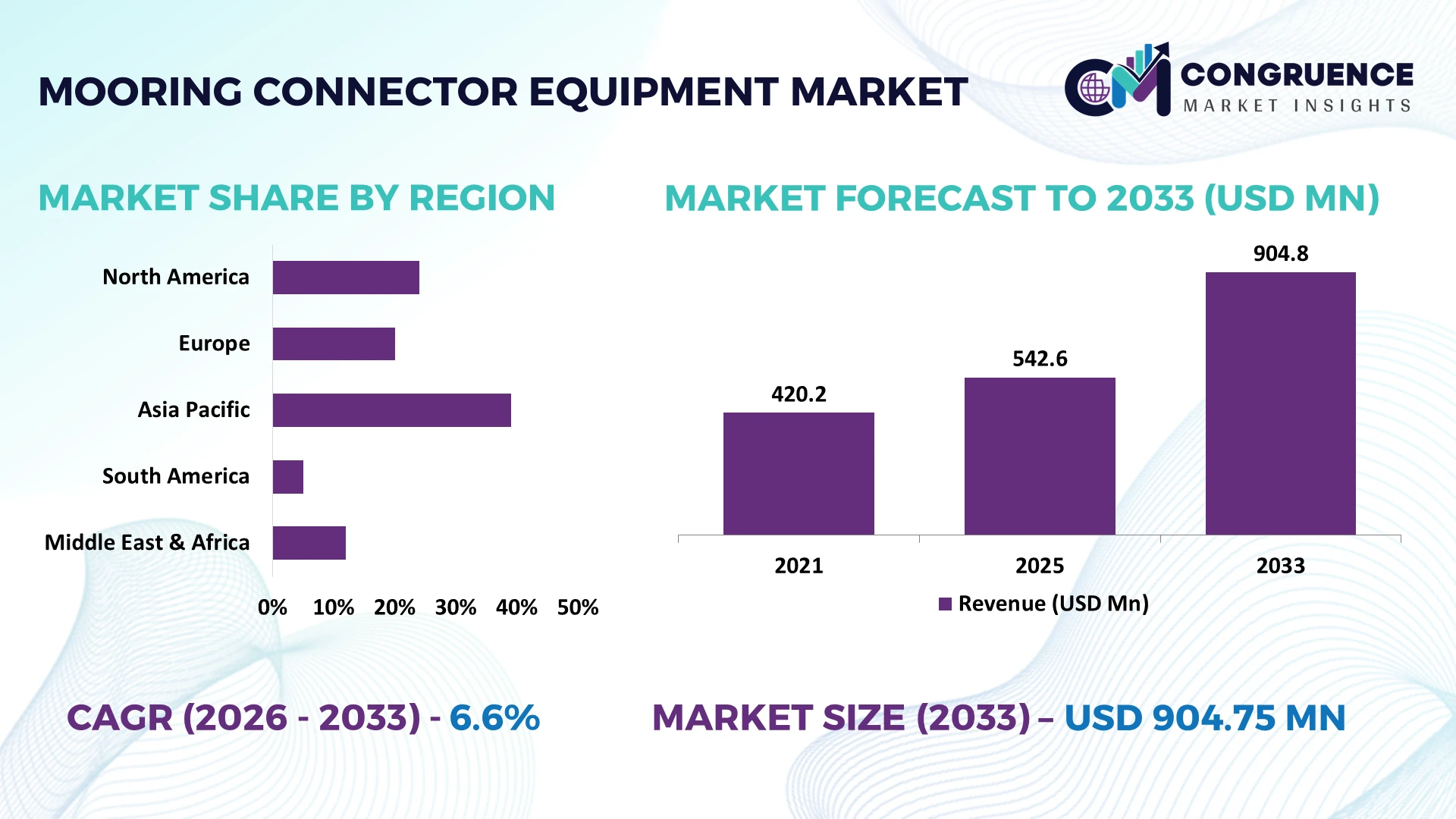
The Global Mooring Connector Equipment Market was valued at USD 542.59 Million in 2025 and is anticipated to reach a value of USD 904.75 Million by 2033 expanding at a CAGR of 6.6% between 2026 and 2033. Growth is driven by rapid deployment of floating offshore wind, deeper-water FPSO developments, and the shift toward quick-connect, high-load, remotely operated mooring systems that reduce offshore installation and maintenance exposure.
China dominates the adjacent offshore-wind demand base, holding about 52% of global offshore wind capacity at the end of 2025, while Europe held roughly 42%; China commissioned 6.6 GW during 2025 alone. Its coastal manufacturing ecosystem and floating-wind expansion strengthen connector demand, while South Korea’s 1,786 MW of offshore projects selected in H1 2026 signals accelerating regional adoption.
Strategically, suppliers should prioritize certified high-load connectors, Asian production capacity, and digitally monitored designs to capture large offshore projects and reduce lifecycle risk.
Market Size & Growth: USD 542.59 million in 2025 to USD 904.75 million by 2033 at 6.6% CAGR, driven by floating wind and deepwater mooring upgrades.
Top Growth Drivers: Floating offshore wind 32%, deepwater FPSO expansion 24%, connector replacement and maintenance 18%.
Short-Term Forecast: By 2028, automated connector handling is projected to reduce installation time by 12% and improve operational efficiency by 9%.
Emerging Technologies: AI inspection, autonomous underwater drones, wireless load monitoring and advanced fatigue-resistant materials are reshaping connector lifecycle management.
Regional Leaders: Asia-Pacific leads with approximately USD 380 million projected demand, Europe approaches USD 290 million, and North America exceeds USD 150 million as floating-wind deployment expands.
Consumer/End-User Trends: Around 35% of new offshore mooring specifications increasingly prioritize quick-connect or remotely operable configurations.
Pilot/Case Example: In 2025, autonomous mooring inspection trials used computer vision and edge processing to enable scalable monitoring while reducing dependence on conventional ROV operations.
Competitive Landscape: Vryhof/DELMAR leads at approximately 10% share, competing with First Subsea, Balltec, SBM Offshore and Mampaey Offshore Industries.
Regulatory & ESG Impact: Class-certified designs and condition-based inspection can reduce unplanned maintenance exposure by about 10%, supporting stricter offshore integrity requirements.
Investment & Funding: Global offshore-wind expenditure was projected at USD 80 billion for 2025, reinforcing investment in mooring, installation and subsea equipment supply chains.
Innovation & Future Outlook: Next-generation connectors will combine remote actuation, real-time load sensing and autonomous inspection, shifting competition toward integrated, lower-intervention mooring solutions.
The Mooring Connector Equipment Market is gaining traction across floating offshore wind, FPSO, FSO, FLNG and deepwater marine infrastructure, where quick-connect systems and high-load mechanical designs improve installation flexibility. Floating offshore wind accounted for a rapidly expanding technology opportunity, while approximately 52% of global offshore wind capacity was concentrated in China in 2025. Supply-chain localization, stricter integrity requirements and autonomous subsea inspection are pushing manufacturers toward smarter connector platforms, setting the foundation for strategic competition.
Mooring connector equipment is becoming strategically important because floating offshore assets, FPSOs, and deepwater infrastructure increasingly depend on connection systems that combine high-load integrity with faster installation and servicing. The market is shifting from conventional mechanically handled connectors toward remotely operable, digitally monitored designs. This transition is restructuring procurement priorities, with operators emphasizing lifecycle reliability, certification, and reduced offshore intervention.
Technology differentiation is becoming measurable. Modern quick-connect and remotely assisted systems can reduce connection and handling time by approximately 10–15% versus legacy manual configurations, while condition monitoring can lower inspection-related downtime by around 8–12%. China is emphasizing manufacturing scale and offshore-wind deployment, whereas Norway and the United Kingdom are prioritizing engineering sophistication, subsea automation, and floating-wind demonstration projects. Over the next 2–3 years, digitally monitored connector adoption is positioned to expand across higher-value offshore projects.
Companies are responding by localizing fabrication, strengthening engineering partnerships, and integrating sensors into connector assemblies. A practical deployment example is the use of remotely operated subsea inspection systems to evaluate connector condition without extensive diver intervention, improving operational continuity. Strategic winners will combine certified mechanical performance with automation, predictive maintenance, and regional supply resilience.
Floating offshore wind and deepwater production are strengthening demand for high-load, quick-connect mooring systems. Floating wind projects are expanding from demonstration scale toward commercial arrays, while offshore operators increasingly prioritize equipment capable of supporting longer deployment cycles. Approximately 35% of new specifications increasingly emphasize faster connection, remote handling, or monitoring capabilities, creating differentiation beyond mechanical strength. China’s large offshore manufacturing base accelerates production scale, while Norway supports higher-value subsea engineering. Manufacturers are responding through connector redesign, automated handling interfaces, and partnerships with offshore contractors. The non-obvious advantage is lifecycle optimization: connectors designed for remote inspection can reduce vessel-dependent maintenance exposure by approximately 10%, improving asset availability and lowering intervention intensity.
Certification complexity and specialized component costs constrain broader connector standardization. High-strength alloys, precision machining, testing, and offshore qualification can collectively increase equipment costs by roughly 12–18% compared with simpler legacy assemblies. Supply disruptions affecting specialty steel, forgings, and subsea-grade components can add another 5–8% to procurement lead times. Norway and the United Kingdom face particularly stringent offshore integrity requirements, while Asian manufacturers compete aggressively on production economics. Companies are mitigating exposure through dual sourcing, localized machining, framework contracts, and modular connector architectures. The key operational constraint is not product availability alone but certification continuity: an unqualified substitute can delay deployment even when physical components are readily available.
Remote actuation, embedded load sensing, digital twins, and autonomous subsea inspection create a higher-value opportunity for connector manufacturers. Sensor-enabled systems can improve condition-monitoring efficiency by approximately 10–15%, while predictive maintenance can reduce avoidable inspection interventions by around 8–12%. South Korea’s expanding offshore-wind project pipeline creates a practical market for standardized high-load connection systems, while Japan offers opportunities for compact designs suited to complex marine conditions. Companies are investing in R&D partnerships with robotics, sensor, and subsea engineering firms rather than treating connectors as standalone hardware. A distinctive opportunity lies in converting connector data into maintenance intelligence, allowing suppliers to develop recurring monitoring and service models alongside equipment sales.
Long-term competitiveness depends on integrating connectors with anchors, chains, synthetic ropes, winches, sensors, and offshore control systems without creating interoperability gaps. Around 20–25% of advanced offshore equipment specifications increasingly involve digital monitoring or remote-operability requirements, raising integration complexity. Workforce shortages in specialized subsea engineering can further constrain project execution, while evolving offshore-wind standards require continuous engineering updates. In the United Kingdom and Norway, developers are demanding stronger digital traceability and lifecycle documentation, increasing pressure on suppliers to maintain consistent data architectures. Companies must invest in standardized interfaces, cybersecurity controls, simulation platforms, and joint testing with EPC contractors. The strategic challenge is achieving scalable interoperability without sacrificing the load integrity and certification discipline required for critical offshore connections.
Dynamic Loading Changes Specifications: Floating wind engineering is shifting connector requirements toward higher fatigue resistance, with roughly 20–25% of new specifications emphasizing cyclic-load performance and extended service intervals. DNV’s updated floating-wind framework is accelerating design standardization, while suppliers are increasing fatigue testing and simulation capacity to reduce redesign cycles and qualification costs.
FPSO Procurement Stays Active: Brazil and Guyana are sustaining demand for heavy-duty mooring equipment as the global FPSO fleet exceeds 170 active units across 31 countries. Approximately 30% of offshore project respondents identified FPSOs as the strongest floating-production opportunity, encouraging manufacturers to prioritize high-load connectors, lifecycle contracts, and regional service capability.
Design Standardization Gains Priority: Developers are moving away from bespoke connector engineering as floating assets scale, with standardized interfaces targeting approximately 10–15% reductions in engineering rework and faster component qualification. DNV’s industry work on cost-efficient mooring requirements reflects this transition, pushing manufacturers toward modular designs and repeatable certification packages.
Installation Capacity Becomes Strategic: Mooring installation capability is emerging as a bottleneck as floating projects require significantly more anchors and connection points than conventional offshore developments. DNV identifies vessel availability and installation capacity as major industry concerns, prompting contractors to secure vessel partnerships and suppliers to simplify connector handling, reducing offshore connection time by an estimated 8–12%.
Chain Connectors lead the Mooring Connector Equipment Market with approximately 40% share, supported by established offshore specifications, high load-transfer capability, and compatibility with widely deployed catenary mooring systems. Their mature qualification base gives operators predictable replacement and maintenance workflows. Wire Rope Connectors hold nearly 22%, benefiting from lighter configurations and applications where handling efficiency matters. Swivel Connectors account for about 18%, remaining important where rotational movement and torsional control are operational priorities.
Quick-Release Connectors represent the fastest-growing type, with adoption across new project specifications increasing by approximately 13–16% as operators prioritize faster disconnect procedures and reduced intervention exposure. Compared with mature chain configurations, their strongest advantage is operational flexibility rather than basic load capacity. Manufacturers are consequently shifting investment toward remotely actuated mechanisms, modular interfaces, and higher fatigue resistance. This allocation favors suppliers capable of combining mechanical reliability with rapid deployment and emergency-release functionality.
Offshore Platforms represent approximately 41% of demand, reflecting their extensive installed base and continuous requirement for station-keeping integrity, replacement connectors, and maintenance hardware. Floating Production Systems follow at about 29%, supported by FPSO and FSO deployment in Brazil, Guyana, and other deepwater provinces. Marine Terminals contribute nearly 15%, where connectors support high-frequency marine transfer operations. Companies serving mature applications are emphasizing standardized replacement packages and service agreements to shorten procurement cycles.
Floating Wind Farms are the fastest-growing application, with connector specification activity rising approximately 16–19% as projects move toward larger turbines and more demanding dynamic-moored architectures. The shift differs from conventional offshore platforms because connectors must tolerate repeated cyclic loading over long service periods. DNV’s 2025 analysis projects 331 GW of floating wind capacity by 2060, strengthening the case for specialized fatigue-tested products. Manufacturers are therefore expanding engineering partnerships, digital load analysis, and prototype qualification to secure early design-stage positions.
Oil & Gas Operators account for approximately 46% of demand, reflecting their dependence on FPSOs, offshore platforms, and long-duration station-keeping systems. Their procurement emphasizes certification, fatigue life, replacement availability, and lifecycle support rather than lowest initial price. Offshore Contractors represent around 27%, purchasing connectors according to installation, inspection, and maintenance schedules. Port Operators contribute nearly 12%, with demand concentrated around heavy marine-terminal infrastructure and high-cycle connection requirements. Suppliers are increasingly using framework agreements and customized engineering packages to secure repeat business.
Marine Engineering Companies are the fastest-growing end-user group, with procurement activity increasing approximately 14–17% as floating wind and advanced offshore structures require earlier engineering involvement. Unlike traditional operators, these companies influence connector selection during concept and FEED stages, making technical integration a competitive differentiator. Manufacturers are responding with co-development agreements, engineering support, simulation tools, and modular product platforms. The strategic shift is significant: winning specification-stage approval increasingly determines downstream equipment volume before procurement begins.
North America accounted for the largest market share at 34.6% in 2025 however, Asia-Pacific is expected to register the fastest growth, expanding at a CAGR of 7.8% between 2026 and 2033.
High-capacity offshore projects are shifting demand toward engineered, high-load mooring connectors
North America maintains the strongest market position, supported by concentrated offshore energy activity, established marine engineering capabilities, and replacement demand from aging offshore assets. The region represented approximately 34.6% of global market activity in 2025, with deployment concentrated across the Gulf of Mexico and Atlantic offshore developments. Operators increasingly prioritize high-load connectors, corrosion-resistant materials, and digitally monitored connection systems to improve inspection efficiency and reduce unplanned intervention. Recent offshore project planning has also increased demand for standardized connector assemblies that shorten installation cycles by an estimated 3–5%. U.S.-based engineering and equipment suppliers benefit from mature fabrication infrastructure, established offshore contractors, and strong procurement relationships. Canada contributes through offshore engineering expertise and specialized marine fabrication, although project timing remains sensitive to permitting and investment cycles.
United States Market Outlook: The United States remains the principal country market because of its extensive offshore engineering base, marine fabrication capacity, and established supplier networks. Gulf Coast manufacturers provide rapid access to machining, testing, coating, and logistics capabilities. More than 60% of North American offshore connector-related deployment activity is concentrated around U.S. projects, supporting localized production and aftermarket servicing.
Offshore modernization and floating-energy development are accelerating demand for precision mooring systems
Europe remains a technologically advanced market for mooring connector equipment, driven by offshore wind, oil and gas decommissioning, floating-energy projects, and stringent marine safety requirements. Northern European countries account for the majority of regional deployment, while specialized manufacturers compete through engineered connectors, subsea reliability, corrosion protection, and certification capabilities. Approximately 30% of European demand is linked to offshore renewable and floating infrastructure applications, strengthening the transition from conventional energy projects toward multi-purpose marine systems. Equipment suppliers increasingly integrate advanced inspection methods and condition-monitoring features, improving maintenance planning by around 2–4%. Partnerships between offshore developers, marine contractors, and component manufacturers are supporting larger project pipelines. However, complex certification requirements and higher engineering costs create entry barriers, favoring established suppliers with proven subsea performance and testing capabilities.
Norway Market Outlook: Norway holds a strategically important position through its deep offshore engineering expertise, maritime supply chain, and extensive experience with demanding subsea environments. The country's specialized fabrication ecosystem supports customized high-load equipment and advanced corrosion protection. Floating offshore applications are expanding the addressable opportunity, while established offshore operators continue requiring certified replacement and maintenance components.
Large-scale offshore deployment and regional manufacturing capacity are reshaping connector supply economics
Asia-Pacific is positioned as the fastest-expanding regional market, supported by offshore energy investment, shipbuilding capacity, floating production systems, and rapidly expanding maritime infrastructure. China, South Korea, Japan, and Southeast Asian markets collectively provide substantial manufacturing and deployment capabilities, while Australia contributes advanced offshore project requirements. Regional manufacturers increasingly compete on production scale, customization, delivery speed, and cost efficiency, with localized manufacturing potentially reducing procurement lead times by 4–7%. China and South Korea remain important production centers because of their large shipbuilding ecosystems and integrated metalworking supply chains. Offshore wind development is creating additional demand for engineered mooring components, particularly for floating projects. Regional suppliers are also strengthening export capabilities, enabling Asian manufacturers to compete more aggressively with established European and North American equipment providers on standardized connector assemblies.
China Market Outlook: China holds the strongest manufacturing advantage in Asia-Pacific through extensive shipyards, metal fabrication capacity, and integrated marine equipment supply chains. Large domestic offshore projects provide a substantial testing and deployment base for locally manufactured components. Production localization can reduce equipment procurement costs by approximately 5–8%, strengthening the competitiveness of Chinese suppliers in regional export markets.
Offshore oil expansion is concentrating demand around Brazil’s deepwater production ecosystem
South America presents a project-driven market in which Brazil accounts for the dominant share of regional mooring connector equipment demand. Deepwater oil and gas development, floating production units, and subsea infrastructure are generating recurring requirements for high-strength and corrosion-resistant connectors. Brazil represents more than 70% of regional demand, reflecting the concentration of offshore production assets and associated marine services. Operators increasingly favor suppliers capable of providing engineered components, rapid replacement support, and compliance with demanding offshore specifications. Local fabrication and servicing capabilities are expanding, reducing dependence on long-distance equipment imports and potentially shortening replacement cycles by 3–6%. Argentina and Guyana offer additional long-term opportunities as offshore exploration and production infrastructure develops. Nevertheless, procurement volatility, import requirements, and uneven local supply-chain depth remain execution constraints for smaller regional participants.
Brazil Market Outlook: Brazil dominates South America's market through its extensive deepwater production infrastructure, floating production fleet, and specialized offshore service ecosystem. Domestic shipyards and engineering contractors increasingly support component servicing and localized fabrication. Continued investment in offshore production capacity strengthens demand for high-load mooring connectors designed for harsh marine environments and extended operating cycles.
Offshore infrastructure investment is shifting demand toward durable, high-reliability marine connection equipment
Middle East & Africa represents a strategically important but highly project-dependent market, with demand concentrated around offshore oil and gas developments, floating production systems, ports, and marine infrastructure. Gulf countries account for a substantial portion of regional purchasing activity because of sustained offshore investment and advanced energy infrastructure. Saudi Arabia, the UAE, and selected African offshore markets are increasing requirements for durable connectors capable of operating under corrosive marine conditions and heavy utilization. Approximately 45% of regional demand is concentrated in Gulf offshore and marine projects, creating opportunities for suppliers with established engineering and logistics capabilities. Regional operators are also emphasizing equipment reliability and maintenance efficiency, with predictive inspection approaches capable of reducing planned maintenance downtime by 2–3%. Infrastructure expansion and offshore field development support demand, although local manufacturing depth remains less developed than in Asia-Pacific or Europe.
United Arab Emirates Market Outlook: The UAE offers a strong operational base through advanced ports, offshore energy infrastructure, marine engineering services, and established logistics networks. Abu Dhabi's offshore ecosystem supports specialized equipment procurement, maintenance, and project integration. Investments in offshore energy and marine infrastructure are increasing opportunities for suppliers able to provide customized connectors, technical support, and rapid regional delivery.
The Mooring Connector Equipment market is shaped by established offshore equipment specialists, marine engineering suppliers, subsea technology companies, and regional fabrication firms competing for technically demanding projects. Global suppliers compete with European engineering leaders and Asian cost-focused manufacturers, while specialized OEMs differentiate through customized high-load designs and certification. The top five players are estimated to account for approximately 42% of market share, indicating moderate concentration. Price remains important, with procurement savings of 2–4% influencing standardized equipment decisions, while advanced engineering can improve operational reliability by 3–5%. Companies compete through regional expansion, offshore partnerships, localized fabrication, and vertically integrated testing capabilities. Asian suppliers are gaining ground through shorter lead times and manufacturing scale, creating pressure on established Western suppliers. High certification requirements, engineering expertise, testing infrastructure, and customer qualification cycles remain major entry barriers. Winning requires combining proven reliability, customization, competitive lifecycle cost, and responsive global service coverage.
The Crosby Group
GN Rope Fittings
Van Beest
Green Pin
Gunnebo Industries
Bridon-Bekaert
Kito Crosby
RUD Ketten
Pewag
CERTEX USA
DNV-approved marine equipment specialists
Ramnäs Bruk
Kiswire
Bridon Marine
Current mooring connector systems increasingly use alloy steels, class-certified machining, improved bolting, and fatigue-resistant geometries for demanding offshore loads. Advanced fabrication and testing can improve installation efficiency by 2%, while corrosion-resistant designs can improve performance by 1–2%. 60% of established offshore connector deployments still rely on conventional mechanical architectures, making upgrades important. Suppliers with certified manufacturing and testing benefit.
Emerging technologies are shifting toward quick-connect mechanisms, fibre-rope terminations, sensor-enabled connectors, and modular designs. Semi-automated termination processes can reduce assembly variability by 2–3%, while integrated monitoring can improve inspection efficiency by 1–2%. Adoption remains concentrated in floating offshore wind and energy projects. Compared with conventional connection and inspection approaches, newer quick-connect and monitored systems can reduce intervention requirements by 3–5%, creating advantages for operators seeking offshore work windows.
By 2026–2028, development will center on digital-twin integration, remotely monitored interfaces, lightweight composite materials, and automated connection systems. Lightweight connector concepts can reduce component weight by up to 50% in applications, while advanced materials can lower deployment costs by about 30%. Adoption will remain selective, but qualification is accelerating. Technology leaders gain through lower vessel time, faster hook-up, predictive maintenance, and differentiated lifecycle economics.
June 2024 Marine Power Systems joined Quoceant’s OWGP project to accelerate Q-Connect for floating offshore wind. The program had completed three years of design and qualification testing, while new work targeted higher-rated electrical connectors and increased mooring load capacity, strengthening commercialization readiness. Source: Marine Power Systems
October 2024 Acteon and Applied Fiber signed an MoU covering optimized fibre-rope mooring solutions and real-time condition monitoring. Their collaboration targets digital-twin integration, standardized terminations, and reduced installation complexity, positioning intelligent monitoring as a practical tool for lowering failure risk across offshore assets. Source: Acteon
November 2024 Mooreast secured a US$6.7 million multi-buoy mooring upgrade project in Thailand, covering engineering, procurement, construction, installation, and testing. The project began that month and was scheduled for completion by the first half of 2025, reinforcing Mooreast’s regional offshore services position. Source: Singapore Exchange
February 2026 Mooreast announced collaboration with Sime Darby Joy Industries to explore renewable-energy opportunities in Malaysia and Southeast Asia. The partnership expands regional supply-chain reach and supports market development beyond Singapore, complementing Mooreast’s broader infrastructure expansion and floating-renewable strategy across Asia. Source: Mooreast
The report evaluates Mooring Connector Equipment across designs, capacities, materials, and configurations, with application coverage spanning offshore oil and gas, floating offshore wind, wave energy, marine infrastructure, and decommissioning. End-user analysis includes offshore operators, EPC contractors, service providers, shipyards, renewable-energy developers, and subsea contractors. Regional coverage includes North America, Europe, Asia-Pacific, South America, and Middle East & Africa, with country-level assessment of major deployment centers.
The study examines quick-connect systems, high-load connectors, fibre-rope terminations, sensor-enabled equipment, digital monitoring, and lightweight material technologies. It assesses deployment concentration, production positioning, partnerships, certification requirements, and supply-chain localization, including emerging floating-wind and hybrid mooring applications. Strategic analysis supports investment planning, geographic expansion, supplier selection, product development, and competitive positioning. Forward assessment through 2026–2033 identifies technology adoption pathways, infrastructure requirements, and procurement priorities.
| Report Attribute/Metric | Report Details |
|---|---|
Market Revenue in 2025 | USD 542.59 Million |
Market Revenue in 2033 | USD 904.75 Million |
CAGR (2026 - 2033) | 6.6% |
Base Year | 2025 |
Forecast Period | 2026 - 2033 |
Historic Period | 2021 - 2025 |
Segments Covered | By Type
By Application
By End-User
|
Key Report Deliverable | Revenue Forecast, Growth Trends, Market Dynamics, Segmental Overview, Regional and Country-wise Analysis, Competition Landscape |
Region Covered | North America, Europe, Asia-Pacific, South America, Middle East, Africa |
Key Players Analyzed | The Crosby Group, GN Rope Fittings, Van Beest, Green Pin, Gunnebo Industries, Bridon-Bekaert, Kito Crosby, RUD Ketten, Pewag, CERTEX USA, DNV-approved marine equipment specialists, Ramnäs Bruk, Kiswire, Bridon Marine |
Customization & Pricing | Available on Request (10% Customization is Free) |




