
Reports
The Global MOOCs Market was valued at USD 9451.57 Million in 2025 and is anticipated to reach a value of USD 33188.74 Million by 2033 expanding at a CAGR of 17% between 2026 and 2033. This growth is driven by rising digital learning adoption and increasing investments in online education platforms.
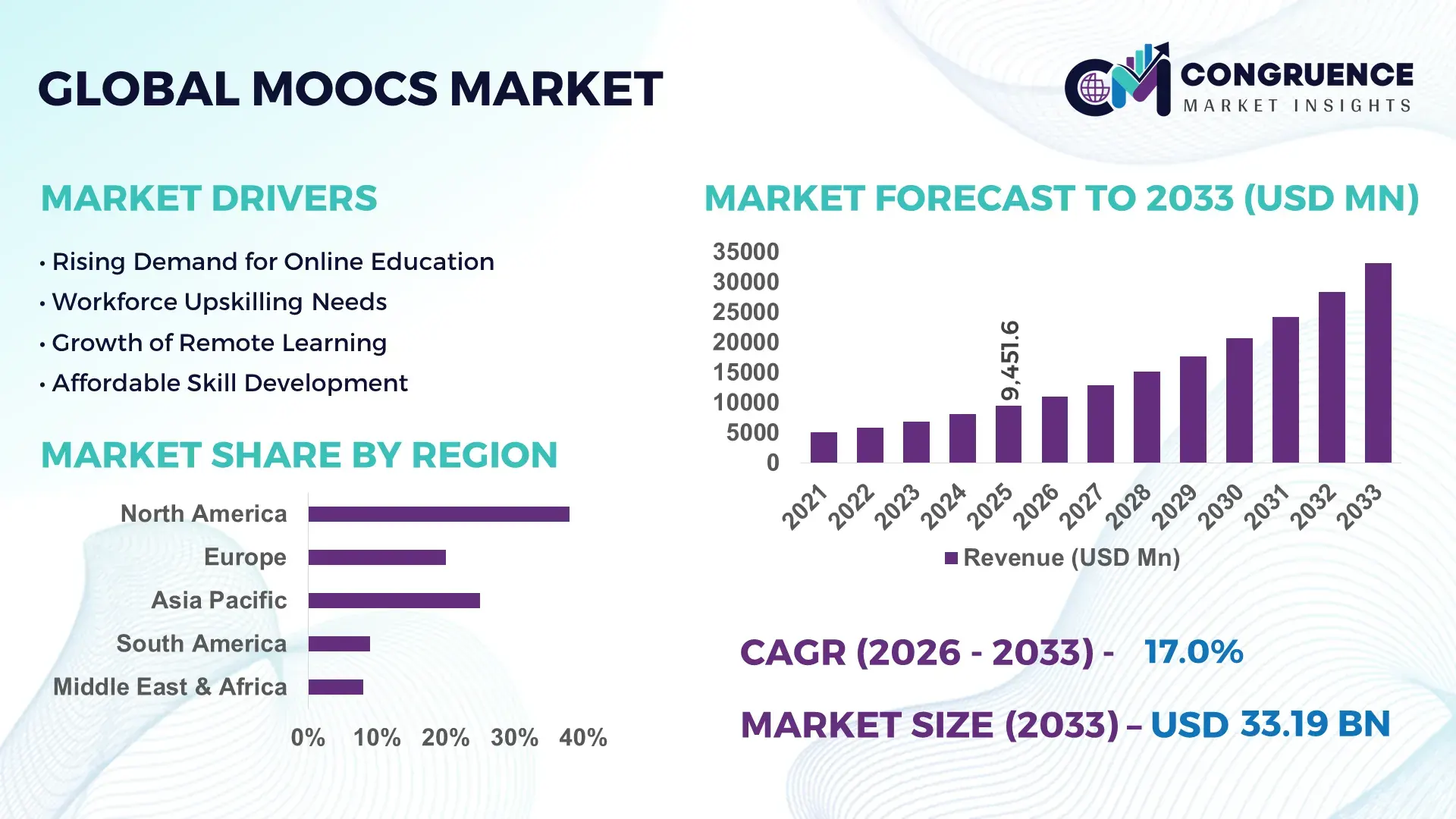
The United States dominates the MOOCs market, with over 2,500 active platforms supporting millions of learners annually. The country has invested approximately USD 1.8 Billion in MOOC infrastructure and technological development between 2022 and 2025, enabling advanced AI-driven personalized learning and automated assessment systems. Higher education institutions and corporate training sectors account for more than 60% of adoption, while emerging hybrid models integrate MOOCs into K-12 and professional certification programs. The U.S. market also demonstrates high regional penetration, with California, New York, and Texas contributing significant user bases and regional content customization. Key technological innovations include adaptive learning algorithms, mobile-first delivery, and cloud-based content management, fostering high scalability and user engagement.
Market Size & Growth: USD 9451.57 Million in 2025; projected USD 33188.74 Million by 2033; CAGR 17%; growth fueled by digital learning adoption
Top Growth Drivers: Digital adoption 72%, corporate training integration 65%, AI personalization 58%
Short-Term Forecast: By 2028, learner engagement expected to increase by 40%, course completion rates up 25%
Emerging Technologies: AI-driven adaptive learning, blockchain credentialing, cloud-based platform scalability
Regional Leaders: North America USD 12,500 Million, Europe USD 9,200 Million, Asia-Pacific USD 8,900 Million by 2033; unique regional adoption trends observed
Consumer/End-User Trends: High uptake among working professionals, students, and lifelong learners; preference for modular and micro-credential courses
Pilot or Case Example: 2024 AI-enabled corporate MOOC pilot reduced training downtime by 30% for a Fortune 500 company
Competitive Landscape: Coursera ~25% share, edX, Udemy, FutureLearn, Skillshare as major competitors
Regulatory & ESG Impact: Supportive educational policies, digital learning incentives, and sustainable content delivery initiatives driving adoption
Investment & Funding Patterns: USD 1.8 Billion invested recently; increasing venture capital in AI and personalized learning solutions
Innovation & Future Outlook: Integration of AI, AR/VR, and gamification expected to enhance engagement and accelerate MOOC expansion globally
The MOOCs market continues to transform education across multiple sectors, including higher education, professional certification, and corporate learning. Recent technological advances such as AI-based personalized learning paths, gamified modules, and blockchain-verified credentials have enhanced learner engagement and retention. Regional expansion is driven by localized content development, increased broadband penetration, and supportive regulatory frameworks promoting digital education. Emerging trends include hybrid learning models, micro-credentials, and cross-border collaborative courses, positioning MOOCs as a scalable, versatile solution for lifelong learning and workforce upskilling globally.
The MOOCs Market has emerged as a strategic lever for global education and workforce development, offering scalable, flexible, and cost-effective learning solutions. AI-driven adaptive learning delivers up to 35% improvement in learner engagement compared to traditional online courses. North America dominates in volume, while Asia-Pacific leads in adoption with over 60% of enterprises integrating MOOCs into employee training programs. By 2028, immersive AR/VR learning platforms are expected to improve knowledge retention by 25%, enhancing corporate and academic training outcomes. Firms are committing to ESG improvements such as a 30% reduction in paper-based resources and carbon footprint by 2030, aligning digital education with sustainable development goals. In 2025, Coursera implemented AI-powered skill assessments that achieved a 28% increase in completion rates across U.S. corporate clients. Strategic adoption of MOOCs enables institutions and corporations to maintain compliance with continuous learning mandates while reducing operational costs. Looking forward, the MOOCs Market is positioned as a pillar of resilience, compliance, and sustainable growth, integrating innovative technologies to enhance learning accessibility, improve workforce skills, and support global education initiatives.
Corporate and higher education adoption has accelerated MOOCs Market growth by integrating digital courses into professional and academic curricula. Over 65% of Fortune 500 companies now provide employees with access to MOOCs for skill development, increasing workforce proficiency and reducing training downtime by up to 30%. Universities are incorporating MOOCs into blended learning programs, reaching more than 12 million learners globally in 2025. AI-driven personalization enhances course completion rates, with adaptive modules improving engagement by 28% compared to static content. The market also benefits from government-supported digital education initiatives, promoting accessibility across urban and semi-urban regions. This growing institutional and corporate reliance on MOOCs reinforces its strategic role as a key platform for scalable and efficient learning delivery.
Limited internet access, infrastructure gaps, and technological disparities continue to restrain the MOOCs Market, particularly in emerging economies. Approximately 40% of rural populations in Asia-Pacific still experience suboptimal connectivity, reducing effective participation in online courses. Legacy Learning Management Systems (LMS) in certain institutions lack integration with AI-driven MOOC platforms, leading to inefficiencies and delayed adoption. In addition, data privacy concerns and compliance requirements regarding personal learner information pose regulatory hurdles for global platforms. These constraints limit the reach and effectiveness of MOOCs, affecting engagement levels, especially for learners requiring interactive and real-time content delivery. Addressing these gaps is essential to unlock broader adoption and fully leverage the market’s potential.
Corporate digital training represents a significant opportunity for the MOOCs Market, with enterprises increasingly investing in upskilling and reskilling programs. AI-based skill mapping and personalized learning pathways allow organizations to reduce training costs by up to 25% while enhancing workforce competency. Emerging sectors such as healthcare, IT, and renewable energy are leveraging MOOCs for rapid onboarding and certification of employees. Regional adoption trends show Europe focusing on compliance-driven training, while Asia-Pacific emphasizes workforce scalability and local language content. Additionally, hybrid models integrating MOOCs with in-person workshops open new revenue channels and adoption scenarios. These opportunities indicate that MOOCs can become a central tool for addressing evolving skill gaps in a technology-driven global economy.
Content quality, standardization, and accreditation challenges present obstacles to the MOOCs Market. Diverse course formats, inconsistent assessment mechanisms, and varying instructional standards reduce learner trust and engagement. In 2024, less than 60% of MOOCs in certain emerging markets met accreditation or professional certification requirements, limiting their applicability for career advancement. Regulatory compliance for cross-border digital education adds complexity, with multiple jurisdictions enforcing distinct data protection and intellectual property rules. Additionally, developing region-specific content with high pedagogical quality demands significant investment in AI, faculty expertise, and technology infrastructure. These challenges slow market penetration, affecting scalability, learner retention, and the long-term adoption of MOOCs as a credible alternative to traditional learning models.
• Growth of Micro-Credentials and Short Courses: The demand for micro-credentials and short courses is transforming the MOOCs market, with 62% of learners enrolling in courses under 12 weeks to enhance specific skills. Universities and corporate programs increasingly offer stackable certifications, improving employability and retention rates. In 2025, over 14 million learners globally completed micro-credential programs, with North America leading in enrollment and Asia-Pacific showing 48% annual adoption growth among corporate users.
• Integration of AI and Personalized Learning: AI-driven adaptive learning platforms are enhancing course completion rates by 28% compared to standard modules. Personalization algorithms analyze learner behavior to recommend targeted content, improving engagement and satisfaction. Over 70% of higher education institutions in Europe have implemented AI-enabled MOOCs by 2025, while corporate adoption in North America has reached 65%, leading to measurable efficiency gains in employee training programs.
• Mobile-First and Multi-Device Accessibility: Mobile learning has expanded access to MOOCs, with 57% of users accessing content via smartphones or tablets. Asia-Pacific dominates mobile engagement, with 60% of learners preferring app-based platforms. Multi-device integration enables seamless progress tracking and real-time collaboration, increasing active participation rates by 33% across global learners. The trend supports hybrid learning strategies, combining synchronous and asynchronous delivery models.
• Expansion of Corporate and Professional Training Programs: Corporations are increasingly integrating MOOCs into training frameworks, with 48% of enterprises deploying them for upskilling in technology, management, and compliance. In 2024, AI-enabled corporate MOOC programs reduced employee training downtime by 29%, while adoption in financial services and IT sectors reached 52% and 47%, respectively. Regional variations show Europe prioritizing regulatory compliance training, whereas North America emphasizes innovation and technical skill enhancement.
The MOOCs Market is segmented by type, application, and end-user, offering a structured view of adoption patterns and strategic opportunities. By type, courses are categorized into self-paced, instructor-led, and hybrid models, each tailored to different learning preferences. Applications include higher education, corporate training, professional certification, and lifelong learning programs, reflecting diverse institutional and organizational needs. End-users range from students and working professionals to enterprises and government agencies, highlighting broad adoption across sectors. Self-paced courses dominate engagement due to flexibility, while corporate training applications are growing rapidly, fueled by upskilling initiatives. Regional trends indicate North America leads in volume, whereas Asia-Pacific shows the highest rate of enterprise adoption. Insights into learner behavior, content preferences, and platform interaction inform targeted strategies for platform providers and institutional decision-makers, enhancing personalized learning experiences, improving skill alignment, and optimizing educational ROI.
Self-paced courses currently lead the MOOCs market, accounting for 48% of adoption due to their flexibility and ability to cater to diverse learner schedules. Instructor-led courses hold 30% of the market, valued for interactive engagement and direct mentorship. Hybrid models are the fastest-growing type, expected to surpass 25% adoption by 2033, driven by integration of live sessions with self-paced modules, increasing completion rates by 22%. Other niche types, including micro-credential bundles and skill-specific bootcamps, make up the remaining 12%, catering to specialized upskilling demands.
Higher education dominates the MOOCs market, comprising 42% of adoption, as universities increasingly integrate online courses into degree programs and supplementary learning tracks. Corporate training is the fastest-growing application, with 33% of enterprises now leveraging MOOCs for employee upskilling, digital compliance training, and management programs. Professional certification programs account for 18% of adoption, supporting credentialing across IT, healthcare, and finance, while lifelong learning initiatives cover the remaining 7%, providing modular courses for skill enhancement and personal development.
Students are the leading end-user segment, representing 50% of MOOCs adoption, attracted by flexible learning schedules, accreditation opportunities, and global course access. Corporate professionals constitute the fastest-growing segment, projected to exceed 35% adoption by 2033, driven by organizational upskilling programs, hybrid training models, and AI-personalized pathways. Other end-users, including government agencies, non-profits, and lifelong learners, collectively account for 15%, focusing on sector-specific compliance and continuous skill development. In top industries, IT shows 48% adoption, healthcare 42%, and finance 36%, reflecting high demand for digital learning solutions.
North America accounted for the largest market share at 38% in 2025, however, Asia-Pacific is expected to register the fastest growth, expanding at a CAGR of 18% between 2026 and 2033.
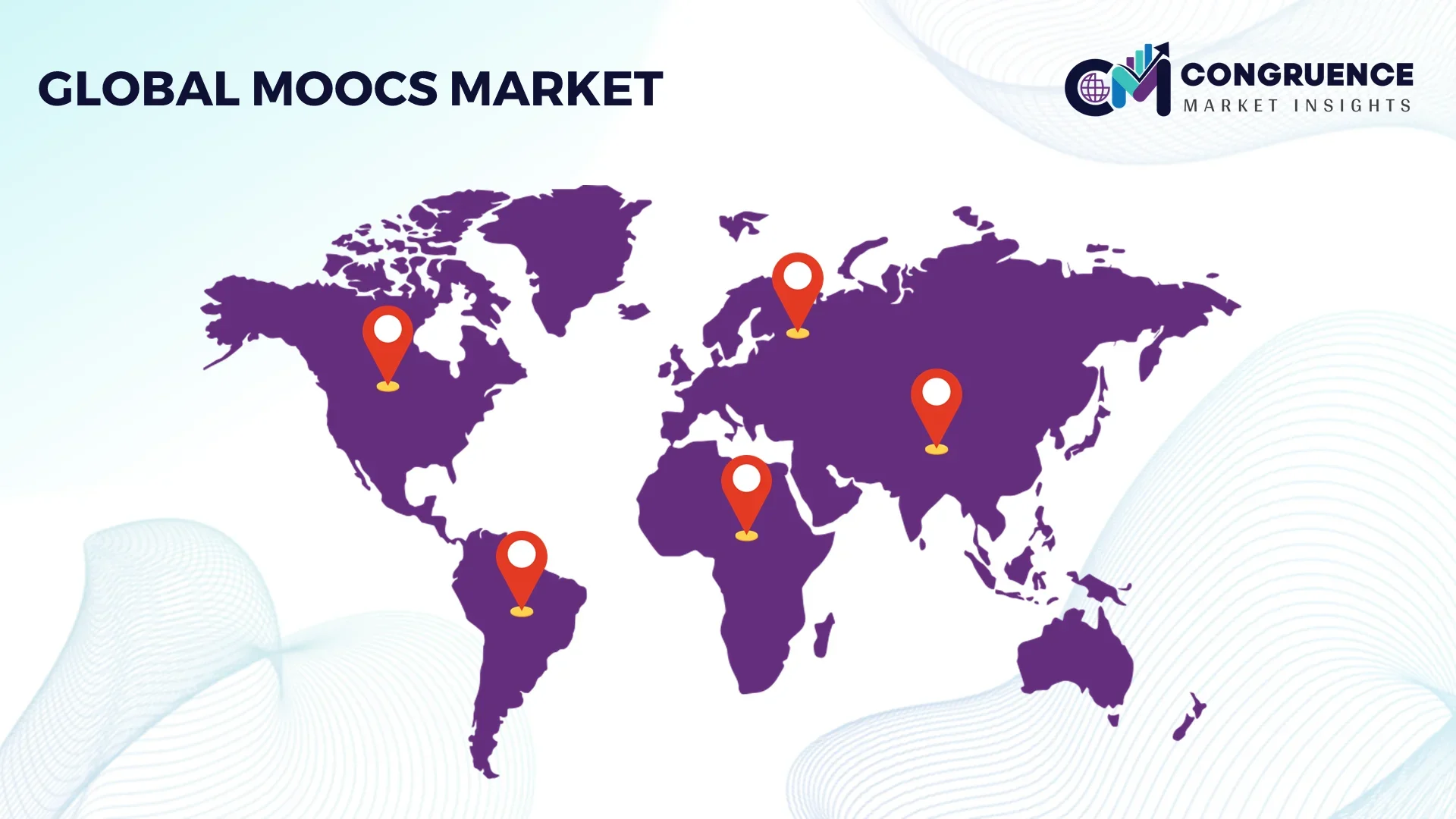
In 2025, North America had over 9.5 million active learners enrolled in MOOCs, while Asia-Pacific recorded more than 7.8 million. Europe contributed 25% of global adoption with 6.2 million users. South America and Middle East & Africa together held 12%, with Brazil and UAE leading adoption in their respective regions. North America shows higher enterprise integration in healthcare and finance sectors, while Asia-Pacific emphasizes mobile-first access and AI-driven learning. The combined learner population across all regions is projected to surpass 50 million by 2033, with significant growth in corporate and higher education adoption driving platform innovations and digital learning investments globally.
How are corporate and higher education platforms shaping advanced learning experiences?
North America accounts for 38% of the global MOOCs Market in 2025, driven by high adoption in healthcare, finance, and technology sectors. Government initiatives supporting digital learning and workforce upskilling have facilitated platform expansion, including funding for AI-enabled adaptive learning. Technological transformation trends such as cloud-based delivery, real-time analytics, and personalized learning paths are prominent. Platforms like Coursera and edX have partnered with major universities to provide hybrid and corporate programs, increasing completion rates by 28%. North American learners exhibit preference for flexible, mobile-accessible courses, with healthcare and finance sectors integrating MOOCs for compliance and professional certification. Enterprise adoption in these industries exceeds 65%, highlighting the strategic importance of North America in the global market.
What regulatory and technological initiatives are driving online learning adoption?
Europe holds 25% of the global MOOCs Market, with Germany, the UK, and France as leading contributors. Regulatory frameworks and sustainability initiatives encourage digital credentialing and lifelong learning programs. Emerging technologies, including AI-based adaptive learning, AR-enabled immersive content, and blockchain verification, are increasingly integrated into platforms. Local players such as FutureLearn collaborate with European universities to provide multilingual and accredited courses, reaching over 3 million learners in 2025. Regulatory pressure ensures demand for explainable and compliant course content. Regional consumer behavior favors structured learning paths and accreditation-focused programs, with a growing shift towards hybrid models combining digital and classroom engagement.
How is mobile-first and AI-driven learning transforming adoption in emerging markets?
Asia-Pacific ranks as the fastest-growing region in the MOOCs Market, accounting for 28% of global adoption in 2025. Top consuming countries include China, India, and Japan, where over 7.8 million learners enrolled in online courses. Infrastructure development and mobile broadband penetration are accelerating adoption, with AI-powered personalized learning tools integrated into educational and corporate platforms. Local players like XuetangX in China focus on scalable, language-specific courses with interactive modules. Regional consumer behavior is heavily mobile-driven, with 60% of learners preferring app-based access. Growth is supported by government incentives for digital education and corporate upskilling initiatives in technology, finance, and manufacturing sectors.
What strategies are driving digital learning adoption in emerging economies?
South America contributes 7% of the global MOOCs Market, led by Brazil and Argentina. The region’s adoption is influenced by expanding digital infrastructure and government incentives promoting e-learning in education and workforce training. Platforms offer localized content to address language diversity, improving engagement across urban and semi-urban areas. Local players, including Descomplica in Brazil, provide modular courses tailored for professional certification and university students, reaching over 1.2 million learners in 2025. Regional consumer behavior emphasizes media-rich courses and language accessibility, driving customized content development. The energy and education sectors are key contributors, supporting online training for operational efficiency and workforce development.
How are technology adoption and strategic investments shaping learning trends?
The Middle East & Africa represents 5% of the global MOOCs Market, with the UAE and South Africa leading adoption. Demand is driven by oil & gas, construction, and government workforce training initiatives. Technological modernization, including cloud-based delivery, AI-driven personalized learning, and mobile integration, supports growth. Local regulations encourage digital literacy programs and cross-border collaborations with international platforms. Regional players like Noon Academy in the UAE focus on interactive online courses and exam preparation for secondary and higher education learners. Consumer behavior varies, with learners preferring bilingual content, interactive modules, and mobile-first access, reflecting regional digital transformation and skill development priorities.
United States: 38% market share – Dominates due to high institutional adoption, strong corporate integration, and advanced digital learning infrastructure.
China: 22% market share – Leads adoption driven by large learner base, government support for digital education, and rapid integration of AI-powered mobile platforms.
The MOOCs Market is moderately fragmented, with over 2,500 active competitors globally, ranging from major platform providers to emerging niche players. The top five companies—Coursera, edX, Udemy, FutureLearn, and Skillshare—together account for approximately 62% of total market adoption, reflecting significant concentration in high-value segments such as higher education and corporate training. Strategic initiatives are shaping competitive dynamics, including Coursera’s partnerships with 200+ universities, Udemy’s expansion into enterprise training solutions serving 50,000 corporate clients, and FutureLearn’s multilingual course offerings targeting over 3 million European learners. Innovation trends such as AI-driven adaptive learning, AR/VR-enhanced immersive courses, blockchain credentialing, and mobile-first content delivery are differentiating market leaders from smaller providers. Over 45% of platforms have launched hybrid course formats combining live instruction with self-paced modules, while 38% are adopting data analytics for learner engagement optimization. Strategic mergers and acquisitions, particularly in Europe and North America, have accelerated platform consolidation and geographic expansion. Overall, competitive intensity is high, with continuous investment in technology, strategic alliances, and content diversification driving the market landscape.
The MOOCs Market is experiencing significant transformation driven by both current and emerging technologies that enhance scalability, engagement, and learner outcomes. AI-powered adaptive learning platforms are now integrated into over 70% of higher education and corporate MOOCs, delivering personalized content recommendations that improve course completion rates by up to 28%. Natural language processing (NLP) technologies enable automated grading, instant feedback, and multilingual content translation, supporting over 4 million active learners globally. Video analytics and interactive simulations are increasingly deployed, with 35% of platforms offering AR/VR-enhanced modules to create immersive learning environments that boost knowledge retention by 22%.
Cloud computing underpins platform scalability, enabling over 2,500 MOOCs providers worldwide to accommodate high-volume concurrent learners while maintaining minimal latency. Mobile-first technologies are critical in regions like Asia-Pacific, where 60% of learners access courses via smartphones, driving demand for responsive interfaces and app-based content delivery. Blockchain technology is being implemented for secure credentialing, digital certificates, and verification of learner achievements, with over 1.2 million certifications issued in 2025 across North America and Europe.
Emerging trends include gamification and microlearning modules, adopted by approximately 42% of platforms to enhance engagement for corporate and professional training programs. AI-powered chatbots are providing real-time support to 28% of learners, reducing dropout rates and improving retention. Additionally, predictive analytics tools are being used to assess learning behaviors and optimize course structure, enabling institutions and enterprises to enhance training efficiency and better align skills with organizational objectives. These technological innovations collectively position the MOOCs Market as a highly adaptable and data-driven segment in global education.
• In December 2025, Coursera and Udemy announced a definitive agreement to combine their platforms in an all‑stock merger valued at approximately USD 2.5 billion, aiming to create a consolidated, AI‑focused learning ecosystem addressing global workforce skills development, with completion expected by the second half of 2026.
• In Q1 2025, edX and IBM launched a new “AI for Everyone” program on the edX MOOC platform, offering foundational artificial intelligence courses to a global audience and expanding access to enterprise and professional learners.
• In 2024, FutureLearn secured USD 50 million in Series C funding to accelerate product innovation and expand its global course catalog, strengthening its competitive position in the international online learning landscape.
• In 2024, edX launched MicroBootCamps in partnership with leading universities, delivering short, intensive tech‑skill programs that reported rapid enrollment growth among professional learners seeking job‑aligned competencies.
The scope of the MOOCs Market Report encompasses an extensive analysis of the massive open online courses landscape, detailing segmentation across course types, applications, and end‑user groups. Course types examined include self‑paced offerings, instructor‑led programs, and hybrid models, with insights into enrollment volumes, engagement patterns, and emerging formats like micro‑credentials and bootcamps. The report also explores core application areas such as higher education, corporate training, continuous professional development, and lifelong learning initiatives, highlighting adoption rates and demand variations across sectors. Geographic coverage spans major regions including North America, Europe, Asia‑Pacific, South America, and Middle East & Africa, offering market volume data, regional consumption behavior, digital infrastructure trends, and regulatory influences in key countries like the United States, China, India, and Brazil.
The report includes insights into enabling technologies impacting the MOOCs market such as AI‑driven personalized learning engines, mobile‑first delivery platforms, cloud‑based scalability, and credentialing technologies like blockchain. Industry focus areas include technology upskilling, business management education, healthcare professional training, and compliance learning, each assessed for platform adoption and learner engagement. Sections on competitive landscape and innovation trends provide profiles of market leaders, strategic initiatives including partnerships, platform integrations, and product expansions. Additionally, the report addresses challenges such as content quality, infrastructure barriers, and multilingual content availability, while identifying opportunities in niche segments like immersive learning, adaptive micro‑learning, and enterprise‑aligned credential pathways. Overall, the scope supports decision‑makers with a comprehensive view of the MOOCs ecosystem’s breadth, technological evolution, and regional growth dynamics.
| Report Attribute/Metric | Report Details |
|---|---|
|
Market Revenue in 2025 |
USD V2025 Million |
|
Market Revenue in 2033 |
USD V2033 Million |
|
CAGR (2026 - 2033) |
17% |
|
Base Year |
2025 |
|
Forecast Period |
2026 - 2033 |
|
Historic Period |
2021 - 2025 |
|
Segments Covered |
By Types
By Application
By End-User
|
|
Key Report Deliverable |
Revenue Forecast, Growth Trends, Market Dynamics, Segmental Overview, Regional and Country-wise Analysis, Competition Landscape |
|
Region Covered |
North America, Europe, Asia-Pacific, South America, Middle East, Africa |
|
Key Players Analyzed |
Coursera, edX, Udemy, FutureLearn, Skillshare, Khan Academy, XuetangX, Swayam, Alison, iversity |
|
Customization & Pricing |
Available on Request (10% Customization is Free) |




