
Reports
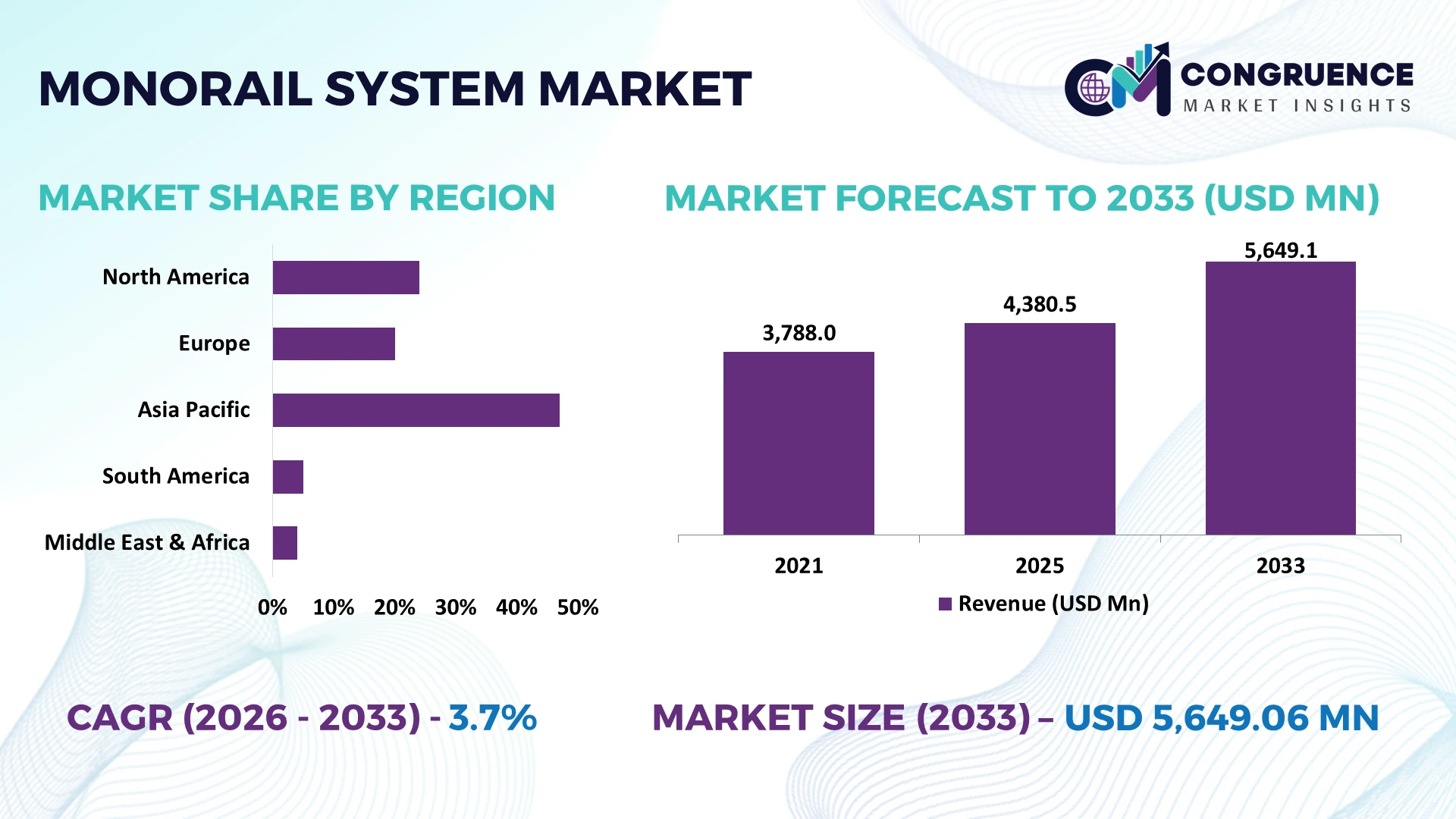
The Global Monorail System Market was valued at USD 4380.51 Million in 2025 and is anticipated to reach a value of USD 5649.06 Million by 2033 expanding at a CAGR of 3.7% between 2026 and 2033. Rapid urban transit modernization, automated train control integration, and government-backed investments in high-capacity public transportation corridors are accelerating deployment of advanced monorail systems across densely populated metropolitan regions.
China remains the dominant market, accounting for approximately 36% of global installed monorail capacity, supported by multi-billion-dollar urban rail investments and extensive smart city programs. Japan follows with nearly 22% capacity, leveraging advanced automation and reliability standards. Continued infrastructure spending across Asia aligns with post-pandemic mobility upgrades and regional transport resilience strategies, reinforcing long-term project execution and operational efficiency.
Organizations prioritizing scalable, automated, and energy-efficient urban transit infrastructure are positioned to secure stronger long-term competitiveness as metropolitan transportation investment accelerates.
Market Size & Growth: USD 4380.51 Million (2025) to USD 5649.06 Million (2033) at 3.7% CAGR, supported by advanced urban mobility projects and automated rail technologies.
Top Growth Drivers: Urbanization contributes nearly 42%, public infrastructure investment 34%, and smart transportation initiatives 24% of market expansion momentum.
Short-Term Forecast: By 2028, automated operations reduce maintenance costs by approximately 15% while improving network efficiency by nearly 18%.
Emerging Technologies: AI-based predictive maintenance, CBTC automation, and digital twin platforms improve asset utilization by over 20% across advanced transit networks.
Regional Leaders: Asia Pacific exceeds USD 2.6 Billion, Europe approaches USD 1.3 Billion, and North America surpasses USD 0.8 Billion, driven by metro expansion and sustainable transport programs.
Consumer/End-User Trends: More than 60% of new urban transit projects prioritize automated, low-emission monorail systems for high-density passenger movement.
Pilot/Case Example: A 2026 smart monorail modernization project improved operational punctuality by approximately 17% through AI-enabled monitoring and automated diagnostics.
Competitive Landscape: Top manufacturers collectively control about 48% market share, with Hitachi Rail, Alstom, CRRC, BYD, and Bombardier Transportation maintaining strong global project portfolios.
Regulatory & ESG Impact: Low-emission transport policies support over 30% higher investment allocation toward electric urban transit infrastructure and energy-efficient operations.
Investment & Funding: More than USD 8 Billion in infrastructure commitments strengthen regional expansion through strategic partnerships and integrated smart mobility projects.
Innovation & Future Outlook: Next-generation autonomous operations, lightweight composite structures, and cloud-connected fleet management accelerate high-growth urban transit transformation amid evolving global supply-chain diversification.
Growing investment in automated urban transportation, airport connectivity, and smart city infrastructure continues to strengthen demand for advanced monorail systems. AI-enabled maintenance platforms, lightweight vehicle designs, and digital signaling improve operational reliability, while over 40% of new transit planning incorporates intelligent mobility features. Ongoing localization of rail component manufacturing enhances project resilience, setting the stage for the following strategic market assessment.
The Monorail System Market has become strategically important as governments and transit authorities prioritize high-capacity urban mobility with lower land requirements and faster construction than conventional metro corridors. Infrastructure modernization, stricter urban emission targets, and digital traffic management are reshaping procurement strategies, while localized manufacturing and diversified component sourcing reduce exposure to global supply-chain disruptions. This transition is strengthening competition among engineering firms, rolling stock manufacturers, and systems integrators pursuing long-term infrastructure contracts.
Modern automated monorail systems equipped with AI-enabled predictive maintenance and communications-based train control achieve nearly 18% lower maintenance requirements and improve service availability by approximately 15% compared with conventional manually managed urban rail systems. China continues to lead large-scale deployment through integrated smart city investments, while Japan emphasizes technology refinement, operational reliability, and export-oriented engineering expertise. Over the next two to three years, digital fleet management adoption is expected to exceed 50% across newly commissioned projects, improving scheduling precision and asset utilization.
Airport connector projects and high-density urban corridors increasingly demonstrate faster passenger movement with reduced operational interruptions through advanced automation and real-time monitoring. Companies are expanding technology partnerships, investing in localized production, and integrating digital lifecycle services to strengthen contract competitiveness. Organizations capable of delivering scalable automation, lifecycle support, and resilient supply networks will secure stronger competitive positioning as urban transportation infrastructure continues to modernize.
Rapid urban expansion and congestion mitigation programs are accelerating adoption of advanced monorail systems across major metropolitan areas. More than 65% of newly planned urban mobility projects incorporate intelligent signaling, while automated train operations improve service reliability by approximately 20% and reduce energy consumption by nearly 12%. India and China continue expanding elevated transit corridors to minimize land acquisition constraints and construction disruption. This structural shift is encouraging manufacturers to strengthen local production, establish technology partnerships, and expand integrated engineering capabilities. A notable operational advantage is the growing preference for turnkey contracts combining rolling stock, signaling, maintenance, and digital monitoring, enabling companies to secure longer service agreements while improving project execution efficiency.
High capital requirements and interoperability challenges continue to constrain wider deployment, particularly in cities with aging transportation infrastructure. Civil construction accounts for nearly 55% of total project expenditure, while imported propulsion, signaling, and control components represent approximately 30% of specialized system costs. Several countries continue facing procurement delays because of lengthy approval processes and inconsistent technical standards. These constraints reduce project scalability and extend commissioning schedules. Companies are responding by increasing component localization, negotiating long-term supplier agreements, and standardizing modular system architectures that simplify integration with existing transport networks. Greater engineering standardization is becoming a decisive factor for improving implementation speed and controlling lifecycle costs.
Integration of AI-driven operations, cloud-based asset management, and digital twins is creating new commercial opportunities beyond infrastructure construction. Predictive maintenance reduces unexpected equipment failures by approximately 25%, while intelligent scheduling improves fleet utilization by nearly 18%. Singapore continues demonstrating advanced multimodal integration through unified mobility platforms, encouraging wider adoption of connected transit ecosystems. Companies are increasing investment in software capabilities, cybersecurity-enabled control systems, and collaborative innovation with technology providers. An emerging strategic opportunity lies in offering long-term digital operations and maintenance services, allowing suppliers to generate recurring value while helping transit authorities optimize operational performance and passenger experience.
Long-term deployment success depends on integrating advanced monorail systems with legacy transport infrastructure, digital control environments, and skilled operational teams. More than 40% of transit operators report shortages of specialized automation engineers, while cybersecurity incidents targeting critical transport infrastructure have increased by over 20% in recent years. Japan and several European industrial hubs continue strengthening operational resilience through workforce development and advanced security protocols. Companies must invest in secure software architecture, digital workforce training, and interoperable communication platforms to maintain reliable operations. Sustainable competitive advantage will increasingly depend on execution capability rather than equipment supply alone, particularly as intelligent transportation ecosystems become more interconnected.
AI-Driven Fleet Optimization AI-enabled predictive maintenance platforms now monitor over 70% of critical rolling-stock components, reducing unplanned service interruptions by nearly 22% and maintenance inspections by about 18%. Japan's rail technology providers are integrating cloud diagnostics with condition-based servicing, enabling operators to improve fleet availability while manufacturers expand digital service partnerships and lifecycle management offerings.
Localized Manufacturing Expansion Supply-chain resilience has become a procurement priority, with localized component sourcing increasing by approximately 28% since recent global logistics disruptions. India and China are strengthening domestic production of propulsion systems, control equipment, and structural assemblies, reducing lead times by nearly 20%. Companies are restructuring supplier networks, expanding regional manufacturing capacity, and securing long-term procurement agreements to stabilize project execution.
Integrated Smart Mobility Networks More than 55% of newly planned monorail projects now incorporate multimodal ticketing, intelligent traffic coordination, and centralized operation centers. Urban mobility regulations encouraging connected transportation ecosystems are accelerating deployment of interoperable digital platforms. Technology firms and rail manufacturers are forming strategic alliances to integrate passenger analytics, automated scheduling, and real-time network management, improving operational efficiency and commuter experience.
Energy-Efficient System Engineering Lightweight vehicle structures, regenerative braking, and advanced power management technologies reduce electricity consumption by approximately 15% while lowering lifecycle operating costs by nearly 12%. Sustainability-focused procurement policies are influencing infrastructure investment decisions, encouraging manufacturers to accelerate composite material development, optimize vehicle design, and expand engineering collaborations focused on environmentally efficient transit systems.
Straddle Monorail remains the leading segment, accounting for approximately 46% of total deployments due to proven operational stability, high passenger capacity, and compatibility with dense urban corridors. Its mature engineering ecosystem, lower maintenance complexity, and extensive deployment history continue supporting long-term procurement across China, Japan, and India. Suspended Monorail maintains strategic relevance for constrained urban environments where limited ground clearance and difficult terrain favor elevated suspended designs, representing nearly 18% of installations.
Automated Monorail is the fastest-growing segment as transit authorities prioritize driverless operations, intelligent traffic management, and lower operating costs. More than 52% of newly planned metropolitan projects now evaluate automation-ready platforms, while digital monitoring improves operational efficiency by approximately 16%. Maglev Monorail continues expanding in premium, high-speed transit applications where superior ride quality and reduced mechanical wear justify higher infrastructure investment. Manufacturers are accelerating automation software development, strengthening technology partnerships, and introducing modular vehicle platforms to address evolving procurement priorities across both mature and emerging transit markets.
Urban Transit dominates the application landscape with approximately 63% of total demand, supported by increasing metropolitan congestion, smart city investments, and long-term public transportation modernization. Elevated guideway infrastructure minimizes land acquisition challenges while improving passenger movement across densely populated corridors. Airport Transit represents the fastest-growing application as international airport expansions prioritize seamless terminal connectivity, automated passenger movement, and reliable scheduling. Nearly 35% of major airport infrastructure upgrades now include evaluation of automated people-mover or monorail technologies.
Theme Parks continue investing in monorail systems to improve visitor circulation and reduce internal traffic congestion, while Industrial Transport gains momentum across large manufacturing complexes requiring efficient personnel movement. Automated fleet management and intelligent scheduling improve operational efficiency by approximately 17%, encouraging operators to integrate digital control systems. Companies are expanding specialized product portfolios, strengthening airport partnerships, and developing application-specific engineering solutions to address increasingly diverse operational requirements.
Public Transit Authorities remain the dominant end-user group, representing approximately 61% of procurement activity due to extensive responsibility for metropolitan mobility, infrastructure modernization, and long-term transportation planning. Large-scale government-backed transit initiatives continue driving demand for integrated signaling, rolling stock, and maintenance solutions. Airport Operators represent the fastest-growing buyer segment as terminal expansion, passenger experience improvement, and automated mobility become central investment priorities. More than 30% of new airport infrastructure projects include advanced transit integration during early planning stages.
Industrial Facilities are increasingly adopting monorail systems for internal logistics and workforce transportation across large production campuses, while Amusement Parks continue upgrading visitor transportation through automated operations and digital passenger management. Companies are responding by offering customized turnkey solutions, flexible maintenance contracts, and integrated digital platforms tailored to individual operational requirements. Strategic partnerships with infrastructure developers and engineering firms are becoming increasingly important as procurement decisions emphasize lifecycle performance rather than standalone equipment acquisition.
Asia-Pacific accounted for the largest market share at 49.2% in 2025 however, Middle East & Africa is expected to register the fastest growth, expanding at a CAGR of 4.9% between 2026 and 2033.

Airport Connectivity and Smart Transit Modernization
North America maintains a strong position through airport transit modernization, urban mobility upgrades, and increasing deployment of automated transportation systems. The region contributes approximately 18% of global market activity, supported by established engineering capabilities and advanced signaling technologies. Airport people-mover upgrades, smart infrastructure investments, and digital asset management platforms continue improving operational performance. More than 45% of recent transit modernization initiatives include intelligent monitoring and predictive maintenance capabilities. Engineering companies are expanding long-term maintenance partnerships while integrating cybersecurity, AI-enabled diagnostics, and cloud-based fleet management to strengthen lifecycle service offerings and improve operational reliability across high-capacity transit corridors.
United States Market Outlook: The United States leads regional deployment through airport transportation systems, entertainment destinations, and urban mobility modernization projects. More than 60% of North America's advanced automated transit installations are concentrated in the country, supported by infrastructure renewal programs and strong engineering expertise. Transit operators continue prioritizing digital signaling, predictive maintenance, and integrated operational control systems to improve reliability while technology providers expand service agreements and modernization partnerships.
Sustainable Infrastructure Drives Modernization
Europe represents approximately 21% of global market activity, driven by low-emission transportation policies, urban mobility transformation, and advanced rail engineering capabilities. Infrastructure modernization programs increasingly emphasize energy-efficient transit systems integrated with digital traffic management and multimodal mobility platforms. Around 40% of newly evaluated urban mobility initiatives include automated rail technologies to improve operational efficiency and environmental performance. Equipment suppliers continue strengthening partnerships with infrastructure developers while expanding modular signaling, lightweight vehicle engineering, and lifecycle maintenance services aligned with evolving sustainability objectives.
Germany Market Outlook: Germany remains the region's strategic technology leader through advanced rail engineering, industrial automation expertise, and intelligent transportation innovation. More than 35% of regional railway technology development projects involve German engineering companies supplying digital control, propulsion, and safety systems. Manufacturers continue investing in automation software, energy-efficient mobility technologies, and export-focused engineering capabilities supporting both domestic modernization and international infrastructure projects.
Large-Scale Urban Deployment Leadership
Asia-Pacific accounts for nearly half of global deployment, supported by extensive metropolitan expansion, high-density urbanization, and government-backed infrastructure investment. China, Japan, India, and Southeast Asian economies continue expanding elevated transit corridors to reduce congestion and improve passenger mobility. Nearly 68% of ongoing global monorail construction projects are concentrated within the region, reflecting unmatched deployment scale. Manufacturers are strengthening localized production, increasing automation capabilities, and expanding digital monitoring solutions while infrastructure developers prioritize integrated smart city transportation networks with long-term operational efficiency.
China Market Outlook: China dominates global monorail deployment through large-scale urban infrastructure development, advanced manufacturing capacity, and integrated smart transportation planning. Approximately 36% of worldwide installed monorail capacity operates within China, supported by domestic rolling stock production and intelligent signaling technologies. National infrastructure programs continue encouraging localized innovation, enabling manufacturers to accelerate deployment timelines while strengthening export competitiveness across international urban transit projects.
Urban Mobility Investment Momentum
South America is steadily expanding monorail adoption through metropolitan transportation upgrades and congestion reduction initiatives, representing approximately 6% of global deployment activity. Governments increasingly evaluate elevated transit systems where conventional metro construction presents financial or geographical constraints. More than 30% of planned urban mobility projects now assess automated elevated transport alternatives for high-density corridors. Project execution remains influenced by financing availability and infrastructure planning timelines, encouraging engineering firms to develop phased implementation models, localized partnerships, and cost-efficient construction strategies that improve investment feasibility.
Brazil Market Outlook: Brazil leads regional adoption through large metropolitan transportation initiatives and airport infrastructure modernization. The country's largest urban centers continue evaluating automated elevated transit solutions to improve commuter mobility while reducing construction disruption. Infrastructure developers increasingly collaborate with international engineering companies, supporting technology transfer, digital operations, and efficient project delivery for complex transportation corridors.
Mega Infrastructure Investment Expansion
Middle East & Africa is emerging as the fastest-evolving regional market, driven by integrated smart city developments, tourism infrastructure, and diversified transportation investment strategies. The region contributes approximately 9% of global deployment while maintaining one of the strongest project pipelines. More than 50% of planned large-scale mobility developments incorporate intelligent transportation technologies, including automated monorail integration. International engineering companies are forming strategic alliances with regional infrastructure developers, accelerating deployment of digital control systems, energy-efficient vehicles, and long-term maintenance solutions supporting rapidly expanding urban environments.
United Arab Emirates Market Outlook: The United Arab Emirates leads regional innovation through large-scale smart city initiatives, airport expansion, and tourism-focused transportation infrastructure. Automated mobility systems are increasingly integrated into mixed-use developments and major transport hubs, supported by advanced digital operations. Public-private partnerships continue accelerating technology deployment while international suppliers establish regional engineering, maintenance, and operations centers to support long-term infrastructure performance.
The market is led by Hitachi Rail, Alstom, CRRC, Siemens Mobility, and BYD, competing directly with regional engineering specialists and integrated infrastructure contractors for large urban transit projects. The top five players collectively control approximately 48% of global market activity through technology leadership, turnkey delivery capability, and long-term maintenance contracts. Competition increasingly centers on automation, lifecycle cost optimization, and digital operations, with AI-enabled maintenance reducing service costs by nearly 18% and modular vehicle platforms shortening deployment schedules by about 15%. Leading manufacturers strengthen competitiveness through localized production, strategic partnerships, vertical integration, and integrated signaling solutions, while regional suppliers compete on project customization and faster execution. The competitive landscape is shifting toward software-enabled mobility, digital asset management, and resilient supply chains rather than equipment alone. High certification requirements, infrastructure expertise, and system integration capabilities remain major entry barriers. Sustainable success depends on delivering complete, intelligent transit ecosystems with proven operational performance and dependable lifecycle support.
Hitachi Rail
Alstom
CRRC Corporation Limited
Siemens Mobility
BYD Company Limited
Bombardier Transportation
CAF (Construcciones y Auxiliar de Ferrocarriles)
Mitsubishi Heavy Industries
Scomi Engineering Berhad
Intamin Transportation Ltd.
Thales Group
Wabtec Corporation
Toshiba Infrastructure Systems & Solutions Corporation
Hyundai Rotem Company
Digital automation is redefining monorail operations through AI-based predictive maintenance, communications-based train control (CBTC), and cloud-enabled fleet management. More than 55% of newly specified urban monorail projects incorporate intelligent monitoring platforms, reducing unplanned maintenance events by approximately 22% while improving fleet availability by nearly 18%. Operators benefit from continuous asset visibility, faster fault detection, and optimized maintenance scheduling, creating measurable operational advantages for infrastructure authorities and system integrators managing high-capacity transit networks.
The technology transition is shifting from conventional fixed-interval maintenance and manually supervised operations toward autonomous diagnostics, digital twins, and condition-based servicing. Compared with legacy maintenance models, AI-enabled monitoring lowers lifecycle maintenance costs by about 16% while improving operational efficiency by approximately 20%. Lightweight composite vehicle structures and regenerative braking further reduce energy consumption by nearly 15%. Global manufacturers, digital engineering firms, and signaling specialists gain the strongest competitive advantage by integrating software, rolling stock, and lifecycle services into unified transportation platforms rather than supplying standalone equipment.
Between 2026 and 2028, intelligent interoperability will become the defining competitive differentiator as automated operations, cybersecurity, and real-time passenger analytics converge within integrated mobility ecosystems. Nearly 60% of upcoming metropolitan transit procurements are expected to prioritize digitally connected operations over conventional infrastructure specifications. Companies investing now in AI software, secure communications, and modular automation architectures will accelerate deployment, strengthen long-term maintenance contracts, and improve operational resilience while establishing stronger competitive positioning in future urban transportation programs.
May 2026 Alstom commenced commercial service of the East of Nile Monorail in Cairo, placing 16 of 22 stations into passenger operation across the 56 km corridor, strengthening urban connectivity and validating large-scale monorail deployment.
September 2024 Alstom confirmed production of 272 Innovia monorail cars at its Derby facility for Cairo's network, reinforcing UK manufacturing capability and export competitiveness while supporting one of the world's largest monorail programs.
February 2025 Hitachi Rail secured the San Francisco Muni signaling modernization program covering approximately 160 million annual passenger journeys, deploying advanced CBTC technology to increase network capacity, operational reliability, and digital rail performance.
June 2026 Hitachi Rail and PESA announced a strategic partnership to develop advanced rail technologies and localized rolling-stock production in Poland, establishing a regional center of excellence that strengthens technology transfer and European manufacturing capability. Source:https://www.hitachi.com/
This report provides comprehensive analysis of the global Monorail System Market across Straddle Monorail, Suspended Monorail, Automated Monorail, and Maglev Monorail technologies, covering Urban Transit, Airport Transit, Theme Parks, and Industrial Transport applications alongside Public Transit Authorities, Airport Operators, Industrial Facilities, and Amusement Parks. It evaluates deployment patterns, technology adoption, competitive positioning, digital transformation, and regional infrastructure strategies across North America, Europe, Asia-Pacific, South America, and the Middle East & Africa. More than 45% of current deployment activity is concentrated in high-density metropolitan transportation programs emphasizing intelligent automation.
The study examines manufacturing trends, AI-enabled operations, predictive maintenance, advanced signaling, digital asset management, and integrated mobility ecosystems shaping industry evolution between 2026 and 2033. It delivers strategic assessment of competitive dynamics, regional investment priorities, operational modernization, emerging deployment opportunities, and niche application areas, enabling stakeholders to strengthen expansion planning, procurement strategies, partnership decisions, technology selection, and long-term competitive positioning within the evolving global urban transportation landscape.
| Report Attribute/Metric | Report Details |
|---|---|
Market Revenue in 2025 | USD 4380.51 Million |
Market Revenue in 2033 | USD 5649.06 Million |
CAGR (2026 - 2033) | 3.7% |
Base Year | 2025 |
Forecast Period | 2026 - 2033 |
Historic Period | 2021 - 2025 |
Segments Covered | By Type
By Application
By End-User
|
Key Report Deliverable | Revenue Forecast, Growth Trends, Market Dynamics, Segmental Overview, Regional and Country-wise Analysis, Competition Landscape |
Region Covered | North America, Europe, Asia-Pacific, South America, Middle East, Africa |
Key Players Analyzed | Hitachi Rail, Alstom, CRRC Corporation Limited, Siemens Mobility, BYD Company Limited, Bombardier Transportation, CAF (Construcciones y Auxiliar de Ferrocarriles), Mitsubishi Heavy Industries, Scomi Engineering Berhad, Intamin Transportation Ltd., Thales Group, Wabtec Corporation, Toshiba Infrastructure Systems & Solutions Corporation, Hyundai Rotem Company |
Customization & Pricing | Available on Request (10% Customization is Free) |




