
Reports
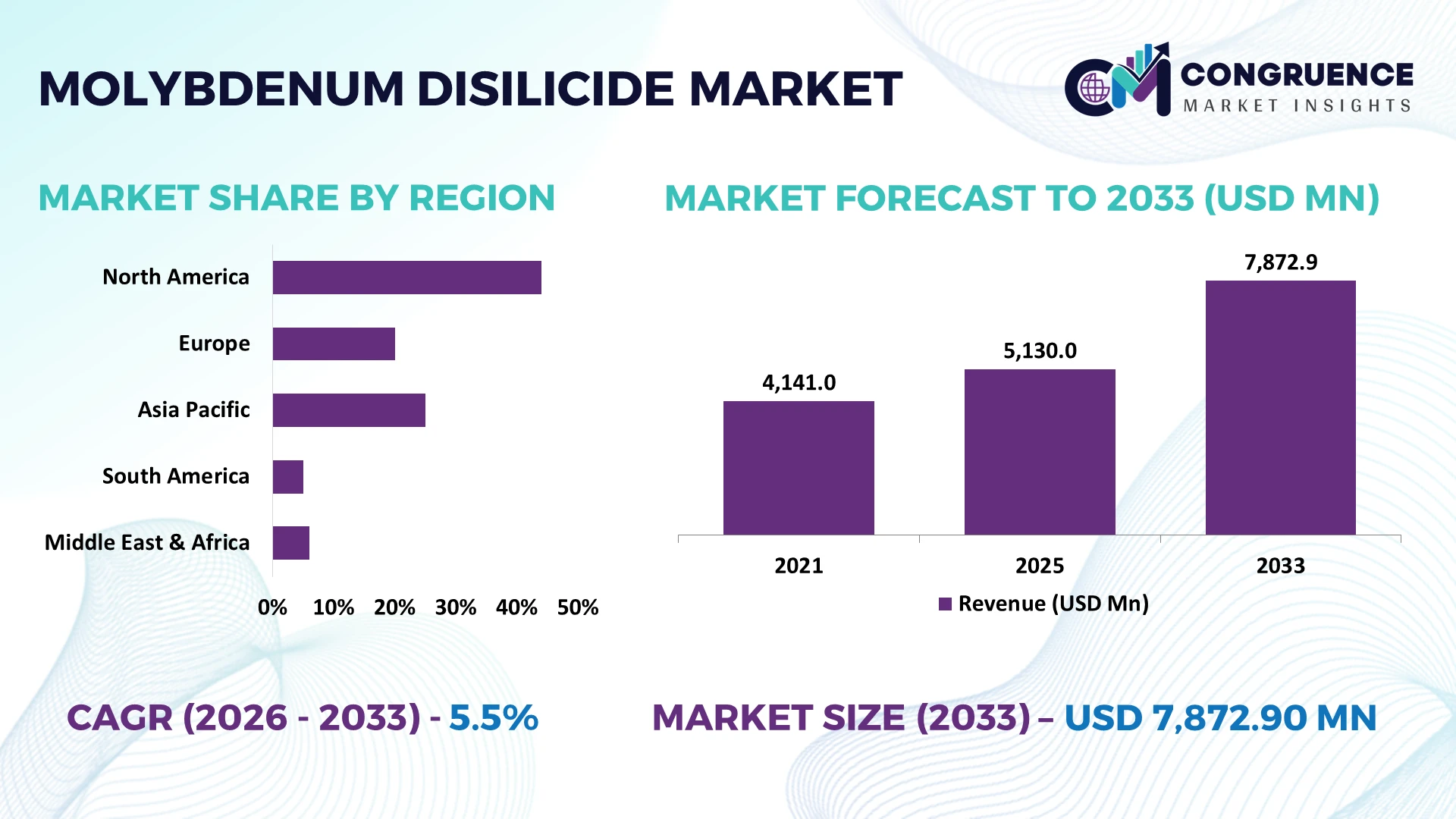
The Global Molybdenum Disilicide Market was valued at USD 5130 Million in 2025 and is anticipated to reach a value of USD 7872.9 Million by 2033 expanding at a CAGR of 5.5% between 2026 and 2033. Growth is driven by industrial furnace electrification, semiconductor-grade ceramic sintering, advanced glass manufacturing, and adoption of oxidation-resistant heating elements operating at temperatures up to 1,850°C.
China holds a strategically dominant position in the global molybdenum supply chain, accounting for approximately 34.6% of global molybdenum mine production in 2025, equivalent to 90,200 metric tons. Chile followed with 16.6%, highlighting China's substantial upstream resource advantage. Its established ceramics, electronics, metallurgical processing, and industrial furnace manufacturing industries strengthen domestic molybdenum disilicide applications. China's February 2025 export controls on molybdenum powders further increased international attention toward supply security, encouraging furnace manufacturers to diversify sourcing and strengthen relationships with regional material processors.
For manufacturers and investors, securing high-purity molybdenum feedstock and developing advanced MoSi₂ heating solutions represent critical priorities for strengthening supply resilience and industrial competitiveness.
Market Size & Growth: Valued at USD 5130 Million in 2025, projected to USD 7872.9 Million by 2033 at 5.5% CAGR, driven by industrial electrification above 1000°C .
Top Growth Drivers: Industrial process heat electrification reaching 3% of EU industrial heat, semiconductor interconnect demand, and high-temperature furnace replacement cycles.
Short-Term Forecast: By 2027, SiBCN-reinforced MoSi2 composite elements achieve commercial deployment in steel reheat furnaces, overcoming creep limitations that restrict horizontal mounting at 1250°C .
Emerging Technologies: Functionally graded MoSi2-SiC architectures decoupling resistivity from mechanical fragility, Al2O3-reinforced composites doubling room-temperature resistivity, and additive manufacturing for graded heating profiles .
Regional Leaders: China at 42% capacity share with Henan and Jiangsu clusters, United States advancing steel electrification through INL research, and Europe driven by Kanthal and SCHUPP in furnace applications .
Consumer/End-User Trends: Heating elements command dominant application share; semiconductor and microelectronics represent fastest-growing segment through interconnect and diffusion-barrier applications .
Pilot/Case Example: Idaho National Laboratory (2026) developing MoSi2 composite heating elements with SiBCN ceramic reinforcements for steel reheat furnace electrification, targeting yield improvements by eliminating scale formation .
Competitive Landscape: Kanthal, I Squared R, ZIRCAR, American Elements, and SCHUPP lead; Chinese manufacturers including Zhengzhou Chida and Shanghai Caixing compete on cost and regional supply .
Regulatory & ESG Impact: EU industrial electrification targets and carbon pricing drive furnace conversion; MoSi2’s 90% electric heating efficiency and elimination of NOx/SOx emissions support compliance .
Investment & Funding: DOE Advanced Manufacturing Office funding INL composite research; private investment targets high-temperature electrification solutions for steel and cement decarbonization .
Innovation & Future Outlook: Composite architectures and functionally graded materials represent decisive pathways for overcoming resistivity and creep limitations, enabling electrification of the hardest-to-abate industrial heat segments .
The global Molybdenum Disilicide Market is benefiting from growing adoption of high-performance ceramic heating elements across semiconductor fabrication, technical ceramics, laboratory furnaces, and specialty glass processing. Advanced molybdenum disilicide grades combine electrical conductivity with oxidation resistance, enabling continuous thermal operations at temperatures approaching 1,850°C. Compared with conventional 1,700°C elements, higher-temperature grades provide approximately 8.8% greater operating temperature capability. Manufacturers are also developing atmosphere-compatible elements and customized geometries for specialized furnace configurations. China's molybdenum export restrictions have strengthened the importance of diversified sourcing, making material purity, component durability, and supply-chain integration central to strategic investment decisions.
The global Molybdenum Disilicide Market is becoming strategically important as precision manufacturing increasingly requires high-temperature electrical heating, oxidation resistance, and consistent thermal performance. Semiconductor processing, engineered ceramics, and specialty glass production are accelerating the transition toward advanced resistance heating systems. China's February 2025 molybdenum export restrictions have also reshaped procurement strategies, encouraging manufacturers to diversify raw-material sourcing and strengthen domestic processing capabilities.
Technological differentiation increasingly determines equipment competitiveness. Advanced MoSi₂ heating elements withstand temperatures reaching 1,850°C, approximately 8.8% higher than conventional 1,700°C grades, enabling more demanding sintering applications without exceeding element temperature specifications. China's extensive molybdenum production infrastructure supports integrated manufacturing, while Germany and Japan emphasize high-purity materials, precision furnace engineering, and specialized industrial applications. Manufacturers are investing in programmable power controllers, improved element geometries, and thermal monitoring technologies to strengthen operating reliability.
Between 2026 and 2028, procurement priorities will increasingly favor atmosphere-compatible heating systems, automated temperature management, and longer service intervals. In technical ceramic production, MoSi₂ elements operating above 1,600°C support advanced sintering processes requiring controlled thermal profiles. Suppliers are expanding application engineering capabilities and collaborating with furnace manufacturers to improve system compatibility. Competitive advantage will depend on reliable material access, specialized heating performance, and lower lifecycle maintenance requirements.
Industrial furnace electrification is strengthening demand for molybdenum disilicide heating elements across technical ceramics, semiconductor materials, and specialty glass manufacturing. Global molybdenum mine production increased approximately 2% in 2025, supporting expanding industrial material requirements. Advanced MoSi₂ elements rated at 1,800°C provide 5.9% higher maximum temperature capability than conventional 1,700°C grades, while specialized 1,850°C elements extend that advantage to 8.8%. Germany's industrial decarbonization initiatives are encouraging manufacturers to evaluate electric heating alternatives for high-temperature processing. Furnace suppliers are responding through advanced element engineering, programmable heating controls, and integrated thermal management solutions. The commercial advantage lies in enabling demanding production cycles while improving temperature consistency and reducing dependence on combustion-based heating infrastructure.
Concentrated molybdenum production and trade restrictions create structural procurement challenges for molybdenum disilicide manufacturers. China supplied approximately 34.6% of global molybdenum mine output in 2025, while Chile contributed 15%, demonstrating the importance of a limited number of producing countries. China's production declined 3% from 2024 levels, increasing attention toward alternative supply arrangements. Export licensing requirements introduced in February 2025 added administrative complexity for affected molybdenum products. These conditions expose heating-element producers to uncertain lead times, inventory costs, and procurement constraints. Manufacturers are strengthening supplier qualification programs, negotiating longer-duration purchasing agreements, and evaluating processing partnerships in the United States and Chile. Securing consistent feedstock purity is essential for protecting manufacturing yields and contractual delivery performance.
Specialized MoSi₂ formulations are creating opportunities in controlled-atmosphere furnaces, electronic ceramics, and advanced material processing. Kanthal Super ER elements operate at temperatures reaching 1,580°C across oxidizing, inert, and reducing environments, enabling multiple thermal processes within compatible furnace configurations. Super HT elements achieve 1,830°C, offering approximately 7.6% greater temperature capability than standard 1,700°C grades. Meanwhile, Super 1900 provides an additional 1.1% operating-temperature advantage over 1,830°C technology. Japan's precision ceramics industry presents opportunities for customized heating geometries, contamination-sensitive processing, and automated thermal control. Manufacturers are positioning through advanced materials research, furnace OEM partnerships, and application-specific element development. Integrated heating solutions create differentiation through process flexibility, equipment utilization, and reduced requirements for dedicated furnace configurations.
Maintaining heating-element durability across repeated thermal cycles presents a significant engineering challenge for molybdenum disilicide suppliers. Standard 1,700°C elements and advanced 1,850°C grades differ by 8.8% in maximum temperature capability, requiring careful matching of operating conditions, insulation, and electrical systems. Specialized atmosphere-compatible elements rated at 1,580°C have approximately 14.6% lower maximum temperature capability than 1,850°C grades, illustrating important application trade-offs. Indian ceramics manufacturers upgrading existing furnaces must address transformer sizing, element positioning, thermal expansion, and process atmosphere compatibility. Inappropriate operating conditions accelerate mechanical damage and increase replacement requirements. Suppliers are developing improved element supports, programmable power regulation, and maintenance protocols. Long-term competitiveness depends on reliable installation engineering, skilled technical support, and consistent heating performance across industrial production cycles.
Higher Temperature Grade Standardization: Industrial buyers are increasingly selecting MoSi₂ elements based on certified temperature ratings rather than material composition alone. Commercial grades support 1,700°C, 1,800°C, and 1,850°C operation, providing respective capability increases of 5.9% and 8.8% over baseline elements. Swedish supplier Kanthal differentiates its product portfolio through temperature-specific formulations, helping furnace manufacturers standardize component selection and reduce specification mismatches during equipment procurement.
Semiconductor Equipment Localization Accelerates: Semiconductor manufacturing equipment investment increased 15% during 2025, while wafer processing equipment expanded 12% and advanced packaging equipment grew 21%. Taiwan and South Korea are strengthening manufacturing infrastructure around advanced memory and chipmaking technologies. Thermal equipment suppliers are responding through localized engineering support, tighter contamination-control specifications, and qualification partnerships, improving access to precision heating applications.
Modular Heating Assembly Adoption Expands: Furnace manufacturers are shifting toward replaceable heating assemblies and application-specific element configurations. U-shaped, W-shaped, and straight MoSi₂ components accommodate different chamber geometries, while available temperature classifications span 150°C between standard 1,700°C and advanced 1,850°C grades. Equipment builders are integrating modular mounting arrangements and standardized electrical connections to simplify maintenance and reduce equipment modification requirements.
Thermal Monitoring Becomes Procurement Priority: Industrial customers increasingly combine resistance heating elements with programmable power controllers, thermocouples, and automated fault detection. Semiconductor test equipment investment expanded 55% in 2025, reflecting increasing precision requirements across electronics manufacturing. Suppliers are incorporating multi-zone temperature monitoring and digital maintenance records into furnace packages, enabling better thermal traceability, earlier identification of element deterioration, and more predictable servicing.
Heating Elements represent the leading product category in the Molybdenum Disilicide Market, with an indicative share approaching 68.8% in published MoSi₂ product segmentation. Their dominance reflects standardized manufacturing, compatibility with industrial electric furnaces, and recurring replacement requirements. Commercial elements rated between 1,700°C and 1,850°C support multiple thermal processing specifications. Powder serves as an essential input for powder metallurgy, reaction sintering, and specialized component fabrication. Rods remain commercially important where established furnace designs require straightforward installation and predictable resistance characteristics.
Custom-Shaped Components represent an important emerging category as manufacturers increasingly require complex element geometries for specialized heating chambers. U-shaped, W-shaped, and multi-leg configurations enable manufacturers to accommodate different thermal zones and installation constraints. Strips support selected compact heating assemblies and specialized thermal engineering requirements. Higher-temperature products rated at 1,850°C offer approximately 8.8% greater maximum temperature capability than standard 1,700°C elements. Suppliers including Kanthal and I Squared R Element are concentrating on product differentiation, dimensional customization, and specialized material formulations. Investment priorities increasingly favor precision fabrication capabilities, application engineering, and collaborative development with industrial furnace manufacturers.
High-Temperature Furnaces represent the dominant application segment, accounting for approximately 76% of the specialized MoSi₂ heating-element application market in industry segmentation estimates. Their leadership reflects continuous equipment utilization, high thermal loads, and established replacement demand from industrial processing facilities. Heating systems operating between 1,600°C and 1,850°C support advanced material production requiring consistent temperature distribution. Ceramic Sintering represents another significant application, particularly in technical ceramics and precision component manufacturing. Glass Manufacturing relies on oxidation-resistant elements for specialized thermal operations, while Heat Treatment remains important for metallurgical processing and controlled material modification.
Semiconductor Processing is emerging as the fastest-growing application opportunity, supported by increasingly sophisticated electronic materials and thermal processing requirements. Semiconductor wafer fabrication equipment investment is projected to increase 23.1% in 2026, strengthening demand for specialized thermal engineering. Laboratory Furnaces continue supporting materials qualification and experimental high-temperature processing. Kanthal and other specialized suppliers are responding through high-purity element development, furnace integration support, and tailored heating configurations. Competitive differentiation increasingly depends on application-specific performance rather than standardized component availability.
Metallurgical Industries constitute a major established end-user category, representing approximately 31.8% of demand in published MoSi₂ heating-element consumption estimates. Their position reflects extensive requirements for high-temperature heat treatment, specialty alloys, and controlled metallurgical processing. Ceramic Manufacturers represent another substantial purchasing group, particularly those operating precision sintering furnaces and advanced ceramic production lines. Industrial Furnace Manufacturers are strategically important because their equipment specifications influence element selection across multiple downstream industries. Heating systems rated between 1,700°C and 1,850°C support differentiated operating requirements and component replacement strategies.
Semiconductor Manufacturers are positioned for the strongest expansion in specialized thermal applications, supported by advanced chipmaking infrastructure and increasingly demanding material processing specifications. Global semiconductor test equipment investment is projected to increase 31% in 2026, indicating accelerated equipment sophistication. Glass Producers continue purchasing specialized heating components for controlled thermal environments, while Research Laboratories prioritize flexibility, replacement availability, and experimental accuracy. Manufacturers are responding through customized assemblies, technical partnerships, and expanded application engineering services. Suppliers capable of supporting contamination-sensitive processes and rigorous component qualification gain stronger positioning in advanced electronics manufacturing.
Asia-Pacific accounted for the largest market share at 42.6% in 2025 however, Asia-Pacific is expected to register the fastest growth, expanding at a CAGR of 9.2% between 2026 and 2033.

Semiconductor Manufacturing Localization and Advanced Thermal Equipment Modernization
North America represents a strategically important market for molybdenum disilicide applications, supported by semiconductor fabrication, specialized ceramics, aerospace materials, and precision furnace manufacturing. The United States anchors regional demand through established semiconductor equipment suppliers and advanced industrial processing infrastructure. Semiconductor manufacturing equipment spending in North America reached approximately USD 10.9 billion in 2025, reflecting substantial investment in high-precision production technologies. Domestic molybdenum mining also provides an important upstream advantage, reducing reliance on exclusively imported mineral resources. Industrial users increasingly prioritize high-purity heating components, programmable thermal systems, and equipment compatible with controlled processing environments. Suppliers such as I Squared R Element serve specialized furnace applications requiring customized element geometries and operating temperatures above 1,600°C. Regional purchasing strategies emphasize component traceability, technical service availability, and qualified domestic manufacturing relationships, strengthening opportunities for suppliers offering reliable replacement components and engineered heating assemblies.
United States Market Outlook: The United States produced approximately 40,000 metric tons of molybdenum in 2025, representing around 14.3% of global mine output. Arizona's semiconductor manufacturing expansion and established industrial processing facilities create opportunities for specialized thermal equipment suppliers. Domestic manufacturers benefit from materials engineering expertise, advanced furnace maintenance capabilities, and semiconductor supply-chain localization initiatives. Procurement competitiveness increasingly depends on consistent element purity, dimensional accuracy, and long-term technical support.
Industrial Electrification and High-Precision Furnace Engineering
Europe's molybdenum disilicide market is characterized by advanced furnace manufacturing, precision ceramics, specialty glass production, and industrial thermal technology development. Germany, Sweden, and France maintain established engineering capabilities supporting specialized high-temperature processing applications. European semiconductor equipment spending reached approximately USD 2.9 billion in 2025, reflecting weaker investment conditions despite continuing requirements for precision thermal systems. The European Union's 2026 electrification strategy targets increasing electricity's share of final energy consumption from approximately 23% toward 46% by 2040, strengthening the policy environment for industrial electric heating. Swedish manufacturer Kanthal offers MoSi₂ heating elements rated up to 1,850°C, demonstrating the region's technological specialization. Furnace manufacturers are increasingly integrating temperature controllers, engineered insulation, and customized heating components into equipment modernization programs. Competitive advantage centers on component durability, process reliability, and compliance with demanding industrial operating specifications.
Germany Market Outlook: Germany maintains strong demand potential through industrial furnace engineering, automotive component heat treatment, technical ceramics, and advanced materials manufacturing. The country's established machinery sector supports domestic integration of programmable heating systems and specialized resistance elements. Industrial modernization increasingly emphasizes temperature uniformity, energy monitoring, and replacement component availability. German furnace manufacturers prioritize coordinated element, insulation, and electrical control design, supporting specialized suppliers capable of delivering application-specific equipment solutions.
Integrated Materials Supply and High-Temperature Manufacturing Leadership
Asia-Pacific maintains the strongest manufacturing position in the molybdenum disilicide industry, supported by China's extensive molybdenum supply chain, Japan's advanced ceramics expertise, and South Korea's semiconductor manufacturing infrastructure. China produced approximately 97,000 metric tons of molybdenum in 2025, representing 34.6% of global mine production and strengthening its upstream materials advantage. Taiwan's semiconductor equipment spending increased 90% during 2025, highlighting the scale of advanced electronics infrastructure development. Specialized MoSi₂ applications benefit from expanding requirements for ceramic sintering, semiconductor material processing, and precision thermal equipment. Chinese heating-element manufacturers compete through manufacturing scale and product availability, while Japanese suppliers emphasize material purity and specialized engineering. Regional suppliers are strengthening fabrication capabilities, establishing industrial partnerships, and improving equipment compatibility to serve customers requiring consistent high-temperature performance and reliable component replacement.
China Market Outlook: China dominates regional upstream molybdenum production and maintains extensive industrial manufacturing clusters across Henan, Jiangsu, and other processing centers. Semiconductor equipment spending reached approximately USD 49.3 billion in 2025, reinforcing the country's advanced manufacturing infrastructure. Domestic MoSi₂ suppliers benefit from integrated materials processing, established furnace manufacturing networks, and broad industrial customer access. February 2025 export restrictions on selected molybdenum products have increased the strategic importance of domestic refining, material qualification, and controlled supply arrangements.
Mining Integration and Industrial Ceramics Modernization
South America's molybdenum disilicide market is shaped by mineral resource availability, technical ceramics manufacturing, metallurgical processing, and specialized industrial furnace requirements. Chile and Peru provide substantial upstream molybdenum resources, while Brazil offers the region's strongest diversified industrial manufacturing base. Together, Chile and Peru produced approximately 81,000 metric tons of molybdenum in 2025, creating opportunities for downstream material processing and specialized component supply chains. Brazil's ceramic manufacturing sector supports requirements for industrial heating equipment, kiln maintenance, and advanced materials processing. However, limited domestic MoSi₂ element manufacturing and dependence on imported specialized components constrain supply-chain flexibility. Equipment suppliers are addressing these limitations through regional distribution partnerships, technical maintenance services, and customized furnace component sourcing. Investments in advanced ceramic processing and industrial equipment refurbishment provide practical opportunities for heating technology providers.
Brazil Market Outlook: Brazil maintains a strong industrial foundation for molybdenum disilicide applications through its ceramics, glass, metallurgy, and equipment manufacturing industries. The country's ceramic tile industry produced 400.1 million square meters during the first half of 2025, demonstrating its substantial manufacturing scale. São Paulo and Santa Catarina host important industrial ceramics operations, supporting opportunities for high-temperature furnace components, specialized sintering equipment, and industrial maintenance services. Suppliers increasingly compete through local distribution, installation expertise, and component availability.
Industrial Diversification and Advanced Manufacturing Infrastructure Investment
The Middle East & Africa molybdenum disilicide market is developing around industrial diversification, specialized glass production, metallurgical processing, and expanding manufacturing infrastructure. Saudi Arabia and the United Arab Emirates are investing in higher-value industrial capabilities, while South Africa maintains established mining, metallurgy, and industrial engineering activities. Saudi Arabia's National Industrial Strategy targets modernization across 12 priority industrial subsectors, supporting demand for advanced processing equipment and precision manufacturing technologies. The kingdom allocated SAR 10 billion to its industrial incentives program in 2025, improving financing conditions for eligible manufacturing investments. Industrial heating suppliers are evaluating partnerships with local equipment integrators and technical service providers to strengthen installation and maintenance capabilities. Demand remains concentrated in specialized processing applications, where equipment reliability and engineering support influence procurement decisions more strongly than standardized component pricing.
Saudi Arabia Market Outlook: Saudi Arabia represents a strategically significant market through industrial infrastructure investment, advanced manufacturing initiatives, and domestic supply-chain development. Its Future Factories Program targets the transformation of 4,000 industrial facilities through automation and improved production technologies. Jubail and Yanbu provide established industrial infrastructure supporting specialty materials processing and thermal equipment applications. Industrial incentives covering up to 35% of qualifying initial investments strengthen opportunities for domestic equipment integration, technical partnerships, and localized maintenance capabilities for specialized high-temperature manufacturing systems.
The molybdenum disilicide heating-element segment is moderately concentrated, with Kanthal, I Squared R, Henan Songshan, ZIRCAR, and Yantai Torch collectively controlling over 65% of global sales in published industry estimates. Kanthal competes through premium temperature capability and application engineering, while I Squared R emphasizes rapid replacement supply and customized configurations. Chinese manufacturers, including Henan Songshan, challenge established suppliers on manufacturing scale and pricing. Elements rated at 1,850°C offer 8.8% greater temperature capability than 1,700°C grades; 1,800°C alternatives provide a 5.9% improvement. These differences shape purchasing decisions in technically demanding furnaces, where qualification matters alongside unit cost. Silcarb integrates powder processing with element production, while MHI develops specialized geometries. China's 2025 molybdenum export controls have intensified interest in diversified sourcing. Material purity, furnace-specific testing, and reliable lead times remain entry barriers. Winning suppliers combine certified performance, flexible fabrication, responsive servicing, and resilient procurement across customer industries without compromising demanding thermal specifications.
Advanced molybdenum disilicide heating elements are transforming industrial furnace performance through oxidation-resistant formulations, stable electrical resistance, and high-temperature processing capabilities. Commercial MoSi₂ systems operate at temperatures reaching 1,850°C, delivering 8.8% higher maximum operating temperature than conventional 1,700°C grades. Compared with silicon carbide elements rated at 1,625°C, advanced MoSi₂ products provide approximately 13.8% greater temperature capability. These technologies are commercially deployed across ceramic sintering, specialty glass, semiconductor materials processing, and laboratory furnaces. Manufacturers benefit from expanded processing capability and reduced equipment modification requirements.
Emerging technologies include tungsten-modified MoSi₂ compositions, atmosphere-compatible heating elements, and digitally controlled thermal systems. Kanthal Super RA technology reduces nitridation rates by approximately 50% compared with conventional Super 1800 elements, improving reliability in reactive atmospheres. Advanced controllers integrate thermocouple feedback, current limitation, and resistance monitoring to improve heating stability. Specialized furnace manufacturers gain competitive advantages through application-specific element selection, faster thermal cycling, and improved operating consistency.
Between 2026 and 2028, disruptive developments will concentrate on oxidation-resistant composite coatings, automated furnace diagnostics, and precision element fabrication. Research into TiAlN diffusion barriers has demonstrated approximately 90% thinner interdiffusion zones than unprotected coating systems. Suppliers investing in protective materials, digital controls, and customized assemblies will strengthen industrial competitiveness and equipment service life.
June 2026 – Kanthal published updated technical guidance for MoSi₂ industrial heating elements rated up to 1,850°C, emphasizing startup current limitation, phase-angle control, and resistance monitoring. These measures address premature element deterioration and strengthen furnace reliability. Source: kanthal.com.
March 2025 – Jinduicheng Molybdenum researchers collaborated with Chang'an University on yttria–ceria-modified molybdenum silicide coatings. Published experiments investigated oxidation protection using two-step pack cementation, supporting advanced refractory component development and improved high-temperature material engineering. Source: mdpi.com.
April 2024 – Researchers demonstrated recycling of spent MoSi₂ heating elements into MoSi₂–ZrSi₂–SiC protective coatings using spark plasma sintering. The composite produced crack-free coatings, unlike unmodified MoSi₂, establishing a technical pathway for industrial waste valorization. Source: sciencedirect.com.
May 2024 – Tsinghua University researchers investigated MoSi₂ oxidation mechanisms at temperatures reaching 1,550°C. Testing identified a 47-micrometer interfacial layer after 100 hours, providing material degradation benchmarks that support coating lifetime assessment and advanced refractory component engineering. Source: nih.gov.
The Molybdenum Disilicide Market Report evaluates material technologies, industrial applications, competitive positioning, and investment opportunities between 2026 and 2033. Product segmentation covers Powder, Heating Elements, Rods, Strips, and Custom-Shaped Components. Application analysis examines High-Temperature Furnaces, Semiconductor Processing, Heat Treatment, Glass Manufacturing, Ceramic Sintering, and Laboratory Furnaces. End-user coverage includes Semiconductor Manufacturers, Industrial Furnace Manufacturers, Glass Producers, Ceramic Manufacturers, Metallurgical Industries, and Research Laboratories. Technical assessment addresses MoSi₂ heating elements operating up to 1,850°C, oxidation-resistant coatings, specialized geometries, and automated thermal controls.
Regional coverage spans North America, Europe, Asia-Pacific, South America, and the Middle East & Africa, emphasizing industrial capabilities and supply-chain development. Competitive analysis examines product differentiation, manufacturing specialization, supplier integration, and procurement risks. The report supports expansion planning, technology investment, partnership evaluation, and strategic positioning across established and emerging high-temperature applications.
| Report Attribute/Metric | Report Details |
|---|---|
Market Revenue in 2025 | USD 5130 Million |
Market Revenue in 2033 | USD 7872.9 Million |
CAGR (2026 - 2033) | 5.5% |
Base Year | 2025 |
Forecast Period | 2026 - 2033 |
Historic Period | 2021 - 2025 |
Segments Covered | By Type
By Application
By End-User
|
Key Report Deliverable | Revenue Forecast, Growth Trends, Market Dynamics, Segmental Overview, Regional and Country-wise Analysis, Competition Landscape |
Region Covered | North America, Europe, Asia-Pacific, South America, Middle East, Africa |
Key Players Analyzed | Kanthal, I Squared R Element Company, Henan Songshan Heating Elements, ZIRCAR Ceramics, Yantai Torch Special High Temperature Ceramics, MHI Inc., SCHUPP Ceramics, Silcarb Recrystallized Pvt. Ltd., Zhengzhou Chida Tungsten & Molybdenum Products, Shanghai Caixing Electric Heating Elements, American Elements, Stanford Advanced Materials |
Customization & Pricing | Available on Request (10% Customization is Free) |




