
Reports
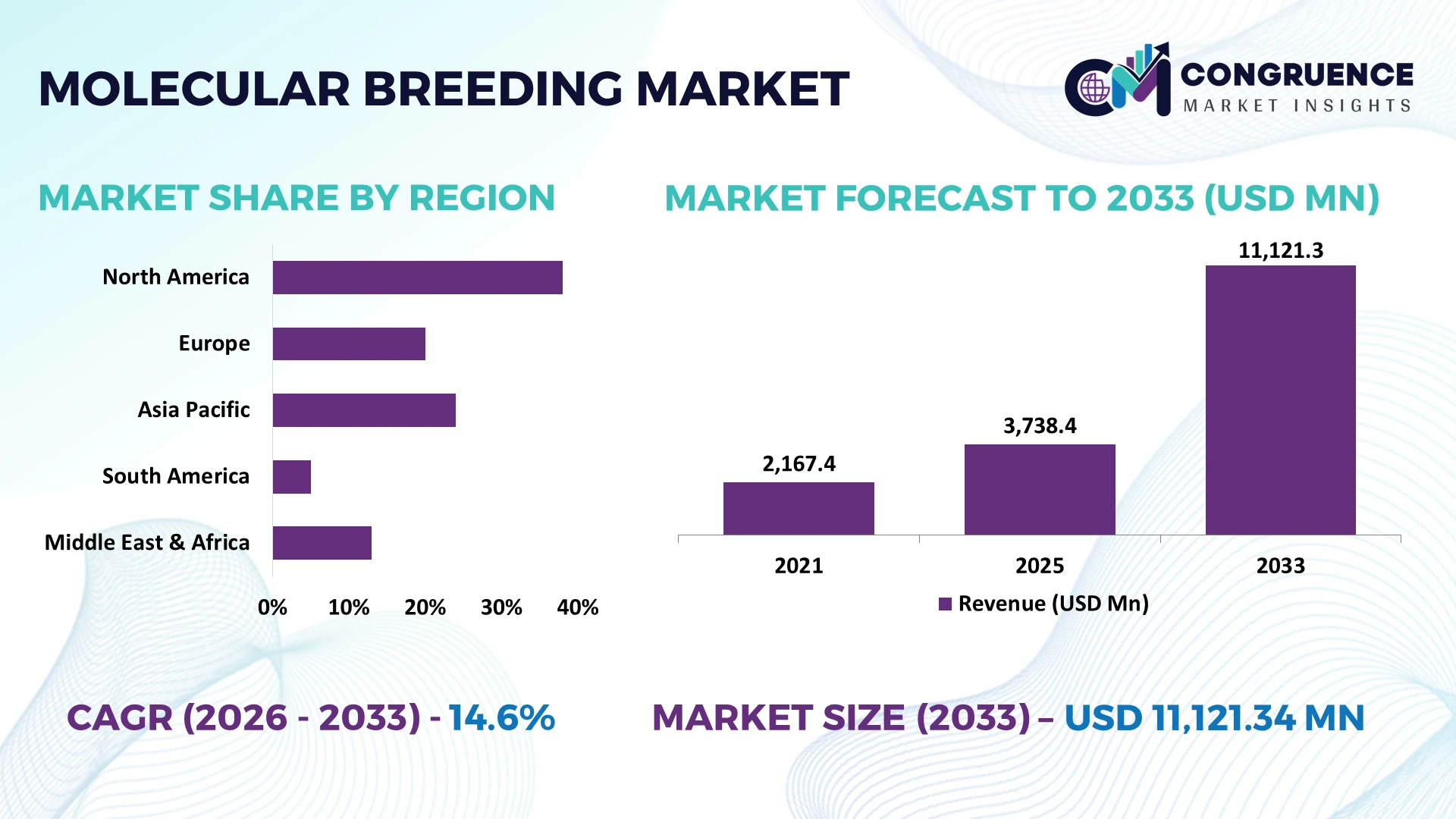
The Global Molecular Breeding Market was valued at USD 3738.35 Million in 2025 and is anticipated to reach a value of USD 11121.34 Million by 2033 expanding at a CAGR of 14.6% between 2026 and 2033. Falling genotyping costs, genomic selection, marker-assisted breeding, high-throughput phenotyping, and climate-resilient seed development are compressing crop-development cycles and accelerating precision breeding across commercial agriculture.
The United States represents an estimated 30% of molecular breeding activity, supported by large seed companies, advanced sequencing infrastructure, USDA research programs, and extensive corn and soybean breeding pipelines. More than 90% of U.S. corn and soybean acreage uses genetically engineered varieties, reflecting strong farmer acceptance of genetics-led productivity tools. Compared with China, the U.S. maintains stronger commercial breeding infrastructure, while China is accelerating genomics and biotechnology under national seed-revitalization policies. U.S.–China competition over agricultural biotechnology and food security is intensifying domestic breeding investment.
Strategically, breeding companies should prioritize integrated genomic-selection platforms, proprietary germplasm, automated phenotyping, and geographically diversified research networks to shorten commercialization cycles and strengthen seed-product differentiation.
Market Size & Growth: USD 3,738.35 million in 2025 reaches USD 11,121.34 million by 2033 at 14.6% CAGR, driven by genomic selection and climate-resilient seed development.
Top Growth Drivers: Genotyping cost reductions above 90%, genomic-selection accuracy gains of 20–40%, and breeding-cycle compression approaching 30% are strengthening commercial adoption.
Short-Term Forecast: By 2028, automated genotyping and predictive breeding workflows are positioned to shorten selected crop-development cycles by approximately 20–30%.
Emerging Technologies: AI genomic prediction, CRISPR-assisted breeding, automated phenotyping, and pangenomics increasingly connect genotype selection with measurable field performance.
Regional Leaders: By 2033, North America approaches USD 3.8 billion, Asia-Pacific USD 3.5 billion, and Europe USD 2.4 billion, reflecting commercial breeding, food-security programs, and precision agriculture.
End-User Trends: Commercial seed companies account for an estimated 55–60% of molecular breeding demand as marker-assisted selection becomes embedded in breeding pipelines.
Pilot/Case Example: CIMMYT genomic-selection programs have demonstrated breeding-cycle reductions approaching 50% in selected rapid-cycle crop improvement workflows.
Competitive Landscape: Bayer holds an estimated low-teens position, competing with Corteva, Syngenta, Illumina, and Eurofins across breeding, genotyping, sequencing, and analytical platforms.
Regulatory & ESG Impact: Precision breeding can reduce development timelines by 20–50%, supporting faster introduction of drought-, disease-, and resource-efficient crop varieties.
Investment & Funding: U.S. agricultural research receives more than USD 3 billion annually across major federal research programs, supporting genomics, crop improvement, phenotyping, and biotechnology infrastructure.
Innovation & Future Outlook: Pangenomics and AI prediction can analyze millions of genetic markers, shifting breeding decisions from phenotype-led screening toward data-intensive predictive selection.
The Molecular Breeding Market is increasingly shaped by climate-resilient crops, hybrid seed development, disease resistance, yield optimization, livestock genetics, and genomic selection. High-throughput sequencing now allows breeding programs to evaluate thousands of candidates across millions of genetic markers, while AI-assisted genomic prediction is improving selection efficiency by approximately 20–40% in optimized programs. National food-security strategies in China, India, and the United States are strengthening domestic breeding capabilities, while tighter biotechnology regulation makes marker-assisted and precision-breeding pathways strategically important, setting the foundation for evolving investment and commercialization priorities.
Molecular breeding is becoming strategically important as seed companies compete to deliver climate resilience, disease resistance, yield stability, and region-specific traits faster than conventional breeding permits. Food-security policies in China and India are reinforcing domestic germplasm development, while digital breeding platforms increasingly combine genotyping, phenotyping, environmental data, and predictive analytics. This shifts competitive advantage from breeding acreage toward proprietary datasets and selection accuracy.
Genomic selection can shorten selected breeding cycles by roughly 20–40% versus phenotype-led workflows by identifying superior candidates before extensive field evaluation. The United States leads commercial genomics integration, China is scaling state-supported seed innovation, and Europe combines advanced breeding research with stricter regulatory oversight. Through 2028, high-throughput genotyping, AI prediction, pangenomics, and automated phenotyping will increasingly become integrated breeding-stack components.
A practical deployment involves screening thousands of maize lines genetically before advancing only high-potential candidates into expensive multi-location trials. This lowers field-testing intensity while improving selection precision. Bayer, Corteva, Syngenta, and specialized genomics providers are expanding computational breeding, sequencing partnerships, and automated phenotyping capabilities. Long-term advantage will depend on converting proprietary germplasm and genomic information into commercially validated traits faster, more accurately, and across increasingly volatile growing environments.
Climate volatility is forcing breeding programs to select drought tolerance, heat resilience, disease resistance, and yield stability simultaneously rather than sequentially. Agriculture accounts for roughly 70% of global freshwater withdrawals, while climate-related yield losses can exceed 20% for sensitive crops under severe stress conditions. Genomic selection can improve selection accuracy by approximately 20–40% in optimized breeding populations, allowing developers to identify resilient candidates earlier. India’s climate-resilient crop programs and China’s seed-revitalization strategy are reinforcing this transition toward genetics-led crop improvement. Bayer, Corteva, Syngenta, and breeding institutions are expanding genomic prediction, marker-assisted selection, and multi-environment phenotyping. The operational advantage is significant: genetic screening removes weak candidates before costly field trials, concentrating breeding budgets on germplasm with stronger commercialization probability.
Molecular breeding requires sequencing platforms, bioinformatics capacity, validated markers, reference genomes, controlled phenotyping, and skilled quantitative geneticists, creating substantial adoption differences between advanced and resource-constrained breeding programs. Although sequencing costs have fallen more than 90% over the past decade, downstream data interpretation and high-quality phenotyping remain expensive. Genotyping thousands of breeding lines can generate millions of marker observations, increasing computational and data-management requirements. Many breeding organizations in developing agricultural markets still depend on external laboratories, extending turnaround times by 20–40% compared with integrated workflows. Companies are mitigating these constraints through outsourced genotyping, regional laboratories, cloud analytics, standardized marker panels, and university partnerships. The critical bottleneck is increasingly phenotype quality rather than DNA generation; inaccurate field measurements directly weaken otherwise sophisticated genomic predictions.
AI-enabled genomic prediction creates a high-value opportunity by combining genotype, phenotype, weather, soil, and environmental interaction data into faster selection decisions. Modern breeding populations can contain hundreds of thousands to millions of markers, making conventional manual analysis impractical. Machine-learning models can improve predictive accuracy by approximately 10–30% in suitable multi-environment datasets, while automated imaging can reduce manual phenotyping workloads by more than 50%. China is expanding digital agriculture and domestic seed technology, while India’s large crop diversity provides substantial potential for localized predictive breeding. Companies are investing in cloud breeding platforms, computer vision, pangenomes, and data partnerships. A non-obvious opportunity lies in reusable breeding intelligence: each completed generation enriches proprietary datasets, allowing established platforms to improve prediction performance without proportionally increasing field-trial acreage.
The principal execution challenge is converting strong genomic predictions into consistent performance across variable field environments. Genotype-by-environment interactions can materially change rankings between locations, requiring multi-season and multi-location validation even when predictive models achieve 60–80% accuracy for selected traits. Complex characteristics such as yield, drought tolerance, and nutrient efficiency are controlled by numerous genes and environmental interactions, limiting single-marker usefulness. Extreme weather in major U.S., Indian, and Chinese agricultural zones further increases model drift as historical datasets become less representative of future conditions. Breeding companies must therefore integrate genomic selection with environmental modeling, high-throughput phenotyping, continuous model retraining, and diversified field-testing networks. Sustainable competitive advantage depends not on generating more genomic data, but on maintaining prediction accuracy when production environments change faster than traditional breeding datasets.
High-Throughput Genotyping Becomes Routine: Commercial breeding programs are shifting from selective genotyping toward population-scale screening involving thousands of lines and hundreds of thousands of markers. Sequencing costs have fallen more than 90% over the past decade, while automated sample workflows can reduce processing time by 30–50%. U.S. seed developers are expanding laboratory automation and outsourced genotyping partnerships, moving genetic screening earlier in breeding pipelines to eliminate unsuitable candidates before expensive field evaluation.
Speed Breeding Compresses Generations: Controlled-environment breeding is increasingly combined with molecular selection to shorten generation intervals. Optimized wheat and barley programs can achieve up to 4–6 generations annually versus 1–2 under conventional field schedules. Australian and European breeding centers are integrating extended photoperiods, controlled environments, and marker screening, allowing companies to advance selected germplasm faster while reducing dependence on seasonal field windows and geographically dispersed nurseries.
Pangenomes Replace Single References: Breeders are moving beyond single reference genomes toward pangenomic datasets that capture structural variants and genetic diversity missing from conventional references. Crop pangenomes can incorporate hundreds of accessions and expose previously hidden trait-associated variation. Major maize, wheat, and rice programs are integrating these resources into marker development and parental selection. The non-obvious benefit is reduced reference bias, improving identification of valuable alleles within diverse and locally adapted germplasm.
Phenotyping Moves Toward Automation: Drones, multispectral cameras, field sensors, and robotic imaging are replacing labor-intensive visual scoring across breeding trials. Automated platforms can reduce manual phenotyping workloads by more than 50% while collecting measurements repeatedly across thousands of plots. Labor constraints and expanding multi-environment trials are accelerating deployment. Breeding organizations are investing in image analytics, standardized sensor workflows, and integrated data platforms to improve trait measurement consistency and selection throughput.
Marker-Assisted Selection represents the leading type with an estimated 30–35% market share, reflecting established deployment across commercial crop breeding and its comparatively straightforward integration into existing selection pipelines. MAS allows breeders to identify target alleles before maturity, reducing unnecessary field advancement and improving selection precision for simply inherited traits. Marker-Assisted Backcrossing remains strategically important for transferring disease-resistance and quality traits into elite germplasm, while QTL Mapping continues supporting discovery of genomic regions controlling complex agronomic characteristics.
Genomic Selection is the fastest-growing type because it evaluates genome-wide marker effects rather than relying on limited trait-linked markers. Optimized programs can improve selection accuracy by approximately 20–40% and shorten breeding cycles by 20–30% when combined with rapid generation advancement. Genotyping provides the infrastructure supporting every molecular workflow as declining sequencing costs enable larger populations. Seed and biotechnology companies are consequently reallocating investment toward high-density genotyping, predictive algorithms, integrated breeding databases, and automated sample processing.
Crop Improvement leads application demand with an estimated 30–35% share because molecular breeding platforms are deployed across multiple objectives including agronomic performance, adaptation, maturity, architecture, and commercial trait stacking. Yield Enhancement remains an established priority for maize, wheat, rice, soybean, and other high-acreage crops, where even 5–10% productivity improvements materially affect farm economics. Quality Improvement supports nutritional composition, processing characteristics, shelf performance, and end-market differentiation, particularly in premium seed and food-value chains.
Stress Tolerance is the fastest-growing application as heat, drought, salinity, and water variability alter breeding priorities. Molecular screening can reduce candidate populations entering expensive field evaluation by 30–50% in structured programs. Disease Resistance is also strengthening as pathogen evolution increases pressure for faster resistance-gene identification and pyramiding. Breeding companies are expanding multi-environment testing, genomic prediction, trait-specific marker panels, and germplasm partnerships. Investment is consequently shifting from maximizing yield under ideal conditions toward maintaining commercially acceptable yield across unstable production environments.
Seed Companies represent the leading end-user group with an estimated 50–55% share, reflecting their large breeding populations, proprietary germplasm libraries, extensive field-testing networks, and direct commercial incentive to shorten variety-development timelines. Major operators routinely evaluate thousands of breeding candidates, making automated genotyping and early molecular selection economically attractive. Agricultural Research Institutes and Breeding Centers remain critical for pre-breeding, germplasm characterization, and trait discovery, while Universities contribute genetics research and specialized analytical capabilities.
Biotechnology Companies represent the fastest-growing end-user segment as sequencing, bioinformatics, predictive breeding, and specialized genotyping increasingly operate through technology partnerships rather than fully internalized infrastructure. Government Agencies support national crop improvement and food-security programs, particularly in India and China. Genotyping costs have declined more than 90% over the longer sequencing-cost curve, enabling smaller programs to access molecular workflows. Providers are responding with outsourced laboratories, cloud breeding platforms, customized marker panels, subscription analytics, and collaborative research models that reduce capital requirements for customers.
North America accounted for the largest market share at 34% in 2025 however, Asia-Pacific is expected to register the fastest growth, expanding at a CAGR of 16.2% between 2026 and 2033.

Genomics Moves Into Commercial Breeding Pipelines
North America accounted for approximately 34% of molecular breeding activity in 2025, supported by commercial seed companies, advanced sequencing laboratories, automated phenotyping, university research, and extensive multi-location crop trials. Corn, soybean, wheat, and specialty-crop programs increasingly integrate marker-assisted selection and genomic prediction before field advancement. U.S. breeding operations benefit from extensive reference genomes and high-density genotyping infrastructure, while Canada contributes cereal, canola, pulse, and climate-resilience programs. More than 90% of U.S. corn and soybean acreage uses genetically engineered varieties, demonstrating strong commercial acceptance of genetics-driven agricultural technologies. Bayer, Corteva, Syngenta, genomics laboratories, and public institutions are investing in computational breeding, predictive selection, automated phenotyping, and integrated genotype-to-environment datasets to compress selection timelines.
United States Market Outlook: The United States combines large commercial seed pipelines with USDA research infrastructure, sequencing capacity, cloud computing, and extensive field-testing networks. Corn acreage exceeds 90 million acres in strong planting years, providing enormous breeding scale. Proprietary germplasm, high-throughput genotyping, and AI-assisted selection increasingly determine competitive advantage by allowing developers to screen candidates before expensive multi-environment trials.
Regulatory Evolution Redirects Breeding Investment
Europe represented approximately 23% of molecular breeding activity in 2025, with Germany, France, the Netherlands, and the United Kingdom concentrating seed research, plant genomics, phenotyping, and agricultural biotechnology. Breeders extensively use marker-assisted selection because it integrates with established variety-development pathways without introducing transgenic material. Regulatory discussions surrounding new genomic techniques are simultaneously reshaping investment priorities toward precision breeding and targeted genetic modification. Europe’s strong wheat, barley, vegetable, potato, and oilseed breeding sectors require disease resistance and climate adaptation as increasingly variable weather affects field performance. High-throughput phenotyping and genomic prediction can shorten selected breeding cycles by approximately 20–30%. Companies and research institutions are expanding sequencing partnerships, digital breeding platforms, controlled-environment facilities, and cross-border germplasm programs to improve selection precision.
Germany Market Outlook: Germany combines advanced plant-science institutions with established cereal, sugar beet, rapeseed, maize, and vegetable breeding businesses. Approximately half of national land area is used agriculturally, creating substantial field-validation infrastructure. Breeders increasingly integrate molecular markers with multi-location phenotyping, while regulatory clarity around precision breeding remains strategically important for determining future commercialization pathways and R&D allocation.
Food Security Accelerates Breeding Modernization
Asia-Pacific accounted for approximately 29% of molecular breeding activity in 2025, with China, India, Japan, and Australia operating major crop-improvement ecosystems. China is strengthening domestic seed technology under its seed-industry revitalization strategy, emphasizing germplasm resources, molecular selection, and biotechnology to reduce dependence on imported agricultural genetics. India’s extensive rice, wheat, pulses, cotton, and horticultural production creates substantial demand for drought, heat, disease, and nutrient-efficiency traits. Australia contributes advanced wheat and barley genomics and speed-breeding expertise. China produces roughly 28% of global rice and nearly 18% of global wheat, giving genetic improvement substantial food-security leverage. Seed developers and public institutes are expanding genotyping laboratories, germplasm databases, genomic-selection programs, and automated breeding infrastructure.
China Market Outlook: China combines enormous crop-production scale with state-supported seed modernization and expanding genomic infrastructure. The country produces more than 200 million tonnes of maize annually, making small genetic improvements commercially significant. Domestic breeding organizations are strengthening proprietary germplasm, genomic prediction, marker discovery, and biotechnology capabilities as food security and reduced dependence on foreign seed genetics become national strategic priorities.
Commercial Agriculture Drives Trait Localization
South America represented approximately 9% of molecular breeding activity in 2025, with Brazil and Argentina providing the principal commercial demand through soybean, maize, cotton, sugarcane, wheat, and specialty-crop improvement. Brazil’s extensive tropical production environments create strong requirements for disease resistance, heat tolerance, maturity optimization, and region-specific germplasm. The country produces more than 160 million tonnes of soybeans in favorable seasons, making incremental improvements in yield stability economically significant. Molecular selection is increasingly integrated with tropical field testing to screen breeding populations before expensive multi-location trials. However, advanced sequencing infrastructure remains concentrated among large companies and research institutions. Seed developers are addressing this gap through outsourced genotyping, university partnerships, shared breeding platforms, and localized trait-development programs.
Brazil Market Outlook: Brazil offers the region’s strongest molecular breeding environment through EMBRAPA research capabilities, extensive commercial seed operations, and diverse tropical production systems. Soybean cultivation exceeds 45 million hectares, providing exceptional scale for genetics-led productivity improvement. Breeders prioritize tropical adaptation, disease resistance, shorter maturity windows, and stress resilience while combining molecular markers with geographically dispersed field-testing networks.
Climate Stress Prioritizes Resilient Genetics
Middle East & Africa accounted for approximately 5% of molecular breeding activity in 2025, with South Africa, Kenya, Egypt, Morocco, Saudi Arabia, and research centers across East Africa advancing drought, heat, salinity, and disease-resistance programs. Water scarcity creates an unusually strong economic case for genetics that maintains yield under constrained irrigation. Agriculture accounts for more than 70% of freshwater withdrawals across many water-stressed economies, making water-use efficiency an operational breeding priority. African programs also target maize lethal necrosis, wheat rust, cassava diseases, and heat-tolerant cereals. Limited laboratory infrastructure and fragmented seed systems constrain deployment outside major research hubs. Governments, international breeding centers, universities, and seed companies are therefore expanding shared genotyping facilities, germplasm networks, training programs, and regional field-testing partnerships.
South Africa Market Outlook: South Africa combines established commercial agriculture, university research, seed-company activity, and relatively advanced biotechnology infrastructure. Maize remains the country’s dominant field crop, creating sustained demand for drought tolerance, disease resistance, and yield stability. Molecular breeding increasingly supports faster germplasm screening across contrasting production zones, while local partnerships help translate genomic discoveries into commercially adapted cultivars.
Bayer, Corteva, Syngenta, Illumina, and Eurofins compete across distinct layers of molecular breeding, with seed majors controlling germplasm and commercial pipelines while genomics specialists compete through sequencing, genotyping, and analytical infrastructure. The top five participants capture approximately 40–45% of addressable commercial activity. Competition centers on selection accuracy, turnaround speed, proprietary genetics, and cost: genomic selection can improve prediction accuracy by 20–40%, automated phenotyping can reduce manual workloads above 50%, and sequencing costs have declined over 90% long term. Bayer, Corteva, and Syngenta vertically integrate breeding data with field networks; Illumina and Eurofins strengthen high-throughput analytical capacity through platform innovation and laboratory scale. Competition is shifting toward AI-assisted prediction and integrated genotype-environment datasets. Proprietary germplasm, multi-season phenotypic data, bioinformatics expertise, and regulatory qualification remain major entry barriers. Winning requires superior datasets, validated genetics, scalable genotyping, precise phenotyping, and faster conversion of predictions into commercially proven varieties.
Bayer AG
Corteva, Inc.
Syngenta Group
BASF SE
KWS SAAT SE & Co. KGaA
Limagrain
DLF
Illumina, Inc.
Thermo Fisher Scientific Inc.
Eurofins Scientific SE
LGC Group
Intertek Group plc
SGS SA
Charles River Laboratories International, Inc.
Current molecular breeding platforms combine marker-assisted selection, high-throughput genotyping, genomic selection, and automated phenotyping to screen larger populations before field advancement. CIMMYT maize pipelines have achieved comparable genetic gain at 35–40% lower cost using genomic selection than full phenotyping. Dense SNP arrays and targeted sequencing now process thousands of breeding samples daily, improving selection speed while preserving accuracy.
Emerging systems integrate AI prediction, pangenomics, speed breeding, drones, and multi-environment data. Training only 10–30% of populations can maintain strong genomic prediction correlations in validated maize workflows, reducing field-testing requirements substantially. Compared with phenotype-only selection, genomic approaches can cut operational costs by roughly one-third. Seed companies with proprietary germplasm and historical phenotype datasets gain the strongest competitive advantage because model accuracy compounds with accumulated breeding data.
Disruptive development centers on predictive breeding that links genomic, environmental, imaging, and management datasets before crosses reach expensive trials. Automated phenotyping can reduce manual measurement workloads above 50%, while rapid-generation systems enable multiple generations annually. Between 2026 and 2028, commercial programs will increasingly combine genomic selection with AI-ranked crosses and targeted sequencing. Investment matters now because integrated datasets become defensible breeding assets, allowing faster candidate elimination, more efficient trial allocation, and stronger trait-development productivity across crops.
September 2024 – Illumina partnered with LGC Biosearch Technologies to combine Amp-Seq targeted genotyping with scalable sequencing across Asia-Pacific excluding China and Latin America, enabling multiplexing of tens of thousands of samples daily and accelerating breeding-program throughput and trait commercialization.
August 2024 – CIMMYT reported genomic selection deployment across eastern and southern African maize pipelines, achieving equivalent genetic gain at approximately 35–40% lower cost than conventional full-field phenotyping, allowing breeders to evaluate larger populations without sacrificing selection accuracy or budgets.
November 2025 – Corteva researchers published the three-year Big BIT maize experiment validating whole-genome prediction for early-stage selection, demonstrating that genomic estimated breeding values from wide-area field testing provide the strongest predictive strategy for advancing superior breeding candidates efficiently globally.
April 2026 – Corteva announced leadership for its planned advanced seed and genetics company, positioning molecular breeding and gene editing as core innovation capabilities while preparing to expand licensing and apply its germplasm platform across additional row crops after separation.
The Molecular Breeding Market Report evaluates Marker-Assisted Selection, Genomic Selection, Marker-Assisted Backcrossing, QTL Mapping, and Genotyping across Crop Improvement, Disease Resistance, Yield Enhancement, Stress Tolerance, and Quality Improvement. End-user coverage includes Seed Companies, Agricultural Research Institutes, Biotechnology Companies, Universities, Breeding Centers, and Government Agencies, with Seed Companies representing approximately half of commercial adoption.
Regional analysis covers North America, Europe, Asia-Pacific, South America, and Middle East & Africa, assessing breeding infrastructure, regulatory conditions, germplasm resources, research capacity, and commercialization pathways. Technology coverage includes genomic prediction, high-throughput genotyping, pangenomics, automated phenotyping, speed breeding, AI-assisted selection, and genotype-environment modeling. The report supports 2026–2033 decisions involving breeding-platform investment, geographic expansion, technology partnerships, laboratory capacity, germplasm strategy, pipeline optimization, competitive positioning, and prioritization of climate-resilient crop programs.
| Report Attribute/Metric | Report Details |
|---|---|
Market Revenue in 2025 | USD 3738.35 Million |
Market Revenue in 2033 | USD 11121.34 Million |
CAGR (2026 - 2033) | 14.6% |
Base Year | 2025 |
Forecast Period | 2026 - 2033 |
Historic Period | 2021 - 2025 |
Segments Covered | By Type
By Application
By End-User
|
Key Report Deliverable | Revenue Forecast, Growth Trends, Market Dynamics, Segmental Overview, Regional and Country-wise Analysis, Competition Landscape |
Region Covered | North America, Europe, Asia-Pacific, South America, Middle East, Africa |
Key Players Analyzed | Bayer AG, Corteva, Inc., Syngenta Group, BASF SE, KWS SAAT SE & Co. KGaA, Limagrain, DLF, Illumina, Inc., Thermo Fisher Scientific Inc., Eurofins Scientific SE, LGC Group, Intertek Group plc, SGS SA, Charles River Laboratories International, Inc. |
Customization & Pricing | Available on Request (10% Customization is Free) |




