
Reports
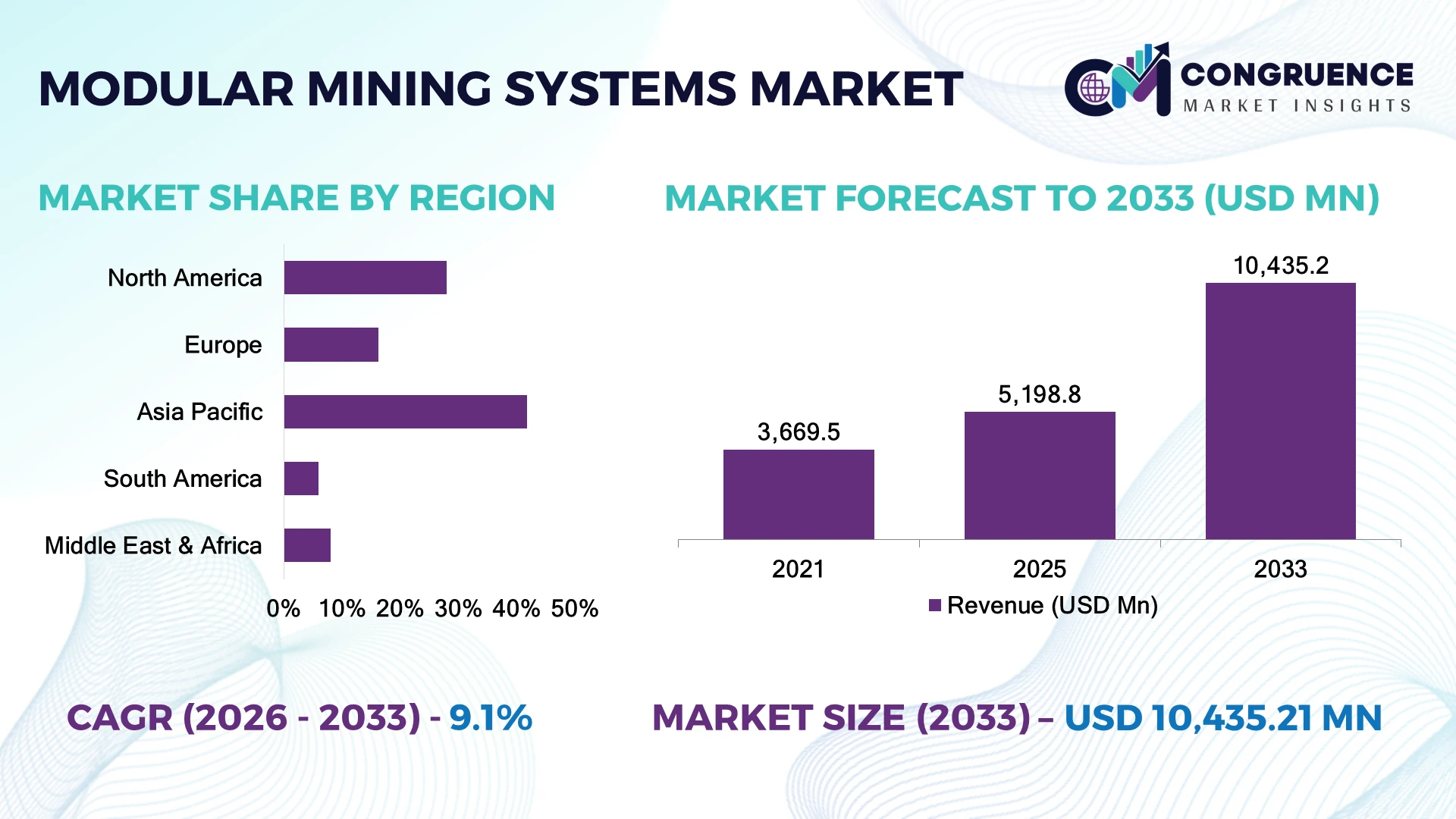
The Global Modular Mining Systems Market was valued at USD 5,198.8 Million in 2025 and is anticipated to reach a value of USD 10,435.2 Million by 2033 expanding at a CAGR of 9.1% between 2026 and 2033. Growth is driven by rapid deployment of autonomous haulage fleets, AI-enabled mine optimization platforms, and digital modernization across large-scale copper, iron ore, and critical mineral operations.
Australia leads the global modular mining systems market with approximately 29% of large-scale autonomous mining deployments, supported by multi-billion-dollar investments in iron ore and lithium operations. More than 62% of Tier-1 surface mines have integrated fleet management and dispatch automation platforms. In comparison, Canada's adoption is expanding through critical mineral projects, while Australia's deployment density remains nearly 24% higher. Ongoing critical mineral supply-chain diversification following geopolitical trade realignments further reinforces technology investment.
Strategic investment is increasingly shifting toward scalable, interoperable mining platforms capable of maximizing productivity, reducing operational risk, and supporting long-term digital mine transformation.
Market Size & Growth: USD 5,198.8 Million (2025) to USD 10,435.2 Million (2033), 9.1% CAGR, driven by autonomous mine digitalization.
Top Growth Drivers: Fleet automation +38%, AI dispatch optimization +31%, critical mineral expansion +27%.
Short-Term Forecast: By 2028, equipment idle time declines nearly 18% through integrated fleet management.
Emerging Technologies: AI analytics, autonomous haulage, digital twins improve operational visibility across advanced mines.
Regional Leaders: Asia-Pacific USD 4.5 Billion, North America USD 2.7 Billion, Australia-led Oceania USD 1.4 Billion with automation-led expansion.
Consumer/End-User Trends: Nearly 59% of large mining operators prioritize integrated modular platforms over standalone software.
Pilot/Case Example: 2026 autonomous fleet deployment increased haulage productivity by approximately 16% at a large open-pit operation.
Competitive Landscape: Top providers control nearly 67% share through software integration, automation, and lifecycle services.
Regulatory & ESG Impact: Digital monitoring reduces fuel consumption by nearly 14% while supporting emissions compliance.
Investment & Funding: More than USD 2.8 Billion directed toward smart mining infrastructure and digital mine modernization.
Innovation & Future Outlook: Edge computing, predictive maintenance, and interoperable platforms accelerate next-generation mining operations.
The Modular Mining Systems Market is evolving around autonomous fleet management, predictive maintenance, and integrated mine planning solutions that improve productivity across metal and mineral extraction. Nearly 44% of new digital mining deployments incorporate AI-driven operational analytics, while ongoing critical mineral supply-chain diversification is accelerating technology investments. These developments are strengthening operational resilience and set the foundation for the strategic market assessment below.
Modular mining systems have become a strategic investment priority as mining companies pursue higher productivity, workforce optimization, and resilient operations amid expanding demand for copper, lithium, nickel, and rare earth minerals. Infrastructure modernization, digital mine transformation, and autonomous equipment deployment are reshaping competitive positioning across global mining operations. Companies increasingly prioritize scalable platforms capable of integrating fleet management, asset monitoring, production scheduling, and operational analytics within a unified ecosystem.
Modern AI-enabled modular mining platforms improve dispatch efficiency by approximately 22% compared with conventional standalone fleet management systems while reducing equipment idle time by nearly 18%. Australia continues leading large-scale autonomous mining deployment, whereas Canada is accelerating investment through critical mineral developments and intelligent underground mining projects. Over the next two to three years, more than 55% of newly commissioned large surface mines are expected to incorporate integrated digital mine management platforms supporting real-time operational decision-making.
Mining operators are expanding partnerships with automation providers, cloud technology companies, and equipment manufacturers to standardize connected mining environments. Large iron ore producers are deploying integrated control centers that combine fleet optimization, predictive maintenance, and production planning into a single operational framework. Companies capable of delivering interoperable, scalable, and data-driven mining platforms will secure stronger competitive positioning as digital mining becomes the operational benchmark across global resource industries.
Mining companies are rapidly modernizing operations through autonomous haulage, intelligent fleet management, and real-time production optimization, making modular mining systems central to operational strategy. Nearly 58% of newly commissioned large surface mines now specify integrated digital fleet platforms, while AI-enabled dispatch solutions improve equipment utilization by approximately 21% and reduce haul cycle variability by nearly 17%. Australia continues expanding autonomous iron ore operations under critical mineral supply-chain diversification initiatives, accelerating demand for scalable software ecosystems. This modernization improves productivity, lowers operating costs, and strengthens asset visibility. Technology providers are expanding cloud-enabled platforms, partnering with equipment OEMs, and investing in interoperable automation solutions. A decisive competitive advantage increasingly depends on seamlessly integrating production planning, fleet management, and predictive analytics within a unified mining environment.
Many mining operations continue relying on heterogeneous equipment fleets, aging communication networks, and proprietary control systems that restrict deployment of fully integrated modular mining platforms. Approximately 34% of existing mines operate mixed-vendor equipment, while interoperability constraints increase implementation timelines by nearly 19% and integration expenses by around 15%. South Africa faces additional deployment complexity where older underground infrastructure limits high-bandwidth digital connectivity. These structural limitations delay productivity gains and reduce return on technology investments. Mining operators are mitigating operational risks through phased digital transformation, vendor-neutral software architectures, long-term technology agreements, and localized systems integration. Organizations capable of simplifying cross-platform interoperability secure stronger adoption across brownfield mining assets.
Next-generation modular mining systems are evolving into intelligent operational platforms that combine AI, edge computing, and predictive analytics for enterprise-wide optimization. Nearly 47% of planned mining technology investments now prioritize integrated analytics and automation capabilities, while predictive maintenance reduces unscheduled equipment downtime by approximately 24%. Chile is accelerating digital transformation across large copper operations by expanding connected mine infrastructure supporting autonomous production workflows. Technology companies are strengthening cloud partnerships, investing in digital twin capabilities, and developing scalable software ecosystems that extend beyond fleet management. A high-value opportunity lies in unified operational intelligence platforms that simultaneously optimize production, maintenance scheduling, fuel efficiency, and sustainability performance across geographically distributed mining assets.
Deploying modular mining systems across multi-site operations requires synchronized integration of autonomous equipment, enterprise software, operational technology, and skilled digital workforces. Around 31% of large implementation projects experience commissioning delays due to systems integration complexity, while cybersecurity validation extends deployment schedules by nearly 18%. Canada continues increasing digital mining investments, yet qualified automation engineers and industrial data specialists remain constrained across major mining districts. These execution challenges affect deployment consistency, operational resilience, and long-term technology scalability. Companies must expand workforce training, strengthen cybersecurity frameworks, standardize digital architectures, and deepen partnerships with automation specialists. Long-term competitiveness will increasingly depend on organizational capability to manage intelligent mining ecosystems rather than deploying standalone automation technologies alone.
AI Fleet Optimization Expansion: Nearly 52% of newly deployed modular mining platforms now integrate AI-driven dispatch and predictive analytics, improving fleet utilization by approximately 20% while reducing idle equipment time by nearly 16%. Australian mining operators are expanding autonomous operations as suppliers strengthen cloud partnerships and embedded operational intelligence across mine management workflows.
Autonomous Operations Scaling: Around 44% of large open-pit expansion projects now incorporate autonomous haulage and drilling integration from initial deployment. Critical mineral supply-chain investments are accelerating digital mine construction, enabling faster production scheduling, improved equipment coordination, and lower operating costs. Vendors are responding through integrated automation suites and long-term technology collaboration agreements.
Edge Computing Adoption: Approximately 39% of advanced mining operations deploy edge computing platforms for real-time equipment monitoring, reducing network latency by nearly 27% and accelerating operational decisions. Chilean copper producers are modernizing digital infrastructure while technology providers restructure software architectures to support distributed processing and continuous production optimization.
Interoperable Platform Ecosystems: Nearly 48% of mining technology investments prioritize open architecture platforms supporting multi-vendor equipment integration, improving implementation flexibility by approximately 18%. Increasing demand for vendor-neutral interoperability encourages software providers to standardize APIs, expand ecosystem partnerships, and simplify digital transformation across both greenfield and brownfield mining operations.
Fleet Management Systems accounted for approximately 38% of the modular mining systems market in 2025, maintaining leadership through enterprise-wide equipment visibility, optimized haulage dispatch, and seamless integration with autonomous mining fleets. Large open-pit operations continue prioritizing these platforms because they improve asset utilization, reduce idle time, and enable centralized operational control. Mine Management Systems remain widely deployed for production planning and resource optimization, while Asset Management Systems support predictive maintenance across mixed equipment fleets.
Autonomous Mining Systems represent the fastest-growing segment as mining companies accelerate digital mine modernization and workforce optimization. Their adoption is expanding through AI-enabled navigation, autonomous haulage, and real-time operational analytics, particularly across Australian and Chilean mining operations. Dispatch and Asset Management platforms are increasingly integrated within unified digital ecosystems, while Analytics and Decision Support modules gain traction for production forecasting. Approximately 54% of new mining technology projects now combine multiple software modules into a single platform, and nearly 46% prioritize cloud-enabled interoperability. Technology providers are strengthening product portfolios through AI integration, platform partnerships, and modular software architectures, reflecting a clear shift toward scalable enterprise-wide mining ecosystems.
According to a 2025 industry assessment published by the International Council on Mining and Metals (ICMM), integrated digital fleet management and operational data platforms are becoming a standard requirement across new large-scale mining modernization programs, with enterprise interoperability identified as a primary investment priority.
Surface Mining accounted for approximately 57% of the modular mining systems market in 2025, supported by extensive deployment across iron ore, copper, coal, and critical mineral operations requiring large autonomous fleets and centralized production control. High equipment utilization, continuous haulage operations, and scalable automation make surface mines the preferred environment for integrated fleet management and dispatch systems. Underground Mining maintains a strong presence where production scheduling, equipment tracking, and worker safety remain operational priorities.
Underground Mining is the fastest-growing application as digital communication infrastructure, autonomous loaders, and remote operations become increasingly viable in complex underground environments. Quarrying and Aggregates continue adopting modular mining software to improve equipment scheduling and fuel efficiency, while Mineral Processing facilities increasingly integrate operational analytics for production optimization. Approximately 49% of newly commissioned mining automation projects extend beyond extraction into processing operations, while around 42% incorporate predictive maintenance from initial deployment. Technology providers are expanding application-specific software, automation partnerships, and integrated control platforms to strengthen operational continuity across the complete mining value chain.
A 2026 enterprise technology survey by the Society for Mining, Metallurgy & Exploration (SME) found that integrated digital mine management solutions are increasingly deployed across both extraction and processing operations to improve operational visibility and production coordination.
Large Mining Enterprises held approximately 64% of the modular mining systems market in 2025 due to extensive equipment fleets, multi-site operations, and sustained investment in autonomous mining technologies. These organizations require enterprise-wide fleet management, predictive maintenance, production optimization, and centralized operational control, making modular platforms strategically essential. Mid-sized Mining Companies continue expanding digital investments to improve equipment productivity and reduce operational costs, while Mining Contractors increasingly adopt interoperable platforms to manage diverse customer fleets efficiently.
Mid-sized Mining Companies represent the fastest-growing end-user segment as falling implementation costs, cloud-based deployment models, and modular software licensing improve accessibility. Contract mining organizations are also accelerating adoption through flexible digital fleet solutions supporting multi-mine operations. Approximately 52% of new software implementations are now delivered through scalable modular architectures, while nearly 44% of operators prioritize integrated analytics before expanding autonomous capabilities. Vendors are responding with subscription-based platforms, localized implementation services, and strategic OEM collaborations, positioning themselves to address evolving digital transformation requirements across both established and emerging mining operators.
A 2025 mining technology assessment by the Global Mining Guidelines Group (GMG) highlighted that enterprise-scale mining companies continue leading investment in interoperable digital operating platforms, while mid-tier operators are accelerating adoption through modular and cloud-enabled deployment strategies.
Asia-Pacific accounted for the largest market share at 41.8% in 2025 however, North America is expected to register the fastest growth, expanding at a CAGR of 9.6% between 2026 and 2033.
Digital Mine Modernization Accelerates Enterprise Automation
North America is rapidly strengthening its position through widespread adoption of autonomous haulage systems, AI-enabled fleet management, and integrated mine control platforms across large copper, gold, and critical mineral operations. The region accounts for nearly 28% of global modular mining system deployments, supported by strong investment in mine electrification and digital infrastructure. More than 48% of newly upgraded large mining sites now incorporate centralized operational control centers integrating dispatch, maintenance, and production analytics. Technology partnerships between mining companies, equipment OEMs, and industrial software providers continue expanding deployment scale while improving operational resilience. Increasing domestic critical mineral development and supply-chain security initiatives are encouraging operators to prioritize modular, interoperable digital ecosystems that maximize productivity and support long-term automation strategies.
United States Market Outlook: The United States leads regional adoption through large-scale copper, gold, and critical mineral developments supported by advanced automation infrastructure and industrial software expertise. Approximately 54% of newly approved large mining modernization projects include autonomous fleet management or integrated digital mine platforms from the planning stage. Mining companies continue expanding investments in predictive maintenance, cloud-enabled operational control, and AI-driven production optimization to improve equipment availability, strengthen workforce efficiency, and enhance long-term operational competitiveness.
Sustainable Mining Technology Reshapes Operations
Europe continues advancing modular mining systems through sustainable extraction strategies, industrial digitalization, and modernization of critical mineral projects. The region represents approximately 21% of global deployment, supported by increasing investment in automation, battery mineral production, and intelligent equipment management. More than 43% of new mining technology projects integrate digital asset management with environmental performance monitoring, enabling greater operational transparency and regulatory compliance. Technology suppliers are expanding interoperable software platforms and advanced analytics capabilities to support highly automated mining environments while improving equipment lifecycle management.
Sweden Market Outlook: Sweden leads the European market through technologically advanced underground mining operations and strong investment in digital mining innovation. Autonomous drilling, intelligent ventilation control, and AI-based production scheduling are increasingly integrated across major mining facilities. Around 46% of ongoing mine modernization initiatives incorporate connected operational platforms, positioning Sweden as a leading center for sustainable and highly automated mining technologies.
Large-Scale Mining Automation Drives Regional Leadership
Asia-Pacific remains the largest regional market, accounting for approximately 41.8% of global demand due to extensive iron ore, coal, copper, and lithium production supported by advanced automation initiatives. Large mining operators continue deploying integrated fleet management, autonomous haulage, and centralized control systems across high-capacity operations. Nearly 61% of newly commissioned autonomous haul trucks globally operate within this region, reinforcing its leadership in digital mining deployment. Strong investment in critical mineral extraction and export-oriented mining infrastructure continues accelerating adoption of scalable modular platforms.
Australia Market Outlook: Australia represents the region's technology leader, supported by globally recognized autonomous mining operations across iron ore and lithium production. More than 65% of Tier-1 surface mines utilize integrated fleet management platforms combined with autonomous haulage and predictive maintenance systems. Mining companies continue investing in AI-enabled operational intelligence, cloud connectivity, and digital twin technologies to maximize production efficiency and strengthen global competitiveness.
Copper Expansion Fuels Digital Mining Demand
South America is experiencing steady adoption of modular mining systems as copper, lithium, and iron ore producers modernize large-scale extraction facilities. The region contributes approximately 6% of global deployments while increasing investment in connected mine infrastructure and production optimization. Nearly 39% of recently modernized copper operations now utilize integrated fleet optimization platforms that improve equipment coordination and operational efficiency. Infrastructure constraints and remote operating environments continue presenting implementation challenges, encouraging phased digital deployment strategies and stronger collaboration with global technology providers.
Chile Market Outlook: Chile remains the region's most influential market because of its world-leading copper industry and continuous investment in mine automation. Major mining operators increasingly deploy autonomous equipment management, predictive maintenance platforms, and centralized operational control systems across large open-pit mines. Approximately 45% of recent digital mining investments focus on integrated operational intelligence, strengthening productivity while supporting long-term mine sustainability objectives.
Resource Development Supports Intelligent Mining
The Middle East & Africa market is expanding through mining diversification, infrastructure modernization, and increased investment in intelligent resource extraction. The region accounts for approximately 8% of global modular mining system adoption, with digital technologies supporting gold, phosphate, copper, and emerging critical mineral projects. Nearly 36% of newly developed industrial mining projects now incorporate modular operational software during initial planning stages, improving deployment efficiency and long-term asset management. Technology providers are strengthening regional partnerships to accelerate digital transformation across developing mining sectors.
Saudi Arabia Market Outlook: Saudi Arabia is emerging as the region's strategic growth engine through extensive mining sector diversification under national industrial development initiatives. Investment in phosphate, gold, and critical mineral extraction increasingly includes digital fleet management, automation platforms, and centralized operational monitoring. Around 40% of recently announced large mining developments include advanced digital infrastructure planning, positioning the country as a future hub for intelligent mining operations in the region.
Global mining technology leaders including Komatsu (Modular Mining), Hexagon, ABB, Sandvik, and Epiroc compete directly in integrated mine automation, while specialist software vendors challenge them through planning analytics, interoperability, and deployment flexibility. The top five providers collectively control approximately 64% of the market, supported by long-term mining contracts and established digital ecosystems. Competition centers on automation performance, implementation speed, and open-platform integration, with AI-enabled optimization improving fleet utilization by 15–20% and predictive maintenance reducing equipment downtime by nearly 18%. Companies are strengthening positions through technology partnerships, acquisitions, vertical integration, and cloud-native platforms connecting planning, dispatch, and autonomous operations. The competitive shift increasingly favors interoperable ecosystems over standalone applications as mining companies demand vendor-agnostic solutions. High implementation costs, cybersecurity requirements, and integration with legacy fleets remain significant entry barriers. Winning requires scalable autonomous technologies, seamless interoperability, proven operational performance, and continuous innovation across the entire mining value chain.
Komatsu (Modular Mining)
Hexagon AB
ABB Ltd.
Sandvik AB
Epiroc AB
Caterpillar Inc.
Hitachi Construction Machinery Co., Ltd.
Micromine Pty Ltd.
Datamine
Deswik
RPMGlobal Holdings Limited
Maptek Pty Ltd.
Siemens AG
Wenco International Mining Systems Ltd.
Artificial intelligence, autonomous haulage, cloud-native fleet management, and digital twin platforms are redefining mine operations. AI-driven dispatch optimization improves equipment utilization by approximately 15%, while predictive maintenance lowers unexpected downtime by nearly 18%. Around 58% of newly commissioned large surface mines now deploy integrated fleet management platforms connected to operational analytics, enabling real-time production visibility and coordinated decision-making across extraction, transportation, and maintenance activities.
Modern modular ecosystems outperform legacy standalone dispatch systems by reducing operational response times nearly 30% while improving production planning accuracy by about 22%. Open architecture platforms capable of integrating mixed OEM fleets are becoming the preferred enterprise model. Global technology leaders benefit most because they combine automation software, machine intelligence, and industrial connectivity into unified digital ecosystems that reduce implementation complexity and accelerate operational value for mining companies.
Between 2026 and 2028, autonomous drilling coordination, edge computing, industrial private 5G, and generative AI-assisted operational planning will transform intelligent mining environments. Digital twins synchronized with real-time equipment telemetry will support faster scenario simulation, improve asset reliability by approximately 20%, and optimize energy consumption across large mine sites. Companies investing early in interoperable, AI-enabled platforms will strengthen productivity, sustainability, workforce safety, and long-term competitive differentiation as fully connected autonomous mining ecosystems become the industry benchmark.
March 2024: Komatsu presented its open, interoperable Modular ecosystem framework designed to connect mixed mining fleets and third-party technologies, strengthening enterprise-wide digital integration and accelerating autonomous mine optimization. Business impact: improved interoperability across complex mining operations. Source: Komatsu (Komatsu)
August 2024: Komatsu and ABB signed a strategic collaboration to develop integrated electrification solutions for mining equipment, supporting decarbonized operations and future autonomous fleets. Business impact: strengthened digital-electrification ecosystem for heavy mining operations. Source: Komatsu (Komatsu)
November 2024: Hexagon acquired indurad and its autonomous haulage subsidiary xtonomy, integrating radar-based collision avoidance and RTLS technologies into its mining portfolio. Business impact: accelerated OEM-agnostic autonomous mining capabilities and enhanced operational safety. Source: Hexagon (Hexagon)
April 2026: Komatsu commissioned its 1,000th autonomous ultra-class haul truck at Barrick's Nevada Gold Mines, extending autonomous haulage into large-scale gold mining. Business impact: reinforced commercial leadership in autonomous mining deployment. Source: Komatsu. (Komatsu)
The report provides comprehensive analysis of modular mining systems across fleet management platforms, mine management systems, asset management solutions, analytics platforms, and autonomous operational technologies. It evaluates adoption across surface mining, underground mining, mineral processing, and integrated mine operations, covering major end-users from metal mining, coal mining, and industrial mineral producers. Regional assessment spans North America, Europe, Asia-Pacific, South America, and the Middle East & Africa while examining digital mine deployment, automation maturity, and enterprise technology adoption patterns across more than 20 mining economies.
The study evaluates technology integration, AI-enabled automation, cloud connectivity, industrial IoT, autonomous equipment coordination, predictive maintenance, and digital twin implementation. It profiles leading industry participants, compares competitive strategies, and assesses deployment trends, investment priorities, interoperability developments, and operational benchmarks between 2026 and 2033. The report supports capital investment decisions, digital transformation planning, technology selection, competitive positioning, expansion strategy, and long-term productivity optimization across modern mining enterprises.
| Report Attribute/Metric | Report Details |
|---|---|
|
Market Revenue in 2025 |
USD 5,198.8 Million |
|
Market Revenue in 2033 |
USD 10,435.2 Million |
|
CAGR (2026 - 2033) |
9.1% |
|
Base Year |
2025 |
|
Forecast Period |
2026 - 2033 |
|
Historic Period |
2021 - 2025 |
|
Segments Covered |
By Type
By Application
By End-User
|
|
Key Report Deliverable |
Revenue Forecast, Growth Trends, Market Dynamics, Segmental Overview, Regional and Country-wise Analysis, Competition Landscape |
|
Region Covered |
North America, Europe, Asia-Pacific, South America, Middle East, Africa |
|
Key Players Analyzed |
Komatsu (Modular Mining), Hexagon AB, ABB Ltd., Sandvik AB, Epiroc AB, Caterpillar Inc., Hitachi Construction Machinery Co., Ltd., Micromine Pty Ltd., Datamine, Deswik, RPMGlobal Holdings Limited, Maptek Pty Ltd., Siemens AG, Wenco International Mining Systems Ltd. |
|
Customization & Pricing |
Available on Request (10% Customization is Free) |




