
Reports
The Global Modular Homes Market was valued at USD 48,120.3 Million in 2025 and is anticipated to reach a value of USD 73,291.4 Million by 2033 expanding at a CAGR of 5.4% between 2026 and 2033. Growth is being driven by factory-based automation, skilled-labor shortages, housing affordability pressures, and developers’ shift toward faster, standardized construction.
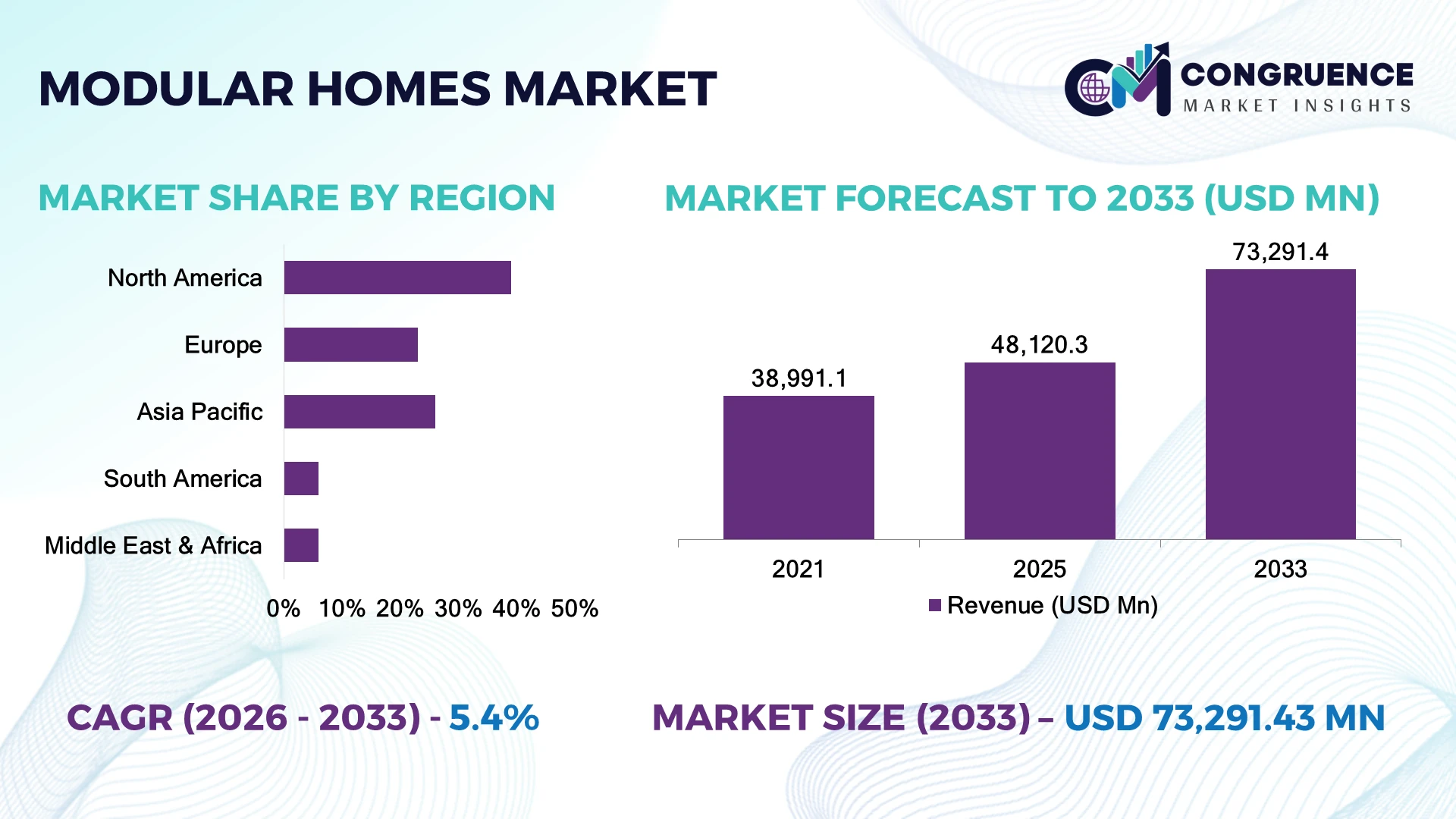
The United States remains the dominant country market, with permanent modular construction reaching approximately USD 20.5 billion in 2025 and representing a substantial share of the global industry. Multifamily modular construction reached approximately USD 6.8 billion, reflecting strong adoption in workforce and affordable housing. By comparison, modular methods remain less penetrated across conventional U.S. single-family construction, where offsite systems represent only around 3% of completed homes. The U.K. is accelerating Modern Methods of Construction through approximately £700 million in additional housing support, strengthening factory-built housing investment.
Strategically, manufacturers that combine automated production, standardized designs, regional factories, and code-compliant customization will capture the strongest developer opportunities.
Market Size & Growth: USD 48.12 billion in 2025 to USD 73.29 billion by 2033 at 5.4% CAGR, supported by factory automation and labor productivity.
Top Growth Drivers: Housing affordability 32%; labor shortages 27%; construction-speed requirements 21%.
Short-Term Forecast: By 2028, automated modular production is positioned to reduce construction timelines by approximately 20–50% versus conventional delivery models.
Emerging Technologies: AI-assisted design, robotic assembly, BIM, light-gauge steel, and digitally controlled factories are reshaping modular production economics.
Regional Leaders: North America approximately USD 27 billion; Asia-Pacific approximately USD 22 billion; Europe approximately USD 14 billion by 2033, supported by multifamily and urban housing deployment.
Consumer/End-User Trends: Multifamily modular construction represents approximately 9.1% of the relevant U.S. construction segment, reflecting increasing adoption in workforce and affordable housing projects.
Pilot/Case Example: 2025 automation testing demonstrated up to 46% lower construction time using automated light-gauge-steel framing, strengthening the commercial case for factory-based construction.
Competitive Landscape: Clayton Homes, Champion Homes, Skyline Champion, Cavco Industries, and Sekisui House remain prominent competitors across manufactured and modular housing markets.
Regulatory & ESG Impact: Approximately £700 million of additional U.K. housing support for Modern Methods of Construction is strengthening factory-based capacity and encouraging lower-waste construction models.
Investment & Funding: U.S. permanent modular construction reached approximately USD 20.5 billion in 2025, supporting factory expansion, automation investment, and developer partnerships.
Innovation & Future Outlook: Next-generation modular housing is shifting toward digitally configured, energy-efficient, robotic-built homes, moving competition beyond basic cost savings toward speed, precision, customization, and lifecycle performance.
The global modular homes market is increasingly concentrated around multifamily housing, workforce housing, affordable residential projects, and urban infill, where factory production directly addresses labor and scheduling constraints. Multifamily modular construction represented approximately 9.1% of its relevant U.S. segment in 2025. Supply-chain localization, automated factories, BIM-led design, and light-gauge-steel systems are strengthening delivery reliability as housing programs increasingly favor scalable offsite construction.
Modular homes are becoming strategically important because housing developers increasingly compete on delivery certainty rather than construction capacity alone. In the United States, permanent modular construction reached approximately USD 20.5 billion in 2025, while multifamily modular construction reached approximately USD 6.8 billion. This positions factory-built housing as a practical response to labor shortages, urban housing constraints, and prolonged project schedules.
Technology is widening the advantage over conventional site construction. Automated light-gauge-steel framing has demonstrated up to 46% lower construction time, while factory-controlled production enables site preparation and building fabrication to proceed simultaneously. Conventional construction remains more exposed to weather interruptions, subcontractor availability, and onsite coordination, whereas modular production shifts a greater proportion of work into controlled manufacturing environments.
Regional strategies are diverging. U.S. developers are prioritizing multifamily, workforce, and affordable housing, while the U.K. is strengthening Modern Methods of Construction through public funding and manufacturing capacity development. Over the next 2–3 years, leading manufacturers will prioritize robotic production, BIM integration, standardized components, and localized factories. Companies securing repeat developer contracts and achieving consistent production economics will gain a durable competitive advantage in high-volume housing programs.
Factory-based construction is gaining traction as labor constraints and project schedules intensify. Automated framing, CNC cutting, and digital production planning can reduce material waste by 10–20% and shorten structural assembly time by 20–40%. In the United States, workforce housing and multifamily developers are increasingly specifying modular systems to improve schedule certainty. Companies are responding by expanding factory capacity, integrating BIM with production workflows, and standardizing component platforms. The non-obvious advantage is schedule decoupling: manufacturers can fabricate modules while foundations are prepared onsite, compressing total project duration without proportionally increasing site labor. This operating model is strengthening the business case for modular homes in high-cost construction markets.
Logistics remain a structural constraint because oversized modules require specialized transportation, cranes, staging areas, and route planning. Transportation and installation can represent 10–20% of delivered modular-home costs, while difficult sites can increase module-handling expenses by 15–25%. In the United States, state-level highway restrictions and permitting requirements create additional routing complexity for large volumetric units. Companies are mitigating exposure through regional manufacturing hubs, smaller module dimensions, supplier localization, and long-term logistics contracts. A critical operational issue is factory-to-site distance: production scale does not automatically improve economics when transportation distances exceed practical thresholds, making decentralized manufacturing strategically important for national expansion.
Digital configuration platforms are creating an opportunity to combine standardized manufacturing with customer-specific layouts. BIM-driven design and parametric engineering can reduce design coordination effort by 20–30%, while repeatable component libraries can cut engineering cycles by 15–25%. In Japan, where precision-built housing is highly established, manufacturers are extending digital workflows into automated production and customer configuration. Companies are investing in configurators, digital twins, robotic fabrication, and interoperable BIM systems to expand customization without rebuilding production processes for every project. The strategic opportunity lies in treating modular homes as configurable products rather than individual construction projects, allowing manufacturers to increase design variety while retaining factory-level production efficiency.
Modular construction reduces onsite labor requirements but increases demand for technicians skilled in robotics, digital fabrication, quality control, and building-systems integration. Advanced factories can shift 30–50% of construction activity into controlled production environments, requiring a corresponding transformation in workforce capabilities. In the United States, manufacturers are increasingly investing in automated assembly and technician training as experienced construction labor becomes harder to replace. Companies must develop cross-functional production teams, standardized quality protocols, and partnerships with technical institutions. The deeper challenge is maintaining consistent module quality as factories scale: a single process deviation can affect dozens of units, making statistical process control and automated inspection more important than conventional site-level supervision.
Automation Moves Beyond Framing: U.S. modular factories are integrating CNC cutting, robotic framing, and automated quality inspection, reducing selected production-cycle times by 20–40% and material waste by 10–20%. Manufacturers are prioritizing connected production cells rather than isolated automation, improving throughput while preserving repeatability.
Multifamily Projects Drive Adoption: Multifamily developers increasingly use volumetric modules to address labor shortages and compressed delivery schedules, with modular systems reducing onsite construction activity by 30–50% in suitable projects. Companies are expanding standardized bathroom, kitchen, and MEP modules to accelerate apartment fit-outs.
Factories Become More Distributed: Transportation costs can account for 10–20% of delivered modular-home economics, encouraging manufacturers to establish regional plants closer to construction clusters. U.S. producers are increasingly balancing factory scale against logistics distance, creating smaller decentralized facilities rather than relying exclusively on mega-factories.
Digital Configuration Reshapes Customization: BIM, parametric design, and digital configurators are reducing design coordination effort by 20–30% while enabling greater product variation. Manufacturers are connecting customer-facing configuration tools with factory production data, turning customization into a controlled manufacturing workflow instead of a manual engineering exercise.
Volumetric modular homes lead the market with an estimated 58% share, supported by factory-complete units, repeatable engineering, and high schedule compression. Their factory-controlled workflow can shift 60–90% of construction activity indoors, reducing weather exposure and onsite coordination. Panelized systems represent the fastest-growing type as developers seek greater design flexibility and lower transportation complexity; adoption is expanding by approximately 8–10% annually in large residential projects. Hybrid and other modular systems remain strategically relevant for complex sites where full volumetric units face crane, access, or planning constraints.
Panelized construction typically reduces module dimensions and logistics requirements by 10–20%, while volumetric systems retain an advantage in repeat-project throughput. Companies are therefore investing in hybrid manufacturing lines rather than committing exclusively to one architecture. The business implication is a shift toward adaptable production platforms capable of serving standardized multifamily developments alongside customized single-family projects.
Multifamily housing leads modular-home applications with approximately 42% share, reflecting the strong suitability of standardized apartments, workforce housing, student accommodation, and urban infill projects. The application benefits from repeat floor plans and concentrated procurement, allowing developers to reuse engineering specifications and production tooling. Workforce and affordable housing represent the fastest-growing use cases, with adoption increasing approximately 10–12% as housing shortages intensify. Single-family housing remains the largest traditional construction opportunity but requires greater customization, while emergency and temporary housing retain specialized demand.
Modular multifamily projects can reduce overall delivery schedules by 20–50%, creating measurable advantages where financing and occupancy timelines are critical. Companies are expanding standardized kitchens, bathrooms, MEP assemblies, and repeatable room modules to increase factory throughput. The strategic shift is particularly important in the United States, where multifamily modular construction reached USD 6.8 billion in 2025 and represented 9.1% of the relevant modular construction segment.
Real estate developers represent the leading end-user group, accounting for approximately 46% of modular-home demand. Their dominance reflects large project pipelines, repeatable building specifications, and direct exposure to construction financing and occupancy schedules. Housing authorities and institutional buyers are the fastest-growing end-user group, with adoption increasing approximately 9–12% as public housing shortages and workforce accommodation requirements intensify. Individual homeowners remain important but typically require higher customization, smaller production volumes, and more fragmented purchasing decisions.
Developers gain the greatest economic advantage when multiple projects use common structural platforms, potentially reducing design and engineering effort by 15–25%. Housing authorities prioritize standardized specifications, procurement certainty, and compliance, while institutional buyers increasingly favor modular solutions for workforce and student accommodation. Companies are responding with developer partnerships, framework agreements, configurable product platforms, and regional production hubs. This shifts competition toward long-term project relationships and manufacturing reliability rather than one-off home sales.
North America accounted for the largest market share at 39% in 2025 however, Asia-Pacific is expected to register the fastest growth, expanding at a CAGR of 7.8% between 2026 and 2033.

Multifamily deployment and factory localization strengthen market leadership
North America remains the largest modular homes market, supported by established volumetric manufacturing, housing shortages, and strong multifamily deployment. The United States alone accounted for approximately 5.1% of construction activity across key modular segments in 2025, while multifamily represented USD 6.8 billion of permanent modular construction. Factory production can reduce project timelines by 20–50%, strengthening adoption where financing costs and occupancy schedules are critical. U.S. manufacturers are expanding regional factories, standardized product platforms, and developer partnerships, particularly across workforce and affordable housing. The operational advantage increasingly comes from integrating manufacturing with site development rather than simply producing modules at larger scale.
United States Market Outlook:
The United States remains the principal North American production and deployment hub, supported by mature modular manufacturers, established code frameworks, and large multifamily pipelines. The permanent modular construction market reached USD 20.5 billion in 2025, with the Western states holding a particularly strong position because of housing affordability pressures and disaster-recovery requirements. Manufacturers are increasing automation and regional production capacity to shorten logistics distances and improve delivery certainty.
Industrialized housing aligns with energy and construction modernization
Europe is shifting toward modular and offsite construction as housing shortages, labor constraints, and decarbonization requirements pressure conventional building models. Germany, the United Kingdom, and the Netherlands are important adoption centers, with demand concentrated in multifamily housing, urban infill, student accommodation, and affordable housing. Factory-controlled production supports tighter material management and repeatable energy-performance specifications. European manufacturers are increasingly combining timber systems, prefabricated MEP assemblies, BIM, and low-carbon materials to meet stricter building requirements. The region's strategic advantage lies less in low-cost manufacturing and more in high-performance, code-compliant housing systems that can be replicated across constrained urban sites.
Germany Market Outlook:
Germany offers strong potential because of its industrial manufacturing base, skilled engineering workforce, and persistent housing supply pressures. Prefabricated timber and hybrid construction are gaining relevance as developers seek shorter build cycles and improved energy performance. Manufacturers are integrating digital design with factory production to standardize structural elements while retaining architectural flexibility, positioning Germany as a technology-intensive modular housing market rather than a purely volume-driven manufacturing center.
Manufacturing scale and urban housing demand accelerate adoption
Asia-Pacific is emerging as the fastest-growing modular homes market, driven by Japan's mature prefabricated housing ecosystem, China's manufacturing capacity, and accelerating urban development in India and Southeast Asia. Japan demonstrates the strongest industrialization model, with major housing manufacturers operating dedicated factories and computer-controlled production. Sekisui House operates five domestic production factories, while its production facilities maintain ISO 9001 and ISO 14001 systems, demonstrating the region's emphasis on standardized quality and environmental management. Companies across Asia-Pacific are increasingly combining factory fabrication with digital configuration and localized assembly to manage dense urban sites and labor constraints.
Japan Market Outlook:
Japan remains the region's technology and process benchmark, supported by extensive prefabricated housing experience and highly standardized manufacturing. Sekisui House had delivered more than 2.7 million homes globally by January 2025, while 96% of its detached homes and 77% of rental homes achieved net-zero-energy-house status in fiscal 2024. Its manufacturing model demonstrates how modularization can integrate energy performance, quality control, and mass customization.
Housing deficits create a strong case for industrialized delivery
South America remains an emerging modular homes market, with Brazil representing the principal commercial opportunity. Housing shortages, urban concentration, and pressure to reduce construction schedules are encouraging developers and public agencies to evaluate prefabricated systems for residential and social housing. Brazil's modular construction market represented approximately 0.6% of global modular construction activity in 2025, leaving substantial penetration headroom. The country's construction ecosystem is also developing specialized offsite expertise, while modular systems are being considered for schools, clinics, disaster recovery, and housing programs. Companies are prioritizing locally sourced materials, simplified module designs, and partnerships with developers to overcome transportation and site-infrastructure constraints.
Brazil Market Outlook:
Brazil is the strongest South American market because of its large urban housing deficit and established construction-material supply chain. The country faces a housing deficit exceeding 5.8 million units, creating a substantial addressable requirement for faster residential delivery. Modular manufacturers are increasingly targeting social housing and public infrastructure alongside private residential developments, while São Paulo is emerging as a key ecosystem for offsite construction technology, engineering, and industry partnerships.
Giga-projects and workforce accommodation reshape modular demand
Middle East & Africa is increasingly using modular construction where conventional onsite delivery faces extreme heat, compressed schedules, remote locations, or large workforce requirements. Saudi Arabia leads regional adoption through large-scale urban development, hospitality, infrastructure, and workforce accommodation programs linked to Vision 2030. Modular systems enable controlled factory production followed by rapid onsite installation, making them particularly relevant to geographically dispersed projects. Companies are strengthening regional fabrication, logistics partnerships, and standardized accommodation platforms. However, the current shift toward faster-return construction projects is making cost discipline increasingly important for suppliers targeting large development programs.
Saudi Arabia Market Outlook:
Saudi Arabia remains the most strategically significant market because of its construction pipeline, infrastructure modernization, and demand for rapidly deployable accommodation. The country's 2034 FIFA World Cup preparations involve approximately 15 venues across five cities, creating substantial construction and temporary accommodation requirements. Modular suppliers are positioning around workforce housing, hospitality, site facilities, and repeatable building systems, while project reprioritization is increasing emphasis on scalable solutions with shorter installation cycles and stronger cost control.
Champion Homes, Cavco Industries, Clayton Homes, Sekisui House, and regional modular specialists compete across factory scale, distribution, customization, and delivery speed. The top five groups hold an estimated 30% combined share, leaving a fragmented field of regional manufacturers. Competition increasingly centers on 10–20% production-cost advantages, 20–50% schedule compression, and 15–25% engineering efficiencies from standardized platforms. Champion is vertically integrating manufacturing, retail, transportation, and installation, while Cavco is adding localized capacity. Sekisui differentiates through automated production, energy performance, and customization. The competitive shift is moving from low-cost factory output toward digitally controlled, energy-efficient, configurable housing systems. Entry barriers include capital-intensive factories, building-code certification, dealer networks, financing relationships, and transportation infrastructure. Regional players face pressure to consolidate purchasing and specialize in local deployment. Winning requires a balanced model combining factory utilization, localized supply chains, rapid customization, reliable installation, and developer relationships, rather than competing on unit price alone across priority housing programs.
Current modular-home technology is shifting from basic prefabrication toward automated, data-linked production. BIM-to-factory workflows, CNC cutting, robotic framing, digital quality inspection, and automated material handling are reducing production-cycle times by 10–20%. Sekisui Heim has 95% automation for steel structural production, signaling how manufacturers are moving from isolated machines toward integrated smart factories. The competitive benefit is higher throughput with tighter dimensional consistency and less dependence on scarce site labor.
Emerging systems include light-gauge-steel robotic fabrication, parametric design, digital twins, heat-pump integration, smart energy management, and advanced building envelopes. DOE-backed Dvele testing demonstrated a 46% construction-time reduction for automated steel framing versus conventional wood framing, establishing a measurable new-versus-old productivity advantage. Factory-integrated energy systems can improve building performance by 10–20% in applications. Japan benefits from deep automation expertise, while North American producers emphasize scalable manufacturing and distribution.
From 2026–2028, AI-assisted scheduling, machine-vision inspection, predictive maintenance, and automated configuration will move from pilots toward commercial deployment. Companies operating high-utilization factories will benefit first because software and robotics spread fixed costs across integrated production volumes. The strategic priority is integration: manufacturers connecting design, procurement, fabrication, logistics, and installation data will achieve faster customization and stronger quality control than producers relying on disconnected workflows.
May 2026 Champion Homes agreed to acquire Homes Direct, adding 11 retail locations across Arizona, California, Colorado, New Mexico, and Oregon. The transaction strengthens vertical integration between factories and distribution, expanding customer access and sales coverage. Source: championhomes.com
May 2026 Cavco Industries announced a 616,000-square-foot manufacturing facility in El Mirage, Arizona, producing HUD-code manufactured and modular homes. The project targets mid-2027 operations and adds Southwest capacity, strengthening affordable-housing supply while introducing advanced manufacturing equipment.
December 2025 Sekisui Chemical established SEKISUI CANADA MODULAR SOLUTIONS in Ontario with C$15 million capital. The planned steel-modular factory targets 500–600 units annually from July 2026, establishing production and positioning the company for Canadian housing expansion. Source: sekisuichemical.com
March 2025 The U.S. Department of Energy reported Dvele’s automated light-gauge-steel framing achieved a 46% construction-time reduction versus traditional wood framing. The result strengthens the case for robotics, fabrication, and factory automation in modular-home production. Source: energy.gov
The Modular Homes Market Report covers volumetric modular, panelized, and hybrid modular systems across single-family housing, multifamily developments, workforce and affordable housing, student accommodation, temporary housing, and other specialized residential applications. End-user coverage includes individual homeowners, property developers, housing authorities, institutional buyers, and community operators. Regional analysis spans North America, Europe, Asia-Pacific, South America, and Middle East & Africa, with country-level assessment of major manufacturing and deployment markets.
The report evaluates BIM-enabled design, automated fabrication, robotic assembly, light-gauge steel, advanced timber systems, digital configuration, smart-home integration, energy-efficient envelopes, and factory quality-control systems. With modular construction capable of reducing selected project timelines by 20–50%, the analysis assesses production capacity, localization, supply-chain positioning, partnerships, customization, and competitive differentiation. Coverage supports investment planning, factory expansion, market-entry strategy, sourcing decisions, partnership development, and competitive positioning throughout 2026–2033.
| Report Attribute/Metric | Report Details |
|---|---|
|
Market Revenue in 2025 |
USD 48,120.3 Million |
|
Market Revenue in 2033 |
USD 73,291.4 Million |
|
CAGR (2026 - 2033) |
5.4% |
|
Base Year |
2025 |
|
Forecast Period |
2026 - 2033 |
|
Historic Period |
2021 - 2025 |
|
Segments Covered |
By Type
By Application
By End-User
|
|
Key Report Deliverable |
Revenue Forecast, Growth Trends, Market Dynamics, Segmental Overview, Regional and Country-wise Analysis, Competition Landscape |
|
Region Covered |
North America, Europe, Asia-Pacific, South America, Middle East, Africa |
|
Key Players Analyzed |
Clayton Homes, Inc., Champion Homes, Inc., Cavco Industries, Inc., Sekisui House, Ltd., SEKISUI CHEMICAL CO., LTD., Daiwa House Industry Co., Ltd., Ichijo Co., Ltd., Lindbäcks Bygg AB, Vantem, Plant Prefab, Method Homes, Volumetric Building Companies, RISE Modular, Fleetwood Australia |
|
Customization & Pricing |
Available on Request (10% Customization is Free) |




