
Reports
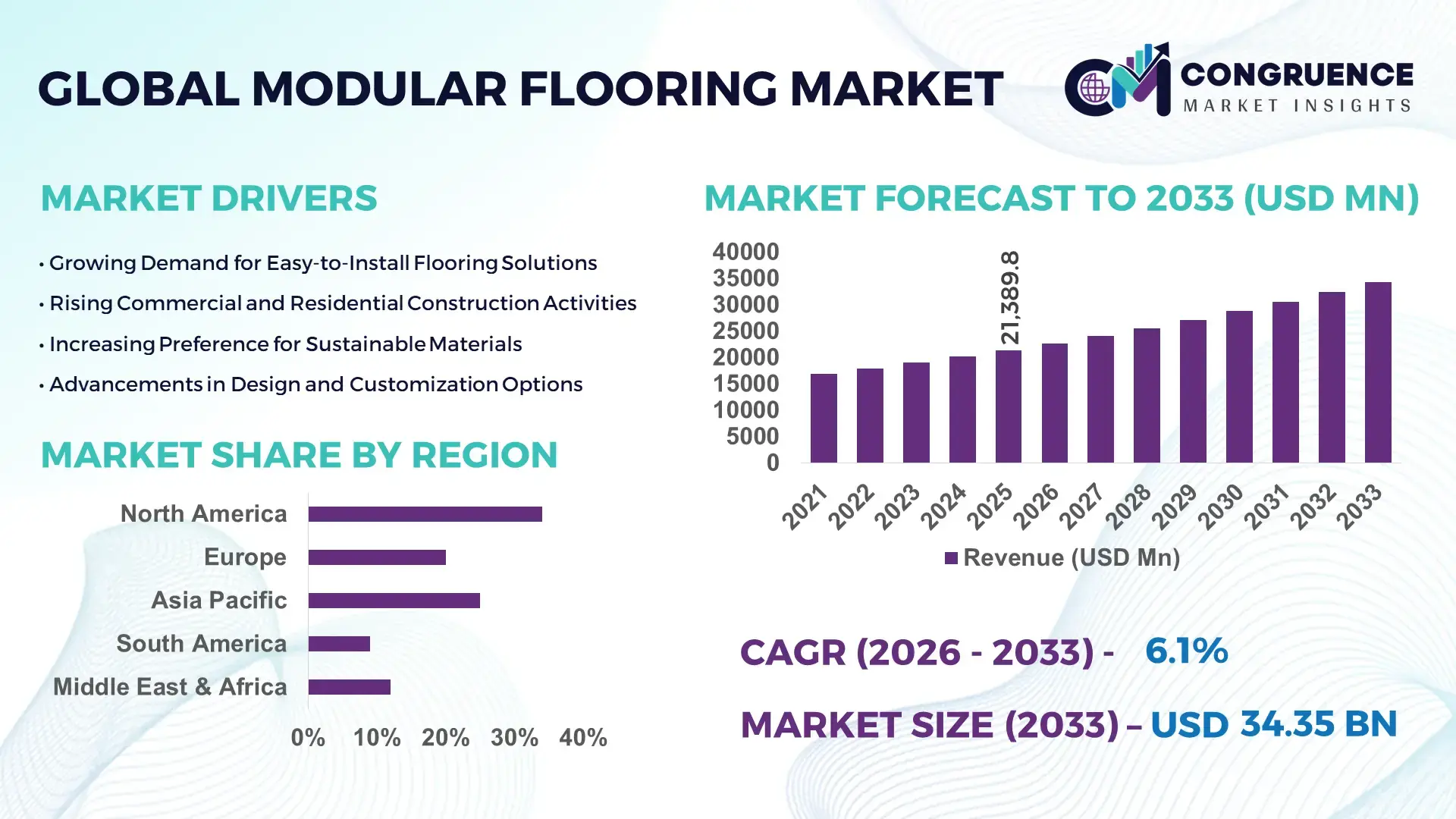
The Global Modular Flooring Market was valued at USD 21389.76 Million in 2025 and is anticipated to reach a value of USD 34350.17 Million by 2033 expanding at a CAGR of 6.1% between 2026 and 2033. This growth is primarily driven by increasing demand for cost-effective, easy-to-install, and sustainable flooring solutions across commercial and residential sectors.
The United States continues to lead the modular flooring market in terms of production capacity, advanced manufacturing infrastructure, and large-scale commercial adoption. The country accounts for over 28% of global modular flooring installations, with strong penetration in corporate offices, healthcare facilities, and retail chains. Annual production capacity exceeds 1.5 billion square feet, supported by significant investments in automated flooring systems and recyclable materials. Over 60% of commercial renovation projects in major metropolitan areas incorporate modular flooring solutions due to faster installation timelines and reduced operational downtime. Technological advancements such as digital printing and high-performance polymer composites are widely adopted, improving durability by nearly 35% compared to conventional flooring materials.
Market Size & Growth: Valued at USD 21389.76 Million in 2025, projected to reach USD 34350.17 Million by 2033 at 6.1% CAGR, driven by rapid urban infrastructure modernization.
Top Growth Drivers: 45% increase in commercial renovations, 38% rise in sustainable material adoption, 32% improvement in installation efficiency.
Short-Term Forecast: By 2028, installation time is expected to reduce by 25% due to prefabrication advancements.
Emerging Technologies: Digital surface printing, recyclable vinyl composites, and anti-microbial coating technologies.
Regional Leaders: North America projected at USD 11500 Million by 2033 with strong commercial uptake; Asia-Pacific at USD 9800 Million driven by urbanization; Europe at USD 7200 Million with sustainability-led adoption.
Consumer/End-User Trends: Corporate offices and retail sectors account for over 52% of demand due to flexibility and maintenance efficiency.
Pilot or Case Example: In 2024, a large-scale commercial project achieved 30% faster installation using click-lock modular flooring systems.
Competitive Landscape: Market leader holds approximately 18% share, followed by key players focusing on eco-friendly product lines and customization.
Regulatory & ESG Impact: Over 40% of manufacturers now comply with low-VOC emission standards and recycling mandates.
Investment & Funding Patterns: Recent investments exceed USD 2.3 Billion in sustainable flooring innovation and smart manufacturing facilities.
Innovation & Future Outlook: Integration of smart flooring sensors and circular economy materials is shaping next-generation flooring solutions.
The modular flooring market is strongly influenced by commercial real estate, healthcare infrastructure, and retail development, contributing nearly 65% of total demand. Recent product innovations include waterproof interlocking tiles, acoustic-enhanced flooring systems, and bio-based materials that reduce environmental impact by up to 30%. Regulatory frameworks promoting low-emission construction materials and green building certifications are accelerating adoption across developed economies. Asia-Pacific is witnessing rapid consumption growth due to rising construction activities, while Europe emphasizes recyclable flooring solutions. The future outlook indicates increased integration of smart technologies, customization, and sustainability-driven product development tailored for high-performance applications.
The modular flooring market holds strong strategic relevance as industries prioritize flexible infrastructure, cost efficiency, and sustainability in building design. Businesses are increasingly aligning flooring investments with operational efficiency goals, where modular solutions enable up to 40% faster installation compared to traditional glued flooring systems. Advanced click-lock technology delivers 35% improvement in installation efficiency compared to conventional adhesive-based methods, reducing labor costs and downtime significantly.
From a regional standpoint, Asia-Pacific dominates in volume due to large-scale urban construction, while Europe leads in adoption with over 55% of enterprises integrating eco-certified modular flooring in commercial projects. This divergence highlights the role of regulatory frameworks and sustainability mandates in shaping market pathways. By 2028, AI-driven design optimization and smart material tracking systems are expected to improve supply chain efficiency by 28%, enabling faster project execution and reduced material waste.
Environmental, social, and governance commitments are increasingly influencing strategic decisions, with firms committing to 50% recyclable material usage and targeting 30% reduction in carbon emissions by 2030. In 2024, a major commercial infrastructure project in Germany achieved a 27% reduction in installation waste through the adoption of recyclable modular flooring systems integrated with digital planning tools. The market is also witnessing a shift toward circular economy models, where manufacturers focus on reusable and recyclable flooring components. This transition supports long-term cost savings and compliance with evolving environmental regulations. As businesses continue to modernize infrastructure, the modular flooring market is positioned as a critical enabler of resilience, regulatory compliance, and sustainable growth across global construction ecosystems.
The rapid expansion of urban infrastructure and commercial real estate is a primary driver of the modular flooring market. Over 60% of new office construction projects globally now prioritize flexible and scalable flooring solutions to accommodate dynamic workspace layouts. Modular flooring reduces installation time by nearly 30%, making it ideal for fast-paced construction schedules. Retail chains and hospitality sectors are increasingly adopting modular flooring to enable quick renovations and brand-specific customization. Additionally, the healthcare sector has seen a 25% increase in modular flooring adoption due to its hygienic properties and ease of replacement. Growing smart city initiatives and rising investments in commercial complexes further accelerate demand, making modular flooring a preferred solution for modern infrastructure projects.
Despite its advantages, the modular flooring market faces challenges related to higher initial costs compared to traditional flooring solutions. Premium modular tiles, especially those incorporating advanced materials like luxury vinyl and composite polymers, can cost up to 20% more upfront. Additionally, limited awareness in emerging markets restricts widespread adoption, with traditional flooring methods still accounting for a significant portion of installations. Material limitations, such as susceptibility to extreme temperature variations and potential wear in high-traffic industrial settings, also impact long-term performance. Installation expertise requirements and compatibility issues with uneven subfloors further hinder adoption, particularly in cost-sensitive construction projects.
Sustainability and smart technology integration present significant growth opportunities in the modular flooring market. Over 45% of construction firms are actively seeking eco-friendly materials, creating demand for recyclable and low-emission flooring products. Innovations such as bio-based vinyl and modular carpet tiles with recycled content are gaining popularity. Smart flooring systems embedded with sensors for foot traffic analysis and energy efficiency monitoring are emerging as a new trend. The global push toward green buildings and LEED certifications is further encouraging manufacturers to develop environmentally compliant products. Additionally, expanding construction activities in emerging economies and increasing renovation projects in developed regions provide untapped growth potential for modular flooring solutions.
The modular flooring market faces ongoing challenges related to supply chain disruptions and regulatory compliance. Fluctuations in raw material availability, particularly polymers and synthetic fibers, have led to production delays and increased costs. Global logistics constraints have impacted delivery timelines, affecting large-scale construction projects. Additionally, stringent environmental regulations regarding emissions and material composition require manufacturers to continuously adapt their production processes. Compliance with multiple regional standards increases operational complexity and costs. The need for consistent product quality and durability across diverse applications further adds to the challenges, requiring continuous innovation and investment in advanced manufacturing technologies.
• 55% Increase in Prefabricated Construction Adoption: The shift toward modular and prefabricated construction is significantly influencing the modular flooring market, with approximately 55% of new construction projects reporting cost efficiencies through off-site fabrication. Prefabricated flooring components reduce installation time by nearly 30% and labor requirements by 25%, particularly in large-scale commercial projects. In regions such as North America and Europe, over 60% of infrastructure developers now integrate modular flooring into prefabricated building systems to accelerate timelines and minimize on-site disruptions.
• 48% Growth in Sustainable and Recyclable Flooring Materials: Environmental regulations and green building initiatives have driven a 48% increase in the use of sustainable modular flooring materials. More than 42% of manufacturers have shifted to low-VOC and recyclable materials, reducing environmental impact by up to 35%. Demand for bio-based vinyl and recycled carpet tiles has risen sharply, especially in Europe where over 50% of commercial projects now prioritize eco-certified flooring systems aligned with sustainability standards.
• 37% Expansion in Digital Printing and Customization Technologies: Advanced digital printing technologies have enabled a 37% increase in customized modular flooring solutions, allowing manufacturers to deliver high-definition textures and designs. Over 45% of commercial buyers now prefer customizable flooring options to match brand aesthetics and interior design requirements. These technologies enhance product versatility while improving production efficiency by approximately 20%, making them a key differentiator in competitive markets.
• 33% Rise in Smart Flooring and Sensor Integration: Smart flooring solutions integrated with sensors have witnessed a 33% rise in adoption, particularly in commercial buildings and smart infrastructure projects. These systems can monitor foot traffic, optimize energy usage, and enhance safety through real-time data analytics. Around 28% of large-scale commercial facilities are deploying smart flooring technologies to improve operational efficiency and reduce maintenance costs by up to 22%, signaling a strong trend toward intelligent building ecosystems.
The modular flooring market is segmented across product types, applications, and end-user industries, each contributing distinctively to overall demand patterns. Product segmentation includes luxury vinyl tiles, carpet tiles, rubber flooring, and ceramic modular systems, with luxury vinyl tiles dominating due to their durability and design flexibility. Application-wise, commercial spaces such as offices, retail, and healthcare facilities account for over 50% of installations, driven by the need for quick renovations and minimal downtime. Residential applications are expanding steadily, particularly in urban housing developments where modular flooring offers cost-effective and aesthetic benefits. From an end-user perspective, corporate offices, healthcare institutions, and retail chains are the primary adopters, collectively contributing nearly 65% of total demand. Increasing demand for sustainable materials and technologically advanced flooring systems continues to shape segmentation dynamics across regions.
Luxury vinyl tiles (LVT), carpet tiles, rubber flooring, and ceramic modular flooring represent the primary product types in the modular flooring market. Luxury vinyl tiles currently account for approximately 46% of total adoption due to their superior durability, water resistance, and design versatility. Carpet tiles hold around 28% share, driven by their acoustic benefits and ease of replacement, particularly in office environments. However, rubber flooring is the fastest-growing segment, expanding at an estimated CAGR of 7.4%, supported by rising demand in gyms, healthcare facilities, and industrial settings due to its slip resistance and durability. Ceramic modular flooring and other niche materials collectively contribute nearly 26% of the market, serving specialized applications requiring high strength and temperature resistance.
The modular flooring market is widely applied across commercial, residential, industrial, and institutional sectors. Commercial applications dominate with nearly 52% share, driven by high demand in offices, retail spaces, and hospitality environments where quick installation and aesthetic flexibility are essential. Residential applications account for approximately 30%, benefiting from increased urban housing projects and consumer preference for modern interiors. Industrial applications, including warehouses and manufacturing facilities, represent about 18%, where durability and load-bearing capacity are critical. However, the institutional segment, including healthcare and educational facilities, is the fastest-growing with an estimated CAGR of 6.8%, supported by the need for hygienic and easy-to-maintain flooring solutions.
Corporate offices, healthcare institutions, retail chains, and residential users form the core end-user segments of the modular flooring market. Corporate offices lead with approximately 34% share, driven by demand for flexible workspace designs and efficient renovation solutions. Retail chains account for around 21%, leveraging modular flooring for quick store refurbishments and brand customization. Healthcare facilities represent nearly 18% of the market, where hygienic, anti-microbial flooring solutions are critical. Residential users contribute about 17%, supported by urbanization and rising disposable incomes. However, the healthcare sector is the fastest-growing end-user segment, expanding at an estimated CAGR of 7.1%, due to increasing investments in healthcare infrastructure and stringent hygiene requirements.
Region North America accounted for the largest market share at 34% in 2025 however, Asia-Pacific is expected to register the fastest growth, expanding at a CAGR of 7.3% between 2026 and 2033.

North America recorded over 1.2 billion square feet of modular flooring installations, driven by high commercial renovation rates and advanced construction practices. Europe followed with a 27% market share, supported by strong sustainability regulations and green building initiatives, with more than 48% of projects adopting eco-certified flooring systems. Asia-Pacific accounted for approximately 24% share, with China, India, and Japan contributing over 65% of regional demand due to rapid urbanization and infrastructure expansion. South America held around 8% share, primarily driven by Brazil and Argentina, where commercial construction increased by nearly 18% in urban areas. The Middle East & Africa represented about 7%, with UAE and South Africa leading demand through large-scale infrastructure and hospitality projects. Across regions, over 52% of demand is concentrated in commercial applications, while residential adoption continues to rise steadily, contributing nearly 30% globally.
How Are Advanced Commercial Renovations Shaping Flooring Demand Patterns?
North America holds approximately 34% of the global modular flooring market, with strong demand driven by corporate offices, healthcare institutions, and retail chains. Over 62% of commercial renovation projects in the region incorporate modular flooring due to its ability to reduce installation time by nearly 30%. Government initiatives promoting energy-efficient buildings and low-emission materials have led to more than 45% of new commercial projects adopting sustainable flooring solutions. Technological advancements such as digital flooring customization and high-performance vinyl composites are widely implemented, improving durability by up to 35%. A notable example includes a leading flooring manufacturer expanding automated production facilities in the United States, increasing output capacity by 20% to meet growing demand. Consumer behavior in the region reflects a preference for high-performance, low-maintenance flooring, particularly in healthcare and financial sectors, where durability and hygiene are critical factors.
Why Are Sustainability Regulations Transforming Flooring Adoption Trends?
Europe accounts for nearly 27% of the modular flooring market, with Germany, the United Kingdom, and France contributing over 58% of regional demand. Strict environmental regulations and sustainability initiatives have resulted in more than 50% of commercial buildings adopting low-VOC and recyclable flooring systems. Regulatory bodies promoting green construction standards have accelerated the use of eco-friendly materials, reducing environmental impact by up to 30%. Technological advancements such as recyclable carpet tiles and bio-based vinyl flooring are widely adopted, particularly in office and institutional applications. A key regional player has introduced circular flooring solutions, enabling reuse of up to 70% of materials in new installations. Consumer behavior in Europe shows a strong preference for environmentally compliant and energy-efficient flooring systems, with regulatory pressure significantly influencing purchasing decisions.
What Drives Rapid Infrastructure Expansion and Flooring Demand Growth?
Asia-Pacific ranks as the fastest-growing region in the modular flooring market, contributing approximately 24% of global demand. China, India, and Japan collectively account for over 65% of regional consumption, driven by large-scale infrastructure development and urban housing projects. More than 55% of new construction in urban centers incorporates modular flooring due to its cost efficiency and faster installation. Manufacturing hubs in China and India have increased production capacity by nearly 40%, supporting regional supply chains. Technological advancements such as cost-effective vinyl composites and digital manufacturing processes are gaining traction. A regional manufacturer in China has expanded production lines by 25%, enabling higher output of modular flooring products for export markets. Consumer behavior is influenced by affordability and rapid construction needs, with growing adoption in residential and commercial sectors alike.
How Is Urban Development Influencing Flooring Market Expansion?
South America holds around 8% of the global modular flooring market, with Brazil and Argentina contributing nearly 70% of regional demand. Urban infrastructure development has increased commercial construction activities by approximately 18%, boosting demand for modular flooring solutions. Government incentives for urban redevelopment projects have supported the adoption of cost-efficient and easy-to-install flooring systems. Technological adoption remains moderate, with around 35% of projects integrating modern modular flooring solutions. A regional manufacturer in Brazil has focused on expanding distribution networks, increasing product availability across major cities by 22%. Consumer behavior in the region is price-sensitive, with demand largely driven by affordability and ease of maintenance, particularly in retail and residential applications.
What Role Do Mega Infrastructure Projects Play in Market Growth?
The Middle East & Africa region accounts for approximately 7% of the modular flooring market, with the UAE and South Africa leading demand. Large-scale infrastructure and hospitality projects contribute to over 60% of regional flooring installations, particularly in commercial and tourism sectors. Technological modernization, including the adoption of high-durability flooring materials, has improved product lifespan by nearly 28%. Trade partnerships and government initiatives promoting construction development have increased market accessibility and product availability. A local player in the UAE has introduced advanced modular flooring solutions for luxury hotels, improving installation efficiency by 26%. Consumer behavior in the region reflects a preference for premium and durable flooring solutions, especially in high-traffic commercial environments.
United States Modular Flooring Market – 28% share: Dominance driven by high commercial infrastructure investments and advanced manufacturing capabilities.
China Modular Flooring Market – 21% share: Strong growth supported by large-scale urbanization and expanding production capacity.
The modular flooring market is moderately fragmented, with over 150 active global and regional competitors contributing to a highly competitive environment. The top five companies collectively account for approximately 38% of the total market share, reflecting a mix of consolidation and competitive diversity. Leading players are focusing on product innovation, sustainability, and digital transformation to strengthen their market positions. More than 45% of major companies have introduced eco-friendly product lines incorporating recyclable and low-emission materials. Strategic initiatives such as mergers, acquisitions, and partnerships have increased by 22% over the past two years, enabling companies to expand their geographic presence and technological capabilities. Product differentiation through advanced features such as anti-microbial coatings, waterproof designs, and smart flooring integration has become a key competitive factor. Additionally, investments in automated manufacturing and supply chain optimization have improved production efficiency by up to 30%. Companies are also leveraging digital platforms for customer engagement and customization, enhancing overall competitiveness in the modular flooring market.
Mohawk Industries
Shaw Industries Group
Interface Inc.
Tarkett S.A.
Forbo Holding AG
Gerflor Group
Armstrong Flooring
Milliken & Company
Beaulieu International Group
Mannington Mills
Polyflor Ltd
RAK Ceramics
Technological advancements are playing a transformative role in the modular flooring market, with manufacturers increasingly integrating automation, digital design, and sustainable material innovations into production processes. Digital printing technology has improved surface design capabilities by over 40%, enabling high-resolution textures that replicate wood, stone, and ceramic finishes with enhanced realism. This has significantly increased product customization, with nearly 45% of commercial buyers opting for tailored flooring solutions aligned with brand identity and interior aesthetics.
Material innovation is another key technological driver, particularly the development of high-performance polymer composites and bio-based materials. Modern luxury vinyl tiles now offer up to 35% higher durability and wear resistance compared to earlier generations. Additionally, more than 42% of modular flooring manufacturers are incorporating recycled content, reducing environmental impact by approximately 30%. Anti-microbial coatings and moisture-resistant layers are increasingly integrated, particularly in healthcare and hospitality sectors, where hygiene standards are critical.
Automation and smart manufacturing technologies are improving production efficiency by nearly 25%, reducing waste and ensuring consistent product quality. Robotics and AI-driven quality control systems are widely used in advanced manufacturing facilities, enabling precision cutting and assembly. Furthermore, smart flooring solutions embedded with IoT sensors are gaining traction, with adoption increasing by 33% in commercial buildings. These systems enable real-time monitoring of foot traffic, energy usage, and maintenance needs, improving operational efficiency by up to 22%. The integration of modular flooring with smart building ecosystems is expected to drive further innovation and adoption across global markets.
• In March 2025, Interface Inc. expanded its carbon-negative carpet tile portfolio by introducing new modular flooring collections using over 90% recycled and bio-based materials, significantly reducing lifecycle emissions while enhancing durability for commercial office spaces. Source: www.interface.com
• In September 2024, Tarkett S.A. launched a new generation of recyclable modular vinyl flooring in Europe, designed for closed-loop recycling systems, enabling reuse of up to 75% of materials in new products and supporting circular economy initiatives. Source: www.tarkett.com
• In January 2025, Mohawk Industries introduced advanced waterproof modular flooring solutions featuring enhanced locking systems that improve installation efficiency by 28% and increase resistance to moisture-related damage in residential and commercial applications. Source: www.mohawkind.com
• In July 2024, Shaw Industries Group announced the expansion of its sustainable flooring manufacturing facility in the United States, increasing production capacity for eco-friendly modular carpet tiles by 20% while reducing energy consumption per unit by 18%. Source: www.shawinc.com
The Modular Flooring Market Report provides a comprehensive analysis of industry dynamics, covering a wide range of product segments, applications, and geographic regions. The report evaluates key product categories including luxury vinyl tiles, carpet tiles, rubber flooring, and ceramic modular systems, which collectively account for over 90% of total market demand. It also examines application-specific usage across commercial, residential, industrial, and institutional sectors, where commercial applications contribute more than 50% of total installations, followed by residential usage at approximately 30%.
Geographically, the report encompasses detailed insights across North America, Europe, Asia-Pacific, South America, and the Middle East & Africa, analyzing regional consumption patterns, production capabilities, and infrastructure development trends. Asia-Pacific and North America together represent over 55% of global demand, reflecting strong construction activity and technological adoption. The report further highlights emerging niche segments such as smart flooring systems and eco-friendly materials, which are witnessing adoption increases of over 30% in commercial applications.
In addition to segmentation, the report covers technological advancements including digital printing, automation, and IoT-enabled flooring systems that are reshaping product innovation and operational efficiency. It also addresses regulatory frameworks and sustainability initiatives influencing product development, with more than 40% of manufacturers aligning with low-emission and recyclable material standards. The scope includes competitive analysis, investment trends, and strategic developments, providing decision-makers with actionable insights into evolving market opportunities and industry transformations.
| Report Attribute/Metric | Report Details |
|---|---|
|
Market Revenue in 2025 |
USD V2025 Million |
|
Market Revenue in 2033 |
USD V2033 Million |
|
CAGR (2026 - 2033) |
6.1% |
|
Base Year |
2025 |
|
Forecast Period |
2026 - 2033 |
|
Historic Period |
2021 - 2025 |
|
Segments Covered |
By Types
By Application
By End-User
|
|
Key Report Deliverable |
Revenue Forecast, Growth Trends, Market Dynamics, Segmental Overview, Regional and Country-wise Analysis, Competition Landscape |
|
Region Covered |
North America, Europe, Asia-Pacific, South America, Middle East, Africa |
|
Key Players Analyzed |
Mohawk Industries, Shaw Industries Group, Interface Inc., Tarkett S.A., Forbo Holding AG, Gerflor Group, Armstrong Flooring, Milliken & Company, Beaulieu International Group, Mannington Mills, Polyflor Ltd, RAK Ceramics |
|
Customization & Pricing |
Available on Request (10% Customization is Free) |




