Global Modern Methods Of Construction (MMC) Market Report Overview
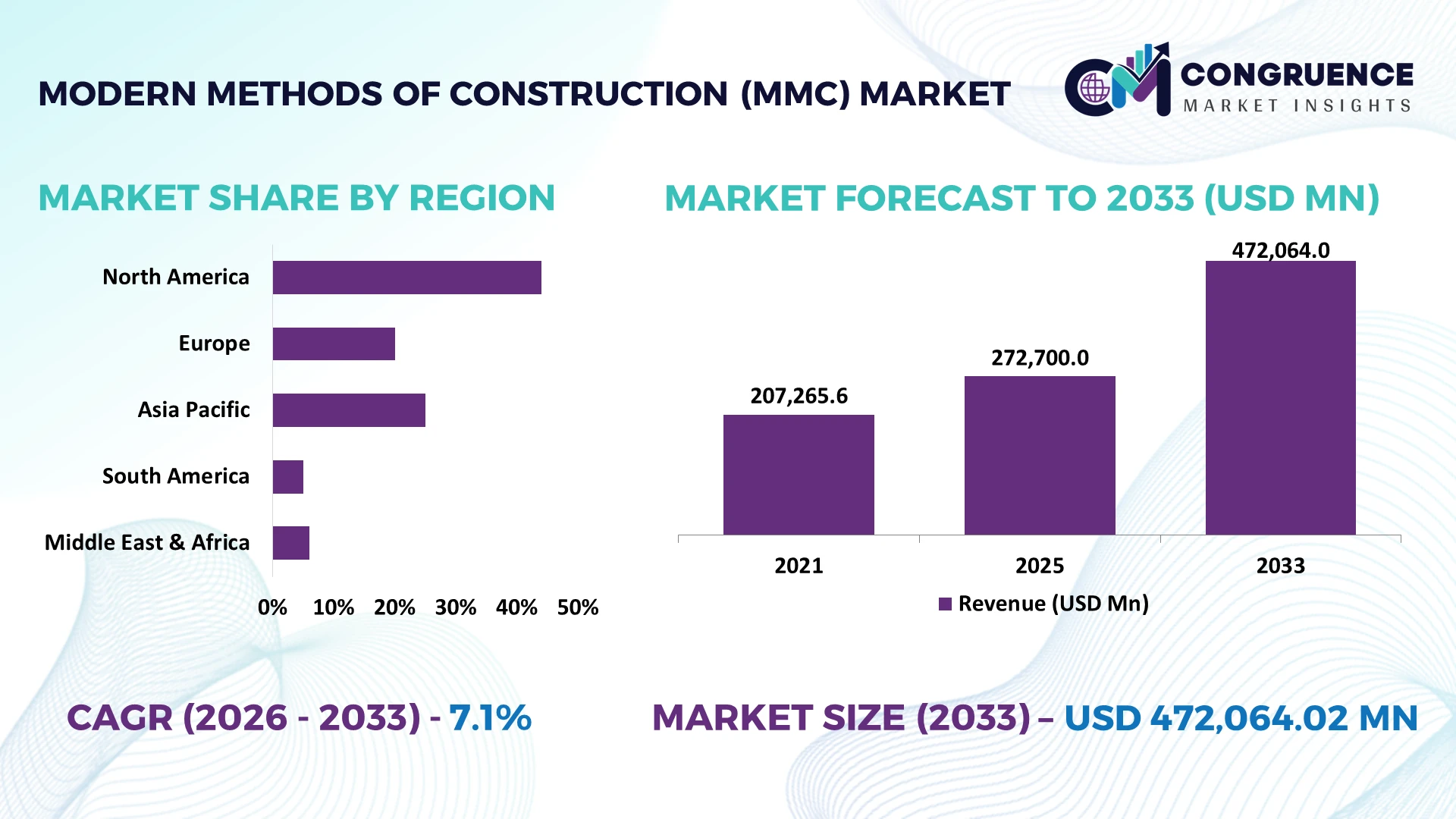
The Global Modern Methods Of Construction (MMC) Market was valued at USD 272700 Million in 2025 and is anticipated to reach a value of USD 472064.02 Million by 2033 expanding at a CAGR of 7.1% between 2026 and 2033. Growth is driven by construction labor shortages, industrialized offsite manufacturing, government-backed housing programs, and increasing adoption of prefabricated building systems.
China maintains a dominant position in the global Modern Methods Of Construction (MMC) Market, supported by extensive prefabrication capacity and large-scale residential infrastructure development. An indicative 30% global market share reflects established modular manufacturing networks and industrialized building practices. China's policy framework has targeted prefabricated construction for 30% of new buildings, compared with the United Kingdom's stronger emphasis on standardized housing components and public procurement. Automated precast production, volumetric modular assembly, and digital building modeling support faster project delivery across residential, commercial, and infrastructure developments.
Strategic implication: Developers investing in standardized modular production and digital construction workflows can target 20–30% shorter project schedules and 10–15% lower material waste in optimized projects.
Key Highlights of the Global Modern Methods Of Construction (MMC) Market
-
Market Size & Growth: USD 272,700 million in 2025, reaching USD 472,064.02 million by 2033 at 7.1% CAGR, supported by offsite manufacturing and construction labor shortages.
-
Top Growth Drivers: Indicative demand contributions include housing shortages at 40%, labor productivity pressures at 35%, and sustainable construction requirements at 25%.
-
Short-Term Forecast: By 2027, standardized modular construction programs target 20–30% shorter schedules and 10–15% lower material waste.
-
Emerging Technologies: Three innovations lead adoption: AI-assisted design, robotic prefabrication, and digital twins, targeting 15–20% fewer design coordination errors.
-
Regional Leaders: Illustrative 2033 allocations place Asia-Pacific at USD 188.83 billion, Europe at USD 132.18 billion, and North America at USD 103.85 billion, supported by prefabrication, public housing, and modular investment.
-
Consumer/End-User Trends: Residential construction represents an indicative 45% of MMC demand, supported by standardized housing production and accelerated project delivery.
-
Pilot/Case Example: A modeled 2026 modular housing project targets 25% faster completion and 15% lower construction waste through factory-built assemblies.
-
Competitive Landscape: China State Construction Engineering Corporation holds an illustrative 8% share, competing with Skanska, Bouygues, Laing O'Rourke, and Sekisui House.
-
Regulatory & ESG Impact: Offsite construction programs target 10–20% lower material waste, supporting building decarbonization and circular construction requirements.
-
Investment & Funding: An illustrative USD 2 billion investment scenario prioritizes automated modular factories, precast manufacturing, and digital construction partnerships.
-
Innovation & Future Outlook: By 2033, industrialized building platforms target 20–30% faster project delivery through standardized components and integrated manufacturing workflows.
The Modern Methods Of Construction (MMC) Market encompasses volumetric modular buildings, panelized construction, precast concrete systems, and advanced offsite manufacturing technologies. Residential housing, healthcare facilities, educational buildings, and commercial developments represent major demand areas. Standardized component production and automated factory assembly reduce dependence on variable onsite labor availability while improving quality consistency. Residential construction accounts for an indicative 45% of MMC deployment demand, reflecting pressure to accelerate housing delivery. Digital building information modeling, robotic fabrication, and low-carbon construction materials are reshaping project execution. Government housing initiatives and tightening building performance requirements increasingly favor repeatable, factory-controlled construction methods.
What Is the Strategic Relevance and Future Pathways of the Modern Methods Of Construction (MMC) Market?
Modern Methods Of Construction (MMC) are becoming strategically important as developers shift construction activity from labor-intensive sites toward controlled manufacturing environments. China's prefabricated building policies have targeted 30% adoption in new construction, reinforcing industrialized production capacity. Meanwhile, housing shortages and skilled labor constraints in the United Kingdom encourage standardized building systems. This transition restructures procurement around repeatable components, manufacturing throughput, and predictable installation schedules, giving developers greater control over project execution and working capital requirements.
Factory-manufactured volumetric modules can shorten construction schedules by an estimated 20–30% compared with conventional onsite methods under suitable project conditions. Asia-Pacific emphasizes high-volume precast production, while European developers prioritize building performance, design standardization, and regulatory compliance. North American adoption concentrates on multifamily housing, healthcare facilities, and education infrastructure. During 2026–2028, automated component fabrication and integrated building information modeling are expected to improve coordination efficiency and reduce rework across standardized projects.
A practical modular housing deployment combining factory-built room units with synchronized site preparation targets 25% faster completion and 15% lower material waste. Skanska, Laing O'Rourke, and Sekisui House are advancing industrialized construction capabilities and digital project delivery. Competitive advantage increasingly depends on manufacturing utilization, repeatable designs, and reliable supply-chain coordination.
Modern Methods Of Construction (MMC) Market Dynamics
DRIVER:
Housing Delivery Pressures Accelerate Industrialized Construction
Housing shortages and construction workforce constraints are accelerating investment in factory-manufactured building systems. Residential developments represent an indicative 45% of MMC demand, while standardized modular projects target 20–30% shorter construction schedules and 10–15% lower material waste compared with conventional methods. The United Kingdom's housing delivery challenges are encouraging developers to examine offsite manufacturing and repeatable building designs. Factory assembly transfers weather-sensitive activities into controlled production environments, improving scheduling reliability and reducing onsite labor exposure. Sekisui House, Skanska, and Laing O'Rourke are strengthening industrialized construction capabilities, digital design integration, and standardized component procurement. Developers achieving consistent factory utilization gain operational advantages through faster project turnover and reduced exposure to skilled trade shortages.
RESTRAINT:
High Factory Capital Requirements and Transport Constraints
MMC deployment faces structural limitations from manufacturing investment requirements, transportation restrictions, and uneven project pipelines. Automated modular production facilities require substantial upfront expenditure, while illustrative utilization below 60% can undermine fixed-cost absorption and manufacturing economics. Transporting volumetric modules can add an estimated 10–15% to logistics expenditure compared with locally assembled components in constrained delivery corridors. The United Kingdom's experience with financially distressed modular housing manufacturers demonstrates the risks associated with insufficient factory throughput and unpredictable procurement volumes. Developers must also address differences in building approvals and dimensional transport restrictions. Companies are reducing exposure through phased manufacturing investment, regional supplier networks, standardized components, and framework agreements that secure repeatable project volumes before expanding production capacity.
OPPORTUNITY:
Digital Manufacturing Platforms and Repeatable Building Systems
Integrated digital design and automated component production create opportunities to improve manufacturing productivity and reduce construction coordination losses. Building information modeling linked with factory execution systems targets 15–20% fewer design coordination errors, while automated cutting and component fabrication can reduce material waste by an estimated 10–15% in standardized projects. India's expanding urban housing requirements and infrastructure modernization programs support adoption of precast and panelized construction methods. Reusable digital building configurations enable manufacturers to adapt standardized components across multiple developments without repeating engineering work. Skanska, Sekisui House, and specialist modular manufacturers are investing in design automation, prefabricated building systems, and supplier integration. The strategic opportunity lies in commercializing repeatable building platforms rather than treating each construction project as a separate manufacturing assignment.
CHALLENGE:
Design Integration and Manufacturing Execution Reliability
Scaling MMC requires precise coordination between architectural design, factory production, transportation schedules, and onsite assembly. In modeled modular projects, a 5% dimensional tolerance failure rate can trigger substantial rework when prefabricated components arrive at installation sites. Integrated digital quality control targets 15–20% fewer assembly discrepancies, but successful deployment depends on consistent data exchange between designers, manufacturers, and contractors. Japan's advanced prefabricated housing industry demonstrates the importance of standardized production systems and skilled installation teams. Companies must strengthen digital interoperability, workforce training, component traceability, and installation quality assurance. Skanska, Laing O'Rourke, and Sekisui House are developing integrated construction delivery capabilities. Long-term competitiveness depends on maintaining factory precision while accommodating project-specific design requirements and changing building regulations.
Modern Methods Of Construction (MMC) Market Latest Trends
-
Design Freezes Move Earlier Upstream: British modular developers are shifting design approvals ahead of factory procurement to avoid late engineering changes. Illustrative programs target 15% fewer drawing revisions and 10% lower component rework. Laing O'Rourke and other industrialized contractors are tightening design release procedures and supplier coordination. Earlier specification decisions reduce manufacturing interruptions, although developers must resolve tenant customization requirements before production begins.
-
Precast Connections Receive Greater Scrutiny: Japanese and European contractors are strengthening inspection of structural joints, lifting anchors, and assembly tolerances. Modeled quality programs target 20% fewer connection defects and 15% faster onsite acceptance inspections. Sekisui House and specialist precast manufacturers emphasize factory testing and documented component traceability. The operational benefit extends beyond defect reduction: reliable connections shorten crane occupancy and reduce costly installation resequencing.
-
Low-Carbon Material Procurement Intensifies: European construction teams are increasingly specifying lower-carbon concrete and recycled steel in prefabricated assemblies. Selected procurement scenarios target 20–30% lower embodied emissions and 10–15% recycled material substitution without compromising structural requirements. Skanska and Bouygues are strengthening supplier qualification and environmental product declaration workflows. Building performance regulations encourage material traceability, making verified product documentation increasingly important for tender competitiveness.
-
Factory Production Scheduling Becomes Dynamic: Modular manufacturers are introducing production sequencing systems that synchronize component fabrication with transport and crane availability. Illustrative deployment targets include 15–20% lower finished-module storage requirements and 10% fewer delivery rescheduling events. Industrialized construction contractors are integrating factory planning with site logistics platforms. This approach reduces inventory congestion and protects production continuity when urban access restrictions limit installation windows.
Segmentation Analysis
By Type
Prefabricated Components Lead Industrialized Building Production
Prefabricated Components represent the largest segment, accounting for an indicative 32% of the global Modern Methods Of Construction (MMC) Market in 2025. Their dominance reflects widespread application in structural assemblies, staircases, floor systems, and standardized building elements. Panelized Systems contribute approximately 27%, supported by repeatable wall and floor manufacturing for residential and commercial developments. Volumetric Modular Construction accounts for an estimated 23%, offering extensive factory completion and reduced onsite assembly requirements.
3D-Printed Construction represents the fastest-growing type, holding an indicative 5% share as automated material deposition and digitally controlled fabrication expand beyond demonstration projects. Hybrid Construction Systems account for approximately 13%, combining factory-manufactured assemblies with conventional structural techniques. Emerging 3D printing applications prioritize reduced formwork requirements and geometric flexibility, while mature prefabrication methods compete through production reliability and established certification procedures. Sekisui House, Skanska, and specialist construction technology developers are investing in automated fabrication, modular design platforms, and standardized component interfaces. Investment increasingly favors technologies with repeatable production economics and predictable installation performance.
- The Modular Building Institute's 2025 industry reporting highlights continued adoption of permanent modular construction across residential, commercial, and institutional projects. Its industry tracking reinforces the importance of factory manufacturing capacity, standardized components, and repeatable project delivery.
By Application
Residential Construction Anchors MMC Deployment Demand
Residential Construction accounts for an indicative 45% of the global Modern Methods Of Construction (MMC) Market in 2025, reflecting demand for standardized housing production, accelerated construction schedules, and improved labor productivity. Commercial Buildings contribute approximately 20%, supported by modular offices, hospitality developments, and repeatable building layouts. Industrial Facilities represent an estimated 15%, emphasizing prefabricated structural assemblies and efficient installation within operational industrial environments.
Healthcare and Educational Buildings represent the fastest-growing application, accounting for an indicative 12% share as institutional operators prioritize rapid capacity expansion and predictable project delivery. Infrastructure Projects contribute approximately 8%, including prefabricated civil engineering elements and modular support structures. Factory-built institutional modules can target 20–30% shorter delivery schedules compared with conventional onsite construction under suitable conditions. Skanska, Laing O'Rourke, and Sekisui House are strengthening standardized construction systems and integrated design capabilities. Residential developers prioritize production scalability, while institutional projects emphasize compliance, installation speed, and minimal disruption to existing facilities. Investment priorities increasingly reflect project repeatability and operational continuity requirements.
- The United Nations Environment Programme's 2025 Global Status Report for Buildings and Construction identifies buildings and construction as responsible for approximately 32% of global energy demand, reinforcing interest in resource-efficient construction methods and improved building performance.
By End-User
Residential Developers Dominate MMC Procurement
Residential Developers represent the largest end-user segment, accounting for an indicative 40% of the global Modern Methods Of Construction (MMC) Market in 2025. Their purchasing concentration reflects housing supply pressures, standardized building layouts, and the need to improve construction scheduling reliability. Commercial Property Developers contribute approximately 22%, emphasizing repeatable office, hospitality, and mixed-use developments. Industrial Facility Owners account for an estimated 15%, prioritizing prefabricated structures and reduced installation disruption.
Government and Public Sector represents the fastest-growing end-user category, holding an indicative 13% share as public housing, infrastructure modernization, and institutional procurement programs increasingly evaluate industrialized construction. Healthcare and Educational Institutions contribute approximately 10%, requiring compliant building systems and predictable project completion. Government procurement frameworks can support repeatable manufacturing orders, improving factory utilization and supplier investment confidence. Skanska, Laing O'Rourke, and Sekisui House are strengthening standardized building platforms and collaborative procurement models. Residential developers prioritize cost certainty, while public buyers emphasize lifecycle performance, quality assurance, and transparent delivery schedules.
- The UK government's 2025 housing policy maintained a target of delivering 1.5 million homes during the parliamentary term. This commitment reinforces the importance of scalable construction capacity, standardized housing systems, and coordinated public procurement.
Region-Wise Market Insights
Asia-Pacific accounted for the largest market share at an estimated 40% in 2025 however, Middle East & Africa is expected to register the fastest growth, expanding at a projected CAGR of 9.2% between 2026 and 2033.

North America Modern Methods Of Construction (MMC) Market
Industrialized Housing Production and Modular Infrastructure Development
North America accounted for an estimated 22% of the global Modern Methods Of Construction (MMC) Market in 2025, supported by residential housing shortages, construction labor constraints, and growing investment in factory-built building systems. The United States dominates regional demand through multifamily housing, healthcare facilities, educational buildings, and commercial developments. Canada contributes established modular construction capabilities, particularly in remote infrastructure and institutional projects. The U.S. modular construction industry increasingly emphasizes permanent modular buildings, standardized structural assemblies, and integrated building information modeling. Factory-manufactured modules can target 20–30% shorter construction schedules in optimized projects. Developers are strengthening partnerships with offsite manufacturers to improve project delivery reliability. Regional adoption increasingly depends on building code compliance, transportation accessibility, and predictable factory utilization, encouraging investment in standardized designs and coordinated installation logistics.
United States Market Outlook: The United States maintains a strong MMC position through established prefabrication manufacturers, advanced construction technology, and substantial housing development requirements. Residential construction represents an indicative 45% of domestic MMC demand. California, Texas, and Florida offer opportunities for modular housing and institutional construction. Factory-built construction supports reduced onsite labor requirements, while standardized building systems improve installation consistency. Developers increasingly evaluate prefabricated components for projects requiring accelerated occupancy and predictable completion schedules.
Europe Modern Methods Of Construction (MMC) Market
Standardized Building Systems and Low-Carbon Construction Procurement
Europe represented an estimated 28% of the global Modern Methods Of Construction (MMC) Market in 2025, supported by advanced prefabrication capabilities, building performance regulations, and public housing development programs. Germany, the United Kingdom, Sweden, and the Netherlands maintain significant industrialized construction activity. European developers increasingly use panelized systems, volumetric modular buildings, and prefabricated structural components to improve project delivery reliability. The European Union's revised Energy Performance of Buildings Directive strengthens the emphasis on efficient building design and construction quality. Factory manufacturing can target 10–15% lower material waste compared with conventional onsite practices. Skanska, Bouygues, and specialist modular manufacturers are strengthening digital design coordination and standardized component procurement. Competitive differentiation increasingly depends on certified building performance, manufacturing efficiency, and the ability to integrate lower-carbon materials into repeatable construction systems.
United Kingdom Market Outlook: The United Kingdom maintains strategic importance through housing supply pressures, public procurement initiatives, and established offsite construction expertise. The government has targeted delivery of 1.5 million homes during the parliamentary term, reinforcing interest in scalable construction methods. Laing O'Rourke and other industrialized contractors emphasize digital engineering, precast production, and coordinated building assembly. However, factory utilization and consistent project pipelines remain critical to maintaining commercially sustainable modular construction operations.
Asia-Pacific Modern Methods Of Construction (MMC) Market
Large-Scale Prefabrication and Automated Building Manufacturing
Asia-Pacific held an estimated 40% share of the global Modern Methods Of Construction (MMC) Market in 2025, supported by extensive manufacturing capacity, urban development, and established prefabrication technologies. China dominates regional industrialized construction activity through large-scale precast concrete production and government-supported building modernization. Japan maintains advanced factory-built housing capabilities, while India offers opportunities through urban housing programs and infrastructure development. China's policy framework has targeted prefabricated construction for 30% of new buildings, reinforcing standardized building component production. Japan's Sekisui House demonstrates industrialized housing delivery through integrated design, manufacturing, and installation systems. Regional contractors increasingly invest in automated precast production, modular structural assemblies, and digital quality management. Competitive positioning depends on production scale, standardized engineering, efficient transportation, and consistent onsite installation performance across residential and infrastructure projects.
China Market Outlook: China maintains a leading MMC position through extensive prefabrication manufacturing, large-scale urban construction, and industrialized building technologies. Precast concrete systems and standardized structural components support residential developments, transportation infrastructure, and public facilities. China State Construction Engineering Corporation participates in industrialized construction and advanced project delivery. Automated component manufacturing and building information modeling strengthen production coordination, while national building modernization policies encourage wider adoption of prefabricated structural systems.
South America Modern Methods Of Construction (MMC) Market
Industrial Prefabrication and Affordable Housing Modernization
South America accounted for an estimated 5% of the global Modern Methods Of Construction (MMC) Market in 2025, supported by affordable housing requirements, industrial infrastructure development, and growing interest in prefabricated building systems. Brazil dominates regional construction activity through residential development, commercial projects, and industrial facility expansion. Chile contributes established prefabrication applications in mining infrastructure and remote construction environments. Modular buildings and precast structural elements help reduce onsite construction requirements in geographically challenging locations. Illustrative deployment scenarios target 15–20% shorter project schedules through standardized component manufacturing. Regional developers increasingly evaluate panelized systems and factory-built assemblies to improve labor productivity. However, transportation infrastructure limitations and fragmented construction procurement can restrict deployment scale. Manufacturers are strengthening localized production partnerships and modular design capabilities to improve project economics and installation reliability.
Brazil Market Outlook: Brazil maintains substantial MMC potential through extensive urban housing requirements, industrial construction activity, and established precast concrete manufacturing. The Minha Casa, Minha Vida housing program supports residential development and construction capacity expansion. São Paulo and Minas Gerais concentrate significant construction and manufacturing activity. Prefabricated structural components offer opportunities to improve project scheduling, while regional production facilities help reduce transportation costs and improve component availability for residential and industrial developments.
Middle East & Africa Modern Methods Of Construction (MMC) Market
Megaproject Investment and Industrialized Construction Expansion
Middle East & Africa represented an estimated 5% of the global Modern Methods Of Construction (MMC) Market in 2025, supported by large infrastructure programs, industrial diversification, and expanding demand for accelerated building delivery. Saudi Arabia and the United Arab Emirates lead regional adoption through major residential, hospitality, and infrastructure developments. South Africa contributes demand from housing, institutional buildings, and industrial facilities. Saudi Arabia's Vision 2030 transformation program encourages advanced construction technologies and localized manufacturing capabilities. Modular construction and prefabricated structural systems can target 20–30% shorter installation schedules in suitable projects. Developers are investing in precast production, digital engineering, and factory-built building components. Competitive positioning increasingly depends on large-project execution capacity, local manufacturing partnerships, and reliable supply chains capable of supporting demanding construction schedules and environmental conditions.
Saudi Arabia Market Outlook: Saudi Arabia maintains strong MMC opportunities through Vision 2030 infrastructure development, residential construction, and large-scale tourism projects. NEOM and other major developments have encouraged interest in modular building systems, automated construction, and industrialized component manufacturing. The country's target of 70% homeownership by 2030 reinforces residential development requirements. Localized precast production and modular manufacturing partnerships support faster project delivery while reducing dependence on imported construction components.
Market Competition Landscape
China State Construction Engineering Corporation, Skanska, Bouygues, Laing O'Rourke, and Sekisui House compete through industrialized building capabilities, project execution expertise, and manufacturing integration, while specialist modular producers emphasize customization and regional responsiveness. The leading five companies hold an illustrative combined 22% market share, reflecting fragmented procurement and substantial local contractor participation. Factory-manufactured systems target 20–30% shorter construction schedules, while standardized production offers modeled 10–15% lower material waste. Sekisui House emphasizes integrated housing manufacturing; Laing O'Rourke invests in advanced precast production, while Skanska and Bouygues integrate digital construction workflows. Competition increasingly shifts toward repeatable building platforms, automated component fabrication, and predictable factory utilization. High manufacturing investment requirements, building certification complexity, and inconsistent project pipelines create entry barriers. Successful competitors must combine standardized engineering, reliable installation logistics, competitive lifecycle costs, and sustained manufacturing throughput to outperform established construction contractors across diverse building applications and markets.
Companies Profiled in the Modern Methods Of Construction (MMC) Market Report
Technology Insights for the Modern Methods Of Construction (MMC) Market
Current MMC technologies combine building information modeling, automated precast production, and factory controlled modular assembly. Digital coordination targets 15–20% fewer design conflicts, while standardized fabrication offers modeled material waste reductions of 10–15%. Adoption concentrates in residential developments, institutional buildings, and infrastructure projects requiring repeatable components. Compared with conventional onsite construction, integrated volumetric manufacturing can shorten project schedules by 20–30% under suitable conditions. Sekisui House and Laing O'Rourke benefit from manufacturing consistency, controlled installation sequencing, and reduced exposure to site disruptions.
Emerging technologies include robotic welding, computer vision inspection, and digitally connected production equipment. Automated quality inspection targets 15% fewer component defects, while robotic fabrication can improve repetitive assembly productivity by an estimated 20%. Manufacturers increasingly integrate digital twins with factory scheduling to coordinate component availability, transportation, and installation requirements. These systems strengthen production traceability and reduce costly assembly interruptions.
During 2026–2028, disruptive innovation will emphasize additive construction, configurable building platforms, and AI assisted manufacturing orchestration. Illustrative 3D printing deployments target 20% lower formwork requirements, while automated design validation aims to reduce engineering revisions by 15%. Companies investing in interoperable digital platforms and adaptable production lines gain stronger capacity utilization, faster customization, and greater competitiveness in industrialized construction procurement markets.
Recent Developments in the Global Modern Methods Of Construction (MMC) Market
-
August 2024: Skanska and Hoffman Construction completed Portland International Airport's first redevelopment phase, installing 14 prefabricated roof sections spanning nine acres. Offsite assembly enabled complex structural installation above an operating terminal, demonstrating industrialized construction's value for infrastructure modernization. Source: skanska.com
-
June 2025: UCC Holding partnered with Qatar's Public Works Authority to commence construction printing for two schools totaling 40,000 square meters. Customized COBOD printers support large-scale institutional construction, demonstrating additive manufacturing's transition beyond small residential projects. Source: uccholding.com
-
November 2025: PERI 3D Construction completed Germany's DREIHAUS housing project using COBOD technology, delivering 21 residential units. The contractor reported construction 30% faster than conventional methods, demonstrating repeatable printed housing designs and improved delivery economics. Source: 3dptimes.com
-
July 2025: Homes England published its annual report, confirming that 22% of supported Affordable Housing Programme completions used Modern Methods of Construction. This documented adoption strengthens procurement transparency and provides manufacturers measurable evidence of institutional deployment. Source: gov.uk
Scope of the Modern Methods Of Construction (MMC) Market Report
The Modern Methods Of Construction (MMC) Market Report examines industrialized building systems, manufacturing capabilities, deployment patterns, and competitive positioning between 2026 and 2033. Type coverage includes Volumetric Modular Construction, Panelized Systems, Prefabricated Components, Hybrid Construction Systems, and 3D-Printed Construction. Application analysis evaluates Residential Construction, Commercial Buildings, Industrial Facilities, Healthcare and Educational Buildings, and Infrastructure Projects. End-user coverage includes Residential Developers, Commercial Property Developers, Industrial Facility Owners, Government and Public Sector, and Healthcare and Educational Institutions.
Regional assessment covers North America, Europe, Asia-Pacific, South America, and Middle East & Africa. Prefabricated Components represent an indicative 32% segment share, while Residential Construction contributes approximately 45% of application demand. Technology analysis examines robotic fabrication, digital twins, automated precast production, and additive manufacturing. Competitive benchmarking supports manufacturing investment, market entry, procurement planning, regional expansion, and long-term industrialized construction strategies.
Modern Methods Of Construction (MMC) Market Report Summary
| Report Attribute/Metric | Report Details |
|---|
Market Revenue in 2025 | USD 272700 Million |
Market Revenue in 2033 | USD 472064.02 Million |
CAGR (2026 - 2033) | 7.1% |
Base Year | 2025 |
Forecast Period | 2026 - 2033 |
Historic Period | 2021 - 2025 |
Segments Covered | By TypeVolumetric Modular Construction Hybrid Construction Systems
By ApplicationHealthcare and Educational Buildings
By End-UserCommercial Property Developers Industrial Facility Owners Government and Public Sector Healthcare and Educational Institutions
|
Key Report Deliverable | Revenue Forecast, Growth Trends, Market Dynamics, Segmental Overview, Regional and Country-wise Analysis, Competition Landscape |
Region Covered | North America, Europe, Asia-Pacific, South America, Middle East, Africa |
Key Players Analyzed | China State Construction Engineering Corporation, Skanska AB, Bouygues Construction, Laing O'Rourke, Sekisui House, Ltd., Daiwa House Industry Co., Ltd., Lendlease Group, VINCI Construction, Larsen & Toubro Limited, NCC AB, Balfour Beatty plc, STRABAG SE, Katerra Inc., Kleusberg GmbH & Co. KG |
Customization & Pricing | Available on Request (10% Customization is Free) |





