
Reports
The Global Model Based Testing Tools Market was valued at USD 1382.07 Million in 2025 and is anticipated to reach a value of USD 2877.51 Million by 2033 expanding at a CAGR of 9.6% between 2026 and 2033. Growth is being accelerated by large-scale adoption of AI-assisted software validation, automotive software-defined vehicle development, regulated aerospace testing, and continuous integration workflows that require automated model-driven test generation with higher traceability.
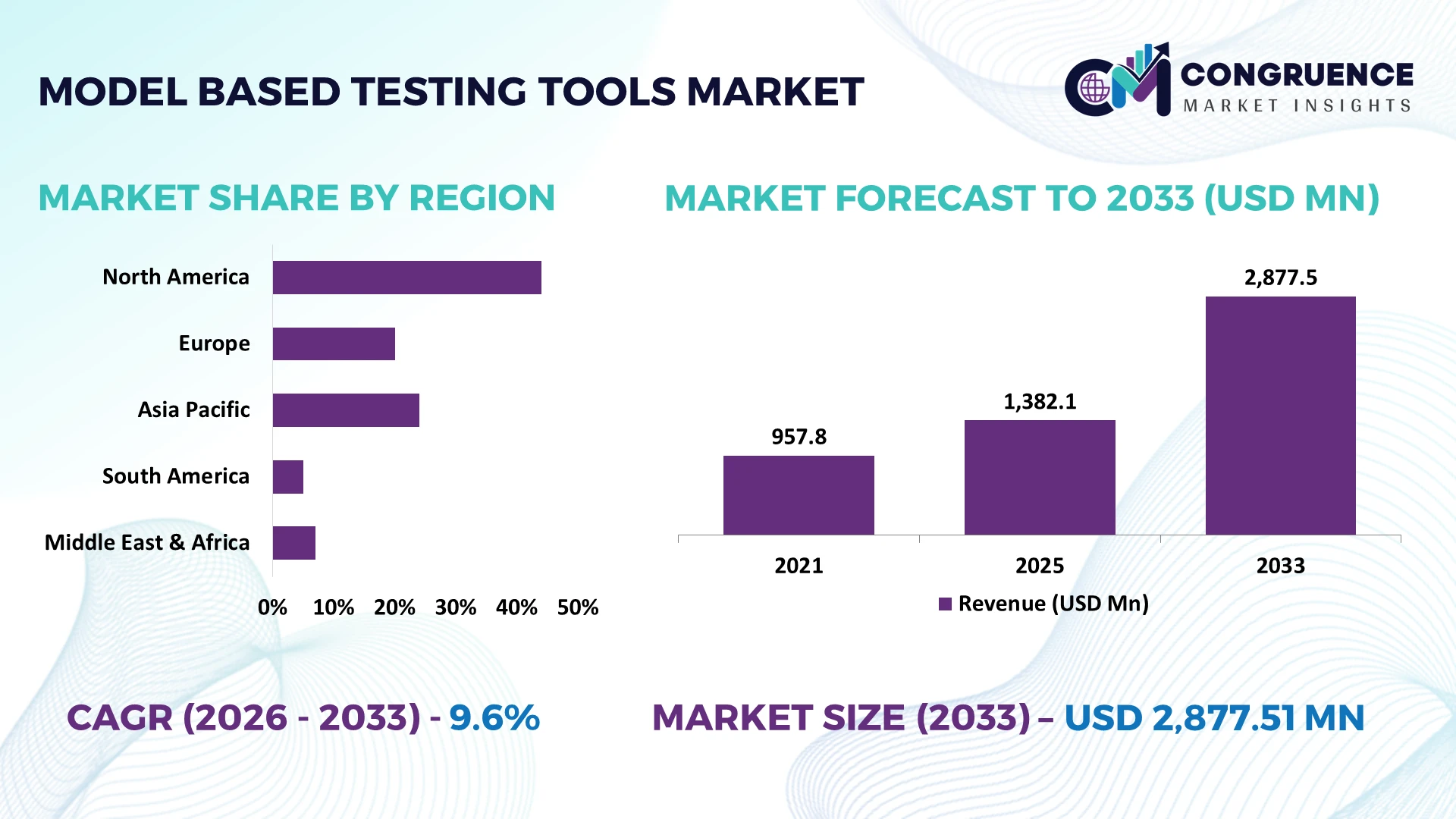
The United States dominates the global Model Based Testing Tools Market with an estimated 34% share, supported by multi-billion-dollar digital engineering investments across defense, automotive, aerospace, and enterprise software sectors. More than 68% of large software engineering organizations integrate automated testing frameworks into DevOps pipelines, compared with approximately 24% in India, where enterprise adoption is expanding through financial services and telecom modernization. Continued digital sovereignty initiatives following evolving global cybersecurity regulations further reinforce enterprise investment in advanced testing ecosystems.
Organizations investing in scalable model-based testing platforms gain faster release cycles, stronger compliance readiness, and a measurable competitive advantage in complex software development environments.
Market Size & Growth: USD 1382.07 Million in 2025, reaching USD 2877.51 Million by 2033 at a CAGR of 9.6%, driven by AI-enabled software validation and digital engineering expansion.
Top Growth Drivers: AI-assisted test generation improves productivity by 35%, DevOps automation increases deployment efficiency by 30%, and software-defined vehicle programs expand testing demand by 28%.
Short-Term Forecast: By 2028, automated model-based testing reduces manual testing effort by 40% and shortens release cycles by 25%.
Emerging Technologies: AI-driven test generation, digital twins, and cloud-native automation platforms improve defect detection rates by nearly 32%.
Regional Leaders: North America exceeds USD 980 Million, Europe approaches USD 760 Million, and Asia-Pacific surpasses USD 690 Million by 2033, supported by regional digital transformation and software localization.
Consumer/End-User Trends: Nearly 64% of enterprise development teams prioritize automated model-based validation for safety-critical and regulated software projects.
Pilot/Case Example: A 2026 automotive software deployment achieved 38% faster validation and reduced regression testing time by 41% using model-based automation.
Competitive Landscape: The leading vendor holds approximately 17% market share, with SmartBear, Tricentis, Parasoft, OpenText, and Keysight maintaining strong global competition.
Regulatory & ESG Impact: Compliance-focused automation lowers audit preparation effort by 27% while supporting secure software lifecycle requirements across regulated industries.
Investment & Funding: More than USD 1.4 Billion in strategic investments supports AI testing platforms, cloud partnerships, and regional expansion amid global software supply-chain modernization.
Innovation & Future Outlook: Next-generation generative AI, autonomous test orchestration, and continuous verification strengthen enterprise software quality while accelerating intelligent engineering strategies.
Model Based Testing Tools are gaining stronger adoption across automotive, aerospace, financial services, healthcare, and industrial automation where complex software validation is essential. AI-assisted model generation and cloud-native testing environments improve testing efficiency by nearly 30% while supporting compliance with evolving cybersecurity requirements. Increasing localization of software engineering operations and resilient digital supply-chain strategies are further strengthening long-term market expansion, setting the stage for broader strategic investments.
Model Based Testing Tools have become strategically important as enterprises accelerate software-defined products, safety-critical applications, and AI-enabled engineering workflows. The market is shifting beyond quality assurance toward continuous validation across automotive, aerospace, healthcare, and financial services, where compliance and rapid software delivery determine competitive positioning. Growing software supply-chain security requirements and stricter cybersecurity regulations are encouraging organizations to replace fragmented testing environments with integrated model-driven validation platforms.
Modern AI-assisted model-based testing platforms generate and optimize test cases up to 45% faster than legacy manual scripting while reducing regression testing effort by nearly 35%. Germany continues to lead industrial deployment through automotive engineering and embedded software validation, whereas India is expanding implementation across banking, telecom, and digital public infrastructure with enterprise adoption exceeding 22% among large development organizations. Over the next two to three years, automated test orchestration is expected to exceed 60% deployment across enterprise DevOps environments supporting mission-critical software delivery.
A practical example is the deployment of model-based validation in software-defined vehicle development, where manufacturers shorten release cycles while improving traceability for functional safety compliance. Technology providers are expanding AI capabilities, strengthening cloud partnerships, and investing in industry-specific testing frameworks. Organizations that align testing automation with digital engineering strategies will secure stronger operational resilience, faster innovation cycles, and sustainable competitive differentiation.
The rapid transition to software-defined products and continuous software delivery is fundamentally reshaping enterprise testing strategies. More than 65% of large organizations now integrate automated testing into DevOps pipelines, while AI-assisted test generation improves productivity by approximately 35% and defect detection by nearly 30%. The United States is strengthening software assurance requirements across defense and critical infrastructure, accelerating adoption of model-based validation platforms. This shift increases demand for scalable, traceable testing environments capable of supporting complex applications. In response, technology vendors are expanding cloud-native offerings, investing in AI-driven automation, and forming strategic partnerships with engineering platform providers to strengthen lifecycle integration and reduce enterprise deployment complexity.
Many enterprises continue to operate fragmented software ecosystems that limit seamless adoption of model-based testing solutions. Around 42% of large manufacturers still depend on legacy testing frameworks, while integration projects increase implementation timelines by nearly 25% and initial deployment costs by approximately 18%. Japan's industrial sector illustrates this challenge, where established engineering infrastructures require extensive customization before modern testing platforms can be deployed effectively. These interoperability limitations reduce scalability and delay digital transformation initiatives. To mitigate these constraints, companies are adopting open architecture standards, localizing implementation services, and expanding technology alliances that improve compatibility across heterogeneous development and validation environments.
The convergence of generative AI, digital twins, and cloud engineering platforms is creating new commercial opportunities for advanced model-based testing solutions. AI-enabled automation reduces test design effort by nearly 40%, while intelligent analytics improve validation efficiency by approximately 28%. India is emerging as a strategic software engineering hub through large-scale digital transformation initiatives and expanding engineering service capabilities. Vendors are investing in industry-specific AI models, low-code testing environments, and ecosystem partnerships that simplify deployment across regulated industries. A notable opportunity lies in integrating cybersecurity validation directly into model-based testing workflows, enabling organizations to improve software resilience while reducing compliance workloads through automated verification.
Sustaining enterprise-wide deployment remains challenging as software architectures become increasingly distributed across cloud, edge, and embedded environments. Nearly 37% of organizations report shortages of specialists with model-based engineering expertise, while complex multi-platform integration increases validation workloads by approximately 26%. The United Kingdom faces growing pressure to strengthen software assurance for critical digital infrastructure, requiring higher levels of testing consistency and governance. These execution challenges affect deployment quality, operational scalability, and long-term competitiveness. Companies must expand workforce development, invest in AI-assisted engineering tools, establish standardized testing frameworks, and strengthen strategic partnerships to deliver secure, scalable, and repeatable software validation across increasingly complex digital ecosystems.
AI-Native Test Generation Expansion AI-powered model generation is becoming a standard enterprise workflow, with nearly 58% of large development teams deploying generative AI for automated test creation and over 32% reducing manual scripting requirements. New software governance rules and secure development mandates are accelerating adoption. Vendors are embedding AI assistants into engineering platforms, expanding strategic partnerships, and standardizing intelligent validation workflows to improve software quality while reducing release bottlenecks.
Cloud-Centric Validation Pipelines Cloud-based testing environments now support approximately 62% of enterprise validation workloads, reducing infrastructure provisioning time by 45% and improving cross-team collaboration by 30%. Multinational organizations are restructuring software delivery after global supply-chain disruptions exposed limitations of isolated testing infrastructure. Companies are scaling cloud-native orchestration, integrating containerized testing environments, and optimizing distributed engineering operations for faster global software deployment.
Digital Twin Verification Growth Digital twin integration has increased by nearly 36% across automotive and industrial engineering programs, while virtual validation reduces physical prototype dependence by approximately 27%. Germany and Japan are accelerating adoption to shorten product development cycles. Software vendors are strengthening simulation partnerships and expanding embedded system compatibility, enabling earlier defect identification and lowering engineering change costs throughout the product lifecycle.
Compliance-Driven Continuous Testing Continuous compliance validation is becoming operationally essential as cybersecurity regulations tighten across critical industries. Around 54% of regulated enterprises now integrate traceability features directly into automated testing pipelines, reducing audit preparation effort by nearly 25%. A notable shift is the growing integration of security verification with functional testing rather than treating them separately. Companies are restructuring software governance frameworks and investing in unified lifecycle management platforms.
Cloud-Based solutions lead the Model Based Testing Tools Market with an estimated 46% market share due to superior scalability, collaborative development environments, and seamless integration with DevOps and CI/CD ecosystems. Enterprises increasingly prefer cloud deployment because infrastructure utilization improves by nearly 35% while deployment cycles shorten by approximately 30%. Commercial platforms remain the preferred option for regulated industries requiring advanced support, security certifications, and lifecycle management capabilities. Vendors continue expanding cloud-native capabilities through AI integration and strategic partnerships with software engineering providers.
Open-Source platforms represent the fastest-growing type as organizations seek lower implementation costs and greater development flexibility. Adoption has increased by approximately 24% among technology-driven enterprises building customized validation environments. Meanwhile, On-Premises deployments retain strategic importance in defense, aerospace, and government projects where data sovereignty and strict security policies remain mandatory. Software providers are responding by delivering hybrid deployment models, expanding interoperability, and enhancing enterprise-grade support to address evolving customer investment priorities across multiple deployment architectures.
Functional Testing remains the leading application with approximately 39% share, reflecting its critical role in validating software behavior across enterprise and safety-critical environments. Organizations increasingly integrate model-based validation into application development pipelines, improving defect detection by nearly 31% while reducing manual verification effort by approximately 28%. Regression Testing continues expanding as software release frequency accelerates, requiring automated validation to maintain quality across continuous deployment environments.
Test Automation is the fastest-growing application as enterprises standardize AI-assisted testing across cloud-native development ecosystems. Adoption has increased by nearly 34% among large software organizations implementing continuous integration strategies. Embedded Systems Testing continues strengthening within automotive, aerospace, and industrial manufacturing, where software-defined products require traceable verification and compliance validation. Technology vendors are enhancing automation frameworks, integrating AI-driven analytics, and expanding platform compatibility to support increasingly complex enterprise software architectures.
Automotive represents the largest end-user segment with an estimated 33% market share as software-defined vehicles, advanced driver assistance systems, and functional safety standards significantly increase validation requirements. Manufacturers report testing workloads rising by nearly 40%, prompting wider adoption of automated model-based verification. IT & Telecom is the fastest-growing end-user group, supported by expanding cloud infrastructure, network virtualization, and continuous software deployment across digital service providers.
Aerospace & Defense maintains strong demand because mission-critical software requires rigorous traceability and certification processes, while Healthcare is increasing implementation for connected medical devices and regulated digital health platforms. Industrial Manufacturing is strengthening adoption through smart factory modernization and industrial automation initiatives. Vendors are introducing sector-specific testing frameworks, expanding strategic partnerships, and offering flexible licensing models that align with diverse operational requirements, enabling stronger customer retention and competitive differentiation across high-value enterprise industries.
North America accounted for the largest market share at 38.4% in 2025 however, Asia-Pacific is expected to register the fastest growth, expanding at a CAGR of 11.2% between 2026 and 2033.
Strong Enterprise Automation and Software Assurance Leadership
North America maintains the largest position in the Model Based Testing Tools Market through advanced software engineering ecosystems, high enterprise digitalization, and strong adoption across automotive, aerospace, financial services, and defense. More than 66% of large enterprises integrate automated testing into DevOps environments, supporting faster software delivery and regulatory compliance. The United States and Canada continue investing in AI-enabled engineering platforms, while cloud-native software validation has reduced enterprise testing cycles by nearly 34%. Strategic collaborations between testing software vendors and cloud platform providers are expanding integrated engineering environments, strengthening deployment efficiency and lifecycle traceability. Increasing cybersecurity compliance requirements are also encouraging enterprises to modernize legacy software validation frameworks.
United States Market Outlook: The United States remains the regional technology leader due to its concentration of enterprise software companies, defense contractors, automotive innovators, and cloud infrastructure providers. Nearly 70% of Fortune 500 software organizations employ advanced automated testing frameworks within continuous integration environments. Growing investment in software-defined systems, AI engineering platforms, and cybersecurity compliance continues strengthening enterprise demand for model-based testing across mission-critical applications.
Automotive Engineering and Regulatory Compliance Drive Adoption
Europe remains a strategically important market through its leadership in automotive software engineering, industrial automation, and functional safety validation. Approximately 31% of enterprise deployments are concentrated across Germany, France, and the United Kingdom, where regulated software development requires extensive model-based verification. Digital engineering initiatives and Industry 4.0 modernization programs continue expanding deployment across manufacturing and transportation sectors. AI-assisted validation platforms improve engineering productivity by nearly 29%, while integrated compliance workflows reduce software certification effort. Companies are expanding technology alliances and engineering partnerships to strengthen lifecycle automation and embedded software validation across regulated industries.
Germany Market Outlook: Germany represents Europe's largest deployment hub, supported by globally competitive automotive manufacturers, industrial automation leaders, and embedded software specialists. More than 60% of large automotive engineering programs integrate model-based development methodologies, creating sustained demand for intelligent testing platforms. Enterprise investment increasingly focuses on AI-enabled validation, digital twins, and software-defined mobility technologies that accelerate engineering efficiency while improving functional safety compliance.
Digital Engineering Scale Accelerates Deployment
Asia-Pacific is experiencing the fastest operational expansion as enterprises modernize software engineering infrastructure across manufacturing, telecommunications, financial services, and automotive industries. Enterprise adoption has increased by approximately 27% over recent years, supported by cloud transformation and software localization strategies. India, China, Japan, and South Korea continue expanding digital engineering capabilities, while AI-enabled testing reduces software validation workloads by nearly 30%. Technology vendors are establishing regional development centers, expanding implementation partnerships, and strengthening localized product support. Government-backed digital transformation initiatives further encourage enterprise investment in intelligent software validation platforms.
India Market Outlook: India has emerged as a major enterprise engineering hub through its large software workforce, expanding global capability centers, and strong digital infrastructure investments. More than 22% of large enterprises have implemented model-based testing within enterprise software delivery environments. Continued investment in cloud engineering, AI-enabled automation, and telecom modernization strengthens demand across banking, healthcare, and technology services while positioning India as a strategic innovation center.
Enterprise Modernization Expands Digital Validation
South America is steadily strengthening adoption through enterprise modernization initiatives across banking, telecommunications, manufacturing, and public-sector digital transformation. Brazil and Chile account for a significant share of enterprise software implementation projects, while cloud migration supports approximately 24% higher testing automation compared with traditional workflows. Infrastructure limitations remain a constraint for smaller organizations, yet multinational software providers continue expanding regional partnerships and implementation services. Organizations increasingly prioritize integrated testing environments that improve software quality while reducing operational complexity in distributed development environments.
Brazil Market Outlook: Brazil leads regional adoption through its growing financial technology sector, expanding cloud infrastructure, and enterprise software modernization programs. Large organizations continue replacing fragmented testing systems with integrated automation platforms, improving deployment consistency across complex applications. Strategic investments in digital banking, industrial automation, and government digital services are strengthening long-term demand for intelligent model-based testing capabilities.
Digital Infrastructure Investment Strengthens Enterprise Adoption
The Middle East & Africa market is expanding through government-led digital transformation, smart infrastructure projects, and enterprise modernization initiatives. Organizations across banking, telecommunications, energy, and public administration increasingly deploy automated testing platforms to improve software reliability and operational resilience. Enterprise cloud adoption has increased by approximately 26%, while integrated validation platforms reduce software deployment delays by nearly 20%. Technology providers are strengthening regional partnerships, expanding implementation capabilities, and supporting localized digital engineering initiatives aligned with national transformation programs.
Saudi Arabia Market Outlook: Saudi Arabia represents the region's strongest strategic market through sustained investment in digital infrastructure, smart city development, and enterprise technology modernization. Large organizations are expanding AI-enabled software engineering capabilities to support national digital transformation priorities. Growing adoption of cloud-native enterprise platforms and software assurance frameworks is strengthening demand for advanced testing solutions across government, financial services, and industrial sectors.
Global leaders including SmartBear, Tricentis, Parasoft, OpenText, Keysight Technologies, and IBM compete directly with specialized engineering software vendors and emerging AI-driven testing platform providers. The top five players collectively control approximately 56% of the market through integrated lifecycle management, enterprise-scale automation, and strong partner ecosystems. Competition is driven by AI-enabled test generation, cloud-native deployment, customization, and DevOps integration, with automated workflows improving testing productivity by nearly 35% and reducing release cycles by around 30%. Vendors are expanding through cloud partnerships, industry-specific solution development, acquisitions, and tighter integration with software engineering platforms. The competitive landscape is shifting toward intelligent automation and unified engineering ecosystems rather than standalone testing applications. High switching costs, enterprise integration complexity, and compliance requirements create significant barriers for new entrants. Success increasingly depends on delivering scalable AI capabilities, seamless enterprise integration, strong security governance, and measurable productivity improvements across complex software development environments.
SmartBear Software
Tricentis
Parasoft
OpenText
IBM
Keysight Technologies
Ranorex
TestPlant
Vector Informatik
Conformiq
QA Systems
Broadcom
ACCELLERA Systems Initiative
Spec Explorer Solutions
AI-assisted model generation, cloud-native test orchestration, and model-driven DevSecOps platforms define the current technology landscape. AI-powered test generation improves testing efficiency by nearly 35%, while intelligent regression analysis reduces execution time by approximately 28%. Around 62% of large enterprises now integrate model-based testing with CI/CD pipelines, enabling continuous validation across complex software environments. These technologies strengthen software quality, reduce manual engineering effort, and accelerate enterprise release cycles for regulated industries.
Emerging technologies include generative AI, digital twins, and autonomous test optimization engines integrated with low-code engineering platforms. Digital twin validation improves virtual verification accuracy by nearly 22%, while autonomous orchestration increases automated test coverage by approximately 30%. Enterprise deployment has surpassed 40% across software-defined automotive and industrial engineering programs. Compared with legacy script-based testing, AI-enabled model-based platforms deliver nearly 45% faster test creation while reducing maintenance effort by approximately 33%, creating measurable operational advantages for technology-driven enterprises.
Disruptive innovation between 2026 and 2028 will focus on agentic AI, self-healing test models, and cybersecurity-aware validation integrated into engineering lifecycles. Early adopters are expected to improve deployment consistency by nearly 25%, while cloud-scale automation reduces infrastructure overhead by approximately 20%. Global technology leaders and enterprise platform providers benefit most through ecosystem expansion, faster product releases, and stronger customer retention, making immediate technology modernization a decisive competitive priority.
September 2025 SmartBear partnered with Adactin to expand AI-powered software testing solutions across Australia, Singapore, Malaysia, and India, strengthening regional delivery capabilities and accelerating enterprise adoption across key APAC markets. Business impact: broader channel reach and faster implementation.
March 2026 SmartBear launched BearQ autonomous testing, supported by a survey showing 70% of software experts believe application quality is declining with faster AI-driven development. Business impact: continuous autonomous testing improves software reliability and enterprise testing productivity.
May 2026 Parasoft introduced MCP-powered AI-driven API mocking through Virtualize, enabling autonomous generation and management of REST API mocks for enterprise workflows. Business impact: reduced dependency bottlenecks and faster developer productivity across distributed software delivery environments. Source: parasoft.com
June 2026 SmartBear enhanced TestComplete with Vision AI, unifying property-based recognition, OCR, and Vision AI to automate highly visual application testing while expanding test coverage. Business impact: improved validation accuracy and lower manual testing effort for complex enterprise applications. Source: smartbear.com
The report delivers comprehensive analysis across Cloud-Based, On-Premises, Open-Source, and Commercial deployment models, covering Functional Testing, Regression Testing, Embedded Systems Testing, and Test Automation applications. It evaluates demand across Automotive, Aerospace & Defense, Healthcare, IT & Telecom, and Industrial Manufacturing while assessing operational trends across North America, Europe, Asia-Pacific, South America, and the Middle East & Africa. More than 60% enterprise deployment patterns, technology adoption trends, AI integration, cloud engineering, and digital validation workflows are incorporated to provide actionable market intelligence.
The assessment examines competitive positioning, technology evolution, enterprise deployment strategies, regional investment priorities, and emerging opportunities between 2026 and 2033. It also evaluates product innovation, ecosystem partnerships, automation adoption, and digital engineering transformation across major participants. The report supports expansion planning, investment prioritization, competitive benchmarking, product development strategies, and long-term decision-making by combining segmentation analysis, operational performance indicators, deployment dynamics, and forward-looking technology insights relevant to enterprise software quality ecosystems.
| Report Attribute/Metric | Report Details |
|---|---|
Market Revenue in 2025 | USD 1382.07 Million |
Market Revenue in 2033 | USD 2877.51 Million |
CAGR (2026 - 2033) | 9.6% |
Base Year | 2025 |
Forecast Period | 2026 - 2033 |
Historic Period | 2021 - 2025 |
Segments Covered | By Type
By Application
By End-User
|
Key Report Deliverable | Revenue Forecast, Growth Trends, Market Dynamics, Segmental Overview, Regional and Country-wise Analysis, Competition Landscape |
Region Covered | North America, Europe, Asia-Pacific, South America, Middle East, Africa |
Key Players Analyzed | SmartBear Software, Tricentis, Parasoft, OpenText, IBM, Keysight Technologies, Ranorex, TestPlant, Vector Informatik, Conformiq, QA Systems, Broadcom, ACCELLERA Systems Initiative, Spec Explorer Solutions |
Customization & Pricing | Available on Request (10% Customization is Free) |




