
Reports
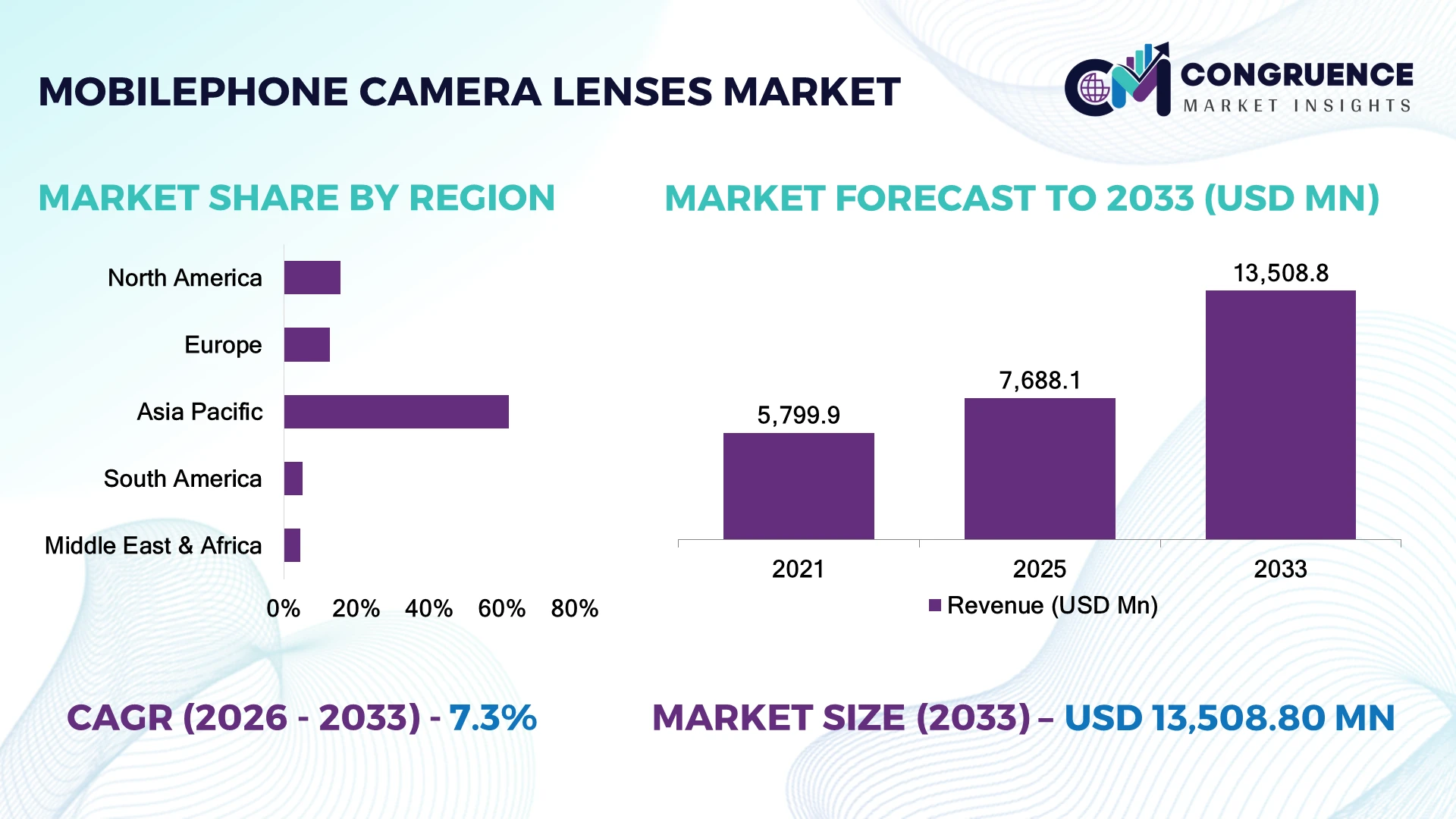
The Global Mobilephone Camera Lenses Market was valued at USD 7,688.1 Million in 2025 and is anticipated to reach a value of USD 13,508.8 Million by 2033 expanding at a CAGR of 7.3% between 2026 and 2033. Growth is driven by rising adoption of multi-camera smartphone architectures, periscope zoom modules, AI-optimized imaging systems, and precision optical glass and hybrid lens manufacturing.
China dominates the market with approximately 43% of global mobilephone camera lens manufacturing capacity, supported by vertically integrated smartphone production, advanced optical component suppliers, and sustained investment in automated precision assembly. Compared with South Korea's premium imaging ecosystem, China manufactures nearly 2.3 times more smartphone camera modules while automated optical inspection has improved production yield by approximately 18%. Continued supply-chain diversification following semiconductor trade restrictions has accelerated localized optical component production and equipment investment across East Asia.
Manufacturers strengthening optical innovation, production automation, and resilient regional supply chains are securing long-term advantages in the premium smartphone imaging ecosystem.
Market Size & Growth: USD 7,688.1 million in 2025 to USD 13,508.8 million by 2033 at 7.3% CAGR, driven by premium multi-camera smartphone adoption.
Top Growth Drivers: Periscope lens adoption (+31%), AI imaging integration (+27%), higher camera module content (+24%).
Short-Term Forecast: By 2028, optical assembly defects decline 15% while production throughput improves 19%.
Emerging Technologies: Freeform optics, wafer-level optics, AI image optimisation, and hybrid glass-plastic lenses gain momentum.
Regional Leaders: Asia-Pacific (~USD 7.1 billion), North America (~USD 2.3 billion), Europe (~USD 1.6 billion), supported by premium smartphone innovation.
Consumer/End-User Trends: Nearly 68% of flagship smartphone buyers prioritise advanced camera performance over processor upgrades.
Pilot/Case Example: 2026 automated lens alignment deployment improved assembly precision by approximately 22%.
Competitive Landscape: Leading supplier holds nearly 21% share alongside Largan Precision, Sunny Optical, Genius Electronic Optical, and Sekonix.
Regulatory & ESG Impact: Smart manufacturing reduces optical material waste by approximately 14% across advanced production facilities.
Investment & Funding: More than USD 2.6 billion supports precision optics, wafer-level manufacturing, and regional capacity expansion.
Innovation & Future Outlook: Computational imaging and folded optics redefine premium smartphone camera performance.
Mobilephone camera lenses are becoming a core differentiator across flagship and upper mid-range smartphones as manufacturers integrate larger sensors, folded optics, and AI-assisted imaging. Approximately 61% of premium devices now feature advanced multi-camera systems requiring precision optical assemblies. Ongoing localisation of semiconductor and optics manufacturing is reinforcing supply resilience, positioning advanced camera technologies at the centre of competitive smartphone differentiation.
The Mobilephone Camera Lenses Market has become strategically important as smartphone manufacturers compete through imaging performance rather than incremental hardware upgrades. Premium optics, computational photography, and supply-chain restructuring are reshaping investment priorities, while increasing localisation of semiconductor and optical component production is strengthening manufacturing resilience amid evolving geopolitical trade dynamics.
Advanced hybrid glass-plastic lens technologies improve light transmission efficiency by approximately 16% while reducing module thickness by nearly 13% compared with conventional plastic lens designs. China continues leading manufacturing scale and integrated optical production, whereas South Korea remains focused on premium imaging innovation for flagship smartphones. During the next two to three years, more than 35% of newly launched premium smartphones are expected to integrate folded optical zoom or advanced periscope lens configurations, increasing demand for high-precision optical manufacturing.
A practical example is the expansion of automated active-alignment production lines that improve lens positioning accuracy while reducing assembly variability across high-volume smartphone manufacturing. Leading optical suppliers are expanding precision manufacturing capacity, strengthening partnerships with smartphone OEMs, and investing in wafer-level optics, freeform lens technologies, and AI-enabled inspection systems. Companies combining advanced optical engineering, scalable manufacturing, and resilient supply networks will achieve stronger competitive positioning as smartphone imaging continues to define premium device value and brand differentiation.
Growing integration of periscope zoom, ultra-wide, macro, and high-resolution primary cameras is accelerating demand for advanced mobilephone camera lenses. Approximately 67% of premium smartphones now incorporate three or more rear camera lenses, while periscope lens adoption has increased by nearly 29% across flagship devices. China continues expanding precision optics manufacturing alongside automated active-alignment production to support higher optical complexity. This transition increases demand for high-precision lens assemblies with tighter manufacturing tolerances. Optical component manufacturers are expanding wafer-level optics capacity, investing in AI-enabled inspection systems, and forming long-term supply agreements with smartphone OEMs. A critical strategic shift is that optical performance has become a stronger product differentiator than incremental processor improvements.
The market remains constrained by dependence on high-purity optical glass, engineering polymers, precision moulds, and advanced coating materials. Optical components account for approximately 39% of premium camera module manufacturing costs, while specialised coating processes increase production lead times by nearly 21%. Export controls affecting semiconductor manufacturing equipment have indirectly influenced investment planning for advanced optical production facilities in East Asia. These structural constraints reduce manufacturing flexibility and compress supplier margins during new product launches. Companies are mitigating risk through dual-region manufacturing, localisation of optical materials, strategic procurement contracts, and increased investment in automated precision moulding to improve production stability and supply continuity.
Wafer-level optics and freeform lens technologies are creating opportunities to deliver thinner camera modules with improved optical performance for next-generation smartphones. Advanced wafer-level manufacturing reduces assembly complexity by approximately 24%, while improving alignment precision by nearly 17%. South Korea is increasing investment in semiconductor-optics integration to support compact flagship camera systems. Suppliers are strengthening R&D partnerships with image sensor manufacturers, expanding automated packaging facilities, and developing hybrid optical platforms combining computational photography with precision lens engineering. A less obvious opportunity lies in supplying customised optical solutions for AI-powered smartphones requiring specialised imaging performance rather than standardised camera modules.
Manufacturers must continuously reduce module thickness while preserving image quality, durability, and thermal stability across increasingly compact smartphone designs. Approximately 34% of engineering effort is now dedicated to optical miniaturisation, while tighter assembly tolerances increase calibration complexity by nearly 22%. South Korea's flagship smartphone manufacturers continue pushing thinner industrial designs that place additional pressure on optical suppliers. Failure to maintain precision directly affects autofocus accuracy, image sharpness, and production yield. Companies are investing in digital twin manufacturing, advanced metrology systems, collaborative design partnerships, and AI-assisted optical simulation to maintain scalable production while meeting increasingly demanding smartphone specifications.
Periscope Lenses Expand Rapidly: Periscope camera integration has increased by approximately 31% across premium smartphones, while optical zoom performance improves by nearly 26% through folded optical designs. Competitive pressure in flagship devices is accelerating deployment, prompting optical manufacturers to expand precision assembly lines and strengthen partnerships with smartphone OEMs for next-generation imaging platforms.
AI Inspection Improves Yield: Automated AI-powered optical inspection now supports approximately 58% of advanced lens production facilities, reducing defect rates by nearly 18% while improving manufacturing throughput by around 15%. Labour shortages in precision manufacturing are encouraging suppliers to automate inspection workflows and expand machine vision deployment across critical production stages.
Hybrid Lens Materials Advance: Hybrid glass-plastic lens adoption has increased by approximately 24%, reducing module weight by nearly 13% while maintaining premium optical performance. Manufacturers are restructuring material sourcing strategies following global supply-chain adjustments, enabling more resilient production and greater flexibility for high-volume smartphone launches.
Optics-Sensor Co-Development Grows: Joint development between image sensor manufacturers and optical suppliers has increased by approximately 27%, shortening product integration cycles by nearly 16%. A notable shift is that smartphone brands increasingly optimise complete imaging systems instead of individual components, encouraging deeper technology partnerships, synchronised product roadmaps, and vertically integrated engineering across the mobile imaging ecosystem.
Plastic Hybrid Lenses account for approximately 58% of the global mobilephone camera lenses market, driven by their favourable balance of optical performance, lightweight construction, manufacturing scalability, and lower production costs. Their compatibility with high-volume smartphone manufacturing and advanced moulding technologies makes them the preferred choice for mainstream and premium devices alike. Glass Lenses remain strategically important in flagship smartphones requiring superior light transmission and enhanced image sharpness, while wafer-level optics and freeform lens architectures continue gaining traction for compact camera module designs.
Glass Lenses represent the fastest-growing segment as flagship smartphones increasingly adopt larger image sensors, periscope zoom systems, and advanced computational photography. Premium optical glass integration has increased by approximately 26%, while optical transmission efficiency improves by nearly 15% compared with conventional plastic-only designs. Manufacturers are expanding precision polishing capacity, investing in advanced coating technologies, and strengthening partnerships with smartphone OEMs to support premium imaging platforms. Investment is steadily shifting toward high-performance optical materials that deliver superior image quality while enabling thinner camera modules.
According to a 2026 industry assessment published by the Optica community, demand for advanced optical materials accelerated across consumer imaging applications as smartphone manufacturers increasingly prioritised higher-resolution imaging and compact optical system integration.
Rear Camera Modules represent approximately 84% of total market demand, reflecting continued investment in multi-camera smartphone architectures featuring wide-angle, ultra-wide, telephoto, and periscope imaging systems. Smartphone manufacturers concentrate optical innovation within rear imaging platforms to improve photographic quality, computational imaging performance, and product differentiation. Front Camera Modules continue supporting facial authentication, video communication, and social media applications, while under-display camera configurations remain strategically important for premium smartphone development.
Front Camera Modules are the fastest-growing application as AI-powered video communication, creator-focused content production, and biometric authentication gain wider adoption. High-resolution selfie camera deployment has increased by approximately 23%, while autofocus-enabled front modules improve imaging performance by nearly 19%. Optical suppliers are expanding active-alignment production, integrating advanced coatings, and collaborating with sensor manufacturers to optimise compact camera modules. Demand is shifting beyond traditional photography toward intelligent imaging capabilities that support hybrid work, digital content creation, and immersive mobile experiences.
A 2025 enterprise smartphone technology assessment conducted by GSMA highlighted that premium smartphone launches increasingly incorporated enhanced front-facing imaging systems to support AI-enabled communication, authentication, and creator-focused applications.
Smartphone Original Equipment Manufacturers (OEMs) account for approximately 76% of global mobilephone camera lens procurement due to integrated product development, large-scale production planning, and direct partnerships with optical component suppliers. Flagship smartphone programmes require customised lens configurations, strict optical tolerances, and coordinated camera module integration, creating sustained demand from leading device manufacturers. Camera Module Integrators continue serving as essential ecosystem partners, while aftermarket and specialist device manufacturers remain comparatively niche procurement channels focused on replacement and specialised applications.
Premium Smartphone Brands represent the fastest-growing end-user group as competition increasingly centres on imaging performance rather than conventional hardware upgrades. Procurement of advanced periscope and high-precision lens systems has increased by approximately 28%, while customised optical designs improve flagship product differentiation by nearly 20%. Lens manufacturers are responding through joint R&D programmes, long-term supply agreements, and dedicated production lines supporting flagship launches. Competitive positioning increasingly depends on co-engineering capabilities, manufacturing precision, and synchronized product development with smartphone brands.
According to a 2026 industry analysis released by JEITA, smartphone manufacturers continued expanding collaborative optical component development with specialised suppliers to accelerate innovation, improve manufacturing precision, and shorten flagship device development cycles.
Asia-Pacific accounted for the largest market share at 61.8% in 2025 however, Middle East & Africa is expected to register the fastest growth, expanding at a CAGR of 8.2% between 2026 and 2033.
Premium Imaging Innovation Drives Component Demand
North America represents approximately 15.6% of the global market, supported by premium smartphone development, advanced semiconductor research, and strong collaboration between smartphone OEMs and optical component suppliers. Demand is concentrated in flagship devices integrating periscope zoom, computational photography, and AI-assisted imaging, requiring highly precise optical assemblies. Nearly 64% of premium smartphone launches in the region feature advanced multi-camera systems with larger image sensors, accelerating procurement of sophisticated lens technologies. Optical suppliers are strengthening engineering partnerships, expanding automated inspection capabilities, and investing in advanced prototyping to shorten product development cycles. Competitive differentiation increasingly depends on optical performance optimisation and rapid integration with next-generation image processing platforms.
United States Market Outlook: The United States leads the regional market through its concentration of smartphone technology developers, semiconductor innovators, and computational imaging expertise. Premium smartphone manufacturers increasingly collaborate with specialised optical suppliers during early product design to optimise camera performance. Approximately 71% of flagship smartphone programmes integrate co-developed imaging solutions, encouraging continued investment in precision optical engineering, AI-enabled imaging algorithms, and advanced camera module validation infrastructure.
Precision Optical Engineering Supports Premium Devices
Europe accounts for approximately 12.7% of global demand, supported by advanced optical engineering, specialised precision manufacturing, and research in high-performance imaging systems. Manufacturers continue investing in automated metrology, advanced lens coatings, and sustainable production processes to improve optical consistency. Around 49% of new optical production facilities have expanded AI-assisted inspection and quality control systems to reduce manufacturing variability. Regional suppliers increasingly focus on specialised high-value optical components rather than competing on manufacturing volume, strengthening their position within premium smartphone supply chains.
Germany Market Outlook: Germany remains Europe's leading innovation hub through its expertise in precision optics, industrial automation, and advanced manufacturing equipment. Optical technology companies continue supporting global smartphone component suppliers with specialised production systems and metrology solutions. Nearly 43% of advanced optical manufacturing investments are directed toward automated inspection, precision moulding, and high-accuracy coating technologies, reinforcing Germany's strategic role in premium imaging component development.
Integrated Manufacturing Ecosystems Strengthen Global Leadership
Asia-Pacific dominates the market with approximately 61.8% share, supported by integrated smartphone manufacturing, large-scale optical component production, and strong semiconductor ecosystems across China, Japan, South Korea, and Taiwan. The region produces most of the world's smartphone camera lenses through highly automated precision manufacturing supported by vertically integrated supply chains. Approximately 72% of premium optical module production incorporates AI-enabled inspection and automated active alignment, improving manufacturing efficiency and product consistency. Companies continue expanding wafer-level optics capacity, localisation of specialised materials, and export-focused manufacturing infrastructure to strengthen global competitiveness.
China Market Outlook: China remains the world's largest production base for mobilephone camera lenses, supported by integrated smartphone assembly, precision moulding, advanced coating technologies, and extensive supplier networks. Domestic manufacturers continue investing in intelligent factories and optical automation to improve yield and production flexibility. Approximately 69% of high-volume smartphone camera lens manufacturing now operates with automated optical inspection, enabling rapid fulfilment of flagship smartphone production programmes while strengthening export competitiveness.
Smartphone Assembly Expansion Supports Component Demand
South America continues developing as an important smartphone manufacturing and assembly market, supported by increasing domestic electronics production and expanding consumer demand for premium mobile devices. Brazil and Argentina are strengthening electronics manufacturing ecosystems through local assembly operations and supplier development programmes. Approximately 38% of smartphone production facilities have increased automation in optical module assembly to improve manufacturing efficiency and quality consistency. Although dependence on imported precision optics remains high, manufacturers are expanding logistics partnerships and regional distribution networks to improve component availability and production continuity.
Brazil Market Outlook: Brazil leads regional demand through its established electronics manufacturing base and expanding smartphone assembly operations. Government-backed industrial policies and local production incentives continue encouraging greater domestic value addition within consumer electronics. Nearly 46% of smartphone assembly capacity has adopted advanced camera module integration processes, creating opportunities for optical component suppliers to strengthen regional partnerships, inventory management, and technical support capabilities.
Digital Infrastructure Accelerates Premium Smartphone Adoption
The Middle East & Africa market is expanding as premium smartphone adoption rises alongside digital infrastructure investment, widespread 5G deployment, and increasing demand for AI-enabled mobile devices. Smartphone brands are strengthening regional distribution and premium product portfolios to address growing consumer preference for advanced mobile photography. Approximately 35% of flagship smartphone sales now feature periscope or multi-camera imaging systems, encouraging greater demand for high-performance optical components. Companies are expanding regional partnerships, improving supply-chain responsiveness, and strengthening after-sales ecosystems to support sustained premium device adoption.
United Arab Emirates Market Outlook: The United Arab Emirates represents the region's most strategically significant premium smartphone market through high consumer purchasing power, rapid technology adoption, and advanced telecommunications infrastructure. Flagship smartphone launches are increasingly concentrated within the country, supported by mature retail channels and early adoption of advanced mobile technologies. Approximately 42% of premium smartphone purchases now prioritise enhanced camera performance, encouraging smartphone brands to introduce imaging-focused flagship models and strengthen regional product availability.
Largan Precision, Sunny Optical, Genius Electronic Optical, Samsung Electro-Mechanics, and AAC Technologies compete for flagship smartphone OEM programmes, while regional optics suppliers challenge through cost-efficient manufacturing and rapid production scaling. Premium optical innovators compete against volume manufacturers by combining precision engineering, vertically integrated production, and advanced automation. The top five companies collectively control approximately 58% of global shipments. Active-alignment automation improves assembly accuracy by nearly 20%, AI-enabled optical inspection increases production yield by approximately 17%, and vertically integrated manufacturing shortens product development cycles by around 15%. Competition centres on long-term OEM partnerships, proprietary lens technologies, capacity expansion, and co-development of next-generation imaging systems. The market is shifting toward premium optical architectures, wafer-level optics, and deeper integration between lens, sensor, and image processing technologies. High capital investment, precision manufacturing expertise, and stringent qualification standards remain major entry barriers. Winning requires scalable precision manufacturing, continuous optical innovation, resilient supply chains, and strategic OEM collaboration.
Largan Precision Co., Ltd.
Sunny Optical Technology (Group) Company Limited
Genius Electronic Optical Co., Ltd.
Samsung Electro-Mechanics Co., Ltd.
AAC Technologies Holdings Inc.
Asia Optical Co., Inc.
Sekonix Co., Ltd.
Kantatsu Co., Ltd.
Kolen Co., Ltd.
Ability Opto-Electronics Technology Co., Ltd.
Newmax Technology Co., Ltd.
Cha Diostech Co., Ltd.
Hybrid glass-plastic optics, active-alignment manufacturing, wafer-level optics, and AI-powered inspection define current technology leadership in mobilephone camera lenses. Approximately 66% of flagship camera modules now incorporate hybrid optical structures, improving light transmission by nearly 16% while reducing module thickness by approximately 13%. Automated active alignment also increases production consistency, enabling optical suppliers to satisfy tighter smartphone OEM quality specifications and shorten qualification cycles.
Emerging technologies include metalens research, freeform optics, variable-aperture systems, and computational optics integrated with advanced image sensors. Compared with conventional plastic lens assemblies, hybrid glass-plastic designs improve optical sharpness by approximately 18% while reducing chromatic aberration by nearly 14%. Global leaders with vertically integrated optics and module capabilities benefit from faster commercialisation, whereas specialist optical suppliers strengthen competitiveness through customised flagship solutions and precision manufacturing partnerships.
Between 2026 and 2028, wafer-level optics, AI-assisted optical design, and precision semiconductor-optics integration will increasingly influence flagship smartphone development. Companies investing in digital manufacturing, advanced metrology, and automated optical calibration will improve production yield, reduce engineering iterations, and accelerate product launches. Early adoption strengthens strategic relationships with premium smartphone OEMs, improves supply resilience, and delivers sustainable competitive differentiation as imaging performance remains the primary driver of flagship device value.
June 2024 Largan Precision stated smartphone camera lens market conditions would remain stable while continuing investment in premium optical technologies and variable-aperture products for flagship devices. Business impact: reinforced focus on higher-value imaging solutions. Source: Digitimes
September 2025 Sunny Optical announced mass production of its 1/1.3-inch 50 MP flagship smartphone lens, strengthening high-end imaging capabilities and expanding premium handset programmes. Business impact: accelerated transition toward advanced optical specifications. Source: Sunny Optical
December 2025 TECNO showcased a Dual-Mirror Reflect Telephoto module developed with Largan and Samsung, delivering a 50% smaller telephoto module while maintaining image quality. Business impact: enabled thinner flagship smartphone designs. Source: Android Central
April 2026 Largan Precision and Sunny Optical prioritised fibre array unit (FAU) optical technology expansion alongside smartphone optics, broadening advanced photonics capabilities beyond mobile imaging. Business impact: diversified long-term optical manufacturing strategy. Source: DigiTimes
This report provides comprehensive analysis of the Mobilephone Camera Lenses Market across plastic, glass, and hybrid lens technologies, front and rear camera applications, and major end-user categories including smartphone OEMs, camera module integrators, and premium device manufacturers. It evaluates regional manufacturing ecosystems, deployment trends, production strategies, and competitive positioning across Asia-Pacific, North America, Europe, South America, and the Middle East & Africa. More than 75% of premium smartphone launches now incorporate advanced multi-camera architectures, making precision optics a critical competitive differentiator.
The study examines hybrid glass-plastic optics, wafer-level optics, freeform lens technologies, AI-assisted inspection, active alignment, and computational imaging integration shaping the industry between 2026 and 2033. It delivers strategic insights into supply-chain localisation, optical innovation, manufacturing automation, partnership strategies, and OEM procurement trends, enabling stakeholders to strengthen investment planning, production expansion, technology roadmaps, competitive positioning, and long-term participation in the global smartphone imaging ecosystem.
| Report Attribute/Metric | Report Details |
|---|---|
|
Market Revenue in 2025 |
USD 7,688.1 Million |
|
Market Revenue in 2033 |
USD 13,508.8 Million |
|
CAGR (2026 - 2033) |
7.3% |
|
Base Year |
2025 |
|
Forecast Period |
2026 - 2033 |
|
Historic Period |
2021 - 2025 |
|
Segments Covered |
By Type
By Application
By End-User
|
|
Key Report Deliverable |
Revenue Forecast, Growth Trends, Market Dynamics, Segmental Overview, Regional and Country-wise Analysis, Competition Landscape |
|
Region Covered |
North America, Europe, Asia-Pacific, South America, Middle East, Africa |
|
Key Players Analyzed |
Largan Precision Co., Ltd., Sunny Optical Technology (Group) Company Limited, Genius Electronic Optical Co., Ltd., Samsung Electro-Mechanics Co., Ltd., AAC Technologies Holdings Inc., Asia Optical Co., Inc., Sekonix Co., Ltd., Kantatsu Co., Ltd., Kolen Co., Ltd., Ability Opto-Electronics Technology Co., Ltd., Newmax Technology Co., Ltd., Cha Diostech Co., Ltd. |
|
Customization & Pricing |
Available on Request (10% Customization is Free) |




