
Reports
The Global Mobile Video Optimization Market was valued at USD 3,114.7 Million in 2025 and is anticipated to reach a value of USD 7,334.6 Million by 2033 expanding at a CAGR of 11.3% between 2026 and 2033. Growth is driven by AI-powered video compression, expanding 5G standalone networks, adaptive bitrate streaming, and rising mobile video traffic across OTT, gaming, and enterprise applications.
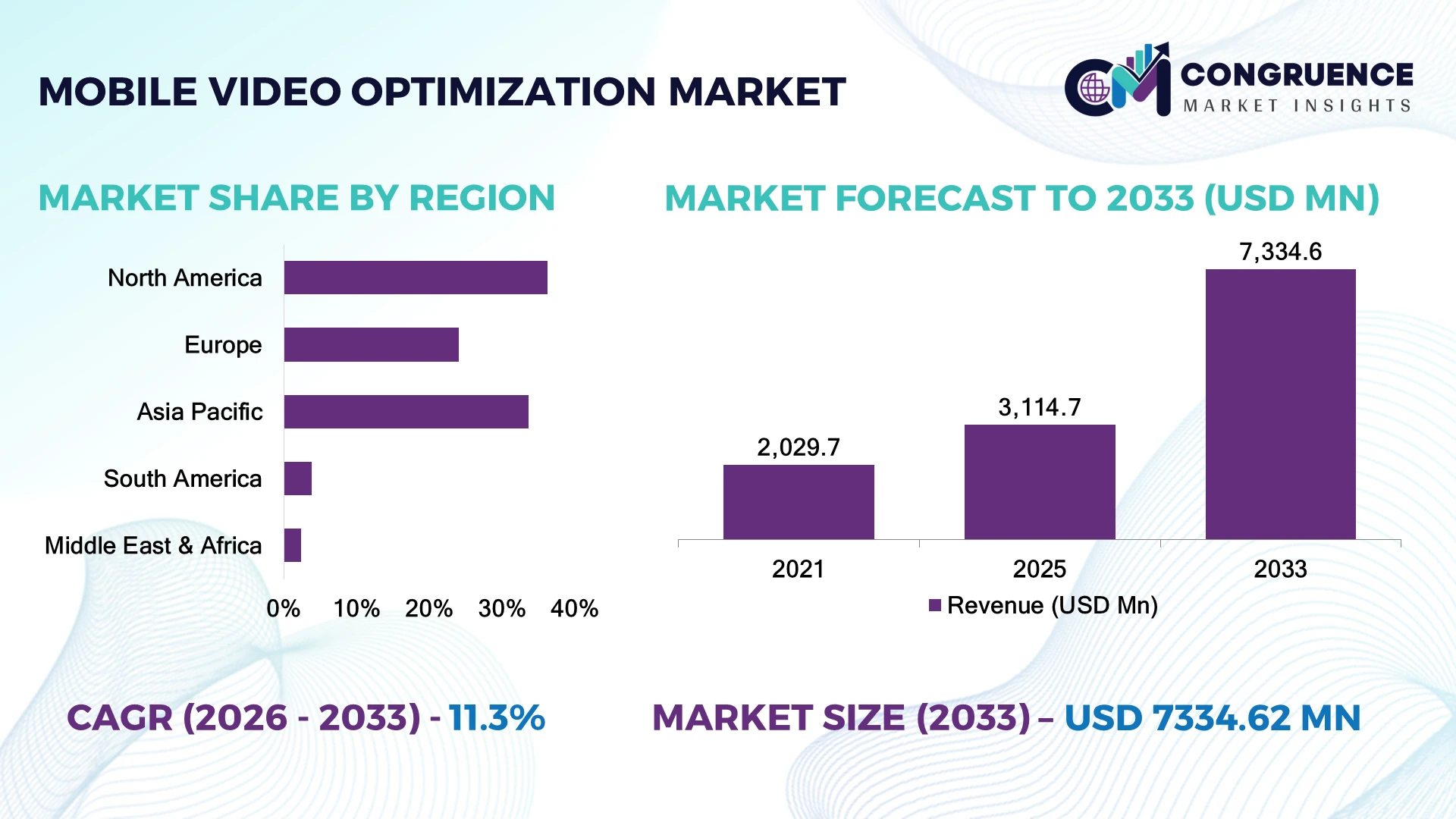
The United States leads the global mobile video optimization market with approximately 33% market share, supported by extensive 5G deployment, hyperscale cloud infrastructure, and strong investments from telecom operators and digital streaming platforms. Compared with China, the United States records higher enterprise adoption of AI-based traffic optimization, while China processes larger mobile video volumes. More than 68% of mobile video traffic is optimized through adaptive streaming and intelligent compression technologies. Ongoing semiconductor supply-chain diversification following U.S.–China technology restrictions continues accelerating distributed edge infrastructure investments.
Organizations integrating AI-driven optimization with edge delivery and telecom partnerships are securing stronger network efficiency and long-term competitive advantage.
Market Size & Growth: USD 3,114.7 million (2025) to USD 7,334.6 million (2033) at 11.3% CAGR, driven by AI video compression and 5G expansion.
Top Growth Drivers: 5G deployment (+32%), AI optimization (+29%), OTT video traffic (+26%).
Short-Term Forecast: By 2028, mobile video buffering declines 24% while bandwidth efficiency improves 28%.
Emerging Technologies: AI encoding, edge computing, and adaptive bitrate streaming transform mobile content delivery.
Regional Leaders: North America (~USD 2.5 billion), Asia-Pacific (~USD 2.2 billion), Europe (~USD 1.6 billion), supported by telecom modernization.
Consumer/End-User Trends: More than 74% of mobile users expect uninterrupted HD video streaming across networks.
Pilot/Case Example: A 2026 telecom optimization program reduced video latency by 31% using AI-assisted traffic management.
Competitive Landscape: Top five providers hold approximately 46% share, led by Cisco, Ericsson, Nokia, Huawei, and Qualcomm.
Regulatory & ESG Impact: Intelligent compression lowers network energy consumption by nearly 18% during peak traffic periods.
Investment & Funding: More than USD 6 billion supports edge infrastructure, AI networking, and telecom software expansion.
Innovation & Future Outlook: Network-aware video intelligence and edge-native optimization redefine mobile streaming performance.
Mobile video optimization has become a strategic capability across telecom operators, OTT platforms, cloud providers, gaming services, and enterprise communications. AI-powered codecs, edge caching, and intelligent traffic orchestration reduce bandwidth consumption by nearly 30% while maintaining high-quality user experiences. Growing investment in distributed edge infrastructure and evolving digital connectivity policies are accelerating deployment, creating the foundation for the strategic market transformation discussed below.
Mobile video optimization has evolved into a strategic infrastructure capability as telecom operators, hyperscale cloud providers, and digital content platforms compete to deliver higher-quality streaming with lower network costs. The rapid expansion of standalone 5G networks and edge computing is reshaping mobile content delivery, while operators increasingly prioritize intelligent traffic management to improve network utilization and customer experience without proportional infrastructure expansion.
AI-driven adaptive video optimization improves bandwidth efficiency by approximately 30% compared with conventional rule-based compression while reducing video buffering by nearly 25% under fluctuating network conditions. North America leads enterprise deployment through advanced cloud-native telecom ecosystems, whereas Asia-Pacific benefits from massive mobile subscriber bases and rapid 5G rollout supporting large-scale optimization platforms. Over the next two to three years, more than 60% of premium mobile video traffic is expected to pass through AI-assisted optimization engines integrated with edge computing infrastructure.
Telecom operators are expanding partnerships with cloud providers and content delivery networks to deploy distributed edge architectures closer to end users. Solution providers continue investing in AI encoding, predictive traffic analytics, and network automation to improve service quality while reducing operational expenditure. Companies combining intelligent software, telecom integration, and scalable edge infrastructure will establish durable competitive advantages as mobile video becomes the dominant form of digital communication and entertainment.
Telecom operators are rapidly deploying AI-driven mobile video optimization platforms to manage rising video traffic without proportional network expansion. AI-assisted traffic orchestration improves bandwidth utilization by approximately 30%, while adaptive bitrate optimization reduces buffering by nearly 25% across congested mobile networks. The United States continues accelerating standalone 5G deployment, encouraging operators to integrate edge-native video optimization into network modernization strategies. This structural shift improves customer experience while lowering transmission costs per video session. Technology providers are responding through AI platform investments, telecom partnerships, and cloud-native software development that combines predictive traffic analytics with automated content delivery, creating stronger operational efficiency and differentiated service quality.
Fragmented telecom infrastructure and inconsistent implementation of network standards continue limiting seamless deployment of mobile video optimization platforms. Nearly 34% of operators maintain hybrid legacy and cloud-native environments, while cross-network integration increases implementation complexity by approximately 21%. Differences in spectrum deployment and edge infrastructure maturity across countries complicate optimization consistency for multinational service providers. These structural limitations extend deployment timelines, increase software customization costs, and reduce scalability across heterogeneous networks. Companies are reducing operational risks by developing vendor-neutral architectures, expanding cloud partnerships, localizing edge infrastructure, and adopting standardized APIs that simplify interoperability across diverse mobile ecosystems.
Distributed edge computing is creating new opportunities to optimize mobile video delivery closer to end users while reducing backbone network congestion. Edge-assisted optimization lowers content delivery latency by approximately 28% and improves video startup performance by nearly 24%. South Korea and Japan continue expanding edge infrastructure to support AI-enabled streaming and immersive digital services. Solution providers are investing in edge analytics, predictive caching, and network-aware orchestration platforms while strengthening partnerships with telecom operators and hyperscale cloud providers. A significant strategic opportunity lies in offering optimization as a cloud-managed service, enabling operators to reduce infrastructure investment while accelerating deployment across emerging digital ecosystems.
Growing adoption of encrypted video traffic limits the effectiveness of conventional optimization techniques and complicates real-time traffic management. More than 72% of mobile internet traffic is encrypted, while encrypted sessions reduce network visibility by approximately 27% for traditional optimization platforms. Operators in Germany and the United Kingdom are balancing privacy compliance with network performance requirements, increasing deployment complexity for intelligent traffic management. Companies must invest in privacy-preserving AI, encrypted traffic analytics, and secure edge computing architectures to maintain optimization efficiency without compromising regulatory compliance. Solving this challenge will determine long-term competitiveness as privacy expectations and encrypted communications continue expanding.
Edge Caching Expansion: Telecom operators are relocating video processing closer to subscribers through distributed edge nodes, reducing content delivery latency by approximately 30% while improving streaming responsiveness by nearly 24%. Standalone 5G deployment is accelerating this transition. Technology providers are expanding edge partnerships and automating workload distribution to improve network utilization during peak mobile traffic.
AI Codec Optimization: AI-assisted encoding engines are replacing conventional compression workflows, reducing bandwidth consumption by nearly 28% while improving perceived video quality by approximately 20%. Streaming providers increasingly deploy machine learning models that dynamically adjust encoding profiles. Companies are scaling AI infrastructure and integrating adaptive optimization software directly into content delivery networks.
Cloud-Native Network Automation: Mobile operators are migrating optimization platforms toward cloud-native architectures, shortening service deployment cycles by approximately 22% and reducing operational management effort by nearly 18%. Virtualized network functions enable faster software updates and automated scaling. Vendors are restructuring product portfolios around containerized platforms and strengthening cloud ecosystem partnerships to improve deployment flexibility.
Quality-Aware Traffic Prioritization: Intelligent quality-of-experience analytics are becoming central to mobile network operations, improving video session stability by approximately 26% while reducing customer complaints by nearly 17%. Rising demand for live sports and interactive streaming is reshaping traffic prioritization strategies. Companies are deploying real-time analytics, predictive congestion management, and automated policy engines to optimize premium mobile video experiences across increasingly complex network environments.
Cloud-based mobile video optimization solutions account for approximately 57% of the global market because they provide scalable deployment, centralized management, seamless software updates, and rapid integration with telecom and content delivery infrastructures. Their subscription-based operating model lowers deployment costs while enabling real-time optimization across distributed mobile networks. On-premise solutions remain strategically important for government agencies, financial institutions, and telecom operators requiring strict data sovereignty and network control. Hybrid deployment models continue serving organizations balancing cloud flexibility with critical workload protection.
Edge-native optimization platforms represent the fastest-growing type as operators increasingly process video traffic closer to end users. Edge-enabled deployments improve content delivery efficiency by approximately 29%, while cloud-managed orchestration reduces infrastructure management effort by nearly 22%. Vendors are expanding cloud partnerships, strengthening multi-cloud interoperability, and investing in AI-driven orchestration software to improve operational performance. Enterprise investment is steadily shifting toward distributed cloud architectures that combine scalability, low latency, and intelligent network optimization across increasingly complex mobile ecosystems.
According to enterprise findings released by the GSMA during 2026, cloud-native network architectures continue to accelerate among mobile operators as AI-enabled service delivery and edge computing become integral to next-generation telecom infrastructure.
Video streaming remains the largest application segment, contributing approximately 46% of total market demand because OTT platforms, social media services, and live entertainment generate the highest mobile video traffic volumes. Adaptive streaming technologies, intelligent bitrate management, and AI-based traffic optimization have become essential for maintaining quality of experience under fluctuating network conditions. Video conferencing continues expanding through enterprise hybrid work environments, while mobile gaming increasingly requires low-latency optimization to support interactive content. E-learning and digital broadcasting also represent strategically important applications with rising mobile engagement.
Cloud gaming is the fastest-growing application as real-time rendering and immersive media require intelligent bandwidth allocation and ultra-low latency. AI-assisted optimization reduces frame interruption by approximately 26%, while edge-based delivery improves response time by nearly 24%. Technology providers are integrating predictive traffic analytics, automated encoding, and edge computing into mobile optimization platforms. Demand is increasingly shifting toward latency-sensitive applications where uninterrupted user experience directly influences subscriber retention and platform competitiveness.
A 2025 industry assessment published by the GSMA highlighted that mobile video continues to account for the majority of mobile data traffic, reinforcing operator investment in intelligent traffic optimization and quality-of-experience management.
Telecom operators represent the largest end-user segment, accounting for approximately 49% of global demand due to their responsibility for managing mobile network performance, bandwidth utilization, and subscriber experience. Continuous 5G deployment and increasing mobile video consumption have made AI-driven optimization platforms operationally essential for maintaining service quality. Content delivery network providers and cloud service companies continue expanding investments in optimization technologies, while OTT streaming platforms increasingly integrate network-aware video delivery capabilities to improve user engagement and reduce streaming disruptions.
OTT streaming platforms are the fastest-growing end-user segment as competition intensifies around video quality, latency, and personalized content delivery. AI-based optimization has improved streaming efficiency by approximately 30%, while predictive traffic management reduces peak network congestion by nearly 21%. Vendors are developing customized optimization engines, expanding telecom partnerships, and integrating analytics platforms to strengthen service performance across multiple distribution channels. Competitive differentiation increasingly depends on delivering consistent mobile video experiences rather than simply expanding network capacity.
According to a 2026 enterprise review published by the GSMA, telecom operators are increasingly deploying AI-powered network automation and video optimization technologies to improve mobile service quality while supporting rising data consumption across 5G networks.
North America accounted for the largest market share at 36.2% in 2025 however, Asia-Pacific is expected to register the fastest growth, expanding at a CAGR of 12.7% between 2026 and 2033.

AI-Driven Telecom Modernization Strengthens Network Performance
North America contributes approximately 36.2% of the global mobile video optimization market, supported by advanced 5G infrastructure, hyperscale cloud ecosystems, and widespread deployment of AI-enabled traffic management platforms. Telecom operators are increasingly integrating edge computing with adaptive video optimization to improve network efficiency and premium streaming quality. Nearly 70% of mobile video traffic is processed using intelligent optimization technologies across major carrier networks. Strategic collaboration between telecom providers, cloud companies, and content delivery networks continues accelerating deployment of cloud-native optimization platforms while improving operational scalability and reducing bandwidth utilization during peak traffic periods.
United States Market Outlook: The United States leads the regional market through extensive standalone 5G deployment, advanced cloud infrastructure, and a mature digital content ecosystem. Mobile operators continue investing in AI-based traffic orchestration and network automation to improve service quality across OTT, gaming, and enterprise communications. More than 75% of nationwide mobile data traffic consists of video services, encouraging continuous investment in intelligent optimization software, edge infrastructure, and cloud-native telecom platforms.
Cloud-Native Infrastructure Reshapes Network Operations
Europe accounts for approximately 24% of the global market, driven by telecom virtualization, stringent digital infrastructure standards, and increasing adoption of cloud-native network architectures. Operators are modernizing mobile core networks while integrating intelligent video optimization to improve user experience without proportionate network expansion. More than 58% of large telecom operators have incorporated AI-assisted traffic management into network modernization initiatives. Enterprise collaboration between telecom providers and cloud infrastructure vendors continues accelerating deployment of distributed optimization platforms.
Germany Market Outlook: Germany serves as Europe's leading market through its advanced telecom engineering capabilities, industrial digitalization initiatives, and strong enterprise cloud adoption. National operators continue expanding edge computing infrastructure while integrating AI-powered optimization into 5G network operations. Digital manufacturing, connected mobility, and industrial IoT applications further strengthen demand for reliable low-latency mobile video delivery across enterprise environments.
Massive Mobile Scale Accelerates Intelligent Video Delivery
Asia-Pacific represents the fastest-expanding regional market due to rapid 5G deployment, expanding mobile subscriber bases, and large-scale digital entertainment ecosystems. China, India, Japan, and South Korea collectively generate the majority of regional mobile video traffic, driving continuous investment in optimization technologies. Approximately 65% of newly deployed telecom edge nodes support AI-enabled video optimization capabilities. Operators are strengthening cloud partnerships and expanding distributed infrastructure to improve streaming quality while efficiently managing exponential mobile data growth.
China Market Outlook: China dominates regional deployment through extensive 5G infrastructure, large-scale cloud investments, and one of the world's highest mobile video consumption levels. Domestic telecom operators continue integrating AI-assisted traffic management and intelligent content delivery platforms into nationwide mobile networks. Rapid expansion of live commerce, short-video platforms, and cloud gaming further reinforces sustained investment in advanced mobile video optimization technologies.
Digital Streaming Expands Infrastructure Demand
South America is witnessing increasing deployment of mobile video optimization platforms as telecom operators modernize broadband infrastructure and streaming services experience sustained user growth. Brazil, Chile, and Colombia are strengthening mobile network capacity to support rising video consumption across entertainment, education, and enterprise collaboration. Mobile video traffic has increased by approximately 27% across major operator networks, encouraging investment in adaptive streaming technologies and edge-enabled optimization. Infrastructure limitations persist in selected markets, but ongoing network modernization continues improving deployment readiness.
Brazil Market Outlook: Brazil leads regional adoption through its large mobile subscriber base, expanding 5G coverage, and rapidly growing digital entertainment industry. National telecom providers continue investing in cloud-native infrastructure and AI-based traffic optimization to improve streaming quality across densely populated urban centers. Increasing adoption of OTT platforms and live sports streaming is strengthening long-term demand for intelligent mobile video delivery solutions.
5G Investment Drives Digital Service Expansion
The Middle East & Africa market is advancing through sustained investment in 5G infrastructure, hyperscale data centers, and national digital transformation programs. Telecom operators are prioritizing intelligent traffic optimization to support premium streaming, cloud applications, and enterprise connectivity services. Approximately 40% of newly commissioned regional edge infrastructure is optimized for latency-sensitive digital applications, including mobile video delivery. Strategic partnerships between telecom providers and global cloud companies continue strengthening network modernization and service quality across high-growth digital economies.
United Arab Emirates Market Outlook: The United Arab Emirates has established itself as the region's technology leader through advanced telecom infrastructure, nationwide 5G deployment, and strong government-backed digital transformation initiatives. Operators continue integrating AI-driven network automation, edge computing, and cloud-native optimization platforms to enhance mobile service performance. Rapid adoption of smart city applications, premium digital entertainment, and enterprise cloud services continues supporting long-term demand for advanced mobile video optimization solutions.
The market is moderately consolidated, with the top five vendors controlling approximately 48% of global demand. Cisco, Ericsson, Nokia, Qwilt, and Synamedia compete through AI-driven traffic optimization and edge-native delivery platforms, while telecom software specialists challenge infrastructure vendors with cloud-first architectures and faster deployment cycles. Competition centers on network intelligence, latency reduction, and integration speed rather than price alone. AI-assisted optimization improves bandwidth efficiency by approximately 30%, edge processing reduces latency by nearly 25%, and cloud-native deployment shortens implementation time by around 20%. Companies are strengthening telecom partnerships, expanding edge infrastructure, integrating predictive analytics, and pursuing standards-based innovation to secure long-term operator contracts. The competitive shift favors software-defined optimization platforms over appliance-centric deployments. Integration with multi-vendor telecom environments and proprietary AI algorithms remain key entry barriers. Winning requires scalable cloud-native software, carrier-grade reliability, AI-powered automation, and deep ecosystem partnerships across telecom and content delivery.
Cisco Systems, Inc.
Ericsson
Nokia Corporation
Huawei Technologies Co., Ltd.
Qwilt
Synamedia
Allot Ltd.
Bitmovin
Enea AB
NETSCOUT Systems, Inc.
Flash Networks Ltd.
Vantrix Corporation
AI-powered traffic optimization, adaptive bitrate streaming, AV1 and HEVC encoding, edge computing, and cloud-native orchestration now define modern mobile video optimization platforms. AI-assisted optimization improves bandwidth utilization by approximately 30%, while adaptive bitrate technologies reduce buffering by nearly 25%. More than 65% of tier-one mobile operators have adopted cloud-native optimization capabilities to improve quality of experience across heterogeneous 5G networks. These technologies deliver measurable operational savings while supporting higher video quality without proportional network expansion.
Disruptive innovation is shifting toward predictive traffic analytics, edge AI inference, multi-CDN orchestration, and network-aware video delivery. Compared with legacy rule-based optimization engines, AI-driven platforms improve traffic prediction accuracy by approximately 35% while reducing optimization response time by nearly 28%. Around 45% of newly deployed optimization platforms now integrate edge processing with cloud-based orchestration. Telecom operators and OTT platforms deploying these intelligent ecosystems gain stronger subscriber retention, lower transport costs, and faster service deployment than organizations relying on conventional centralized architectures.
Between 2026 and 2028, intelligent edge orchestration, neural video compression, and intent-based network automation will redefine mobile video delivery. Organizations investing early in AI-driven optimization, programmable network APIs, and distributed edge infrastructure will achieve superior service quality, operational resilience, and competitive differentiation as immersive streaming, cloud gaming, and interactive mobile applications continue increasing network complexity.
April 2025 – Synamedia introduced new cloud and SaaS-based video optimization innovations at NAB 2025, including machine-learning-based pVMAF technology designed to reduce CDN costs while improving video quality. The launch strengthens AI-driven streaming optimization and monetization capabilities. Source: Synamedia
December 2025 – Ericsson announced the SCONE protocol initiative through the IETF, enabling networks to provide throughput guidance directly to video applications, improving streaming efficiency and reducing unnecessary congestion across mobile networks. The development advances standards-based traffic optimization. Source: Ericsson
May 2026 – Ericsson and AT&T released the open-source Camera Uplink Benchmark (CUB) toolkit to benchmark and optimize 5G video uplink performance for connected cameras, improving objective codec evaluation and accelerating deployment of high-quality mobile video applications. Source: Ericsson
June 2026 – Synamedia launched its integrated video portfolio following Lumine Group's agreement to acquire its Video Network business, enabling operators to simplify operations, accelerate innovation, and strengthen audience monetization through unified cloud-native video delivery. Source: Synamedia Press Release.
This report provides a comprehensive assessment of the global mobile video optimization market across deployment types, applications, end-user industries, and major geographic markets. It evaluates cloud-based, on-premise, and hybrid solutions supporting video streaming, video conferencing, mobile gaming, digital broadcasting, and enterprise communications. The analysis covers North America, Europe, Asia-Pacific, South America, and the Middle East & Africa while examining deployment intensity, technology adoption, operator modernization, and competitive positioning across established and emerging digital ecosystems.
The study further evaluates AI-powered traffic optimization, adaptive bitrate streaming, edge computing, cloud-native orchestration, advanced video codecs, and predictive network analytics shaping industry transformation between 2026 and 2033. More than 65% of leading operator deployments now integrate intelligent automation with edge-enabled optimization, reflecting accelerating technology convergence. The report supports investment planning, product development, market expansion, competitive benchmarking, partnership strategy, and long-term decision-making by identifying operational priorities, deployment trends, and evolving enterprise requirements across the mobile video value chain.
| Report Attribute/Metric | Report Details |
|---|---|
|
Market Revenue in 2025 |
USD 3,114.7 Million |
|
Market Revenue in 2033 |
USD 7,334.6 Million |
|
CAGR (2026 - 2033) |
11.3% |
|
Base Year |
2025 |
|
Forecast Period |
2026 - 2033 |
|
Historic Period |
2021 - 2025 |
|
Segments Covered |
By Type
By Application
By End-User
|
|
Key Report Deliverable |
Revenue Forecast, Growth Trends, Market Dynamics, Segmental Overview, Regional and Country-wise Analysis, Competition Landscape |
|
Region Covered |
North America, Europe, Asia-Pacific, South America, Middle East, Africa |
|
Key Players Analyzed |
Cisco Systems, Inc., Ericsson, Nokia Corporation, Huawei Technologies Co., Ltd., Qwilt, Synamedia, Allot Ltd., Bitmovin, Enea AB, NETSCOUT Systems, Inc., Flash Networks Ltd., Vantrix Corporation |
|
Customization & Pricing |
Available on Request (10% Customization is Free) |




