
Reports
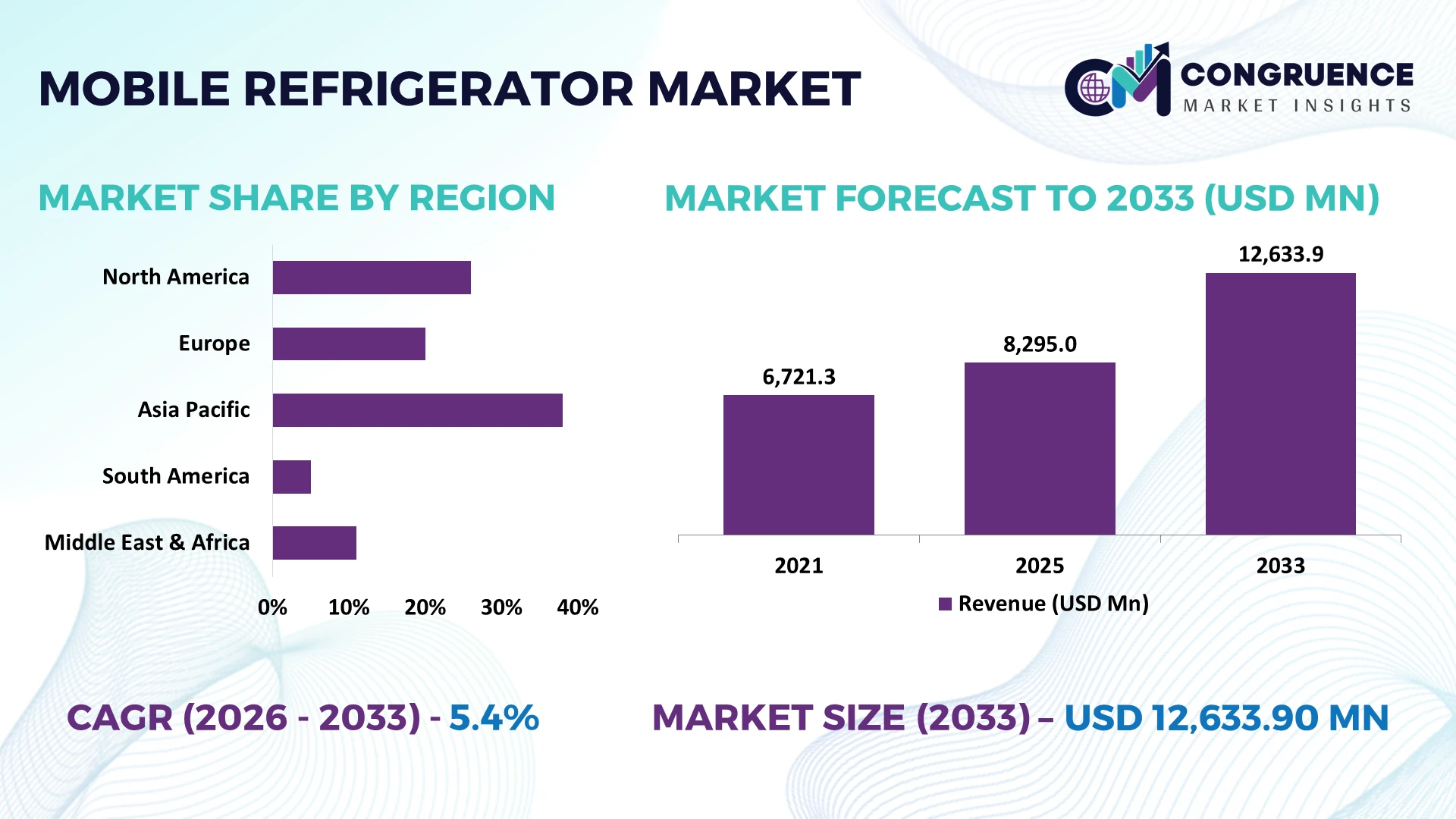
The Global Mobile Refrigerator Market was valued at USD 8294.98 Million in 2025 and is anticipated to reach a value of USD 12633.9 Million by 2033 expanding at a CAGR of 5.4% between 2026 and 2033. Growth is supported by expanding electric vehicle ecosystems, rising cold-chain logistics requirements, outdoor recreation demand, and higher deployment of energy-efficient compressor-based mobile refrigeration systems.
China remains the dominant country, accounting for approximately 34% of global manufacturing capacity, supported by strong automotive, electronics, and appliance industries alongside continued investment in advanced compressor technologies. More than 68% of premium mobile refrigerator production integrates smart temperature control and low-power DC systems. Compared with Germany's specialized premium manufacturing base, China delivers higher production scale, while geopolitical trade diversification since the Red Sea shipping disruptions has accelerated regional supply-chain expansion across Southeast Asia.
Manufacturers securing diversified sourcing, intelligent product portfolios, and regional production footprints are positioned to strengthen long-term competitiveness across global mobile refrigerator market segments.
Market Size & Growth: USD 8294.98 Million in 2025, reaching USD 12633.9 Million by 2033 at 5.4% CAGR, driven by advanced compressor technology and expanding electric mobility applications.
Top Growth Drivers: Energy-efficient compressors improve cooling efficiency by 18%, EV accessory demand rises 15%, and cold-chain transport deployment expands approximately 12%.
Short-Term Forecast: By 2028, intelligent power management reduces battery consumption by nearly 14% while operational cooling efficiency improves about 16%.
Emerging Technologies: AI-enabled temperature optimization, IoT remote monitoring, and lightweight insulation materials improve energy performance by approximately 20%.
Regional Leaders: Asia Pacific exceeds USD 5.1 Billion with manufacturing expansion, North America approaches USD 3.2 Billion through recreational adoption, and Europe surpasses USD 2.6 Billion driven by sustainable transport electrification.
Consumer/End-User Trends: Nearly 58% of premium buyers prefer app-connected portable refrigerators with dual-zone cooling and low-noise operation.
Pilot/Case Example: In 2026, fleet refrigeration modernization programs improved temperature consistency by 17% while reducing maintenance interventions by 13%.
Competitive Landscape: Leading manufacturers collectively control approximately 38% of the global market, with Dometic, ARB, Alpicool, Engel, and Indel B maintaining strong international presence.
Regulatory & ESG Impact: High-efficiency refrigerants and stricter energy standards reduce operational emissions by approximately 12%, supporting compliance across major international markets.
Investment & Funding: More than USD 900 Million supports manufacturing expansion, strategic partnerships, localized production, and supply-chain resilience following regional trade realignment.
Innovation & Future Outlook: Next-generation battery-compatible refrigeration, solar integration, and intelligent diagnostics strengthen high-growth product differentiation and long-term competitive positioning.
The Mobile Refrigerator Market is advancing through stronger demand from recreational vehicles, commercial transport, healthcare logistics, and off-grid applications. Manufacturers are introducing quieter variable-speed compressors, smart connectivity, and eco-friendly refrigerants that improve energy efficiency by nearly 20%. Regional manufacturing diversification and localized component sourcing continue strengthening supply resilience, while battery-compatible refrigeration systems emerge as a key competitive trend, shaping the next phase of strategic market expansion.
The Mobile Refrigerator Market has become strategically important as automotive electrification, pharmaceutical logistics, outdoor mobility, and portable food distribution increasingly depend on reliable temperature-controlled equipment. Supply-chain restructuring following recent global shipping disruptions has encouraged manufacturers to regionalize production and secure compressor, battery, and electronic component availability. This shift is intensifying competition around energy efficiency, product durability, and intelligent connectivity while encouraging long-term investment in localized manufacturing and advanced refrigeration platforms.
Variable-speed compressor technology delivers approximately 18% higher energy efficiency and extends battery runtime by nearly 22% compared with conventional fixed-speed cooling systems, reducing operating costs for commercial fleets. China leads high-volume manufacturing through integrated appliance supply chains, while Germany emphasizes premium engineering and advanced thermal management for specialized applications. Over the next two to three years, connected mobile refrigeration platforms are expected to exceed 45% deployment within premium product categories as remote diagnostics and predictive temperature monitoring become standard operational capabilities.
Fleet operators increasingly deploy dual-zone mobile refrigerators for pharmaceutical transport and last-mile food delivery, improving temperature consistency by approximately 16% while reducing product losses. Manufacturers are expanding partnerships with battery suppliers, vehicle OEMs, and digital monitoring providers to strengthen integrated product ecosystems. Companies combining localized production, intelligent energy management, and resilient sourcing strategies will establish stronger competitive positioning and long-term operational advantage.
The strongest structural driver is the convergence of electric mobility, healthcare logistics, and portable cold-chain operations requiring reliable temperature control with minimal power consumption. Premium compressor-based systems improve energy efficiency by approximately 20%, while intelligent battery management extends operating duration by nearly 18%. Around 60% of newly introduced premium mobile refrigerator models now incorporate app-enabled monitoring and adaptive cooling functions. China's expanding EV manufacturing ecosystem and stricter cold-chain handling standards continue accelerating component innovation and production capacity. In response, manufacturers are investing in localized assembly facilities, strategic compressor partnerships, and advanced thermal control technologies. Companies integrating intelligent power optimization with modular product platforms gain stronger differentiation through lower operating costs, improved fleet productivity, and broader commercial deployment opportunities.
Price fluctuations in compressors, lithium battery components, and electronic controllers continue affecting manufacturing margins and procurement planning. Component costs for selected electronic assemblies have experienced fluctuations approaching 12%, while logistics expenses remain approximately 9% above pre-disruption levels across several international trade routes. Dependence on concentrated supplier networks in China creates procurement challenges during production disruptions or trade policy adjustments. These conditions increase inventory costs, extend procurement cycles, and complicate product pricing strategies for manufacturers. Companies are mitigating exposure through supplier diversification, localized sourcing agreements, long-term procurement contracts, and increased inventory planning. Businesses building multi-country supply networks strengthen operational resilience while improving production continuity and pricing stability across competitive markets.
Rapid integration of IoT connectivity, predictive diagnostics, and battery optimization software is creating new commercial opportunities beyond traditional portable cooling applications. Connected refrigeration systems reduce unplanned maintenance by approximately 15% and improve operational visibility by nearly 20% through real-time performance monitoring. India is expanding cold-chain infrastructure alongside electric commercial vehicle deployment, creating favorable conditions for digitally enabled mobile refrigeration solutions. Manufacturers are increasing R&D investment in AI-assisted temperature optimization, solar-assisted charging compatibility, and modular refrigeration platforms supporting multiple transport applications. Companies establishing software partnerships and integrated digital service ecosystems can generate recurring service value while strengthening customer retention and expanding differentiated product portfolios in high-value commercial segments.
Expanding intelligent mobile refrigeration across commercial fleets requires seamless integration between refrigeration hardware, battery systems, telematics platforms, and fleet management software. Integration complexity increases deployment timelines by approximately 14%, while technician shortages in advanced refrigeration servicing affect nearly 11% of commercial installations in several industrial markets. Japan and Germany continue facing increasing demand for highly skilled maintenance capabilities supporting connected refrigeration systems. These operational pressures influence deployment consistency, lifecycle performance, and long-term sustainability targets. Manufacturers must strengthen technical training programs, invest in standardized communication protocols, and expand strategic partnerships with vehicle OEMs and fleet technology providers. Organizations that simplify system integration while strengthening service infrastructure will secure durable operational advantages and higher customer retention in increasingly technology-driven markets.
Smart Connected Cooling Systems Intelligent mobile refrigerators with IoT connectivity and remote diagnostics now account for approximately 42% of premium product launches, while predictive monitoring reduces maintenance events by nearly 15% and temperature deviations by 18%. Healthcare fleets and commercial transport operators are standardizing connected refrigeration workflows to improve compliance and asset utilization. Manufacturers are expanding software partnerships and cloud-enabled monitoring platforms as digital fleet management becomes a competitive differentiator.
Localized Manufacturing Expansion Supply-chain diversification following global shipping disruptions has increased component localization by around 24% across India, Vietnam, and Mexico. Production lead times have declined by nearly 12% as companies reduce dependence on single-country sourcing for compressors and electronic controls. Leading manufacturers are restructuring procurement networks, establishing regional assembly facilities, and expanding supplier partnerships to improve operational resilience and delivery reliability.
Advanced Battery Integration Battery-compatible refrigeration platforms supporting electric commercial vehicles have increased deployment by approximately 21%, while variable-speed compressors lower power consumption by nearly 19%. Tighter vehicle efficiency standards and fleet electrification initiatives are accelerating product redesign. Companies are integrating intelligent battery management, lightweight insulation, and DC power optimization to improve runtime, reduce operating costs, and strengthen compatibility with next-generation electric mobility ecosystems.
Premium Multi-Zone Product Evolution Dual-zone mobile refrigerators represent nearly 36% of premium commercial installations as operators demand simultaneous frozen and chilled storage within a single unit. Enhanced insulation materials improve thermal retention by approximately 17%, reducing compressor cycling and extending equipment life. Manufacturers are expanding modular product portfolios, collaborating with vehicle OEMs, and introducing customizable refrigeration configurations that address specialized logistics, healthcare, and outdoor recreation requirements.
Compressor-based mobile refrigerators remain the dominant product category, accounting for approximately 56% of global deployments due to superior cooling performance, rapid temperature recovery, and compatibility with automotive DC power systems. Their ability to maintain stable temperatures under varying ambient conditions makes them the preferred solution for logistics, healthcare, and long-distance travel. Thermoelectric models retain strategic relevance for lightweight consumer applications because of lower maintenance requirements, while absorption systems continue serving niche off-grid and silent-operation environments. Manufacturers are strengthening compressor portfolios through inverter technology, improved insulation, and intelligent power management.
Dual-zone refrigerators represent the fastest-growing type as commercial users increasingly require simultaneous frozen and refrigerated storage. Adoption has increased by approximately 22% in fleet applications, while premium consumer demand has expanded by nearly 18% through connected cooling features. Companies are prioritizing modular designs, battery compatibility, and smart temperature controls to differentiate premium offerings. Investment is shifting toward scalable compressor platforms capable of supporting multiple product configurations while improving energy efficiency and operational flexibility.
Food & Beverage remains the leading application, representing approximately 39% of market deployment because restaurants, catering services, and cold-food distribution require dependable portable refrigeration across daily operations. Commercial operators increasingly adopt mobile refrigeration to maintain product quality during transportation and temporary storage. Outdoor Recreation continues generating consistent demand from camping, caravanning, and marine activities, while Commercial Vehicles strengthen utilization through expanding temperature-controlled logistics. Companies continue expanding specialized product lines tailored to each operational environment.
Medical Transport is the fastest-growing application as healthcare providers increase deployment for vaccines, biological samples, and temperature-sensitive medicines. Portable medical refrigeration installations have increased by approximately 24%, while connected monitoring solutions improve temperature compliance by nearly 16%. Manufacturers are integrating digital monitoring, backup battery capability, and precise thermal control to satisfy healthcare requirements. Demand is becoming operationally critical wherever reliable portable cold-chain infrastructure supports emergency response, pharmaceutical distribution, and mobile healthcare services.
Healthcare represents the leading end-user group with approximately 34% of total deployment, driven by strict temperature-control requirements for vaccines, biological samples, and pharmaceutical transportation. Hospitals, emergency response organizations, and mobile diagnostic providers increasingly depend on portable refrigeration to maintain product integrity throughout transportation. Logistics and Food Service remain significant buyers due to expanding temperature-controlled delivery operations, while Automotive supports demand through recreational vehicles and commercial mobility solutions. Manufacturers continue developing application-specific configurations with advanced monitoring capabilities.
Defense is emerging as the fastest-growing end-user segment because mobile medical support, field operations, and remote deployment require reliable portable refrigeration under demanding environmental conditions. Defense-oriented installations have expanded by approximately 19%, while ruggedized product demand has increased nearly 17% through enhanced durability requirements. Companies are responding through customized product development, strategic government partnerships, and reinforced equipment designs. Future demand is shifting toward specialized, mission-specific refrigeration systems that combine intelligent monitoring, battery efficiency, and operational resilience across multiple deployment environments.
Asia-Pacific accounted for the largest market share at 42.8% in 2025 however, North America is expected to register the fastest growth, expanding at a 6.1% CAGR between 2026 and 2033.
Strong Fleet Electrification and Smart Cold-Chain Adoption
North America represents one of the most technologically advanced Mobile Refrigerator markets, supported by widespread deployment across recreational vehicles, pharmaceutical logistics, food distribution, and commercial fleets. The region contributes approximately 27% of global demand, with high penetration of compressor-based portable refrigeration and connected temperature-monitoring systems. More than 54% of newly launched premium products integrate IoT-enabled diagnostics and battery optimization features. Fleet modernization and electric commercial vehicle adoption continue driving equipment upgrades, while manufacturers strengthen partnerships with vehicle OEMs and fleet solution providers. Investment in domestic component sourcing and intelligent refrigeration platforms has reduced average delivery lead times by nearly 11%, improving operational flexibility and inventory planning for enterprise customers.
United States Market Outlook: The United States leads regional deployment through its extensive recreational vehicle industry, healthcare logistics infrastructure, and commercial cold-chain network. Nearly 62% of North American premium mobile refrigeration demand originates from the U.S., supported by expanding electric fleet investments and advanced aftermarket distribution. Manufacturers continue increasing localized assembly, digital monitoring capabilities, and strategic collaborations with automotive and logistics companies to improve product availability and lifecycle service performance.
Energy Efficiency Standards Reshape Product Development
Europe maintains a strong position through premium manufacturing, sustainable refrigeration technologies, and stringent environmental regulations encouraging energy-efficient cooling systems. The region accounts for approximately 24% of global deployment, supported by advanced automotive engineering and expanding pharmaceutical logistics. More than 48% of newly introduced portable refrigeration products utilize low-power compressor technologies aligned with evolving efficiency standards. Manufacturers continue investing in lightweight insulation materials, smart thermal management, and environmentally responsible refrigerants. Strategic partnerships between appliance manufacturers and vehicle OEMs are accelerating deployment of integrated mobile refrigeration solutions across commercial transport and recreational mobility segments.
Germany Market Outlook: Germany serves as the region's industrial and technology hub through its strong automotive engineering ecosystem and precision refrigeration manufacturing capabilities. Around 35% of European premium mobile refrigerator production is concentrated in Germany, where companies prioritize intelligent compressor systems, advanced thermal insulation, and product quality. Continued investment in research, industrial automation, and sustainable manufacturing strengthens Germany's position as a leading exporter of high-performance mobile refrigeration equipment.
Manufacturing Scale and Export Leadership
Asia-Pacific remains the largest manufacturing and consumption hub, supported by integrated electronics production, automotive manufacturing, and expanding cold-chain infrastructure. The region represents approximately 43% of global market activity, while China, Japan, and South Korea lead compressor production and component integration. More than 65% of global portable refrigeration components are produced within regional manufacturing clusters. Companies continue expanding automated production facilities and regional supply networks, reducing manufacturing costs by approximately 14% through economies of scale. Growing outdoor recreation markets and expanding healthcare logistics further strengthen domestic demand alongside export competitiveness.
China Market Outlook: China dominates the regional market through vertically integrated manufacturing, large-scale compressor production, and well-developed electronics supply chains. Approximately 34% of global mobile refrigerator manufacturing capacity is concentrated in China, enabling rapid product innovation and competitive pricing. Manufacturers continue investing in smart refrigeration technologies, automated production lines, and localized semiconductor sourcing to strengthen export resilience and improve operational efficiency across international markets.
Cold-Chain Modernization Expands Commercial Demand
South America is experiencing increasing adoption of mobile refrigeration across food logistics, agriculture, healthcare distribution, and commercial transportation. The region contributes approximately 5% of global demand, with deployment expanding alongside investments in refrigerated transport infrastructure. Fleet modernization initiatives have improved temperature-controlled transport capacity by nearly 16% in key logistics corridors. Manufacturers are strengthening distributor partnerships and localized service networks to improve equipment availability while addressing infrastructure limitations in remote operating environments. Operational expansion remains balanced by transportation costs and uneven cold-chain infrastructure across several countries.
Brazil Market Outlook: Brazil represents the largest national market due to its extensive food processing industry, agricultural exports, and expanding pharmaceutical distribution network. More than 45% of South American mobile refrigerator demand is generated within Brazil, supported by continued investment in refrigerated logistics and commercial transport modernization. Companies are expanding regional assembly operations, aftermarket services, and distribution partnerships to improve delivery efficiency and strengthen nationwide customer support.
Infrastructure Investment Supports Specialized Deployment
The Middle East & Africa market is advancing through investments in healthcare infrastructure, food security programs, commercial logistics, and tourism-related mobility. The region contributes approximately 4% of global demand, with increasing deployment of portable refrigeration for medical transport and temperature-sensitive food distribution. Government-supported logistics modernization has improved refrigerated transport capability by nearly 13% across selected Gulf markets. Manufacturers are expanding regional partnerships, localized warehousing, and technical service networks to improve equipment reliability under demanding climatic conditions while supporting specialized commercial applications.
Saudi Arabia Market Outlook: Saudi Arabia leads regional deployment through infrastructure modernization, healthcare expansion, and logistics investment aligned with national economic diversification initiatives. Nearly 38% of Middle East mobile refrigeration demand is concentrated in the country, supported by expanding cold-chain facilities and commercial transport upgrades. Companies continue strengthening regional distribution centers, service capabilities, and partnerships with fleet operators to improve equipment deployment, maintenance efficiency, and long-term operational reliability.
Competition is led by Dometic, Engel, ARB, Indel B, and Alpicool, while regional manufacturers compete aggressively on pricing and localized distribution. Premium technology providers compete directly with cost-focused Asian manufacturers, whereas OEM-integrated suppliers challenge aftermarket specialists through customized vehicle refrigeration solutions. The top five players collectively control approximately 38% of the market. Competition centers on energy efficiency, intelligent temperature control, supply-chain resilience, and product customization, with advanced compressor systems reducing power consumption by nearly 20% and connected monitoring improving service efficiency by approximately 15%. Companies are expanding manufacturing footprints, strengthening OEM partnerships, investing in inverter compressor technologies, and increasing vertical integration for key refrigeration components. Competitive dynamics continue shifting toward intelligent connected refrigeration and regionalized production following global supply-chain restructuring. High-performance compressor technology, certification requirements, and established distribution networks remain significant entry barriers. Sustainable competitive advantage depends on integrated technology, resilient manufacturing, rapid product innovation, and dependable global service capabilities.
Dometic Group
Engel Australia Pty Ltd.
ARB Corporation Ltd.
Indel B S.p.A.
Alpicool
Sawafuji Electric Co., Ltd.
Evakool
ICECO
National Luna
Whynter LLC
Costway
Vitrifrigo S.r.l.
Ezetil GmbH
SnoMaster International Pty Ltd.
Current mobile refrigerator technology is centered on variable-speed DC compressors, advanced polyurethane vacuum insulation, and intelligent battery management systems that deliver reliable cooling with lower power consumption. Variable-speed compressors improve energy efficiency by approximately 18%, while high-performance insulation reduces thermal losses by nearly 15%. Around 64% of newly introduced premium mobile refrigerators now integrate digital temperature displays, Bluetooth connectivity, and low-voltage battery protection, enabling better fleet utilization and product reliability. These technologies provide logistics operators, healthcare providers, and outdoor equipment manufacturers with measurable operational advantages through longer runtime and reduced maintenance requirements.
Emerging technologies between 2026 and 2028 include AI-assisted temperature optimization, IoT-based fleet monitoring, solar-assisted charging compatibility, and predictive diagnostics. Connected refrigeration platforms improve temperature compliance by approximately 16%, while remote diagnostics reduce service interventions by nearly 14%. Deployment of cloud-connected refrigeration systems is expected to exceed 45% within premium commercial products as fleet operators increasingly integrate refrigeration assets into centralized fleet management platforms. Manufacturers are combining refrigeration, telematics, and battery intelligence into unified mobility ecosystems to strengthen product differentiation.
Compared with conventional fixed-speed refrigeration, inverter-driven compressor platforms deliver approximately 22% longer battery runtime and reduce power consumption by nearly 20% under variable operating conditions. Premium manufacturers benefit through technology leadership and higher-value commercial contracts, while cost-focused suppliers compete through localized production and efficient component sourcing. Companies investing now in connected refrigeration, intelligent energy optimization, and modular product architectures will secure stronger competitive positioning as digital cold-chain operations become the industry benchmark.
October 2024 Dometic launched the CFX5 electric cooler series featuring Vacuum Insulated Panels and its VMSO 3.5 compressor, delivering improved energy efficiency and dual-zone cooling capability. The innovation strengthened premium mobile cooling performance and product differentiation.
December 2024 Dometic announced a global restructuring program targeting operational efficiency, including actions to restore profitability in its Land Vehicles Americas refrigerator business by 2026 while pursuing a 14% EBITA margin target for 2027. The initiative reinforces manufacturing competitiveness.
July 2025 Dometic introduced the Unrestricted Collection, combining portable cooling with travel-ready bag functionality using 100% recycled CORDURA® fabric and 100% PrimaLoft® Gold insulation. The launch expanded sustainable mobile cooling products while strengthening the outdoor mobility portfolio.
April 2026 Dometic expanded its Mobile Cooling portfolio with the Unrestricted Small Backpack, integrating compact cooling, recycled materials, and organized storage into a lightweight everyday format. The product broadens portable cooling applications and supports premium consumer adoption across outdoor and commuter segments. Source: Dometic Group
This report delivers a comprehensive assessment of the Mobile Refrigerator Market across compressor, thermoelectric, absorption, and dual-zone technologies, covering applications in outdoor recreation, medical transport, food & beverage, and commercial vehicles, alongside healthcare, logistics, automotive, food service, and defense end-users. It evaluates market activity across North America, Europe, Asia-Pacific, South America, and the Middle East & Africa while examining deployment patterns, technology adoption, manufacturing concentration, and competitive positioning. More than 60% of premium product launches now emphasize intelligent connectivity and energy-efficient cooling systems.
The analysis provides strategic intelligence on manufacturing trends, supply-chain transformation, digital refrigeration technologies, product innovation, regional expansion strategies, and enterprise partnerships expected to influence market direction between 2026 and 2033. It supports investment planning, portfolio optimization, competitive benchmarking, expansion priorities, and operational decision-making by identifying evolving demand patterns, emerging application areas, technology adoption rates, and differentiated positioning strategies across established and high-potential market segments.
| Report Attribute/Metric | Report Details |
|---|---|
Market Revenue in 2025 | USD 8294.98 Million |
Market Revenue in 2033 | USD 12633.9 Million |
CAGR (2026 - 2033) | 5.4% |
Base Year | 2025 |
Forecast Period | 2026 - 2033 |
Historic Period | 2021 - 2025 |
Segments Covered | By Type
By Application
By End-User
|
Key Report Deliverable | Revenue Forecast, Growth Trends, Market Dynamics, Segmental Overview, Regional and Country-wise Analysis, Competition Landscape |
Region Covered | North America, Europe, Asia-Pacific, South America, Middle East, Africa |
Key Players Analyzed | Dometic Group, Engel Australia Pty Ltd., ARB Corporation Ltd., Indel B S.p.A., Alpicool, Sawafuji Electric Co., Ltd., Evakool, ICECO, National Luna, Whynter LLC, Costway, Vitrifrigo S.r.l., Ezetil GmbH, SnoMaster International Pty Ltd. |
Customization & Pricing | Available on Request (10% Customization is Free) |




