
Reports
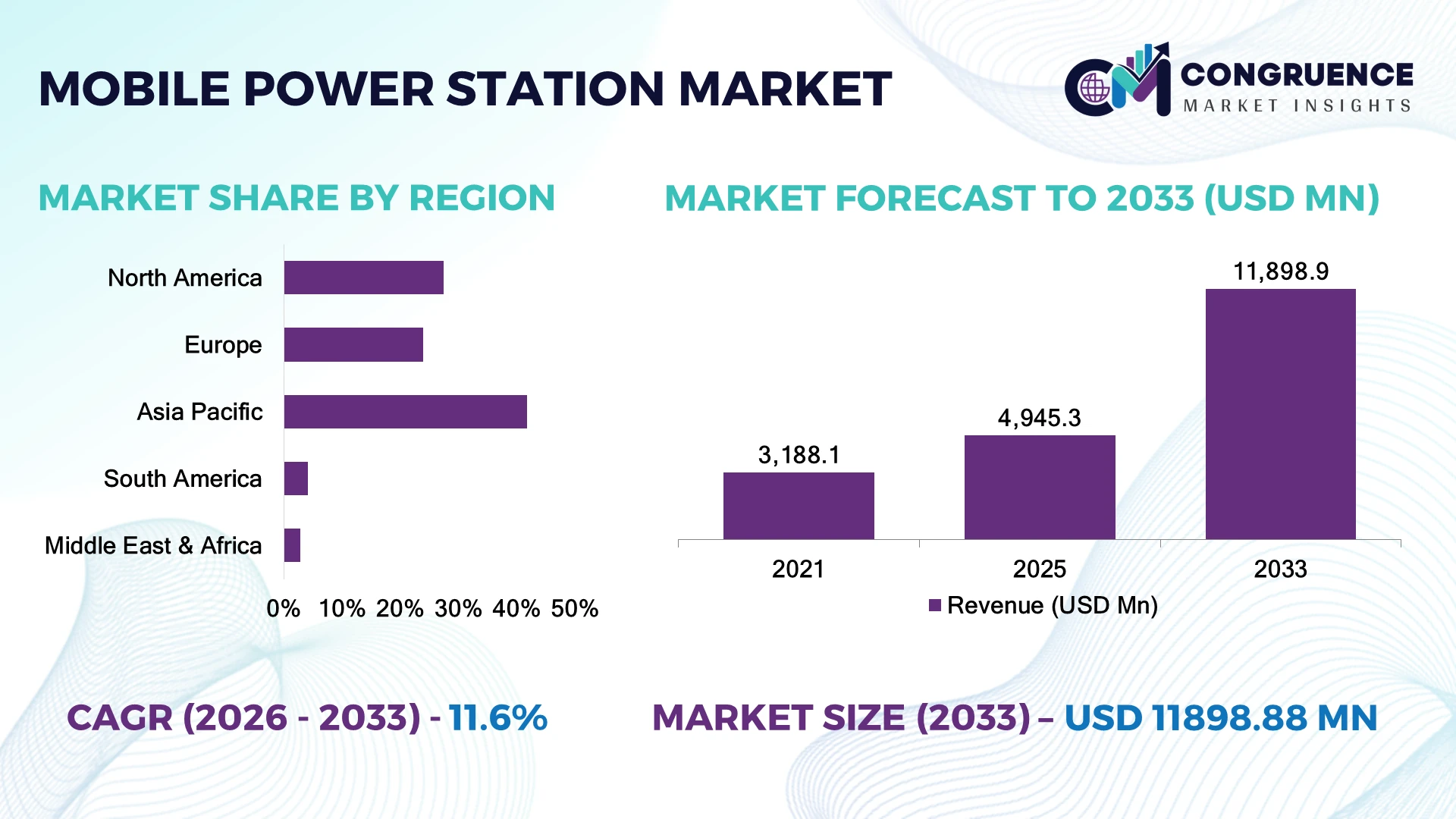
The Global Mobile Power Station Market was valued at USD 4,945.3 Million in 2025 and is anticipated to reach a value of USD 11,898.9 Million by 2033 expanding at a CAGR of 11.6% between 2026 and 2033. Growth is driven by rapid adoption of lithium battery energy storage, expanding off-grid power applications, and increasing deployment of portable backup systems across residential, commercial, and industrial sectors.
China dominates the global mobile power station market with approximately 46% of worldwide lithium battery manufacturing capacity and over 52% of portable energy storage production, supported by strong investments in battery technology, consumer electronics, and renewable energy supply chains. Compared with the United States, which leads premium product innovation and emergency backup deployment, China benefits from greater manufacturing scale and integrated component ecosystems. Continued geopolitical diversification of battery supply chains is accelerating localized production strategies across multiple countries.
Strategic competitiveness increasingly depends on battery innovation, resilient supply-chain integration, and intelligent energy management capabilities.
Market Size & Growth: USD 4,945.3 million in 2025, projected to reach USD 11,898.9 million by 2033 at 11.6% CAGR, driven by battery innovation and portable energy resilience.
Top Growth Drivers: Lithium battery adoption (48%), renewable integration (39%), emergency backup demand (33%).
Short-Term Forecast: By 2028, charging efficiency improves 22% while battery charging time declines nearly 18%.
Emerging Technologies: LiFePO₄ batteries, AI-enabled battery management, and bidirectional charging redefine portable energy systems.
Regional Leaders: Asia-Pacific exceeds USD 5.3 billion, North America surpasses USD 2.8 billion, Europe approaches USD 2.3 billion through resilient energy deployment.
Consumer/End-User Trends: Nearly 57% of buyers prioritize high-capacity portable stations with fast-charging capability.
Pilot/Case Example: During 2025, mobile battery deployment at temporary construction sites reduced diesel generator usage by approximately 31%.
Competitive Landscape: Top five companies hold nearly 49% market share, led by EcoFlow, Jackery, Bluetti, Goal Zero, and Anker.
Regulatory & ESG Impact: Clean energy policies increased battery-based backup deployments by approximately 26% across commercial facilities.
Investment & Funding: More than USD 2.4 billion supports battery manufacturing expansion, strategic partnerships, and production localization.
Innovation & Future Outlook: Modular battery platforms, smart energy management, and solar integration are strengthening next-generation mobile power ecosystems.
Mobile power stations are becoming critical across residential backup, outdoor recreation, construction, disaster response, and remote industrial operations where reliable portable electricity is essential. Nearly 44% of newly launched systems now integrate intelligent battery management and app-based energy monitoring. Battery localization initiatives and evolving energy resilience policies are accelerating product innovation, creating a strong foundation for the market's strategic evolution.
The mobile power station market has evolved into a strategic segment of the distributed energy ecosystem as businesses, governments, and consumers prioritize resilient electricity access beyond conventional grid infrastructure. Growing investments in renewable integration, emergency preparedness, and decentralized energy systems are reshaping purchasing priorities. Simultaneously, battery supply-chain restructuring and regional manufacturing expansion are reducing dependence on concentrated sourcing while strengthening long-term production security.
Modern LiFePO₄ battery systems deliver approximately 45% longer operational life and improve thermal stability by nearly 30% compared with conventional lithium-ion chemistries, lowering ownership costs and enhancing operational reliability. China maintains leadership through large-scale battery manufacturing and integrated supply chains, while the United States focuses on premium innovation, intelligent energy management, and commercial backup applications. Nearly 51% of newly introduced portable power stations now incorporate advanced battery management systems and rapid charging technologies, reflecting a decisive shift toward intelligent energy solutions.
Manufacturers are expanding production capacity, forming battery supply partnerships, and integrating solar charging, vehicle-to-load functionality, and IoT-enabled monitoring into new product portfolios. Mobile power stations are increasingly deployed across disaster recovery operations, telecommunications infrastructure, and off-grid construction projects where uninterrupted electricity directly supports operational continuity. Between 2026 and 2028, companies combining advanced battery technology, software-driven energy optimization, and diversified manufacturing networks will strengthen competitive positioning and establish long-term leadership in portable energy infrastructure.
Rapid improvements in lithium iron phosphate (LiFePO₄) batteries are accelerating mobile power station adoption across residential backup, construction, telecommunications, and outdoor applications. Nearly 58% of newly launched portable power stations now incorporate LiFePO₄ chemistry, while battery cycle life has improved by approximately 45% compared with earlier lithium-ion systems. The United States continues expanding distributed energy resilience initiatives, increasing deployment of battery-powered backup solutions for homes and critical infrastructure. Longer battery life and improved safety reduce total ownership costs, encouraging broader enterprise adoption. Manufacturers are responding by expanding battery production capacity, investing in intelligent battery management systems, and forming strategic partnerships with inverter and solar technology providers. A key competitive shift is the transition from standalone battery products toward integrated portable energy ecosystems.
Dependence on lithium cells, battery-grade materials, and advanced power electronics continues creating structural cost volatility across the mobile power station market. Battery packs account for approximately 54% of total manufacturing costs, while fluctuations in lithium and graphite procurement have increased component pricing by nearly 18% during recent supply adjustments. South Korea and Japan remain dependent on imported battery materials, exposing manufacturers to procurement uncertainty and extended sourcing timelines. These constraints reduce pricing flexibility and complicate production planning for global suppliers. Companies are mitigating risks by localizing battery assembly, securing long-term mineral procurement contracts, and expanding recycling programs to recover valuable battery materials while strengthening supply-chain resilience.
Integration with residential solar systems, electric vehicles, and intelligent home energy management platforms is creating high-value opportunities beyond emergency backup applications. Approximately 43% of premium mobile power stations now support bidirectional charging and smart energy optimization, while AI-enabled battery management improves charging efficiency by nearly 21%. Australia continues promoting distributed renewable energy adoption, accelerating demand for portable battery storage compatible with rooftop solar installations. Companies are investing in cloud-connected energy management, modular battery expansion, and ecosystem partnerships with solar installers and utility technology providers. A notable strategic opportunity lies in subscription-based energy services combining portable storage, monitoring software, and remote diagnostics.
As mobile power stations evolve into connected energy platforms, seamless integration across batteries, inverters, charging systems, and mobile applications has become increasingly complex. Approximately 36% of enterprise deployments require customized software configuration, while interoperability testing extends product validation cycles by nearly 20%. Germany's industrial energy users increasingly demand compatibility with diverse renewable energy assets and digital energy management systems, placing greater pressure on manufacturers to deliver standardized communication protocols. These execution challenges affect deployment consistency, cybersecurity preparedness, and long-term product support. Companies must increase investment in firmware development, cybersecurity protection, standardized communication interfaces, and collaborative software partnerships to maintain reliable connected energy ecosystems.
LiFePO₄ Adoption Accelerates Nearly 64% of newly introduced mobile power stations now utilize LiFePO₄ batteries, extending service life by approximately 42% while improving thermal stability. Manufacturers are restructuring production toward safer battery chemistries as stricter transportation regulations and customer expectations prioritize durability over maximum energy density.
Ultra-Fast Charging Expands Fast-charging technology has reduced recharge time by nearly 35%, while approximately 48% of premium products now achieve substantial charging within one hour. Companies are integrating higher-capacity power electronics and silicon carbide components, enabling faster deployment across emergency response, mobile workforces, and commercial field operations.
Solar Ecosystems Gain Momentum Around 46% of portable power stations launched for residential markets now include optimized solar charging compatibility, improving off-grid energy utilization by approximately 28%. Manufacturers are expanding partnerships with photovoltaic equipment suppliers to deliver integrated renewable energy packages that simplify deployment and strengthen customer retention.
AI Energy Management Emerges Intelligent battery management platforms now appear in nearly 39% of advanced mobile power stations, reducing unnecessary energy consumption by approximately 17% through predictive optimization. Enterprise customers increasingly favor app-connected systems supporting remote diagnostics and fleet monitoring, prompting manufacturers to strengthen software capabilities alongside hardware innovation as connected energy management becomes a primary purchasing criterion.
Lithium-ion mobile power stations accounted for approximately 72% of the global mobile power station market in 2025, making them the leading product category due to their superior energy density, lightweight design, rapid charging capability, and compatibility with portable consumer and commercial applications. Their scalability across capacities ranging from compact personal units to high-output backup systems has strengthened adoption in residential, emergency response, and outdoor recreation markets. Lead-acid mobile power stations continue serving budget-conscious and industrial applications where initial acquisition cost outweighs portability, while hybrid power stations combining battery storage with renewable charging capabilities are steadily expanding their strategic relevance.
LiFePO₄-based mobile power stations represent the fastest-growing segment as users prioritize longer battery lifespan, improved thermal stability, and enhanced safety. Nearly 59% of premium portable power stations introduced during 2025 incorporated LiFePO₄ technology, while modular battery expansion capability increased by approximately 27% across new product launches. Manufacturers are investing in advanced battery management systems, strategic cell supply partnerships, and modular product architectures to strengthen performance while supporting evolving energy resilience requirements.
According to a 2026 International Energy Agency assessment, lithium-based battery technologies continued accounting for the majority of newly deployed portable energy storage systems, reflecting accelerated adoption across residential and commercial backup applications.
Emergency backup power represented approximately 41% of the global mobile power station market in 2025, driven by increasing electricity reliability concerns, disaster preparedness initiatives, and growing deployment across residential and commercial facilities. Businesses and households increasingly rely on portable battery systems to maintain essential operations during grid disruptions without the emissions and maintenance requirements associated with fuel-powered generators. Outdoor recreation remains a mature application supported by demand for portable energy solutions, while construction and remote industrial operations continue expanding their deployment of battery-powered mobile energy systems.
Off-grid renewable energy support is the fastest-growing application as portable energy storage becomes increasingly integrated with solar power installations and distributed energy systems. Approximately 38% of newly deployed mobile power stations now support intelligent solar charging, while integrated energy management functions have improved charging optimization by nearly 24%. Manufacturers are expanding inverter compatibility, app-based monitoring, and modular storage solutions to address rising demand for flexible, low-emission power infrastructure across residential and commercial environments.
A 2025 enterprise survey conducted by the Solar Energy Industries Association indicated that integrated battery storage adoption continued rising among residential solar installations, strengthening demand for portable energy storage compatible with distributed renewable systems.
Residential consumers accounted for approximately 49% of the global mobile power station market in 2025, supported by growing investment in household energy resilience, portable backup solutions, and outdoor lifestyle applications. Increasing adoption of home office infrastructure, weather-related power disruptions, and rooftop solar integration continue driving deployment across urban and suburban households. Commercial users maintain consistent procurement for field operations, retail continuity, and mobile service applications, while industrial users utilize higher-capacity systems for temporary power and remote operational support.
Commercial enterprises represent the fastest-growing end-user segment as telecommunications providers, construction companies, healthcare facilities, and event management firms increasingly deploy portable battery systems to improve operational continuity. Approximately 33% of new commercial purchases now exceed 2 kWh capacity, while fleet-based portable energy deployments have increased by nearly 22% over the past two years. Manufacturers are responding through customized product configurations, enterprise service agreements, flexible financing models, and partnerships with energy solution providers to strengthen long-term customer relationships and recurring business opportunities.
According to the 2026 Consumer Technology Association market outlook, portable battery-powered energy products recorded sustained adoption growth among residential and professional users, driven by increasing demand for reliable backup power and connected energy management solutions.
Asia-Pacific accounted for the largest market share at 41.8% in 2025 however, North America is expected to register the fastest growth, expanding at a CAGR of 12.3% between 2026 and 2033.
Portable Energy Resilience Drives Enterprise Adoption
North America accounted for approximately 27.4% of the global mobile power station market, supported by increasing deployment of battery-based backup systems across residential, commercial, telecommunications, and emergency response sectors. Grid resilience initiatives, growing electrification, and expansion of distributed energy infrastructure continue strengthening demand for portable energy storage solutions. Approximately 44% of premium mobile power station sales in the region are integrated with smart energy management applications, reflecting growing consumer preference for connected energy devices. Manufacturers are expanding regional assembly operations, strengthening battery sourcing partnerships, and increasing investment in intelligent power management platforms to improve product availability and reduce supply-chain dependence on imported battery components.
United States Market Outlook: The United States leads the regional market through advanced battery innovation, widespread residential backup adoption, and strong outdoor recreation demand. Nearly 69% of North American portable energy storage deployments are concentrated in the country, supported by expanding distributed energy investments and emergency preparedness initiatives. Companies continue investing in domestic battery assembly, intelligent energy management software, and modular product development to strengthen energy security and accelerate commercialization of high-capacity mobile power stations.
Energy Transition Accelerates Portable Storage Deployment
Europe represented approximately 23.9% of the global mobile power station market in 2025, supported by renewable energy integration, residential energy resilience programs, and increasing deployment of battery-powered backup systems. Portable energy storage is gaining importance across households, construction, and mobile commercial operations as electrification strategies reduce dependence on fossil-fuel generators. Approximately 37% of newly introduced portable energy products in the region now support direct solar integration and intelligent energy optimization. Manufacturers are expanding partnerships with renewable energy solution providers while developing higher-capacity systems compatible with evolving residential and commercial energy ecosystems.
Germany Market Outlook: Germany remains Europe's leading market due to its advanced renewable energy infrastructure, strong battery technology ecosystem, and extensive adoption of residential energy storage. Approximately 31% of Europe's distributed battery storage installations are concentrated in Germany. Domestic companies continue integrating mobile power stations with rooftop solar systems, smart home platforms, and decentralized energy management solutions to improve energy flexibility and operational resilience.
Battery Manufacturing Scale Strengthens Global Leadership
Asia-Pacific accounted for approximately 41.8% of the global mobile power station market, benefiting from extensive lithium battery manufacturing capacity, vertically integrated supply chains, and large-scale consumer electronics production. China, Japan, and South Korea continue driving product innovation through advancements in battery chemistry, charging technology, and intelligent battery management systems. Approximately 63% of global portable energy storage manufacturing capacity is concentrated across leading Asia-Pacific production hubs. Companies are expanding automated battery production lines, strengthening semiconductor integration, and increasing exports to support growing global demand for portable energy solutions.
China Market Outlook: China dominates the regional market through its leadership in lithium battery production, power electronics manufacturing, and integrated component supply chains. More than 52% of global portable power station manufacturing is concentrated in China, supported by mature battery ecosystems and large-scale production efficiency. Manufacturers continue investing in automated production facilities, next-generation LiFePO₄ battery technologies, and export-oriented manufacturing strategies to reinforce long-term global competitiveness.
Off-Grid Applications Expand Commercial Demand
South America accounted for approximately 4.1% of the global mobile power station market, supported by increasing demand for portable electricity across mining, agriculture, telecommunications, and remote infrastructure projects. Limited grid accessibility in several industrial zones continues encouraging deployment of battery-powered energy solutions capable of supporting essential operations. Approximately 29% of recent mobile power station deployments in the region have been associated with commercial and industrial field applications. Companies are expanding local distribution partnerships, strengthening after-sales service networks, and introducing ruggedized products designed for challenging operating environments while balancing affordability with performance.
Brazil Market Outlook: Brazil leads the regional market through its large industrial economy, expanding renewable energy sector, and growing investment in decentralized electricity infrastructure. Approximately 58% of South America's commercial portable energy deployments are concentrated in Brazil. Industrial enterprises increasingly deploy mobile power stations across construction projects, agricultural operations, and emergency response activities to improve operational continuity while reducing dependence on conventional fuel-powered generators.
Infrastructure Modernization Expands Portable Energy Deployment
The Middle East & Africa accounted for approximately 3.8% of the global mobile power station market, supported by infrastructure modernization, remote industrial operations, and growing investment in decentralized energy solutions. Portable battery systems are increasingly deployed across oil and gas facilities, telecommunications infrastructure, healthcare operations, and disaster response applications where uninterrupted electricity is operationally critical. Approximately 24% of newly deployed off-grid energy systems within major Gulf infrastructure projects incorporate portable battery storage technologies. Manufacturers are strengthening regional distribution channels, expanding technical support capabilities, and introducing high-capacity systems designed for demanding environmental conditions.
Saudi Arabia Market Outlook: Saudi Arabia is the region's leading market, driven by industrial diversification initiatives, expanding renewable energy projects, and modernization of critical infrastructure. Approximately 34% of large-scale portable energy deployments across the Gulf Cooperation Council countries are concentrated in Saudi Arabia. Companies continue investing in battery-powered mobile energy solutions supporting construction, utilities, and industrial operations while strengthening localized service capabilities to improve long-term operational reliability.
Global leaders including EcoFlow, Jackery, Bluetti, Anker, and Goal Zero compete through battery technology, charging speed, software integration, and product ecosystems, while regional manufacturers challenge premium brands with lower pricing and localized distribution. The top five companies collectively account for approximately 49% of the global market. Competition increasingly centers on LiFePO₄ battery platforms, where cycle life improves by nearly 45%, while fast-charging technologies reduce recharge time by approximately 35%. Smart energy management features influence nearly 41% of premium purchase decisions. Companies are expanding battery manufacturing, forming strategic cell supply partnerships, integrating solar charging solutions, and developing modular expansion ecosystems to strengthen customer retention. The competitive landscape is shifting from standalone portable batteries toward intelligent home backup and distributed energy platforms. High battery sourcing requirements, certification standards, and software integration capabilities remain significant entry barriers. Success depends on combining advanced battery engineering, resilient supply chains, intelligent energy management, and scalable ecosystem partnerships.
EcoFlow
Jackery
Bluetti
Anker Innovations
Goal Zero
Zendure
ALLPOWERS
VTOMAN
DJI
UGREEN
Yoshino Technology
Lion Energy
Pecron
Geneverse
LiFePO₄ battery technology has become the foundation of the mobile power station market due to its superior safety, cycle life, and thermal stability. Approximately 62% of newly introduced portable power stations now utilize LiFePO₄ chemistry, improving service life by nearly 45% while reducing thermal degradation by approximately 30% compared with conventional lithium-ion batteries. Intelligent battery management systems, bidirectional inverters, and app-based monitoring are becoming standard features, enabling users to optimize charging, monitor battery health, and improve operational reliability. Companies adopting integrated hardware-software platforms strengthen product differentiation and long-term customer engagement.
Emerging technologies include silicon carbide power electronics, AI-enabled energy optimization, vehicle-to-load functionality, and modular battery expansion. Compared with conventional lithium-ion platforms, modern LiFePO₄ systems provide approximately 40% longer operating life and nearly 20% lower maintenance requirements. Premium manufacturers benefit by offering expandable energy ecosystems and seamless renewable integration, while value-oriented suppliers continue emphasizing cost-efficient hardware with standardized charging capabilities.
Between 2026 and 2028, AI-driven energy scheduling, portable microgrid functionality, and intelligent hybrid charging will redefine mobile energy storage. Nearly 48% of premium product launches are expected to integrate cloud-connected energy management and smart load balancing. Organizations investing now in advanced battery chemistries, software-enabled energy optimization, and modular product architectures will strengthen competitive positioning, improve customer retention, and capture emerging opportunities across residential backup, commercial mobility, and distributed energy applications.
January 2024 Anker introduced the SOLIX F3800 Plus portable power station with expandable battery capacity reaching 53.8 kWh, strengthening whole-home backup capability and reinforcing its position in residential energy resilience. Source: anker.com
July 2025 EcoFlow launched the TRAIL Series, its first DC-only portable power station lineup, delivering a significantly lighter design for outdoor applications while expanding the company's portable energy portfolio. Source: prnewswire.com
September 2025 Jackery introduced the Explorer 240D portable power station, offering a design approximately 70% smaller and 46% lighter than comparable AC power stations, improving portability for outdoor and mobile applications. Source: globenewswire.com
September 2025 EcoFlow expanded its DELTA 3 Series with new Classic, Max, and Ultra models featuring Smart Output Priority Control and configurations ranging from 1 kWh to 3 kWh, strengthening home backup and emergency power solutions. Source: prnewswire (PR Newswire)
The report provides comprehensive analysis of the mobile power station market across product types, including lithium-ion, LiFePO₄, lead-acid, and hybrid portable power systems. It evaluates applications spanning emergency backup, outdoor recreation, off-grid renewable energy support, construction, and remote industrial operations, while assessing demand across residential, commercial, industrial, and government end users. Regional analysis covers North America, Europe, Asia-Pacific, South America, and the Middle East & Africa, supported by country-level manufacturing, battery supply chain, and deployment assessments. More than 60% of the analysis focuses on lithium-based portable energy storage technologies and intelligent power management adoption.
The report further examines battery management systems, fast-charging technologies, bidirectional inverters, solar integration, AI-enabled energy optimization, and modular storage architectures shaping industry competitiveness. It benchmarks leading manufacturers, evaluates product innovation, distribution strategies, deployment trends, and ecosystem partnerships, providing actionable intelligence for investment planning, portfolio expansion, competitive positioning, manufacturing localization, and strategic decision-making across the global mobile power station market between 2026 and 2033.
| Report Attribute/Metric | Report Details |
|---|---|
|
Market Revenue in 2025 |
USD 4,945.3 Million |
|
Market Revenue in 2033 |
USD 11,898.9 Million |
|
CAGR (2026 - 2033) |
11.6% |
|
Base Year |
2025 |
|
Forecast Period |
2026 - 2033 |
|
Historic Period |
2021 - 2025 |
|
Segments Covered |
By Type
By Application
By End-User
|
|
Key Report Deliverable |
Revenue Forecast, Growth Trends, Market Dynamics, Segmental Overview, Regional and Country-wise Analysis, Competition Landscape |
|
Region Covered |
North America, Europe, Asia-Pacific, South America, Middle East, Africa |
|
Key Players Analyzed |
EcoFlow, Jackery, Bluetti, Anker Innovations, Goal Zero, Zendure, ALLPOWERS, VTOMAN, DJI, UGREEN, Yoshino Technology, Lion Energy, Pecron, Geneverse |
|
Customization & Pricing |
Available on Request (10% Customization is Free) |




