
Reports
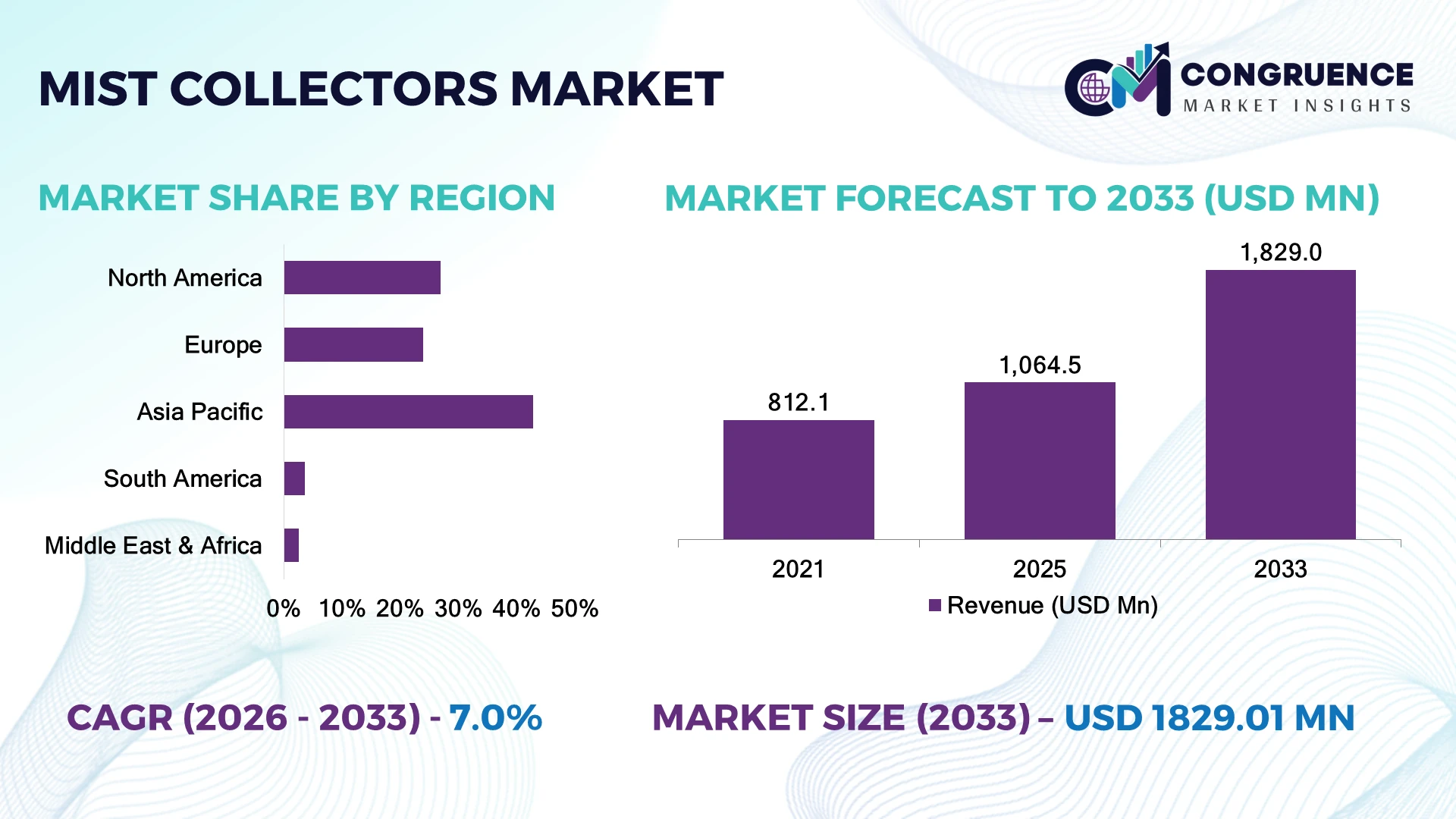
The Global Mist Collectors Market was valued at USD 1,064.5 Million in 2025 and is anticipated to reach a value of USD 1,829.0 Million by 2033 expanding at a CAGR of 7.0% between 2026 and 2033. Growth is driven by stricter industrial air-quality compliance, rising automation in precision manufacturing, and expanding deployment of high-efficiency mist collection systems across CNC machining, metalworking, and electronics production facilities.
China leads the global Mist Collectors market with approximately 31% of manufacturing capacity, supported by large-scale automotive, metal fabrication, and electronics industries alongside continued factory automation investments. Industrial air filtration deployment is nearly 2.3 times higher than India, while smart filtration systems improve maintenance efficiency by approximately 22%. Ongoing global supply-chain diversification and manufacturing relocation since 2026 continue accelerating investments in advanced industrial ventilation infrastructure.
Manufacturers investing in intelligent filtration technologies, localized production, and energy-efficient systems will strengthen long-term competitiveness across high-value industrial markets.
Market Size & Growth: USD 1,064.5 million in 2025 reaching USD 1,829.0 million by 2033 at 7.0% CAGR, supported by factory automation and stricter workplace air-quality standards.
Top Growth Drivers: Industrial automation (+29%), emission compliance (+24%), precision manufacturing (+19%).
Short-Term Forecast: By 2028, predictive maintenance reduces service costs by 15% while filtration efficiency improves by 18%.
Emerging Technologies: AI monitoring, IoT-enabled filtration, and high-efficiency nanofiber filter media accelerate adoption.
Regional Leaders: Asia-Pacific (~USD 780 million), North America (~USD 430 million), Europe (~USD 360 million), driven by manufacturing modernization.
Consumer/End-User Trends: Nearly 64% of installations serve CNC machining, metalworking, and automotive manufacturing.
Pilot/Case Example: A 2026 smart manufacturing upgrade reduced airborne oil mist by approximately 27%.
Competitive Landscape: Top five suppliers hold nearly 48% market share, led by Donaldson, Nederman, Absolent, Camfil, and Parker Hannifin.
Regulatory & ESG Impact: Energy-efficient filtration systems reduce electricity consumption by approximately 13% while improving workplace compliance.
Investment & Funding: More than USD 1.1 billion supports industrial filtration expansion, digital monitoring, and manufacturing upgrades.
Innovation & Future Outlook: Connected filtration platforms and automated performance diagnostics are redefining industrial air management.
The Mist Collectors market continues evolving as manufacturers prioritize cleaner production environments, digital maintenance, and operational efficiency across automotive, aerospace, electronics, and metalworking facilities. Intelligent filtration platforms now represent approximately 37% of premium installations, while tightening workplace emission requirements and resilient manufacturing supply chains are accelerating investment in advanced industrial air management, setting the stage for broader strategic transformation.
The Mist Collectors market has become strategically important as manufacturers increasingly integrate workplace safety, production efficiency, and environmental compliance into core operational strategies. Industrial automation, factory modernization, and stricter occupational air-quality regulations are driving replacement of conventional filtration systems with intelligent mist collection technologies. Supply-chain localization is also encouraging investment in modern manufacturing facilities equipped with advanced air filtration infrastructure.
Smart IoT-enabled mist collectors improve maintenance efficiency by approximately 21% and reduce unexpected downtime by nearly 16% compared with conventional standalone filtration systems. China continues leading large-scale manufacturing deployments through extensive industrial expansion, while Germany emphasizes high-performance filtration integrated with Industry 4.0 production environments. During the next two to three years, connected monitoring systems are expected to become standard across advanced machining operations, improving equipment reliability and workplace air quality simultaneously.
Automotive and precision engineering manufacturers are expanding deployment of centralized filtration systems integrated with digital factory management platforms. Equipment suppliers are strengthening technology partnerships, investing in intelligent sensor development, and expanding regional service networks to support predictive maintenance. Companies capable of delivering energy-efficient, digitally connected, and low-maintenance mist collection solutions will establish stronger competitive positioning as industrial facilities prioritize productivity, compliance, and long-term operational resilience.
Factory modernization and increasingly stringent workplace air-quality requirements are accelerating deployment of advanced mist collection systems across machining-intensive industries. Approximately 68% of CNC machining facilities now prioritize high-efficiency oil mist extraction, while smart filtration reduces unplanned maintenance by nearly 19% and improves machine uptime by around 14%. Germany continues upgrading advanced manufacturing plants under digital production initiatives, encouraging wider integration of intelligent air filtration technologies. Improved workplace safety and longer machine life are directly increasing replacement demand for connected filtration systems. Manufacturers are expanding IoT-enabled product portfolios, investing in high-performance filter media, and strengthening partnerships with industrial automation providers to deliver integrated air management solutions. The strategic advantage is shifting toward suppliers capable of combining filtration performance with predictive maintenance capabilities.
Large-scale mist collection systems require significant upfront capital investment, specialized ducting, and ongoing filter replacement, creating cost barriers for small and medium-sized manufacturers. Installation and integration account for approximately 28% of total project expenditure, while premium filter media can increase maintenance costs by nearly 16%. Mexico's smaller contract manufacturing facilities often delay system upgrades because of budget constraints despite tightening workplace compliance requirements. These structural limitations slow replacement cycles and reduce penetration in cost-sensitive industries. Equipment suppliers are responding through modular system designs, localized component sourcing, flexible service contracts, and energy-efficient filtration technologies that lower lifetime operating expenses while improving affordability.
The integration of AI-driven diagnostics, cloud-based monitoring, and predictive maintenance platforms is creating new value beyond conventional air filtration. Connected mist collectors reduce maintenance interventions by approximately 23% while extending filter service life by nearly 18%. Japan's precision manufacturing sector is accelerating adoption of smart factory technologies that require digitally integrated environmental control systems. Equipment manufacturers are expanding software capabilities, collaborating with industrial automation companies, and investing in digital service platforms that enable subscription-based monitoring and remote diagnostics. A non-obvious opportunity lies in operational data analytics, allowing manufacturers to optimize machining performance while simultaneously reducing filtration energy consumption and maintenance costs.
Integrating intelligent mist collectors into existing manufacturing execution systems remains a significant execution challenge for industrial facilities operating mixed-generation equipment. Approximately 27% of legacy production lines require customized integration, while commissioning timelines can increase by nearly 18% when digital compatibility is limited. The United States faces increasing demand for cybersecurity-ready industrial control environments, adding complexity to connected filtration deployments. Manufacturers must invest in standardized communication protocols, secure industrial networking, and skilled engineering support to ensure reliable interoperability. Long-term competitiveness depends on delivering scalable digital ecosystems that combine air-quality management, predictive maintenance, and operational data without disrupting production continuity.
Smart Monitoring Accelerates Adoption: Connected mist collectors equipped with IoT sensors now represent approximately 39% of new industrial installations, reducing maintenance downtime by nearly 20%. Labor shortages and digital manufacturing initiatives are encouraging companies to automate equipment monitoring while expanding predictive service capabilities through software-enabled filtration platforms.
Compact Modular Systems Expand: Manufacturers are increasingly deploying modular mist collectors that reduce installation space requirements by approximately 24% and shorten commissioning time by nearly 17%. Automotive suppliers and precision machining facilities are restructuring production layouts, prompting equipment manufacturers to develop scalable systems supporting flexible manufacturing environments.
Advanced Filter Media Innovation: High-efficiency nanofiber and multilayer filtration technologies improve fine-particle capture by approximately 26% while extending filter replacement intervals by nearly 15%. A non-obvious shift is growing customer preference for lower total ownership costs rather than maximum airflow, encouraging suppliers to prioritize lifecycle performance over equipment size.
Localized Manufacturing Strengthens Supply: Industrial equipment manufacturers are regionalizing production and component sourcing to reduce delivery lead times by approximately 18% while improving order fulfillment reliability by nearly 14%. Ongoing supply-chain diversification and manufacturing relocation are driving partnerships with local distributors, strengthening aftermarket support and accelerating customer response times.
Electrostatic Mist Collectors account for approximately 47% of the global market due to their superior efficiency in capturing submicron oil mist, low pressure drop, and suitability for continuous-duty machining environments. Their ability to maintain high airflow while reducing filter replacement requirements makes them the preferred solution for automotive, aerospace, and precision engineering facilities. Media Filter Mist Collectors remain widely adopted among small and mid-sized manufacturers because of lower installation costs and simplified maintenance, while centrifugal systems continue serving specialized heavy-machining operations.
Hybrid Mist Collectors represent the fastest-growing segment as manufacturers seek to combine electrostatic separation with advanced mechanical filtration for improved particulate removal and operational flexibility. Hybrid configurations improve filtration efficiency by approximately 21% while reducing maintenance frequency by nearly 16%. Equipment suppliers are expanding modular product portfolios, integrating smart monitoring capabilities, and developing application-specific solutions for automated production lines. Investment priorities are shifting toward intelligent, high-efficiency systems capable of supporting digital manufacturing environments and stricter workplace air-quality requirements.
A 2026 manufacturing technology assessment released by SME (Society of Manufacturing Engineers) highlighted growing deployment of electrostatic and hybrid air filtration systems in automated machining facilities to improve equipment reliability and workplace air quality.
Metalworking accounts for approximately 44% of global Mist Collectors demand owing to extensive deployment across CNC machining, grinding, milling, and turning operations where oil mist generation directly affects equipment performance and worker safety. Continuous machining environments require high-efficiency filtration to maintain productivity while minimizing machine contamination. Automotive Manufacturing remains another mature application supported by large-scale production facilities, whereas Aerospace Manufacturing increasingly demands premium filtration systems for precision machining and compliance with stringent production standards.
Electronics Manufacturing is the fastest-growing application as semiconductor fabrication, battery production, and precision component manufacturing adopt cleaner production environments. Smart filtration systems improve airborne contaminant removal by approximately 19% while lowering maintenance interventions by nearly 15%. Manufacturers are expanding compact filtration platforms, integrating IoT-enabled monitoring, and scaling localized technical support for advanced manufacturing customers. Demand is strengthening in high-value industries where stable production environments directly influence product quality, equipment life, and manufacturing consistency.
A 2025 enterprise manufacturing survey conducted by the Association for Manufacturing Technology identified advanced air filtration as a priority investment across digitally automated machining facilities to improve operational efficiency and production quality.
The Automotive industry represents approximately 39% of global Mist Collectors demand due to high concentrations of CNC machining, engine component manufacturing, transmission production, and precision metalworking operations. Continuous manufacturing schedules and workplace compliance requirements make advanced mist collection systems an essential production asset. Aerospace remains a high-value customer segment focused on premium filtration performance, while general industrial manufacturing maintains broad adoption through replacement of conventional extraction equipment.
Electronics and Semiconductor Manufacturing is the fastest-growing end-user segment as clean production environments become increasingly critical for precision assembly and advanced component fabrication. Intelligent mist collection systems reduce airborne contaminants by approximately 23% while extending machining equipment life by nearly 14%. Suppliers are introducing customized filtration platforms, expanding engineering partnerships, and strengthening lifecycle service offerings tailored to high-precision industries. Competitive positioning is increasingly defined by digital integration, energy efficiency, and application-specific system design rather than standalone filtration performance.
According to a 2026 industry assessment published by SEMI, semiconductor manufacturers continue increasing investment in advanced environmental control technologies to improve production consistency, equipment reliability, and contamination management across precision fabrication facilities.
Asia-Pacific accounted for the largest market share at 42.8% in 2025 however, North America is expected to register the fastest growth, expanding at a CAGR of 7.4% between 2026 and 2033.

Advanced Manufacturing Automation Accelerates Intelligent Air Filtration
North America is strengthening its Mist Collectors market through rapid adoption of smart manufacturing, precision machining, and industrial automation across automotive, aerospace, and medical device production. The region contributes approximately 27% of global demand, supported by widespread deployment of CNC machining centers requiring high-performance oil mist extraction. More than 58% of newly upgraded machining facilities now integrate connected filtration systems linked with factory monitoring platforms, improving equipment availability and maintenance planning. Manufacturers are expanding regional engineering capabilities, strengthening distributor partnerships, and introducing energy-efficient filtration solutions that reduce operational downtime while supporting increasingly stringent workplace air-quality requirements.
United States Market Outlook: The United States dominates the regional market through its extensive aerospace, automotive, defense, and industrial machinery manufacturing base. Factory modernization programs continue increasing deployment of digitally integrated mist collection systems across high-precision machining facilities. Approximately 65% of North America's advanced machining installations are concentrated in the United States, encouraging suppliers to expand localized technical support, aftermarket services, and customized filtration platforms for industrial manufacturers.
Industrial Sustainability Drives Equipment Modernization
Europe maintains strong demand for mist collectors through advanced manufacturing, workplace safety initiatives, and industrial energy-efficiency programs. The region accounts for approximately 24% of global market demand, supported by precision engineering, automotive production, and high-value metalworking industries. Nearly 46% of replacement projects prioritize energy-efficient filtration systems capable of lowering operating costs while meeting increasingly demanding workplace environmental standards. Equipment suppliers continue investing in compact designs, digital monitoring capabilities, and service-based maintenance programs to strengthen long-term customer retention.
Germany Market Outlook: Germany leads the European market through its globally competitive automotive, machine tool, and industrial automation sectors. Advanced production facilities increasingly integrate intelligent mist collection systems into Industry 4.0 manufacturing environments to improve operational reliability and machine lifespan. Continued investment in automated machining technologies supports strong demand for premium air filtration solutions optimized for precision manufacturing applications.
Manufacturing Scale Sustains Market Leadership
Asia-Pacific leads the global Mist Collectors market through its extensive manufacturing ecosystem spanning automotive, electronics, industrial machinery, and metal fabrication industries. The region represents approximately 42.8% of global demand, supported by continuous factory expansion and automation investments. Smart manufacturing upgrades have increased deployment of connected filtration systems by nearly 22% across large industrial facilities, while localized production improves equipment availability and delivery performance. Manufacturers continue expanding production capacity, regional assembly operations, and engineering support to meet rising demand for advanced industrial air management technologies.
China Market Outlook: China remains the largest country market because of its dominant industrial manufacturing base, extensive CNC machining capacity, and rapid adoption of intelligent factory technologies. Industrial modernization initiatives continue driving replacement of conventional filtration equipment with digitally connected systems. Approximately one-third of global industrial equipment production is concentrated in China, creating sustained demand for advanced mist collection solutions across multiple manufacturing sectors.
Industrial Modernization Expands Equipment Adoption
South America is steadily increasing mist collector deployment as manufacturers modernize metalworking operations, automotive production, and industrial processing facilities. Brazil and Argentina account for the majority of regional installations, supported by investments in workplace safety and equipment modernization. Approximately 18% of recently upgraded machining facilities now incorporate advanced mist collection technologies to improve operational efficiency and machine protection. Limited local manufacturing capacity continues to influence equipment availability, encouraging suppliers to strengthen regional distribution partnerships and localized service capabilities.
Brazil Market Outlook: Brazil leads regional demand through its diversified automotive, metalworking, and industrial equipment manufacturing sectors. Modern production facilities increasingly prioritize high-efficiency mist collection systems to improve workplace conditions and extend machining equipment life. Continued expansion of industrial automation projects is encouraging suppliers to establish stronger technical support networks and application-specific filtration solutions for Brazilian manufacturers.
Industrial Diversification Supports Air Management Investments
The Middle East & Africa market is progressing through industrial diversification, manufacturing expansion, and modernization of metal processing facilities. Oil and gas equipment manufacturing, mining, and heavy engineering operations are increasing adoption of industrial air filtration systems to improve operational reliability and workplace compliance. Approximately 16% of new industrial facility investments now include centralized mist collection infrastructure as part of integrated environmental control strategies. Equipment providers are strengthening distributor partnerships and expanding technical service capabilities to support long-term industrial development.
Saudi Arabia Market Outlook: Saudi Arabia represents the region's leading growth market due to expanding industrial diversification initiatives, metal fabrication investments, and large-scale manufacturing developments. New industrial facilities increasingly incorporate advanced ventilation and mist collection technologies during plant design rather than retrofit stages. Growing investment in modern industrial infrastructure is creating sustained opportunities for premium filtration suppliers capable of delivering energy-efficient and digitally monitored air management systems.
Global filtration leaders Donaldson, Nederman, Camfil, Absolent Air Care Group, and Parker Hannifin compete with regional air-filtration specialists and OEM-integrated system providers, while digital filtration innovators challenge cost-focused equipment manufacturers through connected monitoring and lifecycle services. The top five companies collectively account for approximately 48% of the global market. Competition centers on filtration efficiency, energy consumption, digital connectivity, and aftermarket responsiveness. Intelligent monitoring reduces maintenance costs by approximately 18%, high-efficiency filter media extends service life by nearly 22%, and modular systems shorten installation time by around 16%. Companies are expanding manufacturing capacity, strengthening distributor networks, integrating IoT platforms, and pursuing acquisitions to broaden industrial filtration portfolios. Competitive momentum is shifting toward predictive maintenance, subscription-based service models, and integrated factory automation. High certification requirements, established service infrastructure, and application-specific engineering expertise remain significant entry barriers. Winning requires connected filtration, reliable lifecycle support, rapid customization, and measurable operating cost reductions.
Donaldson Company, Inc.
Nederman Holding AB
Absolent Air Care Group AB
Parker Hannifin Corporation
Camfil AB
Losma S.p.A.
Filtermist International Ltd.
Keller Lufttechnik GmbH + Co. KG
3nine AB
Showa Denki Co., Ltd.
Aeroex Technologies Inc.
Air Quality Engineering, Inc.
AGET Manufacturing Company
Electrostatic precipitation, high-efficiency media filtration, and centrifugal separation remain the primary technologies shaping industrial mist collection. Smart airflow control improves filtration efficiency by approximately 19%, while premium nanofiber media extends filter life by nearly 21%. Around 61% of newly installed systems in advanced manufacturing facilities now include connected monitoring for performance optimization, maintenance planning, and compliance reporting across machining-intensive operations.
Emerging technologies include AI-driven predictive maintenance, IoT-enabled remote diagnostics, digital twin integration, and variable-speed airflow optimization. Compared with conventional standalone mist collectors, connected filtration systems reduce unplanned downtime by approximately 24% while lowering maintenance expenditure by nearly 17%. Global manufacturers operating high-volume CNC machining facilities gain the greatest competitive advantage because intelligent filtration minimizes production interruptions and supports continuous manufacturing with lower operating costs.
Between 2026 and 2028, cloud-connected filtration management, self-diagnostic controllers, and advanced sensor integration will become standard across premium industrial facilities. Equipment suppliers investing in software-enabled monitoring, modular filtration architecture, and energy-efficient motors will strengthen aftermarket service revenues and long-term customer retention. Early adoption delivers higher equipment availability, lower energy consumption, improved regulatory compliance, and stronger differentiation in increasingly digital manufacturing environments.
March 2024 – Donaldson opened its new Industrial Dust, Fume & Mist Experience Centre in Pune, showcasing connected iCue™ filtration monitoring technologies to strengthen customer engagement and accelerate smart filtration adoption across industrial manufacturing facilities. Source: Donaldson Filtration Solutions
June 2025 – Filtermist International secured its largest-ever single-project order, reinforcing demand for industrial oil mist extraction solutions and expanding deployment across a major manufacturing program, strengthening the company's position in engineered air filtration systems. Source: Absolent Group
September 2025 – Absolent launched the modular AW-range oil mist filtration units for high-precision machining environments, emphasizing simplified integration and enhanced filtration performance to support modern automated manufacturing operations. Source: Absolent - Great Britain
November 2025 – Parker Hannifin announced its agreement to acquire Filtration Group Corporation in a transaction valued at USD 9.25 billion, significantly expanding its industrial filtration portfolio and strengthening global aftermarket capabilities.
This report provides comprehensive analysis of the global Mist Collectors market across product types, applications, end-user industries, technologies, and major geographic regions. It evaluates electrostatic, media filter, centrifugal, and hybrid systems deployed across metalworking, automotive, aerospace, electronics, and precision manufacturing environments. The assessment covers intelligent filtration technologies, digital monitoring, maintenance strategies, distribution channels, and competitive positioning while examining operational trends across established manufacturing economies and emerging industrial hubs.
The report analyzes market developments between 2026 and 2033, highlighting technology adoption patterns, deployment intensity, and evolving customer purchasing priorities. More than 60% of demand is concentrated in machining-intensive manufacturing industries, while connected filtration platforms continue expanding across smart factory environments. Strategic insights support investment planning, product development, regional expansion, supplier benchmarking, partnership evaluation, and competitive positioning by identifying high-growth application areas, technology transitions, enterprise deployment trends, and long-term opportunities throughout the industrial air filtration ecosystem.
| Report Attribute/Metric | Report Details |
|---|---|
|
Market Revenue in 2025 |
USD 1,064.5 Million |
|
Market Revenue in 2033 |
USD 1,829.0 Million |
|
CAGR (2026 - 2033) |
7% |
|
Base Year |
2025 |
|
Forecast Period |
2026 - 2033 |
|
Historic Period |
2021 - 2025 |
|
Segments Covered |
By Type
By Application
By End-User
|
|
Key Report Deliverable |
Revenue Forecast, Growth Trends, Market Dynamics, Segmental Overview, Regional and Country-wise Analysis, Competition Landscape |
|
Region Covered |
North America, Europe, Asia-Pacific, South America, Middle East, Africa |
|
Key Players Analyzed |
Donaldson Company, Inc., Nederman Holding AB, Absolent Air Care Group AB, Parker Hannifin Corporation, Camfil AB, Losma S.p.A., Filtermist International Ltd., Keller Lufttechnik GmbH + Co. KG, 3nine AB, Showa Denki Co., Ltd., Aeroex Technologies Inc., Air Quality Engineering, Inc., AGET Manufacturing Company |
|
Customization & Pricing |
Available on Request (10% Customization is Free) |




