
Reports
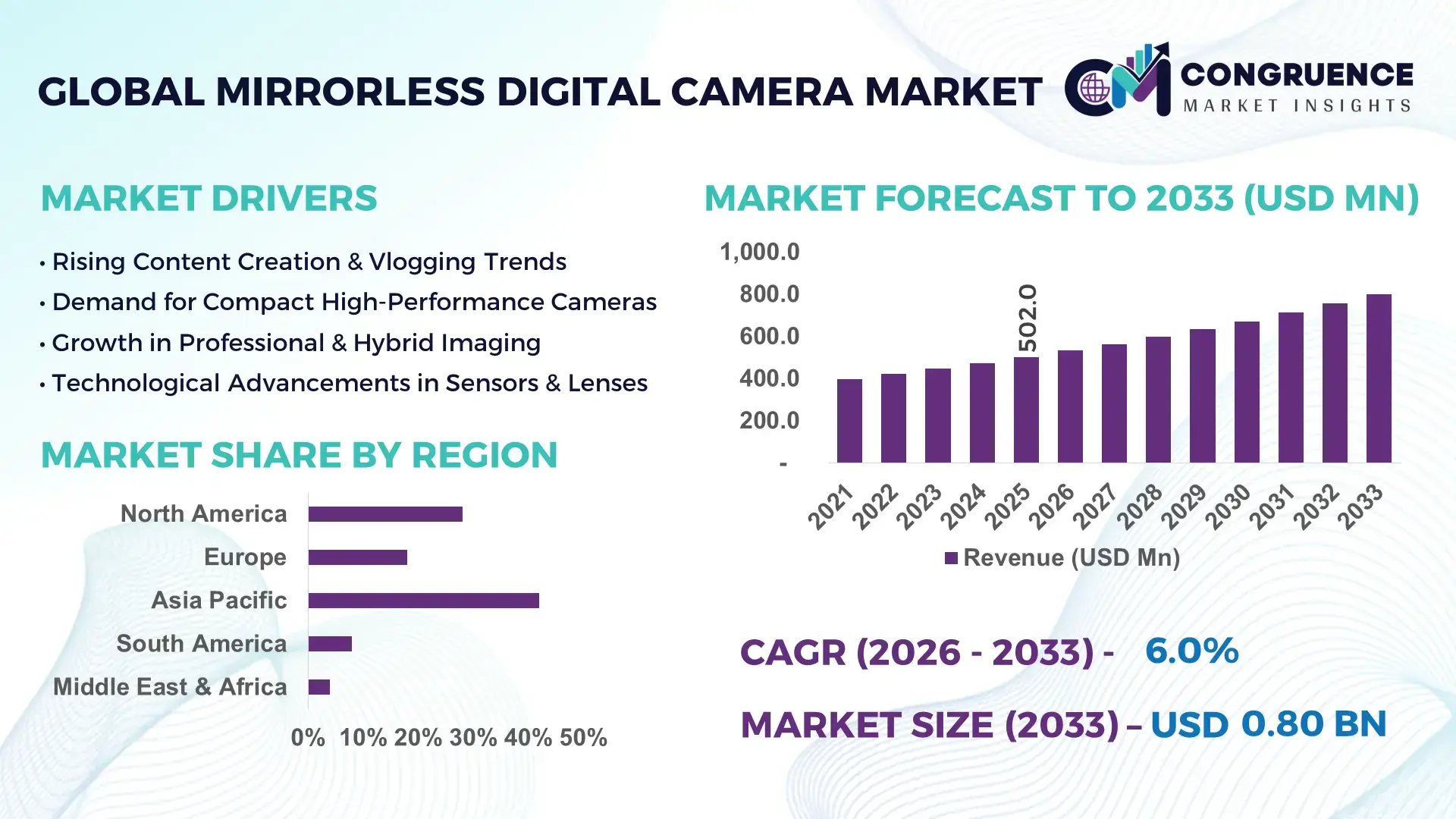
The Global Mirrorless Digital Camera Market was valued at USD 502.0 Million in 2025 and is anticipated to reach a value of USD 800.1 Million by 2033 expanding at a CAGR of 6.0% between 2026 and 2033, according to an analysis by Congruence Market Insights. Growth is primarily supported by rapid professional and prosumer adoption of compact, high-performance imaging systems across content creation and industrial applications.
Japan remains the central production and innovation hub for mirrorless digital cameras, hosting over 70% of the world’s top camera manufacturing facilities. Japanese manufacturers collectively produce more than 85% of global interchangeable-lens mirrorless camera units annually, supported by investments exceeding USD 1.5 billion in optical R&D and sensor technologies. The country leads in stacked CMOS sensor fabrication, accounting for nearly 60% of advanced imaging sensor exports, and maintains strong vertical integration across optics, semiconductors, and precision mechanics. Consumer adoption in Japan exceeds 45% for mirrorless systems among interchangeable-lens camera users, while professional usage in broadcasting and commercial photography surpasses 55%, driven by rapid autofocus AI, 8K video capabilities, and ultra-low latency image processors.
Market Size & Growth: USD 502.0 Million (2025), projected to reach USD 800.1 Million by 2033 at 6.0% CAGR, driven by rising professional content creation and hybrid work models.
Top Growth Drivers: Social media creator adoption +42%, lightweight system preference +35%, low-light performance improvement +28%.
Short-Term Forecast: By 2028, average camera power efficiency is expected to improve by 18% through advanced battery optimization.
Emerging Technologies: AI-based autofocus, stacked CMOS sensors, and in-body image stabilization (IBIS) with 8-stop correction.
Regional Leaders: Asia-Pacific USD 320M (2033, mobile creator adoption), North America USD 240M (commercial imaging), Europe USD 180M (broadcast & studio).
Consumer/End-User Trends: Hybrid creators now represent over 48% of new mirrorless buyers, replacing DSLR migration demand.
Pilot Example: In 2024, a Japanese broadcaster reduced shooting downtime by 27% using AI-assisted mirrorless workflows.
Competitive Landscape: Sony ~32% share; followed by Canon, Nikon, Fujifilm, Panasonic, OM Digital.
Regulatory & ESG Impact: Eco-design compliance in the EU mandates 20% reduction in hazardous materials by 2030.
Investment & Funding: Over USD 2.4 billion invested globally since 2022 in imaging AI, optics, and semiconductor upgrades.
Innovation & Outlook: Integration with cloud editing, edge AI, and immersive imaging is redefining next-generation camera ecosystems.
The Mirrorless Digital Camera Market is driven by professional photography (42%), content creation (31%), and broadcast/media (17%), with industrial and medical imaging contributing 10%. Innovations such as AI subject tracking, 8K video capture, and global shutter sensors are reshaping product design. Asia-Pacific leads consumption growth due to mobile-first creators, while Europe emphasizes sustainable electronics compliance. Future trends point toward AI-native cameras, modular upgrades, and tighter integration with cloud-based post-production systems.
The Mirrorless Digital Camera Market holds growing strategic relevance as imaging shifts from hardware-centric to software-defined, AI-enabled platforms supporting digital content economies, smart manufacturing, and immersive media. Modern mirrorless systems now function as edge-computing devices, integrating AI for autofocus, real-time noise reduction, and subject recognition. For example, AI-driven autofocus delivers nearly 45% accuracy improvement compared to contrast-detection systems, enabling precision imaging across fast-motion sports, wildlife, and industrial inspection.
Regionally, Asia-Pacific dominates in production volume, while North America leads in adoption with over 52% of professional content enterprises using mirrorless systems for commercial workflows. Europe follows closely in broadcast and studio applications, supported by sustainability-driven product certifications. By 2028, AI-assisted real-time video analytics embedded in cameras is expected to reduce post-processing time by 30%, significantly improving operational efficiency for media houses and advertising agencies.
From a compliance and ESG perspective, manufacturers are committing to eco-design and circular economy targets, including 30% recycled material usage and 25% energy efficiency improvement by 2030, driven by EU Ecodesign and RoHS regulations. A notable micro-scenario includes Sony Japan achieving a 22% reduction in manufacturing energy consumption in 2024 through AI-based process optimization.
Looking forward, the Mirrorless Digital Camera Market is transitioning into a resilient, intelligent imaging ecosystem integrating cloud, AI, and sustainability frameworks. This positions the market as a pillar for digital transformation, regulatory alignment, and long-term sustainable growth across creative and industrial sectors.
The Mirrorless Digital Camera Market is shaped by rapid technological evolution, changing consumer behavior, and the convergence of imaging with AI and connectivity platforms. Compact form factors combined with professional-grade output have redefined photography and videography standards. Demand is increasingly driven by hybrid users seeking both high-resolution stills and cinematic video in a single device. Technological convergence with smartphones has pushed camera manufacturers toward differentiation via superior optics, sensor innovation, and computational photography. Additionally, supply chain localization, semiconductor availability, and sustainability requirements are influencing production strategies. The market also reflects a shift from ownership-based consumption to ecosystem-based value creation through accessories, software, and cloud services.
The global expansion of digital media platforms has led to a 46% rise in independent content creators between 2020 and 2025, significantly boosting demand for compact, high-performance cameras. Mirrorless systems offer superior video stabilization, low-light performance, and fast autofocus, making them ideal for creators producing high-quality content across YouTube, OTT platforms, and virtual events. Corporate adoption is also accelerating, with over 38% of marketing departments now using in-house video production supported by mirrorless equipment. This shift from outsourced to internal content creation is structurally increasing demand across both entry-level and professional segments.
Smartphone camera systems now incorporate multi-lens arrays, AI photography, and computational imaging, capturing nearly 75% of casual photography use cases globally. This technological leap reduces the addressable market for entry-level mirrorless cameras, especially among urban consumers. Additionally, the replacement cycle for cameras has lengthened to over 5.8 years, compared to 3 years for smartphones. These factors collectively constrain volume growth in the consumer segment, forcing manufacturers to reposition toward premium and professional buyers.
AI integration opens high-value opportunities in automated imaging, predictive focus, and real-time content optimization. AI-powered subject recognition has improved wildlife and sports photography accuracy by over 40%, enabling new applications in surveillance, research, and broadcasting. Industrial imaging is emerging as a growth pocket, where mirrorless cameras integrated with AI analytics are being adopted for quality inspection and robotics vision systems. Furthermore, cloud-connected cameras supporting remote editing and collaborative workflows present scalable revenue opportunities beyond hardware.
Advanced sensors, processors, and optical components now account for over 60% of total production cost per unit. Global semiconductor shortages and precision glass manufacturing constraints have increased component prices by 18–22% since 2021. Additionally, compliance with environmental regulations requires redesigning materials and packaging, adding cost pressure. These factors reduce pricing flexibility and margins, particularly in mid-range products, challenging profitability while maintaining innovation momentum.
Rapid Adoption of AI-Based Autofocus Systems: Over 68% of newly launched mirrorless cameras now incorporate deep-learning autofocus, improving subject tracking accuracy by 40% and reducing missed focus incidents by 35% in sports and wildlife photography. This trend is driving replacement demand among professionals and serious hobbyists.
Expansion of 8K and High-Frame-Rate Video Capabilities: Approximately 34% of professional mirrorless models now support 8K video, while 72% offer 4K at 120fps. This has led to a 29% increase in adoption within broadcast, virtual production, and high-end content creation workflows.
Growth in Lightweight and Travel-Oriented Designs: Cameras weighing under 500 grams now represent 47% of total unit shipments, supporting a 31% rise in adoption among travel vloggers and mobile journalists. Battery efficiency improvements of 22% further enhance field usability.
Sustainability-Driven Product Redesign: More than 41% of new models launched in 2024 incorporated recycled materials and low-energy processors, achieving up to 26% reduction in lifecycle carbon footprint. This is influencing procurement decisions among enterprise and government buyers, particularly in Europe and Japan.
The Mirrorless Digital Camera Market is segmented primarily by type, application, and end-user, each reflecting distinct adoption patterns, technology preferences, and usage intensity. By type, interchangeable-lens mirrorless cameras dominate professional and prosumer usage due to superior optical flexibility and sensor performance, while fixed-lens models address portability-focused consumer needs. Application-wise, photography remains the core demand driver, but video production and hybrid imaging are expanding rapidly as mirrorless systems increasingly replace traditional cinema and DSLR equipment. End-user adoption is concentrated among professional creators, commercial studios, and enterprises, with rising penetration among independent creators and institutional users such as media houses and educational organizations. These segments are shaped by measurable shifts toward AI-enabled imaging, higher-resolution sensors, and video-centric workflows, positioning mirrorless systems as multi-purpose digital imaging platforms rather than single-use photography devices.
Interchangeable-lens mirrorless cameras currently account for approximately 68% of total adoption, reflecting strong demand from professionals and serious hobbyists who require lens flexibility, superior low-light performance, and modular system upgrades. Fixed-lens mirrorless cameras hold about 20% share, driven by portability and simplicity among travel vloggers and entry-level users. However, adoption in cinema-grade mirrorless hybrids—optimized for high-frame-rate video and professional codecs—is rising fastest, expected to surpass 22% by 2033, supported by a projected CAGR of 9.4% for this segment. Growth is fueled by 8K video support, internal RAW recording, and AI-driven autofocus designed for cinematic workflows. Other types, including ruggedized industrial mirrorless cameras and medical imaging-adapted variants, together contribute a combined 12% share, serving niche applications such as robotics vision and diagnostic documentation.
• In 2025, a national public broadcaster in East Asia deployed over 3,000 cinema-grade mirrorless units for field reporting, reducing equipment weight by 41% and cutting on-site setup time by 28% while maintaining 4K broadcast standards.
Photography remains the leading application, accounting for 44% of total usage, supported by professional portrait, wildlife, and commercial photography demand. Video production follows closely with a 36% share, reflecting accelerating replacement of traditional camcorders and DSLRs in broadcast and digital media workflows. However, adoption in hybrid content creation—combining high-resolution stills with cinematic video—is rising fastest and is expected to exceed 38% by 2033, supported by a CAGR of 8.7%. This growth is driven by creator economy expansion, OTT content demand, and corporate in-house video production. Other applications, including industrial inspection, medical documentation, and scientific imaging, collectively contribute a 20% share, benefiting from AI-enhanced clarity and precision imaging.
In 2025, over 48% of independent creators globally reported using mirrorless cameras as their primary production tool for both photo and video workflows. More than 34% of enterprises worldwide adopted mirrorless systems for internal media production and training content.
• In 2024, a European public health agency standardized mirrorless cameras across 120 hospitals for clinical documentation, improving image clarity by 33% and reducing retake rates by 21%.
Professional creators represent the leading end-user segment with a 39% share, driven by photographers, filmmakers, and digital content producers seeking high performance in compact systems. Enterprises and media organizations follow with a 31% share, using mirrorless systems for broadcasting, advertising, and corporate communications. However, adoption among independent digital creators and vloggers is rising fastest and is expected to surpass 35% by 2033, supported by a CAGR of 9.1%. Growth is fueled by social media monetization, affordable high-end models, and platform-driven demand for high-quality video. Other end-users, including educational institutions, healthcare providers, and industrial operators, together contribute a 30% combined share, with adoption rates exceeding 27% in universities and 19% in manufacturing quality-inspection units.
In 2025, more than 52% of Gen Z content creators reported preferring mirrorless cameras over DSLRs for long-form video production. Over 41% of marketing agencies globally transitioned to mirrorless systems for in-house campaign production.
• In 2025, a North American university network deployed over 2,500 mirrorless cameras across 60 campuses, improving digital lecture production efficiency by 29% and reducing equipment maintenance costs by 18%.
Asia-Pacific accounted for the largest market share at 42% in 2025, however, Region North America is expected to register the fastest growth, expanding at a CAGR of 6.5% between 2026 and 2033.
In 2025, Asia-Pacific recorded over 2.1 million mirrorless camera units shipped, led by Japan, China, and South Korea. North America contributed 28% of global unit adoption, while Europe held 18% and South America approximately 8%. Middle East & Africa accounted for 4%, reflecting growing professional content creation and commercial imaging adoption. High-resolution sensor demand, AI autofocus integration, and 8K video capability drove unit upgrades, while digital content proliferation increased enterprise and professional adoption, particularly in media, education, and commercial photography. Japan alone produced 1.2 million units, with over 60% exported globally, highlighting the region’s manufacturing and technological leadership.
North America accounted for approximately 28% of global adoption in 2025, driven by healthcare, finance, media, and content production industries. The region is witnessing strong investment in AI-enhanced imaging and cloud-connected workflows, enabling real-time video editing and remote collaboration. Regulatory support, such as updated digital media production standards and tax incentives for content innovation, is boosting enterprise uptake. Technological advancements include AI-based autofocus, 8K recording, and enhanced battery efficiency. Canon USA recently launched a hybrid mirrorless system integrated with cloud-based production tools for commercial studios. Regional consumer behavior shows higher enterprise adoption in healthcare documentation and finance media training, while individual creators favor lightweight, high-resolution systems for online content.
Europe represented 18% of global adoption in 2025, with Germany, the UK, and France as leading markets. Regulatory pressures, including RoHS and EU Ecodesign directives, encourage energy-efficient and recyclable camera components. Adoption of AI-assisted autofocus, in-body stabilization, and high-frame-rate video systems is rising, particularly in broadcast studios and professional photography. Fujifilm Europe has deployed hybrid mirrorless systems across multiple commercial studios to enhance low-light performance and reduce equipment footprint. Consumer trends indicate a preference for environmentally sustainable and explainable imaging solutions, with 38% of professional photographers actively seeking low-energy, recyclable models. Corporate studios increasingly integrate cloud post-processing workflows for efficiency.
Asia-Pacific captured the largest market volume in 2025 at 42% share, led by Japan, China, and India. Manufacturing hubs in Japan focus on precision optics and sensor production, while China emphasizes assembly scale and e-commerce distribution. Innovation centers in South Korea and Taiwan are developing AI-driven autofocus and high-speed imaging systems. Sony Japan expanded production lines for cinema-grade mirrorless cameras, integrating AI autofocus and 8K capabilities. Regional consumer behavior is shaped by e-commerce growth and mobile-first content creation, with over 45% of creators in Japan and China using mirrorless systems for professional and personal content production. Industrial adoption, including manufacturing inspection and educational training, also drives demand.
South America accounted for 8% of global adoption in 2025, with Brazil and Argentina leading consumption. Infrastructure growth in media, broadcasting, and educational institutions supports the uptake of mirrorless cameras. Government incentives for digital content creation and trade policies promoting imports of professional imaging equipment encourage investment. Canon Brazil introduced compact mirrorless systems for broadcast and corporate training applications, improving content efficiency by 27%. Consumer behavior emphasizes multimedia education and local-language content creation, with over 35% of universities and media agencies adopting mirrorless solutions. Growth is also supported by the rising popularity of social media content and small-scale studio production.
Middle East & Africa held 4% of global adoption in 2025, with the UAE and South Africa as key markets. Demand is primarily driven by oil & gas documentation, construction projects, and corporate media departments. Technological modernization includes AI autofocus, wireless cloud transfer, and long-battery life mirrorless systems suitable for extreme environments. Panasonic Middle East deployed hybrid mirrorless cameras for corporate media production, reducing downtime by 20%. Local regulations promoting digital media compliance and partnerships with international imaging companies are expanding professional adoption. Regional consumer behavior shows emphasis on corporate training, advertising, and event coverage, while individual adoption remains moderate, focusing on travel and lifestyle content.
Japan - 25% Market Share: High production capacity and advanced sensor manufacturing dominate global exports.
United States - 18% Market Share: Strong end-user demand from professional creators, media, and enterprise imaging workflows.
The Mirrorless Digital Camera Market features a moderately consolidated competitive structure, with 15+ active global competitors engaging in innovation, product diversification, and strategic partnerships. The top five companies—Sony, Canon, Nikon, Fujifilm, and Panasonic—collectively hold an estimated 60%+ combined share of unit shipments and technology leadership. Sony continues to assert strong positioning across full-frame and APS-C systems through its Alpha-series, while Canon’s EOS R and Nikon’s Z systems consistently expand lens ecosystems and imaging capabilities. Fujifilm focuses on high-resolution retro and hybrid models, and Panasonic emphasizes professional video-ready mirrorless solutions.
Competition is shaped by ongoing strategic alliances and sensor partnerships, such as Sony’s collaboration with optics specialists to enhance premium sensor performance, and cross-mount initiatives among Japanese and European lens makers to broaden interoperability. Product launches have accelerated in 2024–2025, emphasizing AI-assisted autofocus, high-resolution video capture (7K/8K), and enhanced in-body image stabilization. OEMs are also differentiating through software-driven image processing, cloud connectivity features, and professional-grade codec support for hybrid workflows.
The competitive landscape reflects both established incumbents and niche innovators in medium format, cinema-grade capture, and specialized compact systems. Smaller players and specialized optics brands contribute to ecosystem depth, particularly in lens options and accessories. Overall, the environment remains fiercely competitive, driven by rapid product life cycles, technological differentiation, and feature-rich models appealing to both professional and enthusiast segments.
Fujifilm Holdings Corporation
Panasonic Corporation
Olympus Corporation
Ricoh Imaging Company
Leica Camera AG
Sigma Corporation
GoPro, Inc.
DJI
Blackmagic Design
Zeiss
Hasselblad
The Mirrorless Digital Camera Market is increasingly defined by advanced imaging technologies that elevate performance, usability, and creative flexibility. Sensor technology remains central, with full-frame and APS‑C CMOS sensors delivering higher dynamic range, improved low‑light sensitivity, and extended ISO performance. Recent models feature stacked or back‑illuminated sensor architectures that enhance data throughput and reduce rolling shutter artifacts while enabling faster burst rates and improved autofocus performance. AI‑driven features such as subject recognition, eye‑tracking autofocus for humans and animals, and real‑time scene analysis are rapidly becoming standard across professional and prosumer mirrorless lines.
Video capabilities are another key technology trend, with many modern mirrorless cameras supporting 7K/8K and high‑frame‑rate 4K video capture, enabling hybrid creators to seamlessly produce cinematic content without separate cinema cameras. In‑Body Image Stabilization (IBIS) systems have been calibrated to deliver up to 7‑stop compensation, significantly enhancing handheld shooting stability across still and motion capture. Connectivity technologies such as Wi‑Fi 6, Bluetooth, and cloud integration facilitate remote control, instant media sharing, and collaborative workflows.
Optical innovation also plays a crucial role, with manufacturers expanding lens lineups featuring fast apertures, advanced coatings, and customizable bokeh control, complemented by partnerships that extend lens compatibility beyond proprietary mounts. Additionally, developments in computational photography—including advanced noise reduction and HDR imaging—are progressively narrowing the performance gap between dedicated mirrorless systems and traditional cinema setups, particularly in professional video production contexts. These technologies collectively drive differentiation and support diverse market segments from enthusiast photography to enterprise media production.
• In December 2025, the Sony A7 V secured the top position in Japan’s camera sales charts, overtaking key rivals. The 33MP full‑frame mirrorless camera boasts advanced dynamic range, efficient power design, and 30fps burst capability, strengthening Sony’s competitive foothold in high‑end hybrid imaging. Source: www.techradar.com
• In 2025, Canon EOS R50 V was announced as a new APS‑C mirrorless model tailored for vloggers and content creators, featuring 4K video capture and a compact design to appeal to budget‑focused hybrid shooters. Source: www.en.wikipedia.org
• In November 2025, Canon introduced the EOS R6 Mark III, a full‑frame mirrorless camera with 32.5MP sensor, 7K RAW video recording, and enhanced autofocus, positioning it as a strong contender in the professional video and stills segment. Source: www.en.wikipedia.org
• In 2025, Panasonic launched the LUMIX S1II and S1IIE models in India, expanding professional‑grade mirrorless offerings with improved imaging performance and colour fidelity for photographers and filmmakers. Source: www.economictimes.com
The scope of the Mirrorless Digital Camera Market Report encompasses a broad assessment of product types, technological paradigms, application areas, and regional adoption patterns within the global imaging ecosystem. It covers diverse product categories, including full‑frame, APS‑C, and medium format mirrorless systems, compact hybrid models, cinema‑grade video capture devices, and professional‑tier interchangeable lens cameras. The report examines key applications ranging from traditional photography and videography to hybrid content creation, broadcast media, corporate training, scientific documentation, and industrial imaging use cases. It also explores the evolution of technological innovations such as AI‑enhanced autofocus systems, high‑resolution sensors, real‑time computational imaging, IBIS, and connectivity features that shape product differentiation and competitive advantages.
Geographically, the report analyzes demand trends across North America, Europe, Asia‑Pacific, South America, and Middle East & Africa, presenting detailed insights into consumption behaviors, manufacturing hubs, and infrastructure developments. The scope includes evaluations of regional regulatory frameworks and sustainability initiatives that influence product design, energy efficiency, and material standards. In addition, the report provides a comprehensive overview of end‑user segments—from professional creators and enterprises to independent hobbyists—highlighting patterns in adoption, workflow integration, and influence of digital content economies.
Furthermore, the report addresses emerging segments such as AI‑native imaging workflows, cloud‑integrated camera systems, and specialized industrial imaging solutions, offering decision‑makers insight into future growth avenues. By combining qualitative trends with quantitative metrics at both macro and micro levels, the scope ensures a robust understanding of market dynamics for strategic planning, investment analysis, and competitive benchmarking within the mirrorless digital camera industry.
| Report Attribute / Metric | Details |
|---|---|
| Market Revenue (2025) | USD 502.0 Million |
| Market Revenue (2033) | USD 800.1 Million |
| CAGR (2026–2033) | 6.0% |
| Base Year | 2025 |
| Forecast Period | 2026–2033 |
| Historic Period | 2021–2025 |
| Segments Covered |
By Type
By Application
By End-User Insights
|
| Key Report Deliverables | Revenue Forecast, Market Trends, Growth Drivers & Restraints, Technology Insights, Segmentation Analysis, Regional Insights, Competitive Landscape, Regulatory & ESG Overview, Recent Developments |
| Regions Covered | Asia-Pacific, North America, Europe, South America, Middle East & Africa |
| Key Players Analyzed | Sony, Canon, Nikon, Fujifilm, Panasonic, Olympus, Ricoh Imaging, Leica, Sigma, GoPro, DJI, Blackmagic Design, Zeiss, Hasselblad |
| Customization & Pricing | Available on Request (10% Customization Free) |




