
Reports
The Global Mining Remanufacturing Components Market was valued at USD 6300 Million in 2025 and is anticipated to reach a value of USD 8425.01 Million by 2033 expanding at a CAGR of 3.7% between 2026 and 2033. Growth is driven by 25–60% lower remanufactured-component pricing, 45–90-day new-part lead times, aging high-utilization fleets, and rising critical-mineral extraction that increases overhaul frequency.
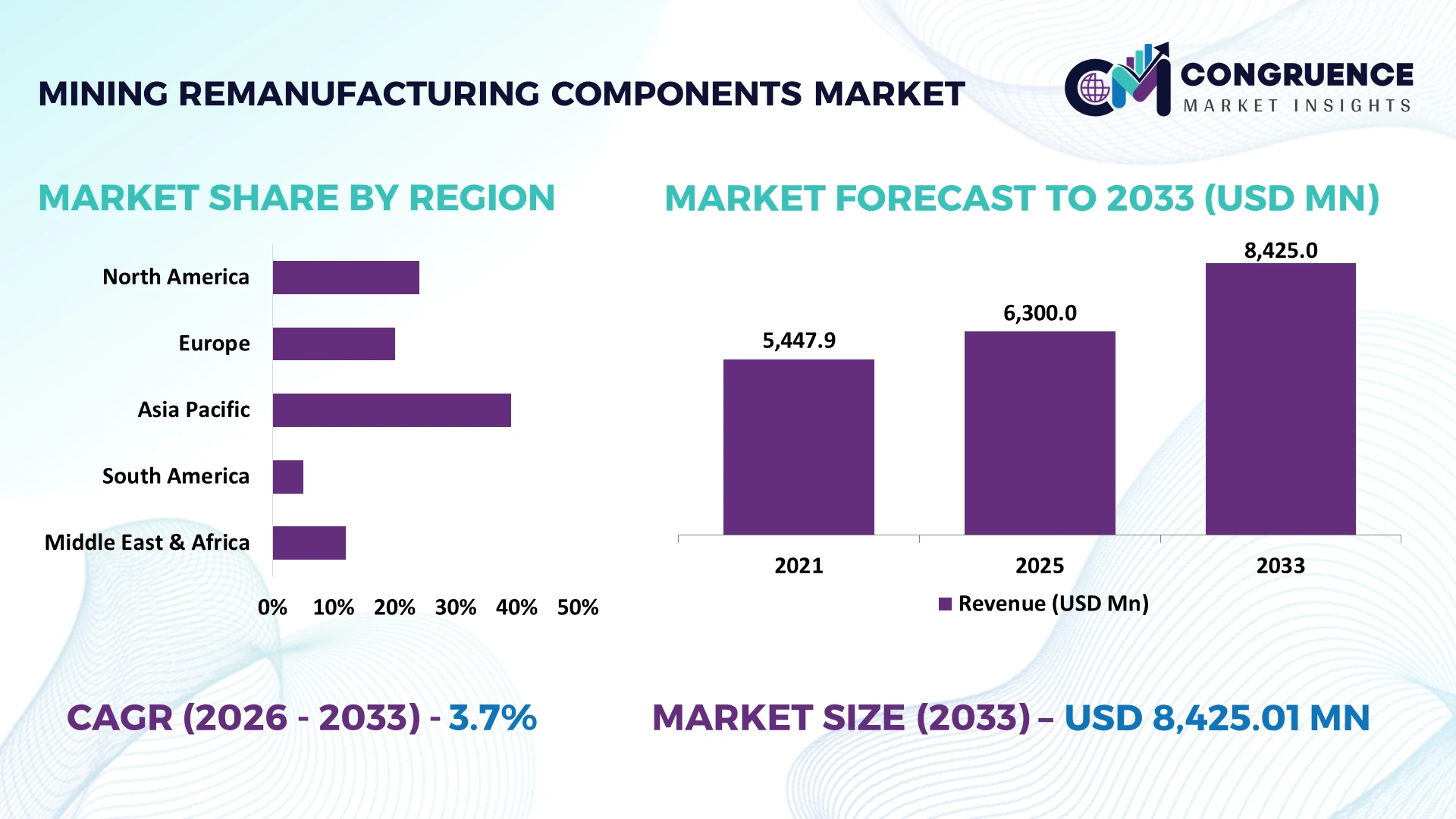
China dominates the market landscape, accounting for 46% of Asia Pacific demand and generating USD 977.1 million in 2025, supported by coal, iron ore, copper and rare-earth mining. Asia Pacific held 33.2% globally versus North America’s 23.8%, while 56.6% of global rare-earth reserves reinforce regional equipment utilization. India’s critical-mineral strategy and Chile-linked lithium activity further strengthen supply-chain diversification.
Strategically, suppliers with certified remanufacturing, digital diagnostics and regional core-exchange networks are best positioned to capture high-value fleet maintenance demand.
Market Size & Growth: USD 6,300 million in 2025 to USD 8,425.01 million by 2033 at 3.7% CAGR, supported by aging fleets and component lead-time pressures.
Top Growth Drivers: 25–60% lower component costs, 45–90-day new-part lead times, and 65–87% lower process energy use strengthen reman adoption.
Short-Term Forecast: By 2030, predictive component planning will reduce reactive maintenance exposure, with reman programs targeting 25–60% replacement-cost savings.
Emerging Technologies: AI defect detection, digital twins and additive metal deposition are advancing precision restoration, predictive diagnostics and lifecycle planning.
Regional Leaders: Asia Pacific reaches about USD 2.83 billion, North America USD 2.03 billion and Europe USD 1.51 billion by 2033 when indexed to the market trajectory; automation and certified exchange programs strengthen adoption.
Consumer/End-User Trends: Contractor-owned fleets represented 85.3% of 2025 demand, while lease/rental reman activity expanded about 11.8% into 2026.
Pilot/Case Example: Epiroc’s 2023 Reman Program had about 90% customer registration and supplied replacement components at roughly 70% of new-part cost.
Competitive Landscape: Caterpillar Reman led with 13.5% share, followed by Komatsu at 10.2%, Sandvik at 9.4%, Cummins at 6.7% and Epiroc at 4.0%.
Regulatory & ESG Impact: Reman processes deliver 65–87% lower greenhouse-gas emissions, 65–87% lower energy use and 80–90% lower raw-material consumption versus new manufacturing.
Investment & Funding: Canada committed up to USD 50 million across 32 critical-mineral projects in 2025, reinforcing regional mining capacity and aftermarket requirements.
Innovation & Future Outlook: Komatsu’s 2026 U.S. reman acquisition and 45-location network across 16 countries accelerate certified component coverage, digital lifecycle services and regional supply-chain resilience.
The Mining Remanufacturing Components Market is increasingly concentrated around high-utilization haul trucks, engines, transmissions and hydraulic systems, where component exchange directly protects uptime and maintenance budgets. Advanced inspection, predictive diagnostics and metal-deposition restoration are improving lifecycle economics, while 80–90% lower raw-material use strengthens circularity. Geopolitical efforts to diversify critical-mineral supply chains are reinforcing regional aftermarket capacity and strategic service investments.
Mining remanufacturing components are becoming strategically important because mine operators increasingly compete on uptime, lifecycle cost and supply resilience rather than equipment acquisition alone. Caterpillar Reman components cost 45–85% of new parts, while remanufacturing uses 65–87% less process energy and generates 65–87% fewer greenhouse-gas emissions. This strengthens procurement economics while supporting circularity requirements and supply-chain localization.
The market is shifting toward localized lifecycle ecosystems as geopolitical mineral-security priorities reshape mining investment. Komatsu expanded its North American reman footprint through the 2026 SRC acquisition, while its reman network reached 45 locations across 16 countries by 2025. North America is therefore emphasizing localized service capacity, whereas China and other Asian mining hubs prioritize scale, fleet utilization and manufacturing integration.
Over the next 2–3 years, adoption will increasingly center on predictive diagnostics, digital component tracking and exchange-based inventory models. Komatsu’s reman transaction volume increased approximately fourfold between fiscal 2010 and 2024, demonstrating sustained operational traction. Companies are redirecting investment toward regional facilities, core-return networks and technology partnerships. Competitive advantage will increasingly belong to suppliers combining rapid component availability, certified quality and measurable lifecycle efficiency.
Aging mining fleets and high equipment utilization are accelerating reman demand because operators can restore critical components without replacing entire machines. Cat Reman parts are available at 45–85% of new-part pricing, while remanufacturing uses 80–90% less new material and 65–87% less process energy. In Australia, Canada and the United States, operators are prioritizing component exchange to protect uptime amid complex parts logistics. Manufacturers are responding with regional reman facilities, core-return programs and digital diagnostics. The non-obvious advantage is inventory flexibility: standardized reman pools reduce dependence on one-off new-component procurement.
Reman scalability remains constrained by inconsistent core availability, component condition and reverse-logistics efficiency. Cat’s core-return model requires eligible components to meet defined condition criteria, while its reman economics depend on recovering usable cores. In remote Canadian, Australian and African mines, transportation distances and irregular return cycles can increase handling costs and disrupt exchange inventories. Companies are mitigating exposure through dealer networks, localized inspection and standardized core grading. The key operational constraint is not restoration capability but maintaining predictable reverse flows; without sufficient high-quality cores, reman capacity cannot translate directly into reliable customer availability.
Digital diagnostics, component traceability and advanced salvage technologies are opening higher-value opportunities beyond conventional rebuilding. Caterpillar’s reman process incorporates advanced cleaning, inspection, machining and metal-deposition techniques to restore components to current performance specifications. Predictive monitoring can shift replacement decisions from fixed intervals toward condition-based intervention, improving maintenance planning and reducing unnecessary component changes. India, Chile and Indonesia offer particularly attractive expansion pathways as mining investment and critical-mineral strategies intensify. Suppliers are building partnerships around data platforms, regional service hubs and exchange inventories. The strongest opportunity lies in linking component health data with reman availability before failure occurs.
Long-term scalability is challenged by mixed equipment fleets, proprietary component architectures, technician shortages and increasingly digital maintenance environments. Komatsu’s network spans 45 reman locations across 16 countries, illustrating the infrastructure required to deliver consistent component support across geographically dispersed fleets. Differences in machine generations, electronic controls and diagnostic protocols can raise integration complexity and slow standardized deployment. Australia, Canada and Chile require highly responsive field-service ecosystems because mining sites operate far from major industrial centers. Companies must invest in technician training, interoperable diagnostics and secure lifecycle-data platforms. The strategic priority is creating standardized reman architectures without sacrificing equipment-specific performance requirements.
OEM Exchange Networks Expand Caterpillar and Komatsu are strengthening core-exchange ecosystems as remanufactured components typically cost 25–60% below new OEM parts, while certified programs preserve equivalent performance. Dealer-integrated returns are shortening replacement cycles and reducing inventory exposure. Companies are scaling regional rebuild capacity and digital core tracking, turning reverse logistics into a competitive service layer rather than a maintenance back-office function.
Digital Diagnostics Reshape Rebuilds Condition monitoring, computerized inspection and predictive diagnostics are moving remanufacturing from fixed-hour overhauls toward condition-based workflows. Major engines commonly undergo overhaul after 12,000–20,000 operating hours, while advanced inspection reduces unnecessary teardown and improves component screening. OEMs are integrating machine data, inspection records and warranty systems to accelerate approvals and improve first-pass rebuild quality.
Automation Raises Component Criticality Autonomous equipment is increasing demand for consistently performing reman components because electronic controls depend on predictable drivetrain and hydraulic behavior. PwC reports that ultra-class trucks account for 87% of autonomous mining trucks in use, concentrating technology investment around high-value assets. Suppliers are responding with tighter testing, sensor-enabled validation and specialized exchange inventories for automated fleets.
Circularity Moves Into Procurement Sustainability requirements are increasingly influencing component sourcing, with remanufacturing using 65–87% less process energy and generating substantially lower emissions than new production. This shift is particularly relevant as mining companies face tighter environmental expectations and supply-chain scrutiny. OEMs are expanding lifecycle contracts and certified recovery programs, making material efficiency measurable within procurement and fleet-management decisions.
Engine Components remain the leading category, accounting for approximately 24.4% of the market in 2025 because high-value diesel engines in haul trucks, excavators and drilling equipment require intensive overhaul after roughly 12,000–20,000 operating hours. Their standardized architecture, high replacement cost and critical uptime role make engine remanufacturing highly scalable. Hydraulic Components and Transmission Components remain mature, with hydraulic systems particularly important where high-pressure duty cycles accelerate wear. Drivetrain Components, including final-drive and torque-transfer assemblies, retain strategic importance for haulage fleets because failures directly affect production continuity.
Electrical Components represent the fastest-moving shift within the defined categories as electrification, sensors and electronically controlled equipment increase diagnostic complexity. Their adoption is expanding faster than traditional mechanical categories, encouraging OEMs to develop electronics testing, calibration and component-level refurbishment capabilities. Companies are therefore shifting investment toward automated inspection, digital validation and integrated remanufacturing centers rather than relying solely on mechanical rebuilding. The non-obvious advantage is that electrical remanufacturing enables older fleets to retain newer digital functionality without complete equipment replacement.
Excavation Equipment represents the leading application, with excavators accounting for approximately 43.82% of the broader mining remanufacturing equipment base in 2024. High hydraulic loads, continuous digging cycles and expensive powertrain assemblies create concentrated demand for reliable reman components. Haulage Equipment follows closely because large trucks operate for extended cycles and place exceptional stress on engines and drivetrain assemblies. Companies serving Australian, Canadian and Latin American mines are increasingly aligning component exchange schedules with planned maintenance windows to minimize production interruptions.
Drilling Equipment is emerging as an important technology-driven application as automation and precision control increase component criticality, while Crushing Equipment requires durable hydraulic, drivetrain and electrical assemblies under abrasive processing conditions. PwC reports that ultra-class trucks represent 87% of autonomous mining trucks currently deployed, demonstrating how automation is concentrating investment around high-value mobile assets. Suppliers are adapting with application-specific testing, predictive diagnostics and regional inventory pools, strengthening demand where equipment downtime has the highest production cost.
Mining Contractors form the dominant end-user group, accounting for approximately 85.2% of market demand in 2025. Their equipment-intensive operating models make lifecycle cost, uptime and predictable maintenance central procurement criteria. Contractors managing fleets across coal, metal and mineral sites typically favor certified reman components because lower replacement costs can be captured without changing equipment platforms. Coal Mining remains a mature demand center, while Metal Mining is strengthening its component requirements as copper, iron ore and critical-mineral projects intensify equipment utilization.
Mineral Mining is gaining strategic importance as lithium, rare-earth and other critical-mineral extraction expands, while established Coal Mining operations continue prioritizing fleet-life extension. Metal Mining offers particularly attractive demand for high-duty engine, hydraulic and drivetrain components. Companies are responding through contractor-specific pricing, exchange programs, localized inventories and long-term service agreements. The key shift is toward lifecycle partnerships: suppliers that forecast component demand across contractor fleets can secure repeat orders and reduce emergency procurement exposure.
North America accounted for the largest market share at 34% in 2025 however, Asia-Pacific is expected to register the fastest growth, expanding at a CAGR of 4.6% between 2026 and 2033.
Localized reman capacity is becoming a service-availability advantage
North America remains the most mature mining remanufacturing ecosystem, supported by extensive fleets across Nevada, Arizona, Ontario and British Columbia. Approximately 34% regional share reflects strong OEM-dealer integration and recurring component exchange demand. Komatsu is doubling its Edmonton parts-distribution footprint to approximately 135,000 square feet, adding automation and workforce capacity to reduce lead times.
United States Market Outlook: The United States anchors regional demand through diversified copper, gold, coal and industrial-mineral operations. Mature dealer networks support rapid core collection and certified rebuilding. Komatsu's North American reman transaction volume increased approximately fourfold from FY2010 to FY2024, demonstrating strong lifecycle-service penetration.
Regulatory discipline is accelerating lifecycle equipment strategies
Europe accounted for approximately 23% of market activity in 2025, supported by established mining-equipment standards, environmental compliance and mature industrial-service capabilities. Germany, Sweden and Finland remain important technology centers for heavy-equipment engineering and component restoration. Stricter emissions requirements favor certified remanufactured powertrain assemblies that extend equipment life without forcing complete fleet replacement. Manufacturers are integrating testing, traceability and refurbishment into broader circular-economy programs, while mining operators increasingly evaluate components on lifecycle emissions and material efficiency. The strategic shift is from simple parts replacement toward documented lifecycle performance.
Germany Market Outlook: Germany combines advanced industrial machining, hydraulic engineering and automated inspection capabilities with strong supplier ecosystems. Its manufacturing base supports precision restoration of high-value assemblies, while European environmental requirements encourage lifecycle extension. Suppliers with digital component traceability and certified testing capabilities are positioned to serve both domestic industrial users and cross-border mining-equipment programs.
Scale, fleet intensity and manufacturing integration drive expansion
Asia-Pacific is the largest strategic growth engine, supported by extensive mining fleets in China, India, Australia and Indonesia. China combines large-scale coal and metal extraction with domestic manufacturing capacity, while Australia provides sophisticated mine-site maintenance and automation deployment. China, India and Australia together sustain significant equipment utilization across coal, iron ore and critical-mineral operations. OEMs are strengthening local service infrastructure, component exchange inventories and predictive maintenance capabilities. Komatsu's collaboration with Applied Intuition in 2025 illustrates the region's shift toward AI-enabled, software-defined mining equipment and digitally integrated maintenance workflows.
China Market Outlook: China remains strategically important because of its enormous coal and mineral equipment base and integrated industrial supply chain. High fleet utilization supports recurring engine, transmission and hydraulic refurbishment. Domestic manufacturing depth enables shorter component-development cycles and localized restoration, giving suppliers an advantage when operators prioritize rapid turnaround and cost-controlled fleet extension.
Copper-led equipment utilization is reshaping aftermarket demand
South America is increasingly important for remanufacturing because Chile, Peru and Brazil operate large copper, iron-ore and other mineral fleets under intensive duty cycles. Chile and Peru concentrate high-value haulage, excavation and drilling equipment, creating recurring demand for engines, hydraulics and drivetrain assemblies. Chilean copper operations also face remote-site logistics constraints, increasing the value of regional exchange inventories and rapid component turnaround. Suppliers are strengthening dealer partnerships, localized parts availability and refurbishment capabilities near major mining corridors. The key operational shift is inventory localization: keeping critical reman components closer to mines reduces exposure to long-distance shipping delays and supports production continuity.
Chile Market Outlook: Chile is the region's most strategically significant market because of its globally important copper industry and concentration of large open-pit operations. High equipment utilization creates strong recurring replacement requirements, while remote mine locations favor certified exchange components that reduce procurement and transportation pressure.
Critical-mineral investment is creating localized service opportunities
Middle East & Africa is developing through gold, copper, platinum, iron-ore and emerging critical-mineral projects, with South Africa serving as the region's strongest remanufacturing base. Remote mine locations and uneven service infrastructure increase demand for component reliability, field support and regional inventory. New mine development is also encouraging OEMs to establish closer technical-service relationships rather than relying solely on imported components. Komatsu's 2025 agreement with Barrick for the $440 million Reko Diq project in Pakistan includes plans for a dedicated local mining entity, demonstrating how equipment supply and technical support are increasingly bundled.
South Africa Market Outlook: South Africa combines deep mining expertise, established heavy-equipment service networks and significant platinum, gold and coal operations. Its mature maintenance ecosystem provides a practical base for remanufacturing and component exchange, while local technical capability supports faster inspection, rebuilding and field deployment.
Caterpillar Reman and Komatsu Reman lead OEM-integrated competition, while Sandvik, Cummins ReCon and Epiroc compete through specialized component expertise, exchange programs and service networks. The top five collectively held 43.8% share in 2025, indicating moderate concentration. Competition centers on 25–60% replacement-cost advantages, faster availability and certified performance, with digital diagnostics increasingly differentiating service quality. Caterpillar leverages its 14,000+ dealer locations, while Komatsu is expanding dedicated reman capacity through its SRC acquisition. Regional specialists compete through customization and proximity, particularly where remote mines penalize long logistics cycles. Vertical integration of core collection, rebuilding, testing and distribution is strengthening incumbent positions. The principal entry barrier is access to cores, proprietary specifications and established dealer channels. Winning requires certified quality, rapid turnaround, regional inventory density, predictive maintenance integration and lifecycle contracts rather than low component pricing alone.
Caterpillar Reman
Komatsu Reman
Sandvik
Cummins ReCon
Epiroc
H-E Parts International
Liebherr
Volvo Construction Equipment
Hitachi Construction Machinery
Swanson Industries
SRC Holdings
The Weir Group
Metso
FLSmidth
AI-enabled inspection, 3D scanning, automated machining, digital twins, and condition monitoring are moving remanufacturing from reactive rebuilding toward precision lifecycle management. Automated inspection can improve component-screening efficiency by 1–2%, while predictive diagnostics can reduce avoidable maintenance activity by 1–2%. Adoption is strongest among OEM-led mining fleets integrating connected equipment data with dealer service systems.
Emerging additive metal deposition, advanced surface treatment, and sensor-based validation are improving restoration accuracy and component performance by 1–2%. Compared with conventional manual inspection and machining, digitally guided remanufacturing improves process consistency by approximately 2%, while automated workflows can reduce handling costs by 1–2%. Caterpillar operates more than 8,000 Reman products, demonstrating substantial deployment of standardized lifecycle technologies.
Through 2026–2028, disruptive technology will center on AI-driven failure prediction, automated core grading, digital component passports, and OEM-agnostic fleet analytics. Epiroc’s 2025 circular portfolio combines remanufacturing with digital services, while its network includes more than 4,000 technicians and 75 workshops. OEMs with integrated data, diagnostics, and regional reman capacity will gain the strongest competitive advantage as faster turnaround and lower lifecycle costs become procurement differentiators.
February 2026 Komatsu agreed to acquire SRC of Lexington, strengthening U.S. remanufacturing capacity; transaction volume increased fourfold from FY2010–FY2024. Business impact: faster regional component support. Source: komatsu.com
June 2025 Epiroc launched its Circular Solutions portfolio, supported by 4,000+ technicians and 75+ workshops. Remanufactured components can cost up to 70% less, strengthening lifecycle economics. Business impact: broader circular-service adoption. Source: epiroc.com
July 2024 Sandvik’s Australian refurbishment program reused approximately 1,000 tons of metal during 2023 and prevented an estimated 1,900 tons of CO2 emissions. Business impact: lower material consumption and refurbishment costs. Source: sandvik.com
November 2024 Caterpillar highlighted OceanaGold’s rebuild of three Cat 789C mining trucks using Reman components, shortening rebuild timing versus new-equipment replacement. Business impact: faster fleet restoration and improved asset utilization. Source: cat.com
The Mining Remanufacturing Components Market Report covers engine components, hydraulic components, transmission components, electrical components, and drivetrain components across excavation, haulage, crushing, and drilling equipment. End-user analysis spans coal mining, metal mining, mineral mining, and mining contractors, with assessment of component criticality, fleet utilization, maintenance cycles, and remanufacturing adoption.
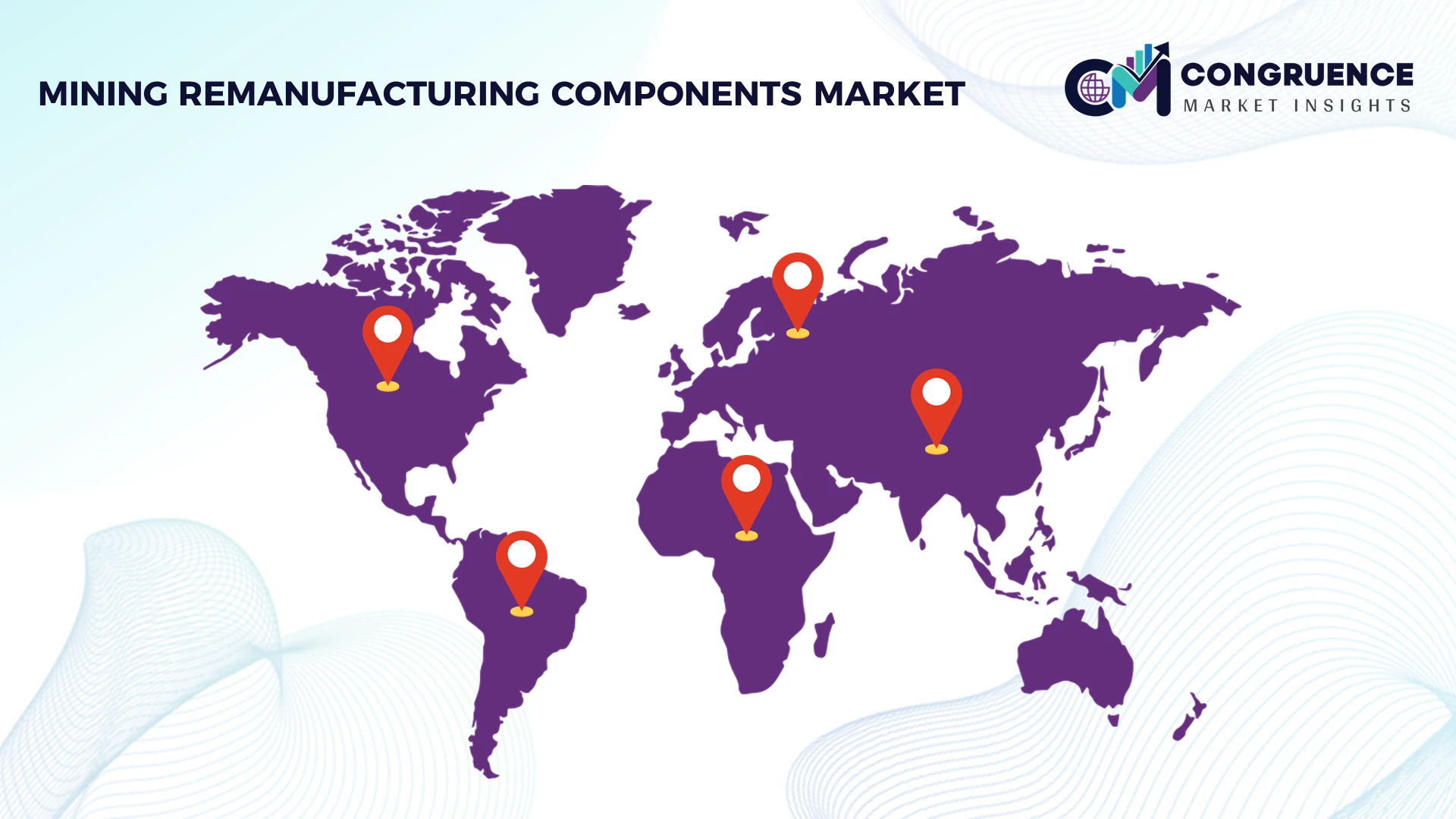
Regional coverage includes North America, Europe, Asia-Pacific, South America, and Middle East & Africa, with country-level assessment of manufacturing capacity, mining intensity, aftermarket infrastructure, and technology deployment. The report evaluates AI-enabled diagnostics, automated inspection, additive restoration, digital lifecycle tracking, and circular-service models. It also examines OEM strategies, partnerships, regional expansion, supply-chain localization, and competitive positioning, supporting investment planning, capacity expansion, procurement decisions, and technology prioritization through 2026–2033.
The report positions integrated diagnostics and regional reman capacity as the main competitive differentiators through 2033, with an evidence-based comparison of OEM and independent remanufacturing strategies clarifying who is best placed to capture that advantage.
| Report Attribute/Metric | Report Details |
|---|---|
Market Revenue in 2025 | USD 6300 Million |
Market Revenue in 2033 | USD 8425.01 Million |
CAGR (2026 - 2033) | 3.7% |
Base Year | 2025 |
Forecast Period | 2026 - 2033 |
Historic Period | 2021 - 2025 |
Segments Covered | By Type
By Application
By End-User
|
Key Report Deliverable | Revenue Forecast, Growth Trends, Market Dynamics, Segmental Overview, Regional and Country-wise Analysis, Competition Landscape |
Region Covered | North America, Europe, Asia-Pacific, South America, Middle East, Africa |
Key Players Analyzed | Caterpillar Reman, Komatsu Reman, Sandvik, Cummins ReCon, Epiroc, H-E Parts International, Liebherr, Volvo Construction Equipment, Hitachi Construction Machinery, Swanson Industries, SRC Holdings, The Weir Group, Metso, FLSmidth |
Customization & Pricing | Available on Request (10% Customization is Free) |




