
Reports
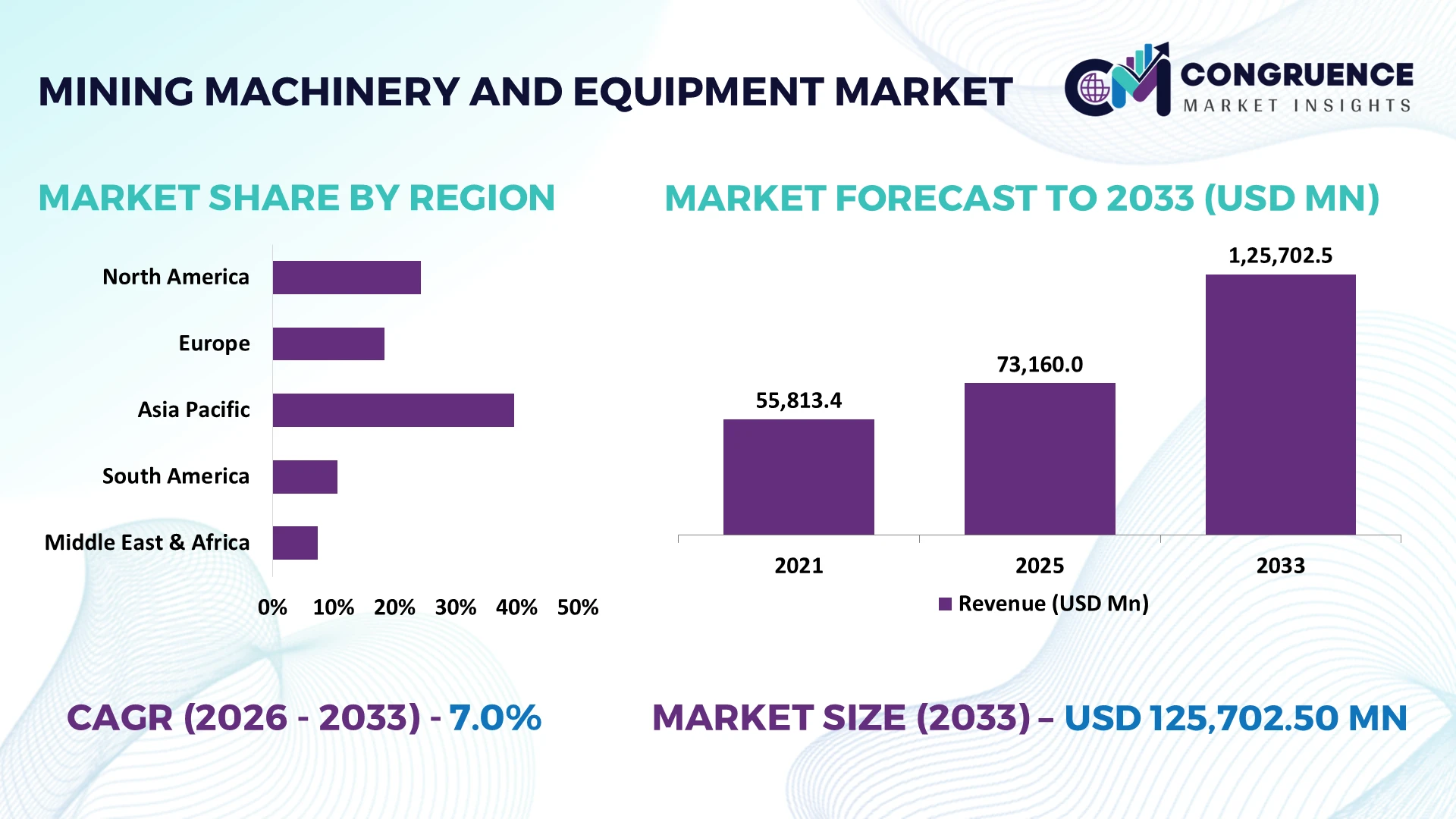
The Global Mining Machinery and Equipment Market was valued at USD 73,160.0 Million in 2025 and is anticipated to reach a value of USD 1,25,702.5 Million by 2033 expanding at a CAGR of 7.0% between 2026 and 2033. Rising critical mineral extraction, accelerated mine mechanization, autonomous haulage deployment, and replacement of aging excavation equipment are driving market expansion.
China dominates the global mining machinery and equipment market, producing approximately 50% of global coal and controlling nearly 60% of rare earth mining output. Its annual coal production exceeds 4.7 billion tonnes, compared with approximately 1 billion tonnes in India. Investments in intelligent mining infrastructure, domestic equipment manufacturing, and mineral supply-chain security are accelerating automated machinery adoption amid geopolitical competition over critical minerals.
Equipment manufacturers must prioritize autonomous systems, localized production, energy-efficient machinery, and integrated aftermarket services to strengthen competitive positioning across mineral-rich economies.
Market Size & Growth: USD 73,160.0 million in 2025, reaching USD 1,25,702.5 million by 2033 at 7.0% CAGR, driven by mine mechanization.
Top Growth Drivers: Indicative demand contributions include mineral extraction expansion (40%), equipment modernization (35%), and mining automation (25%).
Short-Term Forecast: By 2028, advanced fleet management systems target 10–15% improvements in equipment productivity.
Emerging Technologies: AI-enabled predictive maintenance, autonomous haulage, and battery-electric machinery target 10–20% operational efficiency improvements.
Regional Leaders: Illustrative 2033 projections include Asia Pacific (USD 51,538.0 million; mechanization), North America (USD 27,654.6 million; automation), and Europe (USD 20,112.4 million; electrification).
Consumer/End-User Trends: Large mining operators target equipment availability exceeding 90% through connected machinery and predictive servicing.
Pilot/Case Example: Rio Tinto's autonomous haulage operations reported approximately 15% lower operating costs than conventional truck operations in 2018.
Competitive Landscape: Caterpillar leads with an indicative 18% market share, competing with Komatsu, Sandvik, Epiroc, and Hitachi Construction Machinery.
Regulatory & ESG Impact: Battery-electric underground equipment eliminates 100% of direct diesel exhaust emissions during operation.
Investment & Funding: Rio Tinto announced USD 6.7 billion in capital investment for the Oyu Tolgoi underground development in 2020.
Innovation & Future Outlook: Next-generation autonomous machinery targets 15–20% productivity improvements, shifting competition toward integrated digital mining ecosystems.
The Mining Machinery and Equipment Market encompasses excavation, drilling, crushing, screening, mineral processing, and material transportation systems supporting surface and underground operations. Advanced hydraulic excavators, intelligent drilling rigs, and autonomous haul trucks are transforming extraction workflows. With optimized fleet systems targeting approximately 15% productivity improvements, critical mineral supply-chain diversification is strengthening the strategic importance of digitally integrated mining equipment.
The mining machinery and equipment market is becoming strategically important as mineral security, extraction productivity, and operational resilience increasingly determine industrial competitiveness. Expanding copper, lithium, nickel, and rare earth extraction is restructuring equipment procurement strategies. Government-backed critical mineral initiatives in the United States, Australia, and Canada are encouraging mining companies to invest in advanced extraction machinery and diversified mineral supply chains.
Autonomous haulage systems deliver approximately 10–15% lower operating costs than conventional manually operated fleets through optimized routing, reduced idle time, and consistent operating cycles. China emphasizes large-scale mine mechanization and domestic equipment manufacturing, while Australia leads advanced autonomous machinery deployment. Between 2027 and 2029, digitally connected fleet modernization programs are expected to target equipment availability exceeding 90% across major mining operations.
Rio Tinto's deployment of autonomous haul trucks across its Pilbara iron ore operations demonstrates the commercial advantages of integrated fleet management. Caterpillar, Komatsu, Sandvik, and Epiroc are expanding automation portfolios, electrification capabilities, and technology partnerships. Equipment manufacturers are increasingly prioritizing lifecycle service contracts alongside machinery sales. Competitive leadership will depend on delivering measurable productivity improvements, interoperable equipment platforms, and reliable operational support throughout increasingly complex mining environments.
Expanding critical mineral extraction is accelerating demand for high-capacity excavators, drilling rigs, crushing systems, and underground mining machinery. Electric vehicles require approximately six times the mineral inputs of conventional vehicles, while China accounts for nearly 60% of global rare earth mining output and approximately 50% of coal production. The United States and Australia are strengthening domestic mineral supply chains to reduce strategic import dependencies, encouraging investment in new extraction facilities. Increasing excavation volumes and declining ore grades require greater material handling capacity per tonne of recovered minerals. Caterpillar, Komatsu, and Sandvik are expanding equipment portfolios and regional service networks to capture mechanization demand while supporting higher extraction throughput and equipment utilization.
High equipment acquisition costs, financing expenses, and specialized component dependencies restrict machinery procurement, particularly among smaller mining operators. Fuel can represent approximately 30–40% of conventional haul truck operating costs, while maintenance and repair expenses frequently account for 20–30% of equipment operating expenditure, depending on mine conditions. China’s concentration of approximately 90% of rare earth processing capacity also creates supply exposure for selected electrified equipment components. Specialized hydraulic systems, power electronics, and heavy-duty drivetrain procurement extend replacement lead times and increase inventory requirements. Manufacturers are expanding localized assembly, remanufacturing programs, supplier diversification, and equipment leasing arrangements. Lifecycle financing is increasingly important because constrained capital budgets favor machinery refurbishment over complete fleet replacement.
Battery-electric mining machinery presents significant opportunities across underground operations requiring lower ventilation expenditure and improved working conditions. Ventilation can account for approximately 30–40% of underground mine electricity consumption, while battery-electric equipment eliminates 100% of direct diesel exhaust emissions during operation. Electrified drivetrain systems also achieve energy efficiencies exceeding 85% under suitable operating conditions. Canada and Sweden are advancing underground mining electrification through collaborations between mining operators, battery developers, and equipment manufacturers. Epiroc and Sandvik are expanding battery-electric loaders, underground trucks, modular battery platforms, and battery-as-a-service offerings. The strongest commercial opportunity extends beyond equipment replacement into ventilation infrastructure optimization, enabling mining companies to reduce operating expenditure while accessing deeper mineral deposits.
Scaling autonomous mining operations requires reliable communications infrastructure, interoperable equipment controls, cybersecurity safeguards, and specialized workforce capabilities. Advanced autonomous fleets target 10–15% productivity improvements and equipment availability exceeding 90%, while safety-critical communication systems require availability approaching 99.9% under demanding operating conditions. Australia's Pilbara mining operations demonstrate the importance of integrating autonomous trucks, dispatch platforms, positioning systems, and centralized control centers. Mixed-brand fleets and legacy machinery complicate deployment, particularly at established mining sites undergoing phased modernization. Caterpillar, Komatsu, and technology partners are investing in interoperable automation platforms, remote diagnostics, and technical workforce training. Long-term competitiveness depends on maintaining consistent autonomous performance without creating proprietary technology dependencies that restrict future fleet expansion.
Expansion of Equipment Remanufacturing Programs: Mining operators are extending machinery lifecycles through component rebuilding, with remanufactured parts offering approximately 20–40% cost savings compared with new components. Rebuilding programs can restore equipment to original performance specifications while reducing material consumption. Caterpillar and Komatsu are expanding certified rebuild facilities to address replacement costs and component procurement delays.
Shift Toward Condition-Based Maintenance: Mining companies are replacing fixed maintenance schedules with sensor-based equipment monitoring, targeting 10–20% lower maintenance expenditure and 15–25% reductions in unplanned downtime. Continuous monitoring of hydraulic pressure, vibration, and lubricant quality enables earlier fault detection. Sandvik and Epiroc are expanding remote diagnostic platforms and integrated equipment servicing capabilities.
Increasing Adoption of In-Pit Crushing: Mining operators are integrating in-pit crushing and conveying systems to reduce conventional truck transportation requirements. Suitable installations can reduce haulage energy consumption by approximately 20–40% and transportation costs by 15–30%. Metso and thyssenkrupp are developing modular crushing and conveying solutions that support continuous material movement across large mining complexes.
Growing Demand for Equipment Rental: Capital expenditure discipline is encouraging mining contractors to adopt flexible machinery rental and performance-based service agreements. Rental arrangements can reduce initial equipment investment by 20–30% compared with equivalent purchase-based deployment scenarios. Equipment suppliers are expanding managed fleet services, enabling contractors to accommodate fluctuating production schedules without maintaining permanently oversized machinery inventories.
Surface mining equipment dominates the type segment with an estimated market share of 42.5%, supported by extensive deployment of excavators, draglines, bulldozers, and high-capacity haul trucks across open-pit mining operations. Surface extraction accounts for a substantial proportion of global mineral production, with large-scale operations achieving equipment utilization rates exceeding 80%. Underground mining equipment represents the fastest-growing segment as declining near-surface ore reserves encourage deeper mineral extraction.
Crushing, pulverizing and screening equipment maintains consistent demand through mineral processing requirements, while drilling equipment and mineral processing machinery support exploration and beneficiation activities. Other specialized mining equipment addresses site-specific operational requirements. Caterpillar, Komatsu, Sandvik, and Epiroc are strengthening product portfolios through advanced hydraulic systems, modular equipment designs, and application-specific machinery. Investment priorities are shifting toward equipment configurations that improve extraction capacity while reducing material handling requirements.
Metal mining leads the application segment with an estimated market share of 46.8%, supported by extensive copper, iron ore, gold, nickel, and aluminum ore extraction activities. Large-scale metal mining operations require high-capacity excavation, transportation, crushing, and beneficiation equipment, with material handling frequently representing more than 40% of surface mining operating costs. Mineral mining is expected to register the fastest growth as lithium, rare earth elements, and other industrial minerals gain strategic importance in advanced manufacturing and energy storage supply chains.
Coal mining maintains substantial machinery requirements across China, India, and Indonesia, although procurement increasingly emphasizes equipment replacement and operational efficiency rather than unrestricted capacity expansion. Manufacturers including Metso, Caterpillar, and Sandvik are developing application-specific crushing systems, precision drilling technologies, and advanced mineral separation equipment. Equipment demand is increasingly concentrated in operations requiring higher processing throughput and improved recovery from lower-grade deposits.
Large mining enterprises account for an estimated 58.6% market share, reflecting their extensive production infrastructure, capital-intensive extraction operations, and continuous fleet modernization requirements. These enterprises prioritize equipment reliability, integrated maintenance contracts, and standardized machinery platforms, frequently targeting mechanical availability above 90%. Mining contractors represent the fastest-growing end-user segment as mining companies increasingly outsource drilling, excavation, transportation, and specialized extraction activities to improve capital flexibility.
Small and medium-sized mining companies maintain demand for compact machinery, refurbished equipment, and flexible financing arrangements, with certified rebuilt components offering approximately 20–40% savings against new replacements. Government-owned mining organizations support substantial procurement volumes across strategically important coal and mineral extraction projects. Caterpillar, Komatsu, and Epiroc are targeting differentiated buyer requirements through customized equipment packages, flexible ownership models, dealer partnerships, and comprehensive aftermarket support. Competitive positioning increasingly depends on accommodating different capital expenditure structures without compromising equipment performance.
Asia Pacific accounted for the largest market share at 39.5% in 2025 however, North America is expected to register the fastest growth, expanding at a CAGR of 8.2% between 2026 and 2033.
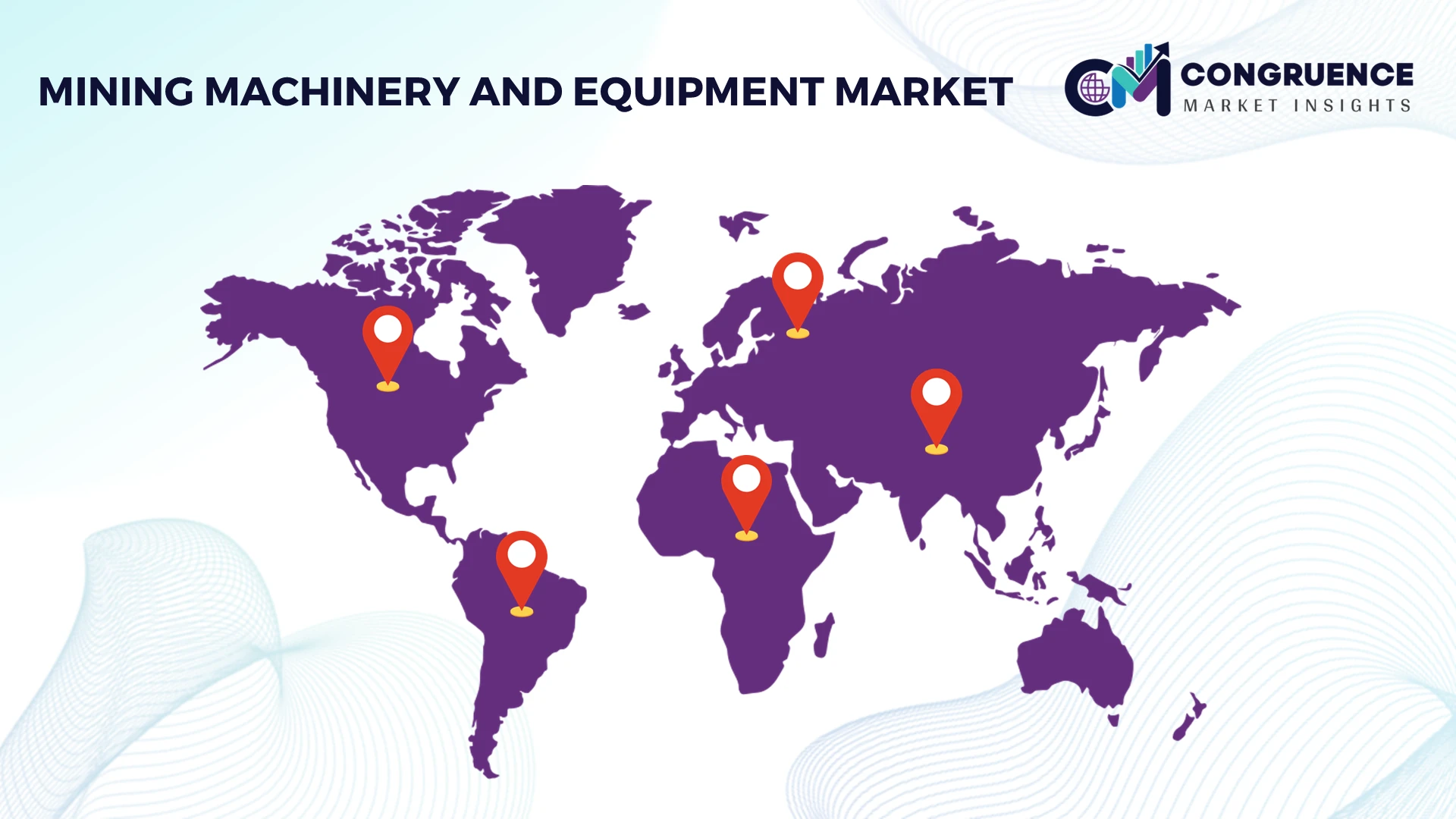
North America accounted for an estimated 24.2% market share in 2025, supported by established mining infrastructure, advanced machinery manufacturing capabilities, and increasing investment in domestic critical mineral extraction. The United States and Canada are strengthening mineral supply chains through copper, lithium, nickel, and rare earth development projects. Canadian underground mining operations are increasingly integrating battery-electric loaders, precision drilling systems, and remotely operated excavation machinery to improve productivity and workplace safety. In 2024, the United States Department of Energy announced over USD 3 billion in funding for battery manufacturing and materials processing projects, strengthening upstream mineral requirements. Caterpillar and other equipment manufacturers are expanding connected machinery platforms, component remanufacturing capabilities, and specialized aftermarket services. Regional procurement increasingly emphasizes equipment reliability, lifecycle cost optimization, and compliance with stringent environmental and occupational safety requirements.
U.S. Market Outlook: The United States benefits from established heavy machinery manufacturing capabilities, extensive mineral reserves, and government-backed mineral supply-chain diversification initiatives. In 2024, the country produced approximately 1.1 million metric tonnes of copper, supporting sustained demand for excavation, crushing, and material transportation equipment. Mining operators in Arizona, Nevada, and Utah are prioritizing high-capacity machinery, predictive maintenance systems, and equipment modernization to improve extraction economics.
Europe accounted for an estimated 18.3% market share in 2025, supported by advanced mining equipment engineering, underground extraction technologies, and stringent environmental requirements. Sweden, Finland, and Germany maintain strong industrial capabilities in precision drilling, mineral processing, and energy-efficient machinery manufacturing. The European Union's Critical Raw Materials Act establishes a domestic extraction benchmark of 10% of annual strategic raw material consumption by 2030, encouraging investment in regional mining infrastructure. Equipment procurement increasingly prioritizes low-emission powertrains, intelligent monitoring systems, and machinery designed for complex underground environments. Sandvik, Epiroc, and Metso are expanding specialized equipment portfolios and integrated digital servicing capabilities. High labor and energy costs are accelerating investment in precision extraction technologies that minimize material waste, improve equipment utilization, and strengthen operational competitiveness across established European mining facilities.
Sweden Market Outlook: Sweden maintains a strong competitive position through its advanced underground mining infrastructure and globally established equipment manufacturers. The country produces approximately 90% of the European Union's iron ore, creating substantial demand for specialized drilling, excavation, and mineral transportation machinery. Mining operations in Kiruna and Malmberget support continued investment in deep-level extraction technologies, automated rock handling systems, and advanced geotechnical monitoring capabilities.
Asia Pacific accounted for an estimated 39.5% market share in 2025, supported by extensive coal and metal extraction activities, competitive machinery manufacturing, and accelerating industrial infrastructure development. China, India, Australia, and Indonesia represent major equipment consumption centers across surface and underground mining operations. India's coal production surpassed one billion tonnes during the 2024–2025 financial year, strengthening demand for high-capacity excavators, continuous miners, and material transportation systems. Australia maintains advanced autonomous haulage capabilities, while Indonesia's expanding nickel processing industry supports specialized mineral extraction and beneficiation equipment requirements. Manufacturers including Komatsu, Hitachi Construction Machinery, SANY, and XCMG are expanding production capabilities, dealer networks, and application-specific machinery portfolios. Regional procurement increasingly combines competitive acquisition costs with higher equipment productivity, localized servicing capabilities, and operational adaptability across diverse geological conditions.
China Market Outlook: China dominates regional machinery manufacturing and consumption through its extensive coal mining infrastructure, integrated industrial supply chains, and domestic equipment production capabilities. Annual coal production reached approximately 4.76 billion tonnes in 2024, supporting substantial machinery replacement and modernization requirements. Domestic manufacturers are expanding intelligent excavation systems, high-capacity hydraulic equipment, and digitally integrated mining machinery while strengthening export competitiveness across emerging mining economies.
South America accounted for an estimated 10.6% market share in 2025, supported by extensive copper, iron ore, lithium, and gold extraction activities across Chile, Brazil, Peru, and Argentina. Expanding mineral production and declining ore grades are increasing requirements for high-capacity crushing, grinding, excavation, and material transportation equipment. Chile's copper production reached approximately 5.5 million metric tonnes in 2024, reinforcing demand for continuous fleet modernization and mineral processing infrastructure. Argentina's expanding lithium industry is creating additional requirements for specialized extraction and material handling systems. However, remote mining locations, water scarcity, and transportation infrastructure limitations increase equipment deployment and servicing complexity. Caterpillar, Komatsu, and Metso are strengthening regional service capabilities, equipment refurbishment programs, and customized processing solutions. Machinery suppliers increasingly compete through operational reliability, local spare-parts availability, and adaptability to demanding high-altitude mining environments.
Brazil Market Outlook: Brazil maintains a significant position through its extensive iron ore, bauxite, gold, and niobium extraction infrastructure. Vale produced approximately 328 million metric tonnes of iron ore in 2024, supporting substantial demand for heavy-duty excavation, screening, conveying, and mineral processing machinery. Mining operations in Minas Gerais and Pará are prioritizing dry processing technologies, integrated material transportation systems, and equipment modernization to improve resource efficiency and operational resilience.
Middle East & Africa accounted for an estimated 7.4% market share in 2025, supported by expanding mineral exploration, infrastructure modernization, and economic diversification initiatives. South Africa, Saudi Arabia, the Democratic Republic of the Congo, and Zambia represent strategically important equipment demand centers. Saudi Arabia increased its estimated untapped mineral resource valuation to approximately USD 2.5 trillion in 2024, strengthening investment momentum across mineral exploration and extraction infrastructure. Copper and cobalt mining expansion in Central Africa is increasing requirements for excavation, drilling, crushing, and ore transportation machinery. Limited electricity infrastructure and remote operating environments encourage procurement of durable, easily serviceable equipment. Manufacturers are expanding regional distribution partnerships, technical training programs, and mobile maintenance capabilities. Competitive opportunities increasingly favor suppliers capable of supporting challenging geological conditions, infrastructure constraints, and long-distance equipment servicing requirements.
South Africa Market Outlook: South Africa benefits from established deep-level mining expertise, extensive mineral reserves, and specialized mining equipment engineering capabilities. The country accounts for approximately 70% of global mined platinum production, sustaining demand for underground drilling, rock excavation, ventilation, and material handling systems. Mining enterprises are prioritizing mechanized extraction methods and energy-efficient equipment to address rising operating costs, workforce safety requirements, and electricity supply constraints.
Caterpillar and Komatsu compete through integrated mining fleets, extensive distribution networks, and lifecycle services, while Sandvik and Epiroc specialize in underground extraction technologies. Hitachi Construction Machinery challenges established suppliers through hydraulic excavator performance and competitive equipment configurations. The five leading companies collectively hold an estimated 52.5% market share, reflecting moderate concentration. Autonomous haulage systems target 10–15% operating cost reductions, while certified remanufactured components offer approximately 20–40% savings against new replacements. Manufacturers are expanding regional assembly facilities, strengthening technology partnerships, and integrating predictive maintenance into aftermarket contracts. Chinese equipment manufacturers intensify pricing pressure through localized production and competitive financing arrangements. Competition is shifting from standalone machinery sales toward integrated equipment, software, and performance-based servicing ecosystems. Extensive dealer infrastructure, proprietary engineering capabilities, and demanding equipment qualification requirements create substantial entry barriers. Winning requires demonstrable lifecycle cost advantages, interoperable automation capabilities, dependable spare-parts availability, and responsive technical support across geographically dispersed mining operations.
Caterpillar Inc.
Komatsu Ltd.
Sandvik AB
Epiroc AB
Hitachi Construction Machinery Co., Ltd.
Liebherr Group
Metso Corporation
FLSmidth & Co. A/S
SANY Heavy Industry Co., Ltd.
XCMG Machinery Co., Ltd.
Terex Corporation
TAKRAF Group
Weir Group PLC
Astec Industries, Inc.
Autonomous haulage, intelligent drilling, and predictive maintenance technologies are transforming mining equipment productivity. Compared with manually operated fleets, autonomous haulage systems target 10–15% lower operating costs through optimized routing, consistent loading cycles, and reduced idle time. Predictive maintenance platforms integrate vibration sensors, lubricant analysis, and machine learning algorithms to target 15–25% reductions in unplanned downtime. Commercial deployments across Australian iron ore operations demonstrate established adoption of integrated autonomous equipment.
Battery-electric underground loaders, regenerative braking systems, and advanced hydraulic technologies are reshaping machinery energy consumption. Electric equipment eliminates 100% of direct diesel exhaust emissions during operation, while optimized ventilation requirements offer potential energy savings of 20–30% under suitable conditions. Digital twins and three-dimensional mine mapping support equipment configuration, production scheduling, and extraction planning. Sandvik and Epiroc benefit from specialized underground electrification portfolios and integrated technical support capabilities.
Between 2026 and 2028, interoperable fleet management platforms, edge computing, and private wireless networks will increasingly connect mixed-brand machinery. Advanced dispatch systems target 10–15% improvements in equipment utilization through coordinated material movement and real-time production monitoring. Manufacturers offering integrated hardware, software, and lifecycle services gain competitive advantages through recurring customer engagement. Early technology investment strengthens operational resilience, equipment availability, and scalability across increasingly complex mineral extraction environments.
September 2024, Liebherr expanded its partnership with Fortescue at MINExpo, announcing the planned supply of 475 zero-emission mining machines, including 360 autonomous battery-electric haul trucks. The agreement strengthens Liebherr’s electrification portfolio and accelerates commercial deployment of sustainable mining fleets. Source: liebherr.com
August 2025, Metso completed its Antofagasta service center expansion in Chile, adding 1,200 square meters of operational space and increasing technical workspace to 4,800 square meters. The expansion strengthens equipment repair capabilities, reduces turnaround times, and improves machinery availability. Source: metso.com
April 2026, Komatsu commissioned its 1,000th autonomous ultra-class haul truck, deploying a 930E-5AT model with a 290-metric-ton payload at Barrick’s Nevada Gold Mines operation. The milestone strengthens Komatsu’s autonomous haulage leadership and demonstrates commercial scalability across diverse mineral extraction applications. Source: komatsu.com
November 2026, Sandvik completed its acquisition of ThoroughTec Simulation, a South African mining equipment simulation and training specialist employing over 200 people. The transaction strengthens Sandvik’s aftermarket capabilities, expanding simulator-based workforce development and supporting safer, more productive mining equipment operations. Source: home.sandvik
The Mining Machinery and Equipment Market Report provides comprehensive analysis across surface mining equipment, underground mining equipment, crushing, pulverizing and screening equipment, drilling equipment, mineral processing machinery, and other specialized equipment. Application coverage includes metal mining, mineral mining, and coal mining, while end-user analysis encompasses large mining enterprises, mining contractors, small and medium-sized mining companies, and government-owned mining organizations. The report evaluates market distribution across North America, Europe, Asia Pacific, South America, and Middle East & Africa.
The study examines autonomous haulage systems, battery-electric machinery, predictive maintenance, intelligent drilling technologies, and integrated fleet management platforms. It assesses competitive strategies, equipment modernization requirements, supply-chain dependencies, technological adoption, and emerging critical mineral extraction opportunities. Covering the 2026–2033 forecast period, the report supports investment planning, product development, geographical expansion, strategic partnerships, and competitive positioning across established and emerging mining equipment markets.
| Report Attribute / Metric | Details |
|---|---|
| Market Revenue (2025) | USD 73,160.0 Million |
| Market Revenue (2033) | USD 1,25,702.5 Million |
| CAGR (2026–2033) | 7.0% |
| Base Year | 2025 |
| Forecast Period | 2026–2033 |
| Historic Period | 2021–2025 |
| Segments Covered |
By Type
By Application
By End-User
|
| Key Report Deliverables | Revenue Forecast; Market Trends; Growth Drivers & Restraints; Technology Insights; Segmentation Analysis; Regional Insights; Competitive Landscape; Regulatory & ESG Overview; Recent Developments |
| Regions Covered | North America; Europe; Asia-Pacific; South America; Middle East & Africa |
| Key Players Analyzed | Caterpillar Inc.; Komatsu Ltd.; Sandvik AB; Epiroc AB; Hitachi Construction Machinery Co., Ltd.; Liebherr Group; Metso Corporation; FLSmidth & Co. A/S; SANY Heavy Industry Co., Ltd.; XCMG Machinery Co., Ltd.; Terex Corporation; TAKRAF Group; Weir Group PLC; Astec Industries, Inc. |
| Customization & Pricing | Available on Request (10% Customization Free) |




