
Reports
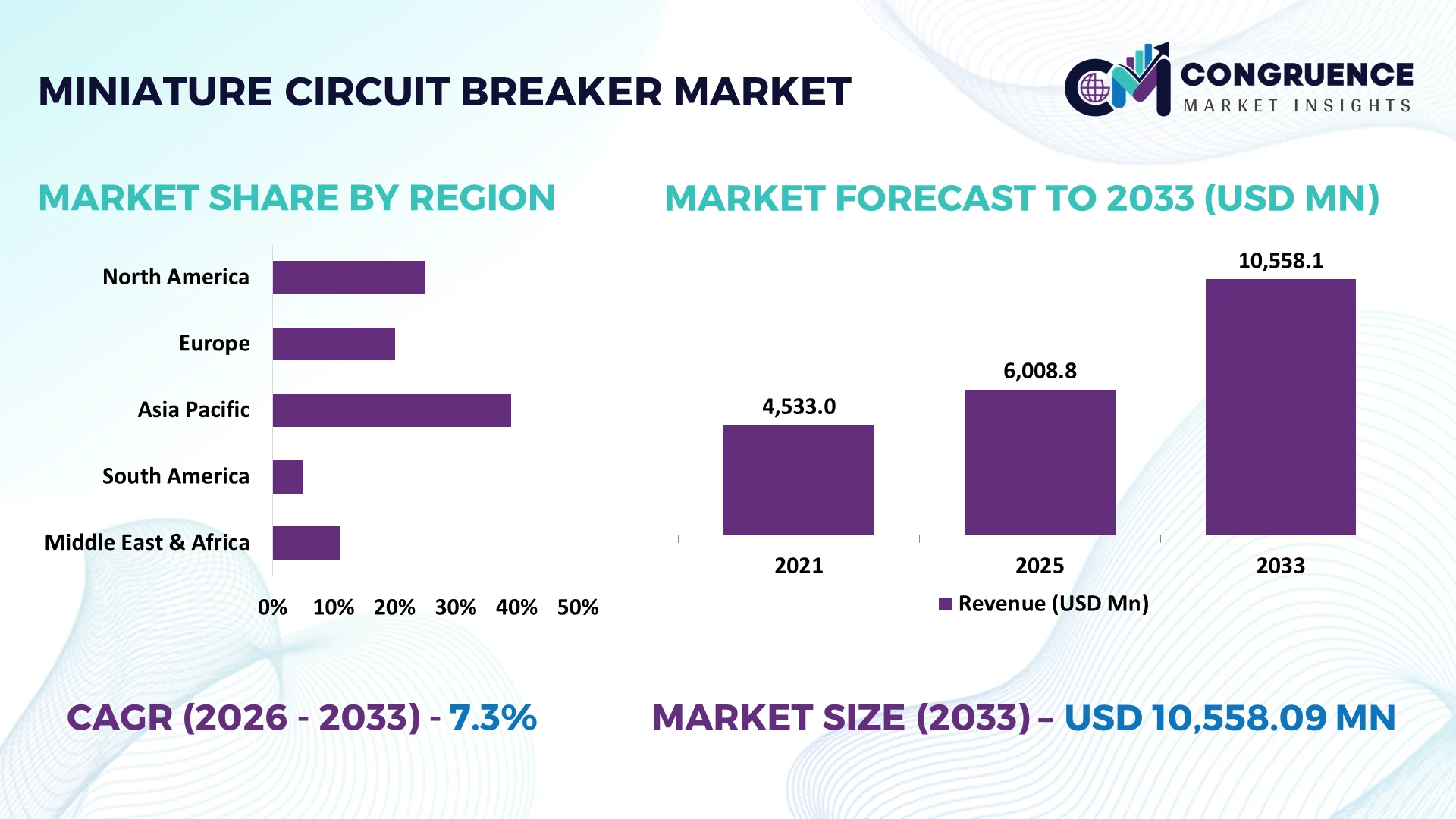
The Global Miniature Circuit Breaker Market was valued at USD 6008.8 Million in 2025 and is anticipated to reach a value of USD 10558.09 Million by 2033 expanding at a CAGR of 7.3% between 2026 and 2033. Growth is driven by low-voltage distribution upgrades, stricter electrical protection requirements, renewable energy installations, and expanding industrial automation infrastructure.
China represents a dominant manufacturing and consumption hub for miniature circuit breakers, supported by its extensive electrical equipment supply chain and infrastructure investment. The country's renewable electricity capacity exceeded 1,800 GW in 2024, strengthening requirements for distribution protection equipment. Industrial automation, commercial construction, and residential electrification reinforce domestic demand for DIN-rail miniature circuit breakers. Compared with India, China maintains a larger established manufacturing ecosystem, while India's expanding electricity distribution infrastructure and domestic electrical equipment production create opportunities for regional suppliers.
Manufacturers prioritizing IEC-compliant protection devices, automated production, and renewable-ready electrical distribution products are positioned to capture higher-value procurement opportunities.
Market Size & Growth: Valued at USD 6008.8 Million in 2025, projected to USD 10558.09 Million by 2033 at 7.3% CAGR, driven by smart MCB integration and grid modernization.
Top Growth Drivers: Renewable energy installations, data center construction, and smart city initiatives expanding electrical protection demand.
Short-Term Forecast: By 2027, smart MCB adoption accelerates as IoT integration and remote monitoring capabilities reduce unplanned downtime in industrial and commercial installations.
Emerging Technologies: Smart MCBs with integrated telemetry, software-driven trip adjustment, and cloud-based analytics for predictive maintenance.
Regional Leaders: Asia-Pacific at 38% revenue share, North America fastest-growing with USD 4.07 billion US low voltage circuit breaker market, and Europe driven by IEC compliance.
Consumer/End-User Trends: Residential and commercial applications command dominant volume; data centers and renewable energy represent fastest-growing segments.
Pilot/Case Example: Schneider Electric and Siemens continue expanding smart MCB portfolios with IoT connectivity, enabling remote diagnostics and condition monitoring for industrial and commercial customers.
Competitive Landscape: Schneider Electric, ABB, Eaton, Siemens, and Legrand lead; CHINT, DELIXI, and Havells compete on cost efficiency and regional distribution.
Regulatory & ESG Impact: IEC 60898 and UL 1077 compliance govern product qualification; EU Battery Directive and carbon footprint disclosure influence manufacturing sustainability.
Investment & Funding: Newer entrants leverage digital capabilities, bundling hardware with subscription-based services for condition monitoring and predictive maintenance.
Innovation & Future Outlook: Modular product architectures enabling trip module and communication option swaps; smart MCBs capture premium pricing through service-oriented offerings.
The Miniature Circuit Breaker Market is benefiting from rising requirements for overload protection, short-circuit isolation, and compact electrical distribution systems across residential, commercial, and industrial facilities. Manufacturers are advancing thermal-magnetic trip mechanisms, high-breaking-capacity configurations, and modular DIN-rail installations to improve protection reliability. Demand for 10 kA circuit breakers is particularly relevant in commercial and industrial distribution environments with higher prospective fault currents. India's Revamped Distribution Sector Scheme, backed by approximately USD 36 billion in planned expenditure, highlights ongoing electrical network modernization. These developments are shifting competitive priorities toward product certification, installation efficiency, and application-specific protection technologies.
The Miniature Circuit Breaker Market is becoming strategically important as electrical infrastructure modernization shifts purchasing priorities toward protection reliability, installation efficiency, and standardized distribution equipment. India's Revamped Distribution Sector Scheme targets improvements in distribution network performance, while China's industrial electrification programs support advanced low-voltage switchgear manufacturing. Compliance with IEC 60898-1 and IEC 60947-2 increasingly influences product engineering, testing investment, and access to commercial procurement contracts.
Technological differentiation is emerging through compact thermal-magnetic mechanisms, automated assembly, and improved arc-extinguishing designs. Modern DIN-rail miniature circuit breakers typically occupy 18 mm per single-pole module, enabling standardized panel configurations and faster replacement than older, nonmodular installations. China benefits from integrated component manufacturing, whereas Germany emphasizes precision engineering and industrial protection technologies. Through 2026–2028, automated calibration, digital production monitoring, and higher breaking-capacity variants will become increasingly important for manufacturing consistency and application coverage.
Commercial building distribution boards illustrate this transition, with 6 kA and 10 kA miniature circuit breakers selected according to prospective fault-current requirements. Manufacturers including Schneider Electric, ABB, and Siemens are strengthening modular protection portfolios, engineering capabilities, and distribution partnerships. Companies combining certified performance, production flexibility, and application-specific engineering will secure stronger competitive positions in modern electrical infrastructure.
Expanding electrical distribution networks and industrial electrification are accelerating demand for miniature circuit breakers with standardized overload and short-circuit protection. India's distribution modernization initiatives target aggregate technical and commercial losses of 12–15% and an average cost of supply–average revenue realized gap of zero under RDSS. Meanwhile, renewable energy represented more than 90% of China's newly installed power generation capacity in 2024, reinforcing investment in associated electrical infrastructure. Commercial facilities increasingly require coordinated protection across lighting, HVAC, and equipment circuits. Manufacturers are expanding modular breaker portfolios, strengthening local distribution networks, and investing in automated assembly. Suppliers offering reliable 6 kA and 10 kA protection configurations gain advantages in infrastructure procurement.
Miniature circuit breaker manufacturing remains exposed to copper, silver-contact materials, engineered polymers, and precision mechanical components. Copper prices experienced substantial volatility during 2024, with annual average prices approximately 8% higher than in 2023, increasing pressure on conductive component procurement. Silver prices also rose by approximately 21% on an annual average basis, affecting contact material economics. India's electrical equipment manufacturers face additional complexity when balancing imported specialty components with domestic sourcing requirements. Product qualification under IEC standards adds testing and documentation costs, particularly for manufacturers serving multiple jurisdictions. Companies are responding through material optimization, supplier diversification, long-term procurement agreements, and localized component production. Contact-material efficiency has become an important profitability lever without compromising electrical endurance.
The transition toward digitally managed electrical infrastructure creates opportunities for compact miniature circuit breakers with auxiliary signaling, remote status indication, and improved protection coordination. India's smart meter modernization program targets approximately 250 million installations, establishing a broader foundation for digital distribution management. The country's non-fossil electricity generation capacity also exceeded 50% of total installed capacity in 2025, reinforcing investment in modern electrical systems. In commercial facilities, advanced distribution boards increasingly incorporate monitoring accessories alongside conventional thermal-magnetic protection. Manufacturers are developing modular accessories, compact switching mechanisms, and integrated panel solutions. Partnerships with panel builders and building automation providers offer access to retrofit projects where installation flexibility, equipment compatibility, and maintenance visibility influence procurement decisions.
Maintaining consistent protection performance across increasingly complex electrical installations presents a major engineering challenge for miniature circuit breaker manufacturers. IEC 60898-1 defines B-curve instantaneous tripping at 3–5 times rated current, C-curve at 5–10 times, and D-curve at 10–20 times, requiring careful application matching. Motor starting currents, inverter-connected equipment, and distributed electrical loads complicate breaker selection and discrimination. In Germany, renewable generation accounted for approximately 59% of electricity generation in 2024, illustrating the growing complexity of electrical system integration. Manufacturers must strengthen application engineering, thermal testing, and coordination documentation while training installation partners. Competitive advantage increasingly depends on reducing nuisance tripping, improving selectivity, and maintaining protection consistency across diverse operating environments.
• Compact Electrical Panel Design Advancements: Manufacturers are refining distribution board layouts around standardized 18 mm single-pole modules and integrated 1P+N arrangements. These compact solutions support 6 kA and 10 kA breaking capacities while limiting enclosure modifications. German suppliers are improving busbar connections, terminal access, and mounting designs, helping panel assemblers simplify installation procedures and accelerate production of standardized electrical distribution equipment.
• Automation Transforms Breaker Production Processes: High-volume miniature circuit breaker production increasingly incorporates robotic handling, automated tripping calibration, and machine-vision inspection. Critical functional checks now extend to 100% of finished units in increasingly automated testing workflows. Flexible assembly lines support configurations ranging from 1-pole to 4-pole devices. Chinese producers are strengthening digital inspection and traceability systems to improve manufacturing precision, minimize manual intervention, and meet export-market quality requirements.
• Protection Selectivity Shapes Equipment Specifications: Electrical contractors are placing greater emphasis on matching breaker characteristics with connected loads. Type B devices provide instantaneous tripping at 3–5 times rated current, compared with 5–10 times for Type C configurations. Manufacturers are improving time-current characteristic documentation and coordination guidance, helping commercial facilities reduce incorrect device selection and maintain continuity across lighting installations, electronic systems, and inductive equipment.
• Specialized DC Circuit Protection Expands: Photovoltaic arrays and battery-connected installations are increasing requirements for purpose-designed DC miniature circuit breakers. Available products include polarity-sensitive and non-polarized configurations, with application-dependent ratings of 500 V DC and 1,000 V DC. Suppliers are refining arc chambers and contact separation designs for reliable current interruption, while collaborating with electrical integrators to improve device selection and compatibility across installations.
Among established miniature circuit breaker categories, Type C devices occupy a leading position because their operating characteristics suit commercial electrical distribution, mixed-load circuits, and industrial installations. Instantaneous tripping occurs at approximately 5–10 times rated current, allowing equipment with moderate starting currents to operate without unnecessary disconnection. Type B breakers, with instantaneous tripping thresholds of 3–5 times rated current, remain widely applicable to household circuits and lighting systems. Type D configurations serve transformers and heavy machinery requiring greater tolerance for inrush currents, with thresholds reaching 10–20 times rated current. Mature product categories retain advantages in production standardization, distribution availability, and installer familiarity.
The product mix is also evolving toward specialized direct-current protection. DC MCBs address photovoltaic and battery-connected circuits, whereas AC MCBs continue serving conventional alternating-current installations. Type K breakers meet protection requirements for inductive loads, while Type Z devices address sensitive electronic equipment. Manufacturers are directing engineering investment toward enhanced arc interruption, broader voltage configurations, and relevant certification requirements. Competitive differentiation increasingly rests on precise application suitability rather than conventional portfolio breadth.
Residential Wiring remains a principal application for miniature circuit breakers because lighting, sockets, and household appliances require individual circuit protection against overloads and short circuits. Standard single-pole and multipole devices support cost-efficient installation in new housing and renovation projects. Commercial Buildings also account for substantial deployment through HVAC equipment, tenant distribution networks, and dedicated electrical circuits. Lighting Circuits contribute recurring replacement requirements as LED modernization alters electrical load profiles and installation specifications. Manufacturers continue supplying extensive Type B and Type C ranges to address these established requirements.
EV Charging Systems are becoming a more significant application as charging infrastructure expands and dedicated circuits experience greater utilization. AC chargers rated at 7.4 kW, 11 kW, and 22 kW create different current-rating and coordination requirements. Solar Power Systems require AC or DC protection according to the circuit arrangement. Industrial Control Panels prioritize dependable equipment operation, while Motor Protection emphasizes compatibility with starting currents and operational continuity. Manufacturers are expanding technical collaboration with charging equipment producers, photovoltaic integrators, and electrical panel builders to strengthen design approvals and repeat procurement.
The Residential Sector constitutes a major purchasing category because household installations depend on multiple protected circuits, standardized equipment specifications, and periodic electrical upgrades. Approximately 70% of final energy consumption within buildings originates from residential properties, illustrating the extensive infrastructure supporting this buyer group. The Commercial Sector purchases protection equipment for hospitals, offices, retail buildings, and institutional facilities. Industrial Manufacturing places greater emphasis on equipment availability and selective circuit protection in automated operations. Electrical Panel Manufacturers represent an important purchasing channel through bulk acquisition for standardized assemblies. Suppliers are responding with broader distributor coverage, contractor partnerships, and coordinated product offerings.
Renewable Energy Operators are emerging as an increasingly important customer category as decentralized electricity generation introduces specialized protection requirements. Power Utilities procure devices for auxiliary systems and distribution-related infrastructure, while Infrastructure Developers incorporate circuit protection into public facilities and transportation projects. Solar photovoltaic systems represented more than three-quarters of renewable capacity additions worldwide in 2025, reinforcing procurement requirements for compatible electrical components. Manufacturers are expanding coordinated AC and DC portfolios, collaborating with engineering partners, and providing technical specification assistance. Securing equipment design approval before purchasing decisions is becoming a stronger competitive advantage than relying solely on distributor pricing.
Asia-Pacific accounted for the largest market share at approximately 43% in 2025 however, Asia-Pacific is expected to register the fastest growth, expanding at a CAGR of 8.6% between 2026 and 2033.

Electrical Infrastructure Upgrades and Industrial Protection Modernization
North America represents an established market for miniature circuit breakers, supported by commercial electrical renovations, industrial facility modernization, and increasing requirements for compact branch-circuit protection. The United States leads regional procurement through manufacturing facilities, data centers, institutional buildings, and electrical distribution equipment suppliers. Canada contributes through commercial construction, renewable energy installations, and electrical infrastructure replacement programs. Product qualification remains a defining purchasing consideration, with UL 489 and UL 1077 addressing distinct circuit protection applications. The United States Department of Energy's Grid Resilience and Innovation Partnerships program supports approximately USD 10.5 billion in federal funding for electricity infrastructure improvements, creating opportunities across associated electrical equipment supply chains. Manufacturers are strengthening relationships with electrical contractors, panel assemblers, and industrial distributors while developing protection devices compatible with evolving equipment specifications.
United States Market Outlook: The United States benefits from established electrical equipment manufacturing, extensive industrial automation infrastructure, and strong demand for certified protection devices. Federal manufacturing incentives and expanding semiconductor facilities are supporting new electrical installations. The CHIPS for America program provides approximately USD 39 billion in manufacturing incentives, reinforcing investment in industrial facilities requiring coordinated low-voltage electrical protection systems.
Regulatory Standardization and Advanced Electrical Equipment Engineering
Europe maintains a strong position in miniature circuit breaker engineering, supported by established electrical equipment manufacturers, industrial automation expertise, and stringent product conformity requirements. Germany, France, Italy, and the United Kingdom represent important manufacturing and consumption centers, with electrical installation upgrades increasingly emphasizing protection selectivity, equipment compatibility, and installation safety. IEC 60898-1 and IEC 60947-2 provide important technical frameworks for product design and application suitability. European manufacturers are also integrating recyclable materials, compact enclosures, and automated testing into production processes. The European Union's revised Energy Performance of Buildings Directive requires new buildings owned by public bodies to meet zero-emission standards from 2028, followed by all new buildings from 2030. These regulatory changes are influencing electrical design specifications and encouraging suppliers to expand compliant modular protection portfolios.
Germany Market Outlook: Germany remains strategically important through its electrical engineering ecosystem and established manufacturers, including Siemens and Hager. Industrial machinery production, building automation, and precision electrical assembly support sophisticated protection requirements. Renewable sources supplied approximately 59% of German electricity generation in 2024, increasing the importance of properly coordinated electrical systems across industrial and commercial installations.
Manufacturing Scale and Accelerated Electrical Infrastructure Deployment
Asia-Pacific dominates miniature circuit breaker manufacturing and consumption through extensive electrical equipment production, urban construction, and industrial capacity expansion. China anchors the regional supply chain with integrated production of contacts, molded housings, switching mechanisms, and electrical distribution assemblies. India is strengthening domestic electrical equipment manufacturing through industrial investment and distribution infrastructure programs, while Japan and South Korea emphasize precision engineering and advanced factory electrical systems. Southeast Asian economies are attracting manufacturing investment that requires standardized protection equipment for new production facilities. India's installed electricity generation capacity exceeded 475 GW by March 2025, illustrating the scale of infrastructure supporting electrical equipment procurement. Manufacturers are expanding regional production capabilities, strengthening distributor networks, and developing application-specific circuit breakers to serve construction contractors, industrial panel manufacturers, and electrical infrastructure developers.
China Market Outlook: China combines high-volume electrical component manufacturing with extensive domestic infrastructure requirements. The country's installed solar photovoltaic capacity surpassed 880 GW by the end of 2024, strengthening associated electrical protection and distribution equipment supply chains. Domestic manufacturers benefit from automated production lines, integrated component sourcing, and competitive export capabilities, supporting both standardized products and specialized protection configurations.
Distribution Network Reinforcement and Industrial Facility Electrification
South America's miniature circuit breaker market is shaped by electricity distribution improvements, commercial construction, and industrial electrical equipment replacement. Brazil accounts for substantial regional activity through its manufacturing base, construction sector, and established electrical equipment distribution networks. Chile supports specialized protection requirements through mining operations and renewable electricity installations, while Argentina presents opportunities in industrial maintenance and electrical infrastructure rehabilitation. Brazil's electricity system has experienced significant renewable integration, with renewable sources accounting for approximately 88% of electricity generation in 2024. This operating environment increases the importance of dependable low-voltage protection across supporting electrical installations. Import dependency for selected electrical components, currency fluctuations, and uneven infrastructure investment influence procurement strategies. Manufacturers are responding through local distributor partnerships, regional inventory management, and product configurations aligned with national installation requirements.
Brazil Market Outlook: Brazil benefits from established industrial centers in São Paulo and Minas Gerais, extensive commercial electrical installations, and domestic electrical equipment manufacturing capabilities. WEG provides a significant local industrial electrical equipment presence. Brazil's installed solar photovoltaic capacity exceeded 50 GW in early 2025, supporting procurement of appropriately rated protection devices across distributed generation and associated electrical installations.
Infrastructure Diversification and Large-Scale Electrical System Investment
The Middle East & Africa market is influenced by commercial construction, utility infrastructure expansion, industrial diversification, and increasing investment in modern electrical distribution systems. Saudi Arabia and the United Arab Emirates are developing industrial facilities, transportation infrastructure, and large commercial projects requiring standardized electrical protection equipment. South Africa contributes through industrial maintenance, electrical network rehabilitation, and distributed energy installations. Saudi Arabia's Vision 2030 infrastructure transformation supports extensive construction activity, while the United Arab Emirates continues investing in energy and industrial development. The UAE Energy Strategy 2050 targets a 30% contribution from clean energy to its total energy mix by 2030. Electrical equipment manufacturers are strengthening relationships with regional engineering contractors, switchboard assemblers, and project developers to secure procurement opportunities requiring certified protection products.
Saudi Arabia Market Outlook: Saudi Arabia is a strategically significant market through industrial diversification, major construction projects, and electrical infrastructure expansion. The National Renewable Energy Program targets approximately 50% renewable electricity generation by 2030. Large industrial developments in Riyadh, Jubail, and emerging economic zones are strengthening requirements for coordinated electrical protection, certified modular devices, and dependable contractor supply networks.
Schneider Electric, ABB, Eaton, Siemens, and Legrand anchor the global miniature circuit breaker market, with the top five players commanding approximately 50–55% of worldwide revenue through established distribution networks and comprehensive product portfolios. Competition bifurcates sharply: these global leaders compete on smart MCB integration and IEC/UL certification depth, while Chinese manufacturers including CHINT Group, DELIXI Group, and Shanghai Liangxin compete aggressively on price and regional distribution, controlling approximately 40% of global manufacturing capacity. The basis of competition is shifting from commodity protection devices toward intelligent, connected platforms: smart MCBs now capture 15–20% of new premium installations, enabling manufacturers to bundle hardware with subscription-based condition monitoring services. Competition in practice involves vertical integration through component supply control—Schneider and ABB manufacture their own contacts and trip mechanisms—and partnerships with building management system providers. The competitive shift is toward software-enabled protection ecosystems where data analytics drive recurring revenue.
Schneider Electric
ABB
Eaton
Siemens
Legrand
CHINT Group
DELIXI Group
Havells India
Shanghai Liangxin Electrical
Fuji Electric
Mitsubishi Electric
Rockwell Automation
Hager Group
OEZ
Current miniature circuit breaker technology centers on thermal-magnetic tripping, precision arc chambers, and modular DIN-rail construction. Standard 18 mm single-pole modules support compact distribution boards, while 6 kA and 10 kA breaking capacities address different fault-current requirements. Automated calibration and end-of-line inspection improve manufacturing consistency through repeatable mechanical testing. Compared with manual assembly, automated production can deliver approximately 15–20% shorter processing cycles under optimized operating conditions, benefiting high-volume manufacturers supplying residential and commercial electrical installations.
Emerging technologies include electronic trip monitoring, auxiliary communication modules, and advanced contact materials. Digitally enabled protection assemblies provide operational status information and fault indication without replacing established mechanical protection functions. Integration with building management systems supports faster maintenance diagnostics, while machine-vision inspection identifies assembly defects before shipment. Manufacturers combining standardized breaker platforms with optional monitoring accessories gain advantages in customization, installation flexibility, and technical differentiation across industrial distribution networks.
Between 2026 and 2028, innovation will increasingly emphasize compact DC protection, automated production traceability, and improved electrical endurance. Photovoltaic installations require application-specific DC interruption capabilities, including configurations rated up to 1,000 V DC. Suppliers investing in validated arc-extinguishing designs, automated quality assurance, and interoperable protection accessories will strengthen procurement competitiveness while reducing installation complexity and supporting more reliable electrical infrastructure operation.
October 2025: Schneider Electric launched its Acti9 Pro terminal distribution series, featuring the iC65 circuit breaker with 18mm compact dimensions, 25kA breaking capacity, and -40°C to 70°C operating range. The series includes smart control and precise metering capabilities for end-load monitoring in industrial and infrastructure applications. Source: dzsc.com
December 2025: ABB expanded its miniature circuit breaker portfolio with the S200C series, delivering up to 50% space savings versus traditional solutions. The compact design covers 1P+1P in 1M, 2P in 1M, and 3P/4P in 2M configurations with 4.5kA to 10kA breaking capacity for residential through marine applications. Source: voltimum.se
May 2025: Siemens partnered with EMAS to launch Egypt's first-ever MCB manufacturing facility, establishing domestic production capacity for miniature circuit breakers. The facility addresses regional demand growth and reduces import dependency for North African electrical infrastructure projects. Source: ahk.de
September 2025: Shelly Group unveiled the world's first smart MCBs in compact 1M form factor at IFA 2025, featuring B and C trip characteristics, 1P+N poles, and 6A to 25A ratings with Z-Wave LR or Bluetooth plus Zigbee connectivity. Market launch is planned for early 2026. Source: asia.shelly.com
The Miniature Circuit Breaker Market Report evaluates industry performance, competitive structure, technology development, and investment priorities between 2026 and 2033. Segmentation covers Type B, Type C, Type D, Type K, Type Z, AC MCBs, and DC MCBs. Application analysis examines residential wiring, commercial buildings, industrial control panels, motor protection, lighting circuits, solar power systems, and EV charging systems. End-user coverage includes residential and commercial sectors, industrial manufacturing, power utilities, renewable energy operators, infrastructure developers, and electrical panel manufacturers.
Regional assessment encompasses North America, Europe, Asia-Pacific, South America, and the Middle East & Africa, highlighting manufacturing concentration, electrical infrastructure investment, and country-specific procurement patterns. Technology coverage evaluates thermal-magnetic protection, electronic switching, arc interruption, automated testing, and connected monitoring. The report supports manufacturing expansion decisions, product differentiation, distribution partnerships, and strategic positioning across emerging electrical protection applications.
| Report Attribute/Metric | Report Details |
|---|---|
Market Revenue in 2025 | USD 6008.8 Million |
Market Revenue in 2033 | USD 10558.09 Million |
CAGR (2026 - 2033) | 7.3% |
Base Year | 2025 |
Forecast Period | 2026 - 2033 |
Historic Period | 2021 - 2025 |
Segments Covered | By Type
By Application
By End-User
|
Key Report Deliverable | Revenue Forecast, Growth Trends, Market Dynamics, Segmental Overview, Regional and Country-wise Analysis, Competition Landscape |
Region Covered | North America, Europe, Asia-Pacific, South America, Middle East, Africa |
Key Players Analyzed | Schneider Electric, ABB, Eaton, Siemens, Legrand, CHINT Group, DELIXI Group, Havells India, Shanghai Liangxin Electrical, Fuji Electric, Mitsubishi Electric, Rockwell Automation, Hager Group, OEZ |
Customization & Pricing | Available on Request (10% Customization is Free) |




