
Reports
The Global Mineral Processing Equipment Market was valued at USD 108990 Million in 2025 and is anticipated to reach a value of USD 143454.65 Million by 2033 expanding at a CAGR of 3.1% between 2026 and 2033. Growth is driven by declining ore grades, critical mineral capacity expansion, mine electrification, tailings reprocessing, and investment in automated crushing, grinding, separation, classification, and ore sorting systems.
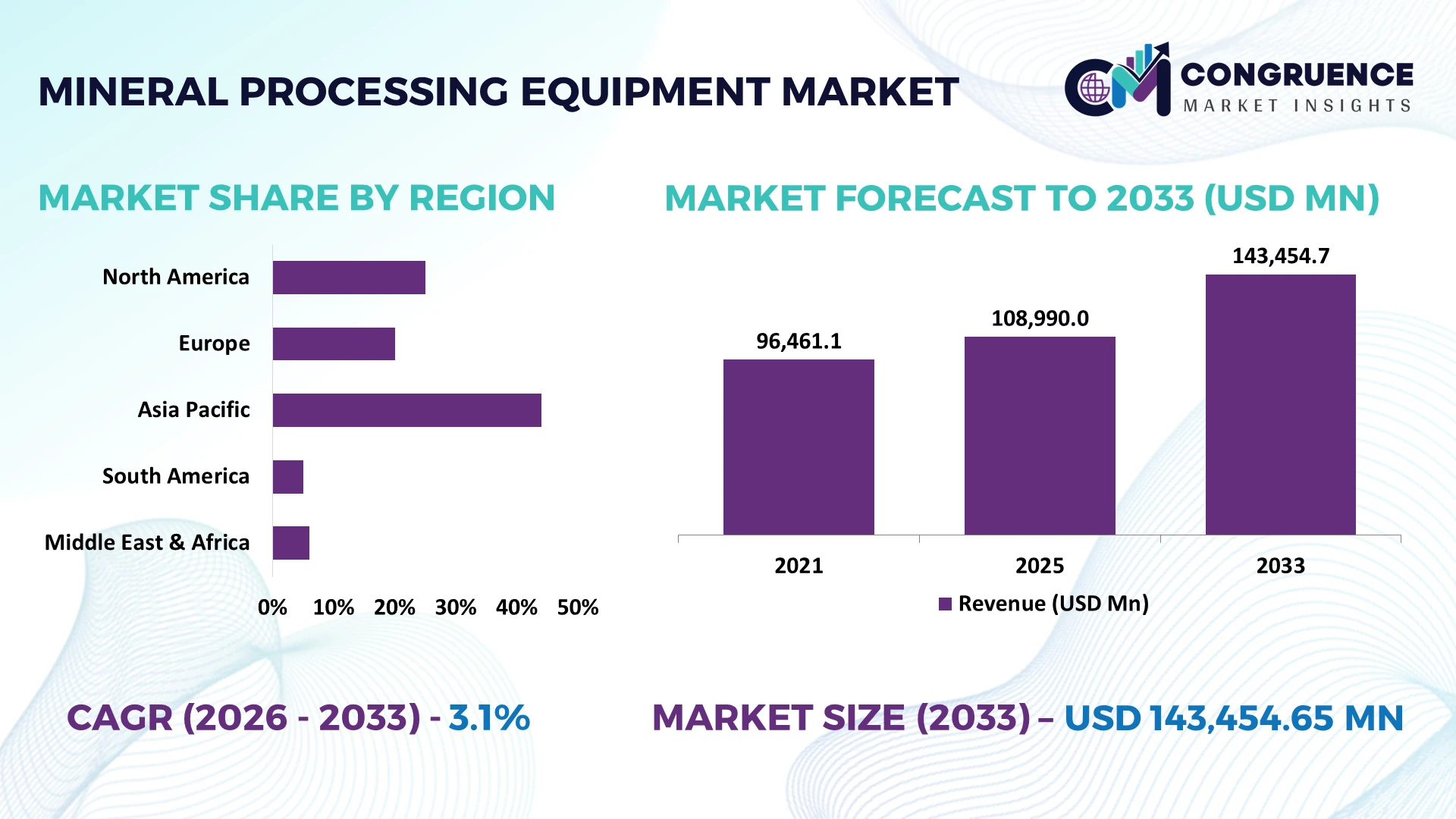
China anchors global mineral processing equipment demand through its dominant metals refining and beneficiation ecosystem. The country processes about 90% of global rare earth elements and accounts for more than 70% of lithium chemical production, supporting intensive deployment of crushers, mills, flotation systems, magnetic separators, and filtration equipment. Australia provides a resource focused comparison, producing roughly 37% of global lithium mine output. China's 2025 export controls on selected critical minerals further intensified geopolitical pressure to establish diversified processing capacity and equipment supply chains outside established production hubs.
Strategically, equipment suppliers combining energy efficient comminution, advanced separation, digital process control, and localized aftermarket support are best positioned to capture critical mineral processing investments.
Market Size & Growth: USD 108,990 million in 2025 reaches USD 143,454.65 million by 2033 at 3.1%, supported by critical mineral processing expansion and ore grade deterioration.
Top Growth Drivers: Copper demand rises 70%, lithium demand expands 500%, and graphite requirements increase 400% through 2050 under accelerated energy transition scenarios.
Short Term Forecast: By 2028, advanced process control can improve concentrator throughput by 5% to 10% through tighter grinding and flotation optimization.
Emerging Technologies: AI ore characterization, sensor based sorting, and autonomous process control can reduce downstream comminution energy requirements by 10% to 20%.
Regional Leaders: Applying indicative 2025 distribution gives Asia Pacific USD 53.4 billion, North America USD 22.9 billion, and Europe USD 17.4 billion, with automation adoption strengthening across major processing hubs.
End User Trends: Copper processing remains strategically critical as average mined copper grades have declined by more than 25% since the early 2000s, increasing beneficiation intensity.
Pilot Case Example: In 2024, NextOre bulk ore sorting technology demonstrated throughput capability above 5,000 tonnes per hour, enabling earlier waste rejection before energy intensive processing.
Competitive Landscape: Metso holds an estimated 10% global position, competing with FLSmidth, Weir, Sandvik, and TAKRAF across comminution, separation, classification, and lifecycle services.
Regulatory & ESG Impact: The EU Critical Raw Materials Act targets 40% domestic processing capacity and limits dependence on any single external processing country to 65% by 2030.
Investment & Funding: The US Department of Energy announced up to USD 1 billion in 2025 funding opportunities covering critical minerals, materials processing, recycling, and associated supply chain development.
Innovation & Future Outlook: Advanced ore sorting can reject 20% to 40% of barren material before grinding, shifting investment toward preconcentration and lower energy flowsheets.
The Mineral Processing Equipment Market serves copper, iron ore, gold, lithium, nickel, rare earth, coal, and industrial mineral operations requiring higher recovery from increasingly complex feedstocks. Innovation is shifting toward sensor based ore sorting, high pressure grinding, coarse particle flotation, intelligent classification, and digitally optimized concentrators. Comminution can consume more than 50% of a mine site's electrical energy, making efficiency a decisive equipment selection criterion. Critical mineral localization policies in the United States, Europe, and Australia are simultaneously encouraging new processing infrastructure outside established Chinese supply chains, creating a strategic transition toward efficient, automated, and geographically diversified beneficiation capacity.
Mineral processing equipment is becoming strategically critical as miners pursue greater metal recovery from lower quality and increasingly complex deposits while governments strengthen domestic critical mineral supply chains. Copper ore grades have declined by more than 25% since the early 2000s, increasing material processed per unit of recovered metal. High pressure grinding rolls can consume 15% to 30% less energy than conventional tumbling mills in suitable circuits, strengthening their investment case.
China retains unmatched processing scale, while Australia is accelerating downstream beneficiation to capture more value from its mineral resources. The United States is simultaneously rebuilding domestic processing capacity for lithium, rare earths, and battery materials. Through 2028, new concentrator projects will increasingly specify automated flotation, intelligent classification, advanced dewatering, and continuous mineral characterization to improve recovery stability without proportionally increasing labor intensity.
At an operating copper concentrator, sensor based sorting before grinding can reject low value rock and reduce downstream tonnes processed. Equipment manufacturers are consequently investing in integrated flowsheets, test centers, digital optimization, and local service partnerships. Competitive advantage will increasingly belong to suppliers that improve recovery per tonne while reducing processing intensity and commissioning complexity.
Declining ore quality is forcing miners to process more material for each tonne of saleable concentrate, directly increasing equipment utilization and beneficiation requirements. Average copper ore grades have fallen more than 25% since the early 2000s, while copper demand is projected to rise roughly 70% by 2050. Gold operations face similar pressure as mature deposits become deeper and mineralogy more complex. Chile illustrates the shift, with miners investing in harder ore treatment, desalinated water systems, and concentrator modernization as deposit quality deteriorates. Lower grades increase crushing, grinding, classification, and flotation intensity, making equipment efficiency central to project economics. Suppliers are responding with larger throughput platforms, improved wear components, optimized flotation cells, and integrated flowsheet engineering. The strategic opportunity is increasingly tied to recovery productivity rather than simple installed tonnage.
Water availability is a structural constraint for mineral beneficiation because grinding, flotation, classification, and tailings transport remain water intensive. Mining accounts for roughly 3% of Chile's national water withdrawals, yet copper operations are concentrated in the exceptionally dry north, where seawater already represents more than 30% of sector water consumption. Desalination and long distance pumping reduce freshwater dependence but increase capital requirements and electricity consumption. This constraint directly affects concentrator location, expansion economics, and equipment specifications. Operators are prioritizing high rate thickeners, filtration, dry stacking, and closed circuit water recovery to reduce intake requirements. Equipment suppliers are strengthening dewatering portfolios and partnering with water technology specialists. The non obvious competitive factor is water balance performance: processing systems that recover more usable water can unlock capacity where additional ore throughput alone cannot.
Historic tailings are shifting from environmental liabilities toward processable mineral inventories as improved separation technology makes previously uneconomic material recoverable. Conventional operations can lose 5% to 15% of valuable minerals into tailings depending on ore characteristics and flowsheet performance, while modern reprocessing can recover residual copper, gold, iron, and critical minerals. Chile holds more than 700 registered tailings deposits, creating a sizeable installed opportunity for retreatment equipment without requiring conventional greenfield mine development. Future projects will increasingly combine fine grinding, enhanced flotation, magnetic separation, sensor characterization, and filtered tailings technology. Equipment manufacturers are establishing pilot facilities, modular processing packages, and partnerships with miners evaluating legacy deposits. Reprocessing creates a distinctive commercial advantage because suppliers can generate equipment demand while helping operators recover saleable material and reduce historical rehabilitation liabilities simultaneously.
Processing increasingly complex mineralogy creates an execution challenge that equipment scale alone cannot solve. Harder ores can raise comminution energy requirements by more than 20%, while grinding already represents roughly 40% to 50% of concentrator energy consumption in many hard rock operations. Australia faces an additional technical skills constraint as remote mines deploy increasingly automated circuits requiring process control, metallurgy, instrumentation, and maintenance expertise simultaneously. Variability in hardness, liberation size, clay content, and mineral associations can destabilize throughput and recovery when equipment is optimized around narrow feed assumptions. Suppliers must therefore integrate mineralogical testing, dynamic process control, simulation, operator training, and remote technical support into project delivery. The strategic challenge is maintaining stable plant performance across variable feed conditions; manufacturers that cannot connect equipment engineering with process intelligence risk losing technically demanding projects.
Modular Plants Accelerate Mine Commissioning: Miners are shifting toward skid mounted and modular beneficiation systems that reduce civil works and simplify staged capacity additions. Modular configurations can shorten installation schedules by 20% to 30%, while factory assembled equipment can reduce onsite construction labor by roughly 25%. Suppliers are expanding prefabricated crushing, screening, and separation packages to serve remote deposits where contractor availability and logistics constrain conventional plant construction.
Coarse Flotation Changes Flowsheet Economics: Operators are deploying technologies capable of recovering valuable minerals at particle sizes above traditional flotation ranges. Coarse particle systems can lower grinding requirements by 20% and reduce water consumption by around 30% in suitable ores. Equipment developers are scaling specialized cells, fluidized separation systems, and demonstration installations, enabling miners to redirect capital from ultrafine comminution toward selective recovery stages.
Wear Monitoring Becomes Digitally Managed: Processing plants are replacing calendar based liner inspections with scanner supported wear management. Three dimensional mill and crusher scanning can reduce inspection exposure by more than 50%, while digital wear profiles provide millimeter level measurement accuracy. Equipment companies are integrating remote inspection, liner forecasting, and maintenance planning into aftermarket contracts, helping operators synchronize replacement schedules with planned shutdowns and avoid premature component changes.
Dry Processing Gains Commercial Attention: Water constrained mining districts are increasing evaluation of dry crushing, screening, magnetic separation, and air classification. Dry magnetic systems can eliminate nearly 100% of process water from selected separation stages, while filtered material can substantially reduce slurry handling requirements. Australian and Brazilian operators are advancing dry beneficiation workflows, prompting suppliers to develop high intensity separators, enclosed conveying systems, and dust controlled circuits.
Crushers represent the leading equipment type with an estimated 28% share, reflecting their mandatory position at the front of most mineral processing flowsheets. Primary and secondary crushing platforms handle feed reductions exceeding 80% between run of mine material and downstream processing specifications, supporting installations from aggregates to hard rock mining. Grinders remain capital intensive assets for liberation intensive ores, while Screens provide essential sizing control before subsequent processing. Classifiers increasingly complement grinding circuits where particle size precision directly influences downstream recovery.
Flotation Equipment is the fastest developing type as increasingly complex polymetallic ores require selective mineral recovery rather than mechanical size reduction alone. Separators are strengthening in magnetic and density based beneficiation, while Thickening Equipment remains essential for concentrate handling and process water management. Suppliers are investing in larger flotation cells, intelligent crusher controls, improved screening media, and high capacity separation platforms. Investment priorities are consequently moving toward equipment combinations that maximize usable output per processing stage.
Grinding leads application demand with an estimated 27% share because mineral liberation determines the effectiveness of virtually every subsequent concentration stage. Large mills routinely process tens of thousands of tonnes daily, making availability and specific energy consumption decisive investment criteria. Crushing remains the principal upstream size reduction application, while Screening separates material before recirculation or downstream treatment. Separation and Ore Concentration serve increasingly complex flowsheets requiring multiple physical and physicochemical recovery stages.
Flotation is the fastest advancing application as copper, nickel, zinc, and polymetallic operators seek greater selectivity from complex mineral assemblages. Modern flotation circuits can contain cells exceeding 500 cubic meters, enabling higher throughput within smaller equipment footprints. Dewatering is gaining operational importance as concentrate transport specifications tighten, while classification improvements are sharpening grinding circuit control. Manufacturers are responding with larger mills, optimized liners, advanced flotation mechanisms, and integrated control packages. Capital allocation is increasingly determined by liberation quality and recovery stability rather than nameplate throughput alone.
Mining represents the leading end user with an estimated 44% share, reflecting continuous requirements for primary size reduction, beneficiation, concentrate preparation, and replacement equipment across operating mines. Mineral Processing represents specialized plant operators focused directly on upgrading extracted material, while Metals & Mining combines upstream extraction with integrated downstream treatment. Coal maintains substantial screening and separation requirements, whereas Cement depends heavily on crushing and grinding for raw material preparation.
Industrial Minerals is the fastest developing end user as lithium bearing minerals, silica, potash, phosphate, graphite, and specialty mineral producers require increasingly precise particle sizing and purification. Construction Materials remain volume driven buyers emphasizing throughput and equipment durability. Industrial mineral processing can demand product purity above 95% for selected applications, increasing investment in classification and selective separation. Suppliers are targeting these buyers with modular equipment, application testing, specialized wear materials, and performance based service packages, shifting competitive focus toward mineral specific processing expertise.
Asia Pacific accounted for the largest market share at 48.9% in 2025 however, Asia Pacific is expected to register the fastest growth, expanding at a CAGR of 4.2% between 2026 and 2033.
Critical Mineral Projects Reshape Equipment Deployment
North America accounted for about 21.0% of global mineral processing equipment demand in 2025, supported by copper, gold, potash, aggregates, battery minerals, and mine modernization programs. Processing investment is increasingly moving from conventional mine expansion toward domestic critical mineral infrastructure and brownfield plant upgrades. Canada strengthened this equipment pipeline through its Critical Minerals Infrastructure Fund, which provides up to CAD 1.5 billion for clean energy and transportation infrastructure supporting priority mineral projects. Ontario, Quebec, and British Columbia consequently offer concentrated opportunities for crushing, grinding, separation, filtration, and material handling suppliers. Equipment procurement increasingly favors scalable plants that can accommodate changing feed characteristics while maintaining recovery performance. Manufacturers are expanding Canadian service coverage, pilot testing capability, and engineering partnerships to capture projects requiring both process equipment and long term technical support.
Canada Market Outlook: Canada produced 3.9 million tonnes of potash in December 2025 alone, demonstrating the processing intensity of its established mineral sector. Federal policy identifies 34 critical minerals, creating a diversified project pipeline beyond conventional precious metals. Suppliers with mineral testing, cold climate engineering, rebuild services, and domestic parts inventories gain an operational advantage across geographically dispersed Canadian mines.
Strategic Autonomy Accelerates Processing Projects
Europe represents around 16.0% of global mineral processing equipment demand, with procurement increasingly shaped by mineral security legislation, recycling integration, and domestic beneficiation requirements. The Critical Raw Materials Act establishes a 2030 benchmark for extracting at least 10% of annual strategic raw material consumption within the European Union, directly encouraging new mines and processing infrastructure. In March 2025, the European Commission selected 47 strategic projects spanning lithium, nickel, cobalt, graphite, copper, and other priority materials. This project pipeline increases requirements for compact beneficiation plants, selective separation equipment, dewatering systems, and specialized materials handling solutions suited to stricter permitting environments. Manufacturers are strengthening European test facilities, modular engineering, and project development partnerships. The commercial shift favors suppliers capable of supporting technically complex projects from pilot testing through commissioning rather than competing primarily on equipment price.
Finland Market Outlook: Finland combines operating mines with established metallurgical and equipment engineering capability, making it a strategic processing hub. The European Commission designated six Finnish projects as strategic projects in 2025. This concentration strengthens demand for technically sophisticated comminution, classification, flotation, and dewatering systems while creating partnership opportunities between miners, engineering companies, research organizations, and domestic equipment manufacturers.
Processing Scale Reinforces Equipment Leadership
Asia Pacific holds 48.9% of global mineral processing equipment demand, reflecting concentrated mining, steelmaking, coal preparation, construction material production, and battery mineral processing. Australia provides a major equipment deployment base through iron ore, gold, lithium, bauxite, and mineral sands operations, while India is increasing domestic mining output to support steel, power, infrastructure, and manufacturing requirements. India's iron ore production reached 289 million tonnes in FY2025, rising 4.3%, while manganese ore output increased 11.8%. These production gains require additional crushing, screening, concentration, and bulk material processing capacity. Procurement is increasingly shifting toward higher throughput equipment supported by local component inventories and faster field servicing. Manufacturers are expanding Indian production, distributor networks, refurbishment facilities, and application engineering as mine operators place greater weight on lifecycle availability alongside initial equipment performance.
Australia Market Outlook: Australia produced 1.1 billion tonnes of iron ore in 2024 to 2025, sustaining one of the world's most equipment intensive mineral supply chains. Large remote operations favor high capacity systems with extended wear life, autonomous inspection capability, and predictable maintenance intervals. Equipment suppliers therefore compete heavily on field service coverage and component availability across Western Australia's mining corridors.
Copper Expansion Drives Concentrator Investment
South America accounts for roughly 9.0% of global mineral processing equipment demand, with copper, iron ore, gold, silver, and lithium supporting concentrated equipment deployment. Peru produced approximately 2.74 million tonnes of copper during 2024, reinforcing demand for large concentrators and associated crushing, grinding, flotation, and concentrate handling infrastructure. Argentina is simultaneously building a stronger lithium project pipeline, broadening equipment demand beyond traditional Andean copper operations. High altitude sites, limited grid capacity, lengthy logistics routes, and permitting timelines remain practical constraints, making equipment reliability and maintainability particularly important. Suppliers are strengthening rebuild centers, wear parts availability, technical field teams, and mine specific engineering partnerships. The region rewards vendors that can maintain production continuity at remote operations, where delayed replacement components can impose greater economic penalties than modest differences in equipment acquisition cost.
Chile Market Outlook: Chile produced about 5.5 million tonnes of copper in 2025, preserving its position as the world's largest copper producing country. Major mining districts increasingly depend on brownfield concentrator upgrades and debottlenecking rather than entirely new processing complexes. This favors suppliers offering retrofit compatible crushers, mills, flotation systems, pumps, and control packages that raise existing plant utilization without extensive site reconstruction.
Mine Development Broadens Processing Infrastructure
Middle East and Africa represents about 5.1% of global mineral processing equipment demand, supported by gold, phosphate, copper, iron ore, platinum group metals, diamonds, and emerging battery mineral projects. Zambia's copper production reached about 820,000 tonnes in 2024, rising 12%, as mine rehabilitation and expansion restored processing activity. Saudi Arabia is simultaneously developing mining as a core industrial diversification pillar, creating equipment opportunities beyond Africa's established extraction centers. New projects increasingly require complete processing packages covering feed preparation, concentration, dewatering, and residue handling rather than standalone machinery. Equipment manufacturers are establishing local service partnerships, training centers, spare parts inventories, and engineering support to address long distances between mines and industrial centers. Reliable aftermarket infrastructure is becoming a decisive procurement criterion because remote projects cannot absorb prolonged processing interruptions.
South Africa Market Outlook: South Africa supplied more than 70% of global mined platinum in 2024, maintaining an unusually concentrated requirement for complex hard rock beneficiation. Deep mines and mature processing infrastructure create persistent replacement demand across comminution and concentration circuits. Suppliers with local rebuilding, wear component manufacturing, and metallurgical support are positioned strongly where extending existing asset life is economically preferable to wholesale plant replacement.
Metso, FLS, Weir, Sandvik, and TAKRAF compete across full flowsheet and specialist mineral processing platforms, while regional fabricators challenge them on price, speed, and localized service. The top five suppliers account for about 40% of global equipment demand, leaving project capture dependent on installed base and application expertise. Global OEMs command 8% to 15% price premiums for engineered systems, while standardized regional equipment can reduce procurement costs by 10% to 20%. Digital service penetration exceeds 30% across selected large mine fleets, shifting competition toward lifecycle performance. Metso and FLS integrate crushing, grinding, flotation, filtration, and automation; Weir combines separation partnerships with vertically integrated wear products; Sandvik emphasizes connected crushing. Current competition is moving from standalone machines toward optimized process packages and guaranteed performance. Qualification requirements, metallurgical testing, reference installations, and service infrastructure remain formidable entry barriers. Winning requires proven recovery performance, rapid parts availability, application engineering, and measurable lifecycle economics.
Metso
FLS
Weir Group
Sandvik
TAKRAF Group
CITIC Heavy Industries
Multotec
McLanahan Corporation
Eriez
Haver & Boecker Niagara
Derrick Corporation
Tenova
Sepro Mineral Systems
FEECO International
Current mineral processing technology is shifting toward intelligent comminution, advanced flotation, and connected process control. High pressure grinding rolls can lower energy consumption by 15% to 25% against conventional crushing and milling configurations in suitable ores. Operators increasingly deploy online particle sizing, machine vision, and automated control loops, with digital optimization improving throughput by 3% to 8%. This gives established OEMs an advantage through installed equipment data.
Emerging systems combine vertical stirred milling, pneumatic flotation, hyperspectral sensing, and machine learning. Stirred mills can consume up to 35% less energy than conventional ball mills, while advanced flotation architectures improve recovery of fine particles previously lost to tailings. Compared with legacy fixed setpoint control, predictive optimization can raise process stability by 5% to 10%. Technology suppliers integrating mineralogy, equipment, and control software benefit most.
Between 2026 and 2028, disruptive flowsheets will increasingly connect coarse particle recovery, ore characterization, robotic inspection, and digital twins. Early deployment is concentrated at copper, gold, and iron ore concentrators where energy intensity justifies modernization. Integrated simulation can reduce commissioning adjustments by 20%, improving ramp up speed. Companies acting can influence equipment specifications, secure data relationships, and build recurring optimization services before autonomous plant control becomes mainstream.
July 2024 Metso agreed to acquire Australia's Jindex, adding valve and process flow control capability to its slurry handling portfolio. The transaction integrated pumps, hydrocyclones, and valves, strengthening lifecycle coverage and plant flow control across mineral processing operations globally. Source: Australian Mining
May 2025 Weir invested in CiDRA and signed a global collaboration to commercialize P29 mineral separation technology. BHP's Carrapateena trial plant processes up to 5 tonnes daily, supporting flowsheets targeting selective coarse recovery with lower comminution and water intensity globally. Source: International Mining
September 2025 FLS secured an Indian beneficiation order comprising 22 horizontal belt filters and 12 high rate thickeners for the world's largest filtered tailings system. Delivery during 2026 expands industrial scale water recovery and dry tailings processing capability significantly. Source: FLS
June 2026 Metso launched Primarok, Optirok, and Durarok primary crushers spanning targeted mining duties. Primarok capacity reaches 20,000 tonnes hourly, while Optirok covers 1,200 to 2,500 tonnes hourly, widening application matching and reducing station complexity for mine operators. Source: Metso
The report evaluates seven equipment categories: Crushers, Grinders, Screens, Separators, Classifiers, Flotation Equipment, and Thickening Equipment. Application coverage spans Crushing, Grinding, Screening, Separation, Flotation, Dewatering, and Ore Concentration, while seven end user groups capture demand across mining and downstream materials processing. Competitive assessment profiles 14 influential manufacturers and examines portfolio breadth, engineering specialization, aftermarket capability, and technology positioning.
Geographic coverage includes North America, Europe, Asia Pacific, South America, and Middle East and Africa, with analysis extending to equipment localization, project pipelines, processing infrastructure, and procurement models. Emerging areas include hyperspectral characterization, pneumatic separation, robotic inspection, intelligent wear management, and integrated process simulation. The 2026 to 2033 framework supports investors and manufacturers in prioritizing capacity expansion, technology partnerships, service networks, product development, and market entry decisions across changing mineral processing ecosystems.
| Report Attribute/Metric | Report Details |
|---|---|
Market Revenue in 2025 | USD 108990 Million |
Market Revenue in 2033 | USD 143454.65 Million |
CAGR (2026 - 2033) | 3.1% |
Base Year | 2025 |
Forecast Period | 2026 - 2033 |
Historic Period | 2021 - 2025 |
Segments Covered | By Type
By Application
By End-User
|
Key Report Deliverable | Revenue Forecast, Growth Trends, Market Dynamics, Segmental Overview, Regional and Country-wise Analysis, Competition Landscape |
Region Covered | North America, Europe, Asia-Pacific, South America, Middle East, Africa |
Key Players Analyzed | Metso, FLS, Weir Group, Sandvik, TAKRAF Group, CITIC Heavy Industries, Multotec, McLanahan Corporation, Eriez, Haver & Boecker Niagara, Derrick Corporation, Tenova, Sepro Mineral Systems, FEECO International |
Customization & Pricing | Available on Request (10% Customization is Free) |




