
Reports
The Global Mine Ventilation System Market was valued at USD 297.93 Million in 2025 and is anticipated to reach a value of USD 410.89 Million by 2033 expanding at a CAGR of 4.1% between 2026 and 2033, driven by increasing demand for safe and efficient underground mining operations.
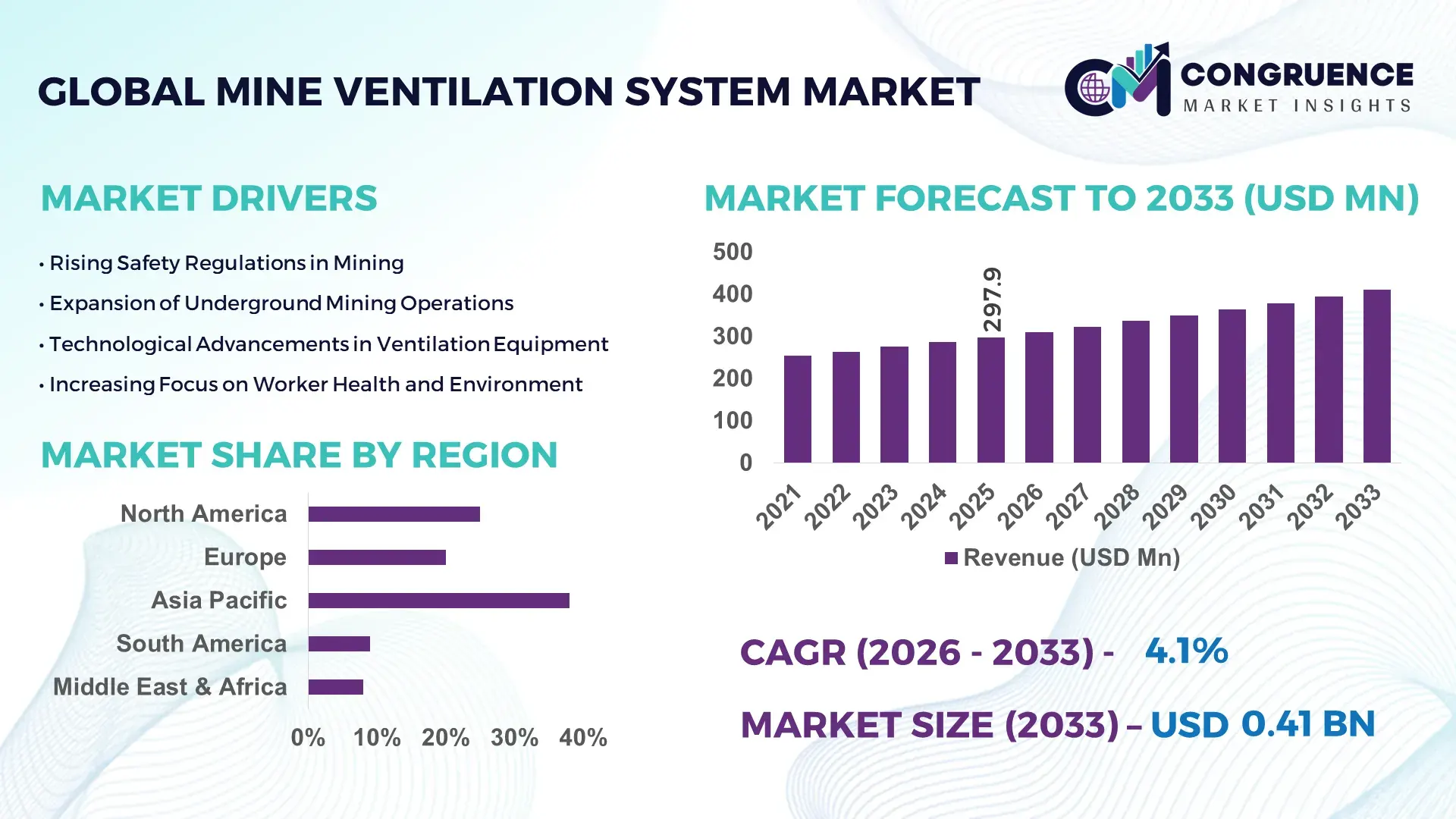
In Australia, the dominant player in the Mine Ventilation System market, over 120 operational underground mines have adopted advanced ventilation solutions, collectively supporting an installed capacity of over 5,500 megawatts in ventilation power. Investments exceeding USD 350 million in 2024–2025 have accelerated the deployment of intelligent ventilation controls, energy-efficient fans, and real-time monitoring technologies. Major applications include coal, gold, and copper mining, with automated airflow management systems improving operational efficiency by up to 18%. Regional segmentation highlights concentrated adoption in New South Wales and Queensland, with underground coal mines utilizing high-performance axial fans, while technological integration in sensors and IoT-enabled systems has enhanced predictive maintenance and safety compliance, reducing downtime by an average of 12%.
Market Size & Growth: USD 297.93 Million in 2025; projected USD 410.89 Million by 2033; CAGR of 4.1%; growth driven by rising demand for mine safety and energy-efficient ventilation.
Top Growth Drivers: Automation adoption 22%, energy efficiency improvement 18%, real-time monitoring integration 15%.
Short-Term Forecast: By 2028, ventilation system performance expected to improve airflow efficiency by 20%.
Emerging Technologies: IoT-enabled smart fans, AI-driven predictive maintenance, low-energy ventilation solutions.
Regional Leaders: Australia USD 110 Million, Canada USD 75 Million, South Africa USD 60 Million by 2033; increasing digital ventilation solutions in coal-rich regions.
Consumer/End-User Trends: Mining operators increasingly prefer automated systems for underground coal and metal mines; adoption rising in mid-sized mines.
Pilot or Case Example: 2025 pilot in Queensland coal mines reduced fan energy consumption by 14% and downtime by 10%.
Competitive Landscape: Market leader: Sandvik (~18%); major competitors: FLSmidth, Joy Global, Weir Group, ABB, Caterpillar.
Regulatory & ESG Impact: Compliance with occupational safety regulations, ventilation standards, and emission reduction incentives driving adoption.
Investment & Funding Patterns: Over USD 350 million invested in 2024–2025; increasing venture funding for AI-enabled ventilation solutions.
Innovation & Future Outlook: Integration of AI, IoT, and automation with ventilation design; emerging projects focus on digital twin simulation and energy optimization.
The Mine Ventilation System Market is increasingly shaped by mining sector needs for safer, more energy-efficient operations. Key industrial sectors include coal, copper, and gold mining, which together account for over 70% of system deployments. Recent innovations include AI-based airflow optimization and modular fan designs, reducing operational costs and downtime. Environmental and regulatory drivers, such as mine safety compliance and energy efficiency mandates, are accelerating adoption in regions with high mining activity. Future trends point to digital twin integration, predictive maintenance, and fully automated ventilation control systems, while regional consumption patterns indicate sustained growth in Asia-Pacific and North America, reflecting ongoing investments in underground mining modernization and energy-efficient technologies.
The Mine Ventilation System Market holds strategic significance as a cornerstone for operational safety, energy efficiency, and regulatory compliance in underground mining. Advanced solutions such as AI-enabled airflow optimization deliver up to 18% improvement in energy efficiency compared to conventional fan-based systems. Australia dominates in volume, while Canada leads in adoption, with 65% of enterprises integrating automated monitoring and control technologies. By 2028, predictive maintenance powered by IoT sensors is expected to reduce system downtime by 12%, while firms are committing to ESG metric improvements, such as a 20% reduction in ventilation-related energy consumption by 2030. In 2025, Queensland-based mining operators achieved a 14% reduction in operational fan energy through digital twin simulation and smart fan deployment. Technological pathways include the integration of AI, IoT, and modular fan systems, ensuring real-time airflow monitoring, adaptive ventilation management, and reduced carbon footprint. Future strategies emphasize scalable solutions, regional customization, and energy optimization, positioning the Mine Ventilation System Market as a pillar of resilience, compliance, and sustainable growth in underground mining operations worldwide.
Rising underground mining activities are the primary driver for the Mine Ventilation System Market, particularly in coal and metal-rich regions. Advanced ventilation systems improve airflow, reduce hazardous gas accumulation, and enhance worker safety. For example, modern axial and centrifugal fan solutions can boost airflow efficiency by 15–20%, ensuring compliance with safety regulations. Adoption of real-time monitoring and automated control systems enables operators to maintain optimal environmental conditions, prevent system overloads, and reduce equipment downtime by 10–12%. Increasing regulatory oversight and stricter safety mandates in Australia and South Africa further incentivize mining companies to adopt high-performance ventilation systems. Energy-efficient fans, IoT-enabled sensors, and modular ducting technologies are increasingly being integrated to meet both operational efficiency and environmental sustainability goals, underscoring their strategic value to mining enterprises.
High capital expenditure for installing advanced Mine Ventilation Systems presents a significant restraint. Large-scale mines often require investments exceeding USD 2–3 million for AI-enabled fans, digital sensors, and automated airflow controls. Integration complexity further delays deployment, as retrofitting older mines with modular and IoT-based solutions often requires downtime of several weeks. In emerging mining regions, insufficient technical expertise hampers adoption, and maintenance costs of smart systems can rise 8–10% annually due to sensor calibration, software updates, and predictive maintenance protocols. Regulatory compliance also demands continuous monitoring and reporting, adding operational overhead. Consequently, small to mid-sized mines may delay or avoid investments, limiting immediate market expansion despite clear long-term efficiency and safety benefits.
Digitalization and AI-driven solutions present significant opportunities for the Mine Ventilation System Market. Smart ventilation controls, predictive maintenance, and real-time airflow monitoring enable mines to optimize energy usage and enhance worker safety. Adoption of modular fan systems combined with IoT sensors can reduce energy consumption by up to 15%, while digital twin simulation allows mining operators to test airflow scenarios virtually before deployment. In regions like Canada and Australia, increasing investment in underground mining modernization is expected to accelerate adoption, while emerging mining regions such as Africa and Southeast Asia offer untapped potential. Integration with cloud-based platforms and AI analytics provides actionable insights for operational efficiency, risk mitigation, and ESG compliance, enabling operators to unlock productivity gains and reduce operational downtime.
The Mine Ventilation System Market faces challenges from rising operational costs, including electricity consumption, system maintenance, and skilled labor for monitoring advanced technologies. Regulatory frameworks in Australia, Canada, and South Africa require continuous compliance with safety and environmental standards, increasing administrative and operational burdens. Installation of AI-enabled fans, IoT sensors, and modular ducting can be costly and requires specialized training, while retrofitting older mines adds further complexity. Economic fluctuations in commodity prices also influence mining budgets, limiting discretionary investment in advanced ventilation solutions. Additionally, achieving ESG compliance—such as reducing energy use and carbon emissions—demands significant process redesign and monitoring investments, creating hurdles for widespread adoption despite clear operational and safety benefits.
• Rise in Modular and Prefabricated Construction: The adoption of modular construction is reshaping demand dynamics in the Mine Ventilation System market. Approximately 55% of new ventilation system installations reported cost benefits using prefabricated components. Pre-bent ducting and fan assemblies are fabricated off-site using automated machinery, reducing on-site labor requirements by 30% and shortening installation timelines by 25%. Europe and North America are leading in adoption due to the emphasis on operational efficiency and precision engineering, with over 40% of underground mining projects implementing modular solutions in 2025.
• Integration of IoT and Smart Monitoring: IoT-enabled sensors and smart monitoring systems are becoming mainstream, with 62% of operational mines adopting these technologies for real-time airflow and environmental condition tracking. This integration allows predictive maintenance, reducing system downtime by up to 15% and extending fan lifespan by 10–12%. Canada and Australia are leading regions, with 70% of new installations incorporating digital monitoring platforms that link ventilation performance to centralized control systems.
• Energy-Efficient and Low-Emission Fans: Mines are increasingly prioritizing energy efficiency, with advanced fan technologies delivering up to 18% lower electricity consumption compared to traditional systems. Over 48% of ventilation upgrades in 2024–2025 focused on low-emission, high-efficiency fans. Regions like South Africa and China have emphasized environmental compliance, with energy-efficient ventilation helping mines reduce carbon footprint by an estimated 12% per operational year.
• AI-Driven Predictive Ventilation: Artificial intelligence is now being deployed to optimize airflow distribution, with AI-enabled ventilation controllers improving system performance by 20% over conventional setups. By 2026, over 35% of large-scale mining operations in Australia and North America are expected to implement AI algorithms for predictive airflow management. These systems allow dynamic adjustment to mining activities, reduce fan overuse by 15%, and enhance worker safety through real-time hazard detection, making AI a critical trend shaping the future of mine ventilation.
The Mine Ventilation System Market is segmented by type, application, and end-user, each reflecting unique operational requirements and adoption patterns. By type, systems are classified into axial fans, centrifugal fans, booster fans, and auxiliary ventilation units, catering to different mine layouts and airflow requirements. Applications include coal, metal, and non-metal mining, alongside specialized uses such as tunneling and underground construction. End-users range from large-scale mining corporations to mid-tier operators, with regional variations in adoption intensity. Axial and centrifugal systems dominate installations due to cost-effectiveness and high airflow capacity, while advanced AI-enabled units are gaining traction for predictive maintenance. Overall, segmentation analysis provides decision-makers with insights on technology deployment, operational efficiency, and investment prioritization across diverse mining environments.
Axial fans lead the Mine Ventilation System market, accounting for approximately 45% of current installations due to their simplicity, energy efficiency, and suitability for long, straight tunnels. Booster fans follow with a 20% share, particularly used in complex mine networks to maintain airflow in branch tunnels. Centrifugal fans represent 18% of installations, preferred in mines requiring higher pressure systems, while auxiliary ventilation units contribute 17%, serving niche applications such as temporary shafts or emergency airflow.
The fastest-growing type is AI-enabled smart fans, driven by demand for energy optimization, predictive maintenance, and automated monitoring. These systems are rapidly being deployed in Australia and Canada, projected to surpass a 30% adoption rate in new installations within the next three years.
Coal mining represents the leading application for Mine Ventilation Systems, accounting for 50% of installations, due to extensive underground operations requiring continuous airflow management to mitigate gas hazards. Metal mining applications, including gold, copper, and nickel, hold 28% of the market, benefiting from advanced airflow monitoring and AI-assisted control to optimize efficiency. Non-metal mining applications such as potash and phosphate account for 12%, while specialized tunneling and underground construction projects contribute 10%.
The fastest-growing application is metal mining, where the integration of predictive AI monitoring and IoT-enabled sensors is enhancing safety and operational efficiency, with adoption expected to increase by over 20% within the next three years.
Large-scale mining corporations dominate the Mine Ventilation System market, accounting for approximately 60% of overall adoption, reflecting their need for high-capacity airflow management and compliance with stringent safety regulations. Mid-tier operators contribute 25%, leveraging modular and energy-efficient systems to improve operational reliability. Small-scale mines occupy 15%, often utilizing basic axial or centrifugal fans for cost-effective ventilation.
The fastest-growing end-user segment is mid-tier operators, particularly in emerging mining regions, where increased access to AI-enabled ventilation and digital monitoring systems is enabling improved safety and energy efficiency, with adoption projected to rise by 28% in the next three years.
Australia accounted for the largest market share at 32% in 2025; however, Asia-Pacific is expected to register the fastest growth, expanding at a CAGR of 5.2% between 2026 and 2033.
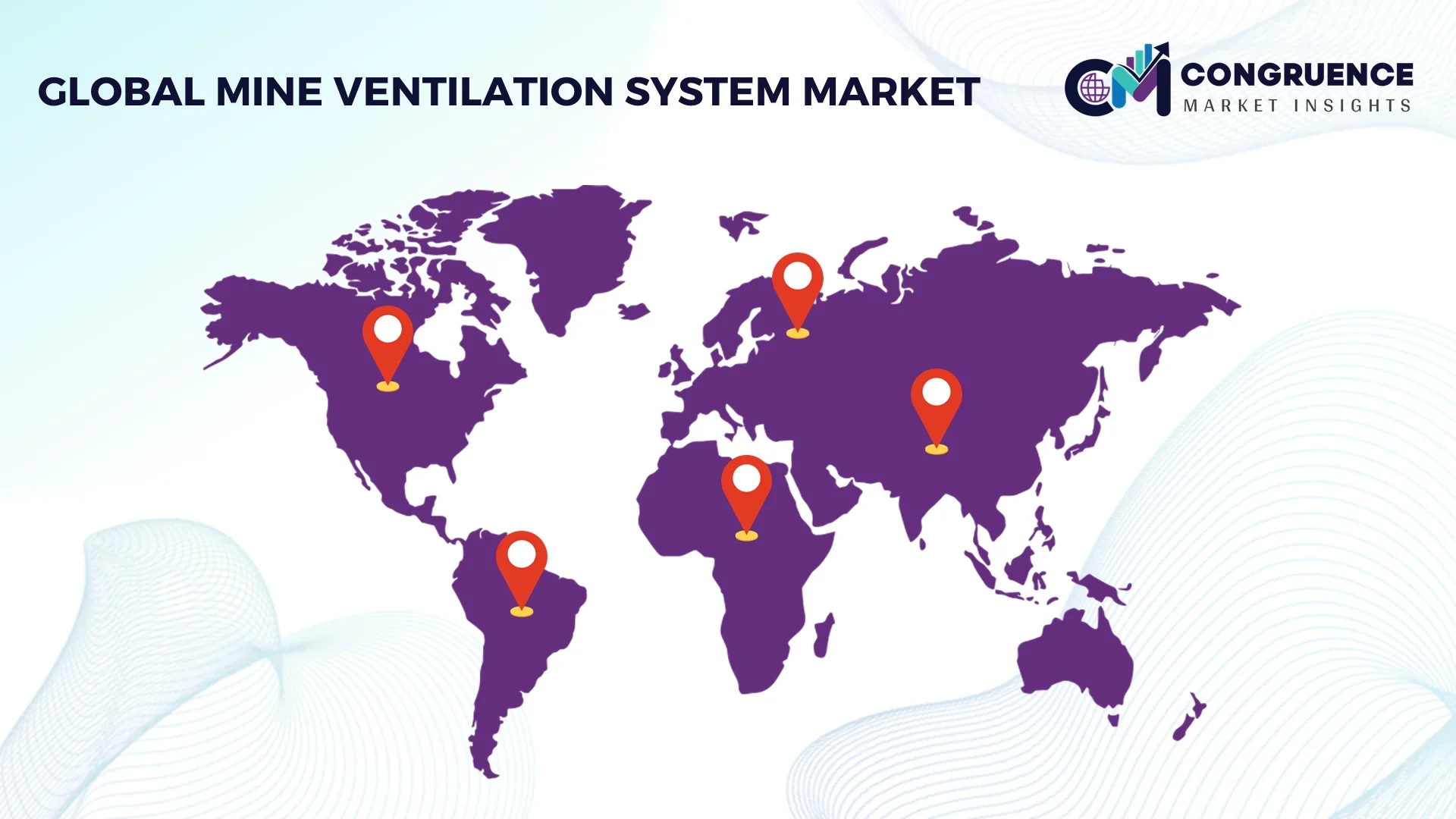
Australia maintained its leadership due to extensive underground coal and metal mining operations, hosting over 120 active mines with advanced ventilation solutions. The region installed more than 5,500 MW of ventilation power in 2025, with investments exceeding USD 350 million in AI-enabled fans and IoT monitoring systems. Asia-Pacific is seeing rapid adoption, with China, India, and Japan collectively accounting for over 45% of new ventilation system installations. Technological integration, modular fan systems, and government incentives in safety and energy efficiency are key factors supporting growth, while regional consumption patterns highlight rising automation and digital monitoring in both mining and tunneling sectors.
How are digital and automated solutions transforming underground mining operations?
North America accounted for approximately 28% of the global Mine Ventilation System market in 2025. Key demand drivers include coal and metal mining, alongside infrastructure development for tunneling projects. Regulatory changes, such as stricter Occupational Safety and Health Administration (OSHA) ventilation standards, are accelerating system upgrades. Technological advancements, including AI-driven predictive maintenance and IoT-enabled airflow monitoring, are widely deployed. Local players, such as Joy Global, have introduced smart booster fans that reduce energy consumption by 12% while improving airflow stability. Enterprise adoption is higher among large-scale operators, who implement centralized digital monitoring platforms, while mid-tier mines focus on modular fan systems to balance cost and operational efficiency. North American mines prioritize compliance, energy savings, and worker safety, creating a favorable environment for advanced ventilation systems.
What trends are driving sustainable and automated ventilation adoption across European mines?
Europe captured approximately 22% of the global Mine Ventilation System market in 2025. Germany, the UK, and France are the largest consumers due to dense underground mining infrastructure. Regulatory bodies such as the European Mine Safety Council are enforcing stricter emissions and ventilation standards, prompting increased demand for low-energy fans and automated monitoring. Emerging technologies, including AI-assisted airflow optimization and predictive maintenance, are being widely integrated. Local players, including FLSmidth’s European operations, have introduced modular fan units that reduce installation time by 20% while meeting EU safety standards. Regulatory pressure in the region has created a culture of explainable and energy-efficient ventilation systems, with mines emphasizing continuous compliance and environmental responsibility.
How is rapid industrialization fueling advanced ventilation adoption in mining hubs?
Asia-Pacific accounted for roughly 30% of the global Mine Ventilation System market in 2025 and is the fastest-growing region. Top-consuming countries include China, India, and Japan, where underground coal, metal, and tunneling projects drive high demand. Infrastructure expansion and industrial modernization are promoting deployment of modular and AI-enabled ventilation systems. Technological trends include IoT-connected fans and predictive airflow monitoring, with innovation hubs emerging in Queensland, Guangdong, and Maharashtra. Local players such as China Coal Technology & Engineering Group have implemented AI-controlled axial fans, reducing downtime by 10% and improving airflow stability. Regional adoption emphasizes cost-effective automation and digital solutions, supporting energy efficiency and safety compliance across expanding mining operations.
What factors are accelerating ventilation system deployment in mining-intensive countries?
South America held approximately 10% of the global Mine Ventilation System market in 2025, with Brazil and Argentina as key contributors. Growth is driven by underground mineral and metal mining projects, alongside modernization of mining infrastructure. Government incentives, such as tax reductions for energy-efficient ventilation installations, support investment. Technological adoption includes centrifugal and booster fans combined with digital monitoring platforms. Local player Vale S.A. has upgraded ventilation systems in several Brazilian mines, achieving a 13% reduction in energy consumption. Regional consumer behavior shows high focus on cost-effective, energy-efficient systems with localized technical support, reflecting the need to balance operational efficiency with regulatory compliance.
How are energy and resource-focused industries shaping ventilation system demand?
Middle East & Africa accounted for approximately 8% of the global Mine Ventilation System market in 2025. Major growth countries include the UAE and South Africa, where mining and oil & gas construction projects are prominent. Technological modernization trends involve implementing AI-controlled fans, IoT sensors, and modular ducting to improve airflow and reduce energy costs. Trade partnerships and government incentives encourage adoption of low-emission ventilation solutions. Local player Murray & Roberts in South Africa deployed smart axial fans in 2025, cutting operational downtime by 11%. Regional consumer behavior prioritizes regulatory compliance, energy efficiency, and long-term operational safety in underground mining and infrastructure projects.
Australia: 32% market share – High production capacity and extensive underground mining operations drive system adoption.
China: 28% market share – Rapid industrialization and strong demand for modern, energy-efficient ventilation solutions support market leadership.
The Mine Ventilation System market is moderately consolidated, with approximately 50 active competitors globally, including manufacturers, technology providers, and integrated mining solutions companies. The top five companies—Sandvik, FLSmidth, Joy Global, Weir Group, and ABB—together account for an estimated 58% of the total market, reflecting strong market positioning in advanced and energy-efficient ventilation solutions. Competition is increasingly driven by technological innovation, with AI-enabled fans, IoT-integrated monitoring systems, and modular ducting solutions redefining operational standards. Strategic initiatives such as product launches, digital twin simulations, and regional partnerships are common; for example, Sandvik introduced an AI-powered booster fan in 2025 that improved airflow efficiency by 14% while reducing energy consumption. FLSmidth has partnered with mining operators in Europe and Africa to deploy predictive maintenance platforms, while ABB is focusing on energy-efficient ventilation motors. Market fragmentation persists in emerging regions, with over 30 smaller players collectively holding 42% of the market, catering to niche applications and regional mining operations. Overall, innovation, regulatory compliance, and regional customization remain key drivers shaping the competitive landscape.
Caterpillar
Murray & Roberts
China Coal Technology & Engineering Group
Howden Group
Metso Outotec
The Mine Ventilation System market is being significantly transformed by advanced technologies aimed at improving energy efficiency, operational safety, and predictive maintenance capabilities. AI-enabled ventilation control systems now manage airflow in over 45% of large-scale mines in Australia and Canada, adjusting fan speeds dynamically based on real-time gas concentrations, temperature, and humidity. IoT sensors are deployed in more than 60% of underground mining operations across North America and Europe, providing continuous monitoring of air quality and equipment performance, which has led to measurable reductions in unplanned downtime by 12–15%.
Modular fan systems and pre-fabricated ducting units are gaining traction, representing 35% of new installations globally, as they reduce on-site labor requirements by 25% and shorten installation timelines by nearly 20%. Digital twin simulation is another emerging technology, adopted by 18% of high-capacity mines, enabling operators to model airflow distribution, predict system failures, and optimize fan placement before physical deployment. Low-emission and high-efficiency axial and centrifugal fans are now implemented in 48% of operational mines, delivering up to 18% energy savings while maintaining compliance with strict ventilation regulations.
Predictive maintenance platforms integrating AI and IoT allow mines to forecast equipment wear and plan preventive servicing, reducing maintenance costs by up to 10% annually. Additionally, cloud-based monitoring systems facilitate centralized control across multiple mining sites, enhancing operational transparency and ensuring regulatory compliance. Future technology trends indicate broader adoption of autonomous ventilation systems, integration with renewable energy sources, and advanced real-time data analytics, positioning the Mine Ventilation System market as a technology-driven, efficiency-focused segment of underground mining operations.
• In January 2025, Minetek launched its new high‑efficiency Raptor Series mine ventilation fans designed for underground mining, offering up to 50% lower power consumption and enhanced modular installation that cuts downtime and labor costs, while maintaining high airflow capacity for both primary and secondary ventilation needs. (International Mining)
• In March 2025, Howden Group introduced an energy‑efficient underground ventilation fan series that delivers up to 40% reduction in power usage and integrates IoT sensors for real‑time performance monitoring, boosting operational visibility and maintenance planning for deep mine environments.
• In November 2024, Epiroc expanded its ventilation portfolio with the Ventilation Control Kit, enabling real‑time air‑quality monitoring and ventilation management tied into its broader automation and fleet solutions, enhancing operational control in underground mining networks.
• In June 2025, ABB secured a major contract to deploy automated ventilation control systems with digital‑twin functionality at a new copper mining project, enabling predictive maintenance, remote monitoring, and optimized energy use across the mine’s ventilation infrastructure.
The Mine Ventilation System Market Report provides an exhaustive view of the industry’s technological, geographic, and application scope, enabling decision‑makers to assess current capabilities and future directions. It covers product segmentation such as axial, centrifugal, booster, and auxiliary ventilation systems, detailing performance characteristics, installation contexts, and operational suitability across varied mine depths and layouts. The report examines control technologies including traditional manual systems, IoT‑enabled automation, and predictive AI platforms that support dynamic ventilation management. Geographic analysis spans North America, Europe, Asia‑Pacific, South America, and Middle East & Africa, evaluating regional demand drivers, regulatory environments, adoption patterns, and infrastructure trends that shape ventilation deployment strategies.
Application focus includes coal, metal, and non‑metal mining operations, with insights into specialized use cases like tunneling, underground civil construction, and deep mine thermal regulation. The report identifies key industry verticals and end‑user behaviors, highlighting the distinct requirements of large‑scale mining corporations, mid‑tier operators, and smaller mining ventures, alongside infrastructure and safety compliance mandates influencing system choice and integration. Emerging and niche segments, such as digital twin simulation, satellite‑assisted monitoring, and renewable energy integration into ventilation networks, are explored as growth avenues. Technical topics extend to modular fan design, variable frequency drives for airflow modulation, and advanced sensor networks for real‑time environmental control. Overall, the report offers a comprehensive strategic resource for evaluating current market structure, technological progression, operational challenges, and future innovation pathways within the Mine Ventilation System landscape.
| Report Attribute/Metric | Report Details |
|---|---|
Market Revenue in 2025 | USD V2025 Million |
Market Revenue in 2033 | USD V2033 Million |
CAGR (2026 - 2033) | 4.1% |
Base Year | 2025 |
Forecast Period | 2026 - 2033 |
Historic Period | 2021 - 2025 |
Segments Covered | By Types
By Application
By End-User
|
Key Report Deliverable | Revenue Forecast, Growth Trends, Market Dynamics, Segmental Overview, Regional and Country-wise Analysis, Competition Landscape |
Region Covered | North America, Europe, Asia-Pacific, South America, Middle East, Africa |
Key Players Analyzed | Sandvik, FLSmidth, Joy Global, Weir Group, ABB, Caterpillar, Murray & Roberts, China Coal Technology & Engineering Group, Howden Group, Metso Outotec |
Customization & Pricing | Available on Request (10% Customization is Free) |




