
Reports
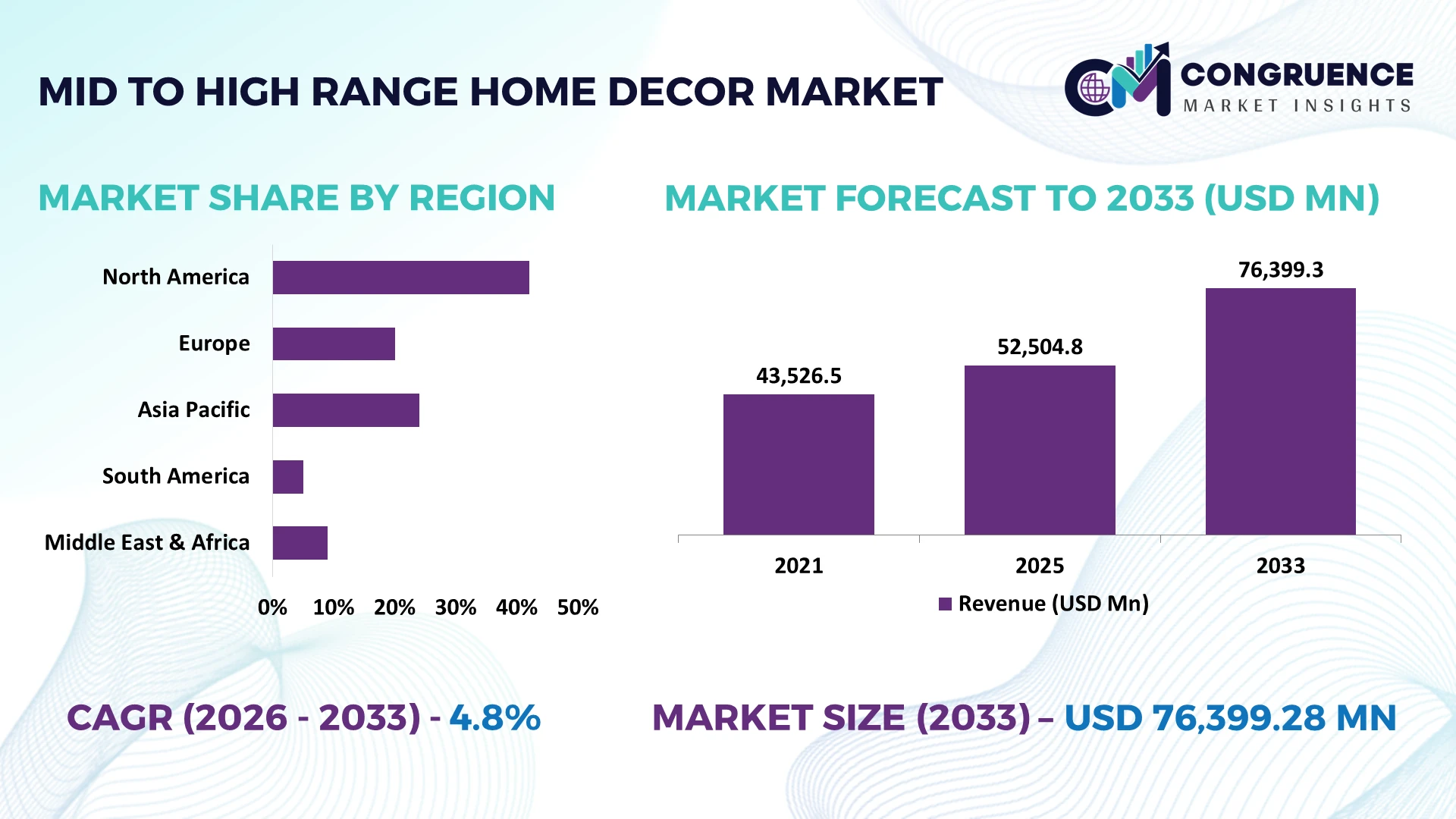
The Global Mid To High Range Home Decor Market was valued at USD 52504.8 Million in 2025 and is anticipated to reach a value of USD 76399.28 Million by 2033 expanding at a CAGR of 4.8% between 2026 and 2033. Market expansion is driven by premium residential renovations, increasing expenditure on designer furnishings, personalized interior solutions, and the integration of digital visualization technologies into furniture purchasing.
The United States represents a major demand center for premium home decor, supported by established furniture retail networks, residential renovation activity, and digital commerce infrastructure. In 2025, approximately 52% of surveyed American homeowners undertook decorating projects, while 54% completed renovations. Spending among the highest 10% of renovation projects reached at least USD 150,000, reflecting substantial purchasing capacity among affluent households. Compared with India, where premium furniture retail is expanding alongside urban residential development, the United States benefits from an established renovation and replacement market.
Manufacturers and retailers should prioritize premium product differentiation, digital customization, and efficient distribution networks to capture higher value residential renovation expenditure.
Market Size & Growth: USD 52504.8 million in 2025, reaching USD 76399.28 million by 2033 at 4.8% CAGR, supported by premium residential renovations.
Top Growth Drivers: Premium renovation expenditure increased 7% among high spending American homeowners, while kitchen and bathroom renovation spending rose 9.1% and 15.4%, respectively, in 2025.
Short Term Forecast: In 2026, 41% of surveyed American homeowners plan decorating projects, establishing a measurable demand indicator for premium furnishing suppliers.
Emerging Technologies: Three technologies are reshaping premium home decor: AI visualization, augmented reality furniture placement, and automated customization.
Regional Leaders: North America, Europe, and Asia Pacific represent three strategically important markets, supported by renovation expenditure, established design industries, and expanding premium residential construction.
Consumer Trends: Approximately 52% of surveyed American homeowners decorated their properties in 2025, supporting demand for premium interior accessories and furnishings.
Pilot and Case Example: In 2025, American homeowners increased median kitchen renovation expenditure by approximately 9.1%, demonstrating investment in residential interior upgrades.
Competitive Landscape: IKEA, Wayfair, Williams Sonoma, RH, and Ashley Furniture compete across five important dimensions, including product design, distribution, pricing, customization, and customer experience.
Regulatory and ESG Impact: Sustainable material procurement, product traceability, and environmental compliance represent three important considerations for manufacturers serving international premium furniture markets.
Investment and Funding: Premium residential renovation projects reached USD 150,000 or more among the highest spending 10% of surveyed American homeowners in 2025.
Innovation and Future Outlook: Three strategic priorities are emerging: digitally customized furnishings, sustainable premium materials, and integrated online and physical retail experiences.
The global Mid To High Range Home Decor Market encompasses premium furniture, decorative lighting, designer textiles, wall coverings, and personalized interior accessories. Residential renovations, luxury property development, and digitally assisted purchasing influence product selection across established and emerging markets. In the United States, 48% of surveyed renovating homeowners purchased lighting fixtures in 2025, illustrating the importance of decorative lighting within residential improvement expenditure. International sourcing requirements and evolving environmental standards are encouraging manufacturers to strengthen material traceability, diversify suppliers, and develop differentiated collections, establishing important priorities for future competitive positioning.
The Mid To High Range Home Decor Market is becoming strategically important as premium residential renovations, digital retail transformation, and personalized interior design reshape competitive positioning. In the United States, 54% of surveyed homeowners completed renovation projects in 2025, demonstrating substantial demand for differentiated furnishings and decorative products. Manufacturers are restructuring procurement networks to improve delivery reliability, while retailers are integrating physical showrooms with digital product visualization. This transition increasingly rewards companies that combine design exclusivity with inventory efficiency and dependable fulfillment.
Artificial intelligence, augmented reality, and automated manufacturing are transforming product development and customer engagement. Compared with traditional showroom purchasing, digital visualization reduces dependence on physical product displays and improves customization capabilities, although marketwide efficiency improvements remain unverified. North America benefits from established renovation activity and premium retail infrastructure, while India offers expanding opportunities through urban residential development. European manufacturers emphasize design heritage, material certification, and specialized craftsmanship, supporting differentiated positioning across international distribution networks.
During 2026 to 2028, manufacturers are expected to prioritize digital merchandising, modular furniture systems, and geographically diversified sourcing. Retailers implementing virtual room visualization alongside physical showrooms can streamline product selection and reduce unsuitable purchases. Strategic partnerships between furniture manufacturers, interior designers, and technology providers will strengthen customization capabilities. Companies combining efficient fulfillment, distinctive product development, and transparent material sourcing will establish stronger competitive positioning.
Premium residential renovation activity is strengthening demand for designer furniture, decorative lighting, customized textiles, and coordinated interior collections. In the United States, approximately 54% of surveyed homeowners completed renovation projects during 2025, while 52% undertook decorating activities. Furthermore, the highest spending 10% of renovation projects involved expenditures of at least USD 150,000, demonstrating substantial purchasing capacity among affluent households. Growing integration of digital interior design platforms enables consumers to evaluate furniture dimensions, material finishes, and room configurations before purchasing. Manufacturers are responding through customizable product portfolios, partnerships with interior designers, and expanded premium retail distribution. Coordinating furniture, lighting, and decorative accessories creates additional opportunities to increase transaction value.
Premium home decor manufacturers face structural pressure from fluctuating timber prices, specialized upholstery materials, international freight costs, and dependence on imported decorative components. The United States maintains substantial furniture sourcing relationships with China and Vietnam, exposing retailers to tariff adjustments and international shipping disruptions. Products incorporating solid hardwood, natural stone, and specialized metal finishes face additional procurement complexity because material specifications restrict supplier substitution. Even a hypothetical 10% increase in imported component costs can materially affect product margins when retailers cannot immediately adjust selling prices. Manufacturers are diversifying procurement across Vietnam, India, and domestic suppliers while negotiating longer procurement contracts. Maintaining alternative material specifications without compromising premium positioning is becoming an important operational requirement.
Digital customization, advanced visualization, and modular product engineering are creating opportunities for premium home decor manufacturers to reach underserved consumer segments. India presents expansion potential through premium residential developments in Mumbai, Bengaluru, and Hyderabad, where developers increasingly incorporate coordinated interior design services. Artificial intelligence enables personalized product recommendations, while augmented reality supports furniture placement and material visualization before purchasing. A targeted 10% reduction in unsuitable purchases would improve fulfillment efficiency, although actual savings depend on implementation and customer behavior. Manufacturers are developing configurable furniture collections, expanding digital showrooms, and establishing partnerships with property developers and interior design platforms. Integrating customization with localized manufacturing provides an opportunity to shorten delivery schedules while maintaining differentiated product offerings.
Maintaining consistent customer experiences across digital platforms, physical showrooms, manufacturing facilities, and international distribution networks presents a significant execution challenge. Premium furniture retailers must coordinate thousands of product configurations, material combinations, and delivery requirements without compromising quality or customization accuracy. European sustainability regulations are increasing expectations surrounding material traceability, product documentation, and responsible timber sourcing. A hypothetical 5% order configuration error rate across 10,000 customized orders would generate 500 potentially costly service exceptions. Manufacturers must invest in integrated product information systems, supplier verification, workforce training, and standardized quality assurance procedures. Establishing reliable digital traceability and consistent production specifications will be essential for scalable international expansion and long-term brand credibility.
Expansion of Sustainable Material Certification: Premium home decor manufacturers are strengthening material traceability as European sustainability requirements influence furniture procurement. FSC certified timber, recycled metals, and responsibly sourced textiles are becoming important purchasing considerations. Suppliers are increasingly tracking material origin, production batches, and environmental documentation. The European Union's deforestation regulation is accelerating supply chain documentation requirements. Manufacturers are investing in certified sourcing partnerships and digital compliance systems to improve export readiness and reduce procurement disruptions.
Restructuring of Global Furniture Supply Chains: International furniture manufacturers are diversifying production beyond China to reduce sourcing concentration and tariff exposure. Vietnam and India are attracting greater attention as alternative manufacturing locations. Companies are evaluating supplier networks using three operational criteria: manufacturing capacity, delivery reliability, and material availability. This restructuring is encouraging investment in regional warehousing, supplier qualification, and inventory visibility systems, improving purchasing flexibility for premium furniture retailers.
Integration of Advanced Decorative Lighting: Premium lighting manufacturers are expanding connected lighting collections featuring adjustable color temperatures, automated dimming, and integrated control systems. LED technology provides approximately 75% lower energy consumption than conventional incandescent lighting and significantly longer operating lifespans. Manufacturers are integrating lighting controls with residential automation platforms while developing architectural fixtures that combine decorative aesthetics with functional illumination. Retailers benefit from differentiated product collections and additional installation services.
Growth of Curated Product Collections: Premium retailers are replacing isolated product merchandising with coordinated furniture, textile, lighting, and decorative accessory collections. This approach enables customers to evaluate complete interior environments rather than individual products. Retailers are reorganizing showrooms around residential design themes and integrating digital catalogs with physical displays. Coordinated merchandising improves product compatibility, supports complementary purchases, and simplifies purchasing decisions. Manufacturers are responding through collaborative product development and integrated collection launches.
Furniture represents the leading segment of the Mid To High Range Home Decor Market, supported by substantial household expenditure on sofas, dining furniture, storage systems, and designer seating. Its dominance reflects relatively high transaction values, extensive customization requirements, and established distribution infrastructure. Premium furniture manufacturers emphasize solid hardwood construction, modular configurations, and specialized upholstery to differentiate their collections. The segment also benefits from established manufacturing capabilities in the United States, Italy, and China. Lighting represents another important category, particularly where architectural illumination and connected residential systems influence purchasing decisions.
Lighting is positioned for faster technology driven expansion as consumers increasingly adopt connected fixtures, energy efficient LED systems, and customizable illumination. LED technology can reduce electricity consumption by approximately 75% compared with incandescent lighting, creating a measurable operational advantage. Wall Decor and Floor Decor remain important for coordinated interior aesthetics, while Textiles support seasonal collection updates and personalization. Decorative Accessories provide complementary purchasing opportunities. Manufacturers are expanding coordinated collections and developing partnerships with interior designers to improve product differentiation and distribution efficiency.
Living Rooms represent a major application segment within the Mid To High Range Home Decor Market because they accommodate multiple premium product categories, including furniture, lighting, decorative textiles, and coordinated accessories. Their importance reflects frequent household use, substantial furnishing requirements, and strong visibility within residential interior design. Premium manufacturers prioritize modular seating, architectural lighting, and coordinated decorative collections for this application. Bedrooms represent another established category, supported by upholstered furniture, premium textiles, and personalized lighting. Dining Areas maintain demand for coordinated furniture and decorative accessories, particularly among affluent households undertaking comprehensive interior renovations.
Home Offices are emerging as an important application as hybrid employment increases demand for ergonomically designed furniture and residential workspace integration. Outdoor Spaces are also attracting attention through weather resistant furnishings and coordinated exterior decoration. Manufacturers are developing multifunctional collections that accommodate changing residential layouts while maintaining premium aesthetics. Digital product configuration enables retailers to demonstrate different furniture arrangements and material combinations. This approach improves purchasing convenience and allows suppliers to address multiple residential applications through adaptable product platforms.
Homeowners represent the principal end user group within the Mid To High Range Home Decor Market because they directly influence residential renovation budgets, furnishing replacement cycles, and personalized interior purchasing decisions. Approximately 54% of surveyed American homeowners completed renovation projects in 2025, while 52% undertook decorating activities. These findings demonstrate substantial household engagement with residential improvement. Interior Designers represent an important professional purchasing channel, influencing material specifications, product selection, and coordinated furnishing projects. Manufacturers are strengthening designer partnerships through dedicated trade programs, product samples, and customization services.
Luxury Residences and Property Developers represent strategically important purchasing categories because their projects require coordinated product specifications and consistent delivery schedules. Hospitality Businesses prioritize durable decorative products, distinctive interior concepts, and standardized procurement across properties. Retail Buyers influence assortment planning and distribution accessibility. Manufacturers are developing differentiated purchasing programs, project specific collections, and professional installation partnerships to address these requirements. Expanding relationships with property developers and hospitality procurement teams also supports larger coordinated orders and improves production planning.
North America accounted for the largest estimated market share in 2025; however, Asia Pacific is expected to register the fastest growth between 2026 and 2033. Exact regional shares and growth rates require validation against consistent market segmentation data.
Premium Residential Renovation and Omnichannel Retail Expansion
North America maintains a prominent position in the Mid To High Range Home Decor Market, supported by established premium furniture retailers, residential renovation expenditure, and sophisticated distribution infrastructure. The United States represents the region's principal consumption center, with Canada contributing through residential remodeling and premium furnishing purchases. Digital merchandising, architectural lighting, and customized furniture collections are reshaping product distribution. Retailers increasingly integrate physical showrooms with digital catalogs to improve product selection and inventory coordination. Established participants, including RH and Williams Sonoma, emphasize distinctive collections, interior design services, and coordinated residential furnishing solutions. Growing attention to imported furniture procurement is encouraging suppliers to diversify manufacturing relationships and strengthen inventory visibility. Manufacturers combining product customization with reliable delivery infrastructure are positioned to address demanding premium residential purchasing requirements.
United States Market Outlook: The United States benefits from extensive furniture distribution networks, established interior design services, and substantial residential renovation activity. Approximately 52% of surveyed American homeowners undertook decorating projects during 2025. California, Texas, and Florida represent important markets for residential furnishing suppliers because of their housing activity and established retail infrastructure. Manufacturers are strengthening professional designer partnerships and expanding coordinated furniture and decorative accessory collections.
Sustainable Manufacturing and Premium Design Differentiation
Europe represents an established premium home decor market, supported by specialized furniture manufacturing, architectural design expertise, and sophisticated retail distribution. Italy and Germany contribute substantial manufacturing capabilities, while France and the United Kingdom maintain established luxury interior design and furnishing markets. European manufacturers emphasize material quality, specialized craftsmanship, and differentiated product collections. Environmental regulations are increasing attention to responsible timber procurement, product durability, and supply chain documentation. Furniture manufacturers are incorporating certified materials and strengthening relationships with specialized component suppliers. Digital product configuration is also supporting customized furniture production and improving communication between designers, manufacturers, and retailers. The European Union's evolving sustainability framework is encouraging manufacturers to strengthen product documentation and material traceability. Companies combining established design capabilities with transparent procurement systems are improving their positioning in premium international distribution channels.
Italy Market Outlook: Italy maintains an established premium furniture manufacturing ecosystem concentrated around Milan, Brianza, and other specialized industrial districts. The country's competitive advantages include advanced furniture manufacturing, designer collaborations, and established international distribution relationships. Milan's annual design exhibitions provide an important platform for introducing new furniture collections and decorative materials. Italian manufacturers increasingly combine traditional craftsmanship with automated production and digital product development to serve international premium furnishing markets.
Manufacturing Scale and Premium Residential Development
Asia Pacific combines extensive furniture manufacturing capabilities with expanding premium residential furnishing markets. China maintains substantial furniture production infrastructure, while Vietnam has strengthened its position in international furniture manufacturing and export supply chains. India represents an emerging premium consumption center, supported by urban residential development and expanding organized furniture retail. Manufacturers increasingly integrate automated woodworking equipment, digital product configuration, and advanced surface finishing technologies to improve manufacturing consistency. International furniture retailers are diversifying procurement relationships to manage tariff exposure and strengthen delivery reliability. Meanwhile, premium residential developments in major metropolitan areas are supporting demand for coordinated furniture, decorative lighting, and specialized interior accessories. Manufacturers establishing regional production partnerships and localized distribution networks can improve product availability while reducing dependence on distant manufacturing facilities.
China Market Outlook: China maintains extensive furniture manufacturing infrastructure concentrated in Guangdong, Zhejiang, and other established industrial centers. Its advantages include integrated component supply chains, advanced manufacturing equipment, and extensive export distribution networks. Chinese manufacturers are expanding automated production, digital furniture design, and specialized surface finishing capabilities. Growing emphasis on differentiated collections and premium domestic retail distribution is encouraging manufacturers to move beyond standardized export production toward customized residential furnishing solutions.
Urban Residential Modernization and Localized Furniture Production
South America's premium home decor market is supported by established furniture manufacturing capabilities in Brazil and growing demand for differentiated residential furnishings in major metropolitan areas. Brazil maintains an extensive domestic furniture manufacturing ecosystem, while Argentina and Chile contribute through specialized retail distribution and residential interior design activity. Manufacturers increasingly emphasize locally sourced timber, customized furniture, and coordinated decorative collections. Currency volatility and imported component costs influence procurement strategies, encouraging manufacturers to strengthen domestic supplier relationships. Premium retailers are expanding digital merchandising capabilities to improve product accessibility beyond established metropolitan showrooms. Brazil's established furniture manufacturing clusters provide opportunities for regional distribution and specialized product development. Companies integrating local production with premium design expertise can improve delivery flexibility while reducing exposure to international logistics disruptions.
Brazil Market Outlook: Brazil represents an important South American furniture manufacturing and consumption market, supported by established industrial clusters in Bento Gonçalves and other manufacturing centers. Domestic timber availability, specialized furniture production, and established distribution networks support its manufacturing position. Premium residential development in São Paulo and other major cities creates opportunities for customized furniture and coordinated interior decoration. Manufacturers are expanding specialized collections and strengthening relationships with interior designers and premium retail distributors.
Luxury Property Investment and Hospitality Interior Development
The Middle East and Africa market is influenced by luxury residential construction, hospitality development, and specialized interior furnishing requirements. Saudi Arabia and the United Arab Emirates represent important demand centers, supported by major property developments and established luxury retail infrastructure. Premium furnishing suppliers are targeting residential developments, luxury hospitality properties, and professionally designed interiors. Large construction projects require coordinated procurement of furniture, decorative lighting, textiles, and architectural accessories. International manufacturers are strengthening relationships with property developers, hospitality procurement specialists, and regional distributors. Saudi Arabia's Vision 2030 development initiatives are expanding the addressable project pipeline for specialized interior suppliers. However, imported product dependence and demanding project delivery schedules require reliable distribution infrastructure. Manufacturers establishing regional partnerships and project procurement capabilities can improve access to large furnishing contracts.
Saudi Arabia Market Outlook: Saudi Arabia represents an important market for premium interior furnishings because of its large residential, hospitality, and tourism development programs. NEOM, the Red Sea development, and other major projects create procurement opportunities for specialized furniture and decorative product suppliers. International manufacturers are establishing relationships with local distributors, architectural consultants, and project procurement companies. Regional warehousing and coordinated installation services are becoming important capabilities for suppliers targeting complex property developments.
The Mid To High Range Home Decor Market features competition between premium furniture specialists, established international retailers, designer furnishing brands, and digitally focused distributors. RH and Williams Sonoma emphasize premium collections and integrated design services, while IKEA and Wayfair compete through extensive distribution networks, digital merchandising, and broad product accessibility. Ashley Furniture combines manufacturing capabilities with established retail distribution. The combined market share of the five leading participants remains unverified because published company figures encompass different product categories and geographic markets. Competitive differentiation increasingly depends on customization, delivery reliability, material quality, and integrated purchasing experiences. Manufacturers are strengthening supplier partnerships, developing exclusive collections, and expanding digital visualization capabilities. Supply chain diversification and coordinated product merchandising are reshaping established retail strategies. Specialized manufacturing requirements, brand recognition, and extensive inventory investment create significant entry barriers. Sustainable competitive positioning requires differentiated design, reliable procurement, efficient fulfillment, and consistent premium customer experiences.
RH
Williams Sonoma, Inc.
IKEA
Wayfair Inc.
Ashley Furniture Industries
MillerKnoll
Ethan Allen
Natuzzi
La-Z-Boy Incorporated
Havertys
Arhaus
Roche Bobois
B&B Italia
BoConcept
Artificial intelligence, augmented reality, and digital product configuration are transforming premium home decor merchandising and manufacturing. AI recommendation engines analyze customer preferences, purchasing histories, and interior design requirements to improve product discovery. Augmented reality enables customers to visualize furniture dimensions, decorative accessories, and material finishes within residential environments. Unlike conventional catalogs, interactive visualization supports accurate spatial evaluation before purchasing. Retailers implementing these technologies should measure conversion improvements, product return reductions, and customer engagement against established operational baselines.
Automated manufacturing, computer numerical control machining, and advanced material processing are improving furniture production consistency. Modern CNC equipment enables repeatable component manufacturing, intricate decorative detailing, and efficient material utilization. Compared with manual production, automated machining reduces repetitive processing requirements, although percentage improvements depend on equipment configuration and production complexity. Connected production systems integrate design specifications with manufacturing schedules and inventory management. Manufacturers benefit from improved customization capacity, reduced production errors, and stronger coordination between design departments and manufacturing facilities.
Between 2026 and 2028, digital product passports, intelligent inventory systems, and advanced material engineering will influence competitive differentiation. Sustainable furniture manufacturing increasingly incorporates recycled polymers, certified timber, and digitally monitored material sourcing. Retailers integrating product visualization with manufacturing and fulfillment systems can strengthen order accuracy and delivery coordination. Established manufacturers benefit from existing production infrastructure, while specialized design brands gain opportunities through digitally enabled customization. Investment priorities should emphasize interoperable systems, measurable production efficiency, and transparent product documentation.
May 2024: Wayfair opened its first large format retail store in Wilmette, Illinois, spanning 150,000 square feet and featuring 19 departments. The expansion integrated physical merchandising with digital retail capabilities, strengthening customer engagement and establishing an additional distribution channel.
September 2025: RH opened its Paris Design Gallery on the Champs Élysées, marking its second bespoke international location following England. The expansion strengthened its European luxury positioning and established another destination for integrated interior design, furniture merchandising, and hospitality experiences.
February 2025: MillerKnoll introduced an expanded sustainability strategy targeting 100% renewable electricity by fiscal 2026 and increased material circularity. The initiative strengthened its environmental manufacturing framework while supporting responsible material procurement, supplier collaboration, and sustainable furniture product development.
January 2026: Ingka Group reported that IKEA's furniture Buyback service processed approximately 686,500 products during fiscal 2025, representing 39% growth. The expansion strengthened circular retail operations, extended furniture lifecycles, and demonstrated increasing adoption of organized furniture recovery services.
The Mid To High Range Home Decor Market Report provides comprehensive analysis of premium residential furnishing demand, manufacturing developments, technological innovation, and competitive positioning between 2026 and 2033. Segmentation covers six product categories: Furniture, Lighting, Wall Decor, Floor Decor, Textiles, and Decorative Accessories. Application analysis examines Living Rooms, Bedrooms, Dining Areas, Home Offices, and Outdoor Spaces. End user coverage includes Homeowners, Interior Designers, Property Developers, Hospitality Businesses, Luxury Residences, and Retail Buyers.
Regional analysis evaluates North America, Europe, Asia Pacific, South America, and the Middle East and Africa, emphasizing manufacturing infrastructure, purchasing patterns, and distribution capabilities. Technology coverage includes artificial intelligence, augmented reality, automated manufacturing, advanced materials, and digital inventory systems. The report examines competitive strategies, supply chain restructuring, sustainability requirements, and premium product differentiation to support investment planning, geographic expansion, and strategic positioning.
| Report Attribute/Metric | Report Details |
|---|---|
Market Revenue in 2025 | USD 52504.8 Million |
Market Revenue in 2033 | USD 76399.28 Million |
CAGR (2026 - 2033) | 4.8% |
Base Year | 2025 |
Forecast Period | 2026 - 2033 |
Historic Period | 2021 - 2025 |
Segments Covered | By Type
By Application
By End-User
|
Key Report Deliverable | Revenue Forecast, Growth Trends, Market Dynamics, Segmental Overview, Regional and Country-wise Analysis, Competition Landscape |
Region Covered | North America, Europe, Asia-Pacific, South America, Middle East, Africa |
Key Players Analyzed | RH, Williams Sonoma, Inc., IKEA, Wayfair Inc., Ashley Furniture Industries, MillerKnoll, Ethan Allen, Natuzzi, La-Z-Boy Incorporated, Havertys, Arhaus, Roche Bobois, B&B Italia, BoConcept |
Customization & Pricing | Available on Request (10% Customization is Free) |




