
Reports
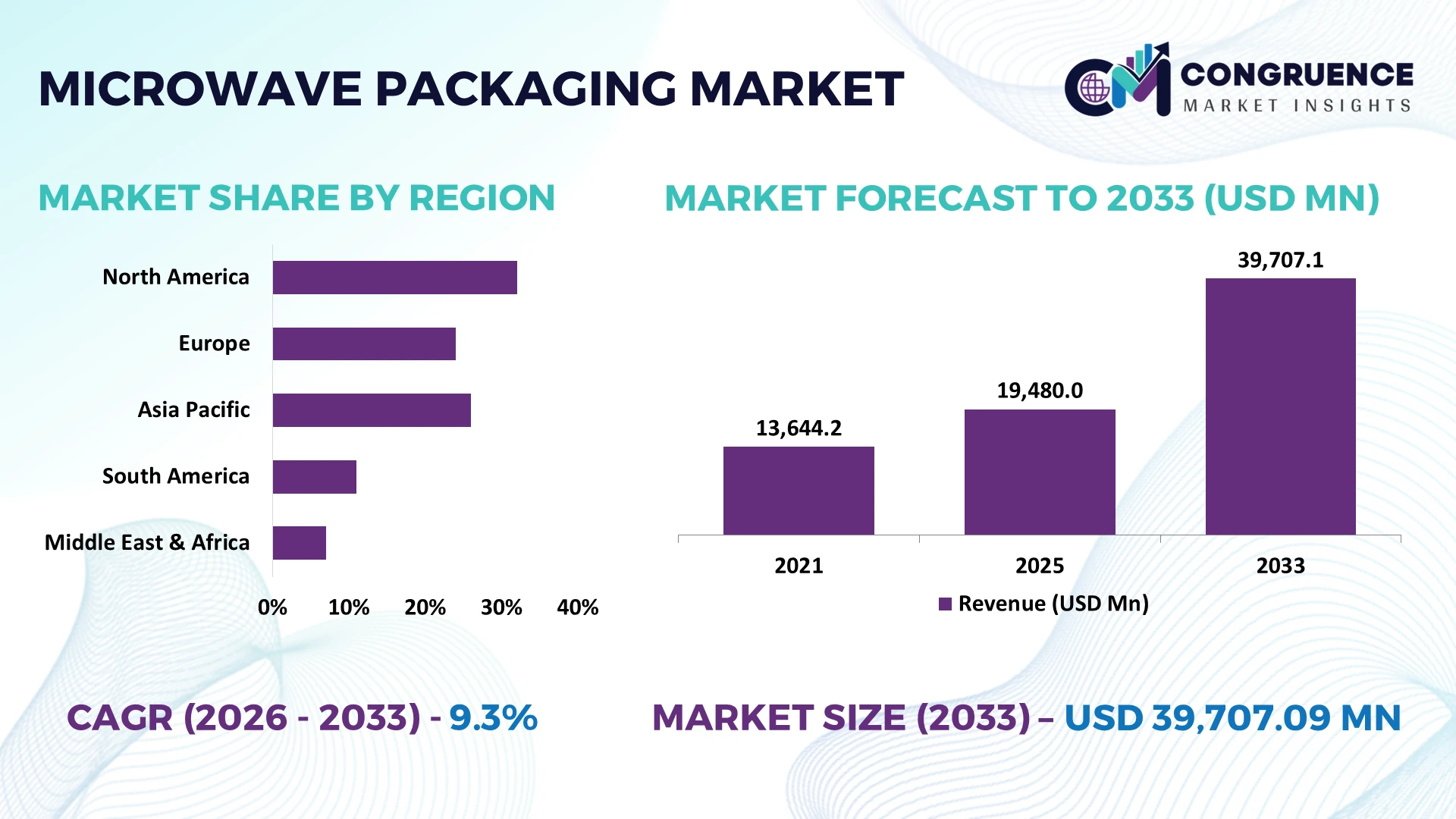
The Global Microwave Packaging Market was valued at USD 19,480.0 Million in 2025 and is anticipated to reach a value of USD 39,707.1 Million by 2033 expanding at a CAGR of 9.31% between 2026 and 2033. Growth is anchored in the rapid expansion of ready-to-eat meal formats across urban retail and food-delivery channels, where packaging must perform across freezing, transport, and high-heat reheating without compromising food safety or texture.
The United States commands approximately 28% of global value, supported by a dense frozen-food base, active food-contact documentation practices, and sustained investment in susceptor and dual-ovenable tray capacity; by contrast, Germany prioritizes mono-material recyclability and packaging-reduction objectives, creating a performance-versus-circularity trade-off that shapes supplier design choices across both markets.
This divergence means procurement teams should treat material qualification and end-of-life compliance as market-entry variables, not downstream afterthoughts.
Market Size & Growth: USD 19,480.0 Million in 2025, forecast to USD 39,707.1 Million by 2033, driven by frozen and chilled convenience food expansion across retail and delivery channels.
Top Growth Drivers: Ready-to-eat meal penetration at 34% of urban lunch occasions; frozen food retail volume up 12% in key markets; food-delivery platform order frequency rising 19% year-on-year.
Short-Term Forecast: By 2028, automated tray-sealing lines cut per-unit labor content by 14% while line throughput rises 22% across high-volume ready-meal plants.
Emerging Technologies: Biodegradable chitosan-carbon nanotube films improve microwave heating uniformity; AI-assisted seal inspection reduces leak defects; mono-material PP trays replace multi-layer laminates in European pilots.
Regional Leaders: United States at USD 5,450 Million with frozen-food dominance; China at USD 3,910 Million with delivery-driven demand; Germany at USD 2,180 Million with recyclability-first procurement.
Consumer/End-User Trends: 61% of urban households purchase microwave-ready meals at least weekly; 47% read heating instructions before purchase, elevating packaging clarity as a brand differentiator.
Pilot/Case Example: 2026 EU-funded trial replaced PFAS-coated popcorn bags with fiber-based alternatives, achieving 92% grease resistance and full compliance with new restrictions.
Competitive Landscape: Amcor, Graphic Packaging, Huhtamaki, and Sealed Air lead; top five players hold approximately 38% of global revenue, with active capacity expansion in Southeast Asia.
Regulatory & ESG Impact: EU PPWR PFAS restrictions effective August 2026 affect 100% of microwave popcorn and takeaway packaging sold in the bloc, forcing reformulation across the category.
Investment & Funding: Over USD 340 Million deployed in 2025–2026 toward recyclable mono-material microwave tray lines and fiber-based susceptor alternatives across North America and Europe.
Innovation & Future Outlook: Next-generation active packaging converts microwave energy into uniform heat via conductive layers; strategic shift moves from passive containment to thermal-performance engineering.
Demand concentrates in frozen ready meals, chilled ready-to-eat bowls, and food-delivery compatible trays, where dual-ovenable and susceptor-enhanced formats command premium pricing. Recent innovation includes chitosan-MWCNT composite films that reduce core-to-surface temperature gradients under 700W irradiation, addressing the persistent uneven-heating problem in ready-to-eat rice and protein formats. A parallel operational shift is visible in India, where the Bureau of Indian Standards is drafting microwave-use plastic container specifications that would permit recycled PET, PP, and PE subject to FSSAI oversight—opening a regulated pathway for recycled content in a high-growth market. These developments position packaging performance and compliance as inseparable procurement criteria.
Microwave packaging is shifting from a low-cost commodity layer to a performance-critical system component as food brands compete on heating consistency, clean-label material profiles, and delivery-ready durability. The EU's August 2026 PFAS restrictions on food-contact packaging removed a widely used grease-barrier chemistry from microwave popcorn and takeaway formats overnight, forcing reformulation timelines that now determine shelf availability in Europe.
Technology comparison illustrates the gap: conventional multi-layer PET/foil laminates deliver reliable barrier performance but fail mono-material recycling protocols, while emerging PP-based mono-material trays with optimized sealants achieve comparable heat resistance at roughly 18% lower material weight and full compatibility with mechanical recycling streams. Regionally, the United States prioritizes susceptor-enhanced browning and dual-ovenable convenience, while Germany and the Nordic markets lead in recyclable mono-material adoption, creating a two-track innovation landscape that rewards suppliers capable of localized formulation strategies.
Over the next 24–36 months, operational indicators will center on seal-integrity defect rates, recycled-content percentage per SKU, and line-speed compatibility of fiber-based formats. One practical deployment: a European ready-meal manufacturer replaced PFAS-coated board bowls with dispersion-coated fiber trays in Q1 2026, cutting coating-related compliance risk to zero while accepting a 6% line-speed reduction that was offset by reduced material cost. Companies are responding by shifting R&D budgets toward coating alternatives and forming supplier partnerships that lock in food-contact documentation early. The competitive advantage will belong to converters and brands that treat packaging as a validated thermal and regulatory system, not a disposable input.
Demand for microwave packaging is being structurally pulled by the ready-to-eat and frozen premium meal categories, where 34% of urban lunch occasions now involve a packaged heat-and-eat format and frozen food retail volumes have risen 12% across key Western markets. In the United States, frozen-food manufacturers are reformatting SKUs toward dual-ovenable trays that move from freezer to microwave to table without decanting, pushing converters to invest in crystallized PET and high-heat PP capacity. Companies are responding through localized tooling investments and co-development agreements with food brands, compressing the qualification cycle from 14 months to under 9 months for new tray formats. The strategic insight is clear: packaging that reduces consumer preparation steps commands a measurable price premium and locks in supplier relationships earlier in the product-development chain.
The technical requirement for heat resistance, grease barrier, and seal integrity has locked much of the category into multilayer structures that remain incompatible with standard recycling streams, and 47% of European converters report that recyclability mandates now influence material selection at the RFP stage. Aluminum foil and metallized PET layers, while effective for susceptor and barrier functions, contaminate PP and paper recycling flows and face increasing extended producer responsibility fees. In Germany, dual-system operators have begun applying higher licensing costs to multilayer microwave trays, directly eroding converter margins on high-volume ready-meal accounts. Companies are reducing exposure by qualifying mono-material PP and coated fiber alternatives, but performance trade-offs in grease resistance and shelf-life remain unresolved for high-fat and high-moisture meal formats.
India's Bureau of Indian Standards is advancing draft specifications that would permit recycled PET, PP, and PE in microwave-use food-contact containers, subject to FSSAI oversight—a regulatory opening that could unlock recycled-content adoption in one of the fastest-urbanizing convenience food markets. This creates a first-mover advantage for converters that establish food-grade recycled PP supply chains and migration-testing protocols before standards finalize. In parallel, biodegradable chitosan-MWCNT composite films demonstrated measurable heating-uniformity improvement under 700W irradiation, pointing to a premium functional-film segment for clean-label ready meals. Companies positioning through R&D partnerships with resin suppliers and early engagement with BIS consultation processes will capture specification-setting influence that persists well beyond the initial compliance window.
The EU's August 2026 restriction on PFAS in food-contact packaging removes a chemistry that has been embedded in microwave popcorn bags, takeaway containers, and bakery boards for decades, and reformulation is not a drop-in substitution. Fiber-based grease barriers typically require dispersion coating or film lamination that adds 8–12% to substrate cost and demands revalidation of heat-sealing windows, print adhesion, and migration profiles. For popcorn in particular, the bag must simultaneously contain expanding volume, channel microwave energy, and release cleanly—performance envelopes that narrow the viable substitute pool. Companies must solve this through dedicated coating-line investment and supplier qualification depth rather than relying on single-source alternatives, because a single failed migration test can halt an entire SKU line across multiple EU markets.
PFAS-Free Fiber Barriers Scale in Europe EU PPWR restrictions effective August 2026 removed PFAS chemistries from microwave popcorn and takeaway formats, pushing converters toward dispersion-coated fiber trays. Early adopters report 92% grease resistance at 8–12% higher substrate cost, with qualification cycles compressed to under 9 months. Companies are investing in dedicated coating lines rather than relying on single-source alternatives, because one failed migration test halts entire SKU lines across multiple EU markets.
Mono-Material PP Trays Replace Multilayer Laminates German and Nordic retailers now apply higher EPR fees to multilayer microwave trays, and 47% of European converters report recyclability mandates influencing material selection at RFP stage. PP-based mono-material trays with optimized sealants achieve comparable heat resistance at roughly 18% lower material weight, though grease resistance remains unresolved for high-fat formats. Converters are responding through sealant co-development partnerships with resin suppliers.
AI Seal Inspection Cuts Defect Rates High-volume ready-meal plants in the United States are deploying AI-assisted seal inspection on tray-sealing lines, reducing leak defects by measurable margins while line throughput rises 22%. The operational trigger is labor instability in secondary packaging roles, not technology novelty. Companies are retrofitting inspection modules onto existing lines rather than replacing entire sealing assets.
India Recycled-Content Standards Open New Supply Path BIS draft specifications would permit recycled PET, PP, and PE in microwave-use containers under FSSAI oversight, creating a regulated pathway in a market where 34% of urban lunch occasions involve packaged heat-and-eat formats. Converters establishing food-grade recycled PP supply chains before standards finalize will capture specification-setting influence. The non-obvious insight: compliance documentation, not resin access, becomes the binding constraint.
Trays command the leading position by type, capturing an estimated 42% of microwave packaging value on the strength of structural rigidity, dual-ovenable compatibility, and direct integration with high-speed thermoform-fill-seal lines. CPET and crystallized PET trays dominate frozen entrée and ready-meal formats where dimensional stability under 200°C-plus exposure is non-negotiable. Folding cartons hold approximately 26% share, concentrated in dry and low-moisture applications, while bags and pouches account for roughly 18%, favored for rice, vegetables, and steam-in-bag formats where flexible geometry accelerates heating uniformity.
Cups, tubs, and bowls represent the fastest-adopting format, gaining traction in single-serve ready-to-eat and food-delivery channels where portion control and branded presentation matter. Companies are responding by adding CPET tray capacity in the United States and qualifying mono-material PP tray variants for German retail accounts, shifting investment from commodity folding cartons toward performance trays and sealable bowl formats.
Frozen foods represent the leading application at approximately 38% of United States microwave packaging demand, driven by the structural requirement for packaging that survives freezer-to-microwave transitions without cracking, delaminating, or compromising seal integrity. Ready-to-eat meals follow at 33% and are the fastest-shifting application, propelled by meal-kit penetration and food-delivery platforms that demand trays capable of surviving transport vibration before reheating.
Snacks hold roughly 12%, with portion-controlled microwavable formats gaining shelf space in convenience channels. Fresh prepared foods represent an emerging use case where shelf-life constraints limit packaging to shorter distribution windows, favoring barrier trays with peelable lidding. Companies are adapting by co-locating tray converting capacity near frozen-food manufacturing clusters in the Midwest and investing in delivery-compatible bowl formats with vented lidding for urban Asian markets.
Food processors and manufacturers constitute the leading end-user group, commanding an estimated 55% of microwave packaging demand through high-volume frozen entrée, ready-meal, and snack production lines where packaging is purchased on multi-year contracts and qualified against thermal performance specifications. Retail and supermarket chains represent approximately 25%, heavily influenced by private-label ready-meal programs and store-brand frozen portfolios.
Foodservice and catering accounts for roughly 15% and is the fastest-expanding end-user channel, as airline catering, institutional meal programs, and delivery-only restaurant formats adopt microwave-safe containers that perform across centralized production and decentralized reheating. Convenience stores hold the remaining share, with single-serve bowl formats gaining traction in Japan and South Korea. Companies are targeting foodservice through customized vented-lid systems and portion-specific tray dimensions, while pursuing retail private-label accounts with recyclability documentation packages that simplify retailer compliance reporting.
North America accounted for the largest market share at 32% in 2025 however, Asia-Pacific is expected to register the fastest growth, expanding at a CAGR of 10.61% between 2026 and 2033.

North America's position rests on a deeply embedded frozen-food manufacturing base and high-volume tray-converting capacity clustered across the Midwest and Southeast. The region's 32% share reflects not just consumption scale but production concentration: CPET and high-heat PP tray lines feeding frozen entrée and ready-meal brands operate on multi-year supply contracts with national retailers. Foodservice channels are adding microwave-safe specifications at an accelerating pace, with institutional catering operators increasing packaging requirements in response to labor shortages that push reheating closer to point of service. Investment is flowing toward mono-material tray qualification and PFAS-free coating alternatives, with converters retrofitting existing thermoform lines rather than building greenfield capacity.
United States Market Outlook: The United States drives regional volume through frozen-food dominance, with frozen foods commanding 38% of domestic microwave packaging demand and ready-to-eat meals following at 33%. Dual-ovenable CPET tray adoption is expanding as meal-kit providers favor lightweight formats that withstand chilled distribution while simplifying home preparation. Converters are co-locating tray production near frozen-food manufacturing clusters to compress qualification cycles and reduce freight exposure.
Europe's 24% share is being redefined by the EU PPWR's August 2026 PFAS restrictions, which removed a grease-barrier chemistry embedded in microwave popcorn bags, takeaway containers, and bakery boards for decades. The regulatory trigger is forcing reformulation across the category, with dispersion-coated fiber trays and mono-material PP alternatives entering qualification pipelines. German and Benelux retailers apply higher extended producer responsibility fees to multilayer structures, tilting cost economics toward recyclable formats. Supermarket mandates for up to 30% post-consumer resin in private-label packaging are steering converters toward CPET-rPET blends. Companies are investing in dedicated coating lines and sealant co-development partnerships rather than relying on single-source substitutes.
Germany Market Outlook: Germany leads European reformulation through its dual-system licensing pressure on multilayer trays and retailer-driven recyclability specifications. The country's packaging-reduction objectives have accelerated qualification of mono-material PP trays and fiber-based susceptor alternatives, with converters prioritizing migration-testing depth over resin access as the binding constraint for market entry.
Asia-Pacific holds a 26% share, underpinned by China's role as both a massive consumption market and an export platform for microwave packaging formats. The region's growth trajectory is tied to organized grocery retail expansion and food-delivery platform penetration, which push single-serve bowl and tray formats into urban channels at scale. Localized manufacturing lowers transport costs and allows design tailoring to regional meal formats, from rice bowls to noodle soups. India's BIS draft standards permitting recycled PET, PP, and PE in microwave-use containers create a regulated pathway for recycled-content adoption in a market where packaged heat-and-eat formats are gaining share. Converters are expanding capacity in Southeast Asia to serve both domestic delivery demand and export orders.
China Market Outlook: China anchors regional volume through delivery-platform order frequency and a dense ready-meal manufacturing base concentrated in the Yangtze River Delta and Pearl River Delta. Domestic converters are scaling single-serve bowl formats with vented lidding engineered for transport vibration, while export-oriented capacity targets Southeast Asian and Middle Eastern ready-meal brands seeking cost-competitive dual-ovenable trays.
South America represents an 11% share, with Brazil driving regional demand through organized grocery retail expansion and frozen-food penetration in urban centers. The region's growth potential is constrained by uneven cold-chain infrastructure and limited local CPET tray converting capacity, which raises reliance on imported formats and extends lead times. Food-delivery platforms are expanding in São Paulo and Bogotá, creating demand for delivery-compatible microwave trays, but converter investment remains concentrated in flexible formats rather than rigid tray lines. Companies are entering through partnerships with regional thermoformers and targeting private-label ready-meal programs where packaging specifications can be standardized across retail chains.
Brazil Market Outlook: Brazil leads regional demand through its scale in frozen-food retail and expanding delivery-platform footprint. Local converters are adding PP tray capacity to serve private-label ready-meal programs, though imported CPET formats still dominate high-performance segments where domestic thermoforming depth remains limited.
The Middle East & Africa region holds a 7% share, with Gulf Cooperation Council markets driving demand through institutional catering, airline catering, and modern retail expansion in the UAE and Saudi Arabia. Infrastructure modernization and tourism-linked foodservice investment are creating specification demand for microwave-safe containers that perform across centralized production and decentralized reheating. South Africa contributes volume through retail frozen-food growth, while Sub-Saharan markets remain largely served by imported formats. Investment is concentrated in distribution partnerships and localized converting arrangements rather than greenfield manufacturing, reflecting the region's smaller scale and fragmented retail landscape.
Saudi Arabia Market Outlook: Saudi Arabia leads regional demand through institutional catering scale and giga-project foodservice investment, which specify microwave-safe formats for centralized meal production. Import-dependent supply chains favor converters offering documentation-ready compliance packages and distribution partnerships with local foodservice suppliers.
Amcor, Graphic Packaging, Huhtamaki, Sealed Air, and Sonoco constitute the global leadership tier, competing directly against regional thermoformers and cost-driven Asian converters. The top five hold approximately 38% combined share, leaving a fragmented field where scale economics and food-contact documentation depth separate winners from price-takers. Competition hinges on recyclability qualification (mono-material PP and fiber formats), seal-integrity performance under retort and microwave cycling, and line-speed compatibility with existing filling assets. Amcor's 2025 Cofigeo three-compartment PP tray demonstrates the partnership route to specification lock-in, while Sonoco's AFNOR-certified microwaveable metal bowls target plastic tray displacement under PPWR pressure . The competitive shift is unmistakable: material compliance has become the primary battlefield, with PFAS-free and mono-material formats determining shelf access in Europe. The pressure point is qualification depth—converters lacking migration-testing infrastructure face 9–14 month delays entering regulated accounts. Winning requires documented thermal performance, recycled-content readiness, and co-development speed, not simply low unit cost.
Amcor
Graphic Packaging International
Huhtamaki
Sealed Air
Sonoco Products
Berry Global
Coveris
Mondi Group
WestRock
Pactiv Evergreen
Greiner Packaging
Placon Corporation
Silgan Containers
Printpack
Susceptor and shielding technology remains the operational baseline, converting microwave energy into surface browning and uniform heating across CPET and PP tray formats. Current adoption is near-universal in frozen entrée and snack applications, yet performance gaps persist in high-moisture ready-meal formats where edge overheating degrades seal integrity.
Emerging mono-material PP and dispersion-coated fiber barriers deliver measurable gains: Amcor's three-compartment PP tray achieves over 12 months ambient shelf-life with full NIR-sortable recyclability, while fiber-based systems reach 80%+ recovery rates under CEPI protocols . These formats reduce material weight by roughly 18% versus multilayer laminates and eliminate PFAS chemistry from grease-barrier layers.
Disruptive microwaveable metal packaging from Sonoco targets plastic tray displacement with AFNOR-certified recyclability, leveraging established aluminum recycling streams . Between 2026 and 2028, converters integrating barrier liner and sealing equipment partnerships will compress qualification cycles below 9 months. The competitive advantage belongs to suppliers offering documented thermal performance and recyclability in a single validated system.
June 2025 – Amcor partnered with Cofigeo to launch a mono-material PP three-compartment ready-meal tray with over 12 months ambient shelf-life, NIR-sortable for French recycling, enabling specification lock-in on the William Saurin range with up to 80% consumer intent to eat directly from tray. Source: foodanddrinktechnology.com
January 2025 – Graphic Packaging commercialized its round PaperSeal Shape tray with Elaborados Naturales in Spain, containing under 10% plastic, PPWR-compliant, recyclable in household streams, and compatible with microwave, oven, and air fryer use across two SKUs. Source: worldofprint.com
May 2026 – Sonoco showcased AFNOR-certified microwaveable metal bowls at Interpack, positioning aluminum as a circular alternative to plastic ready-meal trays under PPWR pressure, leveraging established metal recycling infrastructure for regulatory-aligned convenience formats. Source: frozenfoodeurope.com
April 2026 – Amcor, Metsä Group, and G. Mondini launched the AmFiber integrated fibre-based tray system achieving over 80% fibre recovery under CEPI Ver. 3 (2025), with microwaveable and ovenable features, running live on Mondini sealing equipment at commercial speed. Source: sustainabilitymea.com
The report covers the global microwave packaging market across type (trays, folding cartons, bags and pouches, cups, tubs and bowls), application (frozen foods, ready-to-eat meals, snacks, fresh prepared foods), and end-user (food processors, retail chains, foodservice and catering, convenience stores) segments, with regional granularity across North America, Europe, Asia-Pacific, South America, and Middle East & Africa.
Quantitative coverage includes segment share distribution, adoption patterns across dual-ovenable and mono-material formats, deployment concentration by manufacturing hub, and company participation levels across the value chain. The report supports investment planning through qualification-cycle benchmarks, expansion strategy via country-level capacity and infrastructure mapping, and competitive positioning through documented supplier capabilities in recyclability and thermal performance. Strategic direction from 2026 to 2033 is framed around PFAS reformulation execution, recycled-content standardization in emerging regulatory frameworks, and the shift from passive containment to validated thermal-system engineering.
| Report Attribute / Metric | Details |
|---|---|
| Market Revenue (2025) | USD 19,480.0 Million |
| Market Revenue (2033) | USD 39,707.1 Million |
| CAGR (2026–2033) | 9.31% |
| Base Year | 2025 |
| Forecast Period | 2026–2033 |
| Historic Period | 2021–2025 |
| Segments Covered |
By Type
By Application
By End-User
|
| Key Deliverables | Revenue Forecast; Market Trends; Growth Drivers & Restraints; Technology Insights; Segmentation Analysis; Regional Insights; Competitive Landscape; Regulatory & ESG Overview; Recent Developments |
| Regions Covered | North America; Europe; Asia-Pacific; South America; Middle East & Africa |
| Companies Profiled | Amcor; Graphic Packaging International; Huhtamaki; Sealed Air; Sonoco Products; Berry Global; Coveris; Mondi Group; WestRock; Pactiv Evergreen; Greiner Packaging; Placon Corporation; Silgan Containers; Printpack |
| Customization & Pricing | Available on Request (10% Customization Free) |




