
Reports
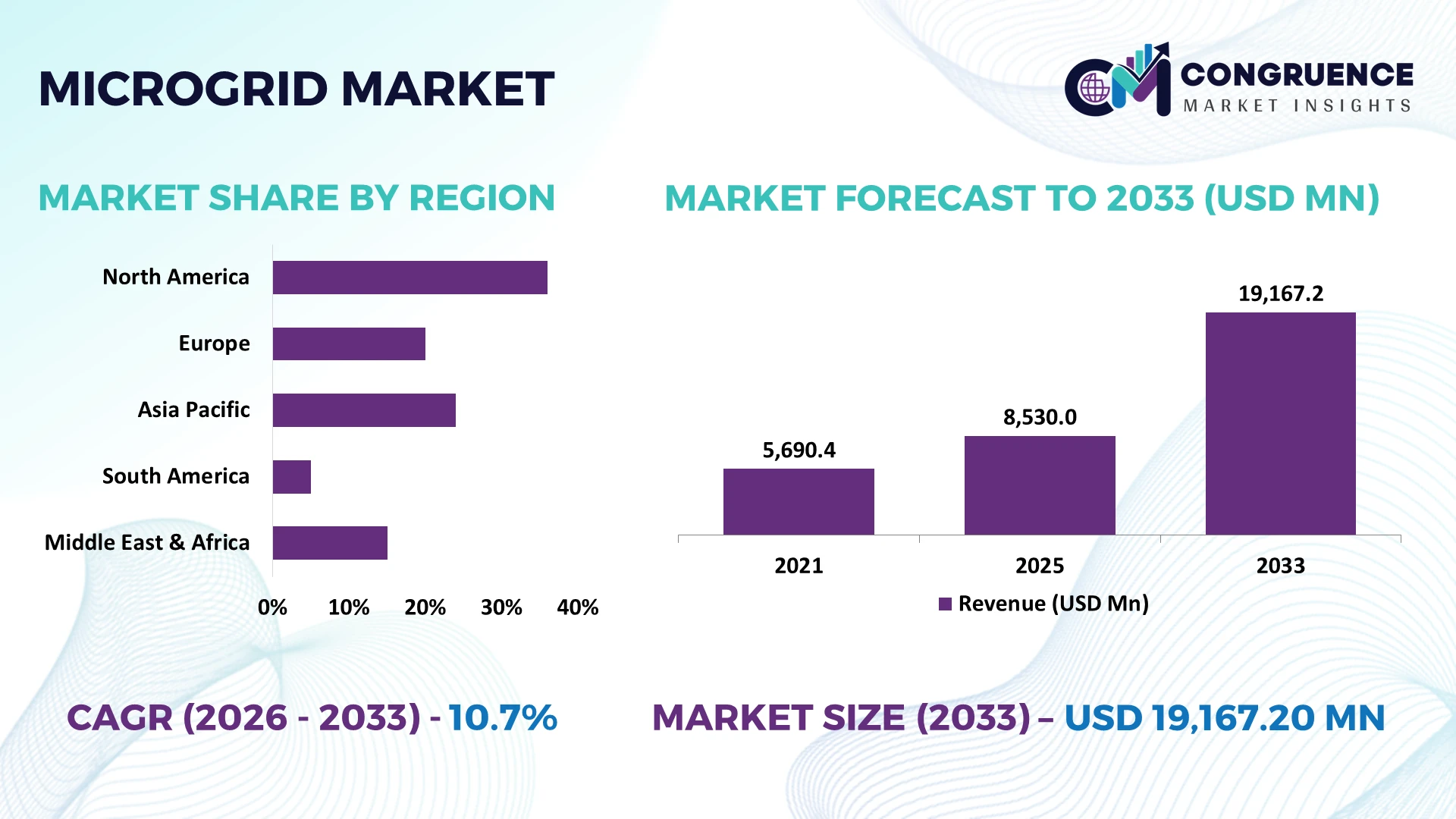
The Global Microgrid Market was valued at USD 8530 Million in 2025 and is anticipated to reach a value of USD 19167.2 Million by 2033 expanding at a CAGR of 10.65% between 2026 and 2033. Growth is driven by distributed energy integration, rising grid resilience investments, renewable power balancing, and increasing deployment of battery-backed microgrid systems across commercial, industrial, and defense facilities.
The United States leads the global microgrid landscape with over 30% market influence, supported by military bases, utilities, and industrial campuses investing in resilient energy infrastructure. Asia-Pacific follows with more than 35% of new capacity additions, led by China and India’s decentralized power programs. Compared with mature U.S. deployments, India’s microgrid installations focus on rural electrification and hybrid solar-storage systems, with renewable integration exceeding 40% in several projects. Geopolitical energy security concerns after global fuel supply disruptions are accelerating national microgrid strategies.
Strategic implication: Businesses prioritizing intelligent microgrid platforms gain stronger energy independence, lower operational risks, and improved long-term power management efficiency.
Market Size & Growth: Global microgrid market reaches USD 19167.2 Million by 2033 from USD 8530 Million in 2025, growing at 10.65% CAGR through renewable integration and grid modernization.
Top Growth Drivers: Renewable integration contributes 40%, energy resilience needs 35%, and industrial electrification accounts for 25% of expansion momentum.
Short-Term Forecast: By 2028, advanced microgrid controls reduce operating costs by 12% and improve energy efficiency by 15% through automation.
Emerging Technologies: AI-based energy management, autonomous controls, and advanced battery storage increase microgrid performance by 10% across new deployments.
Regional Leaders: North America reaches USD 7200 Million, Asia-Pacific USD 6800 Million, and Europe USD 4100 Million by 2033, driven by clean energy adoption.
Consumer/End-User Trends: Industrial users represent nearly 45% adoption as manufacturers prioritize uninterrupted power and carbon reduction targets.
Pilot/Case Example: A 2025 industrial microgrid project achieved 18% energy cost reduction through solar-storage optimization and intelligent demand management.
Competitive Landscape: Leading providers hold around 35% combined influence, with competition among Siemens, Schneider Electric, ABB, Eaton, and General Electric.
Regulatory & ESG Impact: Clean energy policies improve renewable microgrid deployment by 20%, supporting corporate sustainability and emissions reduction goals.
Investment & Funding: Global microgrid investments exceed USD 10 Billion annually, with partnerships focused on storage expansion and digital energy platforms.
Innovation & Future Outlook: Next-generation microgrids integrate AI forecasting, vehicle-to-grid systems, and decentralized energy trading models for future energy networks.
The Microgrid Market is expanding as industries, utilities, and communities prioritize reliable decentralized power solutions. Demand is increasing in data centers, healthcare facilities, manufacturing hubs, and remote infrastructure projects, where operational continuity is critical. Advanced battery technologies and intelligent controllers are improving system performance, with digital monitoring adoption rising by nearly 30%. Regulatory pressure on clean energy deployment and supply-chain diversification after recent global disruptions are accelerating investment, creating a transition toward smarter and more flexible energy ecosystems.
The Microgrid Market is becoming strategically important as energy-intensive industries, utilities, and governments compete for reliable, flexible, and low-carbon power infrastructure. Companies are shifting investments toward decentralized energy networks due to grid instability, energy security priorities, and digital transformation initiatives. Supply-chain restructuring in battery components and power electronics is encouraging localized manufacturing and stronger technology partnerships.
Advanced microgrids using AI-based energy management and automated controls deliver up to 15% higher operational efficiency compared with traditional backup power systems, while reducing energy wastage through predictive optimization. The United States focuses on defense, data centers, and industrial resilience, whereas India emphasizes rural electrification and hybrid renewable systems, creating different deployment models.
Over the next 2–3 years, commercial and industrial adoption is expected to accelerate as organizations integrate solar, storage, and intelligent controllers into energy strategies. Manufacturing facilities in regions such as Texas and Gujarat are deploying hybrid microgrid systems to reduce downtime and stabilize electricity costs. Companies are expanding through technology alliances, storage investments, and integrated energy platforms, making microgrid capability a key competitive advantage.
Rising demand for uninterrupted electricity is the primary driver reshaping microgrid adoption across industries. Data centers, manufacturing plants, and healthcare facilities account for nearly 50% of high-reliability energy requirements, while renewable-powered microgrids improve energy efficiency by 10–15%. The United States defense sector and Japan’s industrial facilities are increasing investments in resilient power systems after global energy disruptions. Companies are responding through partnerships with battery suppliers, automation providers, and renewable developers to create integrated microgrid solutions. A key strategic shift is the move from backup power assets toward intelligent energy management platforms that optimize costs and operational continuity.
Complex installation requirements and technology interoperability remain major barriers for wider microgrid deployment. Initial engineering and integration expenses can represent 20–30% of total project costs, particularly for industrial-scale systems requiring advanced controls and storage. Supply dependency for lithium-based batteries and power electronics creates additional pressure, with imported components affecting project timelines in several countries. Companies are reducing exposure through localized manufacturing, multi-year supplier contracts, and alternative storage technologies. The operational challenge is balancing customization needs with scalable solutions while maintaining profitability across different energy infrastructure environments.
Digitalization creates significant opportunities as AI, IoT monitoring, and automated energy trading reshape microgrid operations. Intelligent control systems can improve energy utilization by 12–18% through real-time forecasting and demand balancing. Countries including India and Australia are expanding renewable-linked microgrid programs, opening opportunities for distributed energy providers. Companies are investing in software platforms, cloud-based monitoring, and ecosystem partnerships to strengthen recurring service models. A less visible opportunity lies in industrial campuses using microgrids as strategic assets for carbon compliance, energy cost optimization, and operational independence rather than only electricity backup solutions.
Growing connectivity introduces cybersecurity and integration challenges for advanced microgrid networks. More than 40% of modern deployments rely on digitally connected monitoring systems, increasing exposure to software vulnerabilities and operational disruptions. Industrial users must manage compatibility between renewable sources, storage units, legacy infrastructure, and grid regulations. Companies are addressing these pressures through cybersecurity investments, standardized communication protocols, and specialized workforce development. The critical challenge is ensuring scalable deployment without compromising reliability, as future competitiveness depends on maintaining secure, intelligent, and continuously optimized energy ecosystems.
AI-Driven Energy Optimization: Intelligent energy management systems are reshaping microgrid operations, with AI-based forecasting improving load balancing by 10–15% and reducing unnecessary energy consumption by nearly 12%. Utilities and industrial operators are integrating predictive analytics to automate demand response, while companies are expanding software partnerships to improve grid visibility and operational efficiency.
Battery Integration Acceleration: Advanced storage deployment is increasing as lithium-ion and alternative battery systems support longer-duration microgrid operations. Storage capacity additions have improved reliability by 20% in critical facilities, while battery cost reductions of around 8–10% are encouraging commercial adoption. Companies are restructuring supply chains and securing localized battery partnerships after global component disruptions.
Digital Control Expansion: Cloud-connected controllers and IoT monitoring platforms are transforming microgrid management, increasing remote system supervision capabilities by over 30%. Manufacturing sites and campuses are adopting centralized dashboards to reduce maintenance response time by 15%. Technology providers are focusing on cybersecurity upgrades and automated control architectures to support scalable deployments.
Hybrid Energy System Growth: Hybrid microgrids combining solar, storage, and conventional generation are gaining traction in industrial and remote applications. These systems improve renewable utilization by approximately 20% while lowering dependence on unstable power sources. Regulatory pressure for cleaner energy systems and resilience planning is driving companies to invest in flexible hybrid configurations.
Grid-connected microgrids represent the leading segment, accounting for approximately 45% of deployments due to their ability to integrate with existing utility networks, renewable sources, and advanced storage systems. Their scalability and lower operational complexity make them preferred among industrial facilities and commercial campuses. AC microgrids maintain strong adoption with nearly 30% share because of compatibility with conventional electrical infrastructure, while DC microgrids are gaining attention in data centers and renewable-powered facilities due to efficiency advantages of 5–10%.
Hybrid microgrids are emerging as the fastest-growing type, supported by demand for energy flexibility and resilience. Adoption is increasing as organizations combine solar, batteries, and backup generation to improve reliability by 15–20%. Off-grid systems remain strategically important for remote communities and isolated industrial sites. Companies are prioritizing modular designs, storage integration, and customized architectures to capture evolving deployment requirements.
Commercial and industrial applications dominate microgrid deployment, representing approximately 45% market share due to rising requirements for uninterrupted power, energy cost control, and sustainability compliance. Manufacturing plants, data centers, and logistics hubs are adopting microgrids to reduce downtime risks by 15% and improve energy management efficiency. Utilities remain a major segment with around 25% share, focusing on grid modernization and distributed energy integration.
Military applications are among the fastest-growing areas as defense facilities prioritize energy security and autonomous operation capabilities. Remote communities and campuses are also expanding adoption, particularly where grid reliability remains limited. Companies are developing scalable platforms, automated controls, and renewable-storage combinations to meet diverse operational requirements. The shift toward mission-critical power infrastructure is increasing demand from enterprise users seeking greater control over energy assets.
Industrial end-users represent the leading buyer group with approximately 40% market share, driven by energy-intensive operations requiring reliable electricity, lower operating costs, and emissions management. Manufacturing, mining, and processing facilities are investing in microgrids to reduce power interruptions by nearly 20% and improve energy utilization. Utilities follow as major adopters, focusing on distributed grid management and renewable integration.
Healthcare and government segments are expanding rapidly as hospitals and public facilities prioritize resilient energy infrastructure. Commercial users are adopting microgrids for campuses, office complexes, and large-scale facilities where automated energy control improves efficiency by 10–15%. Companies are responding with sector-specific solutions, financing models, and integrated service agreements to accelerate adoption. Future demand is shifting toward customers seeking energy independence, digital monitoring, and long-term operational stability.
North America accounted for the largest market share at 38% in 2025 however, Asia-Pacific is expected to register the fastest growth, expanding at a CAGR of 12.5% between 2026 and 2033.

Grid Resilience and Intelligent Energy Infrastructure Expansion
North America maintains a leading position in the Microgrid Market, supported by strong deployment across military facilities, data centers, universities, and industrial campuses. The region contributes nearly 38% of global installations, with the United States representing the majority of operational capacity. Rising grid modernization programs and extreme weather resilience investments are accelerating adoption, particularly in California, Texas, and New York. More than 2,000 microgrid projects are operating or under development across the region, supported by renewable integration and advanced control systems. Companies are expanding through utility partnerships, storage investments, and digital energy platforms to strengthen distributed power capabilities.
United States Market Outlook: The United States dominates North American microgrid deployment through large-scale industrial and government projects. Federal resilience programs and private-sector investments support rapid adoption, with commercial and industrial facilities accounting for over 45% of new installations. Advanced battery storage, AI-based controls, and renewable integration are strengthening operational reliability for critical infrastructure.
Energy Independence and Decarbonization-Driven Modernization
Europe’s microgrid adoption is shaped by energy security strategies, renewable integration targets, and industrial decarbonization initiatives. The region accounts for approximately 25% of global microgrid deployments, with strong activity in Germany, the United Kingdom, and the Netherlands. Increasing electricity price volatility and regulatory pressure are encouraging manufacturers and commercial facilities to adopt localized energy systems. Industrial microgrids are improving energy efficiency by 10–15% through automated controls and renewable balancing. Companies are investing in smart grid partnerships, battery storage integration, and flexible energy management platforms to meet sustainability requirements while reducing operational exposure.
Germany Market Outlook: Germany leads European microgrid advancement through industrial automation expertise and renewable energy infrastructure. Manufacturing facilities are adopting integrated energy systems to improve reliability and reduce carbon intensity. More than 40% of industrial energy users are actively exploring decentralized energy solutions, supporting demand for advanced microgrid technologies.
Large-Scale Deployment and Distributed Energy Transformation
Asia-Pacific represents the fastest-expanding microgrid market, driven by industrial growth, rural electrification programs, and renewable energy investments. The region contributes nearly 30% of global deployment activity, with China, India, Japan, and Australia leading adoption. Manufacturing expansion and remote infrastructure requirements are increasing demand for hybrid solar-storage systems. China’s domestic production strength in batteries and power electronics supports cost competitiveness, while India focuses on decentralized energy access. Microgrid projects across the region are improving renewable utilization by approximately 15–20%. Companies are increasing local manufacturing, forming technology alliances, and expanding modular microgrid solutions.
China Market Outlook: China holds a dominant position in Asia-Pacific due to its battery manufacturing ecosystem and large renewable energy capacity. The country’s industrial parks and rural energy projects are adopting microgrids at scale, with renewable-powered systems representing over 35% of new decentralized energy deployments.
Remote Energy Access and Industrial Reliability Growth
South America’s microgrid market is developing through renewable integration, mining operations, and remote community electrification projects. Brazil, Chile, and Colombia represent major deployment centers due to extensive renewable resources and isolated energy requirements. The region contributes around 8% of global microgrid installations, with mining companies increasingly adopting hybrid systems to stabilize power supply. Solar-based microgrids are improving energy availability by more than 20% in remote applications. Infrastructure limitations and financing challenges continue influencing project timelines. Companies are addressing these barriers through public-private partnerships, modular designs, and localized deployment strategies.
Brazil Market Outlook: Brazil is the largest South American market due to its renewable energy base and industrial demand. Distributed energy projects are expanding across agricultural, commercial, and remote areas, with solar-storage microgrids gaining traction as companies seek improved energy reliability and lower operating costs.
Infrastructure Modernization and Energy Access Transformation
The Middle East & Africa microgrid market is gaining momentum through renewable investments, industrial modernization, and energy access initiatives. The region represents nearly 10% of global deployment opportunities, with activity concentrated in Saudi Arabia, the United Arab Emirates, South Africa, and Kenya. Solar-powered microgrids are expanding rapidly due to high solar availability and the need for reliable electricity in remote areas. Several infrastructure projects are integrating storage systems to improve power continuity by 15–25%. Companies are forming energy partnerships, investing in decentralized systems, and supporting clean energy transition programs to reduce dependence on centralized grids.
Saudi Arabia Market Outlook: Saudi Arabia is emerging as a key Middle East market through large-scale renewable infrastructure development and industrial diversification programs. Government-backed energy modernization projects are increasing demand for smart microgrids, particularly for industrial zones and remote facilities requiring reliable power management.
The Microgrid Market features competition between global energy technology leaders, regional integrators, and specialized control-system providers. Companies such as Siemens, Schneider Electric, ABB, Eaton, and General Electric compete through integrated hardware, software, and automation capabilities, while regional firms compete on customization and cost efficiency. The top five players collectively influence around 35% of the market, creating a moderately consolidated structure. Competition is based on technology leadership, with AI-enabled controls improving efficiency by 10–15%, while modular designs reduce deployment timelines by nearly 20%. Leading players are expanding through utility partnerships, battery ecosystem alliances, and vertical integration of energy management platforms. Competitive pressure is shifting toward digital intelligence, cybersecurity, and supply-chain control for critical components. High engineering complexity and integration expertise remain key entry barriers. Winning requires scalable platforms, strong ecosystem partnerships, and the ability to deliver reliable, intelligent energy solutions.
Siemens
Schneider Electric
ABB
Eaton
General Electric
Honeywell
Caterpillar
Rolls-Royce
Hitachi Energy
Tesla Energy
Bloom Energy
Toshiba Energy Systems
PowerSecure
S&C Electric Company
Advanced energy management systems are becoming central to modern microgrids, with AI-based forecasting, IoT monitoring, and automated controls improving operational efficiency by 10–15%. Current deployments increasingly combine renewable generation, battery storage, and digital controllers, with more than 40% of new industrial microgrid projects integrating intelligent monitoring platforms. These technologies help enterprises reduce downtime, optimize energy usage, and improve grid independence.
Emerging technologies such as solid-state batteries, edge computing, and blockchain-enabled energy trading are reshaping system performance. Compared with traditional microgrids using manual controls, AI-driven platforms deliver approximately 15% faster response times and up to 12% better energy optimization. Industrial operators, utilities, and data centers benefit most as they require predictable power quality and automated demand management.
Between 2026 and 2028, disruptive technologies including autonomous microgrids, vehicle-to-grid integration, and predictive maintenance platforms will accelerate market transformation. Companies investing in digital twins and advanced storage solutions gain competitive advantages through lower operating costs and improved resilience. Technology leaders and integrated solution providers are positioned to capture demand as microgrids shift from backup infrastructure into intelligent energy ecosystems.
March 2024 Schneider Electric partnered with Mainspring Energy to combine EcoStruxure Microgrid Solutions with linear generator technology, enabling fuel-flexible hybrid systems for commercial and industrial users. The solution improves resilience by operating grid-connected or independently, strengthening decarbonization strategies.
April 2024 Schneider Electric launched an all-in-one Battery Energy Storage System for microgrids, integrating storage, controls, and optimization software. The scalable solution supports multiple markets globally and enhances energy flexibility, helping enterprises improve operational reliability through advanced storage integration.
May 2024 Schneider Electric introduced Villaya Flex, a standardized microgrid solution for off-grid communities during the Energy Access Investment Forum. The platform targets faster deployment and supports clean electricity access initiatives, expanding decentralized energy opportunities in emerging infrastructure markets.
May 2026 Siemens launched a 1.25 MW AC microgrid at its Wendell, North Carolina headquarters, integrating solar generation and a 3.9 MWh battery system. The project reduced grid energy consumption by 2.07 GWh annually while demonstrating industrial-scale renewable resilience. Source: Siemens Digital Industries Software
The Microgrid Market Report covers comprehensive segmentation across grid-connected, off-grid, AC, DC, and hybrid microgrid systems, along with applications including remote communities, commercial and industrial facilities, military installations, campuses, and utilities. The analysis evaluates adoption patterns across North America, Europe, Asia-Pacific, South America, and Middle East & Africa, highlighting deployment concentration and infrastructure priorities.
The report examines key technologies such as battery energy storage, AI-based energy management, IoT monitoring, renewable integration, and automated control platforms. It provides strategic insights into competitive positioning, investment priorities, technology transitions, and expansion opportunities between 2026 and 2033. Coverage includes enterprise adoption trends, emerging business models, and niche opportunities in resilient energy infrastructure, supporting informed decisions for manufacturers, investors, utilities, and technology providers.
| Report Attribute/Metric | Report Details |
|---|---|
Market Revenue in 2025 | USD 8530 Million |
Market Revenue in 2033 | USD 19167.2 Million |
CAGR (2026 - 2033) | 10.65% |
Base Year | 2025 |
Forecast Period | 2026 - 2033 |
Historic Period | 2021 - 2025 |
Segments Covered | By Type
By Application
By End-User
|
Key Report Deliverable | Revenue Forecast, Growth Trends, Market Dynamics, Segmental Overview, Regional and Country-wise Analysis, Competition Landscape |
Region Covered | North America, Europe, Asia-Pacific, South America, Middle East, Africa |
Key Players Analyzed | Siemens, Schneider Electric, ABB, Eaton, General Electric, Honeywell, Caterpillar, Rolls-Royce, Hitachi Energy, Tesla Energy, Bloom Energy, Toshiba Energy Systems, PowerSecure, S&C Electric Company |
Customization & Pricing | Available on Request (10% Customization is Free) |




