
Reports
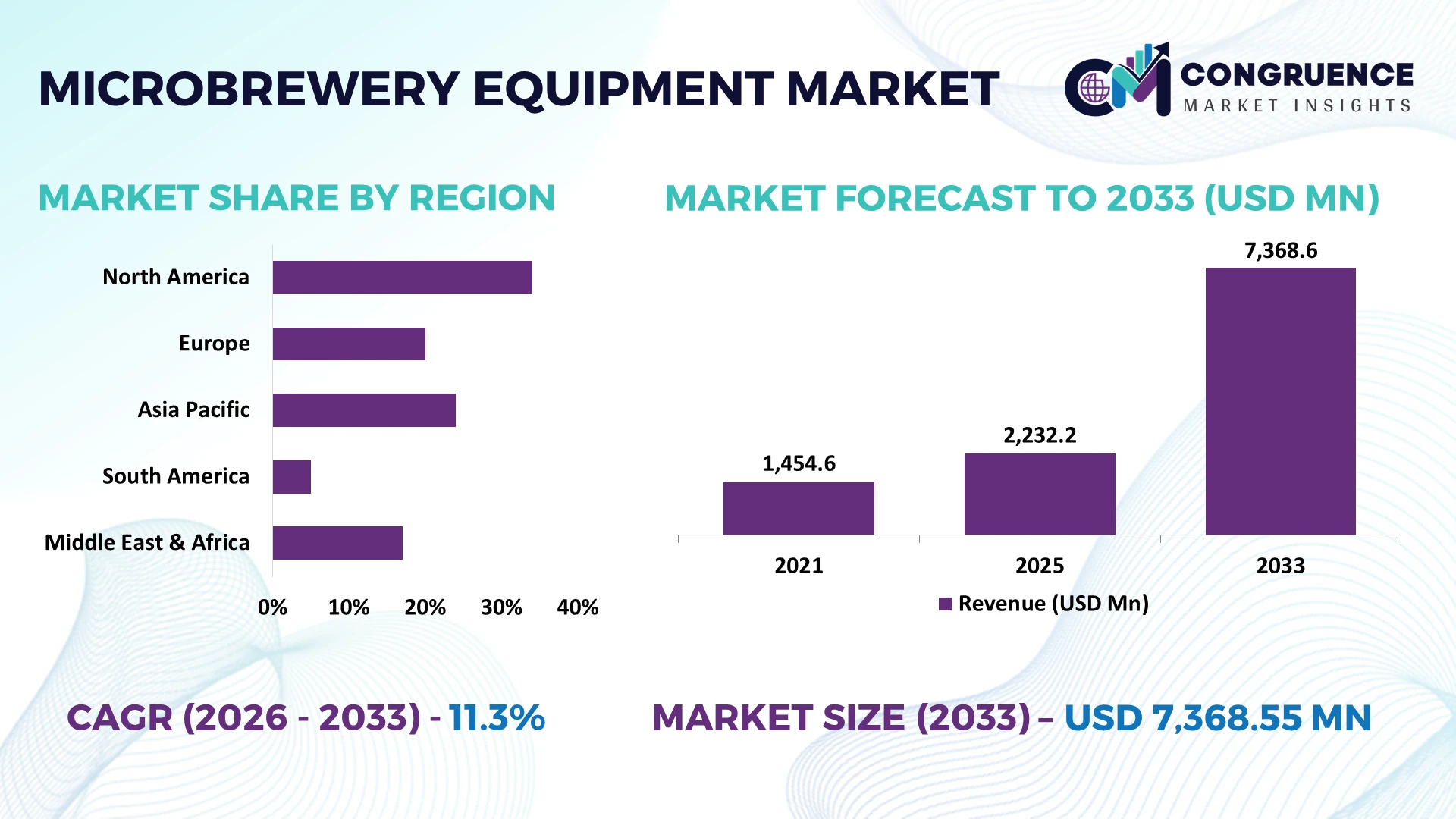
The Global Microbrewery Equipment Market was valued at USD 2232.15 Million in 2025 and is anticipated to reach a value of USD 7368.55 Million by 2033 expanding at a CAGR of 11.3% between 2026 and 2033. Growth is driven by automated brewhouse controls, compact modular systems, energy-efficient heat recovery, and rising installation of flexible fermentation capacity supporting frequent small-batch production.
The U.S. remains the dominant equipment demand center, supported by more than 9,000 operating craft breweries and craft beer accounting for roughly 13% of beer volume, sustaining replacement demand for fermenters, canning lines, filtration systems, and digitally controlled brewhouses. Germany, with more than 1,400 breweries, has a denser traditional brewing infrastructure but greater emphasis on energy-efficient modernization. European energy-security pressures following the Russia-Ukraine conflict have further strengthened interest in heat recovery and lower-utility brewing systems.
For equipment manufacturers and brewery investors, scalable automation, utility reduction, and modular capacity expansion offer the strongest route to improving brewery economics while protecting flexibility as product portfolios become more fragmented.
Market Size & Growth: USD 2,232.15 million in 2025 advances to USD 7,368.55 million by 2033 at 11.3% CAGR, reinforced by automated brewhouses, flexible fermentation capacity, and compact production systems.
Top Growth Drivers: Automation can reduce repetitive manual intervention by 20–30%; heat-recovery configurations can lower brewhouse energy requirements by 10–20%; modular installations shorten capacity-expansion cycles by approximately 15–25%.
Short-Term Forecast: By 2028, advanced process controls and integrated cleaning systems are positioned to reduce batch-to-batch process variability by 10–15% while cutting operator-intensive brewing tasks by approximately 20%.
Emerging Technologies: IoT-connected fermentation monitoring, AI-assisted recipe control, automated CIP, and high-efficiency wort boiling are pushing advanced microbrewery equipment toward 15–25% lower process intervention.
Regional Leaders: North America remains the largest installed craft-brewing ecosystem; Europe operates thousands of breweries across mature beer economies, while Asia-Pacific is accelerating adoption of compact 5–30 barrel brewhouse configurations.
Consumer/End-User Trends: U.S. craft beer represents approximately 13% of total beer volume, supporting equipment optimized for rotating seasonal products, taproom production, specialty styles, and smaller batch sizes.
Pilot/Case Example: Modern heat-recovery brewhouse configurations can recapture thermal energy from wort production, delivering approximately 10–20% utility savings versus conventional systems and improving operating economics for energy-intensive brewing sites.
Competitive Landscape: The global microbrewery equipment sector remains fragmented rather than controlled by a single 20%+ supplier; major participants include GEA, Alfa Laval, Krones, Paul Mueller Company, and Specific Mechanical Systems.
Regulatory & ESG Impact: High-efficiency cleaning, water reuse, and optimized CIP technologies can reduce cleaning-water consumption by approximately 20–30%, strengthening compliance and sustainability performance where water discharge and utility costs are tightening.
Investment & Funding: A USD 1 million-plus microbrewery expansion increasingly prioritizes modular tanks, automated controls, packaging flexibility, and energy management rather than capacity alone, reflecting tighter financing conditions and supply-chain discipline.
Innovation & Future Outlook: Next-generation breweries are shifting toward sensor-connected brewhouses, predictive maintenance, automated fermentation, and modular cellar expansion, targeting 15–25% improvements in labor productivity and faster product changeovers.
Microbrewery equipment demand is increasingly concentrated around automated brewhouses, fermentation vessels, kegging and canning systems, CIP units, and energy-efficient thermal equipment. Digital process controls can reduce operator intervention by approximately 20%, improving batch consistency across smaller production runs. Rising utility costs and tighter wastewater requirements are accelerating heat-recovery and water-efficient installations, creating a clear strategic case for examining competitive positioning and technology investment priorities.
Microbrewery equipment is becoming strategically important as brewers shift from capacity-led expansion toward flexible production, SKU diversification, and tighter process control. With more than 9,000 U.S. craft breweries operating and craft beer representing roughly 13% of domestic beer volume, equipment decisions increasingly influence labor productivity and batch economics. Digital fermentation monitoring and automated clean-in-place systems are replacing manually supervised workflows as breweries modernize aging production infrastructure.
Modern automated brewhouses can reduce operator intervention by approximately 20% while heat-recovery systems can lower thermal energy requirements by 10–20% versus conventional configurations. The U.S. emphasizes modular fermentation and packaging flexibility across decentralized craft operations, while Germany’s 1,400-plus breweries create stronger demand for energy optimization, precision process engineering, and equipment retrofits. Through 2028, automation penetration will increasingly extend from brewing into cellar management, CIP, packaging, and condition monitoring.
A 10–30 barrel brewery, for example, can integrate automated wort production with remotely monitored fermentation tanks, allowing fewer operators to supervise multiple batches while improving repeatability. Equipment suppliers are consequently prioritizing modular platforms, controls integration, service partnerships, and retrofit-compatible systems. Competitive advantage will increasingly belong to vendors that combine brewing flexibility with measurable reductions in labor, utilities, downtime, and production variability.
Labor-intensive production is accelerating investment in automated brewhouses, fermentation controls, and integrated CIP systems. Automated process sequencing can reduce manual intervention by 20–30%, while optimized CIP programs can lower cleaning-water consumption by approximately 20% and shorten sanitation cycles by 15–25%. U.S. breweries operating frequent seasonal and specialty batches increasingly require repeatable recipes without adding proportional headcount. Persistent skilled-production labor constraints have therefore shifted equipment procurement from basic stainless-steel capacity toward PLC-controlled, sensor-connected systems. Manufacturers are responding with modular automation packages, remote diagnostics, and integrated cellar controls suitable for smaller installations. The non-obvious advantage is capacity utilization: automation allows existing vessels to support tighter production schedules, enabling breweries to expand output through faster workflow execution before investing in additional tanks or floor space.
Equipment affordability remains constrained by stainless-steel exposure, imported components, financing costs, and installation requirements. Stainless steel can represent more than 50% of material content in fermentation and storage vessels, making fabrication economics sensitive to metal-price movements. Customized automated systems can also carry 20–40% higher upfront costs than basic manually controlled configurations, while electrical, piping, commissioning, and building modifications can add another 10–20% to project expenditure. U.S. tariff uncertainty and global sourcing adjustments affecting steel and industrial components reinforce procurement risk for smaller breweries with limited capital buffers. Suppliers are mitigating exposure through localized fabrication, standardized vessel platforms, multiyear component contracts, and modular configurations. Strategically, equipment vendors that reduce site-engineering requirements gain an advantage because installation complexity increasingly matters as much as equipment pricing in brewery investment decisions.
Connected brewing systems create an opportunity to move microbrewery equipment from standalone machinery toward integrated production platforms. Sensor-based fermentation monitoring can reduce manual sampling requirements by 20–30%, while advanced heat recovery can lower brewhouse thermal consumption by approximately 10–20%; optimized water-management configurations can cut cleaning demand by another 15–25%. Germany’s energy-intensive brewing sector provides a strong retrofit opportunity as operators prioritize thermal efficiency, while India’s expanding brewpub ecosystem favors compact modular installations that can add fermentation capacity incrementally. Through 2028, predictive maintenance, cloud-connected process records, automated dosing, and intelligent fermentation control will become increasingly accessible to smaller operators. Manufacturers are expanding controls R&D and software partnerships accordingly. A particularly valuable opportunity lies in retrofit automation, allowing established breweries to digitalize existing tanks rather than replace serviceable stainless-steel assets.
Scaling connected microbrewery operations creates an execution challenge around controls integration, technician availability, process-data consistency, and equipment interoperability. A digitally managed brewery can connect 20–50 sensors across brewing, fermentation, utilities, refrigeration, and packaging, increasing commissioning complexity compared with standalone equipment. Unplanned production downtime of even 5–10% can disrupt fermentation schedules and packaging utilization because tanks remain occupied for days or weeks per batch. Smaller U.S. and Indian operators frequently lack dedicated automation engineers, making supplier service capability critical as PLCs, variable-frequency drives, remote monitoring, and cloud interfaces become interconnected. Equipment companies must strengthen technician networks, standardized communication protocols, remote diagnostics, and operator training. The strategic challenge is therefore not simply installing automation; suppliers must ensure that increasingly sophisticated brewery architectures remain maintainable without creating technology dependence that undermines operational resilience.
Smaller Footprints Gain Priority: Brewery closures and softer beer volumes are shifting procurement toward compact, multipurpose systems rather than oversized brewhouses. U.S. craft production declined 4% in 2025 while operating craft breweries fell 2.9%, encouraging operators to favor 5–30 barrel configurations and expandable cellar capacity. Equipment manufacturers are redesigning skid-mounted brewhouses, stackable controls, and flexible piping architectures that reduce installation space and allow capacity additions without major building modifications.
Packaging Mix Becomes More Flexible: Independent breweries are restructuring downstream equipment around changing route-to-market economics. In the UK, cans reached approximately 11% of average independent-brewery production in 2025, bottles increased to 12%, while keg output declined to 19%. Suppliers are responding with compact counter-pressure fillers, combination canning lines, and faster-format changeovers. The operational shift makes packaging versatility increasingly important because breweries can redirect production between taproom, retail, and local distribution channels without maintaining separate lines.
Direct-To-Consumer Operations Expand: Brewery equipment layouts increasingly support taprooms, takeaway packaging, and on-site retail rather than production alone. In 2026, 46% of UK independent breweries operated taprooms, 51% had brewery shops, and 30% of beer was sold directly to consumers. Vendors are consequently integrating serving tanks, compact keg washers, small-format packaging, and cellar equipment into turnkey installations, helping breweries capture higher-margin onsite transactions while reducing dependence on increasingly constrained wholesale access.
Portfolio Complexity Reshapes Cellars: Diversification into specialty and alternative beer categories is increasing demand for flexible fermentation and conditioning assets. In 2025, 80% of UK independent brewers produced stout or porter, 60% produced lager, and 15% produced non-alcoholic beer, up from 8%. Equipment companies are responding with independently temperature-controlled tanks, smaller batch vessels, and adaptable filtration systems, enabling breweries to manage more recipes without dedicating full-scale production capacity to individual products.
Fermentation Tanks represent the leading equipment type, accounting for approximately 32% of Microbrewery Equipment Market demand, reflecting their high vessel intensity and direct influence on production throughput. A brewhouse can support multiple fermenters, making cellar capacity the primary constraint as breweries increase SKU counts or shorten production cycles. Fermentation fleets commonly exceed brewhouse vessel counts by 3–6 times, directing expansion budgets toward temperature-controlled, pressure-rated tanks with digital monitoring. Brewing Kettles remain a mature core category with approximately 22% share because virtually every brewing installation requires reliable wort boiling and thermal control.
Filtration Systems are emerging as the fastest-growing type as breweries pursue greater product stability, non-alcoholic formats, and packaging consistency. Modern membrane and cartridge configurations can reduce product losses by approximately 5–10% compared with less-controlled clarification workflows. Mash Tuns retain strategic importance where brewers require extraction consistency and recipe flexibility, while Bright Beer Tanks support conditioning, carbonation, and packaging synchronization. Manufacturers are therefore expanding modular fermentation portfolios while integrating advanced controls across kettles, tanks, mash systems, and filtration equipment.
Fermentation is the leading application, representing approximately 30% of equipment deployment because it occupies the longest production stage and determines how effectively breweries convert brewhouse output into saleable inventory. Fermentation can require several days to multiple weeks per batch, making tank availability substantially more capacity-sensitive than mashing or brewing. Expanding breweries therefore allocate disproportionately more equipment to cellar operations, often maintaining 3–6 fermentation vessels per primary brewhouse configuration. Brewing remains another established application, supported by kettle, heat-transfer, and process-control requirements, while Mashing remains essential for extraction efficiency and recipe consistency.
Packaging is the fastest-growing application as microbreweries expand direct retail, canned products, taproom takeaway, and diversified distribution. UK independent brewers reported cans reaching approximately 11% of production in 2025, strengthening demand for compact fillers, seamers, labeling equipment, and integrated conveyors. Filtration is also becoming operationally important for stability-sensitive and specialty products. Suppliers are responding by combining brewing, fermentation, filtration, and packaging controls into connected workflows, shifting investment toward equipment that removes bottlenecks between production stages.
Craft Breweries constitute the dominant end-user group with approximately 56% of equipment demand because dedicated production facilities require complete brewhouses, fermentation cellars, filtration equipment, bright tanks, and packaging infrastructure. The United States had 9,578 operating craft breweries in 2025, creating extensive replacement and modernization requirements even as brewery numbers rationalized. These facilities also carry substantially greater vessel intensity than Restaurants or Hotels, making equipment lifecycle management and incremental capacity additions critical procurement considerations. Suppliers increasingly target craft breweries through modular tank portfolios, retrofit controls, service agreements, and scalable brewhouse configurations.
Brewpubs represent the fastest-expanding equipment opportunity within customer models focused on direct consumer engagement, supported by compact production systems that connect brewing with onsite sales. The U.S. still supported 3,525 brewpubs in 2025, while Hospitality Businesses increasingly incorporate small-format brewing into experiential food-and-beverage concepts. Restaurants and Hotels favor lower-capacity turnkey systems with simplified controls and reduced operator requirements. Equipment vendors are responding through customized footprints, financing packages, installation partnerships, and standardized brewery modules suited to constrained hospitality locations.
North America accounted for the largest market share at 38% in 2025 however, Asia-Pacific is expected to register the fastest growth, expanding at a CAGR of 13.2% between 2026 and 2033.

Craft-Brewery Rationalization Accelerates Equipment Modernization
North America accounts for approximately 38% of global Microbrewery Equipment Market activity, anchored by the extensive U.S. installed base and established Canadian craft-brewing infrastructure. The United States operated 9,578 craft breweries in 2025, despite a 2.9% annual contraction, shifting equipment expenditure from greenfield installations toward cellar optimization, replacement vessels, compact packaging lines, and process automation. Microbreweries declined 4.4%, while brewpubs contracted 2.5%, reinforcing demand for equipment capable of supporting higher utilization rather than oversized capacity. Operators are increasingly prioritizing modular fermenters, automated CIP, energy recovery, and integrated canning equipment. This market correction favors suppliers offering retrofit engineering and lifecycle services because financially disciplined breweries are extending existing asset productivity. Canada complements this structure through concentrated craft clusters in Ontario, British Columbia, and Quebec, where flexible small-batch equipment supports locally differentiated production.
United States Market Outlook: The United States remains North America’s strategic equipment center because its 9,578 operating craft breweries provide substantial recurring demand for replacement, refurbishment, cellar expansion, and packaging upgrades. With 1,994 microbreweries and 3,784 taproom breweries operating in 2025, suppliers increasingly differentiate through compact automation, service coverage, flexible financing, and equipment configurations designed around direct-to-consumer production.
Energy Efficiency Reshapes Brewery Modernization
Europe represents approximately 30% of global equipment demand, supported by dense brewing infrastructure across Germany, the UK, Belgium, Italy, France, and Spain. More than 3,000 independent breweries across 12 European countries were represented in a 2026 industry assessment, while elevated electricity, thermal-energy, taxation, and labor costs are redirecting capital toward efficient brewhouses, heat recovery, automated CIP, and optimized refrigeration. Approximately 28% of independent beer covered by that assessment is sold directly to consumers, strengthening demand for flexible cellar and small-format packaging equipment. The UK entered 2026 with 1,578 breweries after 137 net closures during 2025, increasing emphasis on productivity rather than capacity expansion. Equipment manufacturers are responding with retrofit-compatible controls, low-water cleaning systems, energy monitoring, and modular vessels. Europe therefore provides particularly strong modernization economics where breweries must lower production costs while maintaining differentiated small-batch portfolios.
Germany Market Outlook: Germany operated 1,415 breweries in 2025, including 588 in Bavaria, giving equipment suppliers an unusually concentrated modernization base. More than half—821 breweries—produced no more than 100,000 liters annually. With domestic beer sales declining 6.0% during 2025, investment is increasingly directed toward energy efficiency, flexible production, alcohol-free processing, automation, and operating-cost reduction rather than straightforward capacity additions.
Urban Brewpub Deployment Drives Scale-Up
Asia-Pacific represents approximately 24% of Microbrewery Equipment Market demand and is shifting from imported turnkey systems toward locally engineered, modular installations. China contributes manufacturing scale across stainless-steel vessels, refrigeration, pumps, and brewhouse fabrication, while India is strengthening deployment through brewpub clusters in Bengaluru, Pune, Mumbai, Hyderabad, and Gurugram. Australia adds a mature independent-brewing ecosystem with more than 600 independently owned breweries, supporting recurring requirements for cellar upgrades, canning equipment, and process controls. Equipment configurations between roughly 5 and 30 barrels are particularly relevant for urban hospitality operators because constrained floor space rewards compact layouts and expandable fermentation capacity. Chinese and Indian manufacturers are increasing localized fabrication and controls integration, reducing dependence on fully imported systems. The strategic shift is toward equipment platforms that combine lower acquisition costs with automation, after-sales engineering, and standardized components capable of supporting multi-location brewpub expansion.
India Market Outlook: India offers a strategically important deployment pathway through metropolitan brewpub expansion and premium on-premise consumption. Bengaluru and Pune remain prominent brewing clusters, while state-level alcohol licensing continues to shape installation economics. Suppliers are positioning compact brewhouses, automated fermentation controls, glycol cooling systems, and modular tanks for operators seeking 5–20 barrel production footprints that can scale without extensive premises expansion.
Brazil Anchors Local Brewing Investment
South America contributes approximately 5% of global Microbrewery Equipment Market activity, with Brazil providing the strongest manufacturing, brewery deployment, and consumer base. Craft production clusters around São Paulo, Minas Gerais, Paraná, Santa Catarina, and Rio Grande do Sul support demand for brewhouses, fermentation vessels, glycol systems, filtration, and compact packaging equipment. Argentina and Chile provide smaller but technically developed brewing ecosystems where operators increasingly emphasize locally sourced equipment and incremental cellar expansion. Currency volatility and imported-component costs remain important constraints, making domestic fabrication and standardized stainless-steel systems commercially attractive. Suppliers are responding by localizing tanks, piping, installation, and maintenance while importing higher-value controls selectively. This hybrid sourcing structure reduces foreign-exchange exposure and shortens maintenance cycles. Equipment demand is consequently moving toward modular projects that allow breweries to add fermentation or packaging capacity independently instead of financing complete production-line replacements.
Brazil Market Outlook: Brazil is the region’s pivotal equipment market because its geographically dispersed independent brewing base supports both local fabricators and international process-technology suppliers. Southern and southeastern states concentrate much of the specialist brewing infrastructure. Operators increasingly favor domestically fabricated fermenters combined with imported automation, pumps, valves, and controls, reducing project exposure to currency movements while retaining process precision and scalable cellar configurations.
Hospitality-Led Brewing Creates Selective Demand
Middle East & Africa represents approximately 3% of global Microbrewery Equipment Market activity, with deployment concentrated in markets where alcohol regulation permits commercial brewing and hospitality infrastructure supports premium beverage production. South Africa provides the region’s most established independent brewing ecosystem, while tourism-oriented operations in selected African markets generate demand for compact brewhouses, kegging equipment, and temperature-controlled fermentation. In the Middle East, strict alcohol licensing limits conventional microbrewery deployment, redirecting equipment opportunities toward controlled hospitality environments and non-alcoholic brewing technologies. Temperature management is operationally significant because warm climates increase refrigeration loads, elevating the value of insulated vessels, efficient glycol systems, and automated cooling controls. Suppliers therefore compete through turnkey installation, refrigeration integration, training, and technical support rather than equipment supply alone. Long-term positioning depends on adapting production platforms to licensing conditions, water constraints, and high ambient-temperature operations.
South Africa Market Outlook: South Africa provides the strongest regional foundation through established brewing expertise, hospitality demand, and craft-beer activity concentrated around Cape Town, Johannesburg, Pretoria, and Durban. Equipment procurement increasingly emphasizes locally serviceable brewhouses, efficient refrigeration, kegging systems, and modular fermentation. Water and electricity constraints strengthen the commercial case for efficient CIP, insulated tanks, heat recovery, and resilient utility-management configurations.
Krones, GEA, Alfa Laval, DME Process Systems, and Paul Mueller compete as technology-led suppliers against specialist regional fabricators focused on customization and price. The top five collectively control approximately 21% of the market, confirming a fragmented structure where local engineering remains influential. Global suppliers differentiate through turnkey automation, filtration, separation, packaging, and lifecycle service, while regional manufacturers can deliver customized vessels at roughly 15–25% lower acquisition costs. Automated platforms can reduce operator intervention by 20–30%, and optimized CIP configurations cut cleaning-water requirements by approximately 20%, making operating economics a stronger competitive lever than equipment price alone. Leading players are expanding modular product portfolios, controls partnerships, retrofit services, and vertically integrated installation capabilities. Competition is shifting from stainless-steel fabrication toward connected process management and service responsiveness. Engineering certification, installed references, commissioning expertise, and aftermarket coverage remain significant entry barriers. Winning requires measurable lifecycle savings, configurable equipment, dependable local support, and seamless brewhouse-to-packaging integration.
GEA Group
Krones AG
Alfa Laval AB
Paul Mueller Company
DME Process Systems
Specific Mechanical Systems
Deutsche Beverage Technology
Criveller Group
JV Northwest
ABE Beverage Equipment
ProBrew
Premier Stainless Systems
Psycho Brew
Portland Kettle Works
Current microbrewery technology centers on PLC-controlled brewhouses, automated fermentation, centrifugation, CIP, and precision temperature control. High-speed separators can increase usable production capacity by 15–20% from existing tanks, while advanced brewing equipment can improve yield by approximately 10%. Compared with legacy settling and filtration workflows, centrifugation delivers up to 20% higher effective tank productivity, allowing breweries to expand output without proportional cellar investment.
Emerging systems combine IoT sensors, automated valve matrices, digital recipe management, remote diagnostics, and resource-monitoring platforms. Smart cleaning and water-recirculation technologies can reduce water consumption substantially, while modern centrifuge configurations cut energy consumption by up to 60%. Adoption is moving beyond large breweries as compact separators, modular automation, and plug-and-play process skids make advanced controls commercially accessible to microbreweries. Operators gain tighter batch consistency, faster troubleshooting, and reduced manual supervision.
Disruptive technologies increasingly include AI-assisted process optimization, membrane dealcoholization, digital twins, predictive maintenance, and integrated heat recovery. Between 2026 and 2028, sensor-connected cellar management and automated packaging will penetrate more small-batch installations as breweries prioritize asset utilization over physical expansion. Suppliers combining scalable hardware, software integration, and local technical support gain the strongest competitive advantage. Investment now matters because technology increasingly determines yield, turnaround speed, utility intensity, and production flexibility.
May 2024 Blasta Brewing installed Krones’ Craftmate C filler and Ferrum seamer at its Perth brewery, becoming Western Australia’s first Craftmate C installation and Australia’s ninth. The 15-million-liter-capacity brewery strengthened packaged-beer throughput and production flexibility. Source: packagingnews.com.au
May 2025 Alfa Laval deployed its new Optiwia plug-and-play water-recirculation technology with a Brew 250 centrifuge at a French craft brewery, enabling cooling water reuse while maintaining product quality and reducing separator-related freshwater requirements. Source: alfalaval.co.uk
May 2025 Brewers Association highlighted Big Grove’s integration of used and new brewing equipment at Craft Brewers Conference 2025, demonstrating a hybrid modernization model that extends existing asset life while integrating contemporary engineering into one production system. Source: brewersassociation.org
August 2026 Krones opened a 16,000-square-meter beverage-equipment manufacturing facility in Vemagal, India, following an approved 30-acre allocation. The plant targets 400 jobs and localized ErgoBloc production, strengthening equipment availability and service infrastructure for Indian beverage producers. Source: moneycontrol.com
The Microbrewery Equipment Market report evaluates Brewing Kettles, Fermentation Tanks, Bright Beer Tanks, Mash Tuns, and Filtration Systems across Mashing, Brewing, Fermentation, Filtration, and Packaging applications. Coverage extends to Craft Breweries, Brewpubs, Restaurants, Hotels, and Hospitality Businesses, with fermentation equipment representing approximately one-third of equipment demand. The assessment examines automation, centrifugation, CIP, heat recovery, digital controls, modular brewhouses, and flexible packaging technologies.
Geographic analysis covers North America, Europe, Asia-Pacific, South America, and Middle East & Africa, including country-level deployment patterns, manufacturing capabilities, modernization priorities, and regulatory conditions. The report evaluates more than 10 influential equipment suppliers alongside regional specialists and emerging technology providers. Strategic analysis through 2026–2033 addresses retrofit opportunities, cellar optimization, localization, direct-to-consumer brewery models, resource efficiency, and connected production systems, supporting investment prioritization, geographic expansion, supplier benchmarking, competitive positioning, and long-term equipment portfolio planning.
| Report Attribute/Metric | Report Details |
|---|---|
Market Revenue in 2025 | USD 2232.15 Million |
Market Revenue in 2033 | USD 7368.55 Million |
CAGR (2026 - 2033) | 11.3% |
Base Year | 2025 |
Forecast Period | 2026 - 2033 |
Historic Period | 2021 - 2025 |
Segments Covered | By Type
By Application
By End-User
|
Key Report Deliverable | Revenue Forecast, Growth Trends, Market Dynamics, Segmental Overview, Regional and Country-wise Analysis, Competition Landscape |
Region Covered | North America, Europe, Asia-Pacific, South America, Middle East, Africa |
Key Players Analyzed | GEA Group, Krones AG, Alfa Laval AB, Paul Mueller Company, DME Process Systems, Specific Mechanical Systems, Deutsche Beverage Technology, Criveller Group, JV Northwest, ABE Beverage Equipment, ProBrew, Premier Stainless Systems, Psycho Brew, Portland Kettle Works |
Customization & Pricing | Available on Request (10% Customization is Free) |




