
Reports
The Global Micro Nuclear Reactors (MNRs) Market was valued at USD 1184.7 Million in 2025 and is anticipated to reach a value of USD 3403.28 Million by 2033 expanding at a CAGR of 14.1% between 2026 and 2033. Growth is accelerating through defense energy security programs, remote industrial electrification, advanced reactor commercialization, and rising investments in resilient low-carbon power infrastructure.
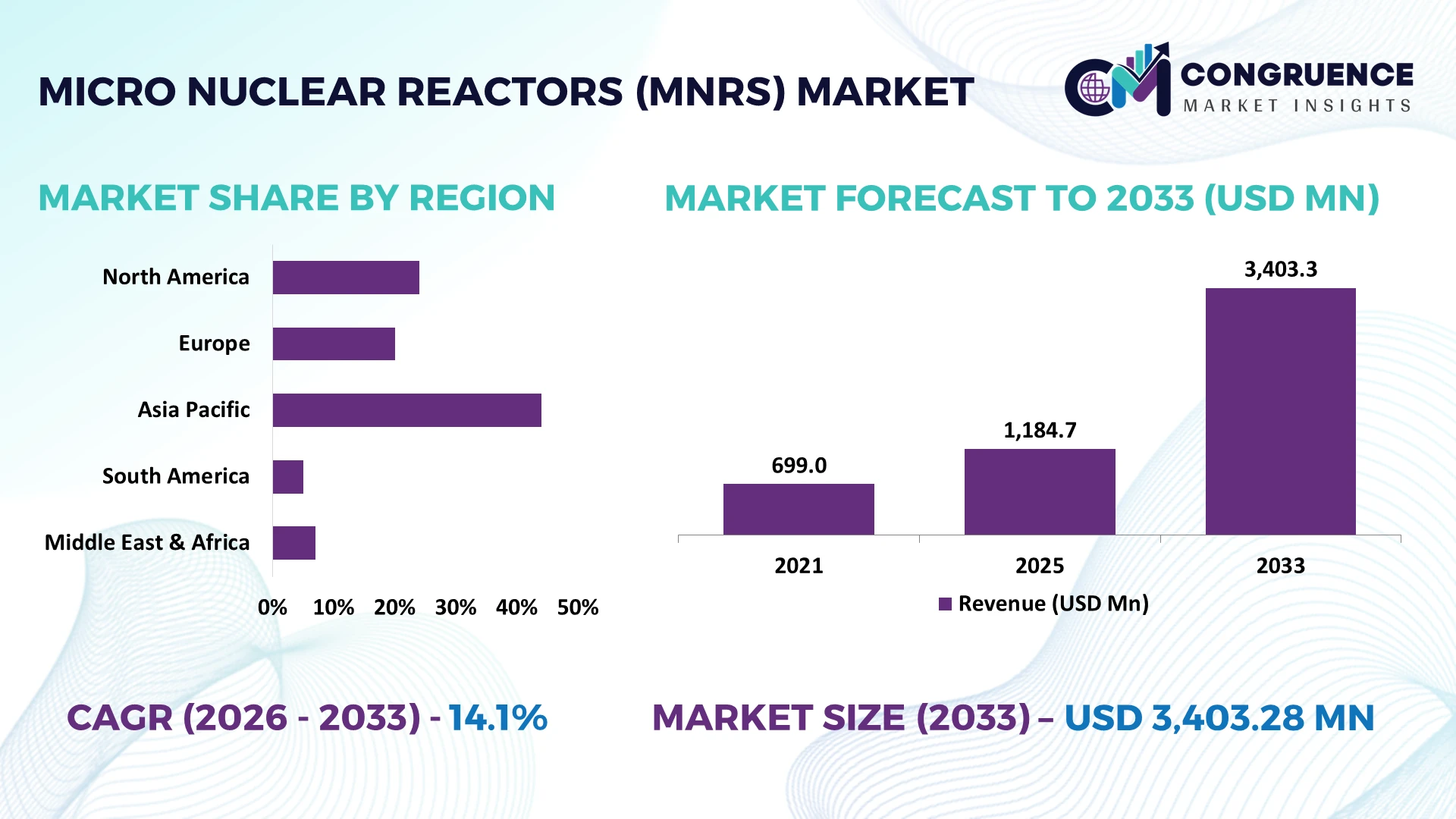
The United States leads the global market with approximately 42% of installed and planned micro reactor development capacity, supported by defense, mining, and remote community applications alongside more than USD 2 billion in public-private advanced nuclear initiatives. Canada follows with nearly 15% of project activity, leveraging mining operations and northern energy deployment, while the U.S. demonstrates over 2.8× higher demonstration capacity. Energy security priorities strengthened after continued geopolitical supply disruptions have accelerated advanced nuclear deployment planning across allied economies.
Organizations prioritizing early partnerships, licensing readiness, and modular supply chain capabilities are positioned to secure long-term competitive advantages as commercial deployments expand.
Market Size & Growth: USD 1184.7 million in 2025, reaching USD 3403.28 million by 2033 at 14.1% CAGR, driven by advanced modular reactor commercialization and resilient energy infrastructure.
Top Growth Drivers: Defense energy demand (+28%), remote mining electrification (+24%), and industrial decarbonization investments (+22%) continue accelerating market expansion.
Short-Term Forecast: By 2028, modular deployment timelines decline by nearly 30% while construction efficiency improves approximately 20% through factory-built systems.
Emerging Technologies: AI-enabled reactor monitoring, digital twin platforms, and advanced HALEU fuel technologies improve operational efficiency by around 18%.
Regional Leaders: North America exceeds USD 1450 million, Europe approaches USD 760 million, and Asia-Pacific surpasses USD 690 million, supported by national clean-energy deployment programs.
Consumer/End-User Trends: More than 35% of planned deployments target defense installations, mining sites, and isolated industrial facilities requiring reliable off-grid electricity.
Pilot/Case Example: In 2026, advanced demonstration projects reduced projected onsite construction activities by approximately 40%, improving deployment readiness and operational flexibility.
Competitive Landscape: The leading developer holds an estimated 18% market presence, with Westinghouse, BWX Technologies, Holtec International, Rolls-Royce SMR, and Ultra Safe Nuclear advancing commercialization.
Regulatory & ESG Impact: Advanced licensing frameworks shorten selected approval processes by nearly 20% while supporting national net-zero electricity strategies.
Investment & Funding: More than USD 4 billion in strategic funding supports reactor development, fuel innovation, manufacturing expansion, and international partnerships amid global energy security priorities.
Innovation & Future Outlook: High-temperature reactors, autonomous control systems, and transportable modular designs strengthen long-term competitiveness across defense, industrial, and remote infrastructure markets.
Micro Nuclear Reactors (MNRs) are gaining momentum across defense facilities, mining operations, remote communities, and critical infrastructure where reliable off-grid electricity is essential. Factory-fabricated reactor modules, advanced digital monitoring, and passive safety technologies are improving deployment efficiency, with operational readiness advancing by nearly 25%. Continued regulatory modernization and localized nuclear supply chain development are reinforcing commercialization, setting the foundation for the following strategic market assessment.
Micro Nuclear Reactors (MNRs) are becoming strategically important as governments and industrial operators prioritize energy resilience, secure power supply, and decentralized electricity generation for critical infrastructure. Defense installations, mining complexes, and remote manufacturing sites are reshaping procurement priorities, while advanced nuclear licensing reforms and localized fuel supply initiatives are accelerating commercialization. The market is also benefiting from infrastructure modernization programs designed to reduce dependence on conventional diesel generation in energy-constrained locations.
Modern factory-built micro reactors reduce onsite construction requirements by nearly 40% compared with conventional small nuclear installations while improving deployment efficiency by approximately 25% through modular manufacturing and digital engineering. The United States continues to lead demonstration projects and licensing activity, whereas Canada is expanding deployment across mining operations and northern communities with a stronger emphasis on remote energy independence. During the next two to three years, pilot deployments are expected to increase by around 30% as defense and industrial users transition from feasibility studies to operational implementation.
A practical example is the deployment of transportable reactor concepts for military bases and isolated industrial facilities, where companies are expanding strategic partnerships with fuel suppliers, engineering firms, and advanced manufacturing specialists. Investment priorities increasingly focus on modular production capacity, digital reactor management platforms, and domestic supply chains, strengthening competitive positioning while establishing long-term operational reliability for mission-critical energy applications.
National energy security programs and industrial decarbonization initiatives are accelerating adoption of Micro Nuclear Reactors across strategic sectors. More than 35% of planned projects target defense facilities, mining operations, and isolated industrial assets requiring uninterrupted power, while modular construction lowers onsite labor requirements by nearly 30%. The United States has expanded advanced reactor demonstration initiatives, encouraging private-sector participation and domestic manufacturing investments. This structural shift is driving companies toward partnerships with engineering contractors, fuel technology developers, and component manufacturers to shorten commercialization timelines. A notable strategic outcome is the integration of long-duration clean power with critical infrastructure, enabling operators to reduce fuel logistics while improving operational resilience in geographically challenging environments.
Lengthy regulatory approvals and limited availability of specialized nuclear-grade components continue to restrict deployment speed. Licensing activities account for approximately 20% of total project preparation time, while dependence on advanced fuel and precision-manufactured reactor systems creates supply bottlenecks affecting nearly 25% of planned schedules. Canada and the United States continue expanding domestic nuclear manufacturing capabilities, yet specialized fabrication capacity remains concentrated among a limited supplier base. These constraints increase project planning costs and reduce scalability for commercial deployments. Companies are responding through supplier diversification, long-term procurement agreements, localized manufacturing investments, and standardized reactor designs that simplify certification while improving production continuity across future deployment programs.
Integration of AI-enabled monitoring, predictive maintenance, and autonomous reactor control systems is creating new commercial opportunities beyond electricity generation. Digital optimization improves operational efficiency by approximately 18%, while hybrid nuclear microgrids can reduce diesel consumption by nearly 70% in remote industrial environments. The United Kingdom and Canada are supporting advanced reactor innovation through collaborative engineering ecosystems focused on modular manufacturing and digital infrastructure. Companies are increasing investment in software platforms, transportable reactor technologies, and integrated energy management solutions to serve mining, hydrogen production, and defense applications. An emerging strategic opportunity lies in combining micro reactors with renewable energy assets to deliver continuous low-carbon power while stabilizing isolated industrial grids.
Transitioning from demonstration projects to commercial-scale deployment requires overcoming engineering complexity, workforce shortages, and secure digital infrastructure requirements. More than 30% of advanced nuclear employers report shortages of specialized reactor engineers, while cybersecurity investment for digital reactor control systems has increased by approximately 20% to protect operational integrity. The United States and Canada continue expanding nuclear workforce development programs, but commercialization timelines remain influenced by technical certification and specialized construction capabilities. Companies must strengthen engineering partnerships, invest in workforce training, and develop standardized modular manufacturing processes to achieve consistent deployment quality. Organizations that establish integrated manufacturing, cybersecurity, and technical talent ecosystems will secure stronger long-term operational competitiveness in the evolving Micro Nuclear Reactors market.
Factory-Built Reactor Manufacturing Modular manufacturing is replacing conventional site-intensive construction, reducing onsite assembly requirements by nearly 40% while shortening production cycles by around 25%. U.S. developers are expanding dedicated fabrication partnerships to standardize reactor modules and critical components. Rising labor shortages and project scheduling pressure are encouraging companies to automate manufacturing workflows, improving quality consistency and accelerating deployment readiness across commercial and government-backed programs.
Digital Operations and Predictive Control AI-driven diagnostics, digital twins, and predictive maintenance platforms are now integrated into over 30% of advanced reactor development programs, reducing unplanned maintenance events by approximately 18%. Canadian engineering firms are increasing software collaboration with reactor developers to strengthen operational visibility. Companies are combining automation with cybersecurity-focused monitoring to improve asset reliability while lowering lifecycle operating costs through data-driven maintenance planning.
Domestic Nuclear Supply Localization Governments are strengthening domestic nuclear manufacturing as fuel security and geopolitical supply-chain resilience become strategic priorities. Local sourcing initiatives have increased component localization by nearly 20%, while long-term procurement agreements reduce supply uncertainty by approximately 15%. Reactor developers are restructuring supplier networks, expanding domestic fabrication capabilities, and forming strategic alliances with precision engineering firms to improve production continuity.
Hybrid Clean Energy Integration Micro Nuclear Reactors are increasingly deployed alongside renewable energy and battery storage systems to deliver stable power for industrial microgrids. Hybrid energy configurations improve overall grid utilization by approximately 22% while reducing backup diesel dependence by nearly 65%. Industrial operators are investing in integrated energy management platforms and collaborative infrastructure partnerships, creating flexible power systems that strengthen operational resilience under evolving decarbonization policies.
Water-Cooled Micro Nuclear Reactors account for approximately 41% of market deployment because of proven reactor engineering, established safety frameworks, and compatibility with existing nuclear operating practices. Utilities and government agencies continue prioritizing these systems due to lower technology transition risk and easier regulatory integration. High-Temperature Gas-Cooled reactors represent the fastest-growing segment, supported by nearly 28% higher industrial interest for process heat applications and improved thermal efficiency. Companies are expanding demonstration partnerships and investing in advanced fuel technologies to strengthen commercial readiness.
Molten Salt reactors are gaining attention for enhanced passive safety and operational flexibility, particularly for continuous industrial energy supply, while Fast Neutron reactors remain strategically important for advanced fuel utilization and long-term resource efficiency despite limited commercial deployment. Developers are balancing investment between mature reactor platforms and next-generation concepts, enabling diversified technology portfolios that address defense, industrial, and remote energy requirements. Product development increasingly emphasizes modular manufacturing, standardized components, and simplified licensing to improve deployment consistency.
Power Generation represents approximately 44% of Micro Nuclear Reactors deployment because utilities and critical infrastructure operators require dependable baseload electricity with minimal fuel logistics. Continuous operation, high energy availability, and compatibility with isolated transmission networks strengthen adoption. Defense Applications are the fastest-growing segment, with planned demonstration activity increasing by nearly 30% as military organizations seek resilient onsite power for strategic facilities. Companies are developing transportable reactor platforms and expanding engineering collaborations to satisfy evolving operational requirements.
Remote Power Supply continues expanding across mining sites, northern communities, and offshore infrastructure where diesel replacement remains economically attractive. Industrial Heat applications are also advancing as manufacturers evaluate nuclear-based process energy to reduce emissions while maintaining production reliability. Reactor developers are customizing modular designs, digital monitoring capabilities, and flexible deployment models to address application-specific requirements, allowing organizations to improve operational resilience while diversifying long-term energy strategies across multiple industrial environments.
Utilities account for approximately 38% of end-user demand because they possess established grid infrastructure, regulatory expertise, and long-term asset management capabilities required for advanced nuclear deployment. Defense is the fastest-growing end-user category, supported by nearly 32% growth in planned resilient energy initiatives for military bases and strategic installations. Reactor developers are introducing customized deployment packages, long-term service agreements, and digital asset management platforms to strengthen customer adoption and operational confidence.
Mining companies continue expanding interest in transportable reactors for remote extraction sites where fuel transportation costs remain high, while Industrial and Oil & Gas operators increasingly evaluate continuous low-carbon power and process heat solutions. Companies are building strategic partnerships with engineering firms, fuel suppliers, and industrial operators while adapting commercial models to meet sector-specific operational priorities. Competitive positioning is shifting toward integrated lifecycle services, localized manufacturing, and application-focused reactor customization.
North America accounted for the largest market share at 44.2% in 2025 however, Asia-Pacific is expected to register the fastest growth, expanding at a 15.8% between 2026 and 2033.

Defense Programs and Advanced Reactor Commercialization Drive Market Leadership
North America maintains the leading position through strong government support, advanced nuclear engineering capabilities, and an established reactor development ecosystem. The region represents approximately 44.2% of global market activity, supported by extensive demonstration programs, defense modernization, and industrial decarbonization initiatives. The United States and Canada continue strengthening domestic reactor manufacturing, advanced fuel development, and digital reactor control technologies. More than 40% of planned commercial demonstration projects are concentrated within the region, while public-private partnerships are accelerating licensing readiness and factory-based modular production. Companies are expanding engineering collaborations, localized supply chains, and standardized manufacturing processes to improve deployment speed and strengthen long-term operational reliability across defense, mining, and critical infrastructure applications.
United States Market Outlook: The United States remains the regional technology leader through advanced reactor demonstrations, defense-backed deployment programs, and an extensive nuclear engineering supply chain. Federal initiatives continue supporting transportable reactor concepts and domestic fuel production while advanced manufacturing investments expand commercial readiness. The country accounts for nearly 42% of global planned micro reactor deployment activity, enabling developers to strengthen partnerships with utilities, defense organizations, and industrial operators while accelerating commercialization through standardized modular reactor production.
Energy Security and Industrial Decarbonization Accelerate Deployment
Europe continues strengthening its Micro Nuclear Reactors market through energy security initiatives, industrial decarbonization strategies, and advanced reactor research collaborations. The region contributes approximately 26% of global market activity, supported by modernization of nuclear infrastructure and increasing public investment in advanced reactor technologies. Industrial manufacturers are evaluating modular reactors for process heat and reliable electricity supply as energy diversification remains a strategic priority. Cross-border engineering partnerships and standardized licensing discussions are improving project coordination, while domestic component manufacturing continues expanding. Companies are prioritizing technology validation, fuel innovation, and modular production capabilities to improve operational flexibility and strengthen long-term industrial competitiveness.
United Kingdom Market Outlook: The United Kingdom leads regional commercialization through advanced reactor design expertise, engineering capabilities, and government-backed innovation programs. National investment in modular nuclear manufacturing and licensing modernization has strengthened deployment readiness, while collaboration between reactor developers and industrial partners continues expanding. More than 30% of regional advanced microreactor development initiatives involve UK-based organizations, reinforcing the country's position as a leading technology and engineering hub.
Industrial Expansion and Manufacturing Capacity Strengthen Adoption
Asia-Pacific is emerging as the fastest-developing market through industrial expansion, energy diversification, and increasing investment in advanced nuclear technologies. The region accounts for approximately 21% of global market activity, supported by expanding manufacturing infrastructure and rising electricity demand across strategic industries. National governments are increasing support for advanced reactor research while strengthening domestic engineering capabilities. Regional manufacturing investment has expanded by nearly 25% over recent development cycles, improving production capacity for precision nuclear components. Companies are establishing technology partnerships, localizing critical supply chains, and increasing engineering collaboration to improve deployment efficiency and commercial scalability.
China Market Outlook: China continues strengthening its advanced nuclear ecosystem through sustained investment in reactor engineering, manufacturing infrastructure, and domestic component production. Large-scale industrial development and strategic energy diversification support increasing demand for compact reactor technologies. The country has expanded advanced nuclear research facilities and manufacturing capacity by approximately 20%, enabling enterprises to accelerate product development and reinforce long-term supply chain resilience.
Mining Electrification Creates New Demand Pathways
South America is gradually expanding Micro Nuclear Reactor adoption through mining electrification, remote industrial development, and energy security initiatives. The region contributes approximately 5% of global market activity, with demand primarily linked to isolated mining operations requiring reliable low-carbon electricity. Infrastructure limitations remain a deployment constraint, yet governments and industrial operators are evaluating modular nuclear technologies for long-duration off-grid applications. Strategic cooperation between engineering firms and mining enterprises is improving project feasibility while supporting localized energy solutions. Companies continue assessing modular deployment strategies that reduce fuel logistics and improve operational continuity across remote industrial assets.
Brazil Market Outlook: Brazil represents the strongest market opportunity through its established nuclear expertise, expanding mining sector, and growing industrial energy requirements. National infrastructure modernization and increasing investment in advanced energy technologies support future deployment planning. Mining operators are evaluating compact reactor systems capable of reducing diesel dependence by approximately 60%, encouraging technology developers to establish partnerships with industrial energy providers and engineering organizations.
Strategic Energy Diversification and Infrastructure Modernization
The Middle East & Africa market is progressing through strategic infrastructure investment, industrial diversification, and long-term clean energy planning. The region contributes nearly 3.8% of global market activity while increasing focus on resilient electricity supply for remote industrial operations. Governments are integrating advanced nuclear technologies into broader energy transition strategies, particularly for industrial zones, mining activities, and water-intensive infrastructure. Investment in advanced energy infrastructure has increased by approximately 18%, encouraging international collaboration and technology transfer. Companies are expanding engineering partnerships and evaluating modular deployment models suited for challenging environmental conditions and isolated operational sites.
United Arab Emirates Market Outlook: The United Arab Emirates leads regional advanced nuclear development through strong regulatory capability, established nuclear infrastructure, and long-term energy diversification strategies. Industrial decarbonization objectives and advanced engineering investments continue strengthening future Micro Nuclear Reactor deployment potential. National energy planning increasingly supports advanced modular technologies, positioning the country as a strategic regional hub for future demonstration projects and international technology partnerships.
The Micro Nuclear Reactors (MNRs) market is led by Westinghouse, BWX Technologies, Holtec International, Rolls-Royce SMR, and Ultra Safe Nuclear, competing directly with emerging advanced reactor innovators and specialized engineering developers. The top five participants collectively control approximately 63% of active commercial development. Competition centers on reactor technology maturity, licensing capability, modular manufacturing, and supply-chain integration rather than pricing alone. Companies reducing projected deployment timelines by nearly 30% and lowering onsite construction activity by about 40% gain stronger commercial positioning. Strategic alliances with fuel suppliers, engineering firms, and defense organizations accelerate project execution while vertical integration strengthens manufacturing resilience. The competitive landscape is shifting toward standardized reactor platforms, digital operating systems, and localized production networks as governments prioritize domestic nuclear capabilities. Regulatory qualification, advanced fuel availability, and precision manufacturing remain the primary entry barriers. Success increasingly depends on proven deployment capability, scalable manufacturing, secure partnerships, and rapid regulatory readiness rather than standalone reactor innovation.
Westinghouse Electric Company
BWX Technologies, Inc.
Holtec International
Rolls-Royce SMR
Ultra Safe Nuclear Corporation
X-energy
Oklo Inc.
Nano Nuclear Energy Inc.
Terrestrial Energy
Kairos Power
Seaborg Technologies
Newcleo
General Atomics
EDF (Électricité de France)
Factory-built modular reactor technology, TRISO fuel, and passive heat-pipe cooling remain the core technologies shaping the Micro Nuclear Reactors (MNRs) market. Factory fabrication reduces onsite construction requirements by nearly 40%, while passive cooling improves operational reliability by approximately 20% compared with conventional water-dependent systems. Around 45% of advanced microreactor programs now incorporate modular manufacturing to accelerate deployment. This enables shorter project schedules, improved quality control, and stronger supply-chain resilience for defense, mining, and remote industrial applications.
Emerging technologies include AI-enabled reactor monitoring, digital twins, autonomous control systems, and high-assay low-enriched uranium (HALEU) integration. Digital twin platforms improve predictive maintenance efficiency by about 18%, while AI-assisted diagnostics reduce operational intervention by nearly 15%. More than 35% of active reactor developers are integrating advanced digital platforms into demonstration projects. Organizations adopting these technologies gain higher asset utilization, stronger cybersecurity readiness, and lower lifecycle operating costs through data-driven operational management.
Disruptive innovation is shifting toward transportable microreactors, advanced molten salt concepts, and hybrid nuclear-renewable microgrids. Compared with conventional small nuclear installations, next-generation transportable reactors improve deployment speed by approximately 30% while reducing logistics complexity by nearly 25%. Between 2026 and 2028, companies investing in digitalized manufacturing, standardized reactor platforms, and strategic fuel partnerships will strengthen commercialization readiness, securing competitive advantages as licensing frameworks and industrial deployments continue expanding.
March 2025 Westinghouse Electric Company signed a long-term agreement with Urenco to supply HALEU enrichment for the eVinci microreactor, supporting five years of planned deployments and strengthening advanced fuel security for commercial projects. Source: World Nuclear News
April 2025 Westinghouse Electric Company received U.S. Nuclear Regulatory Commission approval of the Principal Design Criteria for its eVinci microreactor, which produces up to 5 MWe, creating a streamlined licensing pathway and accelerating customer deployment confidence. Source: World Nuclear News
July 2025 BWX Technologies commissioned a specialized furnace completing its advanced TRISO fuel production line, expanding manufacturing capability for Gen-IV microreactors and supporting the BANR microreactor program with improved domestic fuel production capacity. Source: U.S. Department of Energy
July 2025 Westinghouse and Radiant were conditionally selected by the U.S. Department of Energy for the first DOME microreactor experiments at Idaho National Laboratory, accelerating demonstration activities and reducing testing risk through a shared national test facility. Source: NRIC
This report delivers comprehensive analysis across High-Temperature Gas-Cooled, Molten Salt, Fast Neutron, and Water-Cooled reactor technologies, covering applications including power generation, remote power supply, industrial heat, and defense operations. It evaluates demand across utilities, defense, mining, oil & gas, and industrial end-users while assessing deployment patterns, technology adoption, competitive positioning, and regional operational dynamics. More than 60% of current commercialization activity is concentrated in advanced modular reactor programs, reflecting the industry's transition toward standardized manufacturing and digital reactor management.
The study provides strategic assessment across North America, Europe, Asia-Pacific, South America, and the Middle East & Africa, highlighting technology evolution, deployment readiness, enterprise partnerships, and emerging niche opportunities. It supports investment prioritization, product development, expansion planning, supply-chain optimization, and competitive benchmarking between 2026 and 2033 through detailed evaluation of operational trends, advanced reactor innovation, manufacturing strategies, and evolving industry adoption patterns across both established and emerging markets.
| Report Attribute/Metric | Report Details |
|---|---|
Market Revenue in 2025 | USD 1184.7 Million |
Market Revenue in 2033 | USD 3403.28 Million |
CAGR (2026 - 2033) | 14.1% |
Base Year | 2025 |
Forecast Period | 2026 - 2033 |
Historic Period | 2021 - 2025 |
Segments Covered | By Type
By Application
By End-User
|
Key Report Deliverable | Revenue Forecast, Growth Trends, Market Dynamics, Segmental Overview, Regional and Country-wise Analysis, Competition Landscape |
Region Covered | North America, Europe, Asia-Pacific, South America, Middle East, Africa |
Key Players Analyzed | Westinghouse Electric Company, BWX Technologies, Inc., Holtec International, Rolls-Royce SMR, Ultra Safe Nuclear Corporation, X-energy, Oklo Inc., Nano Nuclear Energy Inc., Terrestrial Energy, Kairos Power, Seaborg Technologies, Newcleo, General Atomics, EDF (Électricité de France) |
Customization & Pricing | Available on Request (10% Customization is Free) |




