
Reports
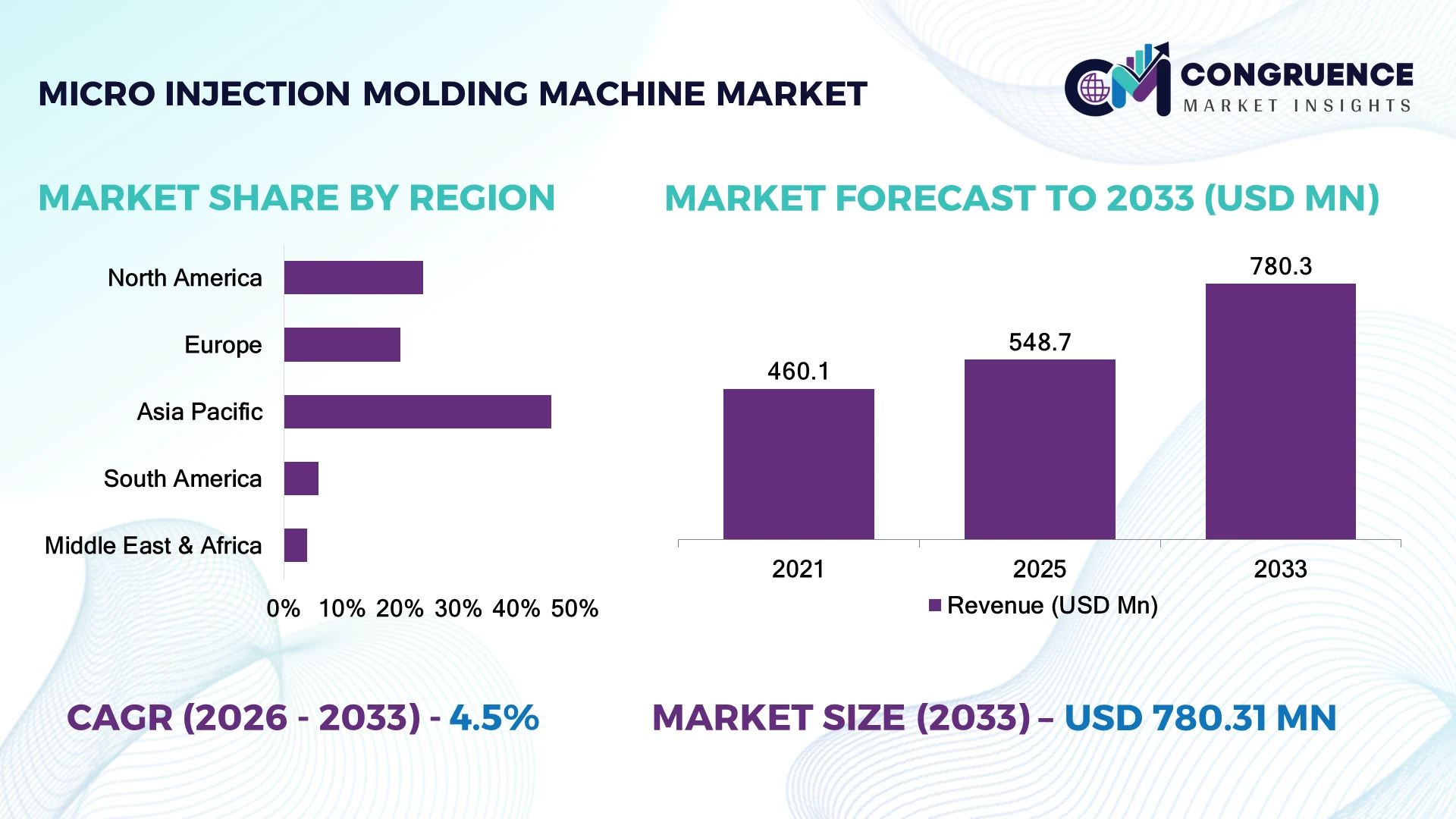
The Global Micro-Injection Molding Machine Market was valued at USD 548.7 Million in 2025 and is anticipated to reach a value of USD 780.3 Million by 2033 expanding at a CAGR of 4.5% between 2026 and 2033. Growth is driven by rising precision component production for medical devices, micro-optics, electronics miniaturization, and automated manufacturing systems requiring micron-level accuracy.
Japan dominates the global micro-injection molding machine landscape with nearly 28% share, supported by advanced precision engineering, strong robotics adoption, and investments in semiconductor and healthcare manufacturing. The country operates over 100,000 precision molding systems across high-value industrial clusters, while China’s expanding electronics sector has increased micro-component production capacity by more than 20% since 2022. Compared with Japan’s technology-led deployment, China emphasizes high-volume manufacturing expansion, creating competitive supply-chain advantages.
Strategic investments in automated precision molding platforms will determine long-term supplier leadership and manufacturing competitiveness.
Market Size & Growth: USD 548.7 Million in 2025 to USD 780.3 Million by 2033 at 4.5% CAGR, driven by precision medical and electronics component manufacturing.
Top Growth Drivers: Medical micro-components (+35% adoption), electronics miniaturization (+30%), and automated molding integration (+25%) are key expansion factors.
Short-Term Forecast: By 2028, automated micro-molding systems reduce material waste by 15% and improve production consistency by 20%.
Emerging Technologies: AI-based process monitoring, IoT-enabled molding controls, and advanced polymer materials are reshaping high-precision manufacturing.
Regional Leaders: Asia-Pacific reaches approximately USD 410 Million by 2033 with electronics adoption; North America exceeds USD 180 Million with medical device demand; Europe approaches USD 150 Million through sustainable manufacturing.
Consumer/End-User Trends: Medical device manufacturers report over 40% adoption of micro-molded components for minimally invasive equipment.
Pilot/Case Example: In 2024, Japanese precision molding projects achieved nearly 18% cycle-time reduction through AI-assisted process optimization.
Competitive Landscape: Leading suppliers include Arburg, Sumitomo (SHI) Demag, Sodick, Nissei Plastic Industrial, and FANUC, with top players controlling approximately 45% of advanced precision molding equipment sales.
Regulatory & ESG Impact: Sustainable polymer adoption increased by nearly 20% as manufacturers align with European environmental compliance requirements.
Investment & Funding: More than USD 500 Million has been directed toward smart manufacturing expansion, robotics integration, and precision equipment upgrades.
Innovation & Future Outlook: Next-generation machines integrating digital twins, predictive analytics, and energy-efficient systems are strengthening competitive positioning across global manufacturing hubs.
Micro-Injection Molding Machine Market demand is accelerating across medical, semiconductor, automotive electronics, and optical applications due to increasing requirements for lightweight, compact, and highly precise components. Innovations such as servo-driven systems and AI-enabled quality inspection are improving production accuracy by nearly 25%, while manufacturers are shifting toward localized supply chains following global semiconductor disruptions and stricter quality standards.
Micro-injection molding machines are becoming strategically important as industries shift toward smaller, lighter, and more complex components requiring advanced manufacturing precision. The rapid expansion of medical electronics, wearable devices, and semiconductor packaging is pushing manufacturers to invest in highly automated production environments. Supply-chain restructuring after global semiconductor shortages has encouraged companies in Japan, Germany, and China to strengthen domestic precision manufacturing capabilities.
Advanced servo-electric micro-molding systems deliver approximately 20–30% lower energy consumption compared with conventional hydraulic machines while improving repeatability for micron-scale components. Japan leads in precision technology adoption, whereas China is expanding deployment through large-scale electronics manufacturing investments. North American companies are prioritizing medical-grade applications with strict quality requirements.
Over the next two to three years, manufacturers are increasing investments in AI-based monitoring, robotics integration, and digital production management to reduce defects and improve operational efficiency. Companies supplying micro-molding solutions are forming partnerships with medical device producers and semiconductor firms to secure specialized demand. Competitive advantage will increasingly depend on automation capability, localized service networks, and innovation in sustainable precision manufacturing.
The rising demand for miniature components in healthcare, electronics, and automotive systems is accelerating micro-injection molding adoption. Medical device applications account for more than 30% of high-precision micro-molding usage, while electronics manufacturers are increasing automated molding investments by nearly 25% to support compact device production. The growth of wearable healthcare technology and semiconductor packaging in Japan and South Korea is creating demand for ultra-precise systems. Companies are responding through servo-electric machine expansion, AI-based monitoring integration, and partnerships with component manufacturers. The strategic advantage lies in reducing production errors while enabling higher-value component manufacturing with improved material efficiency.
High initial investment remains a major barrier, with advanced micro-injection molding machines costing 20–40% more than conventional molding systems due to precision controls and automation requirements. Small manufacturers in India and Southeast Asia face capital constraints, limiting rapid technology adoption. Dependence on specialized components such as precision screws, sensors, and control systems creates additional supply-chain exposure. Companies are mitigating these challenges through equipment leasing models, localized component sourcing, and long-term supplier contracts. The key operational limitation is balancing high precision requirements with affordable production economics for smaller manufacturing facilities.
The integration of AI, robotics, and connected manufacturing platforms creates significant opportunities for micro-injection molding suppliers. Smart monitoring systems can reduce production defects by nearly 25% and improve machine utilization by over 15%. Growing investments in semiconductor, medical technology, and electronics manufacturing in China and the United States are increasing demand for intelligent molding solutions. Companies are expanding R&D programs focused on digital twins, predictive maintenance, and energy-efficient machine designs. A major opportunity lies in combining micro-molding expertise with Industry 4.0 platforms to deliver complete automated production ecosystems rather than standalone equipment.
The deployment of sophisticated micro-injection molding systems faces challenges related to workforce expertise, software integration, and process optimization. Approximately 30% of manufacturers report difficulties in finding technicians trained in precision molding automation and digital controls. Complex calibration requirements and compatibility issues between machines and factory systems can delay implementation. European and Asian manufacturers are addressing these barriers through operator training programs, automation partnerships, and integrated service platforms. Long-term competitiveness will depend on building skilled technical ecosystems capable of managing increasingly automated and data-driven micro-manufacturing environments.
AI-Driven Process Optimization: Manufacturers are integrating AI-based monitoring and predictive analytics into micro-injection molding platforms, improving defect detection by nearly 25% and reducing setup adjustments by 15–20%. Japanese and German equipment suppliers are expanding smart factory partnerships to enable real-time process control. This shift is improving yield rates, reducing downtime, and supporting high-value medical and electronics production where precision consistency is critical.
Servo-Electric Machine Adoption: Servo-electric micro-injection molding systems are gaining traction as companies prioritize energy efficiency and operational stability, delivering approximately 20–30% lower power consumption than hydraulic alternatives. Rising energy costs in Europe and stricter industrial sustainability requirements are accelerating adoption. Equipment manufacturers are redesigning product portfolios around compact, low-maintenance systems that improve lifecycle economics and production flexibility.
Localized Supply Chain Expansion: Global manufacturers are restructuring micro-component supply networks after semiconductor shortages and logistics disruptions exposed dependency risks. China, India, and the United States are increasing domestic precision manufacturing investments, with localized sourcing initiatives improving component availability by nearly 15%. Companies are developing regional service centers and supplier ecosystems to reduce lead times and strengthen production resilience.
Advanced Material Processing Growth: Demand for specialized polymers and bio-compatible materials is increasing as medical and wearable technology applications expand. Material innovation has improved micro-component durability by more than 20% while supporting thinner and lighter designs. Companies are collaborating with polymer developers to optimize molding parameters, creating opportunities in minimally invasive devices and next-generation electronic assemblies.
Servo-electric micro-injection molding machines represent the leading type segment, accounting for approximately 45% of market adoption due to superior energy efficiency, precise motion control, and compatibility with automated production environments. These systems reduce power consumption by nearly 25% compared with traditional hydraulic alternatives and are widely preferred by medical device and electronics manufacturers requiring repeatable micron-level accuracy. Hydraulic and hybrid systems continue to maintain relevance in cost-sensitive applications where higher clamping force and lower initial investment remain priorities. The fastest-growing segment is hybrid micro-injection molding technology, supported by manufacturers seeking a balance between precision performance and operational cost control. Adoption is increasing by nearly 15–20% as companies upgrade existing production lines without fully replacing infrastructure. Pneumatic and specialized compact systems continue serving niche applications, particularly research and prototyping environments. Equipment providers are responding through modular designs, automation compatibility, and customized machine configurations to capture demand from advanced manufacturing sectors.
Medical device manufacturing is the leading application segment, accounting for approximately 40% of micro-injection molding machine demand due to increasing production of surgical instruments, diagnostic components, drug delivery devices, and wearable healthcare products. The segment benefits from strict precision requirements, cleanroom manufacturing expansion, and demand for lightweight disposable medical parts. Electronics applications follow closely, with adoption increasing by nearly 30% as manufacturers require miniature connectors, sensors, and semiconductor-related components. The fastest-growing application area is micro-optical and electronic component production, driven by compact consumer devices and advanced sensor integration. Automotive electronics applications are also expanding as vehicle systems incorporate more miniaturized control modules and smart components. Companies are investing in automated inspection systems, clean manufacturing environments, and integrated robotics to improve quality consistency. Packaging and research applications remain important niche segments, supporting innovation testing and specialized production requirements.
Medical device manufacturers represent the dominant end-user segment, contributing approximately 38% of demand due to extensive use of precision-molded components in healthcare equipment, implants, and diagnostic systems. These companies require validated production processes, strict contamination control, and consistent component accuracy. Electronics manufacturers are the fastest-growing end-user group, expanding adoption by nearly 25% as semiconductor packaging, wearable devices, and compact consumer electronics increase production complexity. Automotive suppliers, research institutions, and industrial manufacturers continue adopting micro-injection molding technology for specialized applications, although their deployment scale remains more fragmented. Automotive companies are increasing investments in lightweight electronic modules, while research organizations are using compact systems for prototype development and material testing. Equipment suppliers are targeting these segments through application-specific solutions, financing programs, and technical partnerships that reduce adoption barriers.
Asia-Pacific accounted for the largest market share at 46% in 2025 however, North America is expected to register the fastest growth, expanding at a CAGR of 5.2% between 2026 and 2033.

North America holds approximately 24% of the global micro-injection molding machine market, supported by strong medical device production, semiconductor packaging, and advanced manufacturing infrastructure in the United States. The region has increased adoption of servo-electric and AI-enabled molding systems as manufacturers focus on reducing waste and improving production consistency. More than 35% of new installations in high-value manufacturing facilities incorporate automated inspection and digital monitoring capabilities. The U.S. reshoring movement, driven by supply-chain resilience initiatives and semiconductor investment programs, is encouraging local production of precision components. Equipment suppliers are expanding technical service networks and forming partnerships with healthcare and electronics manufacturers to support localized manufacturing growth.
United States Market Outlook: The United States remains the leading North American market due to its advanced medical technology ecosystem, semiconductor manufacturing expansion, and high automation adoption. Over 40% of precision molding demand comes from healthcare and electronics-related applications. Companies are increasing investments in smart manufacturing platforms and localized production capabilities to improve supply-chain security and meet strict quality requirements.
Europe accounts for nearly 20% of global micro-injection molding machine demand, supported by Germany, Switzerland, and Italy’s established precision engineering industries. The region is experiencing increased deployment of energy-efficient electric molding systems as manufacturers respond to stricter sustainability requirements and rising industrial energy costs. More than 30% of European manufacturers are upgrading production lines with automation and digital process controls to improve efficiency. The European Union’s sustainability regulations and circular material initiatives are encouraging adoption of advanced polymer processing technologies. Companies are strengthening partnerships with machine builders and material suppliers to develop lower-energy, high-accuracy molding solutions.
Germany Market Outlook: Germany leads Europe’s micro-injection molding ecosystem through its strong automotive electronics, medical technology, and industrial automation sectors. The country’s precision manufacturing base supports widespread adoption of intelligent molding equipment, with more than 50% of advanced production facilities integrating robotics or automated quality monitoring systems. Manufacturers are prioritizing energy-efficient technologies to maintain competitiveness under evolving environmental standards.
Asia-Pacific dominates the global market with approximately 46% share, driven by large-scale electronics manufacturing, semiconductor production, and medical component expansion in China, Japan, South Korea, and Taiwan. The region benefits from extensive supplier networks and high-volume production capabilities, with China contributing a significant portion of global precision component output. Micro-injection molding adoption has increased by nearly 25% among electronics manufacturers seeking smaller and lighter components. Government-backed semiconductor and advanced manufacturing investments are strengthening regional production capacity. Companies are expanding automated factories, improving export capabilities, and integrating smart manufacturing technologies to serve global supply chains.
China Market Outlook: China represents the largest Asia-Pacific market due to its electronics manufacturing scale, industrial automation investments, and extensive component supplier ecosystem. The country’s micro-component production capacity has expanded significantly, with more than 20% growth in advanced manufacturing installations since 2022. Companies are focusing on localized equipment development, automation upgrades, and export-oriented production strategies.
South America represents a smaller but developing market with approximately 6% share, supported by medical device manufacturing, automotive component production, and industrial modernization initiatives. Brazil accounts for the majority of regional demand due to its manufacturing base and expanding healthcare equipment sector. Adoption remains concentrated among large manufacturers, with automated micro-molding systems representing nearly 15% of new precision equipment investments. Supply-chain dependence on imported machinery and limited specialized technical expertise continue to influence deployment speed. Companies are addressing these challenges through regional partnerships, equipment service expansion, and localized training programs to improve technology accessibility.
Brazil Market Outlook: Brazil leads the South American market through its automotive, healthcare, and industrial manufacturing infrastructure. The country’s medical device sector is increasing demand for precision components, while manufacturers are gradually adopting automated molding technologies. More than 20% of new industrial equipment investments are directed toward improving production efficiency and reducing dependence on imported finished components.
The Middle East & Africa market with approximately 4% share is emerging through manufacturing diversification, healthcare infrastructure expansion, and industrial development programs. Countries including the United Arab Emirates, Saudi Arabia, and South Africa are increasing investments in advanced manufacturing capabilities to reduce import dependency. Adoption remains focused on medical supplies, electronics assembly, and specialized industrial components, with automated production systems gaining attention among new manufacturing projects. Regional industrial initiatives have increased investment in technology-driven manufacturing facilities by nearly 20% in recent years. Companies are entering partnerships with international equipment suppliers to establish local expertise and improve access to precision molding technologies.
United Arab Emirates Market Outlook: The United Arab Emirates is becoming a strategic manufacturing hub through investment in advanced industrial infrastructure, healthcare technology, and technology-focused production facilities. The country’s manufacturing diversification programs are supporting adoption of automated equipment, with precision manufacturing investments increasing across medical and electronics-related applications. Companies are leveraging free-zone industrial ecosystems to attract global technology partnerships.
The micro-injection molding machine market features competition between global precision equipment leaders such as Arburg, Sumitomo (SHI) Demag, FANUC, Sodick, and Nissei Plastic Industrial, alongside regional manufacturers competing on cost and customization. The top five players collectively account for approximately 45% of advanced machine sales, creating a moderately consolidated structure. Competition centers on automation capability, machine accuracy, energy efficiency, service support, and application-specific customization. Electric and hybrid systems capture nearly 60% of new premium installations, pushing OEMs to accelerate digital upgrades. Players are expanding through robotics integration, regional service centers, strategic partnerships, and proprietary control software development. Technology innovators are challenging traditional suppliers by offering AI-enabled monitoring and predictive maintenance solutions. High precision requirements, engineering expertise, and customer qualification cycles create significant entry barriers. Winning requires combining reliable automation, localized support, application expertise, and continuous innovation against established precision manufacturing competitors.
Sumitomo (SHI) Demag
FANUC
Nissei Plastic Industrial
Sodick
Wittmann Battenfeld
Engel Austria
Husky Technologies
Milacron
Toshiba Machine
Haitian International
Yizumi
Micro-injection molding technology is shifting toward servo-electric platforms, AI-based process monitoring, and connected manufacturing systems. Servo-electric machines improve energy efficiency by approximately 20–30% compared with hydraulic equipment while increasing repeatability for medical and electronic components. Adoption of digital monitoring solutions has exceeded 40% among advanced manufacturing facilities as companies seek lower defect rates and faster production adjustments.
Artificial intelligence, predictive maintenance, and digital twin technologies are becoming critical differentiators. AI-enabled systems reduce process optimization time by nearly 25% and allow manufacturers to detect quality issues earlier. Compared with traditional manual inspection workflows, automated vision-based quality control improves inspection consistency by approximately 20%. Leading OEMs benefit by offering integrated machine, software, and automation ecosystems rather than standalone equipment.
Between 2026 and 2028, robotic integration, sustainable polymer processing, and real-time data analytics will reshape competitive positioning. Manufacturers adopting smart factory solutions gain advantages through reduced downtime, improved material utilization, and faster product qualification cycles. Companies investing early in connected precision manufacturing capabilities are positioned to capture high-value applications in healthcare, semiconductor, and advanced electronics industries.
September 2025 – Arburg announced a digital production cell for medical technology at K 2025 featuring an electric ALLROUNDER 570 A machine and an 8-cavity mold producing injector pen caps in cycle times of less than 10 seconds. The development strengthens Arburg’s position in high-precision medical manufacturing and automated micro-component production. Source: www.arburg.com
July 2025 – Sumitomo (SHI) Demag highlighted its next-generation all-electric injection molding platform designed to improve production flexibility, speed, and precision. The company expanded its all-electric machine portfolio to address growing demand from medical and electronics manufacturers seeking higher process consistency and lower energy consumption.
August 2025 – WITTMANN BATTENFELD unveiled multiple smart injection molding solutions under its “Smart Choices – Smart Savings” strategy for K 2025, emphasizing resource optimization, process efficiency, and sustainability. The initiative expands the company’s digital manufacturing capabilities and strengthens its competitive position in advanced precision molding applications.
December 2025 – WITTMANN Group announced the expansion of its production plant in China to increase locally manufactured injection molding machine capacity. The move enhances regional supply-chain responsiveness, shortens delivery timelines, and supports growing demand from Asian precision manufacturing customers.
The Micro-Injection Molding Machine Market Report covers comprehensive analysis across machine types, including servo-electric, hydraulic, hybrid, and specialized systems, along with applications spanning medical components, electronics, automotive parts, optical products, and research applications. The report evaluates end-users such as medical device manufacturers, electronics companies, automotive suppliers, industrial producers, and research institutions across North America, Europe, Asia-Pacific, South America, and Middle East & Africa.
The study examines technology adoption patterns, automation integration, material innovation, competitive positioning, and emerging manufacturing trends. Coverage includes strategic insights into AI-enabled production, robotics deployment, sustainable materials, and smart factory transformation. The analysis supports investment decisions, expansion planning, supplier evaluation, and competitive strategy development through 2033 by identifying high-potential applications, regional opportunities, and evolving precision manufacturing requirements.
| Report Attribute / Metric | Details |
|---|---|
| Market Revenue (2025) | USD 548.7 Million |
| Market Revenue (2033) | USD 780.3 Million |
| CAGR (2026–2033) | 4.5% |
| Base Year | 2025 |
| Forecast Period | 2026–2033 |
| Historic Period | 2021–2025 |
| Segments Covered |
By Type
By Application
By End-User
|
| Key Deliverables | Revenue Forecast; Market Trends; Growth Drivers & Restraints; Technology Insights; Segmentation Analysis; Regional Insights; Competitive Landscape; Regulatory & ESG Overview; Recent Developments |
| Regions Covered | North America; Europe; Asia-Pacific; South America; Middle East & Africa |
| Companies Profiled | Arburg; Sumitomo (SHI) Demag; FANUC; Nissei Plastic Industrial; Sodick; Wittmann Battenfeld; Engel Austria; Husky Technologies; Milacron; Toshiba Machine; Haitian International; Yizumi |
| Customization & Pricing | Available on Request (10% Customization Free) |




